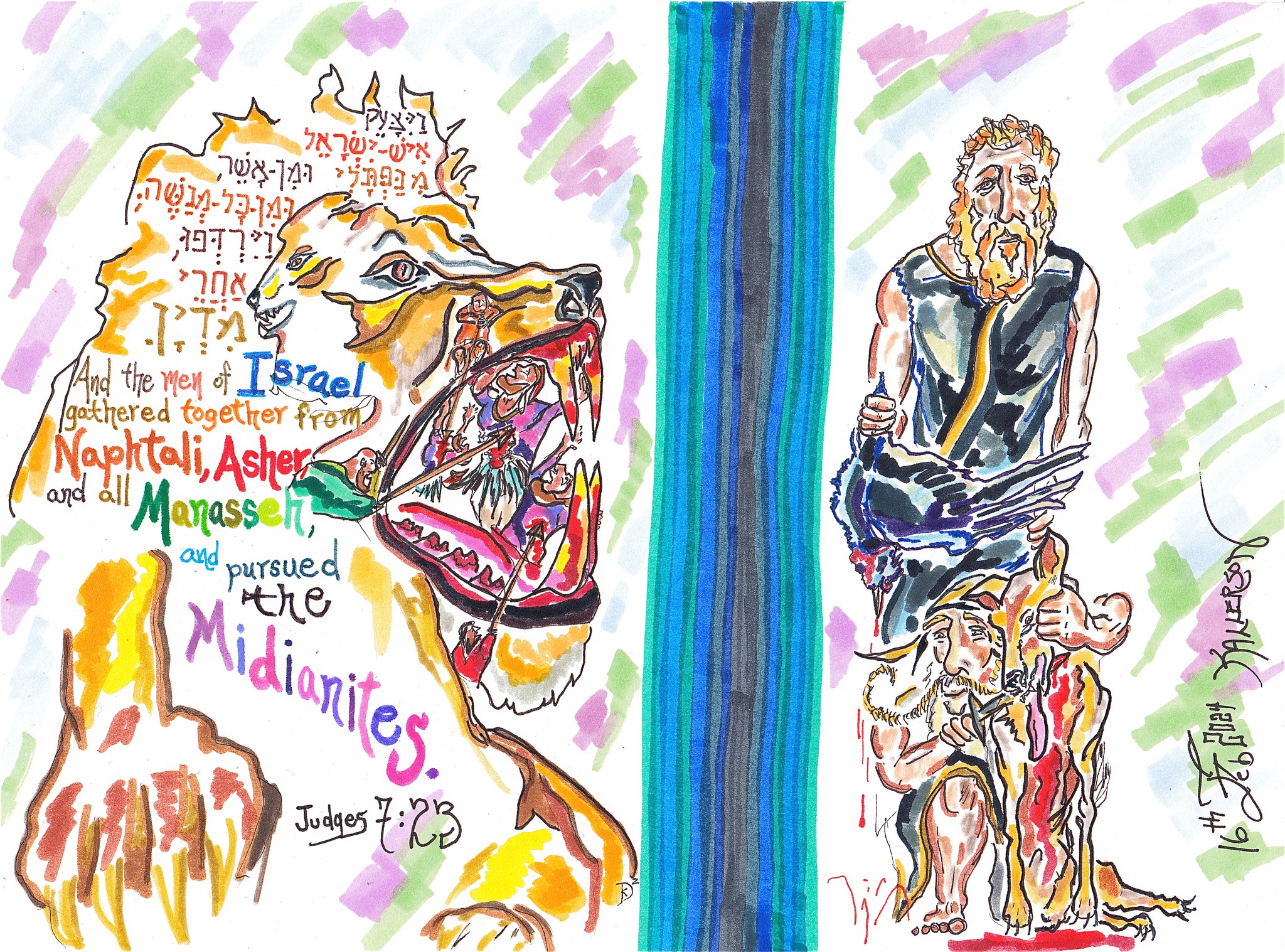
Judges 7:21-25
(Gideon, Judge of Israel, Part VII)
(Typed 11 December 2023) So far, Judges has detailed an amazing journey through much of redemptive history. It started and has led to when Israel will enter the tribulation period. That is made explicit in Scripture, but it is also carefully detailed in typology.
The reason Israel even exists as a nation is because God covenanted with them. Unlike the other nations of the earth, the Lord specifically stated that Israel will always remain before Him as a people. This is grace.
Israel has consistently violated the covenant the Lord made with them. And yet, because of His faithfulness, He has kept it as a nation. Israel will enter the tribulation period for exactly the same reason: because God has covenanted with them.
Rather than destroying them along with much of the world, He will bring them through the tribulation, purify them, and they will again be His people. His attention and focus will be directly upon them, and He will dwell among them.
It’s hard to see how people don’t get this, but it completely escapes a large portion of people in the church. And not all of them are dummies. Many have degrees, reading their Bibles for their entire lives, but yet, it escapes them.
Text Verse: “The wolf also shall dwell with the lamb,
The leopard shall lie down with the young goat,
The calf and the young lion and the fatling together;
And a little child shall lead them.” Isaiah 11:6
In today’s passage, Zeeb is one of the guys who will have his head taken off. Hence, I chose Isaiah 11:6 as our text verse. Please trust that when the Lord promises something to Israel in the Old Testament, it means that the Lord will fulfill those promises to Israel.
The promises are not abrogated through the work of Christ, they are not transferred to the church, and they are not taken away because of Israel’s unfaithfulness. All of these are propositions set forth by various unsound doctrines, and yet none of them align with Scripture.
Hold fast to the truth that God is faithful to His word. If He is not for Israel, He will not be for you either. Where is grace in that? Where is hope in that? Where is confidence in that? God’s word will never fail.
Such great truths as this are to be found in His superior word. And so, let us turn to that precious word once again, and… May God speak to us through His word today, and may His glorious name ever be praised.
I. Oreb and Zeeb (verses 21-25)
In the previous sermon, the narrative left off with Gideon and his three hundred men coming to the outskirts of the camp, blowing their trumpets, and breaking their pitchers. With that, they cried out, “The sword of the Lord and of Gideon.” Now, this most magnificently marvelous action continues as the camp erupts into total chaos…
21 And every man stood in his place all around the camp; and the whole army ran and cried out and fled.
The verbs being imperfect give the sense of ongoing action: vayaamdu ish takhtav saviv lamakhaneh vayarats kal ha’makhaneh vayariu vayanisu – “And standing man his under around to the camp, and running all the camp, and shouting, and fleeing.” The meaning of “his under” is that the place where he stands does not change. The same ground remains under the standing man.
One can see the contrast between the two camps. While Gideon and his men were standing firm, those in the camp were running. While he and his men were blasting the trumpets, those in the camp were shouting. While Gideon’s company was shattering pitchers, those in the camp were fleeing.
It is reminiscent of the chaos that took place at the Battle of Jericho. There was the blowing of trumpets and a great shout, the walls falling down, and then the rush of every man running straight ahead. Here, however, there was no rush by Gideon and his men. The chaos alone would bring about the enemy’s destruction.
The wording is so exact and purposeful that the contrast is stunning –
vayaamdu / vayarats – and standing / and running
vayitqu / vayariu – and blasting / and shouting
vayishbru / vayanisu – and shattering / and fleeing
Hooray!
22 When the three hundred blew the trumpets, the Lord set every man’s sword against his companion throughout the whole camp;
The words return to the narrative in verse 20. This isn’t a second blasting of the trumpets, but a second description of the same action: vayitqu sh’losh meoth ha’shopharoth vayasem Yehovah eth kherev ish b’reehu u-b’kal ha’makhaneh – “And blasting three hundred in the shophars, and set Yehovah sword: man in his friend and in all the camp.”
Setting verses 20 and 22 side by side, the different aspects are more clearly seen –
“And blasting three the companies in the shophars … And crying, ‘Sword to Yehovah and to Gideon.”
“And blasting three hundred in the shophars, and set Yehovah sword: man in his friend and in all the camp.”
There is the call by Israel, and then there is the response by the Lord.
The scene is one of utter chaos. There was no light and no way to turn on a light. Every soldier’s instinct was to fight his way out solely for the sake of self-preservation. Thus, everyone simply plunged his sword into whoever was nearest. Anyone who wasn’t killed took off and headed for the hills, or rather…
22 (con’t) and the army fled to Beth Acacia, toward Zererah, as far as the border of Abel Meholah, by Tabbath.
Much more precisely: va’yanas ha’makhaneh ad beith ha’shitah tserathah ad sephat avel m’kholah al tabath – “And fled the camp until Beith Ha’Shittah Zererath-ward, until lip Abel Meholah upon Tabbath.” Those who could flee put their tails between their legs and took off. The movement of the flight became united and the camp rushed toward these named places.
Beith Ha’Shittah means House the Acacias. The shittah, or acacia, comes from shotet, a scourge because of the scourging thorns.
Tsererah (Tsererath), or Zererah, is found only here in Scripture. It is debated where the root comes from. Three possibilities are tsar, a hard pebble or flint, or an unused root meaning to pierce or puncture, or a word meaning bound. Abarim says, “…to a Hebrew audience it would probably have sounded like Bound. The word צררת [tsarar] occurs with that precise meaning in Exodus 12:34.”
Abel Meholah means Meadow of Dancing or Stream of Dancing.
Tabbath means either Extension, Renowned, or Perpetual.
23 And the men of Israel gathered together from Naphtali, Asher, and all Manasseh, and pursued the Midianites.
Rather: vayitsaaq ish Yisrael min naphtali u-min asher u-min kal m’nasheh vayirdphu akhare midyan – “And cried man Israel from Naphtali, and from Asher, and from all Manasseh. And pursued after Midian.” The meaning is that now that the advantage has been gained, a general cry of alarm went out for the men of these tribes to come and assist in the battle.
The people responded, and Israel chased Midian. It is the same groups, minus Zebulun, who were called in Judges 6 –
“And he sent messengers throughout all Manasseh, who also gathered behind him. He also sent messengers to Asher, Zebulun, and Naphtali; and they came up to meet them.” Judges 6:35
Therefore, it may be that these men had been dismissed from the battle but had simply not left yet, waiting to watch what happened. It said they returned to their tents in verse 7:8, so that is likely.
As for Zebulun, their tribal inheritance was not far away and so they may have headed home due to its close proximity. Even if Zebulun had people represented, it may simply be that their name, Glorious Dwelling Place, does not fit the typology and so they are omitted from the narrative.
Naphtali means My Wrestlings.
Asher means Happy or Blessed.
Manasseh means To Forget and From a Debt.
24 Then Gideon sent messengers throughout all the mountains of Ephraim,
u-malakhim shalakh gidon b’kal har ephrayim – “And messengers sent Gideon in all Mount Ephraim.” Until this point, there was no call for Ephraim to join in the battle. However, with the enemy fleeing, there was a need for them to be cut off as they fled. Saying Mount Ephraim either indicates the mountains of Ephraim in general, or the name Mount Ephraim stands for the tribe.
The name Ephraim means Twice Fruitful and Ashes.
As for the call, the messengers were…
24 (con’t) saying, “Come down against the Midianites, and seize from them the watering places as far as Beth Barah and the Jordan.”
lemor r’du liqrath midyan v’likhdu lahem eth ha’mayim ad beith barah v’eth ha’yarden – “to say, ‘Descend to meet Midian and seize to them the waters until Beth Barah and the Jordan.’” The meaning of “the waters” is unsure. Ellicott thinks it is “the watershed of the hills of Ephraim into the Jordan.” Some think it is a wadi that flows into the Jordan. It could mean that it is saying something like “the Jordan as far as Beth Barah.”
No matter what, Beth Barah is only mentioned twice in Scripture, both times in this verse. Some believe it is the same as Bethabara found in John 1:28. Abarim states the following about it –
“To a Hebrew audience, the name Beth-barah would have meant something like House of Cleanness or House Of Food or even House Of Covenant Making.
Still, for a meaning of the name Beth-barah, both NOBSE Study Bible Name List and Jones’ Dictionary of Old Testament Proper Names read Place Of The Ford. BDB Theological Dictionary offers its signature prudent question mark, and the equation with the imaginary name בית עברה, which BDB translates with Place Of Ford.”
The Jordan means The Descender.
24 (con’t) Then all the men of Ephraim gathered together and seized the watering places as far as Beth Barah and the Jordan.
The words confirm Ephraim’s response to the call: vayitsaeq kal ish ephrayim vayilkdu eth ha’yamim ad beith barah va’eth ha’yarden – “And cried all man Ephraim, and seized the waters until Beth Barah and the Jordan.”
25 And they captured two princes of the Midianites, Oreb and Zeeb.
vayilkdu shene sare midyan eth orev v’eth zaev – “And seized two princes Midian, Oreb and Zeev.” As there is no article before princes, it signifies there are other leaders in Midian. They will be identified in Chapter 8. But these two are singled out here in the narrative as they face their demise.
Oreb signifies a raven (orev), coming from the same root as erev, meaning evening. The connection to darkness is obvious. That comes from arav, to become dark, and that is identical to arav to give or take in pledge. Oreb means Raven. The main idea associated with ravens in Scripture, apart from their obvious dark color, is that of eating.
Zeeb means Wolf, coming from an unused root meaning to be yellow. As for the wolf in Scripture, it is a devourer and a scatterer, at least at this time. During the millennium, such will no longer be the case (Isaiah 11:6 & 65:25).
25 (con’t) They killed Oreb at the rock of Oreb, and Zeeb they killed at the winepress of Zeeb.
vayahargu eth orev b’tsur orev v’eth zaev har’gu b’yeqev zaev – “And killed Oreb in Rock Oreb, and Zeeb killed in Wine-vat Zeeb.” The names are derived from the event. There doesn’t seem to be any need to say that these guys were seized, taken somewhere else, and killed. Rather, by saying they were killed in the rock and in the wine vat, it appears that they were hiding in those places, they were seized, and they were killed. Lastly, we read…
*25 (fin) They pursued Midian and brought the heads of Oreb and Zeeb to Gideon on the other side of the Jordan.
v’yirdphu el midyan v’rosh orev u-zaev heviru el gidon meever layarden – “And pursued unto Midian and head Oreb and Zeeb brought unto Gideon from side to the Jordan.” This would explain why they cut their heads off. The men found them, executed them, and continued to pursue the enemy unto the land of Midian, which is across the Jordan, starting down around the area of the Dead Sea.
Carrying heads would be much less cumbersome than dead bodies. The heads would be sufficient to confirm they had died in battle. Once they had completed their campaign, they then returned from that side of the Jordan to where Gideon was.
Who is fearful and afraid
Whose heart is failing at the sight
The word of the Lord has not been obeyed
He asks you to trust, no matter what the plight
Let us trust in this and go forth confidently
That our destiny is secure through what He has done
Innumerable people gathered around the glassy sea
Forgiven and redeemed through the work of the Son
The forces arrayed against us
Will all be swept away
Through our faith in Jesus
We are again right with God; oh, Glorious Day
II. Pictures of Christ
Judges 7 continues the pattern of showing the inferiority of the law and its inability to save. Rather, it is a detriment to a right and proper relationship with God. Obviously, the law was given to Israel as a means of establishing a relationship between the Lord and His people.
However, that was only so far as it pointed to their need for the coming of their Messiah. Ultimately, the law never brought Israel into a proper relationship with the Lord. Rather, it only highlights sin in fallen man.
The account in Judges 7, once again typologically points to the great work of Jesus Christ, fulfilling the law and bringing about restoration through His completed work.
Verse 1 began by naming Jerubbaal, Let Baal Strive. It is Jesus who strove against the law and prevailed. By stating the name in this manner at the outset, it gives prominence to this point. It is from that starting point that the narrative then continues. It immediately identified Jerubbaal as Gideon, Cutter.
Gideon comes from gada, to cut off. As was previously seen, just as Deborah anticipated the New Testament, coming from diathéké, a covenant or testament, which is a feminine noun, Gideon anticipates the euaggelion, or Gospel, meaning the Good News.
As noted, Jesus is the one who strove with the law. Jesus is also the ultimate meaning behind the gospel –
“I declare to you the gospel which I preached to you … that Christ died for our sins according to the Scriptures, 4 and that He was buried, and that He rose again the third day according to the Scriptures.” 1 Corinthians 15:1, 3, and 4
He, meaning His work which defines Him as the Messiah, is the gospel. Jerubbaal (Gideon) and those with him then encamped above the Spring Harod, Trembling. Their location meant that the camp of Midian (Place of Judgment) was north of them by “hill the Moreh.”
The north, tsaphon, is the hidden side because the north receives less light in the northern hemisphere during the fall and winter. As we have seen, the hill (givah) finds its typological fulfillment in Gabbatha, being etymologically connected to it.
It is where Jesus placed Himself under the rule of Rome, submitting to their authority, which led to His cross. Hill the Moreh has a dual meaning, Hill the Teacher and Hill the Early Rain. Christ is the Teacher of God’s law as well as the Fulfiller of it. The significance is that the law is hidden in Him so that He has authority in the place of judgment.
Along with this is Hill of the Early Rain. As was seen in Part V, James ties the coming of the early and latter rains to the coming of the Lord. Thus, this passage is anticipating events yet ahead in the redemptive narrative when the Lord returns to judge the world.
Verse 2 mentions that there were too many men that had come for battle. Thus, the number needed to be paired down lest Israel assume that they had won the battle. Therefore, those who were fearful and trembling were told to depart.
The word translated as trembling was the source of naming it Spring Harod. Those who were trembly were told while using a jussive (a sort of indirect command), “He shall depart and flit from Mount Gilead.” Mount Gilead (har gilad) signifies a large but centralized group of people (har) of The Perpetual Fountain.
Gilead has consistently represented the eternal presence of the Spirit. This is perfectly reflected in the words of Hebrews 10 concerning those who are not of faith and who turn back –
“For yet a little while,
And He who is coming will come and will not tarry.
38 Now the just shall live by faith;
But if anyone draws back,
My soul has no pleasure in him.” Hebrews 10:37, 38
Remembering that Hebrews is an epistle particularly directed to the end times Jews, after the church age, the symbolism is perfectly clear. The use of the jussive is as an indirect command: “If you are not of faith, you shall depart and flit from the Perpetual Fountain.”
The next words of Hebrews 10 give a sense of their state. The author is speaking to believers but then contrasts it with unbelievers –
“But we are not of those who draw back to perdition, but of those who believe to the saving of the soul.” Hebrews 10:39
Interestingly, the number who are not of faith are said to be twenty-two thousand, roughly two-thirds of the number of men prepared for battle. Without being dogmatic, it certainly appears that this is pointing to the Jews who will perish (without the Perpetual Fountain) during the tribulation period –
“’And it shall come to pass in all the land,’
Says the Lord,
‘That two-thirds in it shall be cut off and die,
But one-third shall be left in it:
9 I will bring the one-third through the fire,
Will refine them as silver is refined,
And test them as gold is tested.
They will call on My name,
And I will answer them.
I will say, “This is My people”;
And each one will say, ‘The Lord is my God.’” Zechariah 13:8, 9
Of those that remained (verses 3 & 4), the Lord noted that there were still too many for the battle. Thus, they were to go down to the water and be refined. It is the same word, tsaraph, just used to describe those who are refined in Zechariah 13:9.
Verse 5 brought in the interesting words about lapping like a dog. Unlike every other commentary on this verse, I explained that the focus is not on how the lapping is conducted but on which animal did the lapping, the dog. The dog consistently anticipates Gentiles in Scripture.
Those who are like the Gentiles during the church age will lap up the water (the word, Christ, the Spirit, etc.), meaning by faith, they are those who will engage in the battle. The others who crouched were to be excluded.
The excluded ones anticipate those who haven’t departed, but they are not those who are fully committed. Unlike the Gentiles and those like them, these may be further refined, but they will not engage in the battle.
As a side note: If you have restrained from owning a dog to this point, you must by now see every reason to go adopt one, or ten.
Verses 6 & 7 noted that three hundred men lapped water and that they would save Gideon and prevail over Midian. Three hundred is a multiple of 3 and 10. Ten signifies that nothing is wanting and the whole cycle is complete. Three signifies Divine Perfection. But more, as noted, Bullinger says of 3 –
“The number three, therefore, must be taken as the number of Divine fulness. It signifies and represents the Holy Spirit as taking of the things of Christ and making them real and solid in our experience. It is only by the Spirit that we realise spiritual things. Without Him and His gracious operation, all is surface work: all is what a plane figure is to a solid.”
The numbers perfectly fit with what one would expect in the final spiritual battle being played out during the tribulation period. Further, the Greek letter Tau, a cross, represents the number 300. It is a clear New Testament note that Christ’s cross, which is the basis of the gospel, is what is being pictured here.
From the cross comes salvation and prevailing over the Place of Judgment. The gospel (Gideon) and the three hundred (the cross/Christ’s work) will win the battle.
Remember that the odds between the two sides were four hundred fifty to one. The number is derived from 5, 9, and 10. Five is the number of grace. Nine is the number of finality or judgment. Ten signifies that nothing is wanting and the whole cycle is complete. It is a perfect match to what will transpire.
Verses 9 & 10 noted the victory was won, but if Gideon wasn’t convinced, he should go down with Purah his servant. Purah means either Fruitful or Branch, but in the sense of Honor, Beauty, Glory, etc.
Actually, either definition can reflect what the New Testament says about the gospel. It is both Fruitful (Romans 7:4, etc.) and Glorious (2 Corinthians 4:4, etc.). The close etymological connection between the words is probably purposeful. It asks us to consider both the fruitfulness and glory of the gospel’s effect in the end times.
Once Gideon and his troops were near the camp, it made a note about Midian, Amalek, and the people of the east lying in the valley. Midian, Place of Judgment, is the main force. It speaks of the tribulation period that Israel will someday endure.
Amalek, the People Who Wring Off, are those disconnected from the body (meaning the body among whom God is present) and who strive to disconnect the body.
The b’ne qedem, or “sons East,” signifies those who continue to cling to the law, annulled in the past through Christ’s work, simply because they cannot let go of it. Being as numerous as locusts means that they seemed endless in number. This is then set in contrast to the cross and the gospel. There is an actual battle ahead for Israel, but there is a spiritual battle that must be won for them to prevail as well.
Also, the number of camels was noted as being an incredible number, even beyond counting. The word comes from the verb gamal, to deal fully or adequately with. Thus, it can mean to wean, repay, require, reward, ripen, and so forth. It speaks of the treatment the world will receive due to its rejection of Christ.
Verse 13 detailed the dream of the man in the camp of Midian. A round loaf or cake of barley bread turned through the camp of Midian, destroying it. As noted, barley is the lesser, or more inconsequential, grain. It is also the grain of hairy ears. Hair signifies an awareness, especially that of sin.
The gospel is considered inconsequential to those who do not accept it. It is also that which properly identifies and deals with the awareness of sin. The law only highlights sin, but apart from Christ, it cannot deal with it.
The connection of the word haphak, turn, between the turning of the barley bread and the turning of the sword (kherev, the law) in Genesis 3:24 was noted, and it is not without significance. The law is what keeps man from returning to fellowship with God. The gospel is what terminates the law and allows man to return to that marvelous state –
“So He drove out the man; and He placed cherubim at the east of the garden of Eden, and a flaming sword [ha’kherev: the sword / the law] which turned [ha’mithhapekheth: the turning] every way, to guard the way to the tree of life.” Genesis 3:24
Verse 14 directly equated the turning barley bread (zoth bilti: this except) to the kherev, sword, of Gideon. Again, it is a perfect representation of Christ’s fulfillment of the law, which establishes the gospel (Gideon).
Think of Genesis 3:24! Think of Christ’s work! Consider the marvel of what is being pictured! Think of those who reject the gospel. They will be destroyed through their rejection of Jesus. It is all about Jesus!
Verse 15, a marvelous verse, includes anyone who is dissecting the typology of this passage right in its words. “And was according to hearing Gideon account the dream and its fracture, and he worshiped.”
The word shavar signifies a breaking, a fracture, a crushing, etc. In this case, the dream was given, but its meaning was closed up. We have been included in the telling of the dream. However, the other man was able to cause a fracture in the words, thus exposing the meaning. Hence, it signifies a solution or interpretation of the dream.
But, as we have seen, the dream has more than the surface meaning. Therefore, we are included in the fracture of the dream. Someday, Israel will pay heed, and they too will understand what is being said.
Verse 16 noted the shophars, pitchers, and torches. The shophar is for the call to battle. The pitchers, normally used for water, were to conceal the torches. The torches were to reveal the light. The three could not be more exactingly described than what Paul says in 2 Corinthians 4. Listen and think of this passage from Judges –
“But even if our gospel is veiled, it is veiled to those who are perishing, 4 whose minds the god of this age has blinded, who do not believe, lest the light of the gospel of the glory of Christ, who is the image of God, should shine on them. 5 For we do not preach ourselves, but Christ Jesus the Lord [the blowing of the shophars], and ourselves your bondservants for Jesus’ sake. 6 For it is the God who commanded light to shine out of darkness, who has shone in our hearts to give the light of the knowledge of the glory of God in the face of Jesus Christ [the torches].
7 But we have this treasure in earthen vessels [the pitchers], that the excellence of the power may be of God and not of us.” 2 Corinthians 4:3-7
In Gideon (the gospel) and his three hundred (the cross/Christ’s work) deploying these three things, the enemy will find its destruction. At the time they are employed, it says in verse 19 that it was “head the watch, the middle.”
It would have been at the time that Midian was least prepared for such a battle. This clearly speaks of the world during the tribulation period. The division into three companies, which was stated several times, refers to the Divine Perfection of the event and the Divine Fulness of the Spirit in causing the work of Christ to be realized, as noted by Bullinger earlier.
As for the employment of the shophars and torches, it was specific, “And strengthened in hand left in the torches, and in hand their right the shophars to blowing.” It could have simply said, “They held the torches and blew the trumpets.” But it didn’t in order to specifically reveal typology.
The left side refers to the north, or darker side, in Scripture. The word semol, or left, comes from simlah, a wrapper or mantle. Hence, the left is the hidden side. It is like saying, “And strengthened in the hidden hand, the torches.” Thus, the focus is on the torches.
The left hand pictures Christ in His humanity covering His deity. The light of the gospel is seen in the Person of Christ. As Paul noted earlier, “to give the light of the knowledge of the glory of God in the face of Jesus Christ” (2 Corinthians 4:6).
The right is the position of power. The blasting of the shophar, the heralding of the gospel, is what is seen. With that also came the cry, “Sword to Yehovah and to Gideon.” The meaning of “to” is “of.” The call is of Lord’s sword, meaning the fulfillment of the law by Christ and the gospel. The two are united as one, just as 1 Corinthians 15:3, 4 proclaims.
Verse 21, which opened our verses today, showed the contrast between the army of Gideon and that of Midian: and standing / and running, and blasting / and shouting, and shattering / and fleeing.
Despite the seeming odds, with the Lord behind the gospel, the world cannot prevail but will find absolute defeat, even to the point where it will destroy itself. This is seen in Yehovah’s setting a sword (kherev: the law] between a man and his friend within the camp. Without Jesus, the law can only bring death.
As for the names of the locations that were fled to, each of them is either used only once or this is the first time it is seen in Scripture. Therefore, it is probable that they were named based on these events.
Thus, in an attempt to explain the typology, I submit House of Acacias (meaning House of Scourges) describes the effects rendered upon the enemy. Toward Zererah (Bound) signifies the coming state of those who reject the gospel. At the final judgment, they will be bound forever in the Lake of Fire.
The border of Meadow (or Stream) of Dancing signifies the state of those victorious in the battle. Dances are used to describe joy, most often after a battle. Being by Tabbath (Perpetual) is the eternal state where either side will find itself.
Verse 23 mentioned the crying out and pursuing of Israel (He Strives with God) by Naphtali (My Wrestlings and signifying the work of Christ to secure salvation), Asher (Blessed because of the work of Christ), and Manasseh (To Forget/From a Debt signifying Christ who forgets sins, having paid the sin debt).
These went forth pursuing Midian, Place of Judgment, having been declared not guilty because of Christ. As we saw, Zebulun was notably missing. Those of Israel who survive the tribulation will enter into the millennium. They will not be translated directly to heaven.
Verse 24 detailed the call of Ephraim (Twice Fruitful/Ashes). It speaks of the continued salvation of both Jews and Gentiles during the tribulation because of the afflictions of Christ. They pursued Midian until Beth Barah (House of Covenant) and the Jordan (the Descender).
Whether this is referring to the negative effects of Midian rejecting Christ or the positive effects of Israel accepting Christ, the result is the same. There is one New Covenant and one Jesus. Those who are in Him will be saved, and those who reject Him will be lost. As it is Israel seizing the waters, I would go with the latter.
It speaks of the coming destruction of all who reject Jesus. That would follow with the words of verse 25. The two princes of Midian, Oreb and Zeeb, were captured and killed. Being two, they provide a contrast and yet a confirmation. Oreb, Raven, ultimately comes from arav, to take in pledge. Zeev, Wolf, signifies those who devour.
It speaks of those who have tried to obtain the pledge of the Spirit without Christ and those who devour the flock. They contrast, and yet they confirm the totality of those who are separated from God. These were able to overcome such through their faith in Christ, just as Revelation says will come about.
Being killed at the rock of Oreb is set in contrast to having life in the Rock of Christ. One is a false hope. The other is the true Hope. Being killed at the winepress of Zeeb also provides a contrast. There is the overflowing vat given by the Lord (Proverbs 3:10) or the vat of punishment for rejecting Him (Joel 3:13).
The final words of the chapter noted the heads being carried back to Gideon on the other side of the Jordan. It is a note of the victory over these two as seen elsewhere in Scripture. The enemy is defeated, and the battle is complete.
Judges 7 is not the end of Gideon’s time as the judge of Israel. Chapter 8 is long and detailed. But Judges 7 is an integral part of what is typologically anticipated in the future. In studying and understanding typology, many errors in theology, such as Israel’s covenant relationship with God, are cleared up.
The Lord’s promises to Israel are absolutely sure to come about. This includes being brought into the New Covenant and enjoying all the blessings and privileges promised to them in the prophets. That time is ahead, but probably not far ahead.
The world is primed for self-destruction. But what good is knowing this if the word cannot be trusted? If God’s word is not eternal and decided once and for all time, there is absolutely no point in trusting Him or bothering with His word.
What a sad state to be in. “Jesus saved me! Hooray! But He might take it back. Therefore, my salvation is up to me.” That is where Israel is right now. They don’t trust the Lord and they don’t trust His word. Thus, they are stuck in a place where there is no faith, no hope, and no confidence except in themselves.
Let us learn the lesson of Scripture by understanding the lesson of Israel. God has been, and He will be, faithful to His unfaithful people. That includes you. Look to Israel and be confident that He will (not maybe!) carry you through to a good end. Thank God for His faithfulness in the giving of His Son. Yes, thank God for Jesus Christ our Lord.
Closing Verse: “The wolf and the lamb shall feed together,
The lion shall eat straw like the ox,
And dust shall be the serpent’s food.
They shall not hurt nor destroy in all My holy mountain,”
Says the Lord.” Isaiah 65:25
Next Week: Judges 8:1-12 More battling to be done, so the word does tell, but the outcome will be great… (Gideon, Judge of Israel, Part VIII) (25th Judges sermon)
The Lord has you exactly where He wants you. He has a good plan and purpose for you. It is He who judges His people according to their deeds. So, follow Him, live for Him, and trust Him, and He will do marvelous things for you and through you.
(Gideon, Judge of Israel, Part VII)
And every man all around the camp in his place stood
And the whole army ran and cried out and fled. Sayonara
———-for good.
When the three hundred blew the trumpets
The LORD set every man’s sword against his companion
———-throughout the whole camp, felicity was shot
And the army fled to Beth Acacia, toward Zererah
As far as the border of Abel Meholah, by Tabbath
And the men of Israel gathered together, not just to see the sights
From Naphtali, Asher, and all Manasseh, and pursued
———-the Midianites
Then Gideon sent messengers
Throughout all the mountains of Ephraim, saying
“Come down against the Midianites, and seize from them
———-the watering places
As far as Beth Barah and the Jordan, so he was conveying
Then all the men of Ephraim gathered together and seized
The watering places as far as Beth Barah and the Jordan
———- doing as Gideon pleased
And they captured two princes of the Midianites, Oreb and Zeeb
They killed Oreb at the rock of Oreb, and Zeeb they killed at
———-Zeeb’s winepress
They pursued Midian and brought the heads of Oreb and Zeeb
To Gideon on the other side of the Jordan, to show off their success
Lord God, turn our hearts to be obedient to Your word
Give us wisdom to be ever faithful to You
May we carefully heed each thing we have heard
Yes, Lord God may our hearts be faithful and true
And we shall be content and satisfied in You alone
We will follow You as we sing our songs of praise
Hallelujah to You; to us Your path You have shown
Hallelujah we shall sing to You for all of our days
Hallelujah and Amen…
21 And every man stood in his place all around the camp; and the whole army ran and cried out and fled. 22 When the three hundred blew the trumpets, the Lord set every man’s sword against his companion throughout the whole camp; and the army fled to Beth Acacia, toward Zererah, as far as the border of Abel Meholah, by Tabbath.
23 And the men of Israel gathered together from Naphtali, Asher, and all Manasseh, and pursued the Midianites.
24 Then Gideon sent messengers throughout all the mountains of Ephraim, saying, “Come down against the Midianites, and seize from them the watering places as far as Beth Barah and the Jordan.” Then all the men of Ephraim gathered together and seized the watering places as far as Beth Barah and the Jordan. 25 And they captured two princes of the Midianites, Oreb and Zeeb. They killed Oreb at the rock of Oreb, and Zeeb they killed at the winepress of Zeeb. They pursued Midian and brought the heads of Oreb and Zeeb to Gideon on the other side of the Jordan.