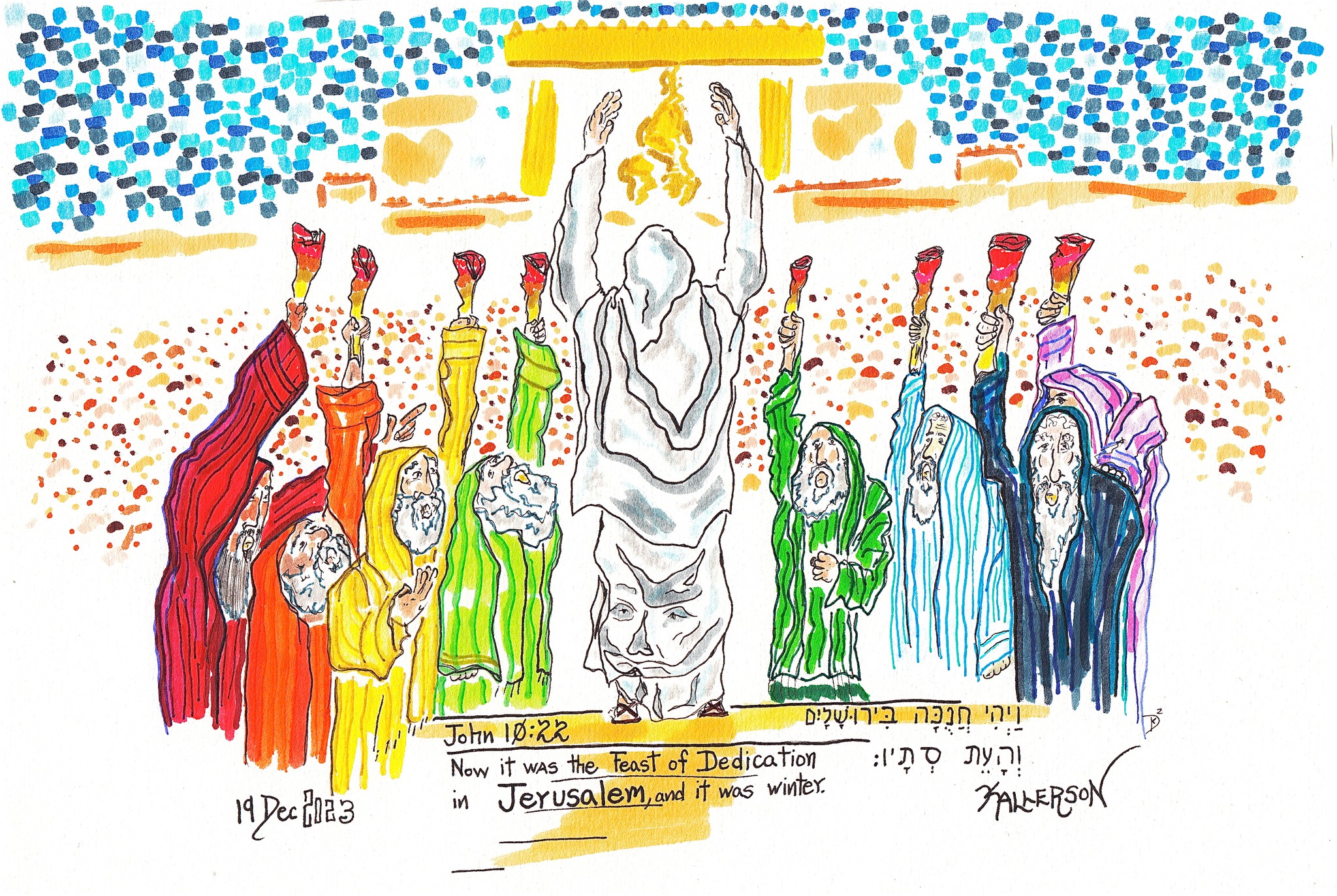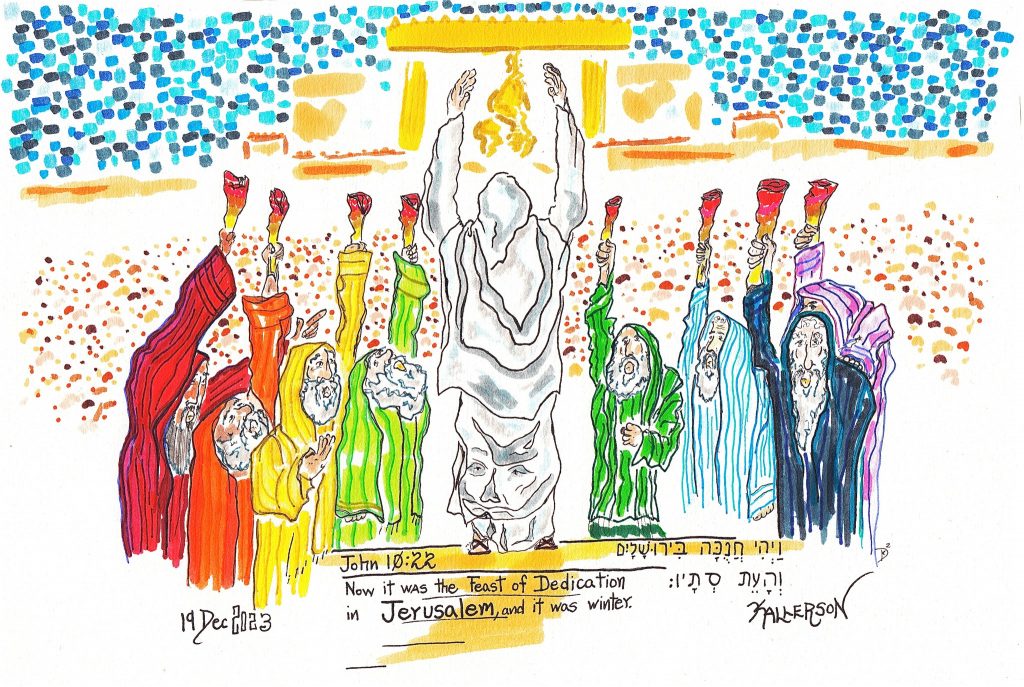
Artwork by Douglas Kallerson.
John 10:22
The Feast of Dedication
“Then the Lord spoke to Moses, saying, 24 ‘Speak to the children of Israel, saying: ‘In the seventh month, on the first day of the month, you shall have a sabbath-rest, a memorial of blowing of trumpets, a holy convocation. 25 You shall do no customary work on it; and you shall offer an offering made by fire to the Lord.’” Leviticus 23:23-25
“Now it was the Feast of Dedication in Jerusalem, and it was winter. 23 And Jesus walked in the temple, in Solomon’s porch. 24 Then the Jews surrounded Him and said to Him, ‘How long do You keep us in doubt? If You are the Christ, tell us plainly.’
25 Jesus answered them, ‘I told you, and you do not believe. The works that I do in My Father’s name, they bear witness of Me. 26 But you do not believe, because you are not of My sheep, as I said to you. 27 My sheep hear My voice, and I know them, and they follow Me. 28 And I give them eternal life, and they shall never perish; neither shall anyone snatch them out of My hand. 29 My Father, who has given them to Me, is greater than all; and no one is able to snatch them out of My Father’s hand. 30 I and My Father are one.’” John 10:22-30
Admittedly, I have heavily plagiarized my Leviticus 23 sermon, which detailed the Feast of Acclamation for this sermon. I made an incorrect statement in that sermon, which has always bugged me. Whenever I tell someone about it, the normal response is, “That’s not a big deal.” But to me, it is.
Precision with the word is important. Therefore, to retell the details of the feast without that blunder is a great relief to me. There are also new details included in this sermon. But even if there weren’t, reviewing all that was previously said is a wonderful reminder of the marvel of what God has done in Christ for us.
Text Verse: “That was the true Light which gives light to every man coming into the world. He was in the world, and the world was made through Him, and the world did not know Him.” John 1:9, 10
The most important question a person can ever be asked is, “Do you know Jesus?” In this case, the question is not “Have you heard of Jesus?” or “Do you know about Jesus?” Rather, it is “Do you know Him for who He is and believe that what is known is true, accepting by faith that He is the Savior of the world?” John explains that in John 1:11-13 –
“He came to His own, and His own did not receive Him. 12 But as many as received Him, to them He gave the right to become children of God, to those who believe in His name: 13 who were born, not of blood, nor of the will of the flesh, nor of the will of man, but of God.”
Who is this Child of Christmas that we celebrate each year at this time? What does the Bible have to say about His coming, His work, and how that pertains to us? The marvel of what God has done is clearly and precisely laid out by God, and yet, it requires much study and careful analysis to fully appreciate the unfolding of the story.
We will see a part of that in today’s sermon. I pray that it will bless you, even if you have heard some of the details before. The Christmas story never gets old because it is the story of the love of God in Christ.
Such great things are to be found in His superior word. And so, let us turn to that precious word once again, and… May God speak to us through His word today, and may His glorious name ever be praised.
I. The Feasts of the Lord
Leviticus 23 details the eight feasts of the Lord. In Leviticus 23:2, these feasts are called moade, the plural of moed, signifying an appointed time, place, or meeting. Specifically, they are called moade Yehovah, or Feasts Yehovah. Then the Lord again specifically says, eleh hem moaday – “These, they, My feasts.”
Thus, these are not Feasts of Israel nor Jewish feasts. They are Feasts of the Lord. It is true that these were proclaimed to Israel and observed by the people, but the Subject of the feasts is the Lord. For a detailed analysis of each of the feasts, to the Leviticus 23 sermons by Superior Word, you are commended. It is an offer now extended. If by you the offer is attended, as recommended, you will find them splendid.
If you choose not to follow this path, they will remain unapprehended or maybe incorrectly comprehended. Set yourselves, therefore, to do as rightly intended, and your time will have been well expended. And with that, my urging on this matter has ended… but perhaps it should be rescinded J
As these are the feasts of the Lord, they are given in anticipation of the coming of the Messiah, the Lord God incarnate. Everything about them will give us insights into His work or how that work is lived out in His people.
Of these eight Feasts, the first is a weekly feast, the Sabbath. Its observance is detailed in Leviticus 23:2. The Sabbath was first given as a sign to Israel in Exodus 16. It was given to no other people on earth, and it was given to anticipate greater truths to be found in Christ Jesus.
As it is designated as a Feast of the Lord, it will be realized and fulfilled in the coming of Christ Jesus.
The next seven feasts are annual feasts. They are:
The Passover. It is mandated in Leviticus 23:3. However, the details of Passover observance are given great attention elsewhere in the books of Moses, beginning with the record of the Passover from Egypt starting in Exodus 12.
Immediately following the Passover is the Feast of Unleavened Bread. It is instructed in Leviticus 23:6-8. Its rites and rituals are detailed elsewhere as well.
That is followed by the Feast of Firstfruits, which is directed in Leviticus 23:9-14.
The next is the Feast of Weeks. It is commanded in Leviticus 23:15-22. This feast is also called the Feast of Harvest in Exodus 23.
That is followed by the Feast of Acclamation. As we saw in the opening, it is detailed in Leviticus 23:23-25. Quite often, it is incorrectly called Rosh Hashanah or the Feast of Trumpets. Rosh Hashanah signifies the beginning of the year. That is based on the original calendar used in Scripture. It is also the Regal calendar (that of the kings of Israel) and the modern calendar used by Israel.
The name Feast of Trumpets is given because it was common for the people to blow trumpets on this day of the year in fulfillment of the words given in Leviticus 23. However, the words read zikron t’ruah, “memorial acclamation.”
In Scripture, the word t’ruah includes the blowing of trumpets at times, but it also signifies a shout of joy, a shout of alarm, etc. In other words, it is a loud acclamation. For example –
“And now my head shall be lifted up
above my enemies all around me,
and I will offer in his tent
sacrifices with shouts [t’ruah] of joy;
I will sing and make melody to the LORD.” Psalm 27:6 (ESV)
Thus, the Feast of Acclamation more appropriately describes the feast.
That is then followed by the Day of Atonement as specified in Leviticus 23:26-32. Extremely detailed instruction for the Day of Atonement is found in Leviticus 16.
Finally, the eighth feast, and the last annual feast, is the Feast of Tabernacles. That is stipulated in Leviticus 23:33-43. It is also called the Feast of Ingathering in Exodus 23:16.
Of these eight feasts, an additional word is used to describe three of them, khag. It is a festival, coming from the verb khagag, to make a pilgrim feast. Specifically, however, it means to move in a circle as if marching in a sacred procession. Further implied in the word is to be giddy and dance, whirling with joy.
These three feasts typologically anticipate the work of the Lord, but being pilgrim feasts, they anticipate the believer’s life in the Lord. This is why the people were specifically mandated to attend these pilgrim feasts each year.
Their participation in them was an anticipation of our participation in the full, final, finished, and forever work of Christ. Each of them is shown to be completed in the work of Jesus as described by the apostles in the New Testament. Paul specifically gives details on their fulfillment –
1) Colossians 2:16, 17 (The Sabbath), “So let no one judge you in food or in drink, or regarding a festival or a new moon or sabbaths, 17 which are a shadow of things to come, but the substance is of Christ.” It is also noted in Hebrews 4:3, where it specifically explains the typology of the Sabbath, “…for we who have believed do enter that rest.”
2) 1 Corinthians 5:7 (Passover), “Christ, our Passover, was sacrificed for us.”
*3) 1 Corinthians 5:8 (Unleavened Bread), “Therefore let us keep the feast, not with old leaven, nor with the leaven of malice and wickedness, but with the unleavened bread of sincerity and truth.”
4) 1 Corinthians 15:20 (Firstfruits), “But now Christ is risen from the dead, and has become the firstfruits of those who have fallen asleep.”
*5) Ephesians 1:13 (and elsewhere – Pentecost), “In Him you also trusted, after you heard the word of truth, the gospel of your salvation; in whom also, having believed, you were sealed with the Holy Spirit of promise.” Weeks, or Pentecost, is literally shown to be fulfilled in Romans 16:5 and 1 Corinthians 16:15 –
“Greet my beloved Epaenetus, who is the firstfruits of Achaia to Christ.”
“I urge you, brethren—you know the household of Stephanas, that it is the firstfruits of Achaia…”
The presentation of the two loaves with leaven in Leviticus 23:17 provides a typological example of what those verses are speaking of – one a Jew, one a Gentile. There is one gospel message that is realized in the saving of all.
6) 1 Corinthians 15:47 (Day of Acclamation), “The first man was of the earth, made of dust; the second Man is the Lord from heaven.”
7) Romans 3:24, 25 (Day of Atonement), “…being justified freely by His grace through the redemption that is in Christ Jesus, 25 whom God set forth as a propitiation by His blood.”
*8) 2 Corinthians 5:7 (Tabernacles), “Therefore, if anyone is in Christ, he is a new creation; old things have passed away; behold, all things have become new.”
*The three pilgrim feasts are highlighted with an asterisk.
The particular feast noted as the Day of Acclamation is held in the September/October timeframe. So, one might question why that is especially highlighted. What can we derive from a feast that occurs in the fall that could help us appreciate what we have come to celebrate in the dead of winter concerning the day we call Christmas?
With the snow piled up outside the church doors, we can sit warmly inside and discover for the first time, or remind ourselves again, of the wonderful details outlined in Scripture that lead us to the celebration of this wonderful day.
Shout to the Lord! Shout with acclamation
It is He who is our King, and He who rules over us
Shout to the Lord, you holy nation
Shout to the King, our Lord Jesus
Let the sound be loud; shout joyfully
Let the land be filled with noise to herald the King
Don’t sit and be silent; don’t act so coyfully
Get up, people, raise your voices and sing
It is He who has created and He who has redeemed us
It is He who sits as King upon the throne of heaven
It is He who rules, even our King Jesus
So shout aloud at the beginning of month number seven
II. The Feast of Acclamation
Earlier I noted that the Feast of Acclamation was fulfilled in Paul’s words of 1 Corinthians 15:47, “The first man was of the earth, made of dust; the second Man is the Lord from heaven.” Of all of the fulfilled Feasts of the Lord, it is the only one that requires a bit of speculation to demonstrate its fulfillment. However, it is sufficiently evident from Scripture that it is fulfilled in the birth of Christ.
It was to be held on the first day of the seventh month, according to Leviticus 23. There are two distinct calendars in the Bible. The first is the creation calendar, and the second is the redemption calendar. This same pattern of creation/redemption is seen throughout the Bible. God creates, and then He redeems.
For example, the reason for giving the Sabbath in the Ten Commandments in Exodus is based on creation, “For in six days the Lord made the heavens and the earth…” (20:11). However, it is based on redemption in the giving of the Ten Commandments in Deuteronomy, “And remember that you were a slave in the land of Egypt, and the Lord your God brought you out from there by a mighty hand and by an outstretched arm” (5:15).
Overt examples of the fulfillment are found elsewhere in Scripture, such as in the book of Revelation, where a doxology of praise to the Lord was uttered in Revelation 4 based on His effort in creation, whereas in Revelation 5, another doxology of praise to Him is given based on His effort in redemption.
Briefly, the seventh month was originally the first month of the year based on creation, but that was changed at the time of the exodus when the Lord declared the first month to commence in the springtime in the month of Aviv (later known as Nisan). That is recorded in Exodus 12:2, and it is based on redemption.
It is the redemption calendar that is used in designating the Feasts of the Lord. Although citing non-biblical sources is not something I like to do, the commentary on the 1st of Tishri, provided by Chabadba, gives invaluable insight into what we need to know –
“The 1st day of creation, on which G-d created existence, time, matter, darkness and light, was the 25th of Elul. (Rosh Hashanah, on which we mark “the beginning of Your works”, is actually the 6th day of creation, on which the world attained the potential for the realization of its purpose, with the creation of the first man and woman, Adam and Eve. Rosh Hashanah is therefore the day from which the Jewish calendar begins to count the years of history; the 1st day of creation thus occurred on the 25th of Elul of what is termed -1 from creation.” Chabadba
In other words, man was created on the sixth day, according to Genesis 1. This would be the first day of the first month of the creation calendar and, later, the first day of the seventh month of the redemptive calendar.
The words of the commentary from Chabadba are actually supported by an anagram that occurs between the first word in the Bible. This anagram is concerning creation and the first day of the month of Tishri. They are both spelled with the same letters, but when rearranged, the Hebrew letters reflect one or the other. “In the beginning,” bereshit, is an anagram of “the first of Tishri,” aleph b’tishri.
בראשית
אבתשרי
As noted earlier, Tishri is also the first month of the regal calendar, as detailed in the books of Kings and Chronicles. That this is the first month of these calendars is significant, as will be seen.
As for the first of this month, it is seen three other times in Scripture. In Genesis 8:13, it is the day that the waters were dried up from the earth, and Noah removed the covering of the ark, looking upon the new world.
Ezra 3 mentions that this is the day Jeshua and Zerubbabel, after their return from Babylon, built the altar of the God of Israel and began to offer burnt offerings to the Lord. It is also the day in Nehemiah 8 when Ezra brought forward the Law of Moses and read it to all the people.
Each instance anticipates Christ. Noah, looking upon the new world, looks to new life in Christ, our Ark of safety. The building of the altar and sacrifices on it anticipate Christ, our Altar of sacrifice, and our Sacrifice. The reading of the Law pictures Christ, the fulfillment of the law.
As this is the first of the month, it would coincide with New Moon celebrations, which are mentioned at various times in the Bible. However, this day in Leviticus, the first of the seventh month, is certainly what is being referred to in Psalm 81, where the word rua is used –
“Sing aloud to God our strength;
Make a joyful shout [rua] to the God of Jacob.
2 Raise a song and strike the timbrel,
The pleasant harp with the lute.
3 Blow the trumpet at the time of the New Moon,
At the full moon, on our solemn feast day.” Psalm 81:1-3
Thus, the New Moon solemn feast coincides with the Day of Acclamation, the darkest night of the month. The full moon solemn feast, the brightest night of the month, would be at the beginning of the Feast of Unleavened Bread, which immediately follows the Passover. It was on these holy convocations, and others like them, that joyful shouts were to be raised.
It is on the first day of the seventh month that Jesus would have been born. Some claim Christ was born in the spring. This conclusion results from a poor analysis of what Scripture is saying, faulty tradition, and incorrect assumptions. It has no basis in reality.
Others claim that Jesus was born during the Feast of Tabernacles, stating that His coming in the flesh to tabernacle among us is fulfilled in His birth. This is also incorrect.
As noted, the Feast of Tabernacles is a pilgrim feast. It signifies believers’ lives in Christ, not the birth of Jesus. It is a common mistake based on a misunderstanding of the Hebrew word khag, which points to believer’s participation in what He has done.
To understand the proper timing of the birth of Jesus, it needs to be fleshed out from what is provided in Scripture. First, Acclamation is the only feast that falls on the first of the month, the time of the New Moon. As noted, this is when the skies are the darkest, having no light from the moon to illuminate them, the significance of which will be seen later.
As for the precise dating, to see the proper pattern develop, we first go to 1 Chronicles 24. This reveals the order of the 24 details of priests who served at the temple in Jerusalem. The division of Abijah was the 8th division –
“And the scribe, Shemaiah the son of Nethanel, one of the Levites, wrote them down before the king, the leaders, Zadok the priest, Ahimelech the son of Abiathar, and the heads of the fathers’ houses of the priests and Levites, one father’s house taken for Eleazar and one for Ithamar.
7 Now the first lot fell to Jehoiarib, the second to Jedaiah, 8 the third to Harim, the fourth to Seorim, 9 the fifth to Malchijah, the sixth to Mijamin, 10 the seventh to Hakkoz, the eighth to Abijah…” 1 Chronicles 24:6-10
Next, Luke 1 reveals that Zechariah, the father of John the Baptist, was of the division of Abijah. He was serving at the Temple and was given the promise of a son –
There was in the days of Herod, the king of Judea, a certain priest named Zacharias, of the division of Abijah. His wife was of the daughters of Aaron, and her name was Elizabeth. 6 And they were both righteous before God, walking in all the commandments and ordinances of the Lord blameless. 7 But they had no child, because Elizabeth was barren, and they were both well advanced in years.
8 So it was, that while he was serving as priest before God in the order of his division, 9 according to the custom of the priesthood, his lot fell to burn incense when he went into the temple of the Lord. 10 And the whole multitude of the people was praying outside at the hour of incense. 11 Then an angel of the Lord appeared to him, standing on the right side of the altar of incense. 12 And when Zacharias saw him, he was troubled, and fear fell upon him.
13 But the angel said to him, “Do not be afraid, Zacharias, for your prayer is heard; and your wife Elizabeth will bear you a son, and you shall call his name John. 14 And you will have joy and gladness, and many will rejoice at his birth. 15 For he will be great in the sight of the Lord, and shall drink neither wine nor strong drink. He will also be filled with the Holy Spirit, even from his mother’s womb. 16 And he will turn many of the children of Israel to the Lord their God. 17 He will also go before Him in the spirit and power of Elijah, ‘to turn the hearts of the fathers to the children,’and the disobedient to the wisdom of the just, to make ready a people prepared for the Lord.”
18 And Zacharias said to the angel, “How shall I know this? For I am an old man, and my wife is well advanced in years.”
19 And the angel answered and said to him, “I am Gabriel, who stands in the presence of God, and was sent to speak to you and bring you these glad tidings. 20 But behold, you will be mute and not able to speak until the day these things take place, because you did not believe my words which will be fulfilled in their own time.”
21 And the people waited for Zacharias, and marveled that he lingered so long in the temple. 22 But when he came out, he could not speak to them; and they perceived that he had seen a vision in the temple, for he beckoned to them and remained speechless.
23 So it was, as soon as the days of his service were completed, that he departed to his own house. 24 Now after those days his wife Elizabeth conceived; and she hid herself five months, saying, 25 “Thus the Lord has dealt with me, in the days when He looked on me, to take away my reproach among people.” Luke 1:5-25
Later, in Luke 1:36, it is revealed that Mary was visited by Gabriel in the 6th month of Elizabeth’s pregnancy, “Now indeed, Elizabeth your relative has also conceived a son in her old age; and this is now the sixth month for her who was called barren.” From this point, we have the details to know the timing of Jesus’ birth –
Mar/Apr Apr/May May/June Jun/July
Month Nisan Iyar Shivan Tamuz
Division 1 & 2 3 & 4 5 & 6 7 & 8 Abijah
*Zechariah would have been at the temple in Jun/Jul (Tamuz)
*Add 6 months until Gabriel spoke to Mary – Dec/Jan (Adar)
*Add 9 months until Christ the Lord was born – Sep/Oct (Tishri)
However, an obvious assumption must be made, which is that Zechariah got his wife pregnant rather quickly. And yet, that is hardly an assumption at all. First, he couldn’t speak until the child was born, something that may have made Elizabeth quite happy, but it is something he would want corrected right away.
Second, if they had been hoping for a child for so long, they would have wasted no time in getting started with the tough work. The assumptions are obvious. Further, Luke, under inspiration of the Spirit, continues the timeline in an uninterrupted fashion, asking us to look at the dates based on the other time frames he provided, meaning in a united fashion.
Based on the evidence, it is clear that Christ Jesus was born in the September/October timeframe. This corresponds to the Hebrew month of Tishri. From that, we can reasonably determine that Jesus was born on the first of Tishri. We can do this in several ways.
First, we look to 1 Corinthians 15 to see a pattern based on the tradition showing that Adam was created on the first day of Tishri, the 6th day of creation. It would follow reasonably that Jesus, the “second Adam,” was born on the same day, 4000 years later, thereby completing a biblical pattern. 1 Corinthians 15:45-48 tells us Jesus is the last Adam –
“And so it is written, “The first man Adam became a living being.” The last Adam became a life-giving spirit.
46 However, the spiritual is not first, but the natural, and afterward the spiritual. 47 The first man was of the earth, made of dust; the second Man is the Lord from heaven. 48 As was the man of dust, so also are those who are made of dust; and as is the heavenly Man, so also are those who are heavenly.”
When Adam was created, the Lord who created him became, in effect, his King at that moment. That He is a King is reflected, for example, in the 47th Psalm –
“God has gone up with a shout,
The Lord with the sound of a trumpet.
6 Sing praises to God, sing praises!
Sing praises to our King, sing praises!
7 For God is the King of all the earth;
Sing praises with understanding.” Psalm 47:5-7
However, the man turned from his King. God knew this would happen from the beginning. Both Peter and John state this unambiguously. Speaking of Christ Jesus, 1 Peter 1:20, 21 says –
“He indeed was foreordained before the foundation of the world, but was manifest in these last times for you 21 who through Him believe in God, who raised Him from the dead and gave Him glory, so that your faith and hope are in God.”
And so, in order to redeem man, God sent Christ into the world, using the same pattern as is found throughout Scripture – creation and then redemption. He created Adam on the first of Tishri, and He sent the Redeemer on that same day. It was the first of the month of the creation calendar and the first of the seventh month on the redemption calendar.
And, as noted, this is the only feast designated specifically as occurring on the New Moon, which is the first day of the month. It is the darkest day of the month. Thus, it was the best day for the glory of the Lord to be highlighted –
“Now there were in the same country shepherds living out in the fields, keeping watch over their flock by night. 9 And behold, an angel of the Lord stood before them, and the glory of the Lord shone around them, and they were greatly afraid.” Luke 2:8, 9
These words of Luke are used to claim that Jesus had to have been born in the spring, saying that it was too cold for flocks to be out in December. As such, the claim is that Jesus could not have been born then.
First, He wasn’t. The details demonstrate that He was born in the fall. But more, the claim is ignorant. The animals are never sheltered away from the weather. They remain in the fields throughout the year. Thus, the entire argument for this Cahn-job is rendered false.
As I said, such analyses result from a poor analysis of Scripture, faulty tradition, and incorrect assumptions. As for the heralding of a king, in 1 Kings 1:34, it is seen that the shofar, the ram’s horn trumpet, is blown at the coronation of the king. In that case, it was Solomon.
It then becomes obvious why the Lord mandated this feast on this particular day. It is the day when all of Israel would be joyously shouting with acclamation and blowing shofars throughout the land. On this day, the King of the Universe was being born among men. Little did they know that they were heralding in the true, great King of Israel – Jesus Christ.
The patterns are too rich, too many, and too well orchestrated to be by mere chance. Again, in Numbers 23:21, we read these words –
“He has not observed iniquity in Jacob,
Nor has He seen wickedness in Israel.
The Lord his God is with him,
And the shout of a King [t’ruat melekh] is among them.” Numbers 23:21
This is the same word, t’ruah, used in Leviticus to signify this particular day in the redemptive calendar. This was certainly fulfilled in the praises of the heavenly host at the birth of the great King, Jesus! And again, Psalm 47, a psalm read on the first day of this particular month in synagogues around the world, it says –
“Oh, clap your hands, all you peoples!
Shout [rua] to God with the voice of triumph!
2 For the Lord Most High is awesome;
He is a great King over all the earth.” Psalm 47:1, 2
Without Israel even now understanding the significance of what they are proclaiming, the idea of rua, shouting to the King, is identified with this day. Three verses later, the psalmist says –
“God has gone up with a shout,
The Lord with the sound of a trumpet.” Psalm 47:5
There, the t’ruah, or shout of acclamation, is combined with the sound of the shofar, all pointing to this one particular day in history when Christ was born, and the King of the universe was made manifest among us.
Again, it is certain that Christ was born on the same day that Adam was created, on the first day of the first month of the creation calendar, which is the first day of the seventh month of the redemption calendar.
But we can ask, “Did anything happen in the Bible on the first day of the first month of the redemption calendar?” The answer is, “And it came to pass in the first month of the second year, on the first day of the month, that the tabernacle was raised up” (Exodus 40:17).
The tabernacle, every detail of which points to Christ and His ministry, was erected on the first day of the first month of the redemption calendar. Thus, we again have, as has been seen many times in Scripture, the pattern of creation being followed by redemption. The Creator is our Redeemer.
The King has come; shout aloud and rejoice
He has come to redeem fallen man
Let your shouts be heard with a resounding voice
Blow the trumpets aloud, as hard as you can
He has come! The King of the ages is here
We gather around Him, the King of the Jews
Yes, all people come, see the sight, draw near
And then go forth and spread the glorious news
The Baby born in a manger is the King of Israel
This Child lying helplessly shall rule all the world
It is the most marvelous news; go forth and tell
May joy from the heart now be unfurled
III. The Significance of Christmas
We are gathered here in December to celebrate Christmas. But why are we doing so if Jesus was born in the fall? Couldn’t we just stay home and not plow the driveway before driving in all this miserable snow? No! We have gathered at this time for a reason.
When you ask a Korean person how old he is, he will give you an answer that doesn’t fit with the Western notion of age. The reason why is they consider their age from conception, not from birth out of the womb.
Understanding this will help you grasp why what they tell you at one time doesn’t seem to match with what you might find out at other times.
Even though Christ, the second Adam and the King of the universe, was born on the first day of the seventh month of the redemption calendar, there is another point that needs to be addressed. What is the significance of our coming together to celebrate on 25 December?
Traditionally, people have said this was a Catholic attempt to align the holiday with a pagan festival to accommodate older beliefs for those who were assimilated into the faith. Whether this occurred or not has nothing to do with what Scripture tells us concerning Jesus.
The equinoxes and solstices were created by God, and they reflect what He is doing in the world of creation and redemption. If this has been misused by other religions, it doesn’t change the true intent for when these things occur. The significance of 25 December is far more beautiful than some crude attempt by Roman Catholicism to harmonize pagan beliefs with those of Christianity.
The human gestation period is approximately 270 days. It does vary, but this is right at the average. If you go back 270 days from the first of Tishri, you will at times come to 25 December.
What this means is that Christ was conceived on this day, approximately 270 days before His birth into the world. And so, the true celebration on this day is not the birth of Jesus from the womb. Rather, what we’ve been celebrating is the incarnation of Jesus in the womb, when God united with human flesh.
Understanding that, eight times in the past one hundred and seventeen years, both Christmas and Hanukkah (the Festival of Lights), have occurred at the same time – 24/25 December. In 2024, it will occur again on 25 December, and in 2027, it will occur on December 24.
This same day is known as the Feast of Dedication, mentioned in John 10:22, and which was included in our opening verses.
Elsewhere in the gospel of John, John cites Jesus’ words concerning His fulfillment of that feast. Although it was not a Leviticus 23 feast, it is noted as a feast nonetheless in the New Testament. Along with our Text Verse today, there are other clearly stated verses that tell us this –
“Then Jesus spoke to them again, saying, ‘I am the light of the world. He who follows Me shall not walk in darkness, but have the light of life.’” John 8:12
“Then Jesus said to them, ‘A little while longer the light is with you. Walk while you have the light, lest darkness overtake you; he who walks in darkness does not know where he is going. 36 While you have the light, believe in the light, that you may become sons of light.’ These things Jesus spoke, and departed, and was hidden from them.” John 12:35, 36
As incredible as it might seem, Jesus was probably conceived on the Festival of Lights (Hanukkah), also known as the Feast of Dedication, and He was certainly born on Yom T’ruah. The prophetic patterns of the Bible completely and amazingly support the wonderful fulfillment of the Feasts of the Lord in Jesus!
Scripture has carefully recorded special circumstances that occurred in one particular line of priests, that of Abijah, for a reason. It then carefully and methodically gives other time frames necessary to pinpoint the time of year Christ was born.
It also gives numerous patterns that confirm the exact date within this time of year for us to know, with all certainty, that He was born on the 1st of Tishri and that he was conceived at what we call Christmas. The Light of the World has come to dwell among us!
None of this is by chance. Rather, these things are recorded because God is alerting us to the fact that Jesus is the Messiah anticipated in every type and picture given in Scripture. And more, He is the fulfillment of them all. As this is so, then He is obviously asking us to follow through with what the Bible says is necessary for our lives concerning Christ.
It says that He is God’s gift to the world and that all who believe in Him will be saved. It further says that He is the only path to salvation and that no one can come to the Father but through Him. He is the one and only Mediator between God and men. In other words, God only acknowledges those prayers that are directed to Him through Jesus.
If you have never accepted Jesus, I would ask you today to consider your eternal state. Think it through, look at what God has done in Christ, and call out to Him for salvation. All He asks is that we simply believe that He has done all the work. Salvation is God’s gift, appropriated by faith in the work of Jesus.
He was conceived at the time of the Feast of Dedication (aka, the Festival of Lights, Hannukah).
He was born on first of the seventh month of the redemption calendar which is the first month of the creation calendar, at the time of the New Moon, the darkest night of the month. God’s glory lit up the heavens, and the heavenly host proclaimed the event. Scripture is revealing to us that the true Light had entered into the spiritual darkness of the world to accomplish all that God had set before Him.
Remarkably, He then died just before the start of the brightest night of the month, the night of the full moon. Again, a spiritual picture was given to us – our Hope is not extinguished by darkness. As it says in John 1:5 –
“And the Light shines in the darkness, and the darkness has not overcome it.”
Let us remember this and carry the true Light with us. May the hope of the Christmas Child remain with you always. And may the Light of Christ shine upon you now and forever. May it be so! Amen.
Closing Verse: Then the angel said to them, “Do not be afraid, for behold, I bring you good tidings of great joy which will be to all people. 11 For there is born to you this day in the city of David a Savior, who is Christ the Lord. 12 And this will be the sign to you: You will find a Babe wrapped in swaddling cloths, lying in a manger.” Luke 2:10-12
Next week: Judges 6:1-10 To Me alone you shall worship and applaud… (I Am the Lord Your God) (17th Judges Sermon)
The Lord has you exactly where He wants you. He has a good plan and purpose for you. He sent His own Son into the world to reconcile you to Himself. Remember the enormity of what that means each day of your life. And then, follow Him and trust Him as He continues to do marvelous things for you and through you.
The Zeal of the Lord of Hosts
Unto us a Child is born
A time to rejoice and not to mourn
Unto us a Son is given
The One to lead us from death to a’livin’
And the government will be upon His shoulder
Every eye will see Him; every soul will be His beholder
Upon the throne of David and over His kingdom’s realm
To order it and establish it with judgment and justice
From that time forward, even forever – He at the helm
The zeal of the Lord of hosts will perform this
And His name will be called Wonderful
The Counselor and Mighty God is He
Everlasting Father, Prince of Peace, pure and white as wool
Of the increase of His government and peace, no end shall we see
Do not be afraid, for behold
I bring you good tidings of great joy
Which will be to all people, forever told
The wondrous story, the birth of a Boy
For there is born to you this day
In the city of David, a Savior, it is He
Christ the Lord whom heaven’s hosts obey
The Messiah has come; and now you may go and see
And this will be the sign to you:
You will find a Babe wrapped in swaddling clothes
Lying in a manger, a glorious view
The Christmas Child whom our Heavenly Father bestows
A Child like no other has come to dwell among us
He shall lead us in paths of righteousness for His name’s sake
And His name is called out, His name is JESUS
Come, and of the Heavenly Child partake
He is God’s gift and heaven’s treasure
He is Immanuel – God with us
And He bestows upon us grace without measure
The Christmas Child, our glorious Lord – JESUS!
Hallelujah and Amen…