Judges 6:33-40
Gideon, Judge of Israel, Part IV
(Typed 20 November 2023) Adam Clarke’s commentary often has interesting insights into what is going on in the surface text. At times, he provides his own thoughts on what a passage is typologically presenting. At other times, however, he will openly dismiss the idea of any passage, even hinting at typology.
What this shows is that he thinks there is an overall picture of something, but that is all it is. The details are irrelevant to the overall picture. If that is his approach, it is a rather sloppy way of looking at things.
What would be the point of giving such minute details of things that are otherwise completely unnecessary to a particular story unless the Lord is telling us precious details of typology?
Maybe Clarke just couldn’t figure out what was being conveyed and so he found fault in those who thought they could. Of this passage from Judges 6, he cites the work of the church father, Origen –
“On the miracle of the fleece, dew, and dry ground, Origen, in his eighth homily on the book of Judges, has many curious and interesting thoughts, I shall insert the substance of the whole: The fleece is the Jewish nation. The fleece covered with dew, while all around is dry, the Jewish nation favored with the law and the prophets. The fleece dry, the Jewish nation cast off for rejecting the Gospel. All around watered, the Gospel preached to the Gentiles. and they converted to God. The fleece on the threshing-floor, the Jewish people in the land of Judea, winnowed, purged, and fanned by the Gospel. The dew wrung out into the bowl, the doctrines of Christianity, extracted from the Jewish writings, shadowed forth by Christ’s pouring water into a basin, and washing the disciples’ feet.”
Origen’s thoughts are interesting and insightful, but there are problems with them that cannot be overcome. Finding proper typology reveals exactly why God chose some stories from history and completely ignores innumerable others.
Improperly analyzing typology will lead people down odd paths of thought that have no real bearing on what is being portrayed. In Origen’s case, he lived so long ago that much of what we now know concerning history could not have been deduced.
Thus, there is an excuse if he missed the mark on what was being conveyed. We are further along in history, and we can more clearly see what God is doing. Jesus is the key, but there are key points that are linked to the picture, such as Israel, the law, etc.
Text Verse: “Therefore they shall be like the morning cloud
And like the early dew that passes away,
Like chaff blown off from a threshing floor
And like smoke from a chimney.” Hosea 13:3
Of the dew on the fleece, John Lange sees it as the advent of Christ, saying, “…his miraculous sign became the type of the highest and most wonderful miracle known to the church, the birth of Jesus from the Virgin Mary. Origen already speaks of the advent of the Son of God as the fall of the divine dew.”
The thought is poetic, but it does not match the rest of the typology being presented here. Either everything fits or it doesn’t. In this case, it doesn’t. And yet, what the dew pictures is based on Christ’s work and what results from it. As for Clarke, he finished his commentary on Origen and Chapter 6 of Judges saying –
“All this to some will doubtless appear trifling; but it is not too much to say that scarcely any pious mind can consider the homily of this excellent man without drinking into a measure of the same spirit, so much sincerity, deep piety, and unction, appear throughout the whole: yet as I do not follow such practices, I cannot recommend them.”
His words concerning Origen are kind, even gracious. But his thoughts about Origen’s finding typology in a passage such as this are dismissive. Hence, he would not appreciate my approach to Scripture. Typology is what explains what is otherwise inexplicable, and it is exactly what God is dealing in.
As for my conclusions concerning today’s passage, they are how I read what is going on. Origen’s thoughts are not entirely out of the ballpark, but they do land a bit far out in left field. God is telling us a story through typology. And it is a great story indeed because it is about what He has done in and through Jesus Christ.
Yes, it’s all to be found in His superior word. And so, let us turn to that precious word once again, and… May God speak to us through His word today, and may His glorious name ever be praised.
I. A Fleece of Wool in the Threshing Floor (verses 33-40)
33 Then all the Midianites and Amalekites, the people of the East, gathered together;
The people groups are singular: v’kal midyan va’amaleq u-b’ne qedem neesphu yakhdav – “And all Midian and Amalek and sons East gathered together.” The words take us back to the beginning of the chapter –
“Then the children of Israel did evil in the sight of the Lord. So the Lord delivered them into the hand of Midian for seven years, 2 and the hand of Midian prevailed against Israel. Because of the Midianites, the children of Israel made for themselves the dens, the caves, and the strongholds which are in the mountains. 3 So it was, whenever Israel had sown, Midianites would come up; also Amalekites and the people of the East would come up against them. 4 Then they would encamp against them and destroy the produce of the earth as far as Gaza, and leave no sustenance for Israel, neither sheep nor ox nor donkey.” Judges 6:1-4
The raiders would come annually to steal away whatever produce had arisen from the labors of the land. It is the reason why Gideon was said to thresh wheat in the winepress, hiding from those who might spot him and raid what he had gathered.
Midian is the main group afflicting Israel. The name comes from madon, strife or contention. That is derived from din, to judge. Thus, it means Strife or Place of Judgment.
Amalek was the first of Israel’s enemies soon after leaving Egypt. The Lord declared war upon them from generation to generation (Exodus 17). Amalek is derived from am, people, and malaq, to nip or wring off the head of a bird with or without severing it from the body. Thus, they are The People Who Wring Off. They are those who are disconnected from the body and strive to disconnect the body.
The b’ne qedem or “sons East” would be the various people groups, including Arab tribes, Ishmaelites, etc. It is a way of saying anyone and everyone in the surrounding area gathered together. As for the word qedem, east, it means not only east in direction, but before in time, or that which has already been.
This would be a great sized force that has gathered…
33 (con’t) and they crossed over and encamped in the Valley of Jezreel.
va’yaavru va’yakhanu b’emeq yizr’el – “And crossed over and encamped in valley Jezreel.” This is the area referred to in Hosea 1, where the Lord uses naming Hosea’s children as object lessons to Israel. In Romans 9, Paul picks up on the words of Hosea’s prophecy and applies them to Israel during her time of rejection while the church is the focus of God’s attention.
In his first epistle, Peter then uses the words of Hosea 2 to reveal that Israel of the future, after the Gentile-led church age, will again be the people of God.
Jezreel means God Sows. Being prefixed with emeq, or valley, it would be the Depth of God Sows, the emeq being a deep, broad valley. One can see the similarity between the two names, Israel and Jezreel, when put side by side –
יזרעאל
ישראל
Israel, He Strives with God, has received judgment for striving against God. Now, that time is over, and God will strive with Israel, meaning for Israel, in the valley where God Judges.
34 But the Spirit of the Lord came upon Gideon;
v’ruakh Yehovah lavshah eth Gidon – “And Spirit Yehovah clothed Gideon.” The word lavash, to clothe, comes from a primitive root meaning to wrap around. One can imagine the Spirit enfolding around Gideon like a garment. The thought is not unlike that of Galatians 3:27 –
“For as many of you as were baptized into Christ have put on [enduo: clothed] Christ.”
Gideon was selected as the judge of Israel. The Lord clothed him with His Spirit readying him for the challenges ahead…
34 (con’t) then he blew the trumpet,
vayitqa ba’shophar – “and blew in the shophar.” The act is a call to arms for warfare. It was seen, for example, in Judges 3 –
“But Ehud had escaped while they delayed, and passed beyond the stone images and escaped to Seirah. 27 And it happened, when he arrived, that he blew the trumpet in the mountains of Ephraim, and the children of Israel went down with him from the mountains; and he led them.” Judges 3:26, 27
Gideon performed according to the word of the Lord by destroying the altar of the baal, upon which was the image of Asherah. After that, the Spirit of the Lord clothed him. Now, he is readied for the main part of his calling –
“Then the Lord turned to him and said, ‘Go in this might of yours, and you shall save Israel from the hand of the Midianites. Have I not sent you?’” Judges 6:14
Upon hearing those words, Gideon responded –
“So he said to Him, ‘O my Lord, how can I save Israel? Indeed my clan is the weakest in Manasseh, and I am the least in my father’s house.’” Judges 6:15
If you remember, theology was being developed in the exchange as Gideon was made to realize that the One he was speaking to was the Lord (YHVH), not merely a man. With that, the Lord responded –
“And the Lord said to him, ‘Surely I will be with you, and you shall defeat the Midianites as one man.’” Judges 6:16
The Lord promised to be with him, and he is clothed with the Spirit of the Lord. Thus, he is suitably prepared for the battle against Midian.
As for the shophar, it is a ram’s horn. The name is derived from shaphar, to be beautiful or comely. That comes from a root signifying to shine. Strong’s notes the connection between the two thoughts is the clear sound. As something beautiful shines, so the beautiful sound shines forth from the shophar. Upon blowing in the shophar, it next says…
34 (con’t) and the Abiezrites gathered behind him.
vayizaeq aviezer akharav – “And cried Abiezer after him.” It is the same word, zaaq, used at the beginning of the chapter to signify the distress of Israel in their affliction –
“So Israel was greatly impoverished because of the Midianites, and the children of Israel cried [zaaq] out to the Lord.” Judges 6:6
The NKJV saying, “gathered behind” is more of a paraphrase. The idea is that Gideon has sounded the trumpet, and Abiezer has cried out, as in a war cry, after him. One can think of the famous rebel yell of the Confederate South.
As for Abiezer, the spelling is different than in verses 11 and 24. There it said avi ha’ezri, My Father, the Ezrite or Father of the Ezrite. Here, it reads aviezer, My Father is Help or Father of Help. The entire clan of Abiezer is collectively named in the singular, but it refers to all who descended from him, be it hundreds or thousands. Along with them…
35 And he sent messengers throughout all Manasseh, who also gathered behind him.
The words concerning Manasseh, Gideon’s tribe, are emphatic: u-malakhim shalakh b’kal m’nasheh vayizaeq gam hu akharav – “and messengers sent in all Manasseh, and cried also, HE, after him.” The word translated as messengers means exactly that. But it is the same word, malakh, ascribed to the Lord seven times in verses 6:11-22.
Manasseh means To Forget and also From a Debt.
In hearing of Gideon’s support from Abiezer, the rest of the tribe coalesced around Gideon as well, crying after him. And more…
35 (con’t) He also sent messengers to Asher, Zebulun, and Naphtali; and they came up to meet them.
u-malkhim shalakh b’asher u-bizvulun u-b’naphtali vayaalu liqratam – “And messengers sent in Asher, and in Zebulun, and in Naphtali. And ascended to meet them.” Asher failed to come forward for battle at the time of Barak’s engaging Sisera, as was noted in Judges 5. However, they are listed first here, indicating a willingness to join with Gideon and his men.
Zebulun and Naphtali, however, willingly joined both battles –
“Asher continued at the seashore,
And stayed by his inlets.
18 Zebulun is a people who jeopardized their lives to the point of death,
Naphtali also, on the heights of the battlefield.” Judges 5:17, 18
Asher means both Blessed and Happy. Zebulun means Glorious Dwelling Place. Naphtali means My Wrestlings.
36 So Gideon said to God, “If You will save Israel by my hand as You have said—
It is a pregnant verse, filled with things to contemplate: vayomer gidon el ha’elohim im yeshkha movoshia b’yadi eth Yisrael kaasher dibarta – “And said Gideon unto the God, ‘If you are Savior – in my hand – Israel, according to which have spoken.’”
Rather than “God,” it says, “the God.” As always, the article is expressive. It is used when referring to the one true God in relation to man. But more especially, it is in relation to those who are in a right relationship with Him, or it is used to contrast those who are not in a right relationship with Him.
In this case, it is directly in relation to Gideon. Inserting the words “in my hand” between Savior and Israel speaks of this intimate relationship.
Also, rather than “as you have said,” it says, “as you have spoken.” It is an authoritative word of the Lord that expects no response or participation. Despite that, Gideon fails to accept the spoken word of “the God.”
However, Adam Clarke says, “Gideon was very bold, and God was very condescending. But probably the request itself was suggested by the Divine Spirit.”
And why not? Gideon is clothed with the Spirit of Yehovah. It would thus appear that the Spirit of the Lord is using Gideon and his request as an object lesson for both the immediate context as well as for typological anticipations of the future…
37 look, I shall put a fleece of wool on the threshing floor;
hineh anokhi matsig eth gizath ha’tsemer ba’goren – “Behold, I placing fleece the wool in the threshing floor.” Rather than the common word sum, to set, Gideon uses the word yatsag. The BDB says, “a vivid and forcible synonym of שָׂם [sam].” The word comes from a primitive root signifying to place permanently.
Next, the gizah, or fleece, is found seven times in Scripture, all in Judges 6. It is a feminine word, coming from gazaz, to shear. That comes from a primitive root signifying to cut off.
That is followed by the goren, or threshing floor. This is the only time it is seen in Judges. It is a place of separation and, thus, judgment. The chaff of the grain is separated from the kernel. It was referred to in the text verse from Hosea. This is also referred to by John the Baptist –
“Now as the people were in expectation, and all reasoned in their hearts about John, whether he was the Christ or not, 16 John answered, saying to all, ‘I indeed baptize you with water; but One mightier than I is coming, whose sandal strap I am not worthy to loose. He will baptize you with the Holy Spirit and fire. 17 His winnowing fan is in His hand, and He will thoroughly clean out His threshing floor, and gather the wheat into His barn; but the chaff He will burn with unquenchable fire.’” Luke 3:15-17
Next, Gideon continues…
37 (con’t) if there is dew on the fleece only, and it is dry on all the ground,
im tal yihyeh al ha’gizah l’baddah v’al kal ha’aretz khorev – “If dew become upon the fleece, to her separation, and upon all the earth dryness…” The word tal, or dew, comes from talal, to cover. The idea is that dew covers the vegetation each day. However, dew is something transitory and fleeting. That was seen in our text verse where it said, “And like the early dew that passes away.”
The words speak for themselves. Gideon is asking for a sign concerning the challenge of the battle that is set before him. As for the word khorev, or dryness, it is the same spelling as Horeb, the mount where the law was received. Both the word and the name come from the verb kharav, to be dry or dried up. For Gideon, if he receives his request…
37 (con’t) then I shall know that You will save Israel by my hand, as You have said.”
Again, it says spoken, not said: vayadati ki tovoshia b’yadi eth Yisrael ka’asher dibarta – “And I shall know for saving – in my hand – Israel.” Gideon again places himself between the idea of saving and Israel. The significance is that the Lord is the One saving, but he is using Gideon to be the instrument of that salvation. And again, he uses the word davar, to speak. The Lord has spoken, and He will accomplish.
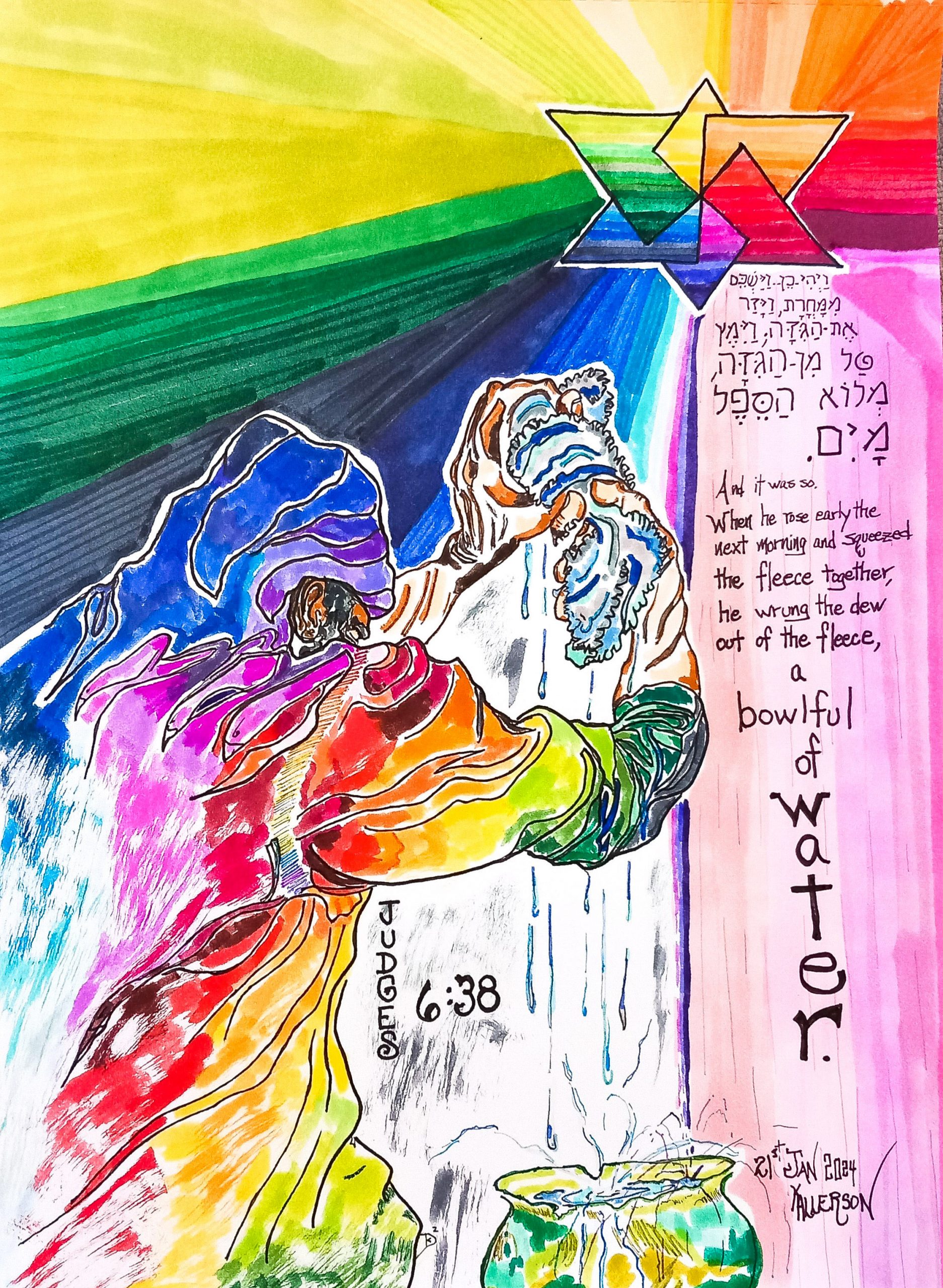
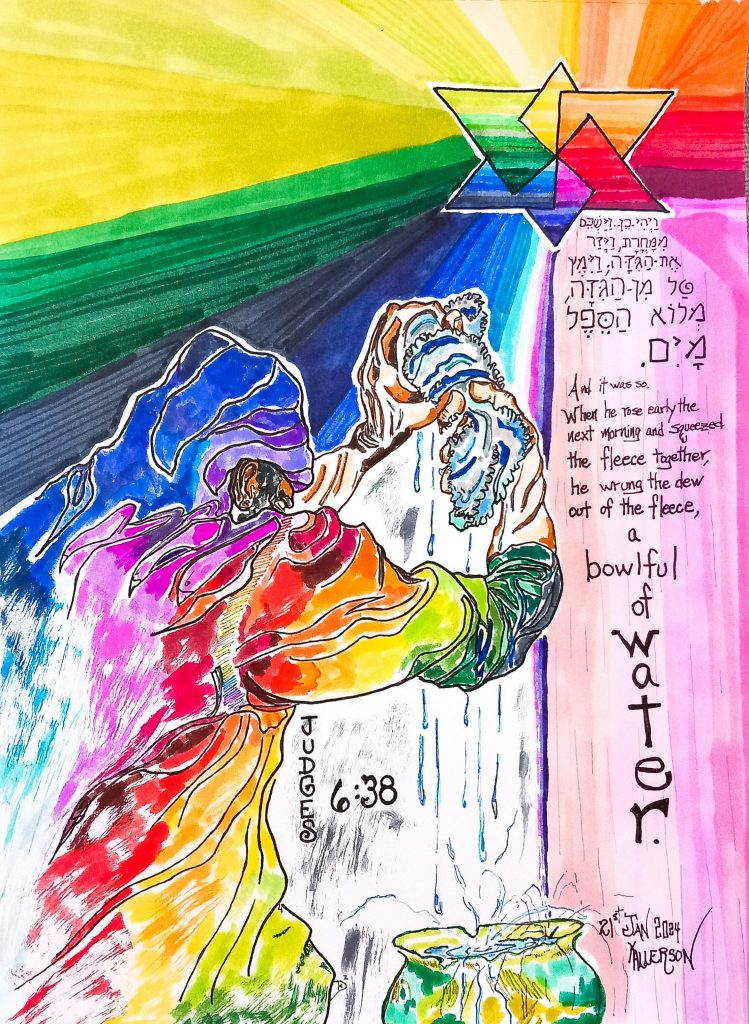
38 And it was so. When he rose early the next morning and squeezed the fleece together,
vayhi ken vayashkem mimakhorath vayazar eth ha’gizah – “And is thus. And rising early from morrow, and pressing the fleece.” Just as Gideon requested, so it was. Here is a new and rare word, zur. It signifies to press down and out. To get the sense, the Lord says to Job –
“The wings of the ostrich wave proudly,
But are her wings and pinions like the kindly stork’s?
14 For she leaves her eggs on the ground,
And warms them in the dust;
15 She forgets that a foot may crush [zur] them,
Or that a wild beast may break them.” Job 39:13-15
Upon pressing the fleece…
38 (con’t) he wrung the dew out of the fleece, a bowlful of water.
vayimets tal min ha’gizah melo ha’sephel mayim – “and drained dew from the fleece: fullness the bowl water.” In pressing the fleece, the water drained out, and not just a bit. The word bowl is sephel. This is the second and last use of it in the Bible. The first was in Judges 5:25, where Jael gave Sisera a majestic bowl of curd. The word comes from an unused root meaning to depress. Thus, it is a deep bowl.
39 Then Gideon said to God, “Do not be angry with me,
Gideon’s words of the verse are filled with cohortatives, jussives, interjections, anthropomorphisms, etc. Here, he uses a jussive, an implied command: vayomer gidon el ha’ elohim al yikhar apekha bi – “And said Gideon unto the God, ‘Not do burn Your nostril in me.’”
Gideon can see that he might get the Lord upset enough to have fire and smoke pour out of his nose and catch him on fire. Hence, he uses this jussive, do burn. Next, he says…
39 (con’t) but let me speak just once more:
The verb is cohortative: vaadaberah akh ha’paam – “and let speak, surely the once.” The word paam signifies a beat, as if pounding out on an anvil. In this case, he has spoken, but he wants to speak again. It is a request for another beat upon the anvil.
39 (con’t) Let me test, I pray, just once more with the fleece;
Again, the verb is cohortative: anaseh na raq ha’paam ba’gizah – “Let, I pray, only the once, in the fleece.” It is as if he is begging for the event to take place. If Clarke was right in suggesting that it was by the Spirit that Gideon was asking for a sign in the fleece, it is surely now only Gideon who is asking.
The Spirit provided a confirmation of “the God’s” intention for what was to take place. However, Gideon suddenly realizes, “Maybe there was dew everywhere, and it evaporated off the ground first.” This should not be unexpected. Charles Ellicott, citing Lord Bacon (mmmm, bacon), notes –
“Sailors have used every night to hang fleeces of wool on the sides of their ships towards the water, and they have crushed fresh water out of them in the morning.”
The fleece, then, is like an absorbent sponge. Gideon would have known this and begs for another, clearer, sign…
39 (con’t) let it now be dry only on the fleece, but on all the ground let there be dew.”
The first verb is a jussive: yehi na khorev el ha’gizah l’badah v’al kal ha’arets yihyeh tal – “Let there be, I pray, dryness unto the fleece, to her separation, and upon all the earth, become dew.” Gideon knows this is impossible apart from the supernatural hand of the Lord. It is something that could not be otherwise…
40 And God did so that night.
Instead of “the God,” it now simply says, “God.” vayaas elohim ken balaylah ha’hu – “And did Elohim thus in the night, the it.” The God whom Gideon stood in a right relationship with is the Powers over creation, the one true God. He accomplished the sign Gideon requested and gave a memorial for future redemptive history…
*40 (fin) It was dry on the fleece only, but there was dew on all the ground.
vayhi khorev el ha’gizah l’badah v’al kal ha’arets hayah tal – “And is dryness unto the fleece, to her separation. And upon all the earth was dew.” The miracle occurred as proposed. The fleece is being used as a metaphor for the small army of Israel, while the surrounding area depicts the vast army of Midian. As Matthew Henry rightly states –
“These signs are truly miraculous, and very significant. Gideon and his men were going to fight the Midianites; could God distinguish between a small fleece of Israel, and the vast floor of Midian? Gideon is made to know that God could do so.”
This is the immediate signification of the details in the story. Gideon has been given assurances that God has made a firm and complete distinction between Israel and the Midianites. However, one must ask, “What is it that separates Israel from the other nations?” In determining that, one can then perceive the typology being pictured.
A fleece to show what God is doing
Phases in a process going since time began
In what happens to the fleece, we are viewing
Steps He is taking in a wondrous plan
He was working in one way in the past
Revealing the heart found in man
What was found there could not last
But He knew that since before time began
One step leading to another along the way
Revealing what we need most of all
Christ Jesus put that on full display
Are you yet ready to heed the call?
II. The Law or Grace
In the introduction today, Adam Clarke summed up Origen’s thoughts about this passage. He said, “The fleece is the Jewish nation.” Though that may be the surface intent, as Matthew Henry stated, and it may be insightful in regard to typology, there is a fatal problem with that analogy. The Lord regularly uses gender in typology, and He does so consistently.
In fact, He actually fills the Old Testament with gender discords to ensure proper typology is maintained. We saw one of those in the account of Jael and Sisera where the text used a masculine imperative when it should have been a feminine imperative –
vayomer eleha amod petakh ha’ohel – “And said unto her, ‘Stand (ms.imp.) door the tent.”
In the book of Ruth, there are nine instances of gender discord in Chapter 1 and seven of them are spoken by Naomi. Other gender peculiarities are found elsewhere in the book. Unless one understands that the Lord is working through typology in such instances, these discords make no sense.
The problem with Origen’s analysis is that the word nation, the name Israel, the word people, etc., are all masculine nouns. Therefore, his analysis cannot be correct, even if it is both insightful and mentally surprising. Giving credit where credit is due, he was not that far off from what is being pictured.
The question just proposed as we closed out the mechanical analysis of the verses needs to be evaluated, “What is it that separates Israel from the other nations?” It is true that the Jewish nation is separate from the other nations, but this was because of their calling. And that calling, as a nation, was based on the Torah, the Law, a feminine noun.
Verse 33 took us back to the fact that Midian, Amalek, and the sons of the East had come against the land, just as was noted at the beginning of Chapter 6. Midian, Place of Judgment, is the main force. It speaks of the tribulation period that Israel will someday endure.
Amalek, the People Who Wring Off, are those disconnected from the body (meaning the body among whom God is present) and who strive to disconnect the body. This has been consistent since their first appearance of coming against Israel in Exodus 17.
That chapter ended with the words, “Because the Lord has sworn: the Lord will have war with Amalek from generation to generation” (Exodus 17:16). They are a true enemy, but they anticipate anyone who would attempt to nip the people of God off from the main body of His redeemed.
As noted, the word qedem, or east, also means beforehand or past times. For example –
“You will give truth to Jacob
And mercy to Abraham,
Which You have sworn to our fathers
From days of old [qedem].” Micah 7:20
The b’ne qedem, or “sons East,” refers to those who continue to cling to the law, annulled in the past through Christ’s work, simply because they cannot let go of it. Such a thought is carefully detailed in the book of Hebrews, such as –
“Of how much worse punishment, do you suppose, will he be thought worthy who has trampled the Son of God underfoot, counted the blood of the covenant by which he was sanctified a common thing, and insulted the Spirit of grace?” Hebrews 10:29
It next noted that these enemies “crossed over and encamped in valley Jezreel.” The words mean the “depth of God Sows.” It signifies Israel’s false ways and God sowing just due into their lives –
“It shall come to pass in that day
That I will break the bow of Israel in the Valley of Jezreel.” Hosea 1:5
Like most prophecies, Hosea’s has an immediate fulfillment and a future one. First, Hosea prophesies of the casting off of Israel, “You are not my people,” (Hosea 1 / Romans 9). He then prophesies of the calling again of Israel, “You are my people,” (Hosea 2 / 1 Peter 2) –
“Now when she had weaned Lo-Ruhamah, she conceived and bore a son. 9 Then God said:
‘Call his name Lo-Ammi,
For you are not My people,
And I will not be your God.’” Hosea 1:8, 9
“As He says also in Hosea:
‘I will call them My people, who were not My people,
And her beloved, who was not beloved.’” Romans 9:25
///
“Then I will sow her for Myself in the earth,
And I will have mercy on her who had not obtained mercy;
Then I will say to those who were not My people,
‘You are My people!’
And they shall say, ‘You are my God!’” Hosea 2:23
“But you are a chosen generation, a royal priesthood, a holy nation, His own special people, that you may proclaim the praises of Him who called you out of darkness into His marvelous light; 10 who once were not a people but are now the people of God, who had not obtained mercy but now have obtained mercy.” 1 Peter 2:9, 10
In verse 34, the Spirit of the Lord clothed Gideon (the gospel, as seen in previous sermons). The meaning was seen in citing Galatians 3 where acceptance of the gospel means being clothed in Christ. It is the gospel that makes that come about.
At that time, Gideon blew the trumpet. It is the calling of the gospel, resounding out. The seven-year treaty Israel made with the Antichrist will be annulled.
As noted, saving Israel from the Place of Judgment (Midian) is the main part of Gideon’s calling. This came after the first objective, tearing down the altar of Baal, was taken care of. The truth is that the Messenger of the Lord is, in fact, the Lord incarnate, Jesus. He is not merely a man who is the Messiah of Israel, but the God/Man. This is key and central in understanding the true gospel.
It next noted, “And cried Abiezer after him.” It is an anticipation of the approval and help of the Father (Father of Help) upon those who accept the gospel message –
“But the Helper, the Holy Spirit, whom the Father will send in My name, He will teach you all things, and bring to your remembrance all things that I said to you.” John 14:26
At the same time, verse 35, said, “and messengers sent in all Manasseh, and cried also, HE, after him.” As always, the name Manasseh (To Forget/From a Debt) anticipates Christ, who forgets our sins, having paid our sin debt.
Likewise, it also noted, “And messengers sent in Asher, and in Zebulun, and in Naphtali. And ascended to meet them.” It is like a smorgasbord of theology. The state of the people upon reception of the gospel is Blessed, they are given an eternal inheritance (Glorious Dwelling Place), and these are a result of the work of Christ alone (My Wrestlings), apart from works or personal merit.
This will be the state of Israel in the future. However, in anticipation of that, and to be certain that this is what is being conveyed, Gideon goes through the account of the fleece. Thus, the account is personal, using the term “the God” that demonstrates a right standing with the Lord –
“And said Gideon unto the God, ‘If you are Savior – in my hand – Israel, according to which have spoken.’”
Think of the typology, “If you are the Savior, in my (the gospel’s) hand, Israel.” Gideon is clothed with the Spirit, and it was inferred that this was the Spirit confirming His word through Gideon. Is the gospel truly Israel’s salvation? The sign of the fleece will show it is so.
Verse 37 then opened with, “Behold, I placing fleece the wool in the threshing floor.” The test of the gospel is to place a fleece (from a word signifying “to cut off”) in the threshing floor, the place of judgment.
Then Gideon used a less common word, translated as “set,” concerning the fleece. The word comes from a primitive root signifying to place permanently. The fleece, the cutting off, is being forcefully and permanently set out.
Previously, sin was dealt with under the law through the day of atonement. That is signified by the wool –
“‘Come now, and let us reason together,’
Says the Lord,
‘Though your sins are like scarlet,
They shall be as white as snow;
Though they are red like crimson,
They shall be as wool.’” Isaiah 1:18
The idea is whiteness and purity. Sin was cut off through the law. The first test was, “If dew become upon the fleece to her separation, and upon all the earth dryness…” That was the time of the law for Israel. The Law alone covered (tal/dew) with life, symbolized by the water pressed out of the fleece. The rest of the world remained apart from God’s redemptive plans.
Gideon, the gospel, knew this. However, he, not the law, is now being asked to lead Israel against the enemy. Therefore, he, through a series of cohortatives, jussives, interjections, anthropomorphisms, and so on, implores to have a more perfect representation of who he is in relation to Israel.
There was the beat of the anvil marking the time of the Law of Moses, but Gideon asks for a second beat, that of the time of the gospel. Maybe the gospel was also effective for those under law and no change is needed? The second test will determine if it is so.
Notice the difference in prepositions for the two propositions:
“If dew become upon the fleece to her separation, and upon all the earth dryness (חרב – the law)…” (verse 37).
“Let there be, I pray, dryness (חרב – the law) unto the fleece to her separation. And upon all the earth, become dew” (verse 39).
Gideon’s words are purposeful. If this is how it is, then the situation will be perfectly evident from a proper response to his plea. The khorev, or dryness/law, upon all the earth is man under sin because of the law given to Adam. Israel was also under law, but it was a law that offered atonement for sin, something lacking outside of Israel.
With that requested, “And did Elohim thus in the night, the it.” It only said Elohim, not “the Elohim.” To be in a right standing with God, one must be in a right standing with what God is doing. First was the time of the law, and then there is the grace that follows. The first must cease for the second to be realized. Therefore –
“And is dryness (חרב – the law) unto the fleece, to her separation. And upon all the earth was dew” (verse 40).
What Gideon has asked for as a confirmation is exactly what God provided. The second beat of the anvil is what God has purposed –
“Previously saying, ‘Sacrifice and offering, burnt offerings, and offerings for sin You did not desire, nor had pleasure in them’ (which are offered according to the law), 9 then He said, ‘Behold, I have come to do Your will, O God.’ He takes away the first that He may establish the second. 10 By that will we have been sanctified through the offering of the body of Jesus Christ once for all.” Hebrews 10:8-10
Where Israel under the law has no life, the whole world under the gospel (meaning any who accept it) is covered.
What we have seen today is a spiritual reality that is actually working out in the world, even as we live and move in it. Time is moving forward and it will lead to a real tribulation period where real calamity will come upon the entire earth.
But that physical reality is something that is actually being worked out in the spiritual world. First, the rapture will take place before the tribulation begins. Scripture is clear on that. The world that has rejected Jesus will fall under judgment.
This will include Israel. However, God covenanted with them that He would bring them into the New Covenant as a nation. This means that the law, the basis for the Old Covenant, must end. For it to end, Israel must agree to what the New Covenant offers.
This is available to anyone who accepts it at any time. However, Israel as a nation must also nationally accept it. Gideon, the gospel, is the means of that occurring, both for individuals and for national Israel. The account of Gideon and the fleece has been given for us to see this.
Israel will learn the lesson of the fleece someday. However, sadly, many people who claim to be followers of Christ Jesus – both Jews and Gentiles – have never learned it. Instead, they cling to the law to find their justification before God.
Paul argues against such an attitude in the most vehement manner. When we read the words of Revelation 4:2 – 19:10, we read words of disaster on the earth, but they are self-inflicted wounds being worked out on a global scale. All of it will stem from a rejection of what God has offered in Christ.
There is one gospel and one Jesus. Salvation is found in Him and the message that properly speaks of Him. Be sure that the Jesus you are following is the one the Bible proclaims, for there is not another (2 Corinthians 11:4).
Hold fast to the grace of God in Christ. It is the message that God has provided for the redemption of man. God in Christ has done the work. We can now do the praising for what He has done.
Closing Verse: “Now therefore, why do you test God by putting a yoke on the neck of the disciples which neither our fathers nor we were able to bear? 11 But we believe that through the grace of the Lord Jesus Christ we shall be saved in the same manner as they.” Acts 15:10, 11
Next Week: Judges 7:1-8 We’re not yet done. There’s more to tell, sakes alive… (Gideon, Judge of Israel, Part V) (22nd Judges Sermon)
The Lord has you exactly where He wants you. He has a good plan and purpose for you. It is He who judges His people according to their deeds. So, follow Him, live for Him, and trust Him, and He will do marvelous things for you and through you.
Gideon, Judge of Israel, Part IV
Then all the Midianites and Amalekites
The people of the East, so many the word does tell
Gathered together; and they crossed over
And encamped in the Valley of Jezreel
But the Spirit of the LORD
Came upon Gideon
Then he blew the trumpet
And the Abiezrites gathered behind him as one
And he sent messengers throughout all Manasseh
Who also gathered behind him
He also sent messengers to Asher, Zebulun, and Naphtali
And they came up to meet them
So Gideon said to God, “If You will save Israel by my hand
———-as You have said—
Look, I shall put a fleece of wool on the threshing floor
If there is dew on the fleece only, and it is dry on all the ground
Then I shall know that You will save Israel by my hand
———-as You have said, for shore
And it was so
When he rose early the next morning; his sleep did cease
And squeezed the fleece together
He wrung a bowlful of water of dew out of the fleece
Then Gideon said to God, “Do not be angry with me
But let me speak just once more to You
Let me test, I pray, just once more with the fleece
Let it now be dry only on the fleece, but on all the ground
———-let there be dew
And God did so that night, the miracle did abound
It was dry on the fleece only, but there was dew on all the ground
Lord God, turn our hearts to be obedient to Your word
Give us wisdom to be ever faithful to You
May we carefully heed each thing we have heard
Yes, Lord God may our hearts be faithful and true
And we shall be content and satisfied in You alone
We will follow You as we sing our songs of praise
Hallelujah to You; to us Your path You have shown
Hallelujah we shall sing to You for all of our days
Hallelujah and Amen…
33 Then all the Midianites and Amalekites, the people of the East, gathered together; and they crossed over and encamped in the Valley of Jezreel. 34 But the Spirit of the Lord came upon Gideon; then he blew the trumpet, and the Abiezrites gathered behind him. 35 And he sent messengers throughout all Manasseh, who also gathered behind him. He also sent messengers to Asher, Zebulun, and Naphtali; and they came up to meet them.
36 So Gideon said to God, “If You will save Israel by my hand as You have said— 37 look, I shall put a fleece of wool on the threshing floor; if there is dew on the fleece only, and it is dry on all the ground, then I shall know that You will save Israel by my hand, as You have said.” 38 And it was so. When he rose early the next morning and squeezed the fleece together, he wrung the dew out of the fleece, a bowlful of water. 39 Then Gideon said to God, “Do not be angry with me, but let me speak just once more: Let me test, I pray, just once more with the fleece; let it now be dry only on the fleece, but on all the ground let there be dew.” 40 And God did so that night. It was dry on the fleece only, but there was dew on all the ground.