Judges 18:1-20
No King in Israel, Part III
(Typed 10 June 2024) There are various approaches to translating the word. One is word-for-word literal. From there, one can swing all the way to the other end of the spectrum and have a paraphrase that conveys the sense of what is recorded in a way that even a poor reader can understand.
There is also what is known as dynamic equivalence. An idea is presented in an understandable way, carrying the same meaning as something that may be completely obscure to someone reading a literal translation.
For example, if I were to say to you, “Until when you leaping upon two the branches?” that wouldn’t make much sense to you. But that is a literal translation of 1 Kings 18:21. Translators will normally use dynamic equivalence and say something like, “How long will you waver between two opinions?” (NKJV).
That is fine to get the intent, but when doing a detailed analytical sermon on that passage, the most literal translation is necessary. This is why we consult the original text.
Text Verse: “Blessed be the Lord my Rock,
Who trains my hands for war,
And my fingers for battle.” Psalm 144:1
Every Monday, when I sit down to type a sermon, I essentially repeat the words of this psalm. It is as if I am going into battle with the words of Scripture, trying to wrestle out what it is telling us. It isn’t always easy. Actually, it hardly ever is. It is a true battle as I struggle with the text.
In the first verse of the passage today, the KJV says, “… for unto that day all their inheritance had not fallen unto them among the tribes of Israel.” The italicized words “all their” are entirely wrong, and they give a completely false sense of what is being conveyed. If someone wanted to know what was being said, and then align it with any chronology or typology that was intended, it would be impossible to do so.
This narrative actually occurred long before, either during the time of Joshua or shortly after his death. That will be explained as we go through the verses, but understanding this tells us that the events recorded here are presented for a categorical reason, apart from the actual chronology.
This is why going through verses in a line-by-line (or verse-by-verse) manner is really the only way to be sure about what the text says. It is true that my translation could be wrong, or my conclusions could be completely off base, but that will certainly be the case without a competent literal translation.
Despite taking up more time and making things more confusing at the beginning, it will lead to a better understanding of what is being presented at the end. So, let’s get into another deep dive into what God has for us. Great things are to be found in His superior word. And so, let us turn to that precious word once again, and… May God speak to us through His word today, and may His glorious name ever be praised.
I. God Has Given It Into Your Hands (verses 1-10)
In those days there was no king in Israel.
bayamim hahem ein melekh b’Yisrael – “In the days, the those, naught king in Israel.” It is a letter for letter copy of the words of the corresponding clause in Judges 17:6. There is not a unified leadership to direct the people. As seen in the previous sermon, this represents the time of the church age. Despite having the word, including the epistles, to direct us, churches are left to follow their own ideas of what is right and what is wrong.
Israel had the law, but there was not a unified leadership to unite the tribes and direct them accordingly. Thus, everyone was out doing whatever he thought was best, whether that included adherence to the word or not. As for the narrative, it next says…
1 (con’t) And in those days the tribe of the Danites was seeking an inheritance for itself to dwell in;
u-vayamim hahem shevet ha’dani m’baqesh lo nakhalah lasheveth – “And in the days, the those, tribe the Danite seeking, to him, inheritance to dwell.” Here the entire tribe of Dan is spoken of in the singular, the Danite. Note that in Joshua 19, the tribe of Dan is the last listed tribe to receive an inheritance. Only after Dan’s inheritance is listed is Joshua’s portion detailed.
This is why I concluded that the events now being detailed could actually go back as far as the time of Joshua. While they are waiting for their allotted inheritance, some of the tribe became restless…
1 (con’t) for until that day their inheritance among the tribes of Israel had not fallen to them.
The word “their” in the NKJV or “all their” in the KJV are italicized, meaning they are inserted for supposed clarity. However, if this is at the time of Joshua, their presupposition damages the readers’ ability to grasp what is actually occurring: ki lo naphlah lo ad hayom hahu b’thokh shivte Yisrael b’nakhalah – “For not fallen to him until the day, the it, in midst tribes Israel in inheritance.”
Without any presuppositional insertions, the text tells us that this falls before the assignment of the seventh and final tribal allotment detailed in Joshua 19:40-48. Notice the differences:
“for unto that day all their inheritance had not fallen unto them among the tribes of Israel” (KJV). This implies some of their inheritance had been attained, but some had not. This removes the narrative completely out of the time of Joshua and moves it to any point in time afterward.
“for until that day their inheritance among the tribes of Israel had not fallen to them” (NKJV). The understanding depends on what “inheritance” means. Does it mean the lot had not yet been cast, or does it mean that the tribe has simply not gone in and acquired what had been previously allotted to them?
“For not fallen to him until the day, the it, in midst tribes Israel in inheritance” (CG). The falling of the lot has not yet taken place. Thus, the Danite has no allotted inheritance as of yet.
The word “fallen” could mean taking of the land after the inheritance (as with the NKJV), but that could also be explained in other ways. Thus, it appears that this occurs during the time of Joshua and it could very well explain these words of Joshua –
“Now therefore,” he said, “put away the foreign gods which are among you, and incline your heart to the Lord God of Israel.” Joshua 24:23
Already, even before Joshua’s death, idolatry had entered into the lives of the people. However, this account in Judges 18 is provided to give us categorical rather than chronological information, thus providing a basis for future typology.
Dan means Judge. Israel means He Strives with God.
2 So the children of Dan sent five men of their family from their territory,
Again, the translation is poor and thus probably gives a false sense of what is being conveyed: vayishl’khu b’ne dan mimishpakhtam khamishah anashim miqtsotham – “And send, sons Dan, from their family, five men from their extremities.” Rather than “their territory,” it says miqtsotham, “their extremities.” The NKJV assumes this means the extremities of their territory. However, the word is speaking of their people, as it is used elsewhere, such as –
“So they feared the Lord, and from every class [miqtsotham] they appointed for themselves priests of the high places, who sacrificed for them in the shrines of the high places.” 2 Kings 17:32
Five is the number of grace.
2 (con’t) men of valor from Zorah and Eshtaol, to spy out the land and search it.
anashim b’ne khayil mitsr’ah u-meeshtaol l’ragel eth ha’arets ul’khaqrah – “men sons valor, from Zorah and from Eshtaol to foot the land and to search her.” The word khayil, valor, gives the sense of being strong and substantial in power, authority, riches, honor, virtue, etc. In this case, they would be strong, brave men who would be able to carry out the necessary task of footing the land, meaning walking throughout to determine a suitable location to meet the intended purpose.
The words here cause scholars to say that Dan had, in fact, received its allotted inheritance already. These men are in the area of Zorah and Eshtaol. These were given to Dan in Joshua 19:41. Thus, it must mean that they have received their allotment.
However, that dismisses the words of Joshua 15:33 where these two cities were located within the allotment of Judah. As was seen during the Joshua sermons, Judah’s land was too big for them, and Simeon’s inheritance was placed within Judah’s tribal allotment.
Other cities, such as Zorah and Eshtaol eventually were placed within the allotment of other tribes. As Dan was already dwelling there, it would make complete sense to give them that land when their allotment came up in Joshua 19. As seen previously, Zorah means Affliction, and Eshtaol means both Entreaty and Bride of God.
2 (con’t) They said to them, “Go, search the land.” So they went to the mountains of Ephraim, to the house of Micah, and lodged there.
The words explain the introduction of Micah and the surrounding narrative in the preceding chapter: vayomru alehem l’khu khiqru eth ha’arets vayavou har ephrayim ad beith mikhah vayalinu sham – “And say to them, ‘Go, search the land.’ And go mount Ephraim until house Micah. And lodge there.” As they footed the land, they passed by the area where Micah dwelt. It is customary for travelers to be welcomed in. Thus, they stayed with him.
Ephraim means Twice Fruitful and Ashes. Micah, as it is spelled here, means Who is Like This.
3 While they were at the house of Micah, they recognized the voice of the young Levite.
hemah im beith mikhah v’hemah hikiru eth qol hanaar ha’levi – “They with house Micah. And they scrutinized voice the servant, the Levite.” The word nakar means to scrutinize, as in looking intently at, hence with recognition implied. Therefore it can be translated as recognize, discern, be acquainted with, and so forth.
Because of this, one of numerous possibilities arises. It could be that they heard the Levite’s voice and recognized it, having known him before. It could be that his accent caught their attention, knowing it was from their area. Some suppose that they heard sounds from him praying or ministering, such as wearing bells on his garments as the high priest at the temple would.
The simplest reading is that they heard his voice and recognized it. However, to make any option possible, I went with scrutinized. It is something that would be done no matter which option is correct. They heard a voice (or sound), thought about it, made a connection to it, and then…
3 (con’t) They turned aside and said to him, “Who brought you here? What are you doing in this place? What do you have here?”
vayasuru sham vayomru lo mi heviakha halom umah atah oseh bazeh umah l’kha phoh – “And they turned aside there. And say, to him, ‘Who brought you hither, and what you doing in this? And what to you here?’” Something alerted them to the fact that he was not from there and that he was now there. Further, what would a Levite be doing there at a private residence?
And more, being a Levite, how was he able to support himself? The whole thing seemed odd to them. Regardless of how they scrutinized his voice, a simple evaluation of it told them that something was peculiar. Therefore…
4 He said to them, “Thus and so Micah did for me. He has hired me, and I have become his priest.”
vayomer alehem kazoh v’khazeh asah li mikhah vayisk’reni vaehi lo l’khohen – “And says, unto them, according to this and according to this done to me, Micah. And hires me to be to him priest.” A short explanation of his situation followed, notably ending with the idea of him, a Levite, being a personal priest.
If this is truly the grandson of Moses, as the text later implies, it is a truly abominable situation that he should have known better than to accept, much less brag about openly.
5 So they said to him, “Please inquire of God, that we may know whether the journey on which we go will be prosperous.”
The words contain a cohortative: vayomru lo sh’al na belohim v’nedah hathatsliakh darkenu asher anakhnu holkhim aleha – “And say to him, ‘Ask, we pray, in God. And we will know surges our journey which we walking upon her.” Like women priests or pastors in the church today, the matter here really is an “in Your face” situation toward God.
The Danites, join in with the delusions of the Levite by asking him to be their mediator to God (or gods), seeking Him (or them) concerning their expedition. The word elohim can mean the true God, a false god, or many gods. We aren’t standing there with the Danites, so we can only speculate about their intent.
As for the word tsalakh, it means to rush upon or surge. It is the same word used when the Spirit came upon Samson. In this case, they want to know if their way will prosper.
One can think of starting out and wondering if you will hit a wall or have a breakthrough in success. We get the same sense when prosperity preachers speak of a breakthrough in finances. They are promising a surge of money from the cosmic ATM in the sky. These Danites want to know if they will likewise prosper…
6 And the priest said to them, “Go in peace. The presence of the Lord be with you on your way.”
vayomer lahem hakohen l’khu l’shalom nokhakh Yehovah dark’khem asher telkhu bah – “And says, to them, the priest, ‘Walk to peace. Fronted, Yehovah, your way which walking in her.’” The Levite, here acknowledged as “the priest,” tells them not to worry (walk to peace). This is because Yehovah would be with them.
Regardless of what they were asking (God, god, or gods), the Levite acknowledges the name of the Lord. This, however, does not necessarily mean anything more than what might be said by a false preacher in the world today when referring to the Lord or Jesus. And more, it is the only time Yehovah is seen in the passage.
As for his words, “Fronted, Yehovah, your way…”, like going to a palm reader, that can actually mean whatever someone wants it to mean. The word nokakh means in front of, opposite to, or over against. It is a true statement, no matter what is said.
The Lord is always opposite all people at all times. However, because of the words “Walk to peace,” they would certainly assume this meant that He would be watching over them in a positive manner as they went…
7 So the five men departed and went to Laish.
vayelkhu khamesheth ha’anashim vayavou laysha – “And walks, five the men, and goes Laish-ward.” This is the first note of Laish in the Bible, and yet it is stated as if it is the obvious destination, thus telling us that this is where they will wind up. The name is identical to layish, a word for lion used three times in the Bible. Thus, it is called Lion.
However, that comes from lush, to knead, as in bread – which is how the word is always used. Thus one gets the sense of a lion’s paws delivering blows. Or one can think of a cat kneading his paws on your tummy as felines are known to do. Thus, Kneading is possible.
If it is derived from a similar word originally spelled with two yods (our y), Sergio notes it would have the sense of I Have, To Me Possession, I Possess, etc. It is not uncommon for a letter to drop out in such cases. Thus, this is a possible secondary meaning. This location was called Leshem in Joshua 19:47 –
“And the border of the children of Dan went beyond these, because the children of Dan went up to fight against Leshem and took it; and they struck it with the edge of the sword, took possession of it, and dwelt in it. They called Leshem, Dan, after the name of Dan their father.”
It will be renamed in the verses ahead, and it will become the northernmost settlement in the land. John Lange assumes the root of Leshem is lesha, to break through (as in water boiling up). Thus, this is where the waters from Mount Hermon break through and form the beginning of the Jordan.
It is the same root for the name Lesha, which is found in Genesis 10:19, where the springs of the Dead Sea come forth. Laish, Lion, is explained by Lange to be used as a symbol of flowing stream sources. Thus, this would explain why the name may have been used in this manner. This might explain Moses’ prophecy over Dan in Deuteronomy 33, even though a different word for lion is used there –
“And of Dan he said:
‘Dan is a lion’s whelp;
He shall leap from Bashan.’” Deuteronomy 33:22
Of this area and for the Danites, upon arriving…
7 (con’t) They saw the people who were there, how they dwelt safely, in the manner of the Sidonians, quiet and secure.
There are a couple of peculiarities in the words: vayiru eth ha’am asher b’qirbah yosheveth lavetakh k’mishpat tsidonim shoqet u-voteakh – “And see the people who in her midst, dwelling to security, according to judgment Sidonians – reposing and trusting.” The first peculiarity is that there is a gender discord. The word people is masculine, but the corresponding verb, dwelling, is feminine. Likewise, the words security, reposing, and trusting are each masculine.
Available commentaries fail to give any suitable explanation for the discord. For example, Lange says, “the writer’s imagination identifies the people with the city in which they live, and so speaks of them as feminine.”
Also, the noun security is from the same root as the verb trusting. Ellicott sees this as a tautology, (something said more than once, a repetition, reiteration, redundancy, superfluity, iteration, duplication, periphrasis, prolixity, etc.). But why? Rather, it seems the verbs are simply describing the state of security.
7 (con’t) There were no rulers in the land who might put them to shame for anything.
Everyone agrees the words are complicated. Translations vary widely, and the usual suspects cry out that the text is corrupt: v’ein makhlim davar ba’arets yoresh etser – “And naught wounding word in the land – possessing restraint.” The word kalam comes from a primitive root and means to wound. It is always used in a figurative manner, such as humiliate, insult, reproach, etc.
The noun etser is found only here and it is assumed to come from the verb atsar, to hold back or restrain. With a literal translation as I have given, the words appear to be saying that the people were not only reposing and trusting, but there was no internal strife where people would argue or insult one another. And more…
7 (con’t) They were far from the Sidonians, and they had no ties with anyone.
urkhoqim hemah mitsidonim v’davar ein lahem im adam – “And far they from Sidonians, and word no to them with man [adam].” It is taken from these words that these people were related to the Sidonians but had settled in this area. However, it is estimated that they were a full day’s journey from Sidon.
Therefore, they would have no one nearby to come to their rescue if attacked. And more, they held no regular communication with anyone. Therefore, their disappearance would go unnoticed by anyone.
The last word, adam, is rendered by some Greek texts as aram, meaning Syria. The two letters are almost indistinguishable when not very clearly written out ר (resh) and ד (daleth). It would then mean they had no relations with the Syrians to the east. The name Sidon means Fishery. If Aram is correct, which seems unlikely, it means Elevated or Highland.
8 Then the spies came back to their brethren at Zorah and Eshtaol, and their brethren said to them, “What is your report?”
The verse is short and to the point. The final portion lacks any verb at all: vayavou el akhehem tsarah v’estaol vayomru lahem akhehem mah atem – “And go unto their brothers, Zorah and Eshtaol. And say to them, their brothers, ‘What you?’” The five return to their starting point and are greeted with the simple words, “What you?” The words are so basic that the meaning could be one of several things. However, the five perfectly understood that it meant to give a report of their survey…
9 So they said, “Arise, let us go up against them. For we have seen the land, and indeed it is very good.
vayomru qumah v’naaleh alehem ki rainu eth ha’arets v’hineh tovah meod – “And say, ‘Arise! And we will go upon them. For have seen the land, and behold! Good, very.” It is certain that more is left out of the report than is provided. Their brothers can’t know what land they are referring to unless they are told. And they can’t know who “them” is referring to unless it is explained to them.
The narrative is excitedly giving just enough for the reader to follow along without being at all specific. That continues in the next words…
9 (con’t) Would you do nothing? Do not hesitate to go, and enter to possess the land.
v’atem makhshim al teatslu lalekheth lavo laresheth eth ha’arets – “And you, hushed? Not dawdling to walk to enter to possess the land!’” A new word is brought in, khashah. It comes from a primitive root meaning to hush. The sense is probably something like, “Get up and raise a war cry!” With that, another word seen only here is used, atsel. It comes from a primitive root meaning to lean idly.
One can imagine the folks simply leaning up against the doorposts, shuffling their feet. Instead of strapping on their swords, they are just dawdling around, waiting for someone else to make the first move, and so more prompting is needed…
10 When you go, you will come to a secure people and a large land.
k’voakhem tavou el am boteakh v’ha’arets rakhavath yadayim – “According to your going, coming unto people trusting, and the land roomy hands.” The description is enticing. The people are trusting. Keil says, “careless security.” They figured that they were doing their own thing and nobody cared at all about them or where they were.
Also, the words rakhavath yadayim, roomy hands, give the sense of the men spreading out their hands with their fingers splayed and then reaching out in both directions. Their fingers symbolically claim everything in eyesight as being a part of the possession…
10 (con’t) For God has given it into your hands, a place where there is no lack of anything that is on the earth.”
ki n’tanah elohim b’yedkhem maqom asher ein sham makhsor kal davar asher ba’arets – “For given, God, in your hands place where no there lack all word which in the land.” They had asked the Levite to inquire of God for them. The Levite told them that the Lord would be with them on their way.
Now, upon their return, they default back to elohim (God, god, or gods) again. Chances are they are referring to God in general, but they have not used the name of the Lord as might be expected.
As for their statement about the location, the word davar, word, is used in the sense of a matter, issue, or thing. There was nothing lacking there. Everything necessary to live out life in their own possession was available to them.
What does it mean to be faithful in life
When all around there is only faithlessness
It is a world of enmity and strife
Man has certainly caused quite a mess
But in this wicked world we can prevail
And do what God would ask us to do
Any loss now will in heaven pale
Compared to the rewards He offers you
So be a faithful soul all your days
And live for the Lord with this life you’ve been given
Take time and give Him all your praise
Someday we’ll move on to what is really livin’
Until then, remember the Lord Jesus
And consider all the things He has done for us
II. Consider What You Should Do (Verses 11-20)
11 And six hundred men of the family of the Danites went from there, from Zorah and Eshtaol, armed with weapons of war.
vayisu misham mimishpakhath ha’dani mitsarah u-meeshtaol shesh meoth ish khagur k’le milkhamah – “And pull up from there, from family the Danite, from Zorah and from Eshtaol – six hundreds man girded implements war.” This does not mean that the entire tribe of Dan went up from this area.
Rather, it means that a small portion of the tribe went up, as is clearly seen in the words “from family the Danite.” The rest of the tribe was still in the general area and was given its inheritance according to Joshua 19 –
“The seventh lot came out for the tribe of the children of Dan according to their families. 41 And the territory of their inheritance was Zorah, Eshtaol, Ir Shemesh, 42 Shaalabbin, Aijalon, Jethlah, 43 Elon, Timnah, Ekron, 44 Eltekeh, Gibbethon, Baalath, 45 Jehud, Bene Berak, Gath Rimmon, 46 Me Jarkon, and Rakkon, with the region near Joppa. 47 And the border of the children of Dan went beyond these, because the children of Dan went up to fight against Leshem and took it; and they struck it with the edge of the sword, took possession of it, and dwelt in it. They called Leshem, Dan, after the name of Dan their father. 48 This is the inheritance of the tribe of the children of Dan according to their families, these cities with their villages.” Joshua 19:40-48
However, their actions fulfill the prophecy of Moses from Deuteronomy 33 exactingly.
As for the number six hundred, it is derived from six and ten. Bullinger defines six, saying, “…it has to do with man; it is the number of imperfection; the human number; the number of MAN as destitute of God, without God, without Christ.” Simply stated, it speaks of fallen man.
As for the number ten, Bullinger says, “Completeness of order, marking the entire round of anything, is, therefore, the ever-present signification of the number ten. It implies that nothing is wanting; that the number and order are perfect; that the whole cycle is complete.”
12 Then they went up and encamped in Kirjath Jearim in Judah.
vayaalu vayakhanu b’qiryath y’arim bihudah – “And ascend, and camp in Kirjath Jearim in Judah.” The trek from where they were to where they encamped is an ascent. For whatever reason, they stopped and camped at Kirjath Jearim, which means City of Forests or City of Honeycombs. Judah means Praise. Next, it says…
12 (con’t) (Therefore they call that place Mahaneh Dan to this day. There it is, west of Kirjath Jearim.)
al ken qaru lamaqom ha’hu makhaneh dan ad hayom hazeh hineh akhare qiryath y’arim – “Upon thus called to the place, the it, Mahaneh Dan, until the day, the this. Behold, behind Kirjath Jearim.” It says they camped in Kirjath Jearim and then it says that the location is behind Kirjath Jearim. So is it these are referring to the same place or not?
If not, then Mahaneh Dan would be where they initially started from. However, that is not the nearest antecedent in the narrative and confuses things. Because of this, it is hard to know what is going on. Judges 13:25 says –
“And the Spirit of the Lord began to move upon him at Mahaneh Dan between Zorah and Eshtaol.”
Some say that these are referring to the same place and some disagree. If it is the same place, it means that these events, without any doubt at all, precede the life of Samson. This makes sense either way, but it would make it explicit.
If they are not the same place, then there are two Mahaneh Dans. Either way, the names are stated with all certainty for the sake of typology. Therefore, we can go with the narrative without actually knowing which option is historically correct.
Mahaneh Dan means Camp of Dan and, thus, Camp of the Judge.
13 And they passed from there to the mountains of Ephraim, and came to the house of Micah.
vayaavru misham har ephrayim vayavou ad beith mikhah – “And pass over from there Mount Ephraim. And come until house Micah.” Leaving Kirjath Jearim, their direction of travel heads northward into the mountainous area of Ephraim, collectively called Mount Ephraim. It is the area where Micah lives. The Danites followed the known route coming as far as his house.
In Scripture, a har, mountain, is a lot of something gathered. In typology, it is synonymous with a large but centralized group of people. Upon arriving, the original trekkers have some news to share…
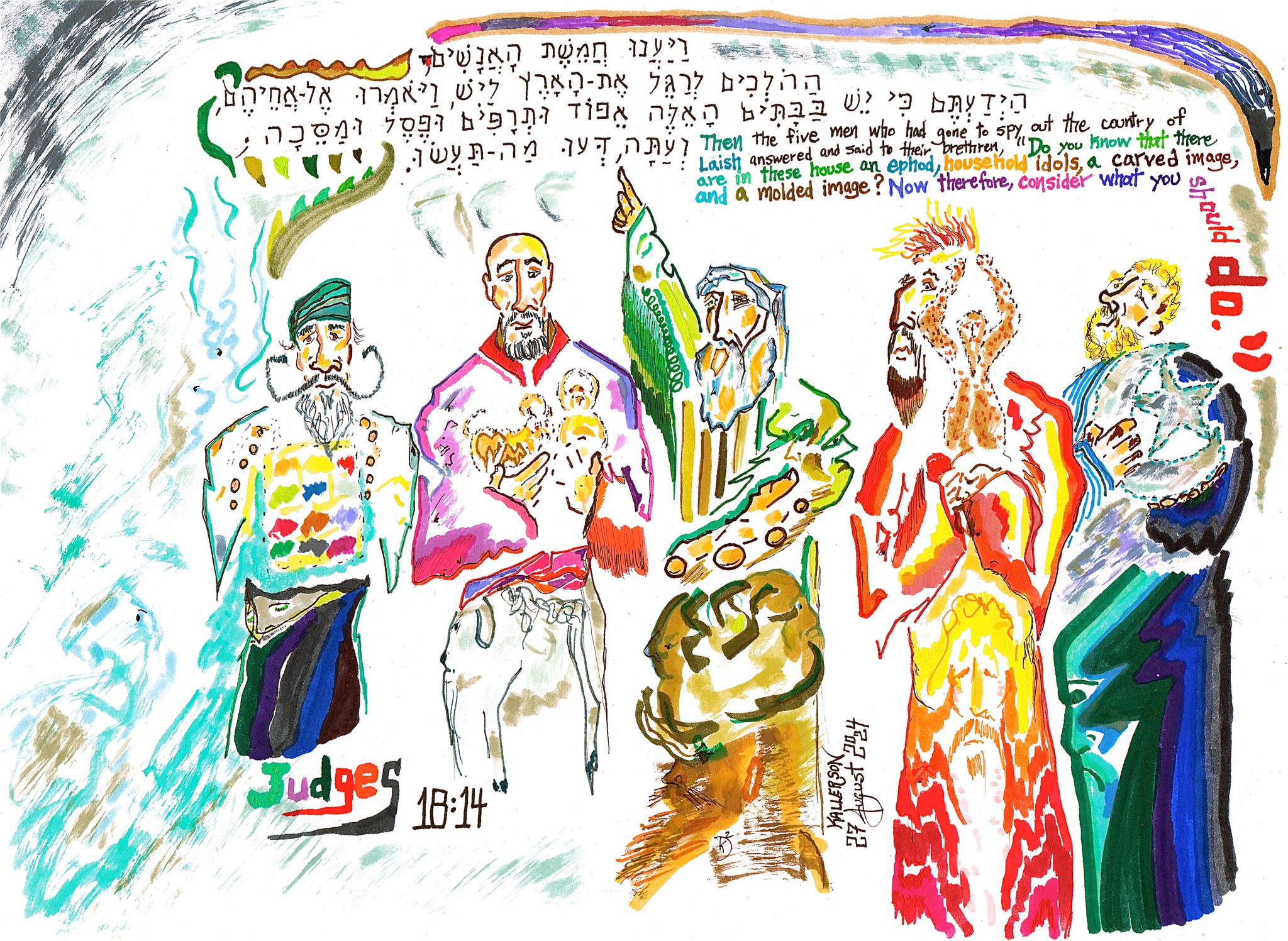
14 Then the five men who had gone to spy out the country of Laish answered
vayaanu khamesheth ha’anashim ha’holkhim l’ragel eth ha’arets layish – “And answered, five the men, the walkers to foot the land Laish.” The Bible is filled with this terminology where the first speaker is said to answer.
Without saying a word, one can see them walking along and coming to the settlement of houses where Micah is. Rather than wait for a question or simply pass by without referring to the place, these men initiate what would normally be a response to a question.
14 (con’t) and said to their brethren, “Do you know that there are in these houses an ephod, household idols, a carved image, and a molded image?
vayomru el akhehem haydatem ki yesh babatim ha’eleh ephod utraphim u-phesel u-masekhah – “and say unto their brothers, ‘Known that is in the houses, the these, ephod, and teraphim, and carved image, and molten image?’”
The others didn’t know. Rather, they are being told this. We do this all the time. For example, “Did you know that he’s a movie star?” It’s a way of stating something emphatically but with a subtle hint of something behind the question. In this case, the subtle hint concerning named items is that they could be beneficial to the tribe. Without saying what it is, they simply continue with…
14 (con’t) Now therefore, consider what you should do.”
The verb is imperative: v’atah d’u mah taasu – “And now, know what you will do.” In other words, “You know what to do, so go do it.” They have plans for the stuff that belongs to Micah.
15 So they turned aside there, and came to the house of the young Levite man—to the house of Micah—and greeted him.
vayasuru shamah vayavou el beith hanaar halevi beith mikhah vayishalu lo l’shalom – “And turn there-ward, and come unto house the servant, the Levite – House Micah – and ask to him to peace.” The words appear to indicate that the settlement is called Beith Micah, House Micah. When the five men arrived, they went to the individual house belonging to the Levite and greeted him.
16 The six hundred men armed with their weapons of war, who were of the children of Dan, stood by the entrance of the gate.
v’shesh meoth ish khagurim k’le milkhamtam nitsavim pethakh hashaar asher mibne dan – “And six hundreds man, girding implements their war, stood entrance the gate – who from sons Dan.” The reason for these words may be to show a united decision on the part of all of the warriors.
They probably broke off from the main caravan, which included women and children and any older folks who continued along. Noting the girding of their weapons is intended to show that they were willing to use force if necessary to obtain what they wanted.
Also, by the narrative stating the disassociated but obvious words that they were from the sons of Dan again ensures that it is known that their actions were intentional, that it was Dan alone who was involved, and that the narrator wants it to be known as such.
17 Then the five men who had gone to spy out the land went up. Entering there, they took the carved image, the ephod, the household idols, and the molded image.
The aspect of the verb changes in the middle of the sentence from imperfect to perfect: vayaalu khamasheth ha’anashim ha’holkhim l’ragel eth ha’arets bau shamah laqhu eth ha’pesel v’eth ha’ephod v’eth ha’traphim v’eth ha’masekhah – “And ascend, five the men, the walkers to foot the land: entered there-ward, took the carved image, and the ephod, and the teraphim, and the molten image.”
The change in aspect gives the narrative an almost haunting tone. It is as if the narrator is telling us to read each word as if it is a singular crime being committed. It’s not just Micah’s household doing wrong. Rather, an entire portion of the tribe of Dan has succumbed to the same fatal idolatry. Meanwhile…
17 (con’t) The priest stood at the entrance of the gate with the six hundred men who were armed with weapons of war.
v’ha’kohen nitsav patakh ha’shaar v’shesh meoth ha’ish he’khagur k’le ha’milkhamah – “And the priest stood entrance the gate, and six hundreds the man, the girding implements the war.” The priest went out to the gate when the men arrived. They were probably just talking when the five walked around him and went into the house to take the items. As they went in, he probably got curious as to what was going on…
18 When these went into Micah’s house and took the carved image, the ephod, the household idols, and the molded image,
v’eleh bau beith mikhah v’yiqkhu eth pesel ha’ephod v’eth ha’traphim v’eth ha’masekhah – “And these entered house Micah, and take carved image the ephod, and the teraphim, and the molten image.” The words essentially repeat what was said, but the aspect goes from the perfect to the imperfect. Put side by side, you can see the difference –
- “And ascend, five the men, the walkers to foot the land: entered there-ward, took the carved image, and the ephod, and the teraphim, and the molten image.”
- “And these entered house Micah, and take carved image the ephod, and the teraphim, and the molten image.”
And more, in these words, it appears that the carved image belongs to the ephod. Only the JPS Tanakh translates the words this way, but the terminology appears specific –
“And when these went into Micah’s house, and fetched the graven image of the ephod, and the teraphim, and the molten image, the priest said unto them: ‘What do ye?’” JPS Tanakh
Even though they are two separate things, it appears that they serve a united purpose. When the priest wanted to consult the carved image, he would wear the ephod.
18 (con’t) the priest said to them, “What are you doing?”
vayomer alehem ha’kohen mah atem osim – “And says unto them, the priest, ‘What you doing?’” In seeing what the five were doing, he must have felt either suspicious or betrayed, depending on how he perceived what was going on. Thus, it was natural to ask what they thought they were doing with the objects of his priesthood.
19 And they said to him, “Be quiet, put your hand over your mouth, and come with us; be a father and a priest to us.
Several verbs are imperative: vayomru lo hakharesh sim yad’kha al pikha v’lekh imanu veyeh lanu l’av ulkhohen – “And say, to him, ‘Keep silent! Put your hand upon your mouth, and walk with us, and be to us to father and to priest.’” In essence, “You need to do these things. Otherwise, it won’t go well with you.”
Telling him to put his hand upon his mouth is a way of saying, “Shut your trap!” They are being firm but are willing to give him a new opportunity if he is willing to take it. To get him to think it through…
19 (con’t) Is it better for you to be a priest to the household of one man, or that you be a priest to a tribe and a family in Israel?”
ha’tov heyothkha khohen l’veith ish ekhad o heyothkha khohen l’shevet u-l’mishpakhah b’yisrael – “The good you being priest to house man one, or you being priest to tribe and to family in Israel?” “Listen, is it better to be priest to just one guy, or would it be better for you to be priest to our entire clan?” The answer should be obvious whether he agreed with the way things were done or not.
It notes both a tribe and a family. The tribe of Dan descended from a single son of Dan. Therefore, if he was a priest to even part of the tribe and family of Dan, he was a priest to all of it. They are tempting him with a great offer.
*20 (fin) So the priest’s heart was glad; and he took the ephod, the household idols, and the carved image, and took his place among the people.
vayitav lev hakohen vayiqakh eth ha’ephod v’eth hatraphim v’eth ha’pasel vayavo b’qerev ha’am – “And pleased heart the priest, and takes the ephod, and the teraphim, and the carved image, and goes in midst the people.” One can see that his allegiance to Micah was completely based on the money and clothing he received.
It would explain the odd statement in verse 10 where he was given an offer by Micah, and then it said, “And walks, the Levite.” After he got the offer, he continued walking while considering the proposition and maybe looking for a better opportunity elsewhere. However, he eventually accepted the offer.
Now, a better offer has come along, and he is immediately elated about it. So he took charge of the priestly things and joined the people. Saying that he went into their midst is a way of saying that he joined them wholeheartedly, probably enjoying lots of pats on the back and compliments for being their official priest.
With that, we are finished for the day. If you care at all about proper worship of the Lord, treating your fellow man with due respect, or having concern for those to whom you owe allegiance, the narrative is both disappointing and disheartening.
However, it is generally what can be expected in the world in which we live. And this doesn’t just mean the secular world. It is becoming rarer by the day to find decent seminaries, denominations, churches, pastors, and Christians who will do what is expected of them from a biblical perspective.
What we need to do is press on in doing right and be the faithful souls we are called to be. Life is short, and we have choices to make. Work out your life, your allegiances, and your friendships with decency, honesty, and integrity. This is key to happy living and a warm and friendly welcome when you stand before the Lord.
First and foremost, however, you need to be right with the Lord. There is only one way that can happen, so be sure to get it right. Have faith in what God has done in Christ. Let me tell you that simple good news before we finish…
Closing Verse: “If you have been foolish in exalting yourself,
Or if you have devised evil, put your hand on your mouth.” Proverbs 30:32
Next Week: Judges 18:21-31 Another great story to tell, and that is for shor… (No King in Israel, Part IV) (51st Judges Sermon)
The Lord has you exactly where He wants you. He has a good plan and purpose for you. It is He who judges His people according to their deeds. So, follow Him, live for Him, and trust Him, and He will do marvelous things for you and through you.
No King in Israel, Part III
In those days there was no king in Israel.
And in those days the tribe of the Danites (descendants of Shem)
Was seeking an inheritance for itself to dwell in
For until that day their inheritance among the tribes of Israel
———-had not fallen to them
So the children of Dan sent five men of their family
From their territory, men of valor from Zorah and Eshtaol
To spy out the land and search it
They said to them, “Go, search the land, not a part but the whole
So they went to the mountains of Ephraim, that is where
To the house of Micah, and lodged there
While they were at the house of Micah
They recognized the voice of the young Levite
They turned aside and said to him
“Who brought you here, to this site?
What are you doing in this place?
What do you have here, from greatest to least?
He said to them, “Thus and so Micah did for me
He has hired me, and I have become his priest
So they said to him, “Please inquire of God, yes for us
That we may know whether the journey on which we go
———-will be prosperous
And the priest said to them, “Go in peace, yes, I say
The presence of the LORD be with you on your way
So the five men departed and went to Laish
They saw the people who were there
How they dwelt safely, in the manner of the Sidonians
Quiet and secure, with nota care
There were no rulers in the land
Who might put them to shame for anything
They were far from the Sidonians
And they had no ties with anyone, not even by a shoestring
Then the spies came back to their brethren at Zorah and Eshtaol
And their brethren said to them, “What is your report?
———-Tell us the whole
So they said, “Arise, let us go up against them
For we have seen the land, and indeed it is very good
Would you do nothing?
Do not hesitate to go, and enter to possess the land. Understood?
When you go, you will come to a secure people
And a large land with no dearth
For God has given it into your hands
A place where there is no lack of anything that is on the earth
And six hundred men
Of the family of the Danites went from there
From Zorah and Eshtaol
Armed with weapons of war, Laish had best beware
Then they went up and encamped in Kirjath Jearim in Judah
(Therefore they call that place Mahaneh Dan to this day
There it is, west of Kirjath Jearim
That’s how the name got to be this way
And they passed from there to the mountains of Ephraim
And came to the house of Micah with a little scheme
Then the five men who had gone
To spy out the country of Laish
Answered and said to their brethren
(First, did you know that Laish rhymes with quiche?)
“Do you know that there are in these houses an ephod
Household idols, a carved image too
Also a molded image
Now therefore, consider what you should do
So they turned aside there
And came to the house of the young Levite man
To the house of Micah
And greeted him as a part of their plan
The six hundred men
Armed with their weapons of war, lookin’ great
Who were of the children of Dan
Stood by the entrance of the gate
Then the five men who had gone
To spy out the land went up, so they did do
Entering there, they took the carved image and the ephod
The household idols, and the molded image too
The priest stood at the entrance of the gate, so was the score
With the six hundred men who were armed with weapons of war
When these went into Micah’s house
And took the carved image, the ephod (bad things were brewing)
The household idols, and the molded image
The priest said to them, “What are you doing?
And they said to him, “Be quiet, put your hand over your mouth
And come with us; be a father and a priest to us – they did tell
Is it better for you to be a priest to the household of one man
Or that you be a priest to a tribe and a family in Israel?
So the priest’s heart was glad
And he took the ephod with the household idols too
And the carved image
And took his place among the people, this he did do
Lord God, turn our hearts to be obedient to Your word
Give us wisdom to be ever faithful to You
May we carefully heed each thing we have heard
Yes, Lord God may our hearts be faithful and true
And we shall be content and satisfied in You alone
We will follow You as we sing our songs of praise
Hallelujah to You; to us Your path You have shown
Hallelujah we shall sing to You for all of our days
Hallelujah and Amen…
In those days there was no king in Israel. And in those days the tribe of the Danites was seeking an inheritance for itself to dwell in; for until that day their inheritance among the tribes of Israel had not fallen to them. 2 So the children of Dan sent five men of their family from their territory, men of valor from Zorah and Eshtaol, to spy out the land and search it. They said to them, “Go, search the land.” So they went to the mountains of Ephraim, to the house of Micah, and lodged there. 3 While they were at the house of Micah, they recognized the voice of the young Levite. They turned aside and said to him, “Who brought you here? What are you doing in this place? What do you have here?”
4 He said to them, “Thus and so Micah did for me. He has hired me, and I have become his priest.”
5 So they said to him, “Please inquire of God, that we may know whether the journey on which we go will be prosperous.”
6 And the priest said to them, “Go in peace. The presence of the Lord be with you on your way.”
7 So the five men departed and went to Laish. They saw the people who were there, how they dwelt safely, in the manner of the Sidonians, quiet and secure. There were no rulers in the land who might put them to shame for anything. They were far from the Sidonians, and they had no ties with anyone.
8 Then the spies came back to their brethren at Zorah and Eshtaol, and their brethren said to them, “What is your report?”
9 So they said, “Arise, let us go up against them. For we have seen the land, and indeed it is very good. Would you do nothing? Do not hesitate to go, and enter to possess the land. 10 When you go, you will come to a secure people and a large land. For God has given it into your hands, a place where there is no lack of anything that is on the earth.”
11 And six hundred men of the family of the Danites went from there, from Zorah and Eshtaol, armed with weapons of war. 12 Then they went up and encamped in Kirjath Jearim in Judah. (Therefore they call that place Mahaneh Dan to this day. There it is, west of Kirjath Jearim.) 13 And they passed from there to the mountains of Ephraim, and came to the house of Micah.
14 Then the five men who had gone to spy out the country of Laish answered and said to their brethren, “Do you know that there are in these houses an ephod, household idols, a carved image, and a molded image? Now therefore, consider what you should do.” 15 So they turned aside there, and came to the house of the young Levite man—to the house of Micah—and greeted him. 16 The six hundred men armed with their weapons of war, who were of the children of Dan, stood by the entrance of the gate. 17 Then the five men who had gone to spy out the land went up. Entering there, they took the carved image, the ephod, the household idols, and the molded image. The priest stood at the entrance of the gate with the six hundred men who were armed with weapons of war.
18 When these went into Micah’s house and took the carved image, the ephod, the household idols, and the molded image, the priest said to them, “What are you doing?”
19 And they said to him, “Be quiet, put your hand over your mouth, and come with us; be a father and a priest to us. Is it better for you to be a priest to the household of one man, or that you be a priest to a tribe and a family in Israel?” 20 So the priest’s heart was glad; and he took the ephod, the household idols, and the carved image, and took his place among the people.