Matthew 4:20

Native Florida Orchid.

Thursday, 31 October 2024

They immediately left their nets and followed Him. Matthew 4:20

Note: You can listen to today’s commentary courtesy of our friends at “Bible in Ten” podcast. (Click Here to listen).

You can also read this commentary, scrolling with music, courtesy of our friends at “Discern the Bible” on YouTube. (Click Here to listen), or at Rumble (Click Here to listen).

“And immediately, having left the nets, they followed Him” (CG).

In the previous verse, Jesus told Simon, called Peter, and Andrew to follow Him, and He would make them fishers of men. With that called out, it next says, “And immediately.”

There is no sense of hesitation. When Jesus was baptized, it said that He immediately went up from the water. One act followed directly after the next. That is how it is here. From the parallel account, it is understood that they already knew Jesus was the Messiah, having come with Him to the region of the Galilee.

While there, they went back to work in order to continue their profession. In responding to this call, however, a break from that has taken place. This should not be pressed too far as they will continue to fish even after the resurrection, as noted in John 21. However, upon receiving this call, it next says, “having left the nets.”

Again, though sermons and scholarly writings indicate that they simply walked away from the nets, leaving behind their livelihood, that must be inserted into the narrative. Were they with others who they left the nests with? Did they roll them up and put them in the boat for later use? Or did they just drop the nets and walk away? Our minds will make up what we want the narrative to say regardless of whatever really happened.

The word translated as nets is diktuon. This is the first use of it in Scripture and it is completely different than the word used in verse 4:18. Thayer’s Greek Lexicon says it is the generic term for any type of net, including fishing. Whatever they did with them, they left them, and “they followed Him.”

Smart move on their part. Nothing in the narrative is forced. Nothing says that they were regenerated in order to follow. Jesus called them and they responded in faith that He was their Messiah. This is recorded in John 1 –

“Again, the next day, John stood with two of his disciples. 36 And looking at Jesus as He walked, he said, ‘Behold the Lamb of God!’
37 The two disciples heard him speak, and they followed Jesus. 38 Then Jesus turned, and seeing them following, said to them, ‘What do you seek?’
They said to Him, ‘Rabbi’ (which is to say, when translated, Teacher), ‘where are You staying?’
39 He said to them, ‘Come and see.’ They came and saw where He was staying, and remained with Him that day (now it was about the tenth hour).
40 One of the two who heard John speak, and followed Him, was Andrew, Simon Peter’s brother. 41 He first found his own brother Simon, and said to him, ‘We have found the Messiah’ (which is translated, the Christ). 42 And he brought him to Jesus.
Now when Jesus looked at him, He said, ‘You are Simon the son of Jonah. You shall be called Cephas’ (which is translated, A Stone).” John 1:35-42

Life application: You may have sat in a church and heard a sermon on this passage. Think of what you heard. The pastor probably said how amazing it was that these two got a call from someone, they were stunned at His offer, and they simply walked away from their nets and started a new life, abandoning everything in the process.

You may have inserted your own thoughts into the narrative as well, such as the color of the water, the size of the Sea of Galilee (if you had never seen it), the color of the sky, and so forth. You may have even made a mental image of Jesus and the two apostles. Of this verse, John Gill says –

“That is, as soon as he had called them, they left their worldly employment, and followed him; they gave up themselves to his service, and became his disciples; they not only left their “nets”, but their fishing boats, and fishing trade, and all that belonged to it, even all their substance; and also their relations, friends, and acquaintance, see Matthew 19:27 which shows what a mighty power went along with the words and call of Christ; and what a ready, cheerful, and voluntary subjection this produces, wherever it takes place.”

Obviously, based on the commentary above, his words are not actually supportable from what the rest of the gospels continue to show. But this is how Gill perceived things.

People often get in a tizzy over movies about the Bible, especially movies about Jesus. They will spend all of their time cutting apart the movie as if it is supposed to be some type of exacting presentation of Scripture, and any deviation from it is heretical.

But you have just been thinking of the color of the sky and what Jesus looks like to you while reading my comments. With that type of logic, either my words were leading you into heresy, or your thoughts have led you into it (terrifying, for sure!). That is unreasonable.

People who have watched and loved The Ten Commandments with Charlton Heston may refuse to watch The Passion of the Christ or a series like The Chosen. Why? Probably because one is a Hollywood blockbuster that was never intended to be anything but a drama about the life of Moses, while the others are held to some inordinately high standard for… for what reason?

Innumerable people love The Greatest Story Ever Told, and yet Max Von Sydow (Jesus) was an atheist or agnostic (he wasn’t sure). Curiously, he also played the devil in Needful Things. But what do those things have to do with the content of The Greatest Story Ever Told? Lots of people watched that, and probably many of them malign other more biblically accurate movies or series.

As for actors, it is common for people to ridicule The Passion of the Christ because some of the actors are sinners (hmm….), but they don’t mind watching The Ten Commandments with Yul Brynner as one of the actors. But it is generally accepted that he was bisexual. In Ben Hur, another great movie, the lady who played Esther, the female star, Haya Harareet, was a twice-divorced Ashkenazi Jew. Throw up your arms! She didn’t even believe in Jesus.

The movie won 11 Academy Awards and is loved by Christians everywhere, and yet it has almost nothing to do with Scripture, and nobody cares about the actors’ personal lives. The attack by Christians over well-made Christian movies is totally hypocritical.

And more to the point, the same people who tear apart Christian movies are almost 100% guaranteed to watch any given Hollywood movie or TV show. Which is going to be more edifying?

Don’t let people rob your joy over presentations of Scripture that may not be minutely precise. If that is what you are looking for, you probably should not think while reading the Bible, lest your mind insert something that actually didn’t happen in whatever story you are reading.

A town in Germany, Oberammergau, has held a Passion play every decade since 1634. It is performed on the world’s largest open-air stage. One can be assured that the play is directed by sinners, played by sinners, and does not exactingly follow Scripture, and yet it has been a cherished part of their history for almost four hundred years.

Instead of tearing apart those who are trying to make a difference in films and videos in regard to their efforts to exalt the Lord, be someone who is willing to simply enjoy these treasures for what they are. Fill your life with Jesus in whatever way is edifying and which exalts Him.

Lord God, thank You for plays, films, and reenactments of our Lord Jesus. They help us to keep our mind on what is good, even if they are not word for word in accord with Your word. They are there to make a difference, and for many of us, they truly do. But, Lord, help us always to put Your word above all else when it comes to our understanding of You and what You expect for us. Amen.


Matthew 4:19

orchids….

Wednesday, 30 October 2024

Then He said to them, “Follow Me, and I will make you fishers of men.” Matthew 4:19

Note: You can listen to today’s commentary courtesy of our friends at “Bible in Ten” podcast. (Click Here to listen).

You can also read this commentary, scrolling with music, courtesy of our friends at “Discern the Bible” on YouTube. (Click Here to listen), or at Rumble (Click Here to listen).

“And He says to them, ‘You come – after Me! And I will make you fishers of men’” (CG).

In the previous verse, it noted Jesus walking by the Sea of the Galilee when He came upon Simon, called Peter, and Andrew his brother. They were casting their net. It then noted that they were fishers. Now, it says, “And He says to them, ‘You come – after Me!’”

The word deute is an exclamatory word meaning come. Although we can’t know the inflection of Jesus’ voice, it was probably something excited and yet directive. Thus “You come – after Me!” is probably close. Of this expression, the Pulpit Commentary says, “There is no thought of continuous following from place to place…, but of immediate detachment from the present sphere of their interest and of attachment to Jesus as their leader.”

He called out to them first with the directive to come and then an explanatory word that they were to be His followers. His choice had been made, and they were now given the opportunity to respond to the call. With that called out, Jesus then continued with a fuller explanation of His intent for them. “And I will make you fishers of men.”

There they were, casting their net into the sea hoping to catch fish. But Jesus now has a greater role to offer them. The idea of fishers of men is not first found here in Scripture. Rather, it goes back to the book of Jeremiah where the Lord judges Israel for its iniquity and then promises restoration. Included in that restoration are the Gentile nations –

“‘Behold, I will send for many fishermen,’ says the Lord, ‘and they shall fish them; and afterward I will send for many hunters, and they shall hunt them from every mountain and every hill, and out of the holes of the rocks. 17 For My eyes are on all their ways; they are not hidden from My face, nor is their iniquity hidden from My eyes. 18 And first I will repay double for their iniquity and their sin, because they have defiled My land; they have filled My inheritance with the carcasses of their detestable and abominable idols.’
19 O Lord, my strength and my fortress,
My refuge in the day of affliction,
The Gentiles shall come to You
From the ends of the earth and say,
‘Surely our fathers have inherited lies,
Worthlessness and unprofitable things.
20 Will a man make gods for himself,
Which are not gods?
21 ‘Therefore behold, I will this once cause them to know,
I will cause them to know
My hand and My might;
And they shall know that My name is the Lord.’” Jeremiah 16:16-21

Even in the Old Testament, the idea of Gentiles coming to the Lord is expressly stated from time to time. God has a plan, and His purposes for the people of the world have been worked out slowly and methodically. With the advent of the Messiah, that salvific process suddenly went into overdrive.

As noted in the previous commentary, in that verse, many translations say “fishermen.” The problem with that is now found in this verse. The same word just used is used again. Therefore, to be consistent in translation, it would then say in this verse, “And I will make you fishermen of men.”

The redundancy is obvious. And so, a change is made in those versions from “fishermen” to simply “fishers.” To be consistent in translation, simply saying “fishers” in both verses is preferable.

Life application: Jesus used the fishers of men terminology as a metaphor for what these men would be doing. Here we have several things coming together to form a picture of something new – men in an occupation, a net, the sea, fish in the sea, hopes for a harvest of fish, etc. Of course, the main Subject is Jesus, the one directing the scene through His words.

Here we have the words “Come – after Me!” Jesus makes the directive call for a change in what they are doing, even if what they will be doing is mirrored in what they have been doing. He calls men of an occupation to continue in that profession but in an entirely new way. They will remain fishers but with a new type of catch.

The net is the means of catching the fish. The new means is the gospel. The men are going from being members of the Galilean sphere of fishers to members of a body (today we call it the church). In other words, the men comprise the church, not a building or an organizational structure built on making money and doing things with that money.

The sea is emblematic of the chaotic world of humanity. That is seen many times in Scripture. The fish in the sea are those who are caught out of the world by the means of the gospel (the net) through the church (the men) whose intent and purpose it is to find the lost and bring them to salvation (the hopes of the harvest of fish).

This short verse in the early chapter of Matthew, although dealing with Israel under the law at this time, is a picture of a greater process that the Lord will be accomplishing through those He has selected. The harvest will be from Israel under the law at first, but it will eventually extend around the entire world. Jeremiah’s prophecy gives hints of this, even from a point in time when it was wholly unknown to the world.

As you read the Bible, look at what is going on in the story or narrative that you are reading and think about what is being said. Then look for parallels of these things elsewhere. Eventually, pictures of the magnificent work of God in Christ become fully developed. Nothing in Scripture is superfluous. Everything has intent, meaning, and purpose.

So, take your time and consider what you are reading. Treasure awaits!

Lord God, what an exciting thing to read Your word and to see how Your plan for the redemption of mankind is detailed there in so many ways. It is glorious to consider what You have been doing and what continues to be done, even until this day. May we respond to the call of the gospel and then to the call to continue furthering this good news as a part of Your redemptive outreach to the world. Amen.

Matthew 4:18

Christmas Cactus.

Tuesday, 29 October 2024

And Jesus, walking by the Sea of Galilee, saw two brothers, Simon called Peter, and Andrew his brother, casting a net into the sea; for they were fishermen.  Matthew 4:18

Note: You can listen to today’s commentary courtesy of our friends at “Bible in Ten” podcast. (Click Here to listen)

You can also read this commentary, scrolling with music, courtesy of our friends at “Discern the Bible” on YouTube. (Click Here to listen), or at Rumble (Click Here to listen).

“And Jesus, walking beside the Sea of the Galilee, He saw two brothers, Simon called Peter and Andrew his brother, casting a net into the sea – for they were fishers” (CG).

In the previous verse, it noted that Jesus began to preach, telling the people to reconsider because the kingdom of the heavens was at hand. With that noted, it next says, “And Jesus.”

The name of Jesus is not included in all of the ancient texts. Some believe it was inadvertently dropped out while others argue it was inadvertently added in or that it was inserted for clarity. As the subject has not changed, it is understood either way. Next, it says He was “walking beside the Sea of the Galilee.”

As noted before, the Galilee is a somewhat circular region. This sea is within that region. Thus, the use of the article before “Galilee” is appropriate. If there were a large body of water like this in the area of the Grand Canyon, we would call it “the sea of the Grand Canyon.”

Jesus was in the area conducting His ministry when “He saw two brothers, Simon called Peter and Andrew his brother.”

The name Simon equates to the Hebrew name Shimon. That comes from shama, to hear. Thus, it means something like Hearing or He Who Hears. Peter comes from petros, a small stone. Thus, the name means Stone or Rock. The name Andrew comes from the Greek word aner, a man, and thus it means something like Manly, Courageous, or Brave.

Although they are introduced into the narrative now, and it appears that the calling that lies ahead is almost sudden and out of the blue, this is hardly the case. By comparing the narrative found in John’s gospel, these two are already well known to Jesus.

They were with John the Baptist in the area of Bethabara (John 1:28), John had proclaimed Jesus as the Lamb of God (John 1:29), one of John’s disciples was Andrew (John 1:40), and they had come to believe that Jesus is the Messiah. When Andrew introduced Simon to Jesus, Jesus then named Simon Cephas which is Peter, the Rock (John 1:42).

From there, they went together to Cana in Galilee (John 2:1). This fills in some of the background information that the synoptic gospels skip over. Therefore, the abruptness of this account is actually smoothed out when the fuller picture is seen. As for Matthew’s words, it says that these two were “casting a net into the sea.”

Here is a word found only this once in Scripture in some manuscripts, or it is found one more time (Mark 1:16) in other manuscripts, amphiblestron. It is derived from amphoteroi, both, and ballo, to cast. Vincent’s Word Studies provides an explanation –

“…the casting-net, which, being cast over the shoulder, spreads into a circle (ἀμφὶ [amphi – both sides and thus “all around”]). The word is sometimes used by classical Greek writers to denote a garment which encompasses the wearer. In Matthew 4:20, the word net again occurs, but representing a different Greek word (δίκτυον [diktuon]) which is the general name for all kinds of nets, whether for taking fish or fowl. Still another word occurs at Matthew 13:47, σαγήνη [sagene], the draw-net.”

These two were out tending to work when Jesus decided to formally call them into a new profession, one which would change the course of their lives and, indeed, the entire world as well as the entirety of human history. As for the reason they were casting this net, Matthew next says, “for they were fishers.”

Many translations say “fishermen.” This is technically correct because the word is in the masculine, speaking of the men. But for precision in translation, saying “fishers” avoids a problem that then appears in the next verse.

The word is halieus, coming from hals, salt. Thus, it would be used like the modern descriptor of a sailor, such as, “He is an old salt.” The meaning is that he has been a sailor for a long time. Even though the Sea of the Galilee is not a salt sea, the thought carries over to any in such a profession.

Life application: It is good to be well-versed in all four gospels before coming to conclusions about various events that take place. As noted in a previous commentary, having all of what is said in the four gospels lined up chronologically really helps to see what is going on.

From there, the life and ministry of Jesus and those with Him seem less abrupt. There is nothing like a rushed or forced narrative actually going on. However, each writer is providing information relevant to his purpose for writing. By giving information in a completely different style than the synoptic gospels, John’s gospel changes the entire focus of what is being said and who it is being directed to.

Jesus, in the Synoptics, is being focused on as the Messiah of Israel who would come and fulfill the law. His words are directed to Israel under the law, even if some of what He says is in anticipation of the future, either for the church or for Israel in the millennium.

John, on the other hand, is addressing matters that speak of Jesus in a completely different way. Jesus is presented as the Christ of all people who is completing His mission in order to bring in a new spiritual realm for all people to join in. The words carry truths that are not limited to the Messiah’s interactions with Israel nearly as much as the Synoptics.

Pay attention to these things and your theology on Christ and His life will be more properly directed to what is actually being conveyed.

O God, Your word is a treasure and a delight. We are so thankful that You can take men who fish and turn them into men who will use that ability in a spiritual way to accomplish great things. As this is so, we know that You can use us just as we are to do similar great things. Use us according to Your wisdom, and may we be willing to follow wherever You lead. Amen.


Judges 21:1-19 (No King In Israel, Part X)

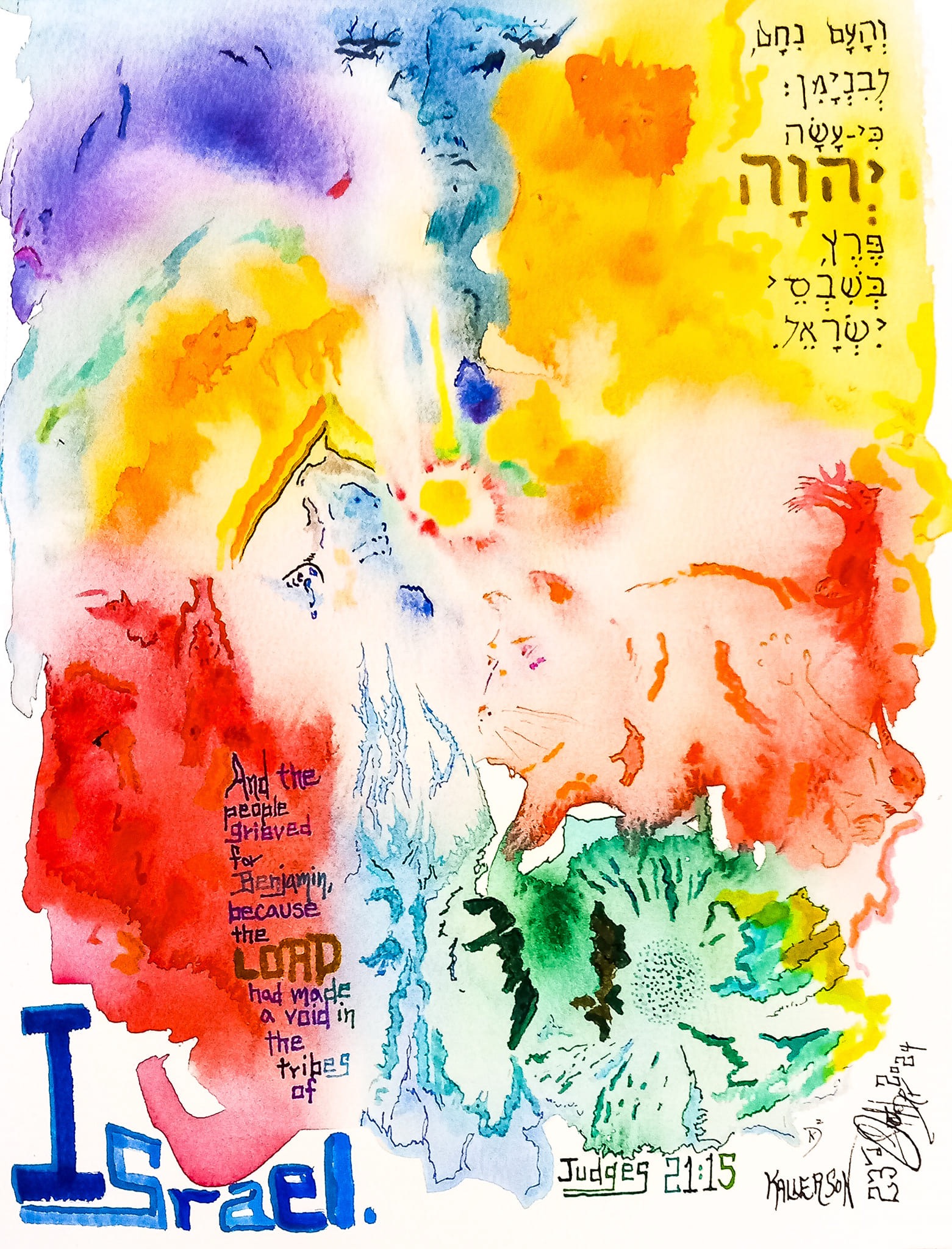
Artwork by Douglas Kallerson


Judges 21:1-19
No King in Israel, Part X

(Typed 29 Jul 2024) The narrative in Judges 21 brings in a point of doctrine that seems to escape a surprisingly large portion of the church. It is such a critical point to understand, that in misunderstanding the precept, it has brought in some of the nuttiest thinking imaginable to various denominations, sects, and cults.

Benjamin has been reduced from a number of 26,700 fighting men, plus women, children, and the aged, to only 600 men. So, does the tribe of Benjamin still exist after the battle? It would be hard to find a single person who would say, “No, Benjamin no longer exists.”

Until those 600 died, Benjamin would still be a tribe. But what if the number was only 120? Would Benjamin still exist? Again, the answer is affirmative. But what if there were only 17, 8, or 2? The answer would remain the same. Even if only one man of Benjamin survived, the tribe would still be considered a tribe.

This is understood in the world today. A couple of times in my life, I have heard of someone thought to be the last remaining person of a particular tribe of people, like the Eskimos, for example. When that person dies, that particular tribe dies out. Until then, the tribe remains.

Text Verse: “…though I also might have confidence in the flesh. If anyone else thinks he may have confidence in the flesh, I more so: circumcised the eighth day, of the stock of Israel, of the tribe of Benjamin, a Hebrew of the Hebrews; concerning the law, a Pharisee; concerning zeal, persecuting the church; concerning the righteousness which is in the law, blameless.” Philippians 3:4-6

The apostle Paul was of the tribe of Benjamin. So, applying the logic, did the tribe of Benjamin exist at the time of Paul? Obviously! Even if Paul was the only Benjamite left (which he wasn’t), the tribe would still exist until he died.

In Luke 2:36, a woman of Asher, Anna, the daughter of Phanuel, is named. Thus, Asher remained. In fact, after the exile of the ten northern tribes of Israel by Sennacherib, King of Assyria, members of almost every tribe in Israel are mentioned. In other words, even though the majority of the tribe was exiled and their land inheritance was lost, there were still people from those tribes residing in the southern area of Judah.

That fact continued on through the time of the apostles. In Acts 26:7, Paul said, “To this promise our twelve tribes, earnestly serving God night and day, hope to attain. For this hope’s sake, King Agrippa, I am accused by the Jews.” Likewise, the book of James is written to “the twelve tribes which are scattered abroad.”

Despite the exile, there were no “lost tribes.” And yet, denominations, sects, and cults within the supposed Christian church claim that they comprise the gathered lost tribes of Israel. This is true of British Israelism, the Worldwide Church of God, the Mormons, Jehovah’s Witnesses (in one respect), and others.

They all claim something that they are not, and they base it on a faulty understanding of Scripture. Benjamin did not die out at the time of Judges, despite what took place in Judges 20. And none of the tribes of Israel died out at the exile of the ten northern tribes.

They continued on through the time of Jesus and the apostles, and they are being regathered to the land of Israel today. A good life lesson for the church would be to stop co-opting things belonging to Israel to which it has no right.

If one wonders why there is so much disunity in the church today, it is because people fail to read the Bible, and even when they do, they take much of it out of its proper context. Do not do this! Great and reliable truths such as this are to be found in His superior word. And so, let us turn to that precious word once again, and… May God speak to us through His word today, and may His glorious name ever be praised.

I. What Shall We Do? (verses 1-7)

Chapter 20 ended with the total defeat of the army of Benjamin and the complete destruction of the tribe and all its people. The only exception was noted in the final verses, saying –

“But six hundred men turned and fled toward the wilderness to the rock of Rimmon, and they stayed at the rock of Rimmon for four months. 48 And the men of Israel turned back against the children of Benjamin, and struck them down with the edge of the sword—from every city, men and beasts, all who were found. They also set fire to all the cities they came to.” Judges 20:47, 48

With that remembered, we now enter into the contents of the final chapter of the book of Judges…

Now the men of Israel had sworn an oath at Mizpah, saying,

v’ish Yisrael nishba bamitspah l’mor – “And man, Israel, sworn in the Mizpah, to say.” In this chapter, it is apparent that there are two oaths that had previously been made by the congregation at Mizpah but which had not been recorded. These oaths form the underlying structure of what will be recorded throughout the chapter. The first of these two oaths is noted next…

1 (con’t) “None of us shall give his daughter to Benjamin as a wife.”

ish mimenu lo yiten bito l’binyamin l’ishah – “Man from us not gives his daughter to Benjamin to wife.” The oath was fortunately not one of kharem, the total devotion of the tribe to God. If that were the case, the six hundred at the Rock of Rimmon would have been hunted down and killed as well.

However, the people made an oath that Benjamin was cut off from marriage rights among the tribes of Israel, at least at this time. Of this practice, John Lange provides an explanation –

“They abrogated the connubium (the right of intermarriage) with the tribe. They determined to treat Benjamin as a heathen people, or as heathen nations, in the absence of special treaties (ἐπιγαμία [epigamia]), were accustomed to look upon each other. There were instances of heathen tribes who did not at all intermix. Such cases were found among Germanic tribes also, until Christianity had fully conquered them. It was the church that brought East-Goths and West-Goths, Anglo-Saxons and Britons, Franks and Romans, to look upon each other as tribes of one Israel. Very great, therefore, must have been the indignation of the collective Israel, when they thus, as it were, cast Benjamin out of their marriage covenant.”

The oath was made, and it could not be taken back. As such, it has left Israel with a problem because they had killed all of the women and children of Benjamin. This left these six hundred men without any ability to continue the existence of the tribe beyond themselves.

Israel means He Strives with God. The Mizpah means The Watchtower. Benjamin means Son of the Right Hand.

Then the people came to the house of God, and remained there before God till evening. They lifted up their voices and wept bitterly,

vayavo ha’am beith el vayeshvu sham ad ha’erev liphne ha’elohim vayisu qolam vayivku b’khi gadol – “And comes, the people, Bethel. And sit there until the evening to faces the God. And lift their voice and weep, ululation whopping.” Here, it says, “the people.” Thus, it is inclusive of soldiers, men, women, and children.

The people came out collectively to Bethel and spent the entire day there before the God, meaning the One True God, among those who are in a right relationship with Him. Of this, the meaning is that the ark was still there after the battle as it was in Judges 20:27. This time before the Lord was one of mourning and sadness.

First, the verb is bakah, to weep. That is enhanced by the next word, the noun b’khi, a weeping. Such a weeping, when it involves an entire congregation, has a lot of noise and emotion. Thus, the word ululation fits perfectly. It has a particular onomatopoetic quality that matches the Mideastern weeping expressed here: ululululululu. Along with this ululating, there are deep searchings of heart and questions to God…

and said, “O Lord God of Israel, why has this come to pass in Israel,

Rather: vayomru lamah Yehovah elohe Yisrael hay’thah zoth b’Yisrael – “And say, ‘Why, Yehovah God Israel, came this in Israel?’” Of these words, Adam Clarke incorrectly says –

“This was a very impertinent question. They knew well enough how it came to pass. It was right that the men of Gibeah should be punished, and it was right that they who vindicated them should share in that punishment; but they carried their revenge too far, they endeavored to exterminate both man and beast.” Adam Clarke

However, they did exactly as the law stipulated. They eradicated the evil from Israel. There was nothing unjust in their actions and there was nothing rude in the question. The Lord directed the battles, He oversaw the events, and He knew what the outcome would be. The question isn’t why the battle took place or came out as it did. Instead, the question involves national integrity…

3 (con’t) that today there should be one tribe missing in Israel?”

The words are a sloppy paraphrase: l’hipaqed hayom miYisrael sheveth ekhad – “To visit the day from Israel tribe one?” The word is paqad, to visit. It is one of the most widely applied words in the Bible and each instance has to be considered from the context to understand the word’s signification.

In this case, the visitation means in judgment leading to near eradication. It cannot mean “one tribe missing in Israel” because the one tribe still exists, even if in a completely degraded and seemingly hopeless, cut-off state. Benjamin was visited, and the concern is that he will check out of the tribal enumeration at some point in the future.

The triple repetition of the name Israel in this one verse stresses the matter in a unique and forceful way that reveals the utter astonishment and confusion in the minds of the people. They were a unified whole, being the twelve sons of Israel. But more than that, this unity was under the headship of the Lord.

The covenant cut with them, and the promises made to them were of a national nature, inclusive of all the tribes. If Benjamin were to be lost entirely, how would that affect the covenant promises and their national identity? This is what is on their minds.

The Lord had covenanted with the twelve tribes at Sinai in Exodus 24. Later in Leviticus 26, He affirmed that they would be kept as a people, noting that even in the distant future, He would be their God –

“But for their sake I will remember the covenant of their ancestors, whom I brought out of the land of Egypt in the sight of the nations, that I might be their God:
am the Lord.” Leviticus 26:45

The sorrow and confusion among the people would be great. How could the words of the covenant be true if Benjamin was set to perish? Therefore, the people come before the Lord in hope of a resolution…

So it was, on the next morning, that the people rose early and built an altar there, and offered burnt offerings and peace offerings.

vayhi mimakhorath vayashkimu ha’am vayivnu sham mizbeakh vayaalu oloth ushlamim – “And is, from morrow, and arose early the people, and build there altar, and ascend burnt offerings and peace offerings.” These words show, with all certainty, that the translation of some versions as house of God instead of Bethel is incorrect.

If Israel had appeared before the house of God in Shiloh, they would not need to build an altar. Rather, the ark had been brought to Bethel (meaning House of God) while the rest of the tabernacle remained at Shiloh. Therefore, the people built an altar according to the Law of the Altar found in Exodus 20:24-26.

Once it was built, then the offerings could be presented. The burnt offerings are those wholly burnt to Yehovah as a sign of complete submission or dedication to Him. The peace offerings had a sacred portion removed for the Lord according to the written law, and the rest was eaten by the people.

As such, the burnt offerings are for restoration from sin, and the peace offerings are a sign of renewed fellowship based on that restoration. After these were offered in the presence of the Lord, the second oath that had been made but was not previously recorded is detailed…

The children of Israel said, “Who is there among all the tribes of Israel who did not come up with the assembly to the Lord?”

vayomru b’ne Yisrael mi asher lo alah vaqahal mikal shivte Yisrael el Yehovah – “And say, sons Israel, ‘Who which not ascended in the assembly from all tribes Israel unto Yehovah.’” A head count was taken in order for Israel to fulfill an oath that was previously made. This timing of this assembly had to have been at the time of Judges 20:1-3. That is the only time that Mizpah is mentioned in the narrative until this chapter. But that is what is next referred to…

5 (con’t) For they had made a great oath concerning anyone who had not come up to the Lord at Mizpah, saying, “He shall surely be put to death.”

ki hashvuah ha’g’dolah hay’thah laasher lo alah el Yehovah hamitspah l’mor moth yumath – “For the oath, the whopping, made to which not ascended unto Yehovah the Mizpah to say, ‘Dying shall die.” When the assembly was called, it was a matter of national concern. Benjamin had to be dealt with. Any who did not come up would thus be considered as allying with Benjamin. Therefore, as was done to Benjamin was to be done to them.

That vow was put on hold while the matter of Benjamin was dealt with. One can see that verse 5 follows chronologically after verses 6 & 7, but it is placed here to reveal the genesis of the process that would lead to the restoration of the tribe of Benjamin. As such, verses 6 & 7 should be considered parenthetical. One can see this if verses 5 & 6 are reversed –

So it was, on the next morning, that the people rose early and built an altar there, and offered burnt offerings and peace offerings. And the children of Israel grieved for Benjamin their brother, and said, “One tribe is cut off from Israel today. What shall we do for wives for those who remain, seeing we have sworn by the Lord that we will not give them our daughters as wives?” The children of Israel said, “Who is there among all the tribes of Israel who did not come up with the assembly to the Lord?” For they had made a great oath concerning anyone who had not come up to the Lord at Mizpah, saying, “He shall surely be put to death.” And they said, “What one is there from the tribes of Israel who did not come up to Mizpah to the Lord?” And, in fact, no one had come to the camp from Jabesh Gilead to the assembly.

And the children of Israel grieved for Benjamin their brother,

vayinakhamu b’ne Yisrael el Binyamin akhiv – “And sigh, sons Israel, unto Benjamin his brother.” The word nakham is variously translated in this verse as repent, lament, grieve, felt sorry, etc. It comes from a primitive root signifying to sigh, as when one breathes heavily. One can see the people with their heads down, worn out from their ululating and simply sighing in anguish. It appears as if there is no hope for Benjamin, and thus, they continue with mournful words…

6 (con’t) and said, “One tribe is cut off from Israel today.

vayomru hayom shevet ekhad miYisrael – “And say, ‘Hewn, the day, tribe one from Israel.’” The words show that the earlier translation of the NKJV that the tribe was missing is incorrect. The tribe exists, but it is hewn away from Israel, cut off from any discernible future because of their weakened state and the oath concerning wives…

What shall we do for wives for those who remain, seeing we have sworn by the Lord that we will not give them our daughters as wives?”

mah naaseh lahem lanotarim l’nashim vaanakhnu nishbanu b’Yehovah l’bilti teth lahem mibnotenu l’nashim – “What do to them, to the remainings, to wives? And we sworn in Yehovah to exception give to them from our daughters to wives.” Benjamin exists, but only as “the remainings.” They are a shadowy remnant of the tribe. And with the oath sworn “in Yehovah,” those who gathered could not go back on their word. And more, this was “to exception.”

It was a united and universal proclamation that their daughters were not to be given to Benjamin as wives. However, as it is said, necessity is the mother of invention. There is a need, and a lightbulb of inspiration comes on in the minds of the people. It is where verse 5 logically follows chronologically –

“The children of Israel said, “Who is there among all the tribes of Israel who did not come up with the assembly to the Lord?” For they had made a great oath concerning anyone who had not come up to the Lord at Mizpah, saying, “He shall surely be put to death.”

Four hundred young virgins for six hundred men
It ain’t enough to give to all
So, you’ll need to plan again
Before you have that six hundred couple wedding ball

But it will come about for sure
Because there is no lack in the Lord’s plan
Trust in Him, He has the cure
To take care of every man

The Lord is faithful, and it will come to pass
And a good end will be the result
For every man, a lovely lass
Because His plan is without fault

II. Four Hundred Young Virgins (verses 8-14)

And they said, “What one is there from the tribes of Israel who did not come up to Mizpah to the Lord?” And, in fact, no one had come to the camp from Jabesh Gilead to the assembly.

vayomru mi ekhad mishivte Yisrael asher lo alah el Yehovah hamitspah v’hineh lo ba ish el hamakhaneh miyavesh gilad el haqahal – “And say, ‘Who one from tribes Israel, which no ascended unto Yehovah the Mizpah.’ And behold! No came man unto the camp from Jabesh Gilead unto the assembly.”

Two stones can be overturned at one time. The people have made an oath that anyone who didn’t come up to the assembly was to be put to death. However, this was not a kherem, or total devotion to the Lord. If it was, it would include the entire family along with all of their possessions. Rather, it was a call for the fighting men to assemble, as is evidenced in Judges 20.

And more, as these men didn’t come out, they did not participate in the oath concerning the giving of daughters. As such, they will relinquish their lives while implicitly giving their daughters.

The name Jabesh (Yavesh) comes from the verb yavesh, to be dry, dried up, or withered. It is used in the drying up of a river, land, bones, etc. It is also used of the withering of grass. Thus, Jabesh Gilead means something like Dry (Drying) Perpetual Fountain or Withered (Withering) Perpetual Fountain. Its location is east of the Jordan in the tribal allotment of Manasseh.

For when the people were counted, indeed, not one of the inhabitants of Jabesh Gilead was there.

vayithpaqed ha’am v’hineh ein sham ish miyovoshve yavesh gilad – “And visits the people. And Behold! Naught there man from inhabitings Jabesh Gilead.” To visit here means to review them for a full census as you would when counting an army. In this action, they found that, sure enough, Jabesh Gilead failed to come up and prepare for the battle against Benjamin.

As such, it is as if they had allied with Benjamin against Israel. This will become a part of the solution to the dilemma faced by the collective nation…

10 So the congregation sent out there twelve thousand of their most valiant men,

vayishl’khu sham ha’edah shnem asar eleph ish mibne hekhayil – “And send there, the congregation, two ten thousand man from sons the valor.” The Latin Vulgate says ten thousand. This was probably to avoid a difficulty based on the assumption that there were one thousand drawn off from each tribe.

If so, with Levi and Benjamin excluded, it would leave ten or eleven tribes depending on whether Joseph was reckoned as one or if Ephraim and Manasseh were counted separately. But nothing is said of a set number from each tribe. It appears that they simply mustered twelve thousand out of the whole for the battle ahead.

The number is derived from twelve, perfection of government or governmental perfection, and ten, completeness of order where the whole cycle is complete.

10 (con’t) and commanded them, saying, “Go and strike the inhabitants of Jabesh Gilead with the edge of the sword, including the women and children.

vaytsavu otham l’mor l’khu v’hikithem eth yoshve yavesh gilad l’pi kherev v’hanashim v’hataph – “And command them, to say, ‘Walk and struck inhabitings Jabesh Gilead to mouth sword, and the woman, and the children.’” There was to be a complete eradication of those in the city by the kherev, or sword. However, one exception is to be made, which is implicitly stated next…

11 And this is the thing that you shall do: You shall utterly destroy every male, and every woman who has known a man intimately.”

v’zeh hadavar asher taasu kal zakhar v’khal ishah yodaath mishkav zakhar takharimu – “And this the word which doing: All male and all woman knowing bed male – anathematize.” Because of what happened with Midian before entering Canaan, there was no need for the explicit command to retain the living females. This is the same generation that heard the words of Moses –

“And Moses said to them: ‘Have you kept all the women alive? 16 Look, these women caused the children of Israel, through the counsel of Balaam, to trespass against the Lord in the incident of Peor, and there was a plague among the congregation of the Lord. 17 Now therefore, kill every male among the little ones, and kill every woman who has known a man intimately. 18 But keep alive for yourselves all the young girls who have not known a man intimately.’” Numbers 31:15-20

The kherem, or anathematized, of the inhabitants was similar to an offering to the Lord. The virgins are to be excepted so they can be presented as an offering to Benjamin, a tribe of the Lord’s people…

12 So they found among the inhabitants of Jabesh Gilead four hundred young virgins who had not known a man intimately;

vayimtsu miyovoshve yavesh gilad arba meoth naarah v’thulah asher lo yad’ah ish l’mishkav zakhar – “And find, from inhabitings Jabesh Gilead, four hundred damsel, virgin, who not known man to bed male.” The number of dead is unimportant to the narrative and so it is excluded. However, the number of virgins is significant and is thus given.

It is a derivative of four, the number of creation and the world (and city) number, and ten which was just explained. It is also a derivative of forty and ten. Forty is described by Bullinger –

“It is the product of 5 and 8, and points to the action of grace (5), leading to and ending in revival and renewal (8). This is certainly the case where forty relates to a period of evident probation. But where it relates to enlarged dominion, or to renewed or extended rule, then it does so in virtue of its factors 4 and 10, and in harmony with their signification.”

12 (con’t) and they brought them to the camp at Shiloh, which is in the land of Canaan.

If this is referring to the virgins, as seems natural, there is a gender discord because the pronoun is masculine: vayaviu otham el hamakhaneh Shiloh asher b’erets k’naan – “And bring them [masc. pl.] unto the camp, Shiloh, which in land Canaan.” That this is referring to the virgins is more definitively supported by the words of verse 22, which will be seen when we get there.

The main camp of Israel is in Shiloh. With the war ending, that is where Phineas and the ark would return. The girls would be brought there until they were given in marriage to one of the Benjamites.

Shiloh means Tranquility. Canaan signifies Humbled, Humiliated, or even Subdued.

13 Then the whole congregation sent word to the children of Benjamin who were at the rock of Rimmon, and announced peace to them.

vayishl’khu kal ha’edah vaydabru el b’ne vinyamin asher b’sela rimon vayiqr’u lahem shalom – “And send, all the congregation, and word unto sons Benjamin who in Sela Rimmon. And call to them, ‘Peace!’” This means that the representative elders of each tribe went as a delegation to meet Benjamin, or a messenger went, carrying the words of approval from all the elders.

The time of warfare is over and a guarantee of Shalom, Peace, is granted to the remnant of the tribe.

Rimmon means Pomegranate. But the pomegranate symbolizes harvest-ready fruit, so it can further mean Mature Mind or Harvest Ready. The type of rock is a sela, or craggy rock. That word comes from a root signifying to be lofty.

14 So Benjamin came back at that time, and they gave them the women whom they had saved alive of the women of Jabesh Gilead;

vayashav Binyamin baeth hahi vayitnu lahem hanashim asher khiyu minshei yavesh gilad – “And returns, Benjamin, in the time, the it. And give, to them, the women who lived from women Jabesh Gilead.” The offer of peace would not be considered a ruse. If Israel wanted four hundred from Benjamin dead, they would have simply sent the army and wiped them out.

Rather, it was understood as a binding offer of peace. As a bonus for the process of reconciliation, the damsels kept at Shiloh would be presented to the men. From this, it would be understood that a full state of harmony between the tribes was reestablished…

14 (con’t) and yet they had not found enough for them.

The words are intentionally sparse to highlight the lack: v’lo matsu lahem ken – “And not found to them thus.” Despite having obtained four hundred virgins, they realized they had not found enough wives for all six hundred of the men of Benjamin. As such, there is a lack that will leave two hundred unmarried, so there needs to be another way of obtaining wives for those still without. In the short term…

No tribe will be rubbed out of Israel
The Lord has covenanted with them forever
And of the faithfulness of the Lord, we can tell
Because He will never fail – no, not ever

The Lord’s promises are sure and true
They can be relied upon without any doubt
When they apply personally to me or you
Trust them, you are dealing with the Lord’s clout

When He says that you are saved
Why would you ever question it is so?
The road to glory He has paved
Through faith in Christ, that’s all you need to know

III. A Yearly Festival of the Lord (verses 15-19)

15 And the people grieved for Benjamin, because the Lord had made a void in the tribes of Israel.

Rather: v’haam nikham l’vinyamin ki asah Yehovah perets b’shivte Yisrael – “And the people sighed to Benjamin. For made, Yehovah, breach in tribes Israel.” One can see the people, once they realized that there were more men of Benjamin than available women they had gathered for them, looking in the eyes of the other two hundred, looking away, and sighing.

It is not so much a void in Israel, but a breach. It is as if a dam has cracked, and a certain amount of one of the tribes is being lost downstream. Even if the dam can be repaired, the lost water cannot be retrieved. This is the thought on the minds of the people.

16 Then the elders of the congregation said, “What shall we do for wives for those who remain, since the women of Benjamin have been destroyed?”

This is probably not a question at all, but an assertion: vayomru ziqne ha’edah mah naaseh lanotarim l’nashim ki nishm’dah mibinyamin ishah – “And say, elders the congregation, ‘What do to the remainings to wives, for destroyed from Benjamin women.’” There is a conundrum. It is apparent that they had promised wives to the men in their offer of peace. However, the supply did not meet the demand.

As such, they state where women can be obtained from and how it will be done. All the women of Benjamin were dead, and the virgins of Jabesh Gilead, the only group who did not show up as mandated, were insufficient. It appears impossible, but a solution is available…

17 And they said, “There must be an inheritance for the survivors of Benjamin, that a tribe may not be destroyed from Israel.

The words are difficult and widely debated: vayomru y’rushath p’leitah l’vinyamin v’lo yimakheh shevet miyisrael – “And say, ‘Possession deliverance to Benjamin. And not rubbed tribe from Israel.’” No matter how they are translated, they require insertions or an explanation to be understood.

The words could be as the NKJV indicates, an adamant assertion that there must be more women or the tribe will perish. But this would assume that they honestly believe the tribe could be lost over two hundred men lacking wives. That seems unlikely.

Ellicott and Keil tie the possession to the land itself, “i.e., the tribe-land of Benjamin shall remain an independent possession for the Benjaminites who have escaped the massacre, so that a tribe may not be destroyed out of Israel” (Keil). Thus, they needed to find wives for the men. But that has nothing to do with the context.

And more, the land was given by the Lord to Benjamin. The other tribes of Israel had no right to withhold it or grant it. Cambridge naturally says the text is corrupt, which is their default setting.

Rather than this being an adamant assertion that there must be more women or the tribe will perish, it seems more likely that this is an adamant assurance by the leaders that the tribe will not be rubbed out. “There will be women (a possession) for those of Benjamin who were delivered (a deliverance), and no tribe will be rubbed from Israel. Stop weeping!”

Lange agrees with this, and it makes the most sense based on simple logic, the progression of thought, and the minimally provided Hebrew. Understanding this, it next says…

18 However, we cannot give them wives from our daughters,

The conjunction is simply “and,” but “however” would rightly explain the thought based on the emphatic “we” that follows: v’anakhnu lo nukhal latheth lahem nashim mibnothnu – “And we, not able to give to them wives from our daughters.’”

The congregation has vowed that they will not give women to Benjamin. This was understood and cannot be violated. Anyone who gave a daughter to a Benjamite would face the consequences. This was said to confirm the oath and ensure the vow’s validity. The reason for it is again reiterated and expanded upon…

18 (con’t) for the children of Israel have sworn an oath, saying, ‘Cursed be the one who gives a wife to Benjamin.’”

ki nishbu v’ne Yisrael l’mor arur nothen ishah l’vinyamin – “For sworn, sons Israel, to say, ‘Cursed giving wife to Benjamin.” All in the congregation made an oath. The details were specific. Anyone giving a wife to Benjamin would be in violation of the oath, and a curse would be upon such a person. Despite this…

19 Then they said, “In fact, there is a yearly feast of the Lord in Shiloh,

The name of the location here and verse 21 is spelled without an “h” ending: vayomru hineh khag Yehovah b’shilo miyamim yamimah – “And say, “Behold! Feast Yehovah in Shilo from days, days-ward.” This confirms the thought that the previous words were an adamant assertion to alleviate the woes of those who were mourning. In other words, “Stop weeping! We have a plan, and here are the details. It is true that nobody can give away a daughter to Benjamin, but that is not necessary to repair this breach.”

The term “from days” is rightly paraphrased as “yearly.” There were three annual feasts. The next one was coming in the days ahead (days-ward), and a solution to the problem rested there. The ingenious cunning of the plan will be laid out with intricate detail…

*19 (fin) which is north of Bethel, on the east side of the highway that goes up from Bethel to Shechem, and south of Lebonah.”

asher mitsphonah l’beith el mizr’khah ha’shemesh limsilah ha’olah mibeith el sh’khmah u-minegev lilvonah – “which from north-ward to Bethel from ascension-ward, the sun, to highway – the ascending – from Bethel Shechem-ward, and from south to Lebonah.’” Of the words, Ellicott rightly says, “This elaborate description of the site of Shiloh, a place which is so often mentioned elsewhere without any addition, is extremely curious.”

Some scholars say the words are a gloss. Others say the elders were being very precise so that Benjamin would know exactly where Shiloh was, but that makes no sense at all. If this is where the annual pilgrim feasts were, everyone would know exactly where Shiloh was.

Instead, it appears that these words are an explanatory parenthesis by the author, not a description by the elders. The location of the Ark of the Covenant had changed by the time Samuel (if he is the chronicler) compiled the narrative. Therefore, he is describing, under inspiration, the layout of the land for the reader.

Tsaphonah means northward, coming from tsaphon, north. North is the hidden direction in the northern hemisphere, where the sun moves toward or away from it, depending on the time of year. Thus, the word signifies Concealed.

Mizrakhah signifies eastward, coming from zarakh, to rise or come forth.

Shechem means the neck between the shoulders. Thus, it literally means Shoulder or Back. But that comes from shakam, to start or rise early, so it gives the sense of (Having a Sense of) Responsibility, as in Personal Interest.

The south, negev, signifies Parched.

Lebonah is found only here in Scripture. It comes from the verb laven, to be white and to make bricks. Thus, it literally means White or Frankincense (which is white), but the word laven has consistently been used in Scripture to describe works, as in man’s works, because bricks turn white when they are fired, but bricks are the work of men’s hands.

That is the end of our review today. We covered a lot of verses and a great deal of information, but it is time to stop and finish both the chapter and the book of Judges next week. A key lesson that can be discovered in so many commentaries on verses like these is that the Bible is to be taken literally and in its proper context.

We are not to appropriate things from Scripture or apply them to ourselves if we do not know what the subject matter is dealing with.

Obviously, in typology, we may find useful applications in our lives. Despite this, in a clear reading of the Bible, we can easily see that the church has not replaced Israel, and those in the church are not “spiritual Israel” or the ten (supposedly) lost tribes of Israel.

And more, we need more than our subjective opinion that the text has been manipulated, added to, or is missing something. Unless there is objective evidence of this, we should never make such claims. Just because we don’t understand what is going on doesn’t mean the content is in question.

It may just mean we have no idea what is being conveyed for one of various reasons. Next week, we will go over the typology of the chapter. When we do, if the typology matches the narrative, then all of the commentaries that say the text is in question are wrong.

Rather, we should give the word the benefit of the doubt, trusting that it is reliable. Only with valid evidence that there is a question should we then search out that avenue. Let us hold fast to the word and cherish it as the most valuable treasure, because it is!

Closing Verse: “Bless God in the congregations,
The Lord, from the fountain of Israel.
27 There is little Benjamin, their leader,
The princes of Judah and their company,
The princes of Zebulun and the princes of Naphtali.” Psalm 68:26, 27

Next Week: Judges 21:20-25 What a great story it has been to tell, like a slice of heaven… (No King in Israel, Part XI) (58th and Final Judges Sermon)

The Lord has you exactly where He wants you. He has a good plan and purpose for you. It is He who judges His people according to their deeds. So, follow Him, live for Him, and trust Him, and He will do marvelous things for you and through you.

No King in Israel, Part X

Now the men of Israel
Had sworn an oath at Mizpah, saying during this time of strife
“None of us shall give his daughter
To Benjamin as a wife

Then the people came to the house of God
And remained before God till evening there
They lifted up their voices and wept bitterly
And said, “O LORD God of Israel” in their prayer

Why has this in Israel come to pass? Do tell
That today there should be one tribe missing in Israel?

So it was, on the next morning
That the people rose early to make their profferings
And built an altar there
And offered burnt offerings and peace offerings

The children of Israel said
“Who is there among all the tribes of Israel, speak the word
Who did not come up
With the assembly to the LORD?

For they had made a great oath concerning anyone
Who had not come up, speaking their shibboleth
To the LORD at Mizpah, saying
“He shall surely be put to death

And the children of Israel
Grieved for Benjamin their brother
And said, “One tribe is cut off from Israel today
As a son taken from his mother

What shall we do for wives
For those who remain, who kept their lives
Seeing we have sworn by the LORD
That we will not give them our daughters as wives?

And they said, “What one is there
From the tribes of Israel
Who did not come up to Mizpah to the LORD?
Speak up! Do tell!

And, in fact, no one had come (and they should be trembly!)
To the camp from Jabesh Gilead to the assembly

For when the people were counted during this affair
Indeed, not one of the inhabitants of Jabesh Gilead was there

So the congregation sent out there twelve thousand
Of their most valiant men, and commanded them, saying
“Go and strike the inhabitants of Jabesh Gilead
With the edge of the sword, including the women and children
———-so they were relaying

And this is the thing that you shall do:
You shall utterly destroy every male
And every woman who has known a man intimately
Yes, every such female

So they found among the inhabitants of Jabesh Gilead
Four hundred young virgins who had not known a man intimately
And they brought them to the camp at Shiloh
Which is in the land of Canaan, north of the Salt Sea

Then the whole congregation sent word
To the children of Benjamin
Who were at the rock of Rimmon
And announced peace to them

So Benjamin came back at that time
And they gave them the women whom they had saved alive
Of the women of Jabesh Gilead
And yet they had not found enough for them
———- (Still missing 40 x 5)

And the people grieved for Benjamin for a spell
Because the LORD had made a void in the tribes of Israel

Then the elders of the congregation said
“What shall we do for wives to be deployed
For those who remain
Since the women of Benjamin have been destroyed?

And they said
“There must be an inheritance, so we tell
For the survivors of Benjamin
That a tribe may not be destroyed from Israel

However, we cannot give them wives from our daughters
For the children of Israel (to their chagrin)
Have sworn an oath, saying
‘Cursed be the one who gives a wife to Benjamin

Then they said, “In fact, there is a yearly feast of the LORD
In Shiloh, which is north of Bethel, oorah!
On the east side of the highway that goes up
From Bethel to Shechem, and south of Lebonah

Lord God, turn our hearts to be obedient to Your word
Give us wisdom to be ever faithful to You
May we carefully heed each thing we have heard
Yes, Lord God may our hearts be faithful and true

And we shall be content and satisfied in You alone
We will follow You as we sing our songs of praise
Hallelujah to You; to us Your path You have shown
Hallelujah we shall sing to You for all of our days

Hallelujah and Amen…


Now the men of Israel had sworn an oath at Mizpah, saying, “None of us shall give his daughter to Benjamin as a wife.” Then the people came to the house of God, and remained there before God till evening. They lifted up their voices and wept bitterly, and said, “O Lord God of Israel, why has this come to pass in Israel, that today there should be one tribe missing in Israel?”

So it was, on the next morning, that the people rose early and built an altar there, and offered burnt offerings and peace offerings. The children of Israel said, “Who is there among all the tribes of Israel who did not come up with the assembly to the Lord?” For they had made a great oath concerning anyone who had not come up to the Lord at Mizpah, saying, “He shall surely be put to death.” And the children of Israel grieved for Benjamin their brother, and said, “One tribe is cut off from Israel today. What shall we do for wives for those who remain, seeing we have sworn by the Lord that we will not give them our daughters as wives?”

And they said, “What one is there from the tribes of Israel who did not come up to Mizpah to the Lord?” And, in fact, no one had come to the camp from Jabesh Gilead to the assembly. For when the people were counted, indeed, not one of the inhabitants of Jabesh Gilead was there. 10 So the congregation sent out there twelve thousand of their most valiant men, and commanded them, saying, “Go and strike the inhabitants of Jabesh Gilead with the edge of the sword, including the women and children. 11 And this is the thing that you shall do: You shall utterly destroy every male, and every woman who has known a man intimately.” 12 So they found among the inhabitants of Jabesh Gilead four hundred young virgins who had not known a man intimately; and they brought them to the camp at Shiloh, which is in the land of Canaan.

13 Then the whole congregation sent word to the children of Benjamin who were at the rock of Rimmon, and announced peace to them. 14 So Benjamin came back at that time, and they gave them the women whom they had saved alive of the women of Jabesh Gilead; and yet they had not found enough for them.

15 And the people grieved for Benjamin, because the Lord had made a void in the tribes of Israel.

16 Then the elders of the congregation said, “What shall we do for wives for those who remain, since the women of Benjamin have been destroyed?” 17 And they said, “There must be an inheritance for the survivors of Benjamin, that a tribe may not be destroyed from Israel. 18 However, we cannot give them wives from our daughters, for the children of Israel have sworn an oath, saying, ‘Cursed be the one who gives a wife to Benjamin.’ ” 19 Then they said, “In fact, there is a yearly feast of the Lord in Shiloh, which is north of Bethel, on the east side of the highway that goes up from Bethel to Shechem, and south of Lebonah.”


Judges 20:36-48 (No King in Israel, Part IX)

Artwork by Douglas Kallerson.

Judges 20:36-48
(No King in Israel, Part IX)

(Typed 22 Jul 2024) The 21st of July was a marvelous day, long and tiring, but all Sundays are. I start at 3:30 am, and there is something to do right through 6 pm. There is no such thing as a 20-minute break, except here at church before the sermon, and that usually involves me taking care of something or someone.

Needless to say, at 6:10 pm, I was quite happy to shut down the computer and say, “Time for a shower, dinner, and then I can sleep.” Unfortunately, at 6:12 pm, Hideko walked up and asked why there was a puddle under Grandpa’s car.

I had no idea what she was talking about, but when I walked out, I saw the whole driveway was flooded there. When I moved his car, the bricks were bulging up like Mr. Creosote. That meant digging up the driveway at 6:30 pm to try and stop an obviously huge water leak.

If I just left it alone, we’d have a one or two-thousand-dollar water bill and possibly no water for the entire night. I had work to do. No shower, no food, no sleep…

Text Verse: “O Israel, you have sinned from the days of Gibeah;
There they stood.
The battle in Gibeah against the children of iniquity
Did not overtake them.” Hosea 10:9

The battle of Gibeah will deal with works. That will be seen as we continue through the verses and explain the typology. There are some works we must do, such as fixing the water line. It could not be fixed Sunday night, so we had no water. I got a temporary fix on it Monday morning, interrupting sermon typing. But at least it got done.

The entire driveway, from the road to the house needed to be dug up to replace the copper line that was now over 50 years old and which needed to be replaced. Then the entire parking lot of paver bricks needed to be re-laid, but that would be contracted out.

It will be a lot of hard, hot, tiring work, and it will be expensive. But it is nothing compared to what Jesus did. He did all the work necessary for man to be saved. All of it. To say otherwise is to essentially slap God in the face.

We cannot earn our way to heaven, and we cannot outdo what Jesus has done. To attempt to do so will result in condemnation. People who think they are meriting God’s favor through the law are deluded. They have rejected Jesus and bear the spirit of antichrist.

Such truths as this are to be found in His superior word. And so, let us turn to that precious word once again, and… May God speak to us through His word today, and may His glorious name ever be praised.

I. The Rock of Rimmon (verses 36-48)

These verses reexplain the battle described in verses 30 to 35, providing more detail than previously.

36 So the children of Benjamin saw that they were defeated.

vayiru v’ne vinyamin ki nigaphu – “And see, sons Benjamin, that struck.” There are two possibilities as to who “they” is referring to. The first is Benjamin, seeing that they have been defeated before Israel based on verse 35, which said, “And strikes, Yehovah, Benjamin to faces Israel.”

The second, correct, view is that this is speaking of the men of Israel being struck before Benjamin as stated in verse 32, “And say, sons Benjamin, ‘Struck, they, to our faces according to in the first.’”

Israel feigned defeat as in the previous days of fighting. This has Benjamin confident. They are being lulled into a sense of their own overwhelming superiority to make a bad decision that will cost them the battle…

36 (con’) The men of Israel had given ground to the Benjamites, because they relied on the men in ambush whom they had set against Gibeah.

vayitnu ish Yisrael maqom l’vinyamin ki batkhu el ha’orev asher samu el hagivah – “And give man Israel place to Benjaman, for trusted unto the ambushing who set unto the Gibeah.” The men of Israel pretended that they were once again being beaten by Benjamin. As such, they retreated. This would draw Benjamin away from the city and expose it to those lying in ambush…

37 And the men in ambush quickly rushed upon Gibeah; the men in ambush spread out and struck the whole city with the edge of the sword.

v’ha’orev hekhishu vayiphsh’tu el hagivah vayimsokh ha’orev vayak eth kal ha’ir l’pi kharev – “And the ambushing hastened and deploy unto the Gibeah, and draws the ambushing and strikes all the city to mouth sword.” With Benjamin successfully drawn away from the city, the city is left in a state of nudity, as indicated in verse 33, which said, “and ambushing Israel gushes from his place from nudity Geba.” Those set in ambush rushed into the city.

Some think the word mashak, draw, means they drew a blast on the trumpet to alert all of those ambushing to take the city. The word was used like that in Joshua 6:5. This is incorrect. That would alert Benjamin of the attack.

Rather, the words “and draws the ambushing” mean that those set in the ambush extended themselves, being drawn out, in order to surround and attack the city. This is how the word was used in Judges 4:6, 7. Once the city was sufficiently surrounded, those with access would rush through the gates and begin the job of killing everyone inside with the mouth of the kherev (חרב), sword.

38 Now the appointed signal between the men of Israel and the men in ambush was that they would make a great cloud of smoke rise up from the city,

A paraphrase is needed. A direct translation is almost unintelligible. And more, the construction causes all kinds of speculation on what is being said: v’ha’moed hayah l’ish Yisrael im ha’orev herev [or kherev] l’haalotham masath he’ashan min ha’ir – “And the appointment was, to man Israel with the ambushing, increase [or sword] to their ascending, ascension the smoke from the city.”

The words, “And the appointment was, to man Israel with the ambushing” refer to what was preset by both parties, meaning the main force of Israel and those set in ambush. They agreed upon the sign. It is the next words, translated as “increase to their ascending,” that are so complicated – הֶ֕רֶב לְהַעֲלֹותָ֛ם.

The first word, herev, has several problems that are quite complicated. The word itself is spelled hay, resh, beith. It is believed to be from ravah, to be or become great. One opinion is that it is an apocopated (shortened by omitting one or more sounds at the end) form of an imperative, mixing the direct with the indirect.

Another opinion is that it is an apocopated infinitive. A third is that it is an incorrect repetition of the preceding word as they are similarly spelled –

הָאֹרֵ֑ב / הארב
הֶ֕רֶב / הרב

A third possibility is that it is simply a gloss (an annotation, a footnote, an explanation, a comment or commentary, etc.). A fourth possibility is that the spelling is actually kheth, resh, beith. The hay and the kheth are almost identical, ה or ח.

This would then change the meaning to “sword to their ascending.” This is supported by some Hebrew manuscripts and one Greek manuscript. Each explanation has its detractors and its own pros and cons.

39 whereupon the men of Israel would turn in battle.

vayahaphokh ish Yisrael bamilkhamah – “And turns, man Israel, in the war.” The forces of Israel, who had retreated as if they were beaten again by Benjamin, have seen the signal of the smoke ascending. With that, they turn in order to face those chasing them.

39 (con’t) Now Benjamin had begun to strike and kill about thirty of the men of Israel. For they said, “Surely they are defeated before us, as in the first battle.”

u-vinyamin hekhel l’hakoth khalalim b’ish Yisrael kishloshim ish ki amru akh nigoph nigaph hu l’phanenu kamilkhamah harishonah – “And Benjamin began to strike pierced in man Israel, according to thirty man. For said, ‘Surely, striking struck he to our faces according to the war the first.” This conveys new information, explaining how the defeat of Benjamin took place.

Benjamin was chasing Israel who was fleeing as if they were losing. While chasing them, thirty men of Israel fell. Benjamin thought things were going just as in the previous battles, which encouraged them to continue the chase, knowing they would be victorious.

Bullinger says, “THIRTY being 3 x 10, denotes in a higher degree the perfection of Divine order, as marking the right moment.”

40 But when the cloud began to rise from the city in a column of smoke, the Benjamites looked behind them, and there was the whole city going up in smoke to heaven.

v’hamaseth hekhelah laaloth min ha’ir amud ashan vayiphen Binyamin akaharav v’hineh alah kh’lil ha’ir ha’shamaymah – “And the ascension began to ascend from the city, column smoke. And turns, Benjamin, behind him. And behold! Ascended whole the city the heaven-ward.” The city was overrun. Once everyone inside was killed, Israel set it on fire. The smoke was the signal for the army of Israel, who is currently pretending to retreat from Benjamin.

With the city on fire, Benjamin saw it. The realization of their error would have completely horrified them. But more…

41 And when the men of Israel turned back, the men of Benjamin panicked, for they saw that disaster had come upon them.

v’ish Yisrael haphakh vayibahel ish Binyamin ki raah ki nag’ah alav ha’raah – “And man Israel turned. And shuddered man Benjamin, for saw that touched upon him the evil.” Benjamin is facing the entire army of Israel who has assumed the initiative. Gibeon is being consumed by fire, meaning Benjamin’s families and homes. They cannot retreat there, and Israel is coming full upon them. Thus, they shudder in fear of what they have to face…

42 Therefore they turned their backs before the men of Israel in the direction of the wilderness;

vayiphnu liphne ish Yisrael el derekh ha’midbar – “And turn to faces man Israel unto road the wilderness.” The men of Benjamin were facing Israel. Thus, they turned their faces away and fled on the road to the wilderness in an attempt to save themselves…

42 (con’t) but the battle overtook them, and whoever came out of the cities they destroyed in their midst.

Rather: v’ha’milkhamah hidbiqathu vaasher mehearim mashkhithim otho b’thokho – “And the war impinged him. And who from the cities, ruined (pl.) him in his midst.” Translations that make the singulars into plurals do so, trying to explain the difficulties, but they only make things worse.

The words “in his midst” are either referring to Benjamin or the wilderness (meaning “in its midst”). If it refers to the wilderness, then everything in between is a circumstantial clause. If it refers to Benjamin, then “who from the cities” would probably mean those of the cities of Benjamin who fled from the cities were destroyed along with the soldiers of Benjamin.

As there is more than one city of Benjamin, and because only Gibeah is said to be burned, the latter seems likely because it would then explain Chapter 21, where there are no women of Benjamin left.

The masculine “him” would be all-encompassing, speaking of the aged, the youth too young to fight, and the women. Anyone who fled the cities was killed along with the warriors of Benjamin.

43 They surrounded the Benjamites, chased them,

The words are obscure and complicated: kitru eth Binyamin hirdiphuhu m’nukhah – “Enclosed Benjamin. Pursued his rest.”

There is a new word, kathar. It signifies to enclose as if in surrounding or besieging. Benjamin is completely hemmed in. As for the word menukhah, it is a noun signifying rest or a resting place. It seems to mean that Benjamin has no place of rest. As soon as he thinks he can stop and rest, Israel is right there to destroy him.

Because of the complicated nature of the words, some translations just say “from Nukhah” which would be the name of a place meaning Rest.

43 (con’t) and easily trampled them down as far as the front of Gibeah toward the east.

hidrikhuhu ad nokhakh hagivah mimizrakh shamesh – “Tread him until front the Gibeah from ascension sun.” Israel chased Benjamin from the point where they had been pursued until they turned back, becoming the pursuers. This continued until they were just in front of the now burned-out city of Gibeah. This pursuit was from east to west. Of those in this pursuit…

44 And eighteen thousand men of Benjamin fell; all these were men of valor.

vayiplu mibinyamin shmoneh asar eleph ish eth kal eleh anshe khayil – “And falls, from Benjamin, eight ten thousand man. All these men valor.” The number 18 was explained in the previous sermon.

45 Then they turned and fled toward the wilderness to the rock of Rimmon;

vayiphnu vayanusu hamidbarah el selah ha’rimmon – “And turn, and flee the wilderness-ward, unto Rock the Rimmon.” This refers to the remaining men of Benjamin who have not yet been killed. Upon coming to the east side of Gibeah and realizing there was no haven left where they could retreat, they turned and fled in the direction of the wilderness as far as Rock the Rimmon.

The name Rimmon means Pomegranate. But the pomegranate symbolizes harvest-ready fruit, and so it can further mean Mature Mind or Harvest Ready. The type of rock is a sela, or craggy rock. That comes from a root signifying to be lofty.

45 (con’t) and they cut down five thousand of them on the highways. Then they pursued them relentlessly up to Gidom, and killed two thousand of them.

vayol’luhu bamsiloth khameshet alaphim ish vayadbiqu akharav ad gidom vayaku mimenu alpayim ish – “And he gleans in the highways five thousands man. And impinge after him until Gidom. And strike from him two thousand man.” The meaning of glean is that the army was already picked through like in a harvest. Anything left is then gleaned, or picked clean, one berry or stalk at a time.

Of those not killed on the way to Gibeah and who were in flight towards the wilderness, five thousand more were killed. Once in the area of Gidom, two thousand more were killed. The name Gidom is derived from the account. It signifies Cut Off or Exterminated, coming from gada, to hew down or cut off. Benjamin had been cut off at this location.

Five thousand is a multiple of five, grace, and ten, completeness of order where “nothing is wanting; that the number and order are perfect; that the whole cycle is complete” (Bullinger).

46 So all who fell of Benjamin that day were twenty-five thousand men who drew the sword; all these were men of valor.

vayhi khal ha’nophlim mibinyamin esrim vakhamishah eleph ish sholeph kherev bayom ha’hu eth kal eleh anshe khayil – “And is all the falling from Benjamin twenty and five thousand man drawing sword in the day, the it. All these men valor.” The number matches: 18+5+2 = 25. The number is a multiple of fives and ten. This is a record of only those killed on the third day of battle. The more precise number on this day was stated in verse 35, 25,100.

47 But six hundred men turned and fled toward the wilderness to the rock of Rimmon, and they stayed at the rock of Rimmon for four months.

vayiphnu vayanusu hamidbarah el sela ha’rimmon shesh meoth ish vayeshvu b’sela Rimmon arbaah khodashim – “And turn, and flee the wilderness-ward unto Rock the Rimmon six hundreds man. And sit in Rock Rimmon four months.” There are only six hundred male soldiers of Benjamin who survived. They fled as far as the rock, and that is where they remained.

The number is derived from six, the number of man, especially fallen man, and tens. Four is the number of material creation, the world number, and especially the city number.

The numbers now total 25,700 because of the number in verse 35. But Judges 20:15 said there were 26,700 total. Of course people complain about this, adjust the text, claim whoever recorded the narrative was a doof, etc. However, it is simple to explain. In the previous two battles, it would be unthinkable that tens of thousands of Israel died in each engagement, but none of Benjamin died.

As such, the additional 1000 are a rounded figure who certainly perished during those conflicts. There being less than one thousand on the two days, the numbers were not recorded to indicate the superlative nature of the rout of Israel by Benjamin.

48 And the men of Israel turned back against the children of Benjamin, and struck them down with the edge of the sword—from every city, men and beasts, all who were found.

Rather: v’ish Yisrael shavu el b’ne vinyamin vayakum l’pi kherev meir m’thom ad b’hemah ad kal hanimtsa – “And man Israel turned unto sons Benjamin, and struck them to mouth sword from city, completion until beast until all the found.” The words mean that the men of the army of Israel turned back to destroy any remaining survivors in Benjamin, killing them all. This was in every city, and it included every beast and every person that breathed. No memory of Benjamin beyond the six hundred at Rock the Rimmon remained.

*48 (fin) They also set fire to all the cities they came to.

gam kal hearim hanimtsaoth shilkhu ba’esh – “Also, all the cities, the found, sent in the fire.” With the people dead in each city, they then proceeded to burn them down. It speaks of utter destruction. With that, the narrative is complete.

Benjamin reaped the rewards of their wickedness, and Israel seemingly has a void in her tribes because of it. The final chapter of the book of Judges will detail how that void is dealt with. The entire narrative is a sad indictment of human sin and man’s failure to deal with it properly.

There is an inheritance that is coming to us
And it has already been granted: the deal is done
We have received the promise because of Jesus
It is based on His work alone – that of God’s own Son

There is no need to worry if we will enter glory
It is guaranteed because we believed what was told to us
We heard the word of faith, the gospel story
And we believed on the glorious name of Jesus

The inheritance is given to all who are sanctified
It has been granted because of what God has done
It has come through the blood of Jesus, He who died
And who rose again! In Him the victory is won

II. Explaining the Typology

The chapter is long and filled with an enormous amount of detail. To explain every verse in detail would take three full sermons. But we can get the picture through broad brushstrokes of what is being presented.

The first thing to remember is that the concubine of the Levite was divided and sent out to all Israel. She pictured the apostate church of the church age. She was violated by the Benjamites of Gibeah and died at the threshold of the house. It was a picture of her missing the rapture.

The Benjamites picture those with a false Jesus and a false gospel. They had super no bueno relations with the false church and eventually brought about her demise. The false church not raptured testifies to Israel.

Verse 1 noted that all of Israel, from Dan to Beersheba, came out to determine the matter. It speaks of the totality of Israel. If this is after the rapture, then it is inclusive of the tribulation period. If so, then Dan, Judge, represents the time of the rapture, something hinted at by James 5:9 where he says the Judge stands at the door.

Beersheba refers to the seven years of the tribulation initiated by the antichrist as was the case in the story of Genesis 26. This also includes those from the Gilead, The Perpetual Fountain, east of the Jordan. That represents the giving of the Spirit to Israel at the end of the tribulation.

The congregation has gathered at Mizpah, the Watchtower, to decide how to respond. The Lord is monitoring the events of Israel. The congregation includes the corners of the tribes, meaning the main supports, their leaders.

The number of those gathered is four hundred thousand. It is the world number and the number of completion where the whole cycle is complete. The totality of Israel in a final decision is thus the intent. Verse 3 noted that the sons of Benjamin heard about the gathering.

Benjamin represents the messianics of Israel. It is the ideology that a Messiah is coming. Those of Gibeah say that the Messiah is Jesus, but they believe in a false Jesus. Hence, they had relations with the false church. They are law observers who failed to trust in the grace of Christ. The cut-up concubine proves that the false church was not raptured, and these people, aligned with them, were not true believers as well.

In verse 8, the proposal is to destroy Gibeah, who has done these things. The agreement included casting the lot (verse 9) to decide who would go first. This shows that Israel does not have the Spirit to make decisions. Instead, they consult lots for guidance this way. Despite that, it does say the Lord responded. As it says in the Proverb, the Lord directs such things –

“The lot is cast into the lap,
But its every decision is from the Lord.” Proverbs 16:33

Verse 10 notes that Gibeah had done foolishness in Israel. They were morally corrupt. As noted, Gibeah is etymologically connected to the word Gabbatha. It has consistently pictured this. However, verse 10 and verse 33 record the name as Geba, not Gibeah.

Geba is missing the hay suffix. The letter is the fifth letter of the Aleph Beth, the number of grace. It also is used when referring to a connection to the Spirit. Its meaning is Look, Reveal, and Breath. Each is something connected with the Spirit. As such, it is a note that these people, though claiming the crucified Jesus, have claimed a false Jesus and have no connection to the Spirit.

Israel comes against this false doctrine, even if they don’t yet know what is right. In order to do so, they go to Benjamin telling them to give up the sons of worthlessness of Gibeah. Benjamin, the messianics, refuse.

To stop and explain, Israel is looking for a messiah. The problem is that whether they accept a false Jesus of works or another messiah, they are not looking for the true Messiah who has already come. This is the pickle that these people are in.

Thus, Benjamin, at this time, is reflective of the spirit of messiah, even if it is the false Messiah. The nation as a whole, whether messianic or not, is not looking for the Jesus of grace at this point. This story is given to show the resolution of that.

In their refusal, Benjamin musters 26000 soldiers. The meaning of the numbers indicates first a division, that of messianic thinking. Next, of rebellion, apostasy, defection, corruption, etc., that of doctrine. Also, completion of the whole cycle where the division and apostasy will end.

It also noted 700 choice men. These are mentioned separately in order to not mar the meaning of the number 26,000. Seven is spiritual perfection, ten is the completion of the cycle. It is a note that when the cycle is complete, spiritual perfection will be realized.

Out of this total number, there are noted 700 left-handed (actually shut up in the right hand) who could sling a stone at a hair and not miss. The description speaks of someone who is so law-observant that they never miss the mark in sinning. They weed out every sin. But it is still law-observance, and it fails to address inherited sin and the forgiveness of sin through Christ.

This is included to show that even the most meticulous messianic, who also observes every point of the law without fail, still stands opposed to grace and thus to the truth of God in Christ.

Verse 18 had the sons of Israel, meaning the soldiers, go to inquire of elohim, God in general, at Bethel (House of God). It is a general appeal to God that anyone, anywhere might do. Despite that, it says the Lord responded that Judah was to go first, meaning Praise is to go first. Unfortunately, one cannot praise God unless he praises Him through Jesus.

In going up, 22,000 of Israel died. There is division in their thinking, there is disorder, disorganization, and imperfection in their actions, and it carries through until the whole cycle is complete.

In their failure, they strengthen themselves. This is a note of self-trust. The Lord is not yet included in their every action. After this, they went up and wept before the Lord. Hooray, they are now acknowledging the Lord.

But it is the Lord in general, the same Lord they have consistently forsaken since Sinai, and the Lord they failed to recognize at His incarnation. The weeping is for their own loss, not for the Lord. They ask Him if they should go up against their brother again or not.

They acknowledge the brotherly affiliation, even if there is a point of strife between them. The answer from the Lord is to go up. No promises are made in the process. On this second day, 18,000 are killed. The number 18,000 is derived from two, nine, and ten, or three, six, and ten.

No matter which way eighteen is divided, there is the sense that man is not under the Lord but under transgression (2) and thus under judgment (9), and that it is for a divinely perfect period of time (3) where he remains fallen and destitute of God (6). That is seen in the words of Paul –

“But when the fullness of the time had come, God sent forth His Son, born of a woman, born under the law, to redeem those who were under the law, that we might receive the adoption as sons.” Galatians 4:4, 5

This state will be resolved when the whole cycle is complete (10). Verse 17 said, “all these drawing the sword.” The sword, kherev, has consistently pictured Mt. Horeb, the mount of the law. They were law observers who died under law. There is defeat from the messianics because of a failure to trust in Jesus.

Next, “all Israel” went up. The writing is on the wall. The messianics are wrong, but Israel under the law is just as wrong. And so they all go up to Bethel (House of God – think of the temple) and weep before the Lord, fasting till evening, and offering burnt offerings and peace offerings.

But this time, there is a new note. They inquire of the Lord, “And there, ark covenant the God in the days, the those.” This anticipates Israel acknowledging Jesus, the true Ark of the covenant of “the” God. The article always expresses those who are in a right relationship with Him or contrasts those who are not in a right relationship with Him. In this case, they now are.

It also noted the presence of Phinehas (Mouth of Judgement) the son of Eleazar (Whom God Helps), the son of Aaron (Very High). Each name anticipates Jesus, the true High Priest. He speaks the Judgment of God, He is the Help of God for His people –

“But I am poor and needy;
Make haste to me, O God!
You are my help [ezri] and my deliverer;
O Lord, do not delay.” Psalm 70:5

Jesus is the Son of the Most High (Luke 8:28). In finally consulting God through Him, the promise is made that God will deliver Benjamin into Israel’s hand. Verses 29-35 detailed the battle that would be conducted by setting an ambush.

Verse 31 had the unusual words “Gibeah-ward in the field.” The field is representative of the world (Matthew 13:38). The false doctrine of law observant messianics will be rooted out and wiped out.

Also, Israel arrayed in Baal Tamar, Lord of Righteousness, which pictures them standing on the merits of Christ and not their own righteousness. At that time, those ambushing are able to come against the nudity (the unprotected state) of Geba – the false belief in a Jesus inclusive of works, lacking grace and the Spirit.

From verse 36 through 46, the battle was reexplained in greater detail. Without going through every detail, verse 37 noted that all in the city were struck with the mouth of the sword. They died by the law observance they clung to.

Verse 38 had the unusual words, “And the appointment was, to man Israel with the ambushing, increase [or sword] to their ascending, ascension the smoke from the city.” As various texts read differently, it shows the confusion of the words. It would make no sense from the context to say a “sword” was ascending unless one understands that it is picturing the elimination of law observance.

Works of the law are completely burned up through acknowledging the grace of God in Christ. Only His works are sufficient to please God in the process of salvation. The ascension of the law in flames is what prompts Israel to turn and defeat the enemy.

Thirty of Israel were said to be struck down before this occurred. In other words, that moment was “the right moment,” marking “the perfection of Divine order.” The city that stood opposed to God was destroyed in fire.

Israel enclosed Benjamin and pursued his rest (verse 43). It is a nice touch. They were completely hemmed in and found no rest. Hebrews 4:3 says, “we who have believed do enter that rest.” Those who trust in self are not believers in the true Jesus. Rather, they follow a false Jesus.

Also, in verse 43, it noted they were trodden “until front the Gibeah from ascension sun [(mizrakh, from zarakh) sun (shemesh)].” It is a perfect description of Christ from His coming (zarakh) until His cross (represented by Gibeah) –

“But to you who fear My name
The Sun [shemesh] of Righteousness shall arise [zarakh]
With healing in His wings.” Malachi 4:2

Faith in the Messiah will destroy the doctrines of the false messianics. The number of those who fell in verse 44 is 18,000, a number which fits perfectly. In verse 45, those remaining soldiers of Benjamin fled toward Rock the Rimmon.

That signifies Lofty of the Mature Mind and will be fully explained in Chapter 21. On the way to Rock the Rimmon, it noted that 5,000 were gleaned. Five is the number of grace. One might think, “Where is grace in that?” But gleaning implies a thorough going over. In this case, some will be spared. So even if there is slaying, there is grace in the process.

From Rock the Rimmon, 2,000 were pursued to Gidom (Cut Off). It is the final number of the battle, and it signifies that this is the end of the destruction. The division and difference (2) are ended, and the whole cycle is complete (10).

In verse 46, the final tally for the third day is recorded, 25,000. Again, a number of grace mixed with completion. Despite the destruction, there is grace in the preservation at the end of the cycle. That is seen in the number noted in verse 47, six hundred.

These men will be used to re-establish the tribe of Benjamin in the next chapter. They are men who will enter into a new economy with a new direction. Despite that, verse 48 closes with a note that everyone and everything else of Benjamin and its cities was destroyed and burned in the fire.

It speaks of the complete removal of all the false messianic beliefs found in Israel. There is one Messiah, and He has come. And in His coming, He ended the law. Adherence to the law is no longer what God expects.

Rather, He wants His people to understand and accept the grace He has given in the coming of Jesus Christ. Nothing else will do and all else will be destroyed. This is what is being conveyed to us in Judges 20.

Yes, there is a real tribulation period coming on the world. It will involve real battles and a great loss of life on earth, but there is a spiritual battle that God is focusing on above all else. All worldly battles are simply an extension of failing to submit in the spiritual realm.

Out of curiosity, I counted the number of times that Israel is mentioned in this chapter. The total is 42. It is the number associated with the antichrist. Although this is speculation, it is reasonable to assume that God is giving us a hint.

Until Israel gets to the end of the tribulation period, they will still be under the law. Even those messianics who claim to know Jesus but still teach law observance are of the spirit of antichrist.

I have explained this before, but this is a good reminder: If you say you must do deeds of the law to be right with God, you are essentially denying the deity of Christ. If Christ is God, and if God fulfilled the law (in His humanity, meaning Jesus Christ), then to say that you must observe the law testifies that you do not believe Jesus is truly God.

It is the spirit of antichrist. How many ways God has shown us this is almost astonishing. And yet, more stories keep coming up with the exact same result in the typology. Judges is a book about judging. God judges us based on what we do. And the one thing He wants us to “do” is to believe in His Son. Nothing else will do.

Come to Jesus and be saved. Everything else leads to a bad end.

Closing Verse: “Then they said to Him, ‘What shall we do, that we may work the works of God?’
29 Jesus answered and said to them, ‘This is the work of God, that you believe in Him whom He sent.’” John 6:28, 29

Next Week: Judges 21:1-19 For Jay, this is uncharted territory, as he knows well – yes and amen… (No King in Israel, Part X) (57th Judges Sermon)

The Lord has you exactly where He wants you. He has a good plan and purpose for you. It is He who judges His people according to their deeds. So, follow Him, live for Him, and trust Him, and He will do marvelous things for you and through you.

(No King in Israel, Part IX)

So the children of Benjamin saw that they were defeated
The men of Israel had given ground to the Benjamites
Because they relied on the men in ambush
Whom they had set against Gibeah like noble knights

And the men in ambush quickly rushed upon Gibeah
The men in ambush spread out and struck
The whole city with the edge of the sword
Benjamin was out of luck

Now the appointed signal between the men of Israel
And the men in ambush was that they would make
A great cloud of smoke rise up from the city
Whereupon the men of Israel would turn in battle and
———-strong action they would take

Now Benjamin had begun to strike and kill
About thirty of the men of Israel
For they said, “Surely they are defeated before us
As in the first battle, so the signs seemed to tell

But when the cloud began to rise from the city
In a column of smoke, this was no joke
The Benjamites looked behind them
And there was the whole city going up to heaven in smoke

And when the men of Israel turned back
The men of Benjamin panicked, things were not swell
For they saw that disaster had come upon them
Therefore they turned their backs before the men of Israel

In the direction of the wilderness
But the battle overtook them, so it didst
And whoever came out of the cities
They destroyed in their midst

They surrounded the Benjamites, chased them, and easily
———-trampled them down
As far as the front of Gibeah toward the east
And eighteen thousand men of Benjamin fell
All these were men of valor from the greatest to the least

Then they turned and fled toward the wilderness
To the rock of RimmonAnd they cut down five thousand of them on the highways
Then they pursued them relentlessly up to Gidom

And killed two thousand of them
So all who fell of Benjamin that day
Were twenty-five thousand men who drew the sword
All these were men of valor, but with their lives they did pay

But six hundred men turned and fled
Toward the wilderness to the rock of Rimmon
And they stayed at the rock of Rimmon
For four months all alone

And the men of Israel turned back against the children of Benjamin
And struck them down with the edge of the sword
———-running them through
From every city, men and beasts, all who were found
They also set fire to all the cities they came to

Lord God, turn our hearts to be obedient to Your word
Give us wisdom to be ever faithful to You
May we carefully heed each thing we have heard
Yes, Lord God may our hearts be faithful and true

And we shall be content and satisfied in You alone
We will follow You as we sing our songs of praise
Hallelujah to You; to us Your path You have shown
Hallelujah we shall sing to You for all of our days

Hallelujah and Amen…


36 So the children of Benjamin saw that they were defeated. The men of Israel had given ground to the Benjamites, because they relied on the men in ambush whom they had set against Gibeah. 37 And the men in ambush quickly rushed upon Gibeah; the men in ambush spread out and struck the whole city with the edge of the sword. 38 Now the appointed signal between the men of Israel and the men in ambush was that they would make a great cloud of smoke rise up from the city, 39 whereupon the men of Israel would turn in battle. Now Benjamin had begun to strike and kill about thirty of the men of Israel. For they said, “Surely they are defeated before us, as in the first battle.” 40 But when the cloud began to rise from the city in a column of smoke, the Benjamites looked behind them, and there was the whole city going up in smoke to heaven. 41 And when the men of Israel turned back, the men of Benjamin panicked, for they saw that disaster had come upon them. 42 Therefore they turned their backs before the men of Israel in the direction of the wilderness; but the battle overtook them, and whoever came out of the cities they destroyed in their midst. 43 They surrounded the Benjamites, chased them, and easily trampled them down as far as the front of Gibeah toward the east. 44 And eighteen thousand men of Benjamin fell; all these were men of valor. 45 Then they turned and fled toward the wilderness to the rock of Rimmon; and they cut down five thousand of them on the highways. Then they pursued them relentlessly up to Gidom, and killed two thousand of them. 46 So all who fell of Benjamin that day were twenty-five thousand men who drew the sword; all these were men of valor.

47 But six hundred men turned and fled toward the wilderness to the rock of Rimmon, and they stayed at the rock of Rimmon for four months. 48 And the men of Israel turned back against the children of Benjamin, and struck them down with the edge of the sword—from every city, men and beasts, all who were found. They also set fire to all the cities they came to.