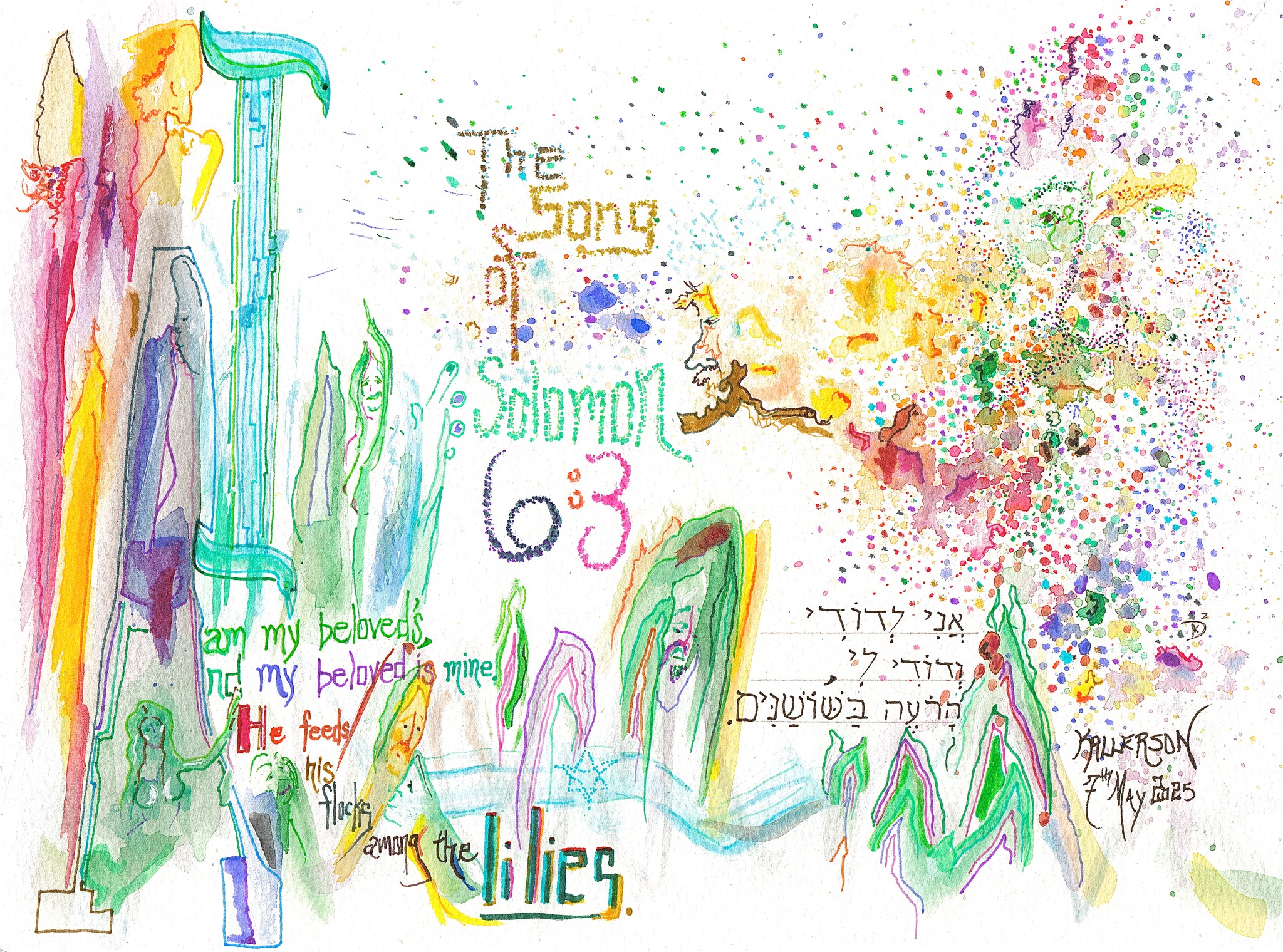
Artwork by Douglas Kallerson.
Song of Songs 6:1-7
Turn Your Eyes From Me
(Typed 10 February 2025) The day before typing this sermon was Super Bowl Sunday. As a result, there were many disappointed people in the nation. A lot of time, effort, and money went into the game. People had their hopes up, and many of them were left crushed like a pomegranate under the foot of an African elephant.
Others reveled in the victory. Though we think that the memory of the Super Bowl will go on and on, the truth is that it won’t be long until it is forgotten. The people in Greece had their Olympiads. The Romans had their gladiator wars. These were men hailed as heroes and champions, but now they are all forgotten.
Time marches on, and the things people find important change. However, the things that God thinks are important are never forgotten by Him. He remembers all things, and He brings them up in Scripture from time to time to remind His people that He has not forgotten.
Text Verse: “A fire devours before them,
And behind them a flame burns;
The land is like the Garden of Eden before them,
And behind them a desolate wilderness;
Surely nothing shall escape them.” Joel 2:3
Joel was likely written sometime between 835 and 796 BC, during the reign of King Joash. That was thousands of years after Adam and Eve were cast out of Eden. Joel is prophetically pointing to circumstances beyond his day, though.
We know this because Peter cites Joel 2 in Acts 2. And what he says clearly anticipates the time after the church age during the tribulation period. So God looks back on Eden but compares it to something thousands of years in the future. This means He is looking back on Eden from the future, telling Joel things about what will happen to the land based on His ability to span all of history.
Obviously, Eden was memorable to the Lord and our relationship with Him, so He brings it up from time to time in later years to remind us.
We know from Scripture that the Lord promised man, just after the fall and before he was cast out of Eden, that he would be restored to God someday. This would be because of the promised Messiah. If God looks back on Eden, it is because He is also looking forward to what Eden implied, meaning perfect fellowship with man once again.
If not, what would be the point of looking back on Eden? It would be like eternally rubbing salt into an ever-festering wound. Rather than that, God is anticipating a state of eternal healing through the work of His promised Messiah.
When all of the supposed great deeds of men, such as sports figures, war heroes, reigning kings, and so forth, are long forgotten, the great deeds of the Lord will still be remembered, even forever.
The pinnacle of the work of the Lord is found in His cross, burial, and resurrection. This is certain because all of Scripture points to that defining act.
This is a great and marvelous truth to be found in His superior word. And so, let us turn to that precious word once again, and… May God speak to us through His word today, and may His glorious name ever be praised.
I. Seeking Him with You (verses 1-3)
Understanding the coming words is dependent on remembering what happened in the previous chapter. The woman was in her room when her beloved came for her. She didn’t want to get up from her bed and dirty her feet, but her desire for him overtook everything else. By the time she went to the door, he was gone.
From there, she went around the city looking for him. After a struggle with the watchmen, she charged the daughters of Jerusalem –
Adjured you, daughters Jerusalem,
If find my beloved,
What declare to him?
That rubbing love, I.
In response, the daughters asked what made him so special that would cause her to so adjure them. From there, she went through her carefully detailed description of him, noting every perfection.
Having given this description, they obviously want to see him and find out if he is as perfect as she has described. Therefore, they offer their assistance in finding him. If he is this amazing, they just have to feast their eyes on him as well. And so, the narrative continues…
Where has your beloved gone,
O fairest among women?
anah halakh dodekh hayaphah banashim –
“Where walked your beloved,
The fairest in the women?”
The words are asking for a general guess from her. In 5:6, she had said –
“Sought him, and no found him.
Called him, and no answered me.”
Then in verse 5:8, she said –
“Adjured you, daughters Jerusalem,
If find my beloved,
What declare to him?
That rubbing love, I.”
She had no idea where he was, but they pressed her on where he had gone anyway. Therefore, it appears they are saying, “Think! Where is it that he has most likely gone?” This is because they next say…
1 (con’t) Where has your beloved turned aside,
That we may seek him with you?
anah panah dodekh unvaqshenu imakh –
“Where turned your beloved,
And seeking him with you.”
Because of these words, they must be thinking of something like, “What part of the city is he likely to have gone? Give us a clue, and we will go looking for him with you.” If she knew specifically where he had gone, she would just go there herself. But because they have offered to search with her, they know she can only give a best guess without specificity.
The thought is expressed quite well in the account of the time when Elijah was taken to heaven.
Then it happened, as they continued on and talked, that suddenly a chariot of fire appeared with horses of fire, and separated the two of them; and Elijah went up by a whirlwind into heaven.
12 And Elisha saw it, and he cried out, “My father, my father, the chariot of Israel and its horsemen!” So he saw him no more. And he took hold of his own clothes and tore them into two pieces. 13 He also took up the mantle of Elijah that had fallen from him, and went back and stood by the bank of the Jordan. 14 Then he took the mantle of Elijah that had fallen from him, and struck the water, and said, “Where is the Lord God of Elijah?” And when he also had struck the water, it was divided this way and that; and Elisha crossed over.
15 Now when the sons of the prophets who were from Jericho saw him, they said, “The spirit of Elijah rests on Elisha.” And they came to meet him, and bowed to the ground before him. 16 Then they said to him, “Look now, there are fifty strong men with your servants. Please let them go and search for your master, lest perhaps the Spirit of the Lord has taken him up and cast him upon some mountain or into some valley.”
And he said, “You shall not send anyone.”
17 But when they urged him till he was ashamed, he said, “Send them!” Therefore they sent fifty men, and they searched for three days but did not find him. 18 And when they came back to him, for he had stayed in Jericho, he said to them, “Did I not say to you, ‘Do not go’?” 2 Kings 2:11-18
Like these prophets looking for Elijah, the daughters of Jerusalem want to go with this woman to find her exquisitely described beloved. The woman, however, gives an answer that is intended, like Elisha advising the prophets, to deter them from going out to find him…
2 My beloved has gone to his garden,
Rather: dodi yarad l’gano – “My beloved descended to his garden.” Why the NKJV diverged from the Hebrew is baffling. The word yarad means to descend or go down. In Ecclesiastes 2, Solomon says –
“I made my works great, I built myself houses, and planted myself vineyards. 5 I made myself gardens and orchards, and I planted all kinds of fruit trees in them. 6 I made myself water pools from which to water the growing trees of the grove.” Ecclesiastes 2:4-6
The woman feels confident that Solomon has descended to his garden. As this is the case, the daughters couldn’t go there seeking him. The gardens would be private, and their entry would be forbidden without being invited.
Next, she describes the garden, using several terms that she had previously used to describe him. As such, it would mean that she had either already been there and seen the gardens as an invitee, using what she saw to make a comparison to him, or she was describing the garden, noting that its perfection must surely be like his perfect beauty.
Either way, she says he has gone…
2 (con’t) To the beds of spices,
laarugoth habosem – “To parterres the fragrance.” In verse 5:13, she had said of her beloved –
“His cheeks –
According to parterre the fragrance.
Towers – perfumes.”
It seems likely that she had actually been to his gardens. She saw them in the past and had likened his cheeks to what she had seen. The exquisite nature of the gardens was remembered by her, and when asked about him, she took the awe-inspiring scene she had beheld and later applied it to him.
Next, she tells the reason why he had descended to his gardens…
2 (con’t) To feed his flock in the gardens,
liroth baganim – “To pasture in the gardens.” It seems unlikely that Solomon would have his flocks feed right in his beautifully manicured gardens unless they were specifically designed to allow for this, with open courtyards big enough to hold a flock.
As such, it speaks of a roomy expanse forming a marvelously broad and verdant place. The fact that Solomon is pasturing the flocks means that he was personally involved with them, something that might be thought unbecoming of a king.
And yet, it actually reveals a caring, contemplative, and contented soul who enjoyed the same lifestyle as his father, David, prior to becoming king.
The thought is later expressed concerning the Lord in Isaiah 40 –
“Behold, the Lord God shall come with a strong hand,
And His arm shall rule for Him;
Behold, His reward is with Him,
And His work before Him.
11 He will feed [ra’ah] His flock like a shepherd [ra’ah];
He will gather the lambs with His arm,
And carry them in His bosom,
And gently lead those who are with young.” Isaiah 40:10, 11
And again, the same terminology is used to describe the care of Jesus for His saints in Revelation, where the word poimainó is used, which corresponds to the Hebrew word ra’ah –
“Therefore they are before the throne of God, and serve Him day and night in His temple. And He who sits on the throne will dwell among them. 16 They shall neither hunger anymore nor thirst anymore; the sun shall not strike them, nor any heat; 17 for the Lamb who is in the midst of the throne will shepherd [poimainó] them and lead them to living fountains of waters. And God will wipe away every tear from their eyes.” Revelation 7:15-17
With that thought expressed, she continues with…
2 (con’t) And to gather lilies.
v’lilqot shoshanim – “And to gather lilies.” In verse 5:13, she had continued her thoughts with –
“His lips –
Lilies – drippings,
Myrrh – overflowing.”
As before, it is likely she described him based on what she had seen while in his gardens. The lilies were probably covered with the morning dew, dripping what they couldn’t absorb. Later, when asked about him, she described his lips according to what she had seen.
The lilies must be referring to wild lilies in an expansive field within the garden because of what she will say about him in the next verse. Therefore, saying he has gone to gather lilies probably means that his flock is there eating them.
The word is somewhat expressed this way in Judges 1 –
“And Adoni-Bezek said, ‘Seventy kings with their thumbs and big toes cut off used to gather scraps under my table; as I have done, so God has repaid me.’” Judges 1:7
Adoni-Bezek’s enemies gathered their food from under his table. Likewise, the flock’s feeding is equated to gathering lilies. The clauses are being set in parallel –
* To pasture in the gardens,
* And to gather lilies.
This thought is correct and will align her words with what will be said in the next verse…
3 I am my beloved’s,
And my beloved is mine.
ani l’dodi v’dodi li – “I to my beloved, and my beloved to me.” It appears she is set on quashing their attempts at finding him so they can have a chance at him. But she sees through their pretense of helping her.
In other words, “You don’t need to go looking for him. I am the one that he has decided upon, and he is the one for me. So, there is no need for you to try to be his girl.” Having said that, she next says of him…
3 (con’t) He feeds his flock among the lilies.
Using a verb in the noun position, she repeats the thought from Chapter 2: ha’roeh bashoshanim – “The ‘pasturing in the lilies.’” This is what confirms that Solomon himself is not out personally gathering lilies. Rather, his flock is feeding among the lilies while he tends to them.
As for the shoshan (also shushan and shoshanah) lily, it signifies great beauty and splendor. It is identical to the name Shushan, the citadel named in the book of Esther. It is derived from sus, to exult or rejoice. It is only mentioned twice in the New Testament, both in the same context in Matthew and Luke –
“And about apparel, why are you disquieted? Fathom the lilies of the field, how it grows. Not it labors, nor it spins. 29 And I say to you that neither Solomon in all his glory, he was arrayed like one of these.” Matthew 6:28, 29 (CG)
It is notable that the one time Jesus speaks of lilies, He does it in connection with Solomon’s garments, which don’t compare to these flowers of the field. Saying that they neither toil nor spin means that they are solely the product of what God has done in bringing them forth and sustaining them.
This leads to the thought of what Jesus said in Matthew 11, where He uses the same word, kopiaó, to indicate the labors of the people –
“You come to Me, all those laboring [kopiaó] and having been encumbered, and I, I will give rest to you. 29 Lift My yoke upon you, and you learn from Me, for benignant I am, and lowly of heart, and you will find rest – your souls. 30 For My yoke – easy, and My encumbrance – it is light.” Matthew 11:28-30 (CG)
The thoughts are all interconnected. Solomon is typical of the Lord. Feeding his flocks in the lilies equates to them eating the beautiful and majestic labors of God, not surviving on their own labors. Jesus then equates His yoke, meaning His labors, with what provides rest.
The love of God in Christ keeps being brought out, time and again, in this “Song the songs” concerning the love between Solomon and his beloved and the various descriptions that are brought forth in their words to and about one another.
As for the verse itself, it is a repeat of the words from Chapter 2, but the first clause contains a verbal modification change-up switcheroo that is to be noted and considered –
“My beloved to me, and I to him –
The ‘pasturing in the lilies.’” Song of Songs 2:16
“I to my beloved, and my beloved to me,
The ‘pasturing in the lilies.’” Song of Songs 6:3
The change is purposeful. By restating but transposing the thoughts in the first clause, she is excluding any others from participating in her beloved. The fact that they are in this relationship and that it is a mutually shared devotion excludes others from participating or interfering.
With that, verse 4 will return to the words of Solomon as he speaks to his beloved, confirming that they are devoted to one another.
Let me tell you again how beautiful you are
Let my words be the rejoicing of your heart
You are on my mind, whether you are near or far
But it is so difficult when we are apart
Someday we will be together forever
Until then, let me tell you how beautiful you are
Nothing can this bond between us sever
You are on my mind, whether you are near or far
Perfect love, wonderful and divine
Is what I have for you, even when apart
I am yours, and you are mine
May my words be the rejoicing of your heart
II. Lovely – According to Jerusalem (verses 4-7)
The following words are those of Solomon speaking about his beloved. Two main possibilities come to mind. The first is that he is considering her beauty and expressing it while they are still separated.
The second is that, without providing any details of how the separation was ended, the song suddenly finds itself conveying the words of Solomon in high praises of his beloved to her once again.
If the former, he is speaking about her like she did of him in Chapter 5, remembering his splendor and speaking about it. This cannot be dismissed because he will change his wording in verse 8, and in verse 9, he refers to her in the third person. Therefore, he may be speaking to her without her actually being there.
If the latter, they got back together, and he is conveying to her again how enraptured he is with her. When he gets to verses 8-10, he changes the way he speaks about her for effect.
A third possibility is that he actually speaks to her only in verses 4-7, and then he is referring to her while speaking to another or thinking out loud in verses 8-10. No matter which, he begins his words with…
4 O my love, you are as beautiful as Tirzah,
yaphah at rayati k’thir’tsah –
“Beautiful you, my querida,
According to Tirzah.”
The location, Tirzah, is mentioned but not described in Scripture apart from this verse. It was one of the cities conquered, as noted in Joshua 12:24. Later, it became a royal residence of the northern tribes of Israel under Abijah, the king.
Despite not being described elsewhere, this verse alone is sufficient to let us know that it was a marvelously beautiful location. The name means Delight or Pleasantness. Thus, the name itself is its own descriptor, possibly given to it when it was built.
Next, Solomon speaks more compliments in parallel…
4 (con’t) Lovely as Jerusalem,
navah kirushalim – “Lovely – according to Jerusalem.”
Jerusalem has several meanings, but Foundation of Peace sufficiently represents the intent. The beauty of Jerusalem as recorded in Scripture is unparalleled. In Psalm 48, it says –
“Great is the Lord, and greatly to be praised
In the city of our God,
In His holy mountain.
2 Beautiful in elevation,
The joy of the whole earth,
Is Mount Zion on the sides of the north,
The city of the great King.
3 God is in her palaces;
He is known as her refuge.” Psalm 48:1-3
Likewise, in Lamentations, it says –
“All who pass by clap their hands at you;
They hiss and shake their heads
At the daughter of Jerusalem:
‘Is this the city that is called
“The perfection of beauty,
The joy of the whole earth”’?” Lamentations 2:15
Such descriptions of Jerusalem tell us that Tirzah must have likewise been an amazingly beautiful place. Today it is known as Tel el-Far’ah, which is located in the West Bank, a bit northeast of Nablus.
Having named these cities, identifying her beauty with them, he next says…
4 (con’t) Awesome as an army with banners!
Rather: ayumah kanidgaloth – “Threatening – according to the bannered.” The word ayom, terrible or dreadful, is introduced here. It is from an unused root meaning to frighten. It will be used again in verse 10 and one more time in Habakkuk 1:7 –
“For indeed I am raising up the Chaldeans,
A bitter and hasty nation
Which marches through the breadth of the earth,
To possess dwelling places that are not theirs.
7 They are terrible [ayom] and dreadful;
Their judgment and their dignity proceed from themselves.” Habakkuk 1:6, 7
The final word dagal was used in verse 5:10 when speaking of Solomon in a superlative way by saying he is “Bannered from a myriad.” In other words, he stood out among a myriad of people. Here, the form of the verb signifies that she is being bannered. The thought of an army as inserted by the NKJV is probably correct.
He is describing her as a foe, threatening and fully bannered, ready for battle. In other words, it appears he is saying something akin to our modern thought, “I don’t stand a chance against you.” Therefore…
5 Turn your eyes away from me,
hasevi enayikh mineg’di – “Turn your eyes from me.” The reason for these words is based on what he just said. She is like a threatening bannered host against him. When she looks at him, he is overwhelmed. The idea is, “You can kill with just one look from your eyes.”
He is utterly defeated by her presence, and he has no power against her gaze. That is next explicitly expressed, saying…
5 (con’t) For they have overcome me.
shehem hirhivuni – “Which they importuned me.” The word rahav is used. It is derived from a primitive root signifying to urge severely. In Proverbs 6, it is used in this way –
“My son, if you have become surety for your neighbor,
Have given a pledge for a stranger,
2If you have been snared with the words of your mouth,
Have been caught with the words of your mouth,
3Do this then, my son, and deliver yourself;
Since you have come into the hand of your neighbor,
Go, humble yourself, and importune [rahav] your neighbor.” Proverbs 6:1-3 (NASB 1995)
The meaning here is surely the same. He cannot stand against the longing of her eyes as they urge him for the desires of her heart.
Considering that these words are reflective of the Lord dealing with His redeemed, the meaning becomes clear. Because they are redeemed, they are His. It would be contrary for the Lord to deny Himself.
Therefore, speaking in human terms, it is as if there is an inability in the Lord to turn away from the urgings of His people. That is reflected in the parable of the persistent widow in Luke 18. Her urgings lead to his concluding thought concerning her –
“…now, will not God bring about justice for His elect who cry to Him day and night, and will He delay long over them?” Luke 18:7 (NASB 1995).
Because he cannot resist her urgings, Solomon asks her to turn away. Next, he repeats words he has already conveyed to her in Chapter 4…
5 (con’t) Your hair is like a flock of goats
sa’rekh k’eder ha’izim – “Your hair according to flock the goats.” The words are letter for letter identical to the corresponding clause in verse 4:1. The sense here is that as he looks at her hair, it is the color of goats, but more, it flows like a flock of goats walking in clusters, some here, some there, rolling along.
As explained before, hair, sear, is used in Scripture to signify the existence of an awareness, particularly an awareness of sin. The ez, goat is used as an offering for sin, such as –
“And to the children of Israel you shall speak, saying, ‘Take a kid of the goats [s’iyir izim] as a sin offering, and a calf and a lamb, both of the first year, without blemish, as a burnt offering.’” Leviticus 9:3
“And he shall take from the congregation of the children of Israel two kids of the goats [s’iyir izim] as a sin offering, and one ram as a burnt offering.” Leviticus 16:5
The words, sear, hair, and sa’iyr, kid, are etymologically connected. For example, sear is used in Genesis 25:25 when describing Esau as being born hairy, while sa’iyr is used in Genesis 27:11 to describe his hairy state.
We are being reminded of the intricate connections to other parts of Scripture as Solomon describes his beloved. Of her hair being like goats, he next says…
5 (con’t) Going down from Gilead.
shegalshu min ha’gilad – “Which cascaded from the Gilead.” This is the second and last use of galash, to cascade. The first was in verse 4:1. It gives the sense of rolling, heaping up, or piling up.
As before, Solomon is thinking of a shepherd leading his flocks down a sloping area, in this case, the Gilead. They would be clumped together in various areas, appearing to be moving and rolling down the hills. Solomon isn’t speaking of them as they are cascading, but as they have cascaded – a moment in time.
In his mind, he sees goats on the side of the mountain and compares them to her hair at that moment. It could even be that they stopped on the side of the mountain and reclined, thus “heaped up” as curled locks would appear. Either way, the picture is beautiful to consider.
The thought is the same as the corresponding clause in verse 4:1, with the exception of the last words –
“…from Mount Gilead.”
“…from the Gilead.”
Gilead means Perpetual Fountain. When used in typology, the two thoughts would bear a similar but different meaning. Mount Gilead refers to people sealed with the Spirit, whereas the Gilead refers to the Holy Spirit.
Both clauses of this verse taken together convey the thought that her hair anticipates the awareness of the atonement for sin provided by the Lord for His redeemed.
Next, he continues with repetition from a previous verse…
6 Your teeth are like a flock of sheep
shinayikh k’eder har’khelim – “Your teeth according to flock the ewes.” The words are identical to the corresponding clause in verse 4:2, with the exception of the word translated as “the ewes.” In 4:2, it said, “the shorn.”
The change tells us that this is not merely a copy-and-paste job but that deliberate care has been taken to ensure the text has been minutely maintained. The word translated as ewes is rakhel. It comes from a root signifying to journey.
It was used twice in Genesis 32, and it is used once when referring to Jesus as the sheep led to slaughter in Isaiah 53:7. It is identical to the name Rachel, from which she certainly derived her name, she being like her father’s little ewe.
6 (con’t) Which have come up from the washing;
shealu min ha’rakhtsah – “Which ascended from the washing.” This clause and the next are letter-for-letter identical to the corresponding clauses of verse 4:2.
These ewes were just washed, accentuating their whiteness. The word rakhtsah, signifying a bathing place, was first seen in verse 4:2, and this is its last use in Scripture. Her teeth are pearly white and…
6 (con’t) Every one bears twins,
shekulam math’imoth – “Which they all twinned.” As seen in verse 4:2, the verb taam means to make double or to twin. The meaning is that each tooth in her mouth bears its corresponding tooth.
Just like sheep coming up two by two from the washing pool, those teeth on the top row have their mate on the bottom row. When she closes her mouth while still showing her teeth, the joining of the top and bottom rows makes twins. Therefore…
6 (con’t) And none is barren among them.
v’shakulah ein bahem – “And bereaved, none, in them.” As in verse 4:2, it is worth noting the interesting play on words which is not noticeable in translations –
shekulam math’imoth / v’shakulah ein bahem
Which they all [shekulam] twinned,
And bereaved [v’shakulah], none, in them
Solomon is enjoying word play while focusing his attention on her beautiful white teeth. This time, Solomon skips over a portion of his words from verse 4:3 and goes to the last thought of it, repeating it letter for letter with the corresponding clause there…
7 Like a piece of pomegranate
Are your temples behind your veil.
k’phelakh ha’rimon raqathekh mibaad l’tsamathekh –
“According to slice the pomegranate,
Your countenance from behind to your veil.”
Notice the difference between 4:3 and here –
“According to thread, the crimson, your lips,
And your wilderness – beautiful,
According to slice the pomegranate,
Your countenance from behind to your veil.” 4:3
“According to slice the pomegranate,
Your countenance from behind to your veil.” 6:7
It is another indication that this too wasn’t just an ancient copy-and-paste job. This time, Solomon focuses solely on her lovely countenance.
Also, notice how the NKJV was inconsistent in its translation –
“Your temples behind your veil
Are like a piece of pomegranate.” 4:3
“Like a piece of pomegranate
Are your temples behind your veil.” 6:7
The error here lies with the KJV, which first confused the translation. The NKJV followed along by simply copying without considering their work.
As for the words of the verse, the word translated as countenance is raqah, meaning thinness. Most translations incorrectly say the plural, temples. Some say cheek or cheeks. One translation says forehead. However, if he is seeing behind her sheer veil, he is seeing the forehead, temples, cheeks, etc.
Slicing a pomegranate in half leaves a circle with a Y shape where there is red in the Y and on both sides of it. Thus, the best solution is the singular word countenance. It then covers the areas of thinness on her face collectively.
This completes the verses in today’s passage. But we are still left with things to ponder. One of them is to question why Tirzah and Jerusalem are singled out for comparison to the woman. Jerusalem seems easy enough to understand as it is highlighted elsewhere, but Tirzah is not. And yet, Solomon made the statement.
Jerusalem continues to be mentioned all the way through Scripture, even until Revelation 21. There it says –
“Now I saw a new heaven and a new earth, for the first heaven and the first earth had passed away. Also there was no more sea. 2 Then I, John, saw the holy city, New Jerusalem, coming down out of heaven from God, prepared as a bride adorned for her husband. 3 And I heard a loud voice from heaven saying, “Behold, the tabernacle of God is with men, and He will dwell with them, and they shall be His people. God Himself will be with them and be their God. 4 And God will wipe away every tear from their eyes; there shall be no more death, nor sorrow, nor crying. There shall be no more pain, for the former things have passed away.” Revelation 21:1-4
After this, verses 21:9-27 go into great detail describing the city and its beauty. The New Jerusalem is where the Lord will dwell with man in perfect harmony and unity forever.
But in this passage, Tirzah was mentioned first. The names Eden and Tirzah, though not etymologically connected, carry the same meaning. As noted above, Tirzah means Delight or Pleasantness. And that is the exact two words the NOBSE Study Bible also uses to identify Eden. Others call it Delight, Place of Delight, etc.
Although the Bible usually uses the same word to form typology to ensure a tight connection is made, this is not always the case. To have said Eden would have made no sense because Solomon had not actually seen it. But the Lord had. Likewise, Solomon had seen Tirzah.
Thus, the comparison, as at other times in typology where different words are used to reveal the same thought, is suitable to make the point understandable.
Like the New Jerusalem, where man will live in harmony with God, this was the intent and state of God and man in Eden. Solomon equates his beloved to Tirzah (Delight/Pleasantness) and Jerusalem (Foundation of Peace).
Together they form a picture of that marvelous place, which was lost through our rebellion; a garden of Delight, and then of what is gained through Christ’s perfect righteousness. There is the establishment and permanency found in the Foundation of Peace.
The Lord remembers Eden as He considers his time with Adam. He sees that again in His redeemed, as He anticipates the future with them as well. Thus, the comparison by Solomon of his beloved to Tirzah and Jerusalem takes on its full marvel for us to consider.
These and the other words and concepts found in the passage, as in the rest of the book, are telling us a story of the love of the King of the Universe for His redeemed. And this reconciliation has been made possible through the giving of His Son.
When Jesus looks at His redeemed, He is looking back on what was, and He is looking forward to what will be. In God’s eyes, it is already a done deal. When a person believes the gospel, God seals him or her with the Holy Spirit.
Consider the change in verse 6 about the sheep being ewes when originally in 4:2, they were shorn. The first thing to be determined is the significance of teeth. They are used in Scripture in a multitude of ways – power, rage, being prepared as weapons or tools, military power, judgment, suffering, famine, even suffering for the father’s sins. They are also equated to eating, beauty, and fear.
As such, the significance of the tooth is the state of a person. Being likened to the rakhel, the ewe lamb, means that to God, we share in the state of what Christ endured for us. As He was led as a lamb to the slaughter for the atonement of our sins, we bear the state of His atoning sacrifice.
Therefore, equating the state of the redeemed to being shorn (4:2) and also to an ewe (6:6) likewise forms a picture. Our sin nature is cut away, and our atonement is realized, both because of the crucifixion of Christ.
Such patterns and pictures tell us why this “Song the songs” is read each year at the Passover. It is the greatest of all songs because it is telling us of the greatest act ever in human history. It tells us of the cross of Jesus Christ when the God/Man gave up His life to pay for the sins of the world.
For those who are willing to accept the payment and receive the offer, there is restoration: complete, without charge, and for eternity. If you have never accepted the gift of God found in the giving of His Son for you, may today be the day.
All He asks is for you to believe. Everything else has been accomplished. Praise God for the cross of Jesus Christ. Amen.
Closing Verse: “But God forbid that I should boast except in the cross of our Lord Jesus Christ, by whom the world has been crucified to me, and I to the world.” Galatians 6:14
Next Week: Song of Songs 6:8-13 I yearn, I yearn for that lady – she is dy-no-mite!… (Return, Return – the Shulamite) (15th Song of Songs sermon)
The Lord has you exactly where He wants you. He has a good plan and purpose for you. He alone is the perfect example of love – untarnished, unblemished, and completely pure and holy. He offers this love to you. So, follow Him, live for Him, and trust Him, and He will do marvelous things for you and through you.
Song of Songs 6:1-7 (CG)
Where walked your beloved,
The fairest in the women?
Where turned your beloved,
And seeking him with you.
2 My beloved descended to his garden,
To parterres the fragrance,
To pasture in the gardens,
And to gather lilies.
3 I to my beloved,
And my beloved to me,
The ‘pasturing in the lilies.’
4 Beautiful you, my querida,
According to Tirzah,
Lovely – according to Jerusalem,
Threatening – according to bannered.
5 Turn your eyes from me,
Which they importuned me.
Your hair according to flock the goats,
Which cascaded from the Gilead.
6 Your teeth according to flock the ewes,
Which ascended from the washing.
Which they all twinned,
And bereaved, none, in them.
7 “According to slice the pomegranate,
Your countenance from behind to your veil.”
Song of Songs 6:1-7 (NKJV)
Where has your beloved gone,
O fairest among women?
Where has your beloved turned aside,
That we may seek him with you?
2 My beloved has gone to his garden,
To the beds of spices,
To feed his flock in the gardens,
And to gather lilies.
3 I am my beloved’s,
And my beloved is mine.
He feeds his flock among the lilies.
4 O my love, you are as beautiful as Tirzah,
Lovely as Jerusalem,
Awesome as an army with banners!
5 Turn your eyes away from me,
For they have overcome me.
Your hair is like a flock of goats
Going down from Gilead.
6 Your teeth are like a flock of sheep
Which have come up from the washing;
Every one bears twins,
And none is barren among them.
7 Like a piece of pomegranate
Are your temples behind your veil.