
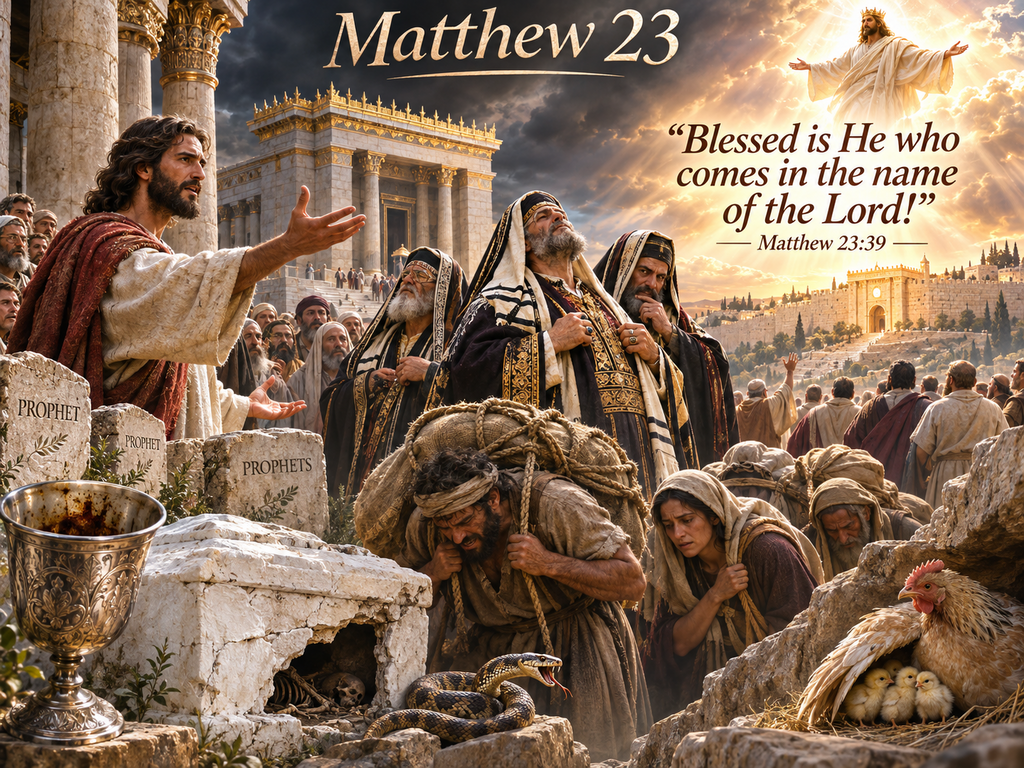
Wednesday, 4 November 2026
A summary of Matthew Chapter 23.
Note: You can listen to today’s commentary courtesy of our friends at the “Bible in Ten” podcast. (Click Here to listen).
You can also read this commentary, scrolling with music, courtesy of our friends at “Discern the Bible” on YouTube. (Click Here to listen), or at Rumble (Click Here to listen).
To read the CG Translation on YouTube (Click Here), or at Rumble (Click Here).
Daniel also did a link concerning the connection between Matthew 23, the Book of Isaiah, and Isaiah 23. That can be listened to (Clicking Here). His readable notes are (Click Here).
Each chapter of Matthew has provided a broad panorama of what is going on in redemptive history. Reviewing the last few chapters, we saw that Chapter 20 hinted at the transition from the dispensation of the law to the dispensation of grace. It presented the truth that God has made faith in what He has done the necessary condition for man’s salvation.
Chapter 21 continued that thought, dealing specifically with the object of that faith, Jesus Christ. Chapter 21 ended with the parable of the wicked vinedressers, revealing that the vineyard would be taken away from Israel and given to other vinedressers.
Chapter 22 began with the parable of the wedding feast. The symbolism was that the Father was preparing Jesus as a bridegroom. The invitation was made to Israel, but they rejected the offer. Because of this, they were destroyed and their city, Jerusalem, was burned, exactly what later occurred.
From there, the message went throughout the world, inviting anyone to come and share in the banquet. At the end of the parable, it was seen that only those who had the appropriate garments, signifying the righteousness of Christ, were welcome. All others would be cast into outer darkness.
The chapter continued, showing Israel what their true responsibilities are and where their proper doctrine should lie. Though they were destroyed and exiled, it did not mean that the nation was finished as far as God’s redemptive plans are concerned.
Chapter 23 focuses almost all of its attention on the scribes and Pharisees. They represent the spiritual leadership in Israel. Despite Israel being exiled, such leaders have remained among the people all along, in their synagogues and rabbinic schools of instruction.
The scribes and Pharisees essentially got Israel into the mess they were in. The rabbis have continued to mislead the people for the past two thousand years, rejecting Christ and looking to establish their own righteousness apart from Him.
Jesus warned the multitudes concerning such people in verses 1-12, explaining how they should handle such people and with whom their fellowship should be. He stressed the people’s need to focus on the teachings of the Christ and have their affections set on the Father. Verses 10-12 were shown to point specifically to the Christ. They are not merely general statements about followers of Christ.
From verses 13-36, Jesus pronounced eight woes upon the scribes and Pharisees, clearly demonstrating that it is their doctrine and teachings that led the people astray. Sheep follow their shepherds. The scribes and Pharisees were worthless shepherds. A good, comparable chapter in the Old Testament to see the Lord’s attitude toward such worthless leaders is Ezekiel 34. In many ways, the words of that chapter mirror the intent of Jesus in Matthew 23 concerning the scribes and Pharisees and now the rabbis and religious schools.
The final woe pronounced by Jesus went from verses 29-36, warning the scribes and Pharisees that they would be held accountable for all of the blood of the righteous, “from the ‘blood, Abel, the righteous’ until the ‘blood, Zechariah, son, blessed of Yah’ whom you murdered between the temple and the altar.” Jesus assured them that this reckoning would arrive upon that generation.
The conclusion stated in the commentary on verse 36 said, “As such, it would logically follow that the generation referred to by Jesus is the entire span of the time of those curses.” In other words, the reckoning of the blood of the righteous was not merely poured out on the scribes and Pharisees of Jesus’ time, but it continues to this day.
Any worthless shepherd in Israel who fails to proclaim Christ Jesus will be a part of that sure judgment. Verses 37-39 confirm this. Jesus wept over Jerusalem, the city led by these worthless shepherds who misdirected the people, telling the city that she would not see Jesus again until she (meaning the leaders within her) says, “Having been blessed, the ‘Coming in Name, Lord’.”
In other words, until the religious leaders of Israel acknowledge Christ Jesus and direct the people to Him, He will not return. When they do, He will return and save them, as indicated in Revelation 19.
These events marked out in Chapter 23 occurred after Jesus completed His work, meaning during the time of the church age, but the chapter does not deal with the church. It deals with Israel’s responsibility toward Christ and the Father, something that has been almost wholly neglected by Israel for two thousand years.
Paul assures us in Romans 11 that there has always been a remnant of Israel according to the election as grace, but for the most part, the woes pronounced upon the scribes and Pharisees have come upon the leaders. In turn, they have come upon the people who have been misdirected by these wicked leaders. Much suffering is ahead for Israel because they rejected and continue to reject Christ Jesus.
Life application: Chapter 24 lies ahead. It is a mournful chapter of the woes coming upon Israel because of their rejection of Jesus, but before it arrives, the hope of Matthew 23:39 is that Jesus will, in fact, be called out to by the leaders in Jerusalem, and He will return to save them. Despite being mournful information about the state of Israel’s leaders and the nation as a whole, there is hope for this wayward nation. That hope is found in their long-rejected Messiah, Jesus.
Lord God, thank You for Your covenant faithfulness. Even when Your people are unfaithful to You, You remain steadfast and faithful to the word You have pronounced. Were it not so, heaven would remain barren of people. But because of Your goodness, grace, and covenant-keeping, it will be filled with the saints of all ages. Thank You for Jesus, who has made this possible. Amen.
Matthew 23
23 Then, the ‘Jesus’, He spoke to the crowds and to ‘disciples, His’. 2saying, “Upon the ‘Moses’ bench’, they sat, the scribes and the Pharisees.” 3All, therefore, as much if they might say to you to guard, you guard, and you do. According, also, to their works, not you do. They say, indeed, and not they do. 4They bind, indeed, burdens, weighty and oppressive, and they lay upon the ‘shoulders, the men’. The also ‘finger, theirs’, not they will to stir them. 5All, also, the ‘deeds, theirs’, they do to ‘see’, the men. They widen, also, the ‘phylacteries, theirs’, and they enlarge the ‘tassels, the cloaks, theirs’. 6They affectionate, also, the first-reclining in the suppers, and the first-sittings in the synagogues, 7and the greetings in the markets, and to be called by the ‘men’, ‘Rabbi, Rabbi.’ 8You, also, not you should be called ‘Rabbi.’ One, indeed, He is of you the Guide: the Christ. All, also you, brothers – you are. 9And ‘father’, none you should call, of you, upon the earth. One, indeed, He is the ‘Father, yours’, the ‘in the celestial’.
10Not also you should be called guides. One, indeed, of you, He is the Guide: the Christ. 11The ‘also Greater’ of you, He will be your Attendant. 12Who, also, he will elevate himself, he will be humbled, and who, He will humble Himself, He will be elevated*.”
13“Woe to you, scribes and Pharisees, hypocrites! Because you close the ‘kingdom, the heavens’ before the ‘men’. You, indeed, neither enter, nor those entering you permit to enter. 14Woe, also, to you, scribes and Pharisees, hypocrites! For you devour the ‘houses, the widows’, and pretense – lengthy praying. Through this, you will receive superabundant judgment.
15“Woe to you, scribes and Pharisees, hypocrites! For you traverse the sea and the arid to make one proselyte, and when he might become, you make him ‘son, Gehenna’ two-fold yourselves.
16“Woe to you, ‘conductors, blind’! Those saying, ‘Who, if he should swear ‘in the temple’, nothing, it is. Who, also, if he should swear ‘in the gold, the temple’, he is obligated. 17Moronics and blind! Which, indeed, greater it is, the gold or the temple, the ‘having hallowed the gold’? 18And who, if he should swear ‘in the altar’, nothing, it is. Who, also, if he should swear ‘in the gift, the atop it’, he is obligated. 19Moronics and blind! Which, indeed – greater: the gift or the ‘altar, the hallowing the gift’? 20The ‘therefore having sworn in the altar’, he swears in it and in all those atop it. 21And the ‘having sworn in the temple’, he swears in it and in the ‘dwelling, it’. 22And the ‘having sworn in the heaven’, he swears in the ‘throne, the God’ and in the ‘sitting atop it’.
23“Woe to you, scribes and Pharisees! Hypocrites! Because you tithe the mint, and the dill, and the cummin, and you left the ‘weightier, the law’: the judgment, and the mercy, and the faith. These, also, it necessitated to do – those, not leave! 24‘Guides, blind’! The ‘through-filtering the gnat’, the ‘also camel gulping’.
25“Woe to you, scribes and Pharisees! Hypocrites! Because you cleanse the ‘outwardly, the cup and the side-dish’. Inwardly, also, they swell from pillage and unrestraint. 26‘Pharisee, blind’! You cleanse first the ‘within the cup and the side-dish’ that it might be, also the outward of them, clean.
27“Woe to you, scribes and Pharisees! Hypocrites! Because you resemble tombs having been whitewashed, which outwardly, indeed, they appear beautiful. Inwardly, also, they swell – ‘bones, dead and all impurity’. 28 Thus, also, outwardly – indeed – you appear to the men righteous. Inwardly, also, you are replete – hypocrisy and lawlessness.
29“Woe to you, scribes and Pharisees! Hypocrites! Because you build the ‘tombs, the prophets’, and you arrange the ‘sepulchers, the righteous’. 30And you say, ‘If we were in the ‘days, the fathers, us’, not if we were ‘sharers with them’ in the ‘blood, the prophets’. 31Thus, you witness to yourselves that sons, you are – the ‘having murdered the prophets’. 32And you, you must fill the measure, the ‘fathers, yours’. 33Serpents! ‘Offspring, vipers’! How might you flee from the ‘judgment, the Gehenna’? 34Through this, you must behold! I, I send to you prophets, and wise, and scribes. From them you will kill, and you will crucify, and from them you will flog in the ‘synagogues, yours’, and you will pursue from town to town. 35That it should come upon you all ‘blood, righteous being outpoured upon the earth’, from the ‘blood, Abel, the righteous’ until the ‘blood, Zechariah, son, blessed of Yah’ whom you murdered between the temple and the altar. 36Amen, I say to you, it will arrive, these all, upon the ‘generation, this’.
37“Jerusalem! Jerusalem! The ‘killing the prophets and stoning those having been sent to her’! How often I willed to upon-gather the ‘children, yours’, which way ‘upon-gathers, hen the chicks, hers under the wings’, and not you willed. 38You must behold! It is left to you, the ‘house, yours’, desolate! 39I say, indeed, to you, no, not Me you should see from now, until if you should speak, “Having been blessed, the ‘Coming in Name, Lord’.”
*Verses 10-12 – It is undoubtedly the case that Jesus refers to Himself in these verses. They explain the reference to “the Christ” in verse 8. Hence, the capitalization.