
Wednesday, 21 October 2026
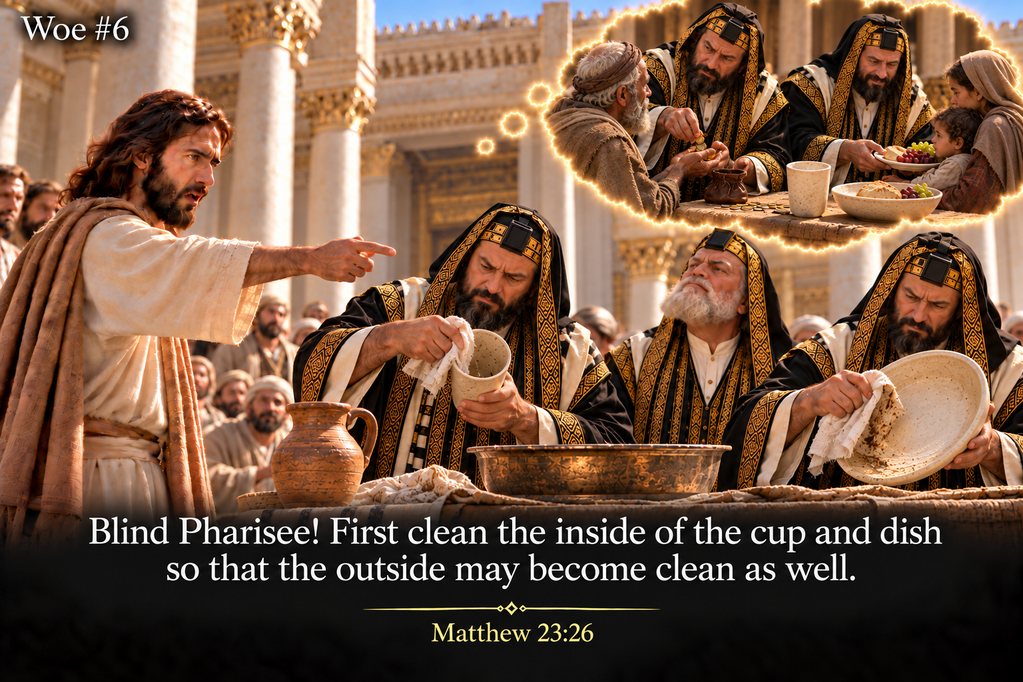
Blind Pharisee, first cleanse the inside of the cup and dish, that the outside of them may be clean also. Matthew 23:26
Note: You can listen to today’s commentary courtesy of our friends at the “Bible in Ten” podcast. (Click Here to listen)
You can also read this commentary, scrolling with music, courtesy of our friends at “Discern the Bible” on YouTube. (Click Here to listen), or at Rumble (Click Here to listen).
“‘Pharisee, blind’! You cleanse first the ‘within the cup and the side-dish’ that it might be, also the outward of them, clean.” (CG)
In the previous verse, Jesus chided the hypocritical Pharisees for cleaning the outside of the cup and side-dish while the inside was full of pillage and unrestraint. He continues that now, saying, “‘Pharisee, blind’!”
Changing “Pharisees” to “Pharisee” makes Jesus’ address more personal. It is an appeal for the individual to change his thinking and act with wisdom. That change continues with the next words, “You cleanse first the ‘within the cup and the side-dish’.”
The verb “you cleanse” remains in the singular. Jesus appeals to each Pharisee to come out from the herd thinking and lifestyle to make a change suitable to be free from his previous aberrant thinking and actions. A new word is seen in this clause, entos, within. It will only be seen here and in Luke 17:21. Jesus next speaks of the result of cleaning the “within” of the dishes, saying, “that it might be, also the outward of them, clean.”
Another new word is seen here, ektos, outward. It can be used to figuratively mean “except” or “besides.” Through this example, Jesus turns their thinking upside down. Cleaning the outside of the cup carefully while neglecting the inside doesn’t help purify the food that is placed in the dish.
As such, if the food is pure before it is put in the cup, and if it remains pure after it is put in because the inside of the cup is pure, then the outside of the cup is made clean without any extra purification. Of this, the Pulpit Commentary says, “So in the case of the moral agent, the ceremonial purity is a mockery and hypocrisy unless it be accompanied by holiness of the heart.”
The point is that Jesus equates the inside and outside of the dishes to the internal and external lives of these men. Unless they purify their insides, the outward showiness is nothing. They remain defiled.
“For a multitude of the people, many from Ephraim, Manasseh, Issachar, and Zebulun, had not cleansed themselves, yet they ate the Passover contrary to what was written. But Hezekiah prayed for them, saying, ‘May the good Lord provide atonement for everyone 19 who prepares his heart to seek God, the Lord God of his fathers, though he is not cleansed according to the purification of the sanctuary.’ 20 And the Lord listened to Hezekiah and healed the people.” 2 Chronicles 30:18-19
Life application: Jesus’ example is plain enough for each of us to consider. What is it about our lives that hides away corruption? Until we get such things cleared up, we may present a decent outward appearance, but the Lord is certainly displeased with our internal state.
And these things come in many degrees and variations. Almost daily, there will be an article about a pastor, priest, missionary, youth minister, etc., who secretly hides away disturbing traits.
Some steal from the church – some are pedophiles, etc. If those who represent the church are inclined to do these things, it is likely that some of us are as well. Staying close to the Lord, reading His word, and applying its lessons to our lives are ways we can crucify the flesh, cleanse our inward inclinations, and thus be presentable to the Lord in our walk before Him.
Let us endeavor to do these. In doing them, we will do well.
Lord God, help us to live lives that honor You, not just as an outward pretense, but as a core part of who we are. May what is inside be pure and honorable as we interact with You and with others in these lives You have given us. Amen.