
Sunday, 26 July 2026
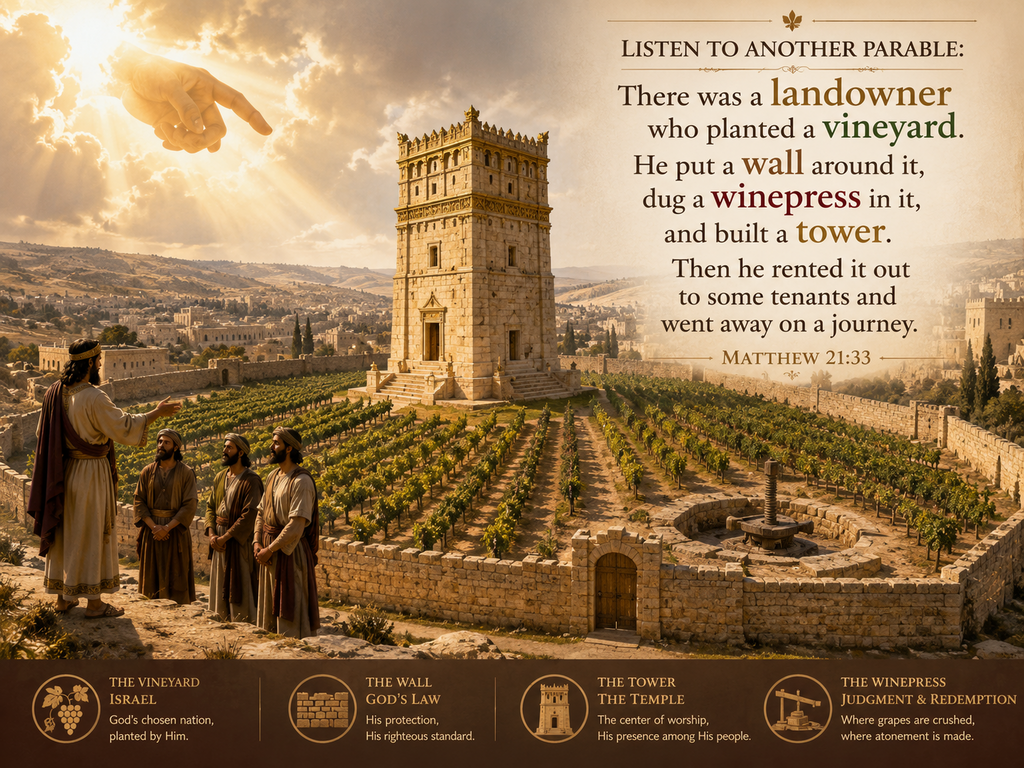
“Hear another parable: There was a certain landowner who planted a vineyard and set a hedge around it, dug a winepress in it and built a tower. And he leased it to vinedressers and went into a far country. Matthew 21:33
Note: You can listen to today’s commentary courtesy of our friends at the “Bible in Ten” podcast. (Click Here to listen)
You can also read this commentary, scrolling with music, courtesy of our friends at “Discern the Bible” on YouTube. (Click Here to listen), or at Rumble (Click Here to listen).
“Another parable, you hear, ‘‘Man, certain’, he was ‘housemaster, who, he planted – vineyard’, and barrier, it, he circuited, and he dug in it – winepress, and he built – tower, and he leased it to land-workers, and he abroaded.” (CG)
In the previous verse, Jesus finished His words to the leaders of Israel concerning the parable of the two sons. However, He is not finished addressing the leaders. Matthew records His next words, saying, “Another parable, you hear.”
Jesus continues using parables in an effort to get these men to think things through, see their situation, and make a decision concerning what path they will follow. Understanding that, He begins with, “‘Man, certain’, he was ‘housemaster’.”
Once again, Jesus uses a subject that was readily understandable to His hearers, a housemaster. He used this same terminology in Chapter 20 in the Parable of the Workers in the Vineyard. This is a man who has authority over the house. In this case, Jesus also returns to the vineyard metaphor, saying, “who, he planted –vineyard.”
Typology must remain consistent unless there is a specific change in the intent of what is being conveyed. As such, the same typology is to be seen here as in the previous vineyard parables.
The vineyard represents the economy (a cultural expression) where God is dealing with man in order to bring about a result. In this case, the initiation of that process is being referred to. The man has planted the vineyard. Next, Jesus says, “and barrier, it, he circuited.”
Two new words are seen again. The first is phragmos, an enclosing barrier. It can be a hedge, partition, fence, etc. The four uses of it in the New Testament are all suited to using the word “barrier.” The next new word is peritithémi, to place around, coming from peri, about, and tithémi, to place. In this case, the word circuit will satisfactorily suit the eight New Testament uses.
The vineyard is now protected by a barrier to keep it from outside influences. After this, Jesus says, “and he dug in it – winepress.”
Two more new words are seen. The first is orussó, to burrow in the ground. The word is seen just three times in Matthew and Mark. The word dug satisfies the three uses. The second new word is lenos, a winepress. It is a primary word signifying a trough. Despite this, all of the New Testament uses are used in conjunction with it being a winepress for the crushing of grapes.
Vineyards produce grapes, or cultural expressions. These are mixed together through a mashing process to produce wine. In the Bible, wine then symbolizes the merging together of these expressions into a result. The thing that ought to happen can happen, symbolized by wine. For the vineyard, Jesus next says, “and he built – tower.”
The purgos, tower, is introduced here. Strong notes that in Greek writings from the time of Homer and afterward, it refers to a tower, meaning a fortified edifice which rises to a considerable height. It was used to repel hostile attacks and to enable watchmen to see in every direction. Such a watchtower is intended to watch over the vineyard for protection. With that complete, Jesus next says, “and he leased it to land-workers.”
Again, two new words are seen. The first is ekdidómi, to give forth. In the New Testament, its four uses are all in relation to leasing out land. The second new word is geórgos, literally a land-worker. It is from gé, soil (by extension, it speaks of a region, ground, land, etc.), and ergon, to work.
The landowner retains the vineyard as his own and has set certain people in the vineyard to do what is necessary for maintaining it. With that, Jesus says, “and he abroaded.”
This is another new word, apodémeó, to go abroad, meaning to visit a foreign land. A single word that carries that exact meaning is the coined word abroaded. The housemaster has headed away from the area, leaving these men in charge with the intent of them caring for his property.
Life application: In one verse, eight new words are seen. It is interesting how a new concept or story will often require the introduction of new words in order to make specific points about what is on God’s mind.
With the introduction of these new words, a story is being developed that is intended to convey information for those who are being addressed to consider what Jesus is telling them. But these leaders are not the only intended recipients of His words. They have been recorded in God’s word.
Because this is so, anyone who picks up the word and reads it should consider what is being said. This is true with those who are not being specifically addressed, meaning the church, which has received God’s word. They are also intended to be considered by the nation of Israel, which originally rejected His words.
As the Gentile led church age, we can learn why things occurred as they did, leading to the current dispensation. As the nation of Israel, they can read what Jesus says, compare His words to their history, and see why they wound up in the situation they have been in for so long.
This parable will explain to any and all what needs to be known concerning a particular issue. Having said that, one parable cannot be used to support a final conclusion about the nation of Israel. It is not uncommon for what Jesus conveys in this parable to be used that way, though. But the whole of Scripture must be considered to form our eschatological doctrines.
So be sure not to assume that because of the words of this parable, there is no future for Israel. It will rather present a reason why Israel is not what God is using for His redemptive purposes at this time.
Lord God, help us to carefully evaluate all that Your word says before we come to conclusions about various things. One story or one teaching may suit a particular timeframe, but it may not be the end of the matter concerning what is being conveyed. So help us to consider the broader picture that is presented at all times. Amen.