
Monday, 13 July 2026
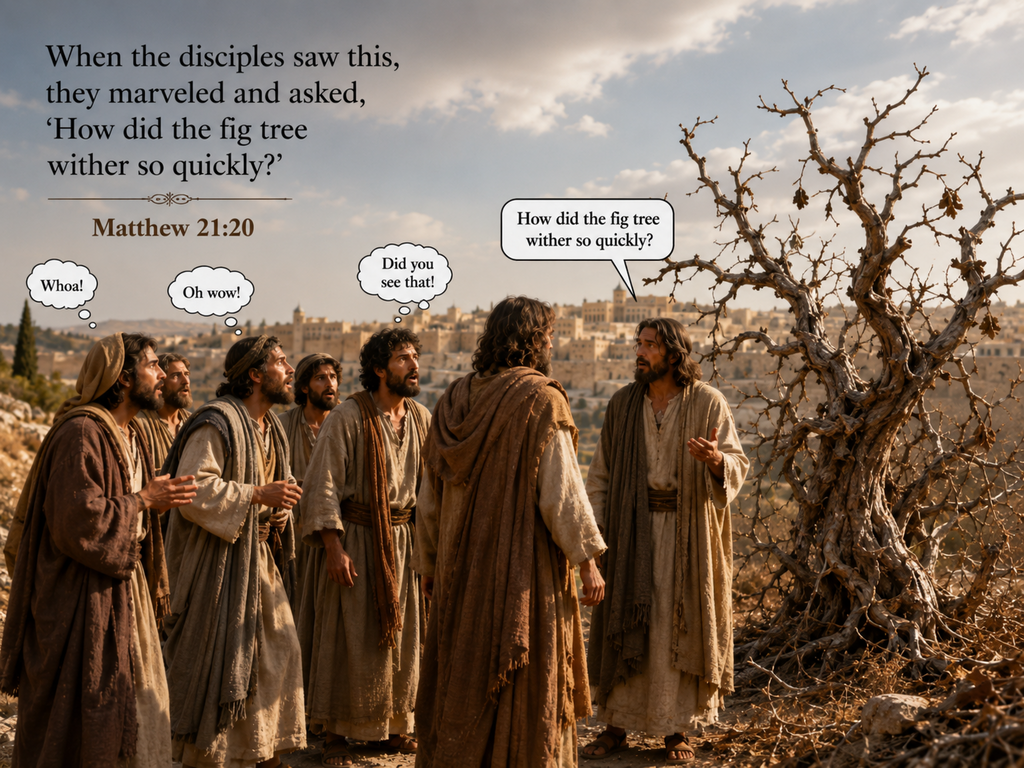
And when the disciples saw it, they marveled, saying, “How did the fig tree wither away so soon?” Matthew 21:20
Note: You can listen to today’s commentary courtesy of our friends at the “Bible in Ten” podcast. (Click Here to listen).
You can also read this commentary, scrolling with music, courtesy of our friends at “Discern the Bible” on YouTube. (Click Here to listen), or at Rumble (Click Here to listen).
“And having seen, the disciples, they wondered, saying, ‘How, straightaway, it desiccated, the fig tree?’” (CG)
In the previous verse, Jesus cursed the fig tree, telling it that no fruit would grow on it again. Matthew recorded that the fig desiccated straightaway. As noted, Mark’s gospel gives more detailed information on the event. Unfortunately, the Pulpit Commentary says, “St. Mark’s more accurate account.”
There is a world of difference between a “more detailed account” and a “more accurate account.” There is nothing inaccurate about Matthew’s record. The word translated as “straightaway” means that it took place forthwith. For example, in Acts 16:33 it says, “And he took them the same hour of the night and washed their stripes. And immediately [parachréma] he and all his family were baptized.”
The event happened straightaway, but it wasn’t like they were standing there and were suddenly baptized. It was the next event in their lives that took place. This is just what was the case in the life of the fig. It went from being alive and vibrant with leaves to being desiccated and dead. Understanding there is nothing inaccurate about Matthew’s words, he next records, “And having seen, the disciples, they wondered.”
In Mark 11:21, it says, “And Peter, remembering, said to Him, ‘Rabbi, look! The fig tree which You cursed has withered away.’” Of this, Barnes says, “Peter said this, Mark 11:21 Matthew means only to say that this was said to him; Mark tells us which one of them said it.”
Barnes equates Matthew’s words to Peter’s exclamation. That is incorrect. Peter noticed it and made his exclamation, but all of the disciples, once they noticed the tree, would have wondered at the matter, just as Matthew records.
Again, there is no contradiction, just more detailed information. Once this was noticed by all of them, they were “saying, ‘How, straightaway, it desiccated, the fig tree?’”
Even if someone put poison around a tree, it may die immediately, but it would take time for it to desiccate. In the case of this fig, it died and desiccated overnight. By the morning, as they passed it again, it was completely desiccated.
This is what happened to the Law of Moses and the effectiveness of the temple to bring restoration between God and men. Jesus’ passion began in the morning. By the afternoon, He had died on the cross. At that time, Matthew records –
“Then, behold, the veil of the temple was torn in two from top to bottom; and the earth quaked, and the rocks were split.” Matthew 27:51
Jesus was tried, sentenced, and crucified. From there, the next thing to take place, meaning straightaway, was that the law was ended. Free, full, and forever access to God was granted, and the temporary and cumbersome connection to God that came through the Law of Moses was ended. The metaphor of the fig tree was realized in its fullness just a few days after Jesus gave it.
Life application: As you can see, commentaries are tools for us to learn information, but they are written down by fallible humans. No one is without errors in thinking. All of us are subject to biases, presuppositions, and cognitive dissonance.
When reading commentaries on the Bible, be careful to sift through them, asking questions as you go. Questions like, “How did they come to this conclusion?”, “Why did they say that?”, “Why did they say, ‘more accurate?’”, etc., are important questions to ask when we read something that doesn’t sound right.
Such questions will cause us to slow down and think through what we might otherwise have taken for granted. Once we do that, we form a brain squiggle that acknowledges that their commentary is correct. From that point on, it becomes more difficult to overwrite that bad information.
So don’t assimilate thoughts without thinking them through. You will benefit in your study by going slowly, carefully, and methodically through whatever you are reading. God’s word is important. We should not make unfounded assumptions, nor assimilate others’ unfounded assumptions concerning it.
Lord God, may our time in Your word be methodical, precise, and carefully considered at all times. It is far too precious not to spend it wanting to know Your intent for us. It is a great, wonderful, and precious word that tells us of our Lord and Savior, Jesus. Amen.