
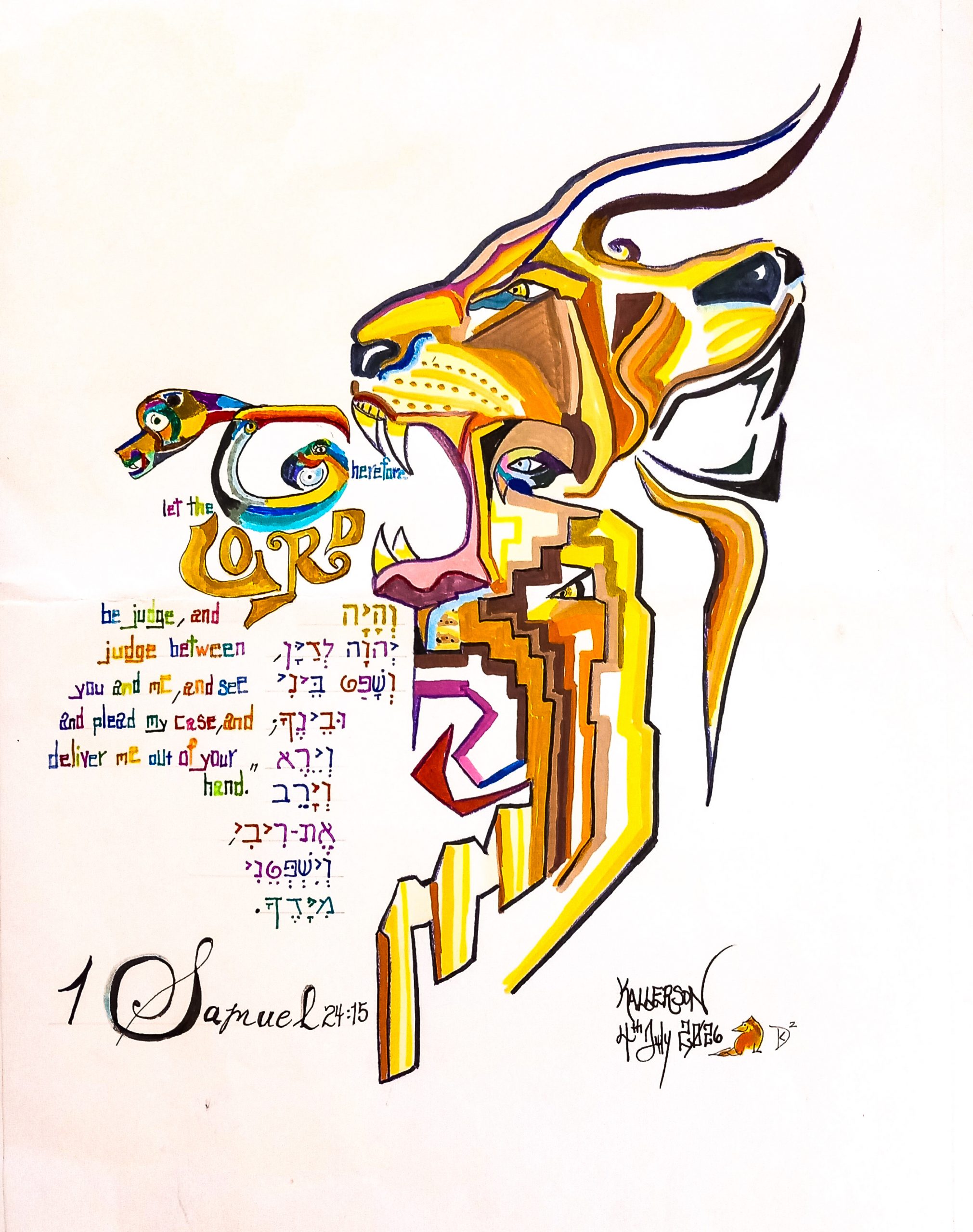
Artwork by Douglas Kallerson
1 Samuel 24:14-22
For Reigning, You Will Reign, Part II
(Typed 2 March 2026) I will be the first to tell you that discovering, understanding, and teaching typology isn’t easy. It can be mentally debilitating in each of these ways.
And more, typology can be misunderstood or manipulated. As this is so, you might wonder what the point of searching it out is. Some people just make up typological meanings without any basis behind them. So why do we need to look into it? A couple of good reasons are available.
The first is obvious. The Lord deals in typology. Therefore, He wants us to understand it. This is true regarding both explicit statements and implicit pictures, such as the things we look for each week.
A second reason isn’t as obvious until you think about it. How many different opinions on the rapture are there? A Google check says there are currently 18,972,277. They estimate the number grows by several thousand each day.
Text Verse: “I will praise You, O Lord my God, with all my heart,
And I will glorify Your name forevermore.
13 For great is Your mercy toward me,
And You have delivered my soul from the depths of Sheol.” Psalm 86:12, 13
Ok, I made that part about the Google numbers up. But the point is that there are a lot of views about the rapture. Some are just poor evaluations of Scripture. Some are purposeful manipulations. Some come from people just making stuff up out of their heads (like I just did 😉).
So, whether it is a clear and precise doctrine like the rapture or something that needs to be searched out like typology, nothing changes. The Lord has given various ways to understand what He is doing. If typology is correctly handled, it is a confirming tool for proper doctrine and sound theology.
Thus, searching these things out is a necessary part of our weekly routine. Its value cannot be underestimated. If you are in a church where catchy sermons are given, that is fine, but you normally will not walk out with any better doctrine than when you walked in.
When you encounter trials and are tempted to worry, speculate, or lose trust, and so forth, that is when you will wish you paid attention to doctrine. Then you would know what to do.” So pay heed!
Great things are to be found in His superior word. And so, let us turn to that precious word once again, and… May God speak to us through His word today, and may His glorious name ever be praised.
I. And He Was Sevened, David (verses 14-22)
14 After whom has the king of Israel come out? Whom do you pursue? A dead dog? A flea?
David questions Saul with short, abrupt language: akhare mi yatsa melekh Yisrael akhare mi atah rodeph akhare kelev meth akhare parosh ekhad – “After whom, he came out, ‘king, Israel’? After whom, you pursuing? After ‘dog, dead’? After ‘flea, one’?”
One can see the contrast. Saul is ‘king, Israel’. David acknowledged himself as the lowest sort in comparison to the king, first saying he is like a dead dog, an unclean animal that is no threat except being irksome to the nose with its stench.
He then moves the comparison lower. If not a dead dog, then he must be a flea on the dog. A single flea! Saul has brought his warriors out to pursue one single flea, something hard to catch, but not worth the effort if it is caught.
As for the parosh, flea, it is only seen here and in 1 Samuel 26:20, where David will again speak of himself in this manner. Because Saul has taken up such a pointless and reckless cause, David continues…
15 Therefore let the Lord be judge,
vehayah Yehovah ledayan – “And He will be, Yehovah, to Advocate.” Another new word is seen, dayan, an advocate. It is from diyn, to sail directly or on a straight course. Hence, it is one who doesn’t waver in his decisions. The only other time the word is seen is in Psalm 68, a psalm of David –
“Father, fatherless
And Advocate [dayan], widows
God – in habitation, His sacred.” Psalm 68:5 (CG)
As the Advocate, He will not err in determining the proper outcome of the matter…
15 (con’t) and judge between you and me,
veshaphat beni u-venekha – “and He will judge between me and between you.” As Yehovah is the righteous Advocate, He will look at the events that have occurred or may occur if Saul doesn’t relent in his pursuit of David…
15 (con’t) and see and plead my case, and deliver me out of your hand.”
Rather: veyere vayarev eth rivi veyishpeteni miyadekha – “(And may He see, and may He grapple my contest!) and He will judge me ‘from your hand’.” Setting this first clause off as parenthetical allows for the sense to be understood.
In the final clause, almost all translations say “deliver,” “rescue,” or “save.” That will be the result, but the word shaphat actually means to judge.
David says that if Saul doesn’t relent in pursuing him, his petition is for the Lord to take up (grapple) his contest, meaning his side of this matter. If He does, His judgment will spare David from the hand of Saul.
“And He was, Yehovah, to Advocate,”
“and He judge between me and between you.”
“(And may He see, and may He grapple my contest!),
“and He will judge me ‘from your hand’.”
David brilliantly structured each word to convey exactly how things will be judged in the heavenly realm based on Saul’s unfounded, relentless pursuit of him.
16 So it was, when David had finished speaking these words to Saul, that Saul said, “Is this your voice, my son David?”
vayhi kekhaloth David ledaber eth ha’devarim ha’eleh el shaul vayomer shaul ha’qolekha zeh beni David – “And it was, according to ‘finish, David’ to speak the words, the these, unto Saul, and he said, Saul, ‘The ‘your voice’, this, my son, David?’” David has been speaking since verse 9. Saul never interrupted him. Rather, he stood there in stunned silence while David spoke, all the while dangling the tassel in front of Saul.
David exactingly laid out his case and then defended it by invoking the name of the Lord. Remember that David prostrated himself before Saul. It very well may be that he was still lying there with his hand upraised to allow the tassel the dignity of being elevated above him. It would provide a visual metaphor of David’s subordination to Saul.
It also explains why Saul mentions David’s voice. Without seeing David’s face, he acknowledges that he still knows him by his voice, the voice of his son, stated in response to David’s words of verse 11 –
“And, my father, you must see! Also, you must see, extremity your robe in my hand.”
“The ‘your voice,’ this, my son, David?”
The scope of the visuals mixed with David’s words overwhelmed Saul…
16 (con’t) And Saul lifted up his voice and wept.
vayisa shaul qolo vayevek – “And he lifted, Saul, his voice, and he wept.” Saul was a dead man in the cave, and yet he stood outside the cave, alive and well. The only reason was that David withheld his hand, something completely contrary to the thoughts that had swirled in Saul’s tortured mind concerning their relationship. Saul’s emotions overtook him…
17 Then he said to David: “You are more righteous than I; for you have rewarded me with good, whereas I have rewarded you with evil.
vayomer el David tsadiq atah mimeni ki atah gemaltani ha’tovah va’ani gemaltikha ha’raah – “And he said unto David, ‘Righteous you from me! For you, you requited me the goodness, and I, I requited you the evilness.’” Saul gives a short, succinct summary of their entire relationship. David had always done right before Saul, and yet, Saul had only returned grief upon David.
It wasn’t David’s fault that the women had praised him above Saul, saying, “He caused to strike, Saul, in his thousand, and David, in his myriads” after his battle with the Philistines. But from that moment, Saul had increasingly turned against him.
Despite David’s ill-treatment from Saul, he maintained his loyal obedience, even in the cave when he could have defended himself from further harm by ending Saul’s life, as Saul acknowledges…
18 And you have shown this day how you have dealt well with me;
veat higadta ha’yom eth asher asithah iti tovah – “And you [k.], you caused to declare, the day, which you did with me goodness.” The written and oral Hebrew are different. The written uses a feminine form, veat, and you (feminine). The oral changes it to masculine, veatah.
David is a male, and the subsequent verb is masculine. Therefore, there is an odd gender discord. Several scholars have made suggestions for keeping the feminine, none of which make any sense*. However, this doesn’t mean it is wrong. A sound reason may exist that has not yet been considered.
I suggest that maybe Saul uses the feminine to describe David based on his actions. Three times in verses 18 and 19, Saul will use the feminine form of the word good, tovah, goodness. This form is only found five times in the entire book of 1 Samuel.
If that is Saul’s intent, David would pick up on such wording and understand it –
“And you (because of tovah), you caused to declare, the day, which you did with me tovah, which He shut me, Yehovah, in your hand, and not you killed me. 19And for he will find, man, his hating, and he sent him in road tovah? And Yehovah, He will reciprocate you tovah under the day, the this, which you did to me.” 1 Samuel 24:18, 19 (CG)
The Bible is filled with fun literary nuances. We do the same thing all the time when we want to have an effect on the person we are speaking or writing to. I don’t suggest that this is correct, just that it is an unusual possibility. Typologically, however, there is a reason for the feminine form being used.
The phrase “caused to declare” is not necessarily referring to David’s explanation. Rather, it is David’s actions that speak for the matter. The NKJV gets the sense, “you have shown,” as seen next…
18 (con’t) for when the Lord delivered me into your hand, you did not kill me.
eth asher sigerani Yehovah beyadekha velo haragtani – “which He shut me, Yehovah, in your hand, and not you slayed me.” It was as if David had Saul’s life firmly in his grasp by the allowance of Yehovah, and yet, David mercifully let him live. This validates that David’s words that followed were true…
19 For if a man finds his enemy, will he let him get away safely?
vekhi yimtsa ish eth oyevo veshilekho bederekh tovah – “And for he will find, man, his hating, and he will send him in road goodness?” Saul asks this rhetorically. Who would send away someone he hated, not only unharmed, but on a road of goodness? To Saul, this is unfathomable, and yet, this is what David did.
19 (con’t) Therefore may the Lord reward you with good for what you have done to me this day.
veYehovah yeshalemkha tovah takhath ha’yom ha’zeh asher asitah li – “And Yehovah, He will reciprocate you goodness under the day, the this, which you did to me.” The NKJV is wrong. It is not a petition, but a statement of fact. The Lord will return goodness upon David. Saying “under the day” is equivalent to saying, “based on.” David’s actions are the supporting reason for why Yehovah sends the blessing. Saul is certain of this…
20 And now I know indeed that you shall surely be king, and that the kingdom of Israel shall be established in your hand.
veatah hineh yadati ki malokh timlokh veqamah beyadekha mamlekheth Yisrael – “And now, behold! I knew that reigning, you will reign, and it will rise in your hand ‘kingdom, Israel’.” The statement might seem obvious to us on some level, but the reason is as real to Saul as the tassel dangling in David’s hand.
The evidence of Saul’s authority, the king’s tassel, is there in David’s hand. Nothing is said of David giving it back to him, but it wouldn’t matter. David obtained it while sparing Saul. Because of this, Saul understood that the kingdom truly was David’s. Therefore, he petitions David for mercy…
21 Therefore swear now to me by the Lord
veatah hishabeah li beYehovah – “And now, you must (surely) seven to me in Yehovah.” The idea is to swear something, as if seven times, thus affirming it in the highest possible manner. Doing so in the name of the Lord would make it an inviolable adjuration.
21 (con’t) that you will not cut off my descendants after me,
im takhrith eth zari akharay – “if you must cause to cut my seed after me.” In this case, the meaning of “if” is a plea to never do so. Saul is asking that his line be allowed to continue, not as a kingly line, but as a name in Israel. That is reiterated next…
21 (con’t) and that you will not destroy my name from my father’s house.”
veim tashmid eth shemi mibeith avi – “and if you must cause to desolate my name from ‘house, my father.’” To cut off Saul’s seed would be to cut off his line, which would be to end his name in his father’s house. In biblical thinking, everything traces back to its source.
22 So David swore to Saul.
vayishava David leshaul – “And he was sevened, David, to Saul.” David agreed to this, and the future narrative testifies to his faithfulness to his word to both Saul and Jonathan. This is seen in his treatment of Mephibosheth in 2 Samuel 9 and 2 Samuel 21.
22 (con’t) And Saul went home,
vayelekh shaul el beito – “And he walked, Saul, unto his home.” Receiving reassurance from David that it would be so, Saul called off the pursuit and returned to Gibeah. However…
*22 (fin) but David and his men went up to the stronghold.
vedavid vaanashav alu al hametsudah – “And David, and his mortals, they ascended upon the stronghold.” David was cautious not to return, probably for a few reasons. The first is that he knew Saul’s proclivities and that with the change of the weather, he might change his mind.
Second, returning with all of his men may cause people to voluntarily choose sides on who they felt should be king. Thus, even unintentionally, he could be the impetus for people abandoning Saul, giving Saul a reason to suspect David’s intentions.
What will happen when I die?
Where is it that I am going to?
I’m not sure, and I know why
Because my priorities, I blew
When I should have read the word
Stupidly, I watched TV instead
Now, I can’t tell if what I heard
Is the truth, or just coming from that guy’s head
Will the rapture be today? Let me check and see
Last week, this guy was wrong
But I’m sure he’ll get it right today, most definitely
Because his Bible ‘kung fu’ is strong
I don’t need to check when specialists do that for me
I just believe what they say and rest confidently
II. The Typology Revealed
In the Bible, some things are explicitly defined. The Lord has a plan. He has given us suitable details to know the things we need to know, and the things He said are set. If we worry, things won’t change. If we try to outsmart the Lord, things won’t change.
What is written is fixed, and we should accept it as such. That should be evident, but it still eludes us. The passage today shows this. Hopefully, we will pay heed.
Verse 1 noted that Saul, Asked, returned from pursuing the Philistines, the Weakeners. It is a quick diversion back to the old typology of Saul, those seeking the truth battling against those who want to weaken the faith of others through law observance.
From there, he will be used in the more recent typology of representing Sheol, asking for the souls of men. David, Beloved, represents accepting the doctrines of Christ, is Saul’s perceived enemy.
Saul was told that David was in the Wilderness of En Gedi. It is the place where David went as Chapter 23 ended. The wilderness is a place of God’s grace and of closeness to Him, as well as a place of testing. For those who accept the doctrines of Christ, it represents a place of fellowship through obedience.
En Gedi means Fountain of a Kid (a young goat). A fountain is a permanent source of fresh water. The gedi is from gadah, to cut off. It is what finishes a matter. It pictures living in the presence of God with the eternal flow of the Spirit and sin being permanently eradicated. It speaks of the eternal security of believers.
Verse 2 said that Saul took three thousand selected from all Israel. If this is the church age and David represents accepting the doctrines of Christ, then Israel (He Strives with God) is striving against God at this time.
Three thousand speaks of Divine Perfection paired with “completeness of order where nothing is wanting, the number and order are perfect, and the whole cycle is complete” (Bullinger). It speaks of the time noted by Paul in Romans –
“For I do not desire, brethren, that you should be ignorant of this mystery, lest you should be wise in your own opinion, that blindness in part has happened to Israel until the fullness of the Gentiles has come in.” Romans 11:25
Still in verse 2, it said that Saul went to seek David “upon faces, ‘Cliffs, the Ibexes’.” The meaning of “upon faces” is before or in the presence of. It is the only time this place is mentioned in this manner. The word cliff, tsur, comes from a word signifying to confine, bind, harass, besiege, etc.
The ibex, yael, is from yaal, to ascend. But it is used to indicate ascending in the sense of profit, and thus to be valuable. This is referring to the state of those in the church before the rapture. They are the ascenders, represented by the ibex. They are those who are valuable in this regard, meaning they profit from their acceptance of Christ.
They are currently bound in their earthly existence, but whether they know it or not, they are always in the presence of the immanency of the rapture. The typology fits what has happened in this chapter and what will be presented in the next chapter.
In verse 3, Saul is coming to the sheepfolds by the road. The gederah is a place of protection from harm. In this case, the fortifications are built outside a cave so that the animals could go in the cave or walk in the outer fortified area if the weather was nice.
The tson, flock, is from a word signifying to migrate. The cave is from a word signifying to make naked, thus is signifies what is exposed or bare. The idea is that when there is a cave, whatever is inside, whether gold or whatever else, is exposed.
Thus, in this instance, we get the idea of the word of God being migrated through, exposing what it contains. This is exactly what those who hold to the doctrines of Christ have been doing for two millennia.
Saul went in there to make himself naked to relieve himself. The irony is amazing. Sheol is exposed and laid bare through a study of the word and a proper knowledge of God –
“Sheol is naked before Him,
And Destruction has no covering.” Job 26:6
This typology is certain because it specifically noted that David and his men were sitting in the flank of the cave. Those who hold to the doctrines of Christ are in the word, finding out what it exposes.
In verse 4, it noted that David’s men said this was the day Yehovah said that He would give his enemies into his hand. This is exactly what the word proclaims. Verses from 1 Corinthians 15 explain the intent. First –
“The last enemy that will be destroyed is death.” 1 Corinthians 15:26
Death is the enemy, but Paul then directly equates death to Hades in parallel verses –
“So when this corruptible has put on incorruption, and this mortal has put on immortality, then shall be brought to pass the saying that is written: ‘Death is swallowed up in victory.’
55 ‘O Death, where is your sting?
O Hades, where is your victory?’” 1 Corinthians 15:54, 55
Still in verse 4, the men noted the Lord’s words, “Behold! I giving your enemies in your hand.” There are two entities that perform the same role: Death and Hades. They are the enemies both individually and combined.
Regardless of whether the words of that verse are all a quote from the Lord, or if only the middle clause is, the typology perfectly explains the difficulties with the written text as opposed to the oral reading.
Still in verse 4, it says that David arose and “cut ‘extremity, the robe’, which to Saul.” David, in essence, cut away a tangible, visible symbol of Saul’s authority because the tassel was given to remind Israel of the Lord’s commandments.
David’s cutting off the tassel was like cutting away the kingship from Saul because the king’s authority stems from the Lord’s commandments. Likewise, the authority of Sheol is only for those who belong in Sheol.
For those who accept the doctrines of Christ, Sheol has no authority over them, even if they are there temporarily. For example, a federal prisoner may be in a local jail awaiting transport to prison, but the federal prison retains rights over him.
In verse 5, David’s heart struck him because he cut off the king’s tassel. In verse 6, he said, “(Surely) Profane to me from Yehovah if I will do the word, the this, to my lord.” There is an order and a propriety within the redemptive plan of God. To usurp that is to usurp the plan of the Lord.
Without getting sidetracked too much, it is sufficient to say that it would be nice if all rapture date setters would learn the Bible, stop offending the Lord by trying to usurp his plan, and let Him run things without needless and pointless interference.
We were told right from Jesus’ mouth that it isn’t for us “to know times or seasons which the Father has put in His own authority” (Acts 1:7). David knew that his actions were contrary to sound order and propriety because he acted against “anointed, Yehovah.”
Sheol is what God has ordained for man at his death during this dispensation. There is nothing wrong with that. God has determined what will happen, when it will happen, and He has reasons for it happening.
If we can accept that, we will be much better off in our thinking. Our emotions, presuppositions, etc., should all be set aside as we allow the Lord to work out His plans.
In verse 7, it said that David split his servants with his words, meaning he severed them from rising against Saul. This is what any biblically competent person should do. We cannot fight against what is ordained by God, so why should we allow others to act as if we can?
Right instruction from the word will smooth out our understanding of such things. Remember, Saul is sitting in the cave with his feet covered. In the word, Sheol is helpless. It seems to be such a great, terrible enemy, but in reality, it is a part of what God has ordained until the time when He brings His people out from there.
The typology should give us comfort concerning this great “enemy” we have. He is a defeated enemy because we hold to the doctrines of Christ. And they are based on…. on? Anyone? What Christ did! We have no need to fear what has already been conquered.
As verse 7 ended, it carefully noted that Saul arose ‘from-the-cave’. In verse 8, David arose from ‘the cave’. Without trying to over-sensationalize this difference, it seems we are being told that the truth of the existence Sheol arose ‘from the Bible’, Gensis 2:17 (man dying) and Genesis 37:35 (the existence of Sheol).
However, David, who is typical of Christ and those who accept the doctrines of Christ, arose from ‘the Bible’. In other words, the word of prophecy in the Bible came to be in Christ and later in the church.
Once outside, David called “My lord the king.” David places himself in subjection to Saul. Until the time when God decides, we too will remain in subjection to Sheol (Genesis 2:17).
David also stooped and prostrated himself before Saul. It signifies total submission to him and his authority. That is how it will be during the church age, right up until the day it ends. Some will have been in Sheol two thousand years (so far).
Someone may die and go there a second before the rapture. But all in Christ will be leaving there. Hence, David said to Saul, “To why you will hear ‘words, human’?” It is the only time the word adam, a human, is used in the chapter. Essentially, why listen to the words of humans when you have the word of God?
God has spoken. It doesn’t matter what people say in regard to theology and doctrine. What matters is what the word says. David meant Saul no harm. He was limited by the fact that God had ordained Saul as king. Likewise, those accepting the doctrines of Christ will not beat the pit until God determines.
In verse 10, David explained this to Saul. The Lord delivered Saul into David’s hand, “And He said, to kill you.” The meaning of that was explained at the time. The Lord said to kill Saul, but David didn’t because the Lord didn’t “tell” David to kill him. Rather, other people did.
Instead, David knew it wouldn’t be appropriate and spared him. And why? Because, as he repeated, “For anointed, Yehovah, he.” The Lord has ordained how things are. To usurp that order is to usurp the will of the Lord.
Understanding this, in verse 11, David shows what that order is by holding up the extremity of Saul’s robe in his hand. David has proof that he would not usurp the Lord’s authority. He cut the robe when he could have cut Saul.
Therefore, he noted that there was no evilness nor revolt in his hand toward Saul, but that Saul sinned against David by chasing his soul to take it. Those who hold to the doctrines of Christ know that Sheol has no authority to take what God does not allow.
He determines our years, and they will come to pass according to His plan alone. David wrote about his struggle with Sheol and being delivered from it, such as in the text verse. Such verses assure us that our lives are set and known to God.
We don’t need to fret about Sheol in this life, nor do we need to fret about it when this life ends. David understood that the Lord has a plan, and that Saul could not thwart it. He could not even attempt to do so.
David was shown to be adamant in his understanding of this in verse 13, citing the proverb of the past. David knew it would be wrong to work against God. To do that would epitomize wrongfulness.
In verse 14, David compared himself to a dead dog and then to a single flea. He was harmless, even if irksome, and he was not worth the effort of pursuing. Even if Saul did catch him, his victory would ultimately prove pointless.
In verse 15, David’s brilliantly structured words conveyed to Saul exactly how things will be judged in the heavenly realm –
“And He was, Yehovah, to Advocate,”
“and He judge between me and between you.”
“(And may He see, and may He grapple my contest!),
“and He will judge me ‘from your hand’.”
In the end, the Lord is in control of all things. Sheol has its duty, but it cannot go beyond what the Lord ordains.
In verse 16, Saul asked, “The ‘your voice’, this, my son, David?” In the Bible, a son signifies identity. If Sheol calls David his son, it means that David identifies with Sheol. That will remain true until God determines otherwise.
Saul gets it and relents, weeping over his inappropriate behavior. Sheol has nothing to fear from those who hold to the doctrines of Christ because it has no ultimate authority over them.
We are sons of Sheol because that is the state we are in. When that changes, there is nothing anyone can do about it. Likewise, until that changes, there is nothing we can do about it. So why should we worry, and why should we prognosticate?
Verse 17 conveyed Saul’s understanding to David about the situation, noting David’s righteousness above himself. Sheol is a place. It lacks any authority or ability beyond itself. Those who are in Christ have defeated Sheol, and someday, that will be realized in its fullness.
The gender discord found in verse 18 might be explained as being an allusion to the church, ekklésia, a single feminine entity, of which Christ is the Head. The Lord delivered Saul into His hand, and yet, He allowed Sheol to continue receiving all people during this dispensation.
In verse 19, Saul referred to David’s goodness toward him. It is a goodness that continues unabated until this day. At the appropriate time, those who belong to the Lord will be freed from Sheol.
With that understanding, Saul noted with emphatic words, “And now, behold! I knew for reigning you will reign, and it rose in your hand ‘kingdom, Israel’.” Sheol has its lot and those who hold to the doctrines of Christ have theirs. Someday, those who hold to the doctrines of Christ will assume total control over Israel.
The last two verses form Saul’s petition to David that he would not cut off Saul’s seed, nor destroy his name from his father’s house. The rapture will do neither, nor will the millennium. Sheol will continue until the dispensational model is complete.
The last words said, “And David, and his men, they ascended upon the stronghold.” It speaks of surety in Christ. Sheol has no right over those who belong to the Lord. It may be a place where we go, if the Lord tarries, but the stronghold remains. That is seen several times in the psalms, such as in the closing verse.
We might question why the Lord would use all this space to teach us something we should already know. But knowing something and applying it to our lives are completely different things. How many of us, if we are completely honest, fear that Sheol might be our final “forever place”?
Even if we have surety in Christ, doubts arise, doctrines are argued over, we forget things, and/or lose focus, etc. Some people are just taught wrongly, and they have a misunderstanding of certain issues. The typology should help us see where we are wrong or help solidify in our minds what is right.
Today, we learned valuable lessons concerning key doctrines that deal with our lives. How sad that some spend inordinate amounts of time trying to predict the rapture. And how sad it is that so many people are deceived by such people.
They wind up spending their own precious time heeding things that have no basis in reality. The same is true with what happens after we die, if the rapture doesn’t come first. The passage today was given by God to reassure us that He has a plan, that we cannot thwart it, and nothing else can either.
We are secure in Christ, and we have absolute assurance that what His word says will come to pass. We can confidently rely on that. Trust the Lord, and trust His word. Each is perfectly reliable, and together, we have just what we need at this time to be assured it is so.
—————————————–
*From verse 18: The Embarrassment (or Weakness) Theory, where Saul feels vulnerable and has a loss of manly authority. The Dialectal Variation, where Northern Hebrew dialects sometimes lacked the final vowel. The Graphic Confusion Theory (scribal error).
Closing Verse: “I will love You, O Lord, my strength.
2 The Lord is my rock and my fortress and my deliverer;
My God, my strength, in whom I will trust;
My shield and the horn of my salvation, my stronghold [matsud].
3 I will call upon the Lord, who is worthy to be praised;
So shall I be saved from my enemies.” Psalm 18:1-3
Next Week: 1 Samuel 25.1-13 More interesting than lobsters in a pail, and a lot more fun… (Abigail, Part I) (53rd 1 Samuel Sermon)
The Lord has you exactly where He wants you. He has a good plan and purpose for you. He is the One who abases the haughty and exalts the humble. He regards the lowly, and the proud, He knows from afar. So yield yourself to Him, trust Him, and believe His word. In this, He will do great things for you and through you.
1 Samuel 24:14-22 (CG)
14After whom, he came out, ‘king, Israel’? After whom, you pursuing? After ‘dog, dead’? After ‘flea, one’? 15And He will be, Yehovah, to Advocate, and He will judge between me and between you, (And may He see, and may He grapple my contest!), and He will judge me ‘from your hand’.”
16And it was, according to ‘finish, David’ to speak the words, the these, unto Saul, and he said, Saul, “The ‘your voice’, this, my son, David?” And he lifted, Saul, his voice, and he wept. 17And he said unto David, “Righteous you from me! For you, you requited me the good, and I, I requited you the evilness. 18And you [k.], you caused to declare, the day, which you did with me goodness, which He shut me, Yehovah, in your hand, and not you slayed me. 19And for he will find, man, his hating, and he will send him in road goodness? And Yehovah, He will reciprocate you goodness under the day, the this, which you did to me. 20And now, behold! I knew that reigning, you will reign, and it will rise in your hand ‘kingdom, Israel’. 21And now, you must (surely) seven to me in Yehovah if you must cause to cut my seed after me, and if you must cause to desolate my name from ‘house, my father’.”
22And he was sevened, David, to Saul. And he walked, Saul, unto his home. And David, and his mortals, they ascended upon the stronghold.
Verse 18 – Kethiv: “and you” (feminine). Qeri: “and you” (masculine).
1 Samuel 24:14-22 (NKJV)
14 After whom has the king of Israel come out? Whom do you pursue? A dead dog? A flea? 15 Therefore let the Lord be judge, and judge between you and me, and see and plead my case, and deliver me out of your hand.”
16 So it was, when David had finished speaking these words to Saul, that Saul said, “Is this your voice, my son David?” And Saul lifted up his voice and wept. 17 Then he said to David: “You are more righteous than I; for you have rewarded me with good, whereas I have rewarded you with evil. 18 And you have shown this day how you have dealt well with me; for when the Lord delivered me into your hand, you did not kill me. 19 For if a man finds his enemy, will he let him get away safely? Therefore may the Lord reward you with good for what you have done to me this day. 20 And now I know indeed that you shall surely be king, and that the kingdom of Israel shall be established in your hand. 21 Therefore swear now to me by the Lord that you will not cut off my descendants after me, and that you will not destroy my name from my father’s house.”
22 So David swore to Saul. And Saul went home, but David and his men went up to the stronghold.