
Saturday, 27 June 2026
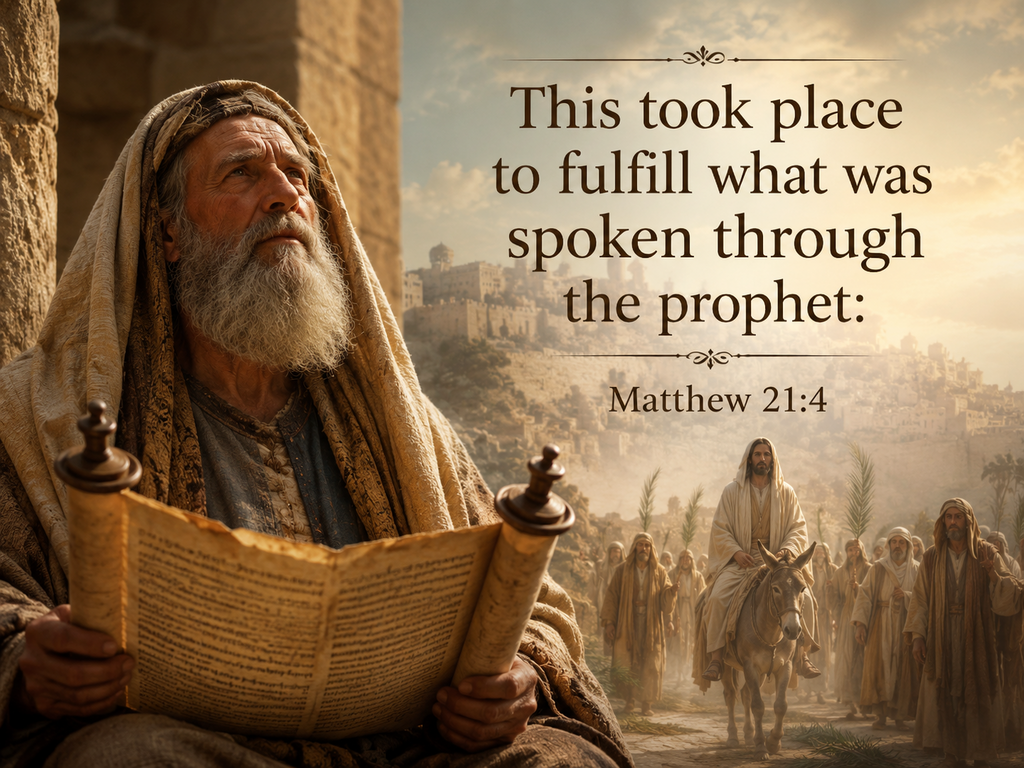
All this was done that it might be fulfilled which was spoken by the prophet, saying: Matthew 21:4
Note: You can listen to today’s commentary courtesy of our friends at the “Bible in Ten” podcast. (Click Here to listen)
You can also read this commentary, scrolling with music, courtesy of our friends at “Discern the Bible” on YouTube. (Click Here to listen), or at Rumble (Click Here to listen).
“This also, all, it having become that it should be fulfilled, the ‘having been spoken through the prophet,’ saying.” (CG)
In the previous verse, Jesus gave instructions to the disciples concerning what to say if anyone challenged them while untying the donkeys. Matthew next shows that what occurred took place in accordance with prophecy, saying, “This, also, it having become.”
As in Matthew 1:22 concerning the fulfillment of prophecy, Matthew uses a perfect participle to indicate that what had happened wasn’t just an event that took place, but that it has a resulting ongoing state.
Matthew indicates that the prophecy was intended to be fulfilled by the Messiah and that, in fact, it occurred. His fulfillment of the prophecy is the final and forever fulfillment of it. That is seen in his next words, “that it should be fulfilled.”
In other words, there was nothing random or unplanned about the event. Rather, the prophecy had been made, and Jesus’ directions to these men brought about the fulfillment of what had been recorded in Scripture. Of this, the Pulpit Commentary states, “Not only the will of the Father, but the words of Scripture, had delineated the life of Christ, and in obeying that will he purposed to show that he fulfilled the prophecies which spake of him.”
This is correct as long as one understands that Scripture is the will of the Father. There should be no separation of thought between the two, as they are harmoniously realized in the life and actions of Christ. And what has been fulfilled is “the ‘having been spoken through the prophet,’ saying…”
Prophecy is inspired by God. The writing prophet is the instrument through whom the prophecy is given, the scroll receives the words that flow from divine revelation expressed through the prophet’s mind to the quill and ink that writes out the words. In the case of the life of Christ, everything was anticipating His coming to fulfill the divine will that had become the written will of recorded prophecy.
Life application: Understanding the way in which prophecy is received is important. God did not write the words of Scripture on the scrolls maintained by Israel. Rather, God is Spirit, having no parts and not working within the stream of time. He created time and is outside of it.
What God does is to inspire a person through a process that uses the person’s own personal characteristics and circumstances. Thus, the prophet is not a tool, like a pen, that is wielded apart from any meaningful input. Rather, for example, the prophet’s personal writing style will come through.
Paul’s handwriting was clearly distinguishable, as he himself notes in Galatians 6:11. The prophet’s experiences, emotions, etc., are revealed in what he writes. And yet, what is written is clearly the word of God, as is seen in Matthew 21:4 (and elsewhere throughout Scripture).
God’s will, being expressed in the writings, will come to pass. Nothing can thwart it as the moment set by Him approaches. Thus, the writings in Scripture are a testimony to what God has determined. They stand as a witness that God’s will is, in fact, being worked out in the world.
This is why we can confidently claim what the Bible says as our own surety in doctrine and in hope. This is not a claim as if saying, “God’s word says someone can be rich and thus I claim wealth.” That is a misuse of the word.
Rather, our claim is based on the reality behind the substance of the words. “God’s word says that we are saved by grace through faith with nothing added. I stand on that. I believe it and have 100% confidence that it is true.”
This is why it is so important to know what the Bible actually says, and in its proper context. If God’s word says that Israel will be brought into the New Covenant as a nation and that they will be the head of the nations during the millennium, we should confidently avow that it will be so.
Understanding what Scripture says about the future and then standing on it is a demonstration of faith in the Lord’s sovereignty over all things. When we waffle in our convictions about a doctrinal matter, we demonstrate either a lack of faith in what is said or a lack of surety in our understanding of what is said. Either way, we should get that corrected. God’s word is written, it is authoritative, and it will come to pass. Trust this.
Lord God Almighty, help us to have surety and confidence in Your word. It is written, it makes claims and proclamations, and we should understand them and have trust in them. May our walk with You be established and grounded in Your precious word. Amen.