
Friday, 19 June 2026
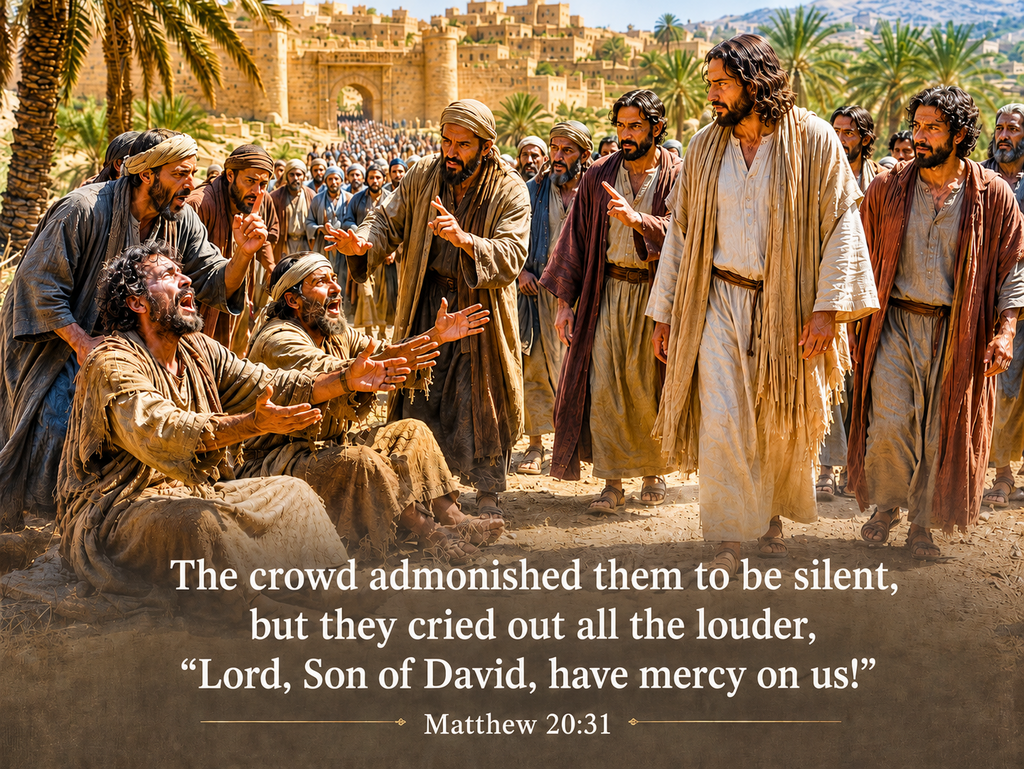
Then the multitude warned them that they should be quiet; but they cried out all the more, saying, “Have mercy on us, O Lord, Son of David!” Matthew 20:31
Note: You can listen to today’s commentary courtesy of our friends at the “Bible in Ten” podcast. (Click Here to listen).
You can also read this commentary, scrolling with music, courtesy of our friends at “Discern the Bible” on YouTube. (Click Here to listen), or at Rumble (Click Here to listen).
“The ‘also crowd’, it admonished them that they should mute. The ‘also greater they croaked’, saying, ‘You compassionate us, Lord, ‘Son, David’!’” (CG)
In the previous verse, it was noted that two blind men were sitting by the road. When they heard Jesus was passing by, they cried out to Jesus for mercy, calling Him the Lord, and the Son of David. In their crying out, there was a reaction. Matthew records, “The ‘also crowd’, it admonished them that they should mute.”
As with everything in Scripture, scholars debate why the crowd would tell them to be silent. Various suggestions have arisen. They were at the gates for a reason, which was to beg for money. This is seen elsewhere, such as the lame man in Acts 3. They would be taken to the most propitious place for getting something to help pay for their daily needs.
Depending on the time of year, that might change. At this time, because this gate sat on the road to Jerusalem, it is certain that it would be a great choice. Many people who were going to Jerusalem for the Passover would traverse the Jordan and go through the city. In the city, they would get supplies, maybe stop for some chicken kabobs, and then head out.
Having stopped, they would be refreshed and happy as they set out on the road to Jerusalem. Thus, they would be predisposed to doing something nice for a blind beggar by tossing him a coin. This would be especially so as they were heading to the Passover celebrations. Their thought would be that it is always good to have done something favorable to another when going to meet the Lord at the temple.
As such, the crowd probably admonished them to shut up, supposing that these men wanted Jesus, the great Prophet, Teacher, and possible Messiah, to give them something. The scene would be perfectly normal to anyone living at the time and surrounded by such circumstances. Despite the admonitions of the crowd, Matthew continues, “The ‘also greater they croaked’.”
One can mentally picture it. They hear that their one chance to encounter the Messiah is happening right then as He passes through the city. They lift their voices in hopes of getting His attention. The people get annoyed at the two blind people, as if they are not important enough to get a moment of Jesus’ time. “Shush! He’s not going to give you anything. Just be quiet.”
Knowing that they have been rejected by the crowds would cause them to amplify their calls. If nobody was going to help them, they would have only themselves to bring about success. Therefore, they continued “saying, ‘You compassionate us, Lord, ‘Son, David’!’”
It is completely reasonable that the crowds would have thought they were looking for a handout. Beggars have to make themselves noticed. Thus, as people walked by, they would call out, “Help for the blind. Help for the blind.” Having them crying out at the top of their voices would be… annoying. If they realized their true intent, the crowds may have been a bit more sympathetic.
The blind men repeat the same words as the previous verse, calling Jesus Lord, ‘Son, David’. Their intent goes beyond a coin being handed out to them. They are looking for the same relief that they had surely heard others had received.
Life application: The old saying, “The squeaky wheel gets the grease,” is true of these two men. They are making noise in hopes of receiving relief. If they paid heed to the admonishments of the people, their chances of having their sight restored would probably never come about. Therefore, they not only ignored the crowd’s words but they also amplified their calls.
In Luke 18, Jesus gives a parable about a woman who went to a judge in the city to get justice from her adversary. She repeatedly went to him until he finally got tired of being bothered by her and agreed to resolve her case. Her persistence brought about the result she desired.
The same is true with the person in Luke 11 who went to his neighbor’s house at midnight to borrow bread. Jesus noted that the man in the house wouldn’t get up because they were friends. Rather, he would rise because of the other man’s persistence.
The point of these teachings, and what can be seen in the plight of these beggars, is that the Lord appreciates us diligently petitioning Him. He will respond when He sees the true nature of a person who is willing to extend himself to persistently call out for an answer to his request. As the Bible bears this out, we can learn from it and continue to present our requests, knowing that in His perfect timing, He will act according to His perfect will.
Lord God, sometimes it is hard to continue prodding You for our desires and needs through prayer, as if we are bothering You. But Lord, Your word tells us we should not feel this way. Help us to be bold in presenting our petitions to You, knowing that You will respond in the manner that is best for us. Thank You for hearing our prayers. Amen.