
Tuesday, 19 May 2026
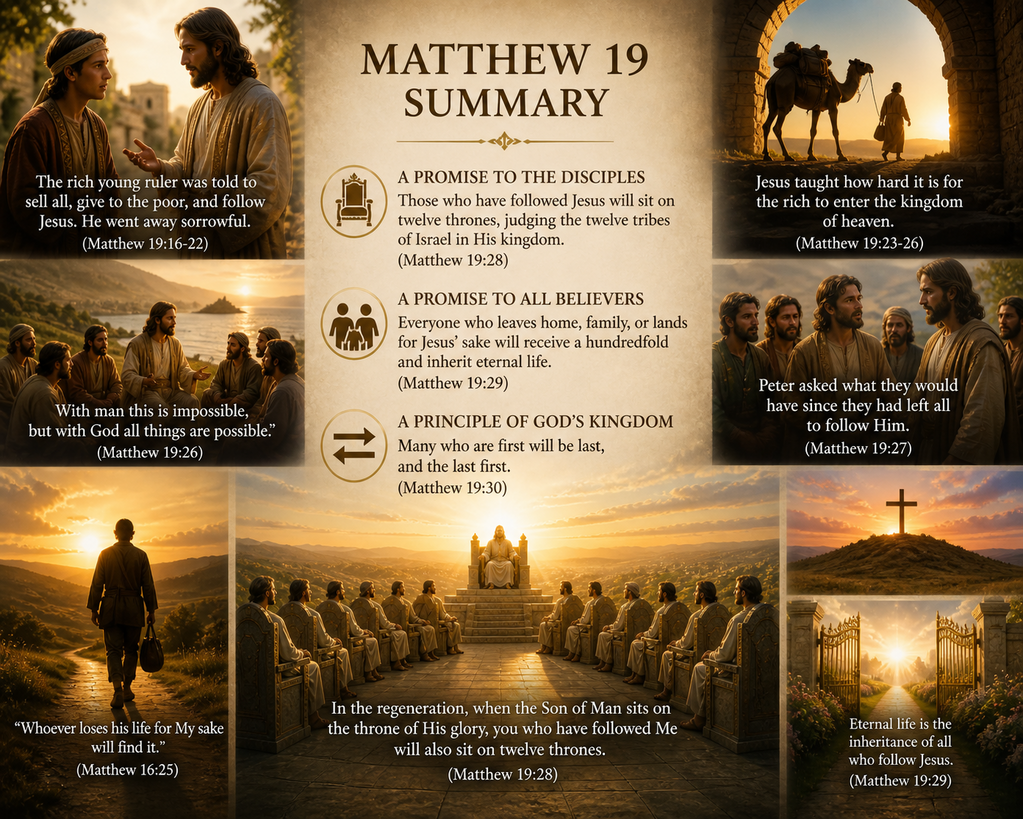
A summary of Matthew Chapter 19.
Note: You can listen to today’s commentary courtesy of our friends at the “Bible in Ten” podcast. (Click Here to listen). You can also listen to “exploring the connection between Matthew 19, the Book of Psalms, and Isaiah 19 at this link (Click Here to listen).
You can also read this commentary, scrolling with music, courtesy of our friends at “Discern the Bible” on YouTube. (Click Here to listen), or at Rumble (Click Here to listen).
Chapter 17 revealed that there is a future for Israel in God’s redemptive plans. Chapter 18, above all, showed that childlike faith is required to enter into the kingdom. The final parable, that of the wicked servant, was a clear indicator that the law is set aside but that Israel rejected Christ’s fulfillment of it and, instead, went to reimpose the law that Christ had fulfilled.
The parable ended with the thought that Israel would be delivered to the torturers (symbolized by the wicked servant being delivered up) until he should pay all that was due. Until Israel enters the New Covenant, they fulfill the typology of that wicked servant.
Chapter 19 takes the reader through various topics to reveal what God prioritizes. One can see the contrasts between law and faith as the verses progress.
Verse 1, using the word after-lifted, indicated a transition in Jesus’ ministry was taking place. The same is true with the narrative that is to be revealed. Jesus departed from the Galilee and “He came unto the borders of Judea beyond the Jordan.”
The east side of the Jordan typologically indicates a time prior to Israel’s acceptance of Jesus, the Descender, symbolized by the Jordan. The Pharisees came to Him, asking about divorce. Could a man dismiss his wife for every cause? Jesus’ answer took them back to the creation.
At the creation, God made the two one. Therefore, man was not to separate what God had conjoined. As this was the only instruction on the matter until the time of Moses, it was the ideal from the dispensation of innocence, even until the time of the law. Being the ideal, however, does not mean this is what man practiced.
As such, Jesus explained that the accommodation, which came during the dispensation of the law, was because of the hardness of their hearts. This is why Moses gave the allowance for divorce, but it was not that way from the beginning.
The covenant of marriage was to be considered binding. So much was this the case that Jesus noted that divorcing and marrying another was to be considered an act of adultery.
The intent of conveying this is to show that the law could not change the heart of man. Rather, it only highlights sin in man, something explained by Paul in Romans 7. Having heard Jesus’ words, the disciples exclaimed that if this was the case of a man with a wife, it would be better not to marry.
Jesus’ response showed that, despite the baggage of marriage, it is God’s intent. Only those who have been eunuchized in one of various ways were to be considered the exception to God’s original mandate to be married and to remain faithfully married. God’s original ideal, despite the law, was to be upheld.
With that thought complete, it was noted that children were brought to Jesus for Him to place His hands on them and to pray. The disciples admonished them concerning this, but Jesus told them not to do so, but rather to allow them to come in this manner because, as He said, “for such, it is, the kingdom of the heavens.”
The intent of His words is that those of childlike faith, not those who are obedient to law, are granted entrance into the kingdom. Immediately after that, the thought of law observance was again brought to the forefront with the introduction of the young ruler, relying on an unstated precept of the law (Leviticus 18:5), to gain him perpetual life.
He wanted to know what good he should do to obtain that state. Jesus cited commandments and precepts specifically relating to one’s relationship with his neighbor, assuring him that if he did such things, he would enter “the life.”
After claiming he had done those things, Jesus reset his thinking by telling him that one thing was lacking. He was to sell all he had, give it to the poor, and then he would have treasure in heaven. With that, he went away sorrowful.
He had failed to see that he could not meet the law’s standard, a law that pointed to Christ. Jesus was essentially telling him exactly that. “The law points to Me. If you want to be perfect under the law, sell what you have and come, follow Me.” That is how you will merit favor under the law.
With his departure, Jesus told His disciples about how difficult it is for the wealthy to enter the kingdom of the heavens. With the disciples’ incredulity at Jesus’ words, He told them that with men, it is impossible, but with God, all things are possible.
It again points to trust and salvation by grace. The wealthy ruler wanted to merit his eternal life. Jesus showed him it could not be done. Only God can provide it, and it must come through faith. Something revealed in the dispensation of grace.
The final paragraph began with the thought introduced by Peter’s question concerning what would be there for him and the other disciples. They had given up all to follow Jesus. Jesus assured them that they would sit upon twelve thrones, judging the twelve tribes of Israel.
That will occur during the dispensation of the millennium. As such, the words of Chapter 19 span all the dispensations of time. With that having been assured to the disciples, Jesus then assured all who sacrifice of themselves for His name will receive their just reward. The chapter finished up with His words that the many who are first will be last and who are last will be first.
That sets the tone for Chapter 20, where Jesus will give a parable and summarize it with that same thought.
Life application: The flow of Chapter 19 is one that repeatedly returns to the thought of the insufficiency of the law to bring about a right state before God. Rather, the law highlights sin in man, but it can do nothing to correct man’s fallen state. The supremacy of Jesus is thus on prominent display in this chapter.
Coming on the heels of Chapter 18, it stands as an admonition for Israel to give up on trying to earn God’s favor through personal merit and to come to Christ for renewal. In that, they will receive all of the promised blessings given to them throughout the prophets.
As Jesus promised the disciples that they would sit and judge Israel, it is a clear indication that these millennial blessings can only come to the nation when they acknowledge Jesus, the recognized Messiah by these disciples and the One they will serve. They have entered the New Covenant. When Israel does, it is these men who will judge them under that New Covenant.
Lord God, thank You that salvation comes through what Jesus has done. We don’t need to fret over what we must do. He has done it all! Thank You for the hope of eternal life because of Jesus Christ, our Lord. Amen.
Matthew 19
19 And it was, when Jesus completed these words, He after-lifted from the Galilee and He came unto the borders of Judea beyond the Jordan. 2And they followed Him, great crowds, and He cured them there.
3And they approached Him, Pharisees, testing Him, and saying to Him, “If it permits a man to dismiss his wife for every cause?”
4And answering them, He said to them, “Not you have read that the ‘having made’ them, from the commencement, male and female, He made them? 5And He said, ‘For this, he will leave, a man, the father and the mother, and he will be glued to his wife, and they will become, the two, into one flesh.’ 6So too, they are no longer two, but one flesh. Therefore, what God, He conjoined, not let him separate, man.”
7They say to Him, “Therefore, why he did enjoin, Moses, to give a divorce scroll to dismiss her?”
8He says to them, “Because Moses, toward the hardheartedness of you, he allowed you to dismiss your wives. But from the commencement, not it has been thus. 9And I say to you that whoever, if he should dismiss his wife not upon harlotry, and he shall marry another, he commits adultery. And the ‘having been dismissed,’ having married, she commits adultery.”
10They say to Him, His disciples, “If it is this, the case of the man with the wife, it conduces not to marry.”
11And He said to them, “Not all, they contain this word, but whom it has been given. 12For they are eunuchs who from ‘mother’s womb’ were born thus, and they are eunuchs who, they were eunuchized by men, and they are eunuchs who, they eunuchized themselves through the ‘kingdom, the heavens’. The ‘being able to contain’ he contains.”
13And they brought to Him children that He might upon-set the hands on them, and He might pray. And the disciples, they admonished them. 14And Jesus, He said, “You permit the children, and not you estop them to come to Me, for such, it is, the kingdom of the heavens.” 15And having laid the hands on them, He went thence.
16And you behold! One having approached Him, he said, “Teacher, what ‘good’ I should do that I may have ‘life perpetual’?”
17And He said to him, “Why, to Me, you say, ‘Good?’ None ‘good’, if not One – the God! And if you desire to enter ‘the life’, you guard the commandments!”
18He says to Him, “Which-such?”
And Jesus, He said, “Not you will murder, not you will commit adultery, not you will steal, not you will ‘false-witness’, 19You honor the father of you and the mother, and you will love the ‘near you’ as yourself.”
20He says to Him, the youth, “All these I guarded from my youth. What yet, I lack?”
21He said to him, Jesus, “If you desire to be complete, you go, you sell your ‘the possessings’, and you give these to ‘poor’, and you will have treasure in heaven. And you, hither! You follow Me.”
22And having heard, the young man, the word, he departed – grieving, for he was ‘having possessions, many’.
23And Jesus, He said to the ‘disciples, His’, “Amen! I say to you that wealthy, impracticably, he will enter into the ‘kingdom, the heavens’. 24Again, now, I say to you, easier, it is: camel through ‘aperture, needle’ to traverse, if rich entered into the ‘kingdom, the God’.”
25Having heard, now, the ‘disciples, His’, they were outstruck, exceedingly, saying, “Who then, he can be saved?”
26Having looked, also, Jesus, He said to them, “With men, this – impossible, it is. With, also, God – all possible, it is.”
27Then answering, Peter, he said to Him, “You behold! We, we left all, and we followed You! What hence it will be to us?”
28And Jesus, He said to them, “Amen! I say to you that you, the ‘having followed Me’, in the rebirth, when He shall sit, the Son of Man, upon ‘throne, glory, His’, you will sit, also you, upon twelve thrones, judging the twelve tribes – the Israel. 29And all, whoever he left houses, or brothers, or sisters, or father, or mother, or wife, or children, or fields because of My name, a hundredfold he will receive, and life perpetual he will inherit. 30Many, also, they will be: first, last, and last, first.”