
Saturday, 24 January 2026
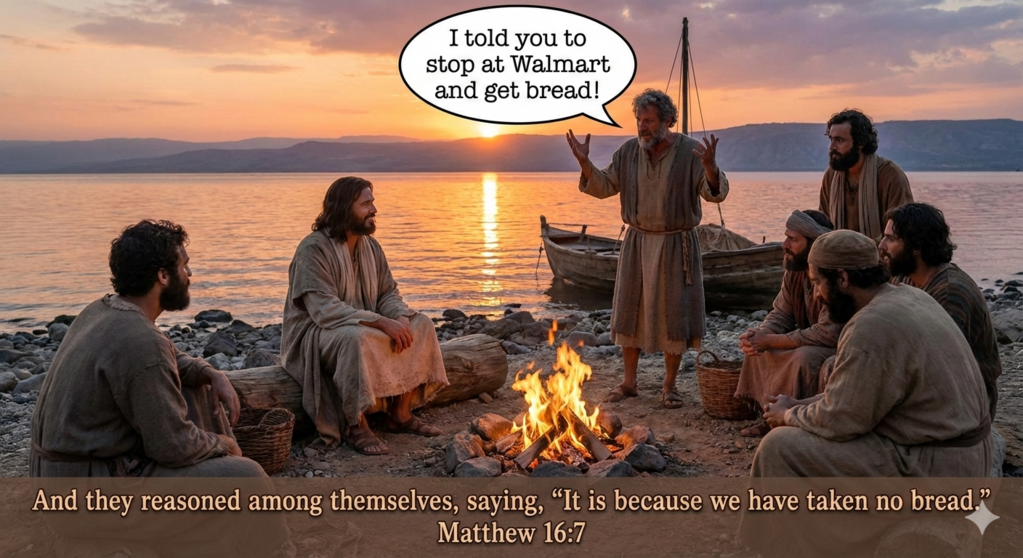
And they reasoned among themselves, saying, “It is because we have taken no bread.” Matthew 16:7
Note: You can listen to today’s commentary courtesy of our friends at the “Bible in Ten” podcast. (Click Here to listen)
You can also read this commentary, scrolling with music, courtesy of our friends at “Discern the Bible” on YouTube. (Click Here to listen), or at Rumble (Click Here to listen).
“And they deliberated in themselves, saying, ‘Because not we took bread!’” (CG).
In the previous verse, Jesus said to the disciples to beware of the leaven of the Pharisees and Sadducees. Because of Jesus’ words, not understanding the metaphor He spoke to them, Matthew records, “And they deliberated in themselves.”
A new word, dialogizomai, to reckon thoroughly, is seen. When one reckons a matter, he deliberates. HELPS Word Studies says, “properly, go back-and-forth when evaluating, in a way that typically leads to a confused conclusion. The term implies one confused mind interacting with other confused minds, each further reinforcing the original confusion.”
This word is only found in the synoptic gospels. At times, such as in Luke 1:29, it signifies an internal pondering or musing over a situation. In this case, however, any internal musing spilled over into dialogue where they deliberated the words of Jesus, “saying, ‘Because not we took bread!’”
Not understanding Jesus’ intent concerning His words about the Pharisees and Sadducees, they could only grasp at straws about what He meant. Eventually, they came to the faulty conclusion that He must be scolding them for not bringing bread. Thus, they assumed Jesus meant their shortsightedness would leave them hungry on their journey.
Life application: The definition concerning the word dialogizomai given by HELPS words studies spoke of a confused conclusion, which resulted from one confused mind interacting with other confused minds. Because they have started with the wrong premise, their conclusions will be faulty.
This pretty much sums up any rapture discussion board you may go to. People start with a faulty premise. In doing so, their analyses will always end with faulty conclusions. Jesus’ last words to His disciples were based on a question they proposed to Him –
“Therefore, when they had come together, they asked Him, saying, ‘Lord, will You at this time restore the kingdom to Israel?’ 7 And He said to them, ‘It is not for you to know times or seasons which the Father has put in His own authority. 8 But you shall receive power when the Holy Spirit has come upon you; and you shall be witnesses to Me in Jerusalem, and in all Judea and Samaria, and to the end of the earth.’” Acts 1:6-8
Paul, when referring to the timing of the rapture, uses Jesus’ words to explain end times matters –
“But concerning the times and the seasons, brethren, you have no need that I should write to you. 2 For you yourselves know perfectly that the day of the Lord so comes as a thief in the night.” 1 Thessalonians 5:1, 2
The Lord, through His word, has told us that we are simply not going to know when the rapture will take place. That is the end of the matter… well, unless you think you are smarter than God. And so people constantly and nauseatingly come up with a constant stream of predictions as to when the rapture will take place.
This has been going on for two thousand years. Eventually, some false prediction is bound to correspond to the day, merely because every day, someone has a false prediction about the rapture.
There will be no reward for “getting it right” by such a person. In fact, there will be no rewards for having wasted one’s life sitting on rapture boards with other ill-informed people, deliberating a day that we are told we will not be able to identify. Instead, there will be many who stand before the Lord and have absolutely nothing of value to present to Him for the lives they lived.
It is even questionable if many of these rapture seekers are even saved. The best way to avoid coming to faulty conclusions because of debating with confused-minded people is to not bother debating with them.
Instead, read your Bible, study it carefully, and be ready to tell people about the goodness of God in Christ. This is what we have been tasked with, so be about that good business. The Lord will come when He comes. Let’s leave that to Him.
Lord God, help us not to get caught up in sensationalism, predictions about things we are told we will not know, and focusing on the nothingness of useless banter about unproductive things. Instead, may our deliberations be based on what is sound, reasonable, and glorifying of You. Amen.