
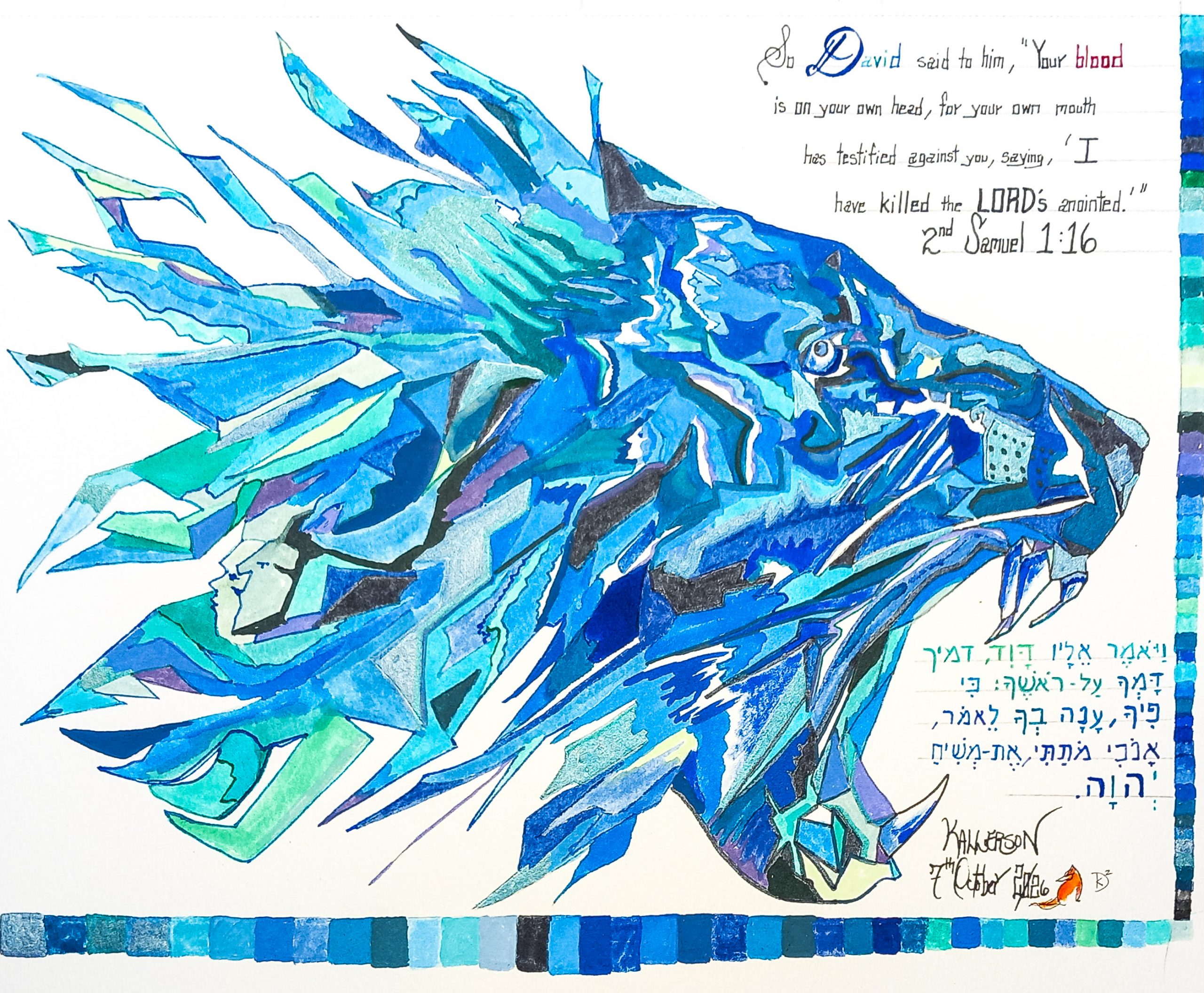
Artwork by Douglas Kallerson
2 Samuel 1:1-16
I Killed ‘Anointed, Yehovah’
(Typed 15 & 17 June 2026) 1 and 2 Samuel are considered one book in the Hebrew canon. 2 Samuel is a seamless continuation of 1 Samuel. However, that doesn’t mean that the division in our canon is inappropriate.
It is not uncommon to read commentaries that dismiss the division of Samuel into two books. Cambridge, for example, says, “The narrative of the closing chapters of the First Book is continued without any break. The division of the Books is purely artificial, and did not exist in the original Hebrew text.”
And yet the division was not invented by a Christian who wanted to disassociate the writings from the Jewish canon. Rather, the division is found in the Septuagint, the Greek translation of the Old Testament, which is of Jewish design.
My introduction to 1 Samuel is thorough, including some of the main information for 2 Samuel. Therefore, only a few key points concerning the book will be provided here, such as the key verse of the book, which is…
Text Verse: “And it will be established, your house and your kingdom, until vanishment to your faces. Your throne, it will be ‘being erect’ until vanishment” 2 Samuel 7:16 (CG)
2 Samuel is the tenth book of the Old Testament. It would be tough to find a better example of the realization of the underlying meaning of the number ten than this being the tenth book. The generations of man began with Adam.
They have been steadily worked through in the pages of the Bible since him, finally leading to David, the one whose house becomes emblematic of the messianic throne, and through whom comes the Messiah who is recognized by that throne, He being the “Son of David.”
The events of the book of 2 Samuel cover about forty years, from the beginning of David’s reign over Judah and later all of Israel, and ending chronologically in Chapter 20, with the quashing of a treasonous uprising against him.
Chapters 21-24 are generally accepted as a non-chronological appendix detailing several key events that occurred during David’s reign.
David’s rule demonstrates great devotion to the Lord, even during times of severe lapses in faithful obedience to Him. That may sound contradictory unless you, as a saved believer, go look in the mirror and consider your own life and actions.
There are twenty-four chapters to go in 2 Samuel, so let’s get started. Great things are to be found in His superior word. And so, let us turn to that precious word once again, and… May God speak to us through His word today, and may His glorious name ever be praised.
I. Saul, and Jehonathan His Son, They Died (verses 1-5)
Now it came to pass after the death of Saul
vayhi akhare moth shaul – “And it was, after ‘death, Saul’.” The words follow after 1 Samuel 31, which detailed the death of Saul and his sons. That was followed by the actions of those in Jabesh Gilead, who arose and retrieved the bodies of Saul and his sons, taking them back to Jabesh and burning them, after which they buried their bones.
While those events were going on, other events were happening.
Saul means Asked. It is identical in unpointed spelling to Sheol. Following those events detailed in 1 Samuel 31, it next says…
1 (con’t) when David had returned from the slaughter of the Amalekites,
vədavid shav mehakoth eth ha’amaleq – “and David, he returned from causing to strike the Amalek.” This is the only time the term “the Amalek” is found in Scripture. It is an odd phrase to use, replacing the more common term “the Amalekites.” Not a single translation that I read accurately translates it as it is given, with the article followed by the name in the singular.
This refers to the battle carefully detailed in Chapter 30, where David and his men crossed Wadi, the Besor to reclaim all the people and booty taken by the Amalekite invaders who plundered David’s city of Ziklag.
David means Beloved. Amalek is derived from am, people, and malaq, to nip or wring off the head of a bird with or without severing it from the body. They are The People Who Wring Off. They are those who are disconnected from the body and who strive to disconnect the body. Once the battle was complete and David returned…
1 (con’t) and David had stayed two days in Ziklag,
vayeshev david bətsiqlag yamim shənayim – “and he sat, David, in Ziklag ‘days, two’.” While Saul was alive, David had escaped to the land of the Philistines. Ziklag belonged to the Philistines at the time. After David took up residence there, it became a city of Judah from that time on.
Ziklag is derived first from tsuq, to pour out or melt, or to oppress or distress, such as to put pressure on someone to give up information or to lay siege to a city. The second part is from log, a small amount poured into a hollow, like the hand. Thus, it signifies Measure of Pressure.
Two is the number of division or difference. Two days after David returned there…
2 on the third day,
vayhi bayom ha’shəlishi – “And it was, in the day, the third.” Following the timeline from David’s return from marching with the Philistines, through all of the trials that occurred after that, it seems that David returned to Ziklag on the same day or within one day of Saul’s death in battle.
Three stands for that which is solid, real, substantial, complete, and entire. Bullinger expands on that and says –
“The number three, therefore, must be taken as the number of Divine fulness. It signifies and represents the Holy Spirit as taking of the things of Christ and making them real and solid in our experience. It is only by the Spirit that we realise spiritual things. Without Him and His gracious operation, all is surface work: all is what a plane figure is to a solid (John 3:6). He it is who has wrought all our works in us, and by whom alone we can serve or worship (John 4:24).”
2 (con’t) behold, it happened that a man came from Saul’s camp
vəhineh ish ba min-ha’makhaneh me’im shaul – “and behold, man coming from the camp, from with Saul.” Whether this person was actually with Saul as a part of his amassed army or whether he was just in the area at the time of the battle is debated. Here it says he came “from with Saul.” That is not definitive enough to say he was a part of Saul’s army. Either way, he came from the battlefield…
2 (con’t) with his clothes torn and dust on his head.
u-vəgadav qəru’im va’adamah al-rosho – “and his garments rent, and ground upon his head.” These are both signs of mourning and distress. One tears his garments in a time of distress, such as bad news or great grief. Putting the ground on one’s head indicates an idea like, “From the ground I came, and to the ground I will return.” As such, it is a sign of mourning for the dead, an indication that one feels he is deserving of death, etc.
2 (con’t) So it was, when he came to David, that he fell to the ground and prostrated himself.
vayhi bevoo el-david vayipol artsah vayishtakhu – “And it was, in his coming unto David, and he fell earthward, and he prostrated himself.” This is an act of subordination, recognizing David as the superior. So far, this is what one would expect of someone attempting to humble himself and report tragic news. David recognizes this…
3 And David said to him, “Where have you come from?”
vayomer lo david ei mizzeh tavo – “And he said to him, David, ‘Where from this you will come?’” When someone shows up in the condition this guy is in, the question is perfectly natural. Something has happened, and David is curious what it is…
3 (con’t) So he said to him, “I have escaped from the camp of Israel.”
vayomer elav mimakhaneh yisrael nimlaṭəti – “And he said unto him, ‘From ‘camp, Israel’ I was eluded.” This doesn’t bode well for Israel. To run from the camp would be unthinkable if there was a resounding victory. Thus, David probably next speaks in a hesitant and anxious tone…
4 Then David said to him, “How did the matter go? Please tell me.”
vayomer elav david meh-hayah ha’davar hagged-na li – “And he said unto him, David, ‘What it was, the word? You must cause to declare, pray, to me.’” Without being in the room, we can’t know the intonation of David’s voice, but it seems he must be stressed or fearful about the answer he may receive. The reason for this is seen in the response…
4 (con’t) And he answered, “The people have fled from the battle,
vayomer asher nas ha’am min-ha’milkhama – “And he said, ‘That it fled, the people, from the battle.’” It seems that his words form an ellipsis. David asked, “What it was, the word?” Instead of replying normally, he said, “It fled, the people, from the battle.” The response begins with a relative pronoun, “That it fled…” Thus, the ellipsis would be something like, “The word is that it fled…”
The person speaking can tell that David is disturbed, and so his response doesn’t follow the expected grammar. Without knowing the intonation, facial expression, and so forth, it is hard to tell if he thinks David is excited (maybe he will be the king soon), fearful (Israel has been defeated in battle), or something else.
Whatever the case, the man has purposefully spoken to accentuate the events. First, the battle has gone in the favor of the Philistines. His next words elevate the intensity of the situation…
4 (con’t) many of the people are fallen and dead,
vəgam harbeh naphal min-ha’am vayamuthu – “and also ‘causing to increase’, he fell from the people, and they died.” Not only did Israel turn and flee, but they were cut down as they did. The use of the singular and then the plural is like saying, “Man after man fell from the people, and as they fell, they died.” His words are excitedly intense and descriptive. And more…
4 (con’t) and Saul and Jonathan his son are dead also.”
vəgam shaul vihonathan beno metu – “And also Saul, and Jehonathan his son, they died.” This is the climax of the matter. Not only did Israel suffer great defeat and loss of men, but also the king and his anticipated successor are dead. This puts the nation in a difficult place without someone competent to assume leadership.
Israel had asked for a king. The request was granted, thus ending the time of the judges. Now, the nation stood as a rudderless ship without the king appointed over them.
Jehonathan means Yah Has Given. With the additional letter, hey, it indicates the presence of the Spirit. As for David, he needs to know more…
5 So David said to the young man who told him, “How do you know that Saul and Jonathan his son are dead?”
vayomer david el-ha’na’ar ha’maggid lo eikh yad’ata ki-met shaul vihonathan bənō – “And he said, David, unto the lad, the ‘causing to declare to him’, ‘How you knew that he died, Saul, and Jehonathan his son?’” The question is natural. If he heard that they fell, it could be that one or both was actually still alive. Falling on the battlefield is not proof that the person died, only that he was no longer actively engaged in the battle.
David hopes that the person before him may have gotten bad information…
We can face the enemy and not realize it’s him
When we are losing in our own fight
Looking for help in our trial, ever so grim
We ask him to relieve us of our plight
And yet, he is there to sever the head
Something that will bring disaster galore
With the leader gone, yes, with him dead
The enemy will destroy many more
Eventually, there is none left to keep up the fight
The battle is lost, and this enemy has won
For those who are left, it is a terrible plight
Imagine having no truth about God’s Son!
II. And They Lamented, and They Wept (verses 6-16)
6 Then the young man who told him said, “As I happened by chance to be on Mount Gilboa,
vayomer ha’na’ar ha’magid lo niqro niqreti bəhar ha’gilboa – “And he said, the lad, the ‘causing to declare to him’, ‘Being encountered, I was encountered in Mount the Gilboa.’” The lad has not said anything definite about why he was on the mountain. Was he a part of the army or the camp in support of the army? Was he there to watch as a spectator?
He leaves out key information that would normally be supplied.
In the Bible, a mountain typologically signifies a large but centralized group of people. The Gilboa means The Rolling Fountain. As for the lad, his evasive or incomplete answers continue…
6 (con’t) there was Saul, leaning on his spear; and indeed the chariots and horsemen followed hard after him.
vəhineh shaul nishan al-khanito vəhineh hā’rekhev uva’ale ha’parashim hidbiquhu – “And behold! Saul ‘being leaned’ upon his spear. And behold! The chariot and ‘masters, the steeds’ they caused to impinge him.” This guy is making the scene as active and lively as he can, setting himself up as the hero.
According to his version of the events, Saul was in retreat, going up Mount Gilboa. He was exhausted from the battle and ascent. He was propping himself up with his spear. Chariots were generally used on flat terrain. They were not intended for much beyond that.
Horsemen may find success, depending on the terrain. But fighting on horseback on an incline has limitations. 1 Samuel 31:3 gives the truth of the matter. It was archers who shot up the incline toward those in retreat.
The spear is the symbol of Saul’s authority. However, the word khanith, spear, is identical to the feminine word meaning grace.
Chariots and horsemen are used at times to signify pride and confidence in self –
“Some trust in chariots, and some in horses;
But we will remember the name of the Lord our God.” Psalm 20:7
7 Now when he looked behind him, he saw me and called to me. And I answered, ‘Here I am.’
vayiphen akharav vayir’eni vayiqra elay vaomer hineni – “And he turned after him, and he saw me, and he called unto me, and I said, ‘Behold me!’” The guy is inserting himself into the narrative in a close and personal way, as if he arrived just in time to heroically resolve whatever situation lay ahead.
8 And he said to me, ‘Who are you?’
vayomer li mi-atah – “And he said to me, ‘Who you?’” According to the person, Saul didn’t recognize him. Was he a Philistine? Was he a soldier of Israel Saul didn’t know? Or was he someone just caught up in the events as they unfolded?
8 (con’t) So I answered him, ‘I am an Amalekite.’
vayomer elav amaleqi anokhi – “— and he said [k.] unto him, ‘Amalekite, I myself.’” The written text says, “And he said.” The oral reading says, “And I said.” The only way the text as written could be correct is if the narration momentarily shifted from the Amalekite’s first-person report to the narrator’s third-person description. If so, it would look as I rendered it –
“And he said to me, ‘Who are you?’ — and he said to him, ‘I am an Amalekite.’”
Although awkward, that is not impossible, especially if Saul didn’t wait for an answer while rushing into his next question. They would have talked over one another. Meanwhile, the narrator added in the information about him being an Amalekite. This actually seems likely because of what it will say in verse 13.
Similar discords occur elsewhere, such as Nehemiah 5:9 and Zechariah 4:2. All translations go with the oral, implicitly agreeing that the variation is best understood as a preserved written irregularity corrected by the traditional reading, rather than a meaningful change in speaker.
Whatever the correct way of interpreting these words, the young man continues…
9 He said to me again, ‘Please stand over me and kill me, for anguish has come upon me, but my life still remains in me.’
vayomer elay amad-na alay umotəteni ki akhazani ha’shavats ki kal-od naphshi bi – “And he said unto me, ‘You must stand, pray, upon me, and you must kill me. For it grasped me, the convulsion, but all, yet, my soul in me.’” The noun translated as convulsion, shavats, is found only here in the Bible.
It is derived from the verb shavats, to interweave, and thus, entanglement. Its meaning is debated, but if one thinks about how convulsions interweave throughout the body when one is in agony or dying, it adequately explains the meaning.
There is a glaring oversight in the lad’s words. He says nothing of Saul’s vessel-lifter or anyone else. It is hard to imagine that Saul would be the last one standing and this guy just chanced upon him. He is setting himself up as the resolver of the matter at hand, but his words are improbable at best.
It is also unlikely that the king of Israel would ask a stranger, and an Amalekite at that, to send him off to the next world. Regardless of each point, he makes his boastful claim…
10 So I stood over him and killed him, because I was sure that he could not live after he had fallen.
va’e’emōd alav va’amotətehu ki yadati ki lo yikhyeh akhare niphlo – “And I stood upon him, and I killed him, for I knew that not he will live after his fall.” This guy has set himself up as the brave hero who mercifully put the king of Israel to death. He also seems to brag about his medical expertise, being fully aware of when a man’s wounds were so great that there was no chance of surviving.
The words “after his fall” are debated. Some take it to mean “his defeat in battle.” Conflating a defeat with physical anguish makes no sense at all. That would be like saying, “He said to me, ‘I lost the battle. I can’t live with this. Kill me now.’”
Two reasonable options come to mind. The first would mean Saul’s fall in battle. It would explain why he was propping himself up with the spear. Another possibility, which is not out of the question, is that the lad is referring to Saul’s fall from God’s favor, like the Nephilim, the fallen ones, mentioned elsewhere.
That may seem dubious, but this person is an Amalekite, the clan that Saul failed to anathematize in 1 Samuel 15. If he was aware of Saul’s state and David’s ascendancy, which is implied in him coming to David, it would explain why he was willing to claim he killed Saul.
Saul was severely wounded, and his kingdom was destined to end. As such, “not he will live after his fall” would not be referring to the time of the battle, but the surety that he would die after God rejected him in the past. The battle simply gave this Amalekite the opportunity to be the hero who would bring about Saul’s death.
If this is the correct interpretation, it is ironic that Saul’s fall was on account of Amalek, and the evidence of the final step in his fall is presented to David by an Amalekite.
As for the head, it speaks of primacy and superiority. The arm speaks of power and exertion, but also effectual reach to accomplish. The man continues…
10 (con’t) And I took the crown that was on his head and the bracelet that was on his arm, and have brought them here to my lord.”
va’eqakh ha’nezer asher al-rosho və’ets’adah asher al-zero’o va’aviem el-adoni hennah – “And I took the crown which upon his head, and step-chain which upon his arm, and I caused to bring them unto my lord hither.” This would not be what we think of as a kingly crown.
Rather, it would be a military crown of some sort that identified him as king, or maybe a ring that would go around his military helmet. Either way, it would identify Saul as the king.
The next word is etsadah, a step-chain. This is its second and last use in the Bible. It is derived from tsa’ad, a pace or a step. It is probably a chain of links, as if marching around the arm, hence a step-chain. This, too, would be an identifier of Saul’s position and authority.
The guy probably found Saul lying dead, realized it was him from his ornaments, and stripped these items from his body. Knowing David was to be the next king, he then rushed them southward to gain David’s favor. This seems to be the most probable explanation of the events. Seeing the evidence of Saul’s death, David reacts emotionally…
11 Therefore David took hold of his own clothes and tore them, and so did all the men who were with him.
vayakhazeq david bivgado vayiqra’em vəgam kal-ha’anashim asher ito – “And he caused to seize, David, in his garment [k.], and he rent them, and also all the mortals who with him.” The written text says garment in the singular. To match the plural “he rent them,” the oral tradition says “garments.”
The written text is possible, because the Hebrew word translated as “garment” can sometimes function collectively, almost like “clothing” in English. That is seen, for example, in Genesis 28:20. It is infrequently used in this manner, so the oral tradition makes the change.
As noted earlier, rending the garment is a sign of anguish and mourning. Seeing David’s actions, the others with him followed suit…
12 And they mourned and wept and fasted until evening for Saul and for Jonathan his son, for the people of the Lord and for the house of Israel, because they had fallen by the sword.
vayispəḏu vayivku vayatsumu ad-ha’arev al-shaul və’al-yəhonathan bəno və’al-am Yəhovah və’al-beith yisrael ki-naphəlu bekharev – “And they lamented, and they wept, and they fasted until the evening upon Saul, and upon Jehonathan his son, and upon ‘people, Yehovah’, and upon ‘house, Israel’, for they fell in the sword.” Saul was the leader of the nation, even if he blew it as a king.
Therefore, he was mourned over as any leader would normally be. The loss of Jonathan would add to the unhappy national situation by removing Saul’s successor and any chance for a smooth transition.
The “people of Yehovah” probably refers to those in the army who died as well as those who lived, now without a military leader. The house of Israel refers to the entire nation, which was now left without a king. The situation was bad news all around.
13 Then David said to the young man who told him, “Where are you from?”
And he answered, “I am the son of an alien, an Amalekite.”
vayomer david el-ha’na’ar ha’magid lo ei mizeh atah vayomer ben-ish ger amaleqi anokhi – “And he said, David, unto the lad, the ‘causing to declare to him’, ‘Where from this, you?’ And he said, ‘Son ‘man, sojourner, Amalekite’ I myself.’” This gives weight to sticking with the written text in verse 8.
If the Amalekite had told David this, rather than it being a narrator’s explanation, it would make no sense for David to ask him again. Attempts have been made to indicate that the words “where from this, you” mean something like “to whom do you belong.”
That would smooth over the obvious difficulty of verse 8, but the person’s response to David shows exactly what David’s intent was. He is the son of an Amalekite who had taken up residence in Israel.
It explains why he was aware of who Saul was, how he knew Saul had fallen out of favor with the Lord, and why he came to David. He was aware of everything going on and wanted to gain favor with the obvious candidate for the next king. One thing he didn’t know, however, was how David would react to his story…
14 So David said to him, “How was it you were not afraid to put forth your hand to destroy the Lord’s anointed?”
vayomer elav david eikh lo yareta lishloakh yadəkha ləshakheth eth-məshiakh Yəhovah – “And he said unto him, David, ‘How not you feared to send your hand to ruin ‘anointed, Yehovah’?’” David was given opportunities to take Saul’s life. He explicitly stated he would not do so because the anointing of the Lord rested on Saul.
The fact that this person claims to be a sojourner in Israel means he should know that Saul was the anointed king. Despite being a liar about the entire death scenario, his words testify that he was guilty of a crime against the Lord. Therefore, whacking time has arrived…
15 Then David called one of the young men and said, “Go near, and execute him!” And he struck him so that he died.
vayiqra david lə’akhad meha’nə’arim vayomer gash pəg’a-bo vayakehu vayamoth – “And he called, David, to one from the lads, and he said, ‘You must near! You must impinge in him!’ And he caused to strike him, and he died.” David already had the ruling authority. He was anointed by Samuel.
Therefore, with Saul dead, he had the full right, authority, and responsibility to vindicate Saul’s death. To not do so would be an affront to the Lord whose anointing oil rested upon Saul. Therefore, the words of the Amalekite were his own witness and sentence against himself. David merely ordered what must be done.
And thus ended the life of one more Amalekite…
16 So David said to him, “Your blood is on your own head,
vayomer elav david damekha al-roshekha – “And he said unto him, David, ‘Your bloods [k.] upon your head!’” The written text says bloods. The oral tradition changes it to read blood in an attempt to smooth out the thought. But that is completely unnecessary.
The plural signifies an association with bloodshed or bloodguilt. It is a way of intensifying the legal sense concerning the responsibility for Saul’s death. The lad made the claim, and he must accept the bloods, the bloodguilt, for his actions. Abigail used the same terminology in 1 Samuel 25:26, and Solomon will used it in 1 Kings 2:37. David gives the explanation next…
*16 (fin) for your own mouth has testified against you, saying, ‘I have killed the Lord’s anointed.’”
ki phikha anah vəkha lemor anokhi motati eth-meshiakh Yəhovah – “For your mouth, it answered in you, to say, ‘I myself, I killed ‘anointed, Yehovah’.” David didn’t need to investigate any further. The man claimed he did it, and he provided the evidence that Saul was dead. Having the king’s ornaments in his possession after admitting the act was all David needed to make his determination.
This is all the surer because David had, in the past, explicitly said that it was morally objectionable for him to take Saul’s life, even after he had been anointed king in place of Saul. There was no excuse for the man’s actions, and there could be no excuse for David to not execute him.
God’s word is truth, sufficient to save
But having the truth isn’t enough
One must believe the word that God gave
But for some, that may still be tough
One can believe that the story of the ark is true
But not understand the message behind it
There must be a lens for one to look through
To find Christ in the story and to believe it
Until the veil is lifted from one’s eyes
Reading the word will not save
Finding Jesus and accepting Him is the prize
Only then can one truly believe the word that God gave
III. The Death of the Truth in Israel
Verse 1 noted that after the death of Saul, Asked, and at the time that David, accepting the doctrines of Christ, returned from striking Amalek, David stayed in Ziklag for two days. Saul died at essentially the same time that David was in Ziklag, Measure of Pressure.
Ziklag typologically pictured the tribulation in 1 Samuel, but it extends beyond that to tribulations in one’s own life. In Colossians 1:24, Paul speaks of the thlipseōn tou Christou, the ‘tribulations, the Christ’. It is a truth that will explain itself as we go.
It is highlighting the difference between Saul and David. There are those who are seeking the truth, whether saved or not, and there are those who accept the doctrines of Christ. One, now dead, was the anointed king. The other is the living anointed king.
In verse 2, it said, “on the third day.” It is the number of that which is solid, real, substantial, complete, and entire. It is the number of Divine fullness. It “signifies and represents the Holy Spirit as taking of the things of Christ and making them real and solid in our experience.” Bullinger
As this is the third day after Saul’s death, it is the day when that which anticipated Christ and His work is realized. It is the time when the Spirit made them real and solid in our experience through the cross and resurrection.
At this time, it mentions the man who came from the camp, from ‘with Saul’. He was supposedly in a state of mourning, having his garments rent and the ground on his head. He came to David, accepting the doctrines of Christ, and prostrated himself before him.
When David asked him where he had come from (verse 3), he said he had escaped from the camp of Israel. Knowing what that meant, in verse 4, David asked to be briefed concerning the situation.
In response, the man said in ascending order that the people fled from the battle, many fell dead, and that also Saul, Seeking the Truth, and Jehonathan, Yah Has Given, the saved believer with the Spirit, had died.
In verse 5, David asked how the man knew they were dead. In verse 6, the man only responded with his knowledge about Saul, but it logically follows that he knew about Jonathan if he proved he knew about Saul.
He said he was there on Mount the Gilboa (Gathering of the Rolling Fountain) and he saw Saul leaning on his spear. As seen in Chapter 31, this was the time of the early church, while those of Israel were still the mainstay of the Christian faith. The spelling of spear, without the later-added vowel points, is identical to the feminine word for grace. Saul was leaning on his grace.
However, the chariots and horsemen, typical of those who are prideful and trust in self, were set to impinge in Saul. Therefore, in verse 7, it said that Saul called to the lad. In verse 8, Saul asked who he was. He continued, requesting that they should come and kill him because the convulsion had grasped him (verse 9), but his soul was still in him.
This typologically looks to the time when Israel’s faith in Jesus was almost at its end. At the same time as Saul was speaking, the man said he was an Amalekite, but Saul talked over him. Hence the narrator (verse 8) said (and he said) that the man said he was an Amalekite.
It appears that Saul didn’t even bother waiting for an answer to find out who he was. He just wanted to get his words out while he had strength, going from one question to the next while the first question was being answered.
Because of this, Saul never realized that the same type of person who had battled against him (the Philistines) was set to finish him off (Amalek). Israel was destroying itself as they got caught up with those who wanted to sever the head from the body.
In verse 10, having heard Saul’s plea, the man said he stood over Saul and killed him, knowing that he could not survive. After that, it said he took the crown off his head and the step-chain off his arm, the proofs of who Saul was.
The head speaks of primacy and superiority. The arm speaks of power and exertion, but also effectual reach to accomplish. He removed these from Saul and took them to David, signifying that those things which belonged to Saul were now David’s. Accepting the doctrines of Christ now possesses what Saul, seeking the truth, once possessed.
Being in Ziklag, Measure of Pressure, means the Jewish believers were suffering the tribulations of Christ during this period. Eventually, accepting the doctrines of Christ would no longer be a part of Israel’s experience. Those who accept His doctrines would be in the Gentile-led church.
With the evidence of Saul’s death presented to him, it said (verse 11) that David and his men tore their clothes, rending them. It also noted in verse 12 that they fasted and wept until evening for Saul and Jonathan, the people of the Lord, and for the house of Israel. The reason was, “for they fell in the sword.”
The kherev, sword, is identical in unpointed spelling to Horeb, the mountain of the law. In typology, they are identical, referring to the Law of Moses. The faith of those of Israel who pursued the truth was eventually killed off by law observance. We are getting essentially the same picture as 1 Samuel 31, but with different points to consider.
In verse 13, David asked the man, “Where from this, you?” He wanted to know about his identity in relation to what he had done. He answered that he was a son of a sojourner, an Amalekite. The meaning is that an Amalekite had taken up residence in Israel, and he was his son. Until this point, David didn’t know this.
Hearing that, in verse 14, David wanted to know how he failed to fear when sending out his hand to ruin the anointed of Yehovah. Without waiting for a response, in verse 15 he called for one of his lads to strike and kill the Amalekite. It never mentioned that this was done with a sword, even if that is what happened. Any picture of the law is left out of the matter.
In verse 16, David noted that his bloods, his bloodguilt, was on his own head because his mouth testified against him. He said that he had killed meshiakh Yəhovah, Messiah, Yehovah.
Every semblance of the Messiah was killed out of Israel by Amalek, typologically picturing the spiritual leaders of the nation who removed every vestige of the truth of Jesus from Israel’s collective conscience. Those same people, represented by Amalek, remain in control of the nation’s spiritual health today in synagogues around the world.
It doesn’t matter if the story given by the Amalekite was true or not. What matters is that he claimed it was and that the Bible records it this way. For all intents and purposes, the Philistines and the Amalekites serve the same purpose. One is there to weaken the faith of others. The other is there to separate the body from the Head.
These are the religious leaders of Israel for the past two thousand years. Those of Israel who were seeking the truth were eventually stopped from doing so by the Judaizers and law observers. They took away any chance of Israel coming to a saving knowledge of the truth about Jesus, their Messiah, after the earliest years of the faith.
Eventually, the knowledge of Jesus was stolen from them, pictured in the death of Saul. Seeking the truth in Israel was over, symbolized by Saul’s death. In 1 Samuel 31, it was the Philistines. In this chapter, it is the Amalekites. David, accepting the doctrines of Christ, saw what was done when Saul’s authority was removed from him.
He was presented with the implement of Saul’s authority, but the Amalekite failed to sway David. Seeking the truth is not the same thing as accepting the doctrines of Christ. At one time, seeking the truth was the preeminent thing going on in redemptive history, but that died out after Christ’s incarnation.
The transition from Israel to the church is seen in this passage, where accepting the doctrines of Christ, meaning having faith in Christ and His work as Yehovah’s Messiah, is what reigns.
For those who teach against this, David’s words to the Amalekite are essentially the words of Jesus to Israel’s religious elite, “Your bloods [k.] ‘upon your head’! For your mouth, it answered in you, to say, ‘I myself, I killed ‘anointed, Yehovah’.”
What a sad place to be on the day when they must stand before Jesus and give a reckoning for their lives and how they have dissuaded so many from ever coming to a saving knowledge of the truth.
Imagine being the people of the Lord, having every imaginable proof that your Messiah had come, and yet not only rejecting those things, but also destroying the faith of those within the nation seeking the truth!
A tragic part of this is that when they read their own Scriptures, they come to stories about the Philistines, Amalek, Haman, and other foes of their national identity, and yet these foes picture them or the doctrines they hold to. Despite this, they cannot see it.
Until they, as a people, come to understand who Jesus is and what He has done, they will continue to be their own worst enemies. In pursuing the Torah, they think they are pursuing the truth, but they are unwittingly pursuing lies because they have missed what the Torah points to.
This extends beyond Israel to many who claim to be in the church. In following the law, they cannot follow the grace of God found in Jesus. The two are mutually exclusive. Until the blinders are removed, they will continue to be represented by the Philistines and Amalekites.
For those who have called on Jesus, hold fast to the grace found in Him. For a right walk with the Lord, nothing else will do.
Closing Verse: “But their minds were blinded. For until this day the same veil remains unlifted in the reading of the Old Testament, because the veil is taken away in Christ.” 2 Corinthians 3:14
Next Week: 2 Samuel 1:17-27 This will move your heart, I know… (The Bow) (2nd 2 Samuel Sermon)
The Lord has you exactly where He wants you. He has a good plan and purpose for you. He is the One who abases the haughty and exalts the humble. He regards the lowly, and the proud, He knows from afar. So yield yourself to Him, trust Him, and believe His word. In this, He will do great things for you and through you.
2 Samuel 1:1-16 (CG)
1 And it was, after ‘death, Saul’, and David, he returned from causing to strike את the Amalek. And he sat, David, in Ziklag ‘days, two’. 2And it was, in the day, the third, and behold, man coming from the camp, from with Saul, and his garments rent, and ground upon his head. And it was, in his coming unto David, and he fell earthward, and he prostrated himself.
3And he said to him, David, “Where from this you will come?”
And he said unto him, “From ‘camp, Israel’ I was eluded.”
4And he said unto him, David, “What it was, the word? You must cause to declare, pray, to me.”
And he said, “That it fled, the people, from the battle, and also ‘causing to increase’, he fell from the people, and they died. And also Saul, and Jehonathan his son, they died.”
5And he said, David, unto the lad, the ‘causing to declare to him’, “How you knew that he died, Saul, and Johnathan his son?”
6And he said, the lad, the ‘causing to declare to him’, “Being encountered, I was encountered in Mount the Gilboa. And behold! Saul ‘being leaned’ upon his spear. And behold! The chariot and ‘masters, the horseforce, they caused to impinge him. 7And he turned after him, and he saw me. And he called unto me, and I said, ‘Behold me!’ 8And he said to me, ‘Who you?’ And he said [k.] unto him, ‘Amalekite, I myself’. 9And he said unto me, ‘You must stand, pray, upon me, and you must kill me. For it grasped me, the convulsion*. But all, yet, my soul in me.’ 10And I stood upon him, and I killed him, for I knew that not he will live after his fall. And I took the crown ‘which upon his head’, and step-chain which ‘upon his arm’, and I caused to bring them unto my lord hither.”
11And he caused to seize, David, in his garment [k.], and he rent them. And also, all the mortals who with him. 12And they lamented, and they wept, and they fasted until the evening~ upon Saul, and upon Jehonathan his son, and upon ‘people, Yehovah’, and upon ‘house, Israel’, for they fell in the sword.
13And he said, David, unto the lad, the ‘causing to declare to him’, “Where from this, you?”
And he said, “‘Son, man, sojourner, Amalekite’ I myself.”
14And he said unto him, David: “How not you feared to send your hand to ruin את ‘anointed, Yehovah’?” 15And he called, David, to one from the lads, and he said, “You must near! You must impinge in him!” And he caused to strike him. And he died. 16And he said unto him, David, “Your bloods [k.] ‘upon your head’! For your mouth, it answered in you, to say, ‘I myself, I killed את ‘anointed, Yehovah’.”
Verse 8 – Qeri: “And I said.” The Qeri follows the flow of the Amalekite’s first-person report. The Kethib requires a narrator shift as indicated. Similar K/Q cases elsewhere include Nehemiah 5:9 and Zechariah 4:2.
*Verse 8 – Hebrew: shabats, a unique word coming from v. shabats, to interweave. As such, there is an interweaving of pains. Hence, convulsions.
Verse 11 – Qeri: To match the plural “he rent them” says, “in his garments.”
Verse 16 – Qeri: “Your blood.”
2 Samuel 1:1-16 (NKJV)
1 Now it came to pass after the death of Saul, when David had returned from the slaughter of the Amalekites, and David had stayed two days in Ziklag, 2 on the third day, behold, it happened that a man came from Saul’s camp with his clothes torn and dust on his head. So it was, when he came to David, that he fell to the ground and prostrated himself.
3 And David said to him, “Where have you come from?”
So he said to him, “I have escaped from the camp of Israel.”
4 Then David said to him, “How did the matter go? Please tell me.”
And he answered, “The people have fled from the battle, many of the people are fallen and dead, and Saul and Jonathan his son are dead also.”
5 So David said to the young man who told him, “How do you know that Saul and Jonathan his son are dead?”
6 Then the young man who told him said, “As I happened by chance to be on Mount Gilboa, there was Saul, leaning on his spear; and indeed the chariots and horsemen followed hard after him. 7 Now when he looked behind him, he saw me and called to me. And I answered, ‘Here I am.’ 8 And he said to me, ‘Who are you?’ So I answered him, ‘I am an Amalekite.’ 9 He said to me again, ‘Please stand over me and kill me, for anguish has come upon me, but my life still remains in me.’ 10 So I stood over him and killed him, because I was sure that he could not live after he had fallen. And I took the crown that was on his head and the bracelet that was on his arm, and have brought them here to my lord.”
11 Therefore David took hold of his own clothes and tore them, and so did all the men who were with him. 12 And they mourned and wept and fasted until evening for Saul and for Jonathan his son, for the people of the Lord and for the house of Israel, because they had fallen by the sword.
13 Then David said to the young man who told him, “Where are you from?”
And he answered, “I am the son of an alien, an Amalekite.”
14 So David said to him, “How was it you were not afraid to put forth your hand to destroy the Lord’s anointed?” 15 Then David called one of the young men and said, “Go near, and execute him!” And he struck him so that he died. 16 So David said to him, “Your blood is on your own head, for your own mouth has testified against you, saying, ‘I have killed the Lord’s anointed.’”