
Tuesday, 17 March 2026
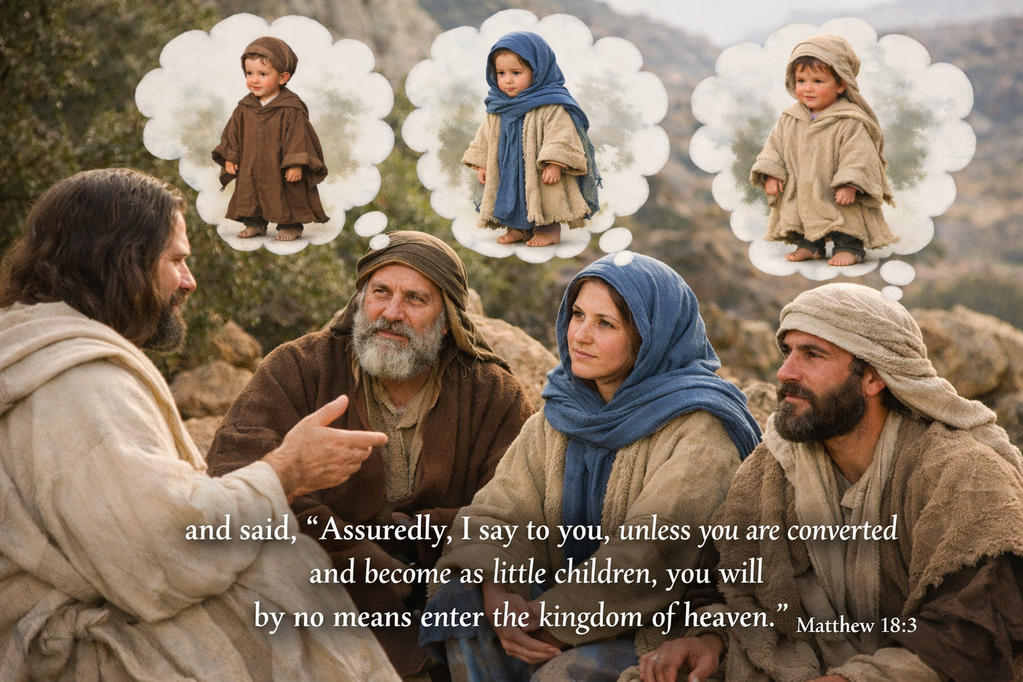
and said, “Assuredly, I say to you, unless you are converted and become as little children, you will by no means enter the kingdom of heaven. Matthew 18:3
Note: You can listen to today’s commentary courtesy of our friends at the “Bible in Ten” podcast. (Click Here to listen)
You can also read this commentary, scrolling with music, courtesy of our friends at “Discern the Bible” on YouTube. (Click Here to listen), or at Rumble (Click Here to listen).
“And He said, ‘Amen! I say to you, if not you should turn, and you should become as the children, no, not you should enter into the kingdom of the heavens’” (CG).
In the previous verse, Jesus called a child to Him and set him in the midst of the disciples. Matthew continues with Jesus’ object lesson as He provides why the child was presented as he was. Matthew records, “And He said, ‘Amen!’”
The sense here is, “Pay attention! This is a truth that you must understand and accept as I speak it.” Understanding this, He continues with, “I say to you, if not you should turn.”
The meaning is that they are on a path of thinking one way, and they must turn and think completely differently. The path they were on is one of “who is the greatest?” It reflects a self-serving attitude that is incompatible with the humility necessary to accept God’s proposition for salvation in Christ. Jesus continues, saying, “and you should become as the children.”
The turning is from adamant assertion to innocent acceptance. Jesus is speaking about the kingdom. There are various meanings of what ‘kingdom’ signifies, but this one is clearly about the offering that is made by God in Christ based on Jesus’ ministry.
Though that is not yet ready to be offered, and though the disciples have no idea what it entails at this point, Jesus is speaking about how to obtain salvation and entry into what God is doing in redemptive history, of which Jesus is the key.
Children are little people. People do wrong. When a child is presented with his wrongdoing and told how to correct it, the child will accept what he is told. This is because children have not yet processed the world around them enough to form their own ideas about such things.
Therefore, he will believe what he is told by simple faith. Until a child learns when people are lying or kidding, they take what they hear at face value. God, who never lies, is to be taken at face value. This is the point of Jesus’ words.
There is no feeling of superiority or earning what is necessary for restoration. There is the innocence of acceptance. Along with that, there is no thought by the child of how great he is or how he can earn exaltation in mommy’s eyes. There is just the simple desire for restoration. With that in mind, Jesus continues with, “no, not you should enter into the kingdom of the heavens.”
The double negative is an adamant assertion that follows emphatically after the “Amen” previously stated. This is exactly what Paul writes about in Galatians 5 –
“Stand fast therefore in the liberty by which Christ has made us free, and do not be entangled again with a yoke of bondage. 2 Indeed I, Paul, say to you that if you become circumcised, Christ will profit you nothing. 3 And I testify again to every man who becomes circumcised that he is a debtor to keep the whole law. 4 You have become estranged from Christ, you who attempt to be justified by law; you have fallen from grace.” Galatians 5:1-4
How does that match what Jesus says, you ask? Because when one rejects Christ’s fulfillment of the law, he rejects Christ’s cross. But the cross is the only thing that can cleanse someone from sin. The law only magnifies guilt before God.
The gospel asks a person to become like a child. The cross demands that a person acknowledge he has sinned (Christ died for your sins, implying you are a sinner), and to accept the avenue God has set forth for restoration. There is no need for a cross for someone who has not sinned.
God has set forth what brings restoration. When we, like children, accept what He has done, it is an acknowledgment that what God has done is sufficient. The simple faith of a child is what God expects.
Life application: Some scholarly comments on this verse show the inability of people to understand what Jesus is saying –
“What was needed was that they should ‘turn’ from their self-seeking ambition, and regain, in this respect, the relative blamelessness of children.” Ellicott. It is true that there is a need for turning from self-seeking ambition, but children are not blameless. When we come to the cross, we do not make ourselves blameless. We come to the cross to be made blameless through Christ’s imputation of His sinlessness.
“…and become like little children — ‘Free from pride, covetousness, and ambition, and resemble them in humility, sincerity, docility, and disengagement of affection from the things of the present life, which excite the ambition of grown men.’” Benson. If Benson is saying that we need to do these things to merit the kingdom, he is completely missing the point. We come to God acknowledging that we are these things, we have offended Him because it is so, and ask to be forgiven in Christ. From there, we can then conform our lives to His expectations. The cart of works must come after the horse of acknowledgment of sin at the cross.
“How many who pass for converted, regenerate persons have need to be converted over again, more radically.” Expositor’s Greek Testament. Are they talking about entering the kingdom after salvation? If so, then they have missed the mark. Salvation is a one-time for all-time proposition. It is true we need to live properly after salvation, but there is no “re-meriting” salvation after it has been granted.
“There is no question here about what is popularly known as conversion – the change from habitual sin to holiness.” Pulpit Commentary. Without explaining how this happens, the words are insufficient and appear to claim we must “fix ourselves.” This is completely incorrect. We come to Jesus as we are with all our baggage, acknowledge we are sinners, and believe He forgives us. Only then do we make an effort to go from “habitual sin to holiness.” If we were to do that first, we would not be like children. We would be “meriting” our salvation.
“The phrase, ‘Except ye be converted,’ does not imply, of necessity, that they were not Christians before, or had not been born again. It means that their opinions and feelings about the kingdom of the Messiah must be changed. They had supposed that he was to be a temporal prince. They expected he would reign as other kings did. They supposed he would have his great officers of state, as other monarchs had, and they were ambitiously inquiring who should hold the highest offices. Jesus told them that they were wrong in their views and expectations. No such things would take place. From these notions they must be turned, changed or converted, or they could have no part in his kingdom. These ideas did not fit at all the nature of his kingdom.” Barnes. Barnes, what are you talking about? Jesus is referring to entering the kingdom of the heavens. If you are born again, you have entered it. The commentary has so overcomplicated what Jesus is saying that there is no hope of reconciling it with coming to Christ for forgiveness, the very thing that will allow the disciples, and indeed all people, to enter.
Life application lesson: Keep the salvation message simple. You have sinned. You need Jesus. Believe the gospel. Don’t try to fix yourself. You can’t. Jesus, we need Jesus to fix us. Believe the gospel.
Lord God, help us to never complicate grace. It is Your offering. If we have to earn it, it is not grace. Help us not to mar the gospel. You have done the work through Jesus. There is nothing we can add to it. Help us to learn these simple, fundamental, and eternity-changing truths. Amen.