
Thursday, 9 April 2026
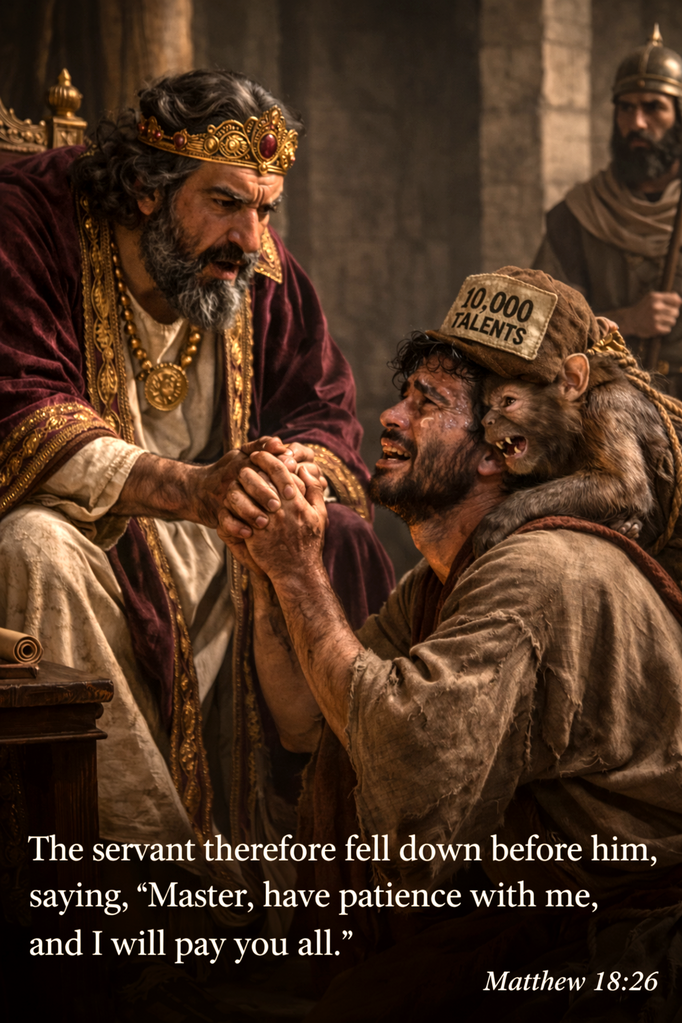
The servant therefore fell down before him, saying, ‘Master, have patience with me, and I will pay you all.’ Matthew 18:26
Note: You can listen to today’s commentary courtesy of our friends at the “Bible in Ten” podcast. (Click Here to listen)
You can also read this commentary, scrolling with music, courtesy of our friends at “Discern the Bible” on YouTube. (Click Here to listen), or at Rumble (Click Here to listen).
“Having fallen, therefore, the servant, he prostrated to him, saying, ‘Lord, you long-wrath upon me, and all, I will pay you.’” (CG)
In the previous verse, the master commanded that the debtor be sold along with his wife and children. In fact, all he had was to be sold to pay his debts. Jesus continues, saying, “Having fallen, therefore, the servant, he prostrated to him.”
It is a natural reaction one would expect when facing such a terrible sentence. The man was completely overwhelmed at the prospect of a life that would forever be removed from him and another life that would end in bondage, maybe until the day he died. Therefore, he fell flat before his master.
The word proskuneó is believed to be derived from kuón, dog or dogs. As such, it signifies total submission, even to licking a master’s hand or maybe his foot. It can be out of honor, respect, or groveling submission. In this case, it is certainly the latter. Along with that, he was saying, “Lord, you long-wrath upon me, and all, I will pay you.”
A new word is seen, makrothumeó, it is derived from makros, long, and thumos, wrath. Thus, a literal translation would be long-wrath, as in holding off in anger and thus being patient. The servant not only asks for this patience, but he also promises full restoration of everything he owed.
With the knowledge that he could be taken into servitude anytime afterwards, he would be highly motivated not to let his promise fall to the wayside.
Life application: An obvious question that comes to mind is, “Just how did the servant amass such an enormous debt?” Regardless of how it came about, the debt existed. One can see an obvious parallel to our pitiful state before God.
We owe a sin debt that must be dealt with. It doesn’t matter if it is a little child in Papua New Guinea or someone like Adolph Hitler, the sin debt that is owed is infinite. We were born of Adam’s race, thus inheriting sin. As Paul says in Romans 5:12, “just as through one man sin entered the world, and death through sin, and thus death spread to all men, because all sinned.”
Hitler may have more sin-debt accrued in his life, but the sin of both is infinite in relation to God. Therefore, there is no hope of restitution, even if we say we will repay it, as law observers think we can. But that is only because pride in self overcomes the realization that only God can accomplish what is necessary for restoration.
A second point of this verse is that the person has asked for release from the sentence. The master has not arbitrarily said, “Ok, you owe me all this money, never mind it. We’ll just start fresh from here.” But this is the premise of Christians who say we must forgive every offense, without exception.
That is not taught in the parable, nor is it taught anywhere else in Scripture as a prescription. God sent Jesus into the world to pay the sin debt for humanity. The payment is universal in scope, but it is not universally applied without the condition for its application being met, which is to believe the gospel.
No person on the planet will ever be received by God without coming through His Messiah, Jesus Christ. To reject Him means that the infinite debt will never be paid. Complete and total separation from God is the inevitable result. Choose wisely. Choose Jesus.
Lord God, may we be wise in understanding the level of debt that is owed to You. May we never assume that by our deeds we can find restoration with You. The law only further separates us from a restored relationship. Help us to think clearly and then trust completely in the cross of Jesus Christ to mend the rift. Amen.