
Friday, 27 March 2026
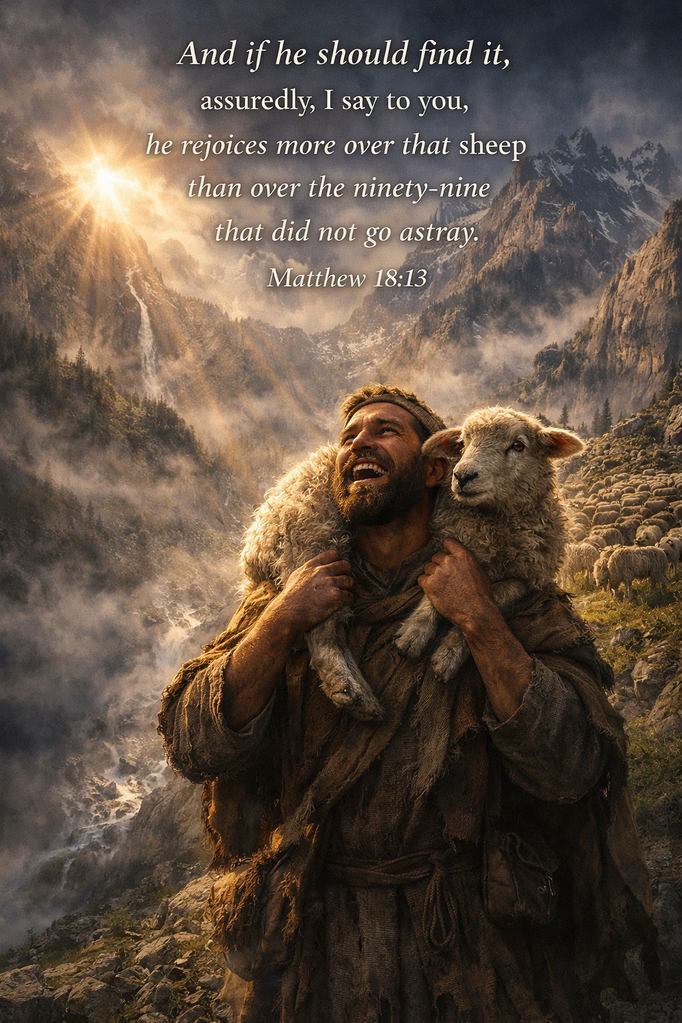
And if he should find it, assuredly, I say to you, he rejoices more over that sheep than over the ninety-nine that did not go astray. Matthew 18:13
Note: You can listen to today’s commentary courtesy of our friends at the “Bible in Ten” podcast. (Click Here to listen)
You can also read this commentary, scrolling with music, courtesy of our friends at “Discern the Bible” on YouTube. (Click Here to listen), or at Rumble (Click Here to listen).
“And if it should become – found it! Amen! I say to you that he rejoices upon it more than upon the ninety-nine, the ‘not having roamed’.” (CG)
In the previous verse, Jesus asked the disciples what they thought a man would do if one of his flock of a hundred went astray. Wouldn’t he go after the one to find it? He now continues, saying, “And if it should become – found it!”
The man went into the mountains looking for his lost sheep, leaving the other ninety-nine that were not lost. As he searched, he eventually caught up with the wayward wanderer. It is an exciting time for him. Hooray! The Lord guided his steps to obtaining his objective and retrieving it. Therefore, Jesus says, “Amen! I say to you that he rejoices upon it.”
This is a natural reaction. When we lose something important to us, it becomes the object of our attention. Other things move to the background, and our pursuit of what is lost takes over as a greatly motivating desire.
This is so much the case that when it is found, our inner emotions are relieved, the tension we felt fades away, and a sense of calm in our mind is restored. Because of this, the emotion of joy replaces these harsher emotions. This is natural anytime we go through such things.
This type of joy actually elevates what transpired so much that there is a sense of it above what wasn’t lost. That was never a consideration, and so we take possession of it as a normal event. Thus, for the man, the joy over what is found is “more than upon the ninety-nine, the ‘not having roamed’.”
This is to be taken as an axiom. If we have money in the bank, for example, we consider it safe. It doesn’t come to mind except when we need it. We assume it is there and may be happy about it in some manner, just as a shepherd is happy about his big flock, but we don’t get anxious about it and then rejoice when we go to the bank to take out some of it, as if we would if it were lost.
But if we have a little stash at the house, which is kept for emergencies, and if we were to lose that, we would be terribly distraught and seek high and low for it. If we should find it, we will have a thorough sense of elation that it has been recovered. Jesus, making an obvious metaphor for us to consider, says that the shepherd feels the same way about his lost sheep.
Life application: Jesus uses a subjunctive verb in this verse to describe the state of His metaphor, “if it should become.” As Jesus is the Lord, the words He uses are precise and carefully laid out in Scripture to convey the way things are. He says as much in Matthew 5:18 concerning the law.
Everything in the word has been meticulously set forth for us to understand what is going on in the world around us. There are facts to be understood in this parable. One is that there is a shepherd and that he has sheep. Jesus is basing this parable on people who came to Him with childlike faith.
After coming to Him in faith, he wanders off. It is Jesus’ intent for that person to come back into the fold. However, the subjunctive verb tells us that it may never be the case. Thus, the doctrine of irresistible will is proven false. There is complete freedom of will in man to pursue the path he is on, even if it is a reckless one.
However, this verse says nothing of salvation. The sheep, even if lost, still belongs to the man. If it returns or is found, that is great. If not, it doesn’t change true ownership. Likewise, man may remain separate from God after being saved to the point where he no longer remembers he was of the fold, but God does, as is evidenced in 2 Peter 1:9.
Such considerations must be on Jesus’ mind for Him to convey this parable the way He does. His examples are clear, precisely stated, and specific in what they convey.
Lord God, we are grateful to You for the salvation You have granted us. In our state of salvation, we are prone to wander, and some of us may not make it back to the fold, but even that can be a lesson for others. Like Hymenaeus and Alexander, we may be handed over to Satan to learn not to blaspheme, but others will have a chance to see and learn. No matter what, we remain Yours through such times. Thank You for this wonderful assurance. Amen.