
Saturday, 14 March 2026
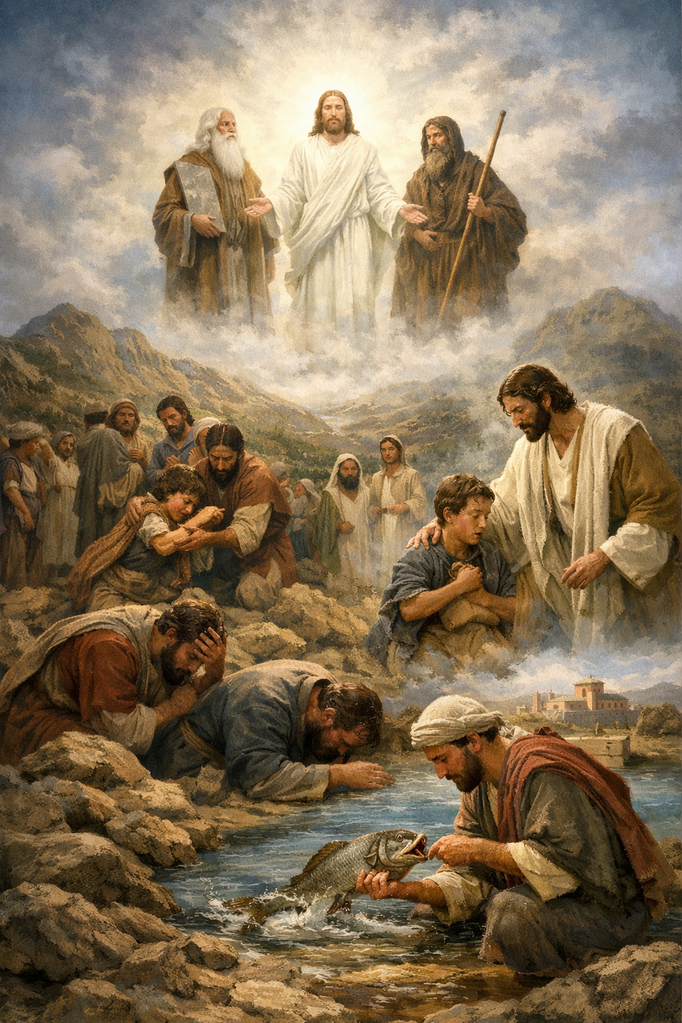
An explanation of the overall pictorial contents of Matthew 17.
Note: You can listen to today’s commentary courtesy of our friends at the “Bible in Ten” podcast. (Click Here to listen)
You can also read this commentary, scrolling with music, courtesy of our friends at “Discern the Bible” on YouTube. (Click Here to listen), or at Rumble (Click Here to listen).
Also, if you would like to listen to Daniel Higgins’ comparison between Esther (the 17th book) and Matthew 17 (Click Here to listen). The notes for his study can be found at this link (Click Here), or just see below this S/W commentary.
Chapter 17 of Matthew completes a picture that has been ongoing for several chapters. In Chapter 14, there was a snapshot of Israel’s history in relation to the law. Chapter 15 then gave a picture of what is going on in the world from the time Jesus fulfilled the law until the rapture. Chapter 16 revealed a passage that petitions the Jews of the end times to consider who Jesus is based on their own history, comparing it to how He is portrayed in Scripture.
Chapter 17 began with the words “after six days.” It is a reference to the six days of creation, which mirror the six thousand years of man’s time before the millennium, the seventh day, the day of God’s rest on earth –
“And in that day there shall be a Root of Jesse,
Who shall stand as a banner to the people;
For the Gentiles shall seek Him,
And His resting place shall be glorious.” Isaiah 11:10
Jesus took Peter, James, and John up on a high mountain. Peter is the apostle to the circumcision (Galatians 2:7), James was the first apostle to die, and John was the last. This is an honor that James and John had sought, but in a different way –
“Then the mother of Zebedee’s sons came to Him with her sons, kneeling down and asking something from Him.
21 And He said to her, ‘What do you wish?’
She said to Him, ‘Grant that these two sons of mine may sit, one on Your right hand and the other on the left, in Your kingdom.’” Matthew 20:20, 21
In one respect, Jesus granted the request concerning the placement of apostolic honor. These three men form a triad of witnesses to the Jews. There on the high mountain, Jesus metamorphosed before them. Moses and Elijah, representing the law and the prophets as well as the living and the dead, appeared along with Jesus.
Peter, whose epistles are strategically placed after Paul’s, indicating they are addressed to the end times Jews after the church age, offered to build three tabernacles, dwelling places, for them. The voice of the Father came out of the cloud, noting that it is His Son, Jesus, in whom He is well pleased, and that they were to hear Him.
It is the final lesson of the end times. The law and prophets are not what the Jews are to focus on, but Jesus. It is His glory alone that will take them into the millennium, the law being finally removed from Israel (see Hebrews 8:13).
While descending the mountain, the disciples asked Him why the scribes said that Elijah was to come first. Jesus said, “Elijah indeed, he comes first, and he will reconstitute all” (17:11). Elijah is literally coming back to witness to Israel. However, Jesus also noted that Elijah had come already. The disciples understood this to mean John the Baptist.
The indication is that Israel will understand from these two appearances that they missed the ball, and the troubles they have faced were a self-inflicted wound. Verses 14-17 detail the healing of the man’s son. No names of people or locations were given, just a description of the boy being moonstruck and suffering badly because he frequently fell into the fire and frequently into the water.
It is a picture of Israel in their history before the Lord, completely untreatable, even by the disciples (their witness to Israel) –
“Your affliction is incurable,
Your wound is severe.
13 There is no one to plead your cause,
That you may be bound up;
You have no healing medicines.” Jeremiah 30:12, 13
See also Micah 1:8,9.
Jesus called them a faithless and perverse generation, something that exactingly describes Israel. It is a point stated to the Jews by Peter in Acts 2:40. Despite their failure, it says that Jesus rebuked the demon, and it left the child that very hour. Israel’s wound will be cured immediately at the return of Christ.
When the disciples asked why they couldn’t cast it out, Jesus said it was because of their unbelief and that that kind could only go out by fasting and prayer. Jesus doesn’t say who must fast and pray. Rather, He says it is a part of such healing.
Fasting is a sign of mourning and repentance toward God. Prayer is the means by which God is petitioned. In the future, at the time of Christ’s return, Israel will, like ancient Nineveh, fast and pray to the Lord. When they do, they will be healed.
The final verses of the chapter referred first to them “overturning” in the Galilee (verse 22). The word was anastrephó. As explained, one can return without any intent or change in the way things are, or one can return while considering, making changes, redirecting to something new, etc. It is also used as a word indicating contrast.
It is the state of Israel after having been healed. There is a return with a considered change, redirecting them to something new. They will enter the New Covenant, returning to God in a new way. That wording is based on Jesus’ words about the Son of Man being betrayed into the hands of men, being killed, and being raised on the third day (verse 23).
That is the exact gospel Paul explains in 1 Corinthians 15:3, 4. Israel will be overturned in their thinking by finally accepting, as Paul says, “the gospel which I preached to you, which also you received and in which you stand, 2 by which also you are saved” (1 Corinthians 15:1,2).
In verse 24, it says that they came to Capernaum. The name is derived from kaphar, to cover, as in atonement, and Nahum, the name of the prophet. However, Nahum is derived from nakham, to sigh. The sense of the word extends to regretting, feeling sorry, and being or getting comfort.
All three of these are tied up in the thought of salvation. While in this location, those who received the temple tax asked if the Teacher paid the tax. Peter’s answer in verse 25 was that He did. The tax, as explained, was based on the ransom money (silver) described in Exodus 30:11-16. It is the money representing salvation through Christ’s sacrifice, ransoming man from the power of the devil.
Still in verse 25, Jesus preanticipated Peter by asking about paying such taxes, does that come from the king’s sons or from unfamiliars (those outside the family). The word used was prophthanó, to get an earlier start on a matter.
Jesus didn’t just speak of the matter of Israel’s salvation before they asked for it. He spoke of the matter before they could ask. In other words, the Bible has clearly proclaimed that Israel will once again be God’s people. Their ransom money had been procured long before they knew there was a need for it. This was preanticipated by God in Christ.
Peter’s response to Jesus about the tax was from unfamilars. Jesus said, “Hence, the sons, they are exempt.” It is a point that will apply to Israel after the Lord returns. Being sons of God (as a nation), once again, they will be free from such payment.
Verse 27 described the manner in which Peter would find such a coin to pay the taxes. It was provided by Jesus in a miraculous way. Likewise, Israel will not pay anything for their ransom. Rather, it will be provided by Christ’s all-sufficient payment at the cross of Calvary.
The final words of the chapter recorded Jesus’ words to Peter, “That, having taken, you give to them for Me and you.” Jesus’ work leading to His resurrection is what validated both His and Israel’s sonship.
For Jesus, that is recorded in Romans 1:4, where it says, “and declared to be the Son of God with power according to the Spirit of holiness, by the resurrection from the dead.” See also Hebrews 1:5.
For Israel of the end times, pictured by Peter, the apostle to the circumcision, it is belief in the gospel that will bring about their state of sonship. The tax is paid through the miracle-working power of God in Christ.
Life application: Chapter 17 of Matthew clearly indicates that there is a future for Israel, the people. They are restored to the land of Israel as prophesied in God’s word. They will never be uprooted from it again, according to that same word –
“‘I will bring back the captives of My people Israel;
They shall build the waste cities and inhabit them;
They shall plant vineyards and drink wine from them;
They shall also make gardens and eat fruit from them.
15 I will plant them in their land,
And no longer shall they be pulled up
From the land I have given them,’
Says the Lord your God.” Amos 9:14, 15
This is good news for Israel. However, for Israel at this time, the news is not so good. They are not currently God’s people (Hosea 1:9, 10 & Romans 9:25, 26). Not being God’s people, they are also not sons of God. That right has been stripped from them at this time.
Rather, Jesus clearly notes that their father is the devil –
“You are of your father the devil, and the desires of your father you want to do. He was a murderer from the beginning, and does not stand in the truth, because there is no truth in him. When he speaks a lie, he speaks from his own resources, for he is a liar and the father of it. 45 But because I tell the truth, you do not believe Me. 46 Which of you convicts Me of sin? And if I tell the truth, why do you not believe Me? 47 He who is of God hears God’s words; therefore you do not hear, because you are not of God.” John 8:44-47
To reject Jesus is to reject God because Jesus is God and the Son of the Father. Jesus calls Israel during this dispensation a “synagogue of Satan” in Revelation 2:9 and 3:9. Calling them God’s people at this time does a disservice to them. What they need is evangelism, not coddling, sycophancy, fawning, or flattering.
They are not right with God, and not to evangelize them, when you have the opportunity to do so, can only continue them down the path leading to the Lake of Fire. This is important. Israel needs Jesus. Without Him, they are like any other nation on the planet that lacks Jesus Christ. Be bold in your proclamation of Jesus Christ to all people, Jew and Gentile alike.
Lord God, help us to think rightly about our conversations with others. Help us to remember that without Jesus, they are on a one-way path to eternal condemnation. May we boldly proclaim the good news of Jesus Christ to all people. Amen.
Exploring the Connection Between Matthew 17 and the Book of Esther
For BibleInTen.com – By DH – 14th March 2026
Welcome back to Bible in Ten.
Today we come to Matthew 17, and in this series that leads us naturally to Book 17 of the Old Testament: Esther.
And with an explanation of the overall pictorial contents of Matthew 17 provided in the previous episode, Matthew chapter 17 becomes much clearer and in this supplementary episode, we will see how Esther strengthens it as a supporting witness.
Esther is not just a story about Jewish survival in Persia. Esther is a book about the Lord hidden from open view, but still directing all things toward redemption. The book exists not mainly to magnify the Jews, but to show the unseen faithfulness of God in preserving them for the sake of His promises and ultimately for the sake of the Redeemer, the true subject of Scripture.
The Esther Bible Study available on the Superior Word develops the following pictures:
- Ahasuerus pictures God, the ruler over the world.
- Vashti pictures disobedience and loss of access to the throne.
- Esther pictures the Gospel, especially in her mediating role before the king.
- Haman pictures Law, even law bringing wrath and death.
- Mordecai pictures Christ: hidden at first, then honored, then exalted, then clothed with authority, then writing with full power, then sending letters of peace and truth, and finally having his greatness recorded through all the realm.
That makes Esther a strong support for what Matthew 17 is picturing.
1) “After six days” — the approach to kingdom rest
Matthew 17 begins, “after six days.” As was said this points toward the six-thousand-year course of man’s time before the seventh-day rest, the millennial kingdom.
Esther supports this by opening in a royal setting already marked by splendor, order, and throne-rule. Shushan is treated almost like a paradise-throne setting, and Ahasuerus is taken as picturing the divine throne-rule itself. So both chapters begin not with chaos, but with the king and the court already in view.
2) Christ revealed in glory before a select company
On the mountain, Jesus is transfigured before Peter, James, and John.
That is the hidden unveiling of the King before His glory is openly seen by all.
Esther supports this pattern through hiddenness before manifestation. The whole book works by concealed identity, concealed movements, and God working in the background long before the reversal appears. The Lord is not named openly in Esther, yet He is there, hidden, moving everything toward the appointed outcome.
So Matthew 17’s select-company glory scene sits very comfortably beside Esther’s hidden-providence structure.
3) Moses and Elijah testify that all prior revelation converges on Christ
Moses and Elijah appear with Jesus, but not as equals. They are witnesses.
That fits Esther’s Christ structure too. The whole book drives toward one central exalted figure: not Vashti, not Haman, not even Esther by herself, but finally Mordecai in exaltation. And Mordecai is clearly picturing Christ Jesus, the one advanced to authority by the king.
So just as Matthew 17 narrows the law and prophets toward Christ, Esther narrows all of its movements toward the greatness of Mordecai, a picture of the greatness of Christ.
4) “Hear Him” and “Jesus only”
This is the heart of Matthew 17.
The Father says, “Hear Him,” and the disciples then see “Jesus only.”
That fits Esther, because Esther repeatedly moves the reader away from outward structures and toward the one through whom life and deliverance actually come. Esther is a picture of the beautiful Gospel message, but Mordecai is the Christ figure who ends up invested with the king’s authority and acting with the signet. The signet granted to Mordecai pictures the authority of Christ.
So if Matthew 17 says, in effect, “Hear Him”, Esther says in its own symbolic way: the decisive authority now rests with the Christ-figure who bears the king’s signet.
5) Hidden glory must wait for resurrection-grounded disclosure
Jesus tells them not to publicise the vision until after resurrection.
Again, Esther supports this because Esther is a book of timed disclosure. Esther conceals her identity, Mordecai watches from outside, and the hidden plan only comes into the open at the appointed hour. The Lord is working behind the scenes and the book’s whole structure depends on that hiddenness.
So Matthew 17 and Esther both teach: that public revelation comes only when the right moment arrives.
6) Elijah / restoration and Israel’s future turning
Matthew 17 speaks of Elijah in two ways at once: John the Baptist has already fulfilled an Elijah-like role, but Jesus’ wording also leaves a still-future restoration role in view.
Esther also supports a future restoration by showing that the covenant people are threatened but not discarded. Esther is treated as a book of redemptive history in which the Jews are preserved because God’s promises to them stand, and because the Messiah must come and return in connection with them.
Esther strengthens the Matthew 17 reading that Israel is not finally cast off. God is not finished with Israel chiefly through Jesus’ future-tense words about Elijah restoring all things, and then reinforced through the picture of Israel’s healing and restored sonship later in the chapter.”
Though threatened and with God’s face hidden from open view, they are brought through to preservation, mourning, reversal, and future blessing
7) The afflicted boy and Israel’s incurable condition
The Matthew 17 explanation treats the afflicted boy as picturing Israel in its historical condition: wounded, unstable, and untreatable by human means.
Esther strongly confirms that pattern. The Jews stand under a decree of destruction that has to be properly and purposefully dealt with. Haman, picturing Law, has issued a death-word, and the people are trapped unless royal intervention occurs.
In Matthew 17 the boy is incurable by the disciples.
IN Esther the Jews are doomed under an irreversible decree.
In both: the people cannot heal or save themselves.
8) Christ alone intervenes to heal and deliver
In Matthew 17, Jesus heals what the disciples could not.
In Esther, the same pattern appears through the Mordecai-Christ picture and the Esther-Gospel mediation.
Matthew 17 pictures Israel’s future restoration, healing, and restored sonship through Christ. The book of Esther supports that pattern by showing that although the first decree of death cannot be revoked, a new decree can be issued through Mordecai’s royal authority that brings life to the threatened people.
The old word of death cannot simply be revoked, but another word can be issued which grants life. That second word comes through Esther and Mordecai, and the edict issued by Mordecai is explicitly treated as a picture of the New Covenant.
Mordecai, picturing Christ, receives the signet, acts with royal authority, and sends out the saving word.
Thus Esther is supportive of Matthew 17’s portrayal of Messiah Himself being the one who intervenes.
9) The cross remains central
IN Matthew 17 Jesus speaks of betrayal, death, and resurrection.
The notes by CG on this from Esther chapter 10 bear repeating:
Haman pictures Law, but Christ actually died. It was Christ who was nailed to the cross, and so in type and picture, Christ became our Haman, our Man under Law, if you will. It is no different at all than Christ equating Himself with the serpent on the pole in John 3:14, or Paul saying that God made Him who knew no sin to be sin for us.
In the death of His body, the law died with Him for all who believe. For all who don’t, Law, and thus the enmity, remains. This is where the marvelous symbolism of a very misunderstood passage in the book of John is explained. It says in John 20, “Then Simon Peter came, following him, and went into the tomb; and he saw the linen cloths lying there, and the handkerchief that had been around His head, not lying with the linen cloths, but folded together in a place by itself.” Many fanciful explanations have been made up about this, but the truth is revealed in what happened to Haman, when he was taken to be executed… they covered his face. The Law was to die. Christ died in fulfillment of the law. When He arose, the face covering was removed, and carefully folded. It was an intentional act of the Lord showing that the shame of death through Law had been removed for those who trust in Him. The people of Israel, the Jews, even to this day, celebrate Purim, and yet they are celebrating the exact opposite of what they think they are celebrating. They curse Haman, stamp their feet, and howl wildly as his name is read, and yet, he simply pictures Law that they are still under. Until they come to Christ, Haman will continue to come after them to destroy, to be killed, and to be annihilated because of the ministry of death, meaning Law (2 Corinthians 3:7). Why do the Jews celebrate Purim? It is because of what pur signifies. It is a lot, a broken piece, and thus Purim, the plural of pur, signifies broken pieces. Pur means “to break,” “frustrate,” “make ineffectual,” “annul,” “bring to naught.” This is what Christ has done concerning our covenant with death according to Paul – For the message of the cross is foolishness to those who are perishing, but to us who are being saved it is the power of God. 19 For it is written: “I will destroy the wisdom of the wise, And bring to nothing the understanding of the prudent.” 20Where is the wise? Where is the scribe? Where is the disputer of this age? Has not God made foolish the wisdom of this world? 21 For since, in the wisdom of God, the world through wisdom did not know God, it pleased God through the foolishness of the message preached to save those who believe. 22 For Jews request a sign, and Greeks seek after wisdom; 23 but we preach Christ crucified, to the Jews a stumbling block and to the Greeks foolishness, 24 but to those who are called, both Jews and Greeks, Christ the power of God and the wisdom of God. 25 Because the foolishness of God is wiser than men, and the weakness of God is stronger than men. 1 Corinthians 1:18-25 The Jews cling to the law, but it is Christ who has defeated that enemy. The law is annulled in Christ. This is the message of Purim.
Life Application
There is also a striking present-day echo. In 2026, Purim began on the evening of March 2nd just 2 days after Israel was again in direct conflict with Iran.
Just as Haman was also not himself Persian (he was Amalekite who gained influence at the heart of the palace and used imperial power against God’s people). In a similar way, The Islamic Republic of Iran’s rulers are militant usurpers who seized control of the land of Persia in 1979 and have held the nation in bondage ever since.
Even the recent reports and speculation about Israeli intelligence using covert medical cover—dentists, hidden tracking, to coordinate a sudden destruction on the Supreme Leader —carry an Esther-like atmosphere. Just for fun check out the link to a stop motion lego video about this by “Stop Motion Sam”!
The deeper parallel is the same: the enemy appears secure, the plot seems advanced, yet unseen movements are already in motion, and when the appointed moment comes, the reversal is sudden.