
Friday, 13 March 2026
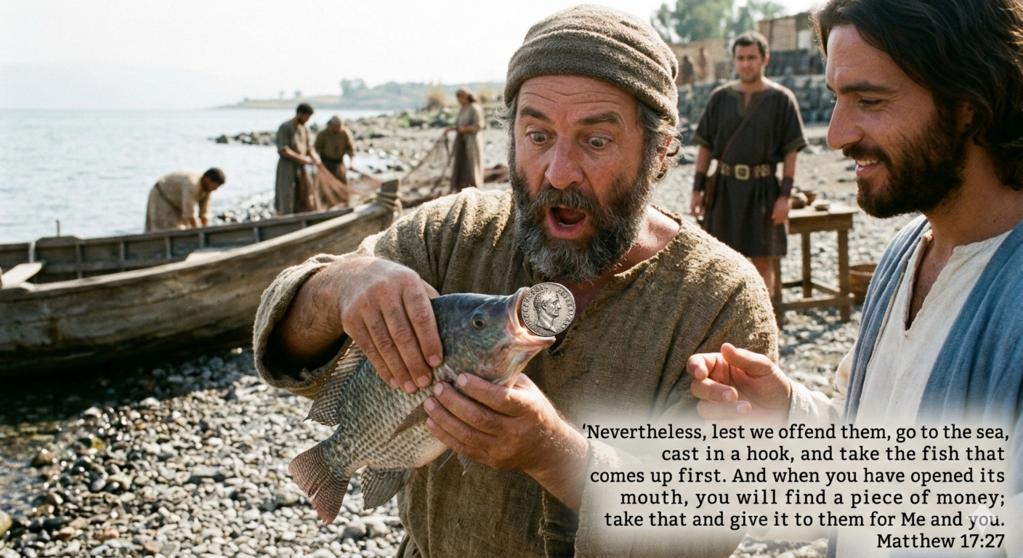
Nevertheless, lest we offend them, go to the sea, cast in a hook, and take the fish that comes up first. And when you have opened its mouth, you will find a piece of money; take that and give it to them for Me and you.” Matthew 17:27
Note: You can listen to today’s commentary courtesy of our friends at the “Bible in Ten” podcast. (Click Here to listen)
You can also read this commentary, scrolling with music, courtesy of our friends at “Discern the Bible” on YouTube. (Click Here to listen), or at Rumble (Click Here to listen).
To read the translation of Matthew 17 in the same manner on YouTube (Click Here to listen), or at Rumble (Click Here to listen).
“And that not we should entrap them, having gone to the sea, you cast a hook, and the ‘having ascended first’ fish, you lift, and having opened its mouth, you will find a stater. That, having taken, you give to them for Me and you.” (CG).
In the previous verse, Peter responded to Jesus that the kings of the earth take their customs and taxes from the unfamiliars. Jesus then responded that the sons are free. Despite this truth, He continues, saying, “And that not we should entrap them.”
The idea is that it would be inappropriate to cause those collecting the census to be tripped up by the claim that the sons are free from paying. It would lead to a difficult set of explanations and argumentations that would serve no purpose in the ongoing ministry as it marched to its completion.
Jesus’ time to be revealed as the Messiah had not yet reached its fulfillment (Matthew 16:20). Therefore, any claims of exemption from paying the temple tax would be misunderstood and could later be used as a charge against Him. Understanding this, Jesus continues His words to Peter, saying, “having gone to the sea, you cast a hook.”
It is a word found only here in Scripture, agkistron, a hook. It is akin to agkalé, an arm (as curved or bent). Both are derived from agkos, a bend. Jesus feels Peter needs a little time to himself for relaxation. Well, maybe not. Jesus has a specific intent for Peter to go fishing, and so He continues, “and the ‘having ascended first’ fish, you lift.”
Jesus doesn’t say, “…if you catch a fish.” Rather, He confirms Peter will. Regardless of its size or kind, he isn’t to toss it back. Rather, Jesus says, “and having opened its mouth, you will find a stater.”
It is another word found only this once in the Bible, statér, a stander (standard of value). HELPS Word studies says it is “a silver coin worth two didrachma and equivalent to four denarii (a tetradrachma, four drachmae) – the exact amount of the Temple-tax required for two people.”
In other words, what Jesus is doing is proving His authority over every possible contingency one could imagine. Peter is to go fishing, cast in a hook, he will catch a fish (a fifty/fifty proposition), when he pulls up the fish, regardless of its type, and out of all the fish he could possibly catch in the Sea of Galilee, and it occurring at that exact moment, there will be a coin in its mouth.
The probability of such an event extends to all the fish in human history that have been found with a coin in their mouths. When the coin is pulled out, it will be the exact coin needed to pay the tax for the two of them. That would open up the probability of every coin ever to have been in the area of the Sea of Galilee, along with the chances of it being the exact type of coin needed to pay for exactly two people.
Further, the fact that it is found in the fish’s mouth, not swallowed, means that either the fish picked it up at the exact moment it also caught the hook, proving Jesus’ omniscient knowledge, or Jesus created it in the fish’s mouth while Peter was catching it, proving Jesus’ omnipotence along with His omniscience.
The impossibility of Jesus’ words, unless He has the ability to affect every single aspect of this event, is obvious. Understanding this, Jesus instructs Peter on what to do with the coin he is going to find, saying, “That, having taken, you give to them for Me and you.”
Jesus sees it as less inconvenient to do what would be utterly impossible for any human being who has ever existed to do than to argue about the temple tax with people who would then be offended at His claim. It is an utterly astonishing proposition to consider.
Life application: The wickedness of the liberal scholar’s heart is exposed in the evaluation of recorded events like these in the Bible. So adamant are they that Jesus could not have done what is stated here, they have come up with several “explanations” of how this miracle was effected.
There is no point in giving them all. Each one fails to adhere to the simplicity and exacting nature of the description given in the account. One example will suffice: Jesus told Peter to go fishing. He gave him these instructions. Peter went out and caught a fish. Peter then sold the fish for a stater so that the temple tax could be paid.
Not only does that not match the account, but it also abuses it so heavily that there would be no point in including the story at all. Peter and the other disciples probably went fishing anytime they had a chance, maybe even when Jesus told them to, so that they could enjoy dinner.
There is no record of such a thing because it has no importance or connection to what is necessary to understand Jesus’ ministry. Such people will receive their rewards for leading people astray with faulty analyses, such as this.
Be careful to take what is recorded in the Bible at face value. It is important to understand that we are to accept God’s word by faith, even when it is not possible for us to do what is recorded there. It is a snap for God to do so if He wishes. Have faith in that.
Lord God Almighty, You can do all things, and we trust that just as You know every fish in the sea, so You are intimately aware of us. Such knowledge is beyond our minds’ ability to grasp, but we can accept it by faith, knowing that You are in complete control of all things. Thank You for this surety. Amen.
Matthew 17 (CG)
1And after six days, Jesus, He takes with – Peter, and James, and John his brother, and them, He uphefts into a high mountain off alone. 2And He metamorphosed before them, and it radiated, His face, like the sun, and His garments, it became whites, as the light. 3And you behold! They appeared to them Moses and Elijah, conversing with Him. 4And answering, Peter, he said to Jesus, “Lord, it is good – us to be here. If You desire, we will make here three tabernacles: You one, and Moses one, and Elijah one.”
5Yet he speaking, you behold! Cloud – lustrous, it overshadowed them. And you behold! Voice – from the cloud, saying, “This, He is, My Son, the Beloved in whom I approved! You hear – Him!” 6 And having heard, the disciples, they fell upon their face, and they feared exceedingly. 7And He came, Jesus. He touched them, and He said, “You rouse, and you fear not.” 8And having uplifted their eyes, they saw none, if not Jesus alone.
9And descending, they, from the mountain, Jesus, He enjoined them, saying, “You tell none the vision until that the Son of Man from dead, He arose.”
10And His disciples, they queried Him, saying, “Why therefore the scribes, they say that Elijah, it necessitates, to come first?”
11And Jesus answering, He said to them, “Elijah, indeed, he comes first, and he will reconstitute all. 12And I say to you that Elijah, he came already, and they knew him not, but they did in him as much as they desired. And thus the Son of Man, He is about to suffer under them.” 13Then the disciples, they comprehended that He spoke to them concerning John the Immerser.
14And they, having come unto the crowd, he approached Him – man, knee-falling to Him, and saying, 15“Lord, You compassionated my son, for he moon-strikes and he suffers badly, for frequently he falls into the fire and frequently into the water. 16And I presented him to Your disciples, and they could not cure him.”
17And Jesus, answering, He said, “O! Generation disbelieving and having been mangled! I will be with you until when? I will uphold you until when? You carry him here to Me.” 18And Jesus, He admonished it, and the demon, it proceeded from him, and the boy, he was cured from that hour.
19Then, the disciples having come to Jesus off alone, they said, “Through what we – not we could eject it?”
20And Jesus, He said to them, “Through your faithlessness. For amen! I say to you, if you should have faith as a mustard seed, you will say to this mountain, ‘You depart hence thither,’ and it will depart. And nothing, it will be impossible for you. 21And this kind it departs not if not in prayer and fasting.”
22And they, overturning in the Galilee, Jesus, He said to them, “The Son of Man, He is about to be surrendered into men’s hands. 23and they will kill Him and the third day, He will rouse.” And they distressed exceedingly.
24And they, having come to Capernaum, they came, those taking the drachmas, to Peter, and they said, “Your Teacher, He completes not the drachmas?”
25“Yes,” he says.
And when he entered into the house, Jesus, He preanticipated him, saying, “What, you, it seems, Simon? The kings of the earth, from whom do they take tributes or census? From their sons or from unfamilars?”
26He says to Him, Peter, “From the unfamilars.”
Jesus, He says to him, “Hence, the sons, they are exempt. 27And that not we should entrap them, having gone to the sea, you cast a hook, and the ‘having ascended first’ fish, you lift, and having opened its mouth, you will find a stater. That, having taken, you give to them for Me and you.”