
Friday, 6 March 2026
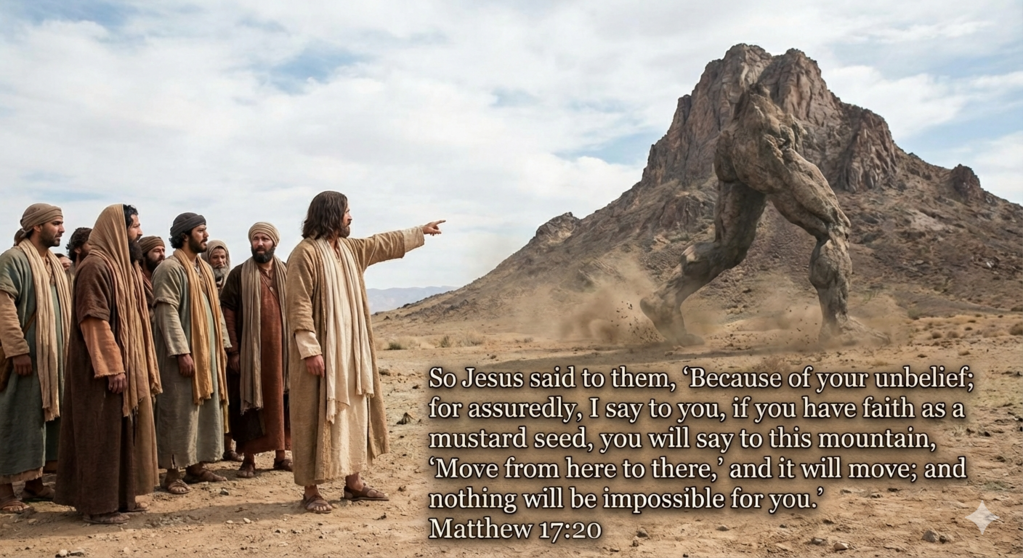
So Jesus said to them, “Because of your unbelief; for assuredly, I say to you, if you have faith as a mustard seed, you will say to this mountain, ‘Move from here to there,’ and it will move; and nothing will be impossible for you. Matthew 17:20
Note: You can listen to today’s commentary courtesy of our friends at the “Bible in Ten” podcast. (Click Here to listen)
You can also read this commentary, scrolling with music, courtesy of our friends at “Discern the Bible” on YouTube. (Click Here to listen), or at Rumble (Click Here to listen).
“And Jesus, He said to them, ‘Through your faithlessness. For amen! I say to you, if you should have faith as a mustard seed, you will say to this mountain, “You depart hence thither,” and it will depart. And nothing, it will be impossible for you.’” (CG).
In the previous verse, the disciples came to Jesus and asked why they couldn’t cast out the demon. In response, Matthew records, “And Jesus, He said to them, ‘Through your faithlessness.’”
Some texts use a word meaning “little faith,” others use the word indicating unbelief or faithlessness. The point of the wording is that the disciples were unfaithful to the faith. They had seen Jesus perform miracles. They had also been given the power to perform miracles. And yet, they allowed their faith to wane in the presence of such a determined demon.
The power they possessed was not actually theirs. It was the power of God bestowed on them to perform duties on behalf of Jesus. Thus, this was not so much little faith as it was faithlessness, even if their faith was also little.
Despite this, concerning the little faith they possessed, which is evident from having been able to heal at other times, Jesus continues, saying, “For amen! I say to you, if you should have faith as a mustard seed.”
Almost all translations incorrectly say, “if you have faith.” The verb is subjunctive, “if you should (may, might) have.” Jesus knows they have faith based on their previous interactions with healing and casting out demons.
Thus, His words now are showing how teeny their faith actually is. “You may have this much faith, but if your faith was as big as a single mustard seed, then…” Next, He tells them what the result would be, saying, “…you will say to this mountain, ‘You depart hence thither,’ and it will depart.”
A new word is seen here in some texts, enteuthen. It signifies the thought of “on both sides,” thus, it gives the sense of the word “hence.” The smallest grain of faith would allow them to move mountains. This is certainly why some texts say, “little faith” rather than “faithlessness.” But Jesus’ point is that they were unfaithful, as if unbelieving, concerning the faith.
Jesus continues. Not only would they be able to move mountains, but He also goes further, saying, “And nothing, it will be impossible for you.”
Another new word is seen, adunateó, to be unable. As such, passively, it means impossible. The word will only be seen again in Luke 1:37. Jesus words here must be qualified. There are things that are in one’s sphere of authority, and there are things that are outside of that sphere.
An example of this is found in Luke 9 when James and John asked Jesus if He wanted them to command fire to come down on the Samaritans. The implication is that they felt they could have done it, but they were forbidden from doing so.
Life application: The words of Jesus in this verse are quite often taken to unhealthy and unintended extremes. People use the words to claim things they will not receive, and they use them to diminish others in their eyes because of their supposed lack of faith.
As noted, there are things in one’s sphere of authority that will restrain him from doing things. It was true with the disciples, even though they were given authority to do things, they were not given absolute authority.
Their ministry called for healing and casting out demons to validate Jesus’ ministry. This is no longer required. His ministry was validated, and He is the Messiah of Israel. This is not in question from a biblical perspective.
As this is so, we can extend the truth concerning faith to any situation. If God does not want something to happen, our faith will not circumvent God’s will. As the Bible tells us that we live by faith and not by sight, it means that our faith is restricted to matters where faith remains faith.
When something occurs because we asked for it in faith, there is still the issue of our needing faith to accept that our petition was granted by God, not merely by chance or by our own power. We cannot go around claiming things, expecting that God is going to do everything we think we have faith to perform.
Using reason, along with proper biblical understanding, is necessary to know what our allowances are. The dispensation in which we live is one that calls for faith that Jesus is the Messiah. The Bible proclaims it is so, and we are expected to believe that. Anything we desire beyond that is something that we should strive for, but it is not something we can claim into existence.
Lord God, may our walk with You be one that is reasonable. May our lives be faith-filled and glorifying of You, not arrogant and presumptuous. Help us to remember that You are our hope and place of security. Understanding this, our faith will be properly directed. Amen.