
Saturday, 14 February 2026
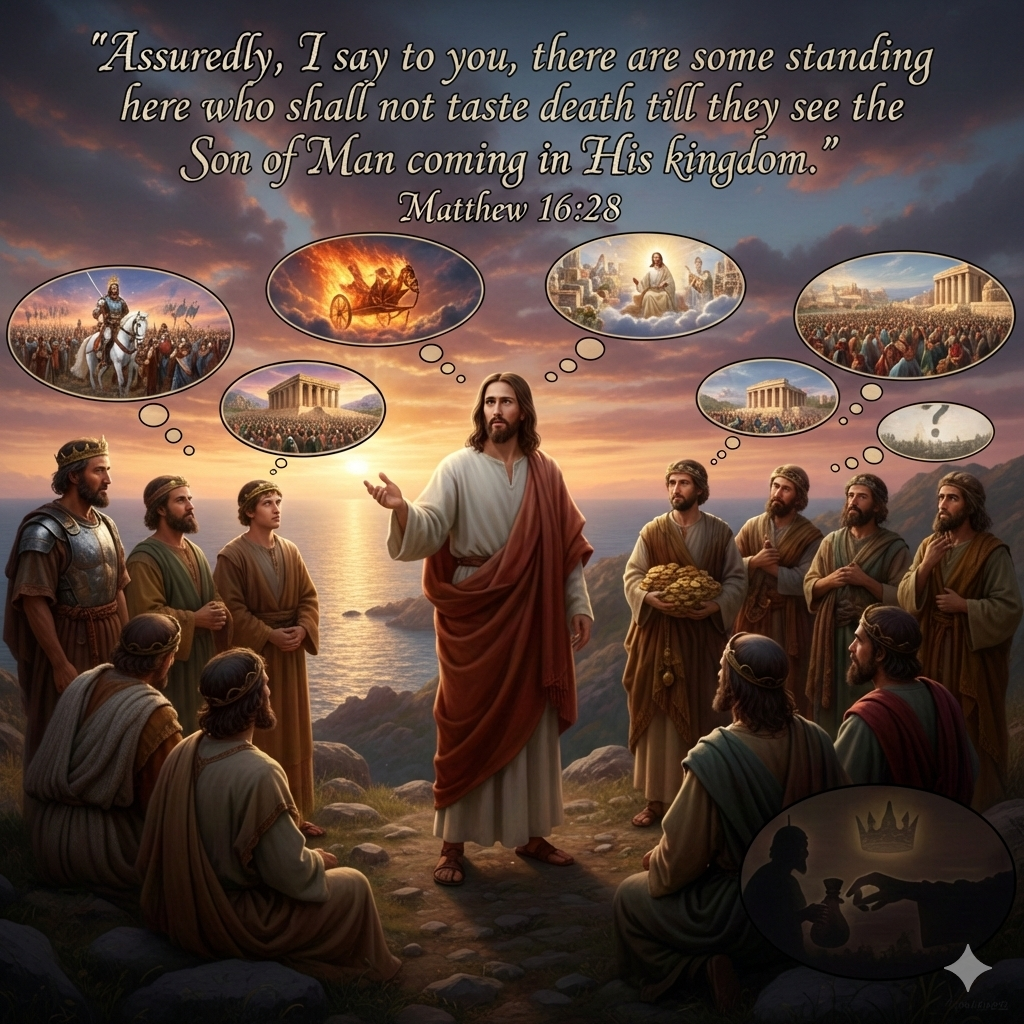
Assuredly, I say to you, there are some standing here who shall not taste death till they see the Son of Man coming in His kingdom.” Matthew 16:28
Note: You can listen to today’s commentary courtesy of our friends at the “Bible in Ten” podcast. (Click Here to listen)
You can also read this commentary, scrolling with music, courtesy of our friends at “Discern the Bible” on YouTube, (Click Here to listen), or Rumble (Click Here to listen).
To read the CG translation of Matthew 16, scrolling with music, on YouTube (Click Here to listen), or on Rumble (Click Here to listen).
An extra bonus from Daniel Higgins at “Bible in Ten” podcast. His input on links between Nehemiah and Matthew 16. (Click here to listen).
“Amen! I say to you that they are some of those having stood here who not they should taste death until if they should see the Son of Man coming in His kingdom.” (CG).
In the previous verse, Jesus told His disciples that the Son of Man is about to come in His kingdom, and then He will give each according to his practice. He next says, “Amen! I say to you that they are some of those having stood here.”
The Greek verb is a perfect participle. As can be seen, the NKJV fails to properly elucidate this, saying, “some standing here.” In fact, one would be hard-pressed to find a translation that accurately translates the verb. Instead, they rely on a present tense or present participle rendering.
But Jesus’ words indicate a completed action, the results of which are still present or relevant, “having stood here.” The same perfect participle is found in the same context in Mark 9:1. Combined with the words, “some…here,” this limits the scope of what is said to those present. Of those referred to, Jesus next says they are those “who not they should taste death.”
A new word is seen, geuomai, to taste. It is used figuratively here to indicate experiencing. It is aorist subjunctive, viewing the whole as a single completed event. In other words, these will not experience death, “until if they should see the Son of Man coming in His kingdom.”
The meaning of this is widely debated. Is this referring to the transfiguration? Does this speak of the resurrection? Is it the beginning of the church at Pentecost? Is it the destruction of the temple in AD70? Is it referring to the millennial kingdom? And so on. Each of these has its supporters. For example, some believe that Jesus’ words in John 21:22 mean that John is still alive and he will be one of the two witnesses.
One of several problems with that is that the two witnesses will be killed before the Son of Man returns. Further, Jesus’ words in Matthew 16:28 are plural, indicating more than one person. One of many problems with the destruction of the temple view is that Jesus didn’t return in AD70. If He did, other words of Jesus would be a complete failure, such as Matthew 24:27.
There is no record of such an event, something that would not be lacking. That is an unbiblical attempt by preterists to dismiss any future prophecy, including the restoration of national Israel as a literal, historical event.
The problem with the Pentecost view is that it was the Holy Spirit, not Jesus, who came upon the people in Acts 2. To conflate the meaning of one with the other is stretching the text like a rubber band, which will eventually snap. As for the resurrection view, as Jesus was not in a glorified state at the resurrection, that also seems to be a stretch of the intent.
The account that is noted next at the beginning of Matthew 17 follows in the same manner in all three synoptic gospels, which is a strong hint that tells us that the transfiguration is what Jesus is referring to. It is a kingdom foretaste for the benefit of the disciples. As it is recorded in the word, it is thus provided as a benefit for all.
This glorified state was then viewed by John when he received the book of Revelation, including Jesus’ return in Revelation 19. For a fuller and more complete explanation of the details of Matthew 16, please continue reading the life application section of this commentary.
Life application: Chapter 16 of Matthew is a passage that petitions the Jews of the end times to consider who Jesus is based on their own history, comparing it to how He is portrayed in Scripture.
In verse 1, Jesus was approached by the Pharisees and Sadducees, who asked for a sign from heaven. As in Chapter 15, these types of men represent the same thinking and paradigm as the rabbis of Israel today. Jesus told them that they could read the signs in the sky, but they could not discern the signs of the times.
With the coming of the end times, the Jews of Israel would naturally be expected to understand the situation they are in, but they will be clueless about the matter. In verse 4, Jesus said that the generation was wicked and adulterous, something akin to what Peter calls the Jews who rejected Jesus in Acts 2:40. Jesus continued that no sign would be given to it, except the sign of the prophet Jonah.
As explained, the sign of the prophet Jonah is the destruction of the temple, it being a year for a day based on Jonah’s proclamation, “Yet forty days, and Nineveh shall be overthrown.”
In the end times, the Jews will have to look to their Scriptures, understand that their temple was destroyed and they were exiled for rejecting Jesus, internalize this truth, and then have faith in Him based on that.
As an explanation of the doctrine of faith in the Messiah, in verse 5, the disciples went across the Sea of Galilee. As such, they crossed the Jordan because the Jordan runs through the sea. Being on the other (east) side signifies those who have not come through Christ to be saved. Jesus told them in verse 6 to take heed and beware of the leaven of the Pharisees. They thought He was talking about bread. But He corrected them by recapping the miracles of feeding the five thousand and the four thousand.
These miracles, anticipating the salvation of Jews and Gentiles, testify to His being the Messiah. What He was warning them about was the doctrine of those false teachers, not about bread. Their doctrine is to be equated with the false doctrine of the rabbis and other law teachers of the end times who have returned to law observance, temple worship, etc. It is a warning that the end times Jews are not to follow those Satan-led examples.
Faith in Jesus, as represented by the feeding of the masses, is what brings restoration with God.
In verse 13, it is noted that Jesus came into the region of Caesarea Philippi. Caesarea is derived from Caesar. The idea of being a Caesar is the deification of the individual. He is attributed a god-like status. Philippi is from Philip, a lover of horses. But in Scripture, a horse is metaphorically used as a source of military pride –
“Some trust in chariots, and some in horses;
But we will remember the name of the Lord our God.” Psalm 20:7
Abarim rightly defines Philippi with the lengthy paraphrase, They Who Lean On Their Military Complex. It is exactly the source of pride that Israel of today is heading towards. Their military superiority is their source of pride and is exalted to god-like status. This will only increase after the battle of Gog/Magog.
It is in this prefigured end-times state that Jesus asks them who He is. The various answers are answers you could expect from Jews. Jesus was a prophet (or false prophet) or whatever. However, Simon Peter proclaims Him the Christ. What was Jesus’ response? “Blessed are you, Simon Bar-Jonah.”
The same name that was acknowledged as the sign in verse 4 is now noted by Jesus. He is Simon (Hearer) Son of Jonah. In other words, he represents the Jews who have understood (heard) the sign of Jonah. To be a son signifies identity. The end times Jews who acknowledge Jesus as the Christ are “sons of Jonah,” because they have made the connection by understanding the sign. In essence, “We missed Him when He came, but we know now who He is.”
It is on this proclamation that Jesus will build His out-calling of those in the end times. They will receive the keys to the kingdom of the heavens, entering into the millennial reign of Christ. In verse 21, Jesus spoke of His destiny to suffer and die. Peter’s words of admonishment stirred Jesus to turn His back on him, call him Satan, and tell him he was not mindful of the things of God, but the things of men.
It is a warning to the end times Jews that they are to accept a crucified Savior as the role of the Messiah. Israel looked, and still looks, for a conquering Messiah, but His role as the crucified Messiah is what God highlights in Him more than all else.
From there, Jesus told the disciples the words about denying themselves and losing their souls (meaning their lives) in order to save their souls. It is exactly what is seen in Revelation –
“Then a third angel followed them, saying with a loud voice, “If anyone worships the beast and his image, and receives his mark on his forehead or on his hand, 10 he himself shall also drink of the wine of the wrath of God, which is poured out full strength into the cup of His indignation. He shall be tormented with fire and brimstone in the presence of the holy angels and in the presence of the Lamb.” Revelation 14:9, 10
&
“And I saw something like a sea of glass mingled with fire, and those who have the victory over the beast, over his image and over his mark and over the number of his name, standing on the sea of glass, having harps of God.” Revelation 15:2
In verse 27, it said, “For the Son of Man is about to come in His Father’s glory with His messengers.” This is exactingly described in Revelation 19:11 –
“And I saw the heaven having been opened. And you behold! Horse, white! And the ‘sitting upon it’ being called ‘Faithful and True,’ and in righteousness He judges, and He battles” (CG).
Jesus is coming in His Father’s glory. In Matthew 24, it notes that in the end times, He will send out His angels (Greek: messengers) to gather His elect.
The final verse of the chapter then said, “Amen! I say to you, that they are some of those having stood here who not they will taste death until if they should see the Son of Man coming in His kingdom.” Again, this is exactly what occurs in Revelation. Some of the end times Jews will make it through the entire tribulation, not seeing death until they behold Jesus coming in His kingdom.
These things are gleaned from Matthew 16, forming a picture of what is coming in the future for Israel.
Lord God, how precious it is to know that You will not reject Israel, even when the whole world is imploding, You will be with them and carry them as a people through the tribulation and into the time promised to them so long ago. Thank You for Your covenant faithfulness, even to those of us who fail You constantly. Amen.
Matthew 16 (CG)
1And having approached, the Pharisees and Sadducees, testing, they queried Him to show them a sign from heaven. 2And answering, He said to them, “Evening having come, you say, ‘Good weather!’, for the heaven, it is red, 3and early, ‘This day… inclemency!’, for glowering, the heaven, it reddens. Hypocrites! Indeed, you know to discern the face of the heaven, and the seasons’ signs, not you can. 4Generation – evil and adulteress – it seeks a sign, and a sign – not it will be given it – if not the sign of Jonah the prophet.” And having left them, He departed.
5And His disciples, having come to the beyond, they overlooked to take bread. 6And Jesus, He said to them, “You behold, and you caution from the leaven of the Pharisees and Sadducees.”
7And they deliberated in themselves, saying, “Because not we took bread!” 8And Jesus, having known, said to them, “Why – you deliberate in yourselves, little-faithed? Because you took no bread? 9You grasp, not yet, nor you recollect the five loaves – the five thousand, and how many handbaskets you took? 10Nor the seven loaves – the four thousand, and how many hampers you took? 11How not you recollect that I spoke not concerning bread to you! Caution from the leaven of the Pharisees and Sadducees.” 12Then they comprehended that not He said to caution from the leaven – the bread, but from the teaching – the Pharisees and Sadducees.
13And Jesus, having come to the allotments – Caesarea, the Phillipi, He entreated His disciples, saying, “Whom they say, the men, Me to be, the Son of Man?”
14And they said, “These, indeed, John the Immerser, and others Elijah, and others, Jeremiah or one of the prophets.”
15He says to them, “And you, whom you say Me to be?”
16And answering, Simon Peter, he said, “You, You are the Christ, the Son of God, the living.”
17And Jesus, answering, He said to him, “Blessed you are, Simon, Bar-Jonah, for flesh and blood not it revealed to you, but My Father, the ‘in the heavens’.” 18And I also, I say to you that you, you are Peter, and upon this – the Rock – I will build My out-calling, and Hades’ gates, not they will overpower her. 19And I will give you the keys of the kingdom of the heavens. And whatever, if you may bind upon the earth, it will be ‘having been bound’ in the heavens. And whatever, if you may loosen upon the earth, it will be ‘having been loosed’ in the heavens.” 20Then He enjoined His disciples that they should say to none that He, He is Jesus the Christ.
21From then He began, Jesus, to show His disciples that it necessitates Him to depart to Jerusalem and to suffer many from the elders, and chief priests, and scribes, and be killed, and the third day be roused.
22And Peter, having clutched Him, he began to admonish Him, saying, “Propitious, to You, Lord! No, not it will be, this to You!”
23And, having turned, He said to Peter, “You withdraw behind Me, Satan! Snare, you are, to Me. For you think not these of God but these of men.”
24The Jesus, He said to His disciples, “If any, he desires to come after Me, let him disown himself, and he took his cross, and he follows Me. 25For whoever, if he may desire to save his soul, he will lose it. And whoever, if he may lose his soul because of Me, he will find it. 26For what it benefits a man if he may gain the whole world and he may lose his soul? Or what will he give, man, equivalent his soul? 27For the Son of Man is about to come in His Father’s glory with His messengers. And then He will give each according to his practice. 28Amen! I say to you, that they are some of those having stood here who not they will taste death until if they should see the Son of Man coming in His kingdom.”