
Wednesday, 4 February 2026
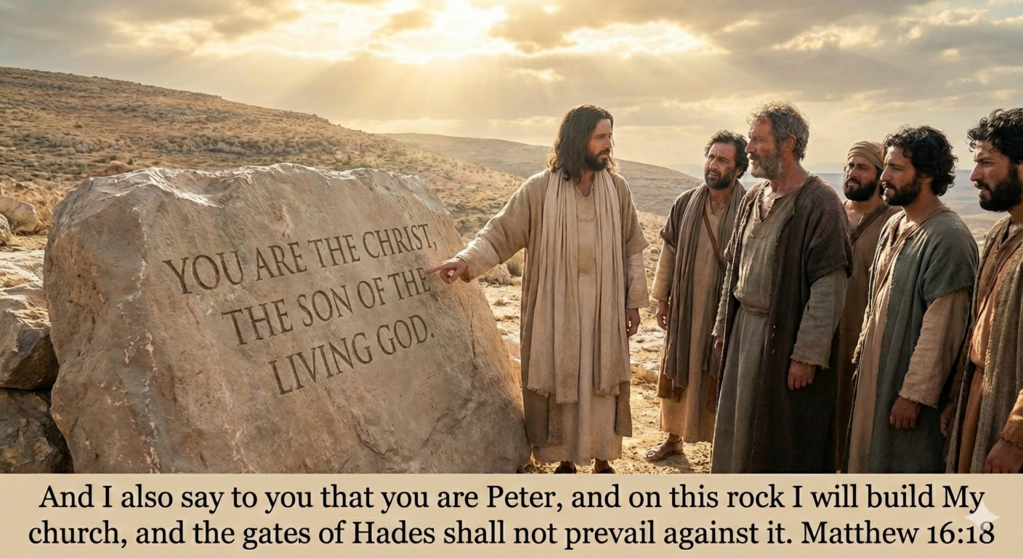
And I also say to you that you are Peter, and on this rock I will build My church, and the gates of Hades shall not prevail against it. Matthew 16:18
Note: You can listen to today’s commentary courtesy of our friends at the “Bible in Ten” podcast. (Click Here to listen).
You can also read this commentary, scrolling with music, courtesy of our friends at “Discern the Bible” on YouTube. (Click Here to listen), or at Rumble (Click Here to listen).
“And I also, I say to you that you, you are Peter, and upon this – the Rock – I will build My out-calling, and Hades’ gates, not they will overpower her” (CG).
In the previous verse, Jesus noted that Simon Bar-Jonah was blessed because it wasn’t flesh and blood that illuminated his proclamation. Rather, it was the Father in heaven who did. He continues, saying, “And I also, I say to you.”
Jesus is going to illuminate more concerning what Peter said, expanding on it to ensure that what was said is highlighted and magnified. With that understanding, Jesus emphatically declares, “that you, you are Peter.”
The name Peter has already been seen and explained. It is a masculine noun, Pétros, meaning rock. It is generally a piece of a rock, like a small rock or stone, found along a path. Jesus continues with, “and upon this – the Rock – I will build.”
The word now is petra, a feminine noun signifying a mass of rock, such as a projecting cliff. HELPS Word Studies, citing Zodhiates, says, “(Pétros) always means a stone . . . such as a man may throw, . . . versus 4073 (pétra), a projecting rock, cliff” (S. Zodhiates, Dict).
Of this difference, Ellicott [et al] says, “it would seem clear that the connection between Peter and the rock (the words in the Greek differ in gender, πέτρος [Pétros] and πέτρα [petra], but were identical in the Aramaic, which our Lord probably used) was meant to be brought into special prominence.”
This conclusion may or may not be correct, but the basis for it is inane. The New Testament is written in Greek, not Aramaic. Therefore, the difference cannot be ignored or downplayed. There is obviously wordplay seen, but a definite distinction is being made between Pétros and petra.
As for what Jesus is talking about, there are several prominent views. One is that He is referring not to Peter, but to his proclamation: “You, You are the Christ, the Son of God, the living.” Others believe Jesus is referring to Himself as the Rock. Still others say that it is, in fact, referring to Peter, but without all of the later-added Roman Catholic baggage that has nothing to do with the simple pronouncement.
Further, what is lacking in Jesus’ words is as telling as what He has stated. Jesus does not simply state, “and upon you I will build…” However, in the coming verse, Jesus will directly speak to Peter with words concerning his position and authority. Therefore, Jesus is not speaking of Peter in His words now.
Letting Scripture interpret Scripture, both testaments tell us who the Rock is. Again and again, in typology and in direct metaphor, the Lord is called the Rock. A couple of the many such examples –
“He is the Rock [tsur], His work is perfect; For all His ways are justice, A God of truth and without injustice; Righteous and upright is He.” Deuteronomy 32:4
“The Lord lives!
Blessed be my Rock [tsur]!
Let the God of my salvation be exalted.” Psalm 18:46
In the New Testament, Paul and Peter both refer to Christ in this way –
Moreover, brethren, I do not want you to be unaware that all our fathers were under the cloud, all passed through the sea, 2 all were baptized into Moses in the cloud and in the sea, 3 all ate the same spiritual food, 4 and all drank the same spiritual drink. For they drank of that spiritual Rock [petra] that followed them, and that Rock was Christ. 1 Corinthians 10:1-4
Therefore, to you who believe, He is precious; but to those who are disobedient,
“The stone which the builders rejected
Has become the chief cornerstone,”
8 and
“A stone of stumbling
And a rock [petra] of offense.” 1 Peter 2:7, 8
As such, the Rock is both the proclamation and the Person. Peter wasn’t speaking about an ethereal concept. He was asked to identify who Jesus was. His proclamation is that of Jesus being the Rock, the Lord Yehovah, who is the Christ, whether Peter realized that or not. Jesus was thinking in human terms, but Scripture, and thus Jesus, is referring to God’s means and mode of redemption.
This is all the more certain because the cornerstone is what Paul refers to as well. It is the setting stone of a foundation –
“For we are God’s fellow workers; you are God’s field, you are God’s building. 10 According to the grace of God, which was given to me, as a wise master builder I have laid the foundation, and another builds on it. But let each one take heed how he builds on it. 11 For no other foundation can anyone lay than that which is laid, which is Jesus Christ.” 1 Corinthians 3:9-11
Jesus, probably pointing to Himself, acknowledging Peter’s confession and what it means, said that He is the Rock. God’s building is not set upon Peter. It is set upon Christ. This building is, as Jesus says, “My out-calling.”
It is a new word, ekklésia, an out-calling. It is derived from ek, from or out of, and kaleó, to call. Thus, it is an out-calling, a group of people called out for a particular purpose. This is the group that Paul calls “God’s building” in 1 Corinthians 3:10. Jesus says that His people will be built upon Himself, “and Hades’ gates, not they will overpower her.”
Another new word, katischuó, to overpower, is used. It is an intensification of ischuó, to have or exercise force. The prefix kata, down, thus gives the sense of overpowering. What is Jesus referring to here? Unfortunately, it is often claimed as a tool for effective evangelizing, as if saying, “We have the power to storm hell itself!”
That is great for sermons, but it has nothing to do with the intent. Gates have two purposes. The first is a defensive barrier that can be opened to allow people in. The second is containment, such as when the gates are shut to keep someone from getting out, a spy or a prisoner, perhaps.
The gates of Hades are gates of containment. Hades (Old Testament Sheol) is the place of the dead. It is where all humanity is destined to go, including saved believers at this time. This is made clear time and again in the New Testament. But a day is coming when the Lord’s out-calling will be taken from there, and the victory Jesus refers to now is realized –
“Now this I say, brethren, that flesh and blood cannot inherit the kingdom of God; nor does corruption inherit incorruption. 51 Behold, I tell you a mystery: We shall not all sleep, but we shall all be changed— 52 in a moment, in the twinkling of an eye, at the last trumpet. For the trumpet will sound, and the dead will be raised incorruptible, and we shall be changed. 53 For this corruptible must put on incorruption, and this mortal must put on immortality. 54 So when this corruptible has put on incorruption, and this mortal has put on immortality, then shall be brought to pass the saying that is written: ‘Death is swallowed up in victory.’
55 ‘O Death, where is your sting?
O Hades, where is your victory?’
56 The sting of death is sin, and the strength of sin is the law. 57 But thanks be to God, who gives us the victory through our Lord Jesus Christ.” 1 Corinthians 15:50-57
It is true that proclaiming the gospel will change a person’s ultimate destiny, but it is not by our power that Hades’ gates are overcome, but by the power of Jesus, the Subject of the gospel, who had already overpowered Hades’ gates.
Life application: The Roman Catholic coopting of this verse to claim Peter is the first pope and that all popes after him have infallible authority to act and make decrees is utter nonsense. That assumes too much, and it lays hands on that which belongs to God alone.
If Peter were the “rock” spoken of here by Jesus, then it would mean he was the foundation of the church, as they claim. But Peter and Paul laid the same foundation, as noted above. This is then confirmed elsewhere –
“Now, therefore, you are no longer strangers and foreigners, but fellow citizens with the saints and members of the household of God, 20 having been built on the foundation of the apostles and prophets, Jesus Christ Himself being the chief cornerstone, 21 in whom the whole building, being fitted together, grows into a holy temple in the Lord, 22 in whom you also are being built together for a dwelling place of God in the Spirit.” Ephesians 2:19-22
The “foundation” here is not speaking of the apostles and prophets, as if they are the foundation. Rather, it refers to their proclamation, which is Jesus. This is exactly what Jesus is referring to in Matthew 16. Jesus is the Chief Cornerstone, which is the basis of the foundation. He is also the entire foundation as proclaimed by God’s messengers.
Sound theology always points to Jesus, not the Roman Catholic Church.
Lord God, thank You for our sure Foundation and Cornerstone, Jesus! We have a Rock, who is faithful and true, upon which our hope is grounded. Nothing, not even the gates of Hades, can separate us from You. Thank You that when we depart, it will not be forever from Your presence. Rather, a day is coming when we will be gathered to You forever. Hallelujah and Amen.