
Monday, 2 February 2026
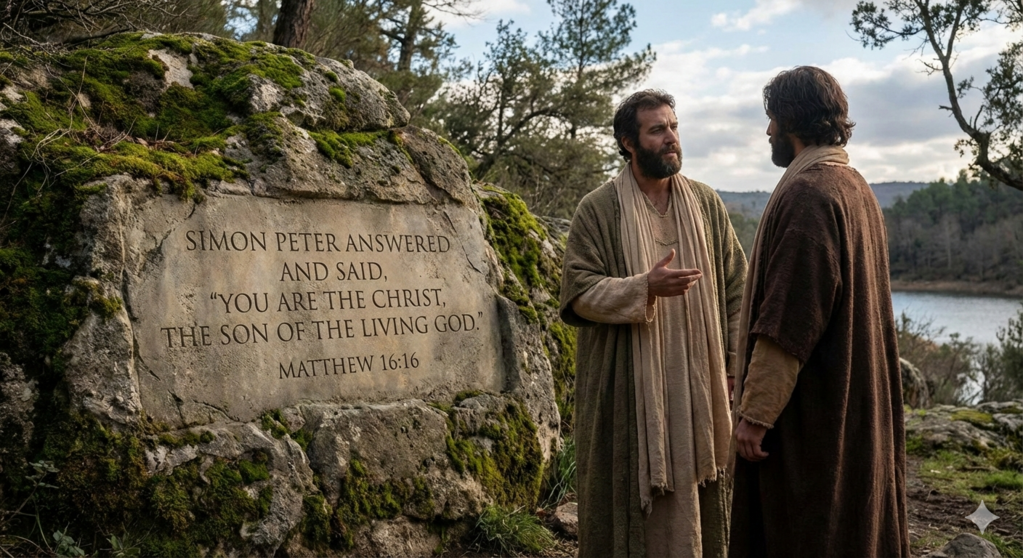
Simon Peter answered and said, “You are the Christ, the Son of the living God.” Matthew 16:16
Note: You can listen to today’s commentary courtesy of our friends at the “Bible in Ten” podcast. (Click Here to listen)
You can also read this commentary, scrolling with music, courtesy of our friends at “Discern the Bible” on YouTube. (Click Here to listen), or at Rumble (Click Here to listen).
“And answering, Simon Peter, he said, ‘You, You are the Christ, the Son of God, the living’” (CG).
In the previous verse, Jesus, in a question bearing emphasis, asked the disciples who they say He is. A response is given in a similar emphatic form. Matthew begins this statement with, “And answering, Simon Peter, he said.”
Simon Peter is generally the one to step forward and speak for the others. He was a bit impetuous, and he was not sound in backing up his faith at times, such as on the night of Jesus’ crucifixion and at the time when Judaizers had come to Antioch. At that time, he waffled in his convictions, withdrew from the Gentiles, and had to be sharply rebuked by Paul for his stand, as recorded in the book of Galatians.
However, he was able to clearly express his thoughts to Jesus about who the disciples agreed Jesus was, saying, “You, You are the Christ.”
The emphatic “You, You” is given as a response to Jesus’ carefully structured question. The word Christ is the same as the Hebrew mashiakh, Messiah, both of which mean “anointed.” This was both a recurring thing and a unique thing, depending on the situation.
Kings were anointed for their position. The high priest was anointed for his. Even Cyrus is called the Lord’s anointed in Isaiah 45:1. It was as if the Lord had personally anointed Cyrus with oil to accomplish a particular task. These and other examples of anointing meant the person was a messiah, a Christ.
However, Peter’s words were indicative of One on a completely different level. There was to be a particular Messiah who would come, anointed of God, to fulfill a role that none other could fulfill. This Messiah was to be the specific representative of God on earth.
It is true that various scholars and sects had varying opinions about what this would mean, but it was generally agreed within society that One was coming who would be Israel’s redeemer, leading them to a golden “messianic” age where they would lead the nations of the world.
At the time of the Roman Empire, the people thought this Messiah’s role would include casting off the Roman oppression and putting Israel over Rome and all other foes. It is certain that none of them, even these disciples, saw Jesus’ role as One who would die for the sins of the people.
It is equally certain that none of these people actually believed that the Messiah would be God incarnate. He may be a “god” to the people, but not Yehovah in the flesh. This was a totally unknown aspect of who Jesus would be.
And more, they never, in a thousand lifetimes, would have thought that His messiahship would level the field for Gentiles as well as Jews, offering them the same benefits in the commonwealth of Israel that they would receive. Such an idea would have been totally repugnant to them.
As such, Peter’s statement, though true, was not something that meant a whole lot in regard to Jesus’ actual ministry and mission. It was a truth, it was an anticipation of Jesus being the fulfillment of their Scriptures, but it was an almost wholly misunderstood proclamation.
And that is fine. Jesus would slowly reveal this to them, including things that would only be understood after His work was complete and He ascended to heaven. In some cases, like speaking to Gentiles such as Cornelius in Acts 10, it would cause confusion in their minds and generate hostility among one another. The Council of Jerusalem in Acts 15 clearly reveals this. As for Peter’s words, he continues with, “the Son of God, the living.”
As noted, this doesn’t mean they understood Jesus to be God incarnate. The term “son of the God” is something that was applied to people throughout the Jewish Scriptures, beginning in Genesis 6:2. Even Gentiles were called “sons of the God” in Job 1:6 and 2:1. It is a title that indicates sonship in an adoptive sense.
Peter’s proclamation is an indication that Jesus is One who is set apart in a preeminent position, even if it was still misunderstood exactly what that meant. One other point is that this was something that was already known to Peter quite some time before –
“One of the two who heard John speak, and followed Him, was Andrew, Simon Peter’s brother. 41 He first found his own brother Simon, and said to him, ‘We have found the Messiah’ (which is translated, the Christ). 42 And he brought him to Jesus.
Now when Jesus looked at him, He said, ‘You are Simon the son of Jonah. You shall be called Cephas’ (which is translated, A Stone).” John 1:40-42
As such, this proclamation of Peter is an adamant assertion of something he and the other disciples already knew. However, Jesus asked it to form the basis of another proclamation that needed to be made at this time.
Life application: The most important question any person can ever answer is, “Who is Jesus to you?” In fact, it is a great question to ask when you are about to evangelize someone. The answer to the question will mean where a person spends their eternal existence.
If someone says, “I don’t know,” he needs careful instruction. If he says that Jesus was a “good person,” though true, it tends to imply that they have been indoctrinated by liberal ideology to accept Jesus as someone who will illuminate one’s path, but who is on the same level as Buddha, Muhammad, or Gandhi.
If the person says, “Jesus is the Savior,” that still needs to be further defined. Jehovah’s Witnesses and Mormons will say Jesus is the Savior, but their understanding of what that means is so vastly different from what is biblical that they are referring to “another Jesus” who proclaims “another gospel.”
Jesus is the Yehovah Elohim, the Lord God, in human form, nothing less. If this is not accepted and believed, they are following the wrong Jesus. Be sure to be precise and properly instruct others on who He is and what He means to the people of the world. There is no other subject that is as important as this.
Lord God, may we carefully convey the message of who Jesus is to those we interact with. Help us to be bold in our proclamation while being correct in our doctrine concerning Him and what He has done. The world needs Jesus! May we be responsible in telling others about Him so that they may be saved. Amen.