
Friday, 28 November 2025
Now in the fourth watch of the night Jesus went to them, walking on the sea. Matthew 14:25
Note: You can listen to today’s commentary courtesy of our friends at the “Bible in Ten” podcast. (Click Here to listen)
You can also read this commentary, scrolling with music, courtesy of our friends at “Discern the Bible” on YouTube. (Click Here to listen), or at Rumble (Click Here to listen).
“And the night’s fourth guarding, Jesus, He departed unto them, walking upon the sea” (CG).
In the previous verse, it was noted that the boat the disciples were in was in the middle of the sea, being tossed by the waves. Next, Matthew records some of the most incredible words imaginable, beginning with, “And the night’s fourth guarding.”
It is the same word, phulaké, found in Matthew 5:25, translated there as prison. It signifies a guarding. As someone is in prison, he is obviously being guarded. In this case, it refers to the divisions of the night. Ellicott explains the term –
“The Jews, since their conquest by Pompeius, had adopted the Roman division of the night into four watches, and this was accordingly between 3 A.M. and 6 A.M., in the dimness of the early dawn.”
Jesus had remained on the mountain praying for hours while the disciples struggled to stay afloat in the tempest that had arisen. Despite their efforts, they had only gone about halfway across the sea. It was during this time that “Jesus, He departed unto them.”
There is immediately a sense of curiosity in the words. It is very early in the morning hours, the narrative has already said that the disciples were straining in the sea to get to the other side, and yet, Matthew notes Jesus departing to them.
If the words finished there, one might think Jesus would walk on a path near the shore to meet them in the spot where they were headed. However, Matthew dismisses that option, saying, “walking upon the sea.”
The words here, combined with the words to come, along with the other gospel accounts, leave no option except that “walking on (upon) the water of the sea” is intended. It cannot mean “walking on the shore of the sea,” something seemingly possible from the immediate wording, as if the shore were being used as a way of explaining a walk on the sea.
However, they are in the midst of the sea (25 or 30 stadia) from shore. In a tempest, they would not see Jesus walking on the shore, nor could they have a conversation with Him, as will be the case. It cannot mean Jesus swam. The Greek word kolumbaó, to plunge into the water (and thus to swim), would have been used.
But more directly, only a lunatic would start swimming across a cold, 7-mile-wide lake in the middle of a raging tempest, particularly in fresh water, which is not as buoyant as salt water. Even the hardiest swimmer would likely perish from such an attempt. And, again, the surrounding narrative makes such suggestions impossible.
Rather, Jesus was giving a hint concerning His nature by doing what He is doing. The words of Job explain the matter –
“He stretching – heavens, to His separation,
And walking upon elevations – sea.” Job 9:8 (CG)
To paraphrase Job’s words, “Yehovah stretches out the heavens all by Himself, and He walks upon the waves of the sea.” Matthew, Mark, and John each testify to the accuracy of the account. The Lord God, Yehovah, walked upon the wavy Sea of Galilee in the early morning hours to attend to His disciples.
Life application: Over the millennia, there have been many skeptics who have tried to conjure up reasons why the text doesn’t really say what it says concerning the account of Jesus walking upon the sea.
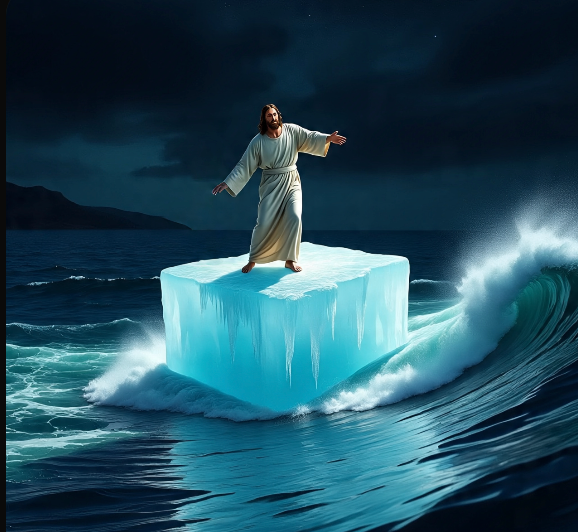
A few years ago, the ridiculous explanation was that the meeting of the winds as they rushed through the Arbel Pass with the waters of the Sea of Galilee formed blocks of ice that allowed Jesus to walk on the sea. Even a mentally challenged farm boy could find a dozen reasons why such a thought is ridiculous.
And yet, when it was proposed, it made the news around the world, as if someone had finally found a reason why the Bible should not be trusted concerning this miracle. Actually, however, for Jesus to surf on a block of ice, or to walk on various blocks of ice until He reached the disciples, would be more of a miracle than anything any person had ever seen in human history.
It would just be another form of a miracle. But the wording in the gospels doesn’t allow for such idiocy. Rather, the disciples truly believed what they saw. They jointly testified to the matter, and their testimony stands. As the judicial apologist Simon Greenleaf says –
“Every document, apparently ancient, coming from the proper repository or custody, and bearing on its face no evident marks of forgery, the law presumes to be genuine, and devolves on the opposing party the burden of proving it to be otherwise.”
The burden of the proof is up to those who dismiss the words of Scripture. To this date, after two thousand years of trying, no such proof has come forward.
Have faith in the word. Have faith in Jesus, who is Yehovah incarnate. The word of God testifies to this fact.
O God, You can do all things. The fact that You walked upon the waters of the Sea of Galilee should come as no surprise because of this. We know Your word is truth. What it proclaims is sound and reasonable when we consider who Jesus is. May we have faith in what it says, holding fast to the record as it has been given. Amen.