Isaiah 9:6, 7 (The Zeal of the Lord of Hosts)

Isaiah 9:6, 7
The Zeal of the Lord of Hosts

Today, we’ll take time to look at the glorious words of Isaiah 9:6 & 7 which is a passage that speaks of the coming Messiah. Isaiah writes in both the present and future tenses as he looks forward to the work of Christ. To him, it was as sure as if it He were already there and at work in the world. And in fact, He was.

In order to see the context, we’ll read all of Isaiah 9:1-7. And then we can together look in detail at the contents of verses 6 and 7.

Introduction: At Christmas, we sing happy songs about the season. We travel off to be with family. We eat yummy food and we take time off work. And if our priorities are right, we make an extra effort to think about the marvelous Christmas Child.

Long before He came, the prophets told us all kinds of things about Him. He would be the Seed of the woman, whatever that means! He would be born in Bethlehem. Where’s that? Well, it’s a little town a few miles south of Jerusalem. According to Zechariah, He would usher in salvation and ride on a donkey – what a fun thought to consider.

There are so many details about the coming Messiah, that cataloging them all actually continues to this day. Hidden pictures suddenly jump out along with the clear and open details. What is apparent is that God does not want us to miss the significance of the Christmas Child after Christmas is over.

He wants us to keep looking for Him every day as we open up His word. Why? Because it is all about Him – this Son who is given by God so that we can understand the very heart of the unseen Father.

Text Verse: “Do not be afraid, for behold, I bring you good tidings of great joy which will be to all people. 11 For there is born to you this day in the city of David a Savior, who is Christ the Lord. 12 And this will be the sign to you: You will find a Babe wrapped in swaddling cloths, lying in a manger.” Luke 2:10-12

What the Old Testament hints at, the New Testament shouts out. What is concealed from eyes, is now revealed to eyes. Where there once was eager anticipation, there is now wonderful realization, but even that leads to more eager anticipation, doesn’t it!

Christ came, Christ is, and Christ is coming again. Until He does, we look back in joy at what has occurred and forward in more antici…….pation of what lies ahead. The Bible, God’s superior word, reveals to us the loving story of how He entered into our humanity.

He walked among us; He shared Himself with us. Now, we wait for the day when He will return and bring us to Himself. Until that wondrous moment, let’s look back to the story about the Christmas Child as given to us from the pen of Isaiah.

There we find that this precious Gift would be the most wondrous Gift of all. God’s word is where we find the story and so let’s turn to it now to see the marvel and the majesty. And so… May God speak to us through His word today and may His glorious name ever be praised.

I. The Government Will Be Upon His Shoulder

6 For unto us a Child is born,
Unto us a Son is given;

The verses leading up to this one spoke of gloom, oppression, and war. The people are walking about in darkness, as if they are groping to see. Into this heavy life of despondency, there comes a Light – a Great Light. The darkness peels away and upon them a light has shined.

And from this Light comes freedom from oppression. There is the breaking of the yoke which laid heavily on the weary people. There is quiet instead of the marching of boots. And there is the burning of the implements of war. In place of the gloom comes joy – joy like the time of harvest when there is abundance, festivity, and celebration.

The pall of the world of darkness is replaced with the glory of Light. This is the backdrop of what Isaiah will now present. And so he begins with a conjunction, “for” to show us how this marvelous splendor will come about. It will be through a Man, but there will be something unique about this Man.

Isaiah asks us to actually peer into the very mind of God and the wonder of His creation in order to discern what is coming… what is revealed in this Person who would change all things in a stunning, spectacular display of glory which had been hidden since the very fall of man.

For unto us. This marvelous Light – the ending of war, the joy as if there were a perpetual harvest… it is to come not from outside of our realm as if God were to suddenly and unexpectedly take charge of things and turn them upside down. Instead, this Light is coming from us, from our human existence. For unto us… a Child is born.

The Light which shines will be a human, born from the stock of humanity. He will wear garments of flesh, just like you and me.

“And the Lord God formed man of the dust of the ground, and breathed into his nostrils the breath of life; and man became a living being.” Genesis 2:7

The Lord God formed man and the Lord God breathed the breath of life into Him. The breath of life which has been transmitted from the Lord to Adam and then to every person since that time will be the same breath of life that this One will breathe too.

He is the Son of Adam, Noah, Abraham, Isaac, and Jacob; He is the Son of Judah and the Son of David. No, God isn’t suddenly and unexpectedly going to take charge of things. Nope,,, He is leaving it up to us, isn’t He. He will be a Man. Unto us a Child is born.

But yet… Unto us a Son is given. The Child is a human, but the Son is something different. If God is giving a Son, then this must be sudden, complete…, and unexpected in the extreme. God doesn’t change, and God is outside of time. And so whatever God gives is all of these things – sudden, complete, and even if told about in advance, completely unexpected… I mean, who would think!

God is giving a Son, but that Son will be a Man. This is the stuff of legends, and yet, it is reality. This,,, this we gotta see.

“Do not be afraid, Mary, for you have found favor with God. 31 And behold, you will conceive in your womb and bring forth a Son, and shall call His name Jesus. 32 He will be great, and will be called the Son of the Highest; and the Lord God will give Him the throne of His father David. 33 And He will reign over the house of Jacob forever, and of His kingdom there will be no end.” Luke 1:30-33

But Mary, one of the people to whom the words of Isaiah were written, didn’t understand. How could she? Luke 1:34, 35 says –

“Then Mary said to the angel, “How can this be, since I do not know a man?” 35 And the angel answered and said to her, “The Holy Spirit will come upon you, and the power of the Highest will overshadow you; therefore, also, that Holy One who is to be born will be called the Son of God.”

Unto us a Child is born,
Unto us a Son is given.

The mystery suddenly becomes clear. He is a human, the Son of man. The same breath of life which was breathed into Adam is to be found in Him. And yet, He is God. The same breath which truly spoke the universe into existence is found in Him as well. He is the Seed of the woman. His mother is human, but His Father is God –

“In the beginning was the Word, and the Word was with God, and the Word was God. He was in the beginning with God. All things were made through Him, and without Him nothing was made that was made. In Him was life, and the life was the light of men.” John 1:1-4

A moment later, John reveals something more, “And the Word became flesh and dwelt among us.” (14)

Isaiah’s pen flowed with a description of the incarnate Word and yet the words weren’t comprehended for more than 700 years. God has entered His creation in order to set things right. Upon this marvelous Being, the Son of God and the Son of Man, will be placed all rule and all authority…

6 (con’t) And the government will be upon His shoulder.


In this verse, we don’t learn how this comes about. Instead, we only see that it will come about. In this marvelous Man will be all rule and governance. This won’t be a localized government, but the government. In Him will rest absolute authority over all of the nations and all of the people’s of the world. And that authority will be, as Isaiah tells us, “upon His shoulder.”

This term is all-inclusive of what it means to rule. The robe of a king rests on the shoulder; the burden of the office is upon his shoulder; the rights and privileges of rule rest there as well. But there is more. The offspring and the posterity of the king, and the riches of the king, are all said to rest upon him.

All rule and all authority in Him is found
The government will upon His shoulder rest
And from Him shall come a rule which will astound
The nations will be at peace, no longer distressed

His genealogy is given in Matthew 1 and in Luke 3. Elsewhere in the Bible we find other people in His ancestry as well. All of these people are filled with faults and to us some of those faults are appalling. They are people just like you and me, sinners in need of a Savior. What an amazing genealogy for the Christmas Child!

But the Son of God also has a genealogy of sorts listed too. God is His Father, and so unlike His human genealogy, His divine entrance into the world is pure, undefiled, perfect, and eternal. What His Father possesses, He possesses as well. God is truth, the Son is truth. God is righteous, the Son is righteous. God is love; the Son embodies love.

In fact, Paul tells us that He is the image of the invisible God and that in Him dwells all the fullness of the Godhead bodily. He is unique and therefore He is uniquely qualified. His rule will be without end, either in scope or in duration.

In the 9th psalm we’re told that –

“He shall judge the world in righteousness,
And He shall administer judgment for the peoples in uprightness.” Psalm 9:8

This is the coming government of this Child who is born to us, and of this Son who has been given to us.

II. How to Describe the Incomprehensible

The prophets had a tough time of it. They were usually out of favor with the people. In the Bible, they are imprisoned, tortured, and killed by the boatload. Even when things went well, it had to be a trying job. But of all the things that must have frustrated those prophets, not knowing what they were actually saying must have been at the top of the list.

God would speak to them and through them in a way that often kept them from understanding the very words they relayed. Peter tells us about this in his first letter. He says there –

“Of this salvation the prophets have inquired and searched carefully, who prophesied of the grace that would come to you, 11 searching what, or what manner of time, the Spirit of Christ who was in them was indicating when He testified beforehand the sufferings of Christ and the glories that would follow.” 1 Peter 1:10, 11

These men of God carefully searched their own prophecies, trying to understand what they had written and what their words were pointing to…

The ink has flowed from the pen guided by my hand
But I cannot comprehend what the words say
These words are so very hard to understand
I pray the Lord reveal them to me some wondrous day

Imagine Isaiah’s puzzled, sleepless nights after reading what he had written…

6 (con’t) And His name will be called Wonderful,

From the mind of God and through the pen of Isaiah now come words of splendor, words of majesty, words of awe. They are insufficient to describe the glory of the Man, but words are what we use to describe things. And so, limited though they are, they have been written to help us attempt to perceive what is just beyond perception.

Isaiah first says that, “His name will be called Wonderful.” The word is pele and means that He will be incomprehensible. He is beyond description and therefore the words used to describe Him are actually unsatisfactory for the task.

This Man is the One who established the order of all things and He is the One in whom is found the perfect completion of that order. In Him is all knowledge which can be derived from all things because all things are originally derived from Him.

This is why John calls Him the Word of God. An alphabet is the basis for a language. The formation of letters results in words. It is through words that we describe, catalogue, analyze, and explain things.

The Word of God is then the explanation of all things – why they exist, how they exist, and what their purpose is. Because God is infinite, then no combination of words can ever fully describe Him. And so the term simple term “Word of God” is used to show us that. Where words fail, the Word ceaselessly, endlessly reveals. Though Him, the infinite Father will eternally be made known.

There are many languages and within the languages are symbols, letters, words, sentences, ideas, and concepts. But all of the information that can be developed for describing something can never attain to describe what is incomprehensible. And so God sent this Wonderful Son to infinitely reveal His infinite goodness.

The wonderment and delight of Messiah will never end. This Son who is born, this Child who is given is more glorious than the mere Christmas story we tell year by year. The true marvel of Christmas is the gift of unpacking an endless journey into the mind of God.

Because the Christmas Child was born, we celebrate His birth once a year. But the Son of Christmas is eternal, so let us celebrate His life always and forever.

Next, He will be called 6 (con’t) Counselor,

This is the Hebrew word yoets. It signifies one of honorable rank. Kings and princes will come into His presence and He will advise them with the wisdom of God to direct all the affairs of the human race. No question can be too difficult for the author of questions. No mystery can be too deep for the infinite Mind.

Later in Isaiah, we are told that –

“Kings shall shut their mouths at Him;
For what had not been told them they shall see,
And what they had not heard they shall consider.” (52:15)

When one comes to this Counselor with an open mouth to challenge Him with hard questions, he will leave with a shut mouth and fully explained answers.

When the Queen of Sheba left with the wisdom of Solomon, she was no more delighted than what the most intellectual man will leave with when he departs from the presence of Christ. He will shake His head in marvel at the revealed depth of wisdom which he had never before even contemplated.

Next, He will be called the 6 (con’t) Mighty God,

The Hebrew term here is el gibbor. In the very next chapter of the book of Isaiah the exact same term, el gibbor, is used again when speaking of the Lord, Jehovah.

As God isn’t confused, the only plain sense of Isaiah’s words in chapter 9 is that this Person, this Human being, will be the omnipotent God. He is the same Lord who is described in chapter 10. And this testimony is found throughout Scripture. Both in the Old Testament and the New we find the incarnation testified to.

Those Old Testament prophets may not have grasped what was written. They may have even thought what they wrote was somehow mistaken, but they didn’t change what they had received. And their words are vindicated in this Child of Christmas.

There He lay wrapped in swaddling clothes and helpless in a manger, a food trough for animals, and yet it was – this little baby lying in a dirty feeding trough – He who created the universe by His magnificent power. He, the mighty God, crying out for mommy’s milk and her caring, loving arms.

Next, He will be called the 6 (con’t) Everlasing Father,

This title must have brought Isaiah right to his knees in astonishment. Abiad – the Father of eternity. But the Father of eternity, the Messiah, isn’t to be confused with God the Father. The title shows possession, not position.

The father of the Hebrews is Abraham. He possesses the title even though he is dead and is no longer in the position. Charles Babbage is called the father of computers because he was the pioneer of the field of computers. He possessed the idea and then developed it.

Abiad, the Father of eternity, is the One who possesses time. He invented it and He has mastery over it. This Child who was born, this Son who has been given is the Alpha and the Omega, the Beginning and the End; He is the First and the Last. There is no time that He didn’t exist and there is no time He will not exist.

As mommy lay sleeping, exhausted from caring for the Boy
He tenderly watched over her just as He today watches over us
To be found in the Everlasting Father is eternal joy
This is the amazing splendor to be found in the Lord Jesus

While dreams fill our sleep, He remains eternally awake and alert. He is our Source, our Sustenance, and our eternal longing. He is Abiad, the Father of Eternity – the Everlasting Father. And now verse 6 finishes with just one more title…

He will be called the 6 (con’t) Prince of Peace.

The Hebrew term is sar shalom. In Hebrew, the word sar signifies a leader, a captain, an officer, etc. It is someone who is in charge of something. In the case of this Man, He is the Prince of Peace. He is the one in charge of it. He grants it to those under Him. But His peace is more than our modern idea of peace.

We think of peace as quiet or maybe calm – “I need peace, I’m trying to study… please be quiet.” But to a Hebrew it is a state of completion and wholeness. This Christmas Child is the place where wholeness is to be realized. In the Messiah we find the fulfillment and completion of all good things.

Where there was strife and enmity with God, we now have peace. Where there was the fear of death, we now have the eternal hope of life. Where there was only groping in heavy darkness, there is now the confident stride of walking in eternal light.

This wonderful Word of God bestows all blessings, and from Him flows all prosperity and goodness. He is complete in all ways and this wholesome state of completeness will be transmitted to all things and to all of His people – those who call on Him. He will be the lamp through which the radiance of God will illuminate New Jerusalem for all eternity – absolute peace flowing in pure light.

In Him, there will be no desire left unfilled because He is the Creator of all things and thus the Source of all blessings. This is the One Isaiah tells us is coming and this is the One whom words fail to adequately describe.

III. The Eternal Throne

Of the increase of His government and peace  There will be no end,

The English translation of this verse makes it seem like the government and peace of Messiah will never cease to increase. But what it means is that there will be no limit to His government and peace. His government will be unlimited as will be the peace which comes with it.

For the people of God, the Prince of Peace will be their peace. He will shepherd them to a place of green pastures and still water. Their souls will be restored and He will lead them in paths of righteousness – all for the sake of His name. There will be no conflict or strife as He tenderly governs the flock of His pasture.

The benevolent rule and wholesome care we long for and are reminded of in the 23rd psalm will be realized and enjoyed forever because of the Christmas Child.

God has given us the five senses to perceive the world around us, but for every flower, there is the smell of death in war. For each warm refreshing bath or swim in a cool lake, there is a stubbed toe or a scrape on the knee. With each lovely child’s face in newness of life, there is an older, wrinkled one coming to life’s end.

If we don’t eat the sweet strawberry soon enough, it becomes repugnant and inedible. And just after the melodious sound of the morning birds comes the overwhelming din of noisy traffic. There is chaos and trial, there is pain and difficulty, there is heartache and there is sadness.

However, it won’t always be that way. We lost Eden, but the New Jerusalem is ahead. The One who sits on the throne will grant peace without measure. Of this state, there will be, as the Hebrew reads, ain qets – “no end.”

In either distance or time, the experience will be without limit. Every new day and each continued step will bring more wonder than even the sweetest Christmas morning because of this marvelous Christmas Child.

7 (con’t) Upon the throne of David and over His kingdom,

In 1 Samuel 7:16, the Lord made this promise to King David – “…your house and your kingdom shall be established forever before you. Your throne shall be established forever.”

The New Testament goes to great length to show the connection between Jesus and David. His genealogies, the book of Acts and the epistles, and especially the numerous gospel references are given to show that Jesus is the fulfillment of this promise to David. Fifteen times, He is called specifically “the Son of David.”

To sit on the throne of David doesn’t mean a literal throne, but the throne which is emblematic of David, the great King of Israel. His throne was unique because it ruled God’s people. He started out as a humble shepherd and he never was far from his humility.

Even 400 years after his death, David was still called a man after God’s own heart. He ruled all of God’s land and he did so with justice and righteousness. And so to sit on David’s throne means to rule in the manner of David. Christ will do this, and more so.

What David pictured is realized in the Messiah spoken of by Isaiah here. He will rule from this throne and over the people of God for all eternity. A Baby in a manger, completely dependent on those around Him for His very survival will rule on a majestic throne, judging the world in righteousness. And His throne will be, as promised to David, established forever. This is seen in the continuation of verse 7 –

7 (con’t) To order it and establish it with judgment and justice
 From that time forward, even forever.

To order a thing is to confirm that thing. When a king orders an execution he confirms what will then be carried out. When a blueprint is made, it is an order confirming what the building will be. And to establish a thing is to execute what has been ordered.

The order to execute is established in the execution. The establishment of a building is the erection of what was directed in the plan. In Messiah, the throne of David is ordered and it is established. And it is done so by the counsel of God; through judgment and justice.

Unlike human governments which start corruptly or which inevitably end in corruption, the reign of the Christmas Child is both ordered and established in judgment and in justice. There will be no unrighteousness when the subjects of His kingdom are purified.

And Isaiah tells us that from the time of its establishment, this harmonious order will continue, “from that time forward, even forevermore.” The kingdom established by Christ is the kingdom that will never, never cease to exist.

The Christmas Child, who at the age of twelve astonished the teaches at the temple in Jerusalem with His insights, will rule forever with the wisdom of God among the people of God.

*7 (fin) The zeal of the Lord of hosts will perform this.

The term Lord of Hosts, or Yehovah Sabaoth, is used almost 240 times in the Bible. Jehovah of hosts is the Commander of heaven’s armies. He directs the angelic warfare, He defends His people, and He fights against all that is unrighteous. And it is He who has vowed from Himself that what He has promised He will perform.

Would He trust this to an angel? Would He trust this to a mere man? No. Rather He spoke and He will perform what He has spoken. In what is no less amazing than the creation of the universe, Jehovah of Hosts stepped into His creation and united with it in order to correct what we had so horribly fouled up.

The Commander of all the heavenly armies allowed Himself to become an utterly helpless human Child. Instead of speaking out orders to His legions of heavenly troops, He gurgled out coos to His mother.

Instead of directing Michael and His angels to protect Israel, He lay threatened by wicked King Herod. And, instead of the dazzling splendor of heaven, he lay in a filthy cave, in a dirty trough where animals fed. The blood around Him came from the birthing process, not from vanquishing His foes.

And the blood in the veins of this precious little Baby would some day in the future stain the cross of Calvary to bring peace between warring armies. Such is the nature of the wisdom of God, displayed in the tender, helpless Christmas Child.

From His humble origins in Bethlehem to His gracious ministry throughout the dirty streets of Israel, He was always amazingly close to the common elements of life. He made wine for a wedding when His mother asked Him to, He slept in a boat on the Sea of Galilee, and He walked through grain fields picking a bite to eat.

Despite possessing all of heaven’s riches, all of them, we’re told by Luke that he was supported by the women around Him from their sustenance. None of the things we see about Jesus seem to make any sense at all unless we understand how deeply God loves us. In order to perform what He has vowed, He became like us so that we could see the full measure of His love.

We may not be able to appreciate that someone really loves us if they come into town with bags of money and no dependence on us; staying in large fine hotels instead. But when someone of great wealth lays all of it aside in order to fellowship with us and even to become dependent on us, we can know that they truly want a meaningful relationship.

In the movie Brubaker, Robert Redford played the role of the new warden of a prison who first went into that prison pretending to be a convict. By doing this, he was able to weed out the corruption, understand the plight of the convicts, and have empathy for the difficulties which are found in prison life.

He was also able to establish relations with the convicts he came to know personally. God already knows our plight and He is fully capable of weeding out corruption, but by coming as a Man, Jesus was able to participate with us in our humanity. He wept with us, He rejoiced with us, He lived among us, and He died among us.

In this wondrous story then is found One who is not only qualified to lead, but who has demonstrated it in a way which gives us the opportunity to willingly join Him or reject Him. Before you turn away from so great a salvation, make sure you take a moment to look again at the stained wood of the cross of Calvary.

His agonizing death at Golgotha came not because He had done wrong, but because you had done wrong; we had done wrong. Instead of bundling you up with the kindling wood of creation and tossing you to the eternal flames, God offered an exchange – your pardon for the life of the Christmas Child.

Today, if you hear His voice, don’t rebel against it. Say right now, “I receive Jesus. I want His pardon. I want that amazing grace.” Today, if you hear His voice, call out on the Christmas Child who sits at God’s right hand, waiting to pardon, even you. Let me tell you how you can be a part of His eternal Christmas story…

Closing Verse: It is finished! John 19:30

The Lord has you exactly where He wants you. He has a good plan and purpose for you. Though we are completely unworthy of His favor, He stepped out of eternity and dwelt among us. The Christmas Child went to the cross of Calvary because of His love for you. So call out to Him and let Him do marvelous things for you and through you.

The Zeal of the Lord of Hosts

Nevertheless the gloom will not be upon
Her who is distressed or in agony
As when at first He lightly esteemed
The land of Zebulun and the land of Naphtali

And afterward more heavily oppressed her
By the way of the sea

Beyond the Jordan it shall occur
In an area of the Gentiles around the land of Galilee

The people who walked in darkness
It is they who have seen a great Light
Those who dwelt in the land of the shadow of death
Upon them has shined a light so bright

You have multiplied the nation
And likewise its joy you have increased
They rejoice before You with great ovation
According to the time of harvest, a joy which will not be ceased

As men rejoice when they divide the spoil
When they receive the bounty and no longer toil

For You have the yoke of his burden broken
And the staff of his shoulder is taken away
The rod of his oppressor no longer an unfriendly token
As in the day of Midian, when he was destroyed that day

For every warrior’s sandal from the noisy battle
And garments roooooolled in blood
Will be used for burning and fuel of fire, worthless chattel
Useless implements overtaken by time’s great flood

For unto us a Child is born
A time to rejoice and not to morn

Unto us a Son is given
The One to lead us from death to a’livin’

And the government will be upon His shoulder
Every eye will see Him, every soul will be His beholder

Upon the throne of David and over His kingdom’s realm
To order it and establish it with judgment and justice
From that time forward, even forever, He at the helm
The zeal of the Lord of hosts will perform this

And His name will be called Wonderful
The Counselor and Mighty God is He
Everlasting Father, Prince of Peace, pure and white as wool
Of the increase of His government and peace, no end shall we see

Do not be afraid, for behold,
I bring you good tidings of great joy
Which will be to all people, forever told
The wondrous story, the birth of a Boy

For there is born to you this day
In the city of David a Savior, it is He
Who is Christ the Lord, to whom heaven’s hosts obey
The Messiah has come, and now you may go and see

And this will be the sign to you:
You will find a Babe wrapped in swaddling clothes
Lying in a manger, a glorious view
The Christmas Child whom our Heavenly Father bestows

A Child like no other has come to dwell among us
He shall lead us in paths of righteousness for His name’s sake
And His name is called out, His name is Jesus
Come, and of the Heavenly Child partake

He is God’s gift and heaven’s treasure
He is Immanuel, God with us
And he bestows upon us grace without measure
The Christmas Child, our glorious Lord Jesus

Hallelujah and Amen…
 

Philippians 3:4-11 (To Know Jesus Christ and the Power of His Resurrection) Resurrection Day 2014

Philippians 3:4-11
To Know Jesus Christ and the Power of His Resurrection
Resurrection Day 2014

Introduction: Once again, we’ve gone from winter to spring and life is again coming back to that beautiful fullness which God has ordained to happen each year. In Florida, it’s not as noticeable as in many other places, but if you look, it’s still plainly evident, isn’t it!

The grass greens up, the flowers rush forth from their buds into blooms in a wild display of beauty, and the shackles of heavy coats or sweaters are replaced with light and comfortable clothes. We get excited about longer days and fun times outdoors. Life takes on a different outlook in the spring and this is what God intended.

It is in the spring that God ordained the first month of the Hebrew calendar to occur and it is in the middle of this first month that He decided His Son would be crucified. But, just like the barley which ripens at this time and puts forth its fruit, so God ordained that His own Son would come forth from the grave through the power of the resurrection at this time as well.

These things aren’t coincidence, but they were decided by God as He set things in motion at the beginning. Everything in nature is a reflection of His wisdom, and He uses the natural to make spiritual applications. It is all balanced and timed so perfectly so that we can see and know that His wisdom ordained it all.

In the resurrection of Jesus Christ, we have a hope which was anticipated from the very first moments of life on earth. Our first father, Adam, erred and through him came death. That death spread to all men and all men died because of it. But right there at the beginning, God made a promise that He would make all things right once again… and God always keeps His promises.

The Bible details how He did it and how we can be a part of what He has done. The wonder of spring is a small reflection of the marvelous wonder of our hope in the true life which will never die and which will never fade.

In the gospel of John, it says this before Jesus was crucified –

“Now there were certain Greeks among those who came up to worship at the feast. 21 Then they came to Philip, who was from Bethsaida of Galilee, and asked him, saying, “Sir, we wish to see Jesus.”
22 Philip came and told Andrew, and in turn Andrew and Philip told Jesus.
23 But Jesus answered them, saying, “The hour has come that the Son of Man should be glorified. 24 Most assuredly, I say to you, unless a grain of wheat falls into the ground and dies, it remains alone; but if it dies, it produces much grain.” John 12:20-24

In the springtime, the second Adam – the Lord Jesus – broke through the bonds of death and now He offers that victory to any who will simply receive it by an act of faith. His resurrection is what makes ours possible. For those who believe, they will become an eternal product of His wondrous work.

Text Verse:  Jesus said to her, “I am the resurrection and the life. He who believes in Me, though he may die, he shall live. 26 And whoever lives and believes in Me shall never die. Do you believe this?” John 11:25, 26

The Jewish people knew of the hope of Messiah and they also knew of the resurrection of the righteous on the last Day when all souls would be brought before their Creator for judgment. But it appears that most didn’t understand that the resurrection of the righteous was because of the work of the Messiah and not something they could earn.

The connection wasn’t made even though the entire body of their Scriptures pointed to that. Righteousness doesn’t come from self before God, but rather it comes from God and is bestowed upon the undeserving sinner. And once it is bestowed, the true hope of spring becomes a reality.

As surely as Jesus Christ came out of the tomb on that spring morning, we too can have the assurance of eternal life through Him. It is all detailed and revealed in God’s majestic and Superior Word. And so let’s turn to that word now and… May God speak to us through His word today and may His glorious name ever be praised.

I. The Curse

Each year at this time, we come to church to hear about the hope of eternal life and the power of the resurrection. But without understanding the work of Jesus Christ in comparison to who we are before God, it doesn’t connect very well. And so today we will first look at why Jesus was needed at all. When we understand that, then we can call out to Him for what we truly need.

Christians talk about “getting saved” or “being saved.” But not much thought is ever given to what that means. If we stop and think it through as if we were souls lost on an ocean after our ship had sunk, we’d can better see the connection. Unless someone comes along and pulls us out of the water, we will be lost – confined to a watery grave.

“Getting saved” then from our perspective implies first and foremost that one is saved “from” something, not “for” something. Because of our careless approach toward “getting saved,” people think we’re simply talking about going to heaven. And everyone is going to heaven, right? “I’m not as bad as the next guy.”

Until we see and treat “getting saved” as from rather than for, we’re not really thinking clearly concerning our need for Jesus. And so at the time of year when we celebrate the resurrection, we need to look at why we needed a resurrection.

So let’s go right back to the beginning and see what happened at the fall of man in order to see what God has done to correct it. There, right after man was created, God gave him a command. It was one command and it was in the negative, “Don’t do this thing.”

Most of us know the story and we’ve read the words of judgment. First they were pronounced upon the serpent. At the end of his sentence came the promise of a Redeemer, the Seed of the woman who would crush the serpent’s head. After that, the Lord turned to the sentencing of the woman and then the man. Here are His words to both of them:

16 To the woman He said:

“I will greatly multiply your sorrow and your conception;
In pain you shall bring forth children;
Your desire shall be for your husband,
And he shall rule over you.”

17 Then to Adam He said, “Because you have heeded the voice of your wife, and have eaten from the tree of which I commanded you, saying, ‘You shall not eat of it’:

“Cursed is the ground for your sake;
In toil you shall eat of it
All the days of your life.
18 Both thorns and thistles it shall bring forth for you,
And you shall eat the herb of the field.
19 In the sweat of your face you shall eat bread
Till you return to the ground,
For out of it you were taken;
For dust you are,
And to dust you shall return.” Genesis 3:16-19

In the bearing of each new life to be born, the woman would be sorrowed. She would feel the pain of the delivery and she would feel the pain of knowing that the child, like her, was destined for the grave someday. And the man would live a life of toil. He would eventually return to the dust from which he was taken.

No human is exempt and all are found to be under the curse – just ask a woman who’s had a child or ask a man who goes to work each day. The judgment was spoken; the sentence was executed. But in this there is more than the terror of physical death. There was the surety of spiritual death and eternal separation from God.

We know this because God promised the man that he would die on the day he disobeyed, and yet the man continued to live for 930 years. The death God spoke of the first time was spiritual death. The death mentioned at the curse would be the physical death which followed.

This premise is confirmed throughout the rest of the Bible. We are born spiritually dead and we are destined for physical death. Unless the spiritual is made alive before the physical dies, we will remain forever dead and separate from God.

Understanding this, and seeing the consequences of our spiritually dead selves, the Bible shows several times and in several ways the seriousness of the matter. One time He destroyed the world by flood. Humanity was separate from God and took no thought of seeking Him out. They corrupted themselves to the point where destruction was the only remedy.

But in the middle of this great sea of wickedness, it says that one man found grace in the sight of the Lord. He was a preacher of righteousness among a race of unrighteousness. And so the Lord instructed him on how to be carried through the destruction that lay ahead. We all know the story of Noah. The curse of death which was pronounced on man was to be executed on a global scale.

After this flood, a promise was made by the Lord that He would never destroy the earth by a flood again. Instead, the relationship would be handled in a different way. A man, Abraham, was selected and he was given a promise that through him all the nations of the earth would be blessed.

One of his sons, Isaac, was chosen to continue the promise and then again one of his sons was chosen. He was Jacob; he is Israel. From him came 12 patriarchs, chosen as a select and unique group. God would deal with them in one way while the rest of the world was allowed to follow their own path.

To this chosen group came the Law. It was God’s standard for righteousness where if a man did those things, he would live. But it was evident that no one could do all that was required in the law. The law only showed them how far below God’s standard they really were. And the law showed them the need for grace.

And grace was given. Once a year, they were given a day on which they could confess their shortcomings and be granted a temporary stay of God’s wrath. This was the Day of Atonement. But, through this group there was more than a just His law and His annual bestowal of grace for failing to meet that law.

Through these people, Israel, there was also the promise of the One who would come to restore all things; they were the stewards of God’s law and the bearers of the line of God’s promise.

But for the grace of God, the curse would fall upon them. When they rejected the grace, the wrath would come. Throughout their history, the Bible shows judgment upon their often unrepentant hearts, and then mercy upon them when they would again turn to Him for healing.

However, with only a few noted exceptions, the rest of the world languished in sin, death, and separation. What would come of it all? How could the curse be removed?

There is a curse upon us, a self-inflicted pain
Our father Adam broke God’s command
It seems as if things will never be right again
And for his transgressions our life God will demand

But there at the beginning was a promise of One to come
Who would reverse the curse and right Adam’s wrong
Whatever this One offers, I sure want me some
To the truth of His message, I wish to belong 

Who will it be, how will it come about?
The thing that He offers, I know I cannot do without

II. The Curse is Reversed

Within the Law of Moses which was given to the people of Israel, there is an odd verse which Paul uses and expands upon in the New Testament. In Deuteronomy 21, we read this –

“If a man has committed a sin deserving of death, and he is put to death, and you hang him on a tree, 23 his body shall not remain overnight on the tree, but you shall surely bury him that day, so that you do not defile the land which the Lord your God is giving you as an inheritance; for he who is hanged is accursed of God.” Deuteronomy 21:22, 23

What Paul told us concerning this is that in Christ the curse of the law was transferred to Jesus at His cross. To understand this, we need to realize that the law is God’s standard. It is the measure to which we can never attain.

And so God, in His grace, stepped out of His eternal realm and united with His own creation – this is Jesus, the Son of God and the Son of Man. He was born without Adam’s imperfection and He was born within the covenant people Israel, under the law.

Because He was born sinless, He was qualified to meet God’s standards. But He still had to do so. Was He capable of accomplishing the task? The four gospels are recorded to show us that He wasn’t just born without sin, but that He prevailed over the law by fulfilling it perfectly.

The law which was contrary to us was fulfilled in Him, but what good was that to us? Was God lording it over us? Was He showing us how greatly we deserve His judgment? No. That was already apparent in the giving of the law. So what good was it for us that Jesus had fulfilled the law?

The answer is that within the law itself, there is what we call the doctrine of substitution. One thing can take the place of another. On the day of grace, the Day of Atonement, an innocent animal was slain in place of the guilty. In this act, God’s wrath against the sins of the people was restrained for yet another year. It was their faith in this act that provided God’s grace and mercy.

But an animal is in a different category than man. It could never truly take away sin; it could only temporarily withhold God’s anger at the sins of the people. A sinless man, however, could take away the sin. His death, in substitution for the sin of Adam, and of you and I, would work.

The fulfillment of the law by Jesus wasn’t God’s arrogant display of greatness over His fallen creatures, it was a demonstration that the law was, in fact, fulfilled. His standard had been met. And that law, which allows for substitution, was now embodied by Jesus Christ. Finally, there was hope for us.

If, in His grace, He would just give Himself for us, then He could take away the curse, remove the wrath, and bring us out of the sentence of eternal condemnation that we deserve…

Let’s go back and evaluate the curse of God upon man in the Garden of Eden and see where the substitution was pictured. Let’s look again at the Lord’s words to the woman and to Adam, listen and see Christ in them –

“I will greatly multiply your sorrow and your conception…” Within the body of the law itself, Isaiah told us that Jesus would be known as a man of sorrows and familiar with suffering. He was one whose soul was in labor – all of this was anticipated in His life and in His cross as a substitution for us.

“In pain you shall bring forth children…” Jesus gave His life while living under the law. He suffered at the cross to bring “many sons to glory.” In pain He brought forth God’s children.

“Your desire shall be for your husband, And he shall rule over you…” The desire of the redeemed is to be the Bride of Christ. We have been redeemed from the curse of the law, in order to be united to a Husband. Jesus is that Husband who rules over His bride – the church, whom He purchased with His own blood.

“Cursed is the ground for your sake…” In Isaiah, Jesus is said to be a root out of dry ground; the cursed ground.

“In toil you shall eat of it All the days of your life.” Again in Isaiah it says, “He shall see the labor of His soul, and be satisfied.” Jesus labored throughout His life in the harvest field of man. He ate the food of His own creation all His days, just like any other man.

“Both thorns and thistles it shall bring forth for you,…” Jesus Christ did not exempt Himself from walking in this fallen world, filled with thorns and thistles. And in His harvest field of man, there have been many who have rejected Him, being thorns against Him as He held out His grace and love to them.

The greatest example of this is when Christ Himself was given a crown of thorns. The very sentence of the first man for his disobedience became the crown of the Lord who sentenced him.

“And you shall eat the herb of the field…” The instructions for the Passover in the book of Exodus say this – “Then they shall eat the flesh on that night; roasted in fire, with unleavened bread and with bitter herbs they shall eat it.” (Exodus 12:8)

Jesus not only participated in the Passover each year, He became our Passover Lamb – crucified for us after leading a life in bitterness to redeem fallen man. He died for us on the same day that the Passover Lamb was slaughtered, thus perfectly fulfilling the ancient pictures that He had given to His people.

“In the sweat of your face you shall eat bread…” In the Garden of Gethsemane, according to Luke, Jesus sweat – as it were – great drops of blood falling to the ground, thus earning His bread, that being the Bread of Affliction, in order to redeem fallen man.

“Till you return to the ground, For out of it you were taken;…” The mortal part of the Lord Jesus died on Calvary’s cross and was interred for the sins committed by His own creatures. Thus He died in fulfillment of the law which He had given and which nobody else could measure up to. Death came in as a result of sin, and sin was dealt with by His obedient death.

The very sentence of the first man for his rebellion was carried out in the Person of Jesus Christ. The Lord God didn’t cause the man to receive anything that He Himself wasn’t willing to endure. Thus He is both Just and the Justifier of everyone who calls on Him.

But, there is one exception in the curse between Adam and Jesus “For dust you are, And to dust you shall return.” Jesus, because He prevailed over the devil was resurrected by the power of God. The curse has been removed in His resurrection and now anyone who calls on Him will likewise be freed from the finality of death.

To show us the wisdom of God, the plan of the ages, and the immensity of the act which is the resurrection of Jesus Christ, we need to again go back to a time before the law, the time of Noah when God judged the world through water. In understanding the story of Noah, we can see the reality of what the resurrection signifies.

In Genesis 8:4, after the curse of the waters prevailing over the earth for 150 days, we read this –

“Then the ark rested in the seventh month, the seventeenth day of the month, on the mountains of Ararat.”

This day, the 17th day of the seventh month is at the same time of year that Jesus Christ came out of the grave almost 2400 years later. You see, the Bible uses two calendars, the creation calendar and the redemption calendar.

Until the time of the Exodus, the calendar started in the fall, but at the Exodus, the first month was changed to the spring for the covenant people. It is the calendar of redemption. The 17th day of the seventh month in the creation calendar is the 17th day of the first month of the redemption calendar.

On that day, the ark of Noah rested on the mountains of Ararat. At that time, the curse of the waters reversed and began to subside. The name Ararat means “the curse is reversed.” On the same day that the ark struck the ground and held fast, Noah was brought to the safety of the land called Ararat – “the curse is reversed”

Noah and his ark then is a picture of the true reversal of the curse which was pronounced allllll the way back at the fall of man in Chapter 3 of Genesis. There, only 5 chapters after the fall of man, Noah and his amazing adventure was given as a sign of what was to come.

Imagine the intricacy of what God did in order to bring that about, and then the wisdom of placing it in the pages of the Bible so that the two could be connected when looking at it through the lens of Christ. Only in Him can this beautiful plan be clearly seen.

Everything in creation is balanced upon that central point in time –  the cross and the resurrection. The cross took away that which was opposed to us and the resurrection granted us the chance for new life and an eternal hope. His cross and His resurrection happened in the springtime – a time of renewal and life.

There, in the wondrous springtime, Paul tells us that we were redeemed from the curse because of the cross. And it is the resurrection which proves it to us. In the work of Jesus Christ, the curse is reversed.

The curse upon man was neither unjust nor unfair
What came upon us we truly deserved indeed
It is we who turned our backs on God, without a care
When we honestly look in the mirror, it must be agreed

But the Lord Jesus, though no wrong He had done
Bore the same curse that was pronounced on you and I
A crown of thorns and a cross of wood for God’s own Son
There at Calvary, the Perfect One did die

Carried away in His death is my sin
And eternal life is promised in the resurrection
Over the devil, Hades, and death He did win
To grant us eternal life without any imperfection

III. A Righteousness Which is Not My Own

The cross of Jesus Christ asks us to evaluate ourselves and our standing before God in a unique way. If you ask unbelievers why they should go to heaven someday, they will give an immensely wide variety of answers.

In an interview, just this week, Michael Bloomberg, the former Mayor of NYC said this in an interview with the New York Times – “I am telling you if there is a God, when I get to heaven I’m not stopping to be interviewed. I am heading straight in. I have earned my place in heaven. It’s not even close,”

He believes that he has earned the right to go to heaven because of the money and effort he has spent on a liberal agenda, including anti-gun laws and taking on obesity and smoking. How about you? Maybe one of these answers is what you would give:

I’m a good person.
I’m not a bad person.
I’m not so bad as other people.
I try to live a good life.
I work hard at helping others.

This list goes on and on – people comparing themselves to others or claiming that their deeds are sufficient to make God happy with them. But then there are a few who will honestly tell you… I’m headed for hell. They know they aren’t good enough. They instinctively know it and they don’t try to hide it.

The reality which the Bible tells us is that nobody… nobody is good enough. The law, given to Israel at Mount Sinai, is God’s standard and we have all failed to meet it. Our attempts at doing good only demonstrate that we aren’t good enough.

Think about it. There have been billions and billions of people who have lived before you and me. Surely you can’t be a better person than all of them, can you? And yet, other than Jesus, not one of them has popped back out of the grave. Not one. They are all in the grave and they will stay there until Judgment Day.

Only one Man has ever come out of that pit, Jesus Christ. And His resurrection is the most documented occurrence in all of human history up to that point. We hold fast to stories about Julius Caesar, Nebuchadnezzar the king of Babylon, Cleopatra, and a host of other notable figures of the past.

And yet, none of them, nor any other person, has even a minute amount of evidence to back up their lives in comparison to that of the resurrection of Jesus Christ. And there isn’t one other validated record, ever, that a person has come out of the grave. Not one!

Of all of those billions of people, not one. Now how sure are you of “being a good person.” And so what is it that makes a follower of Jesus Christ so special? What is it that says, “This person is righteous before God. This one will be given eternal life?” Paul explains it in Philippians 3 –

“But what things were gain to me, these I have counted loss for Christ. Yet indeed I also count all things loss for the excellence of the knowledge of Christ Jesus my Lord, for whom I have suffered the loss of all things, and count them as rubbish, that I may gain Christ and be found in Him, not having my own righteousness, which is from the law, but that which is through faith in Christ, the righteousness which is from God by faith; 10 that I may know Him and the power of His resurrection, and the fellowship of His sufferings, being conformed to His death…” Philippians 3:7-1

Before these words, he first showed us how he once was the cat’s meow in “being a good guy.” He was of the covenant people. He was circumcised according to the Law. He was of the noted tribe of Benjamin, a high honor within the covenant community.

He was a Hebrew of the Hebrews – a way of saying that He was the cream of the crop. On top of that, Paul was a Pharisee. He was a member of the highest class of Jewish religious society.

He pursued the law in the very strictest sense, he persecuted those he felt were working against the law, and He was blameless in his actions under the law. If any person could claim a title to “being a good guy” and meriting heaven, it would be Paul.

And yet, when He met Christ, he realized the truth. He was so far short of God’s standards, that he knew he could never be found worthy before God – never. If Paul couldn’t make it, how much any of us? Billions and billions of us not even as worthy as a man who was seemingly so worthy…. and yet so unworthy.

And so to set the stage for the Source of his righteousness, Paul told us that the things which were gain to him – that long and distinguished list of merit badges – those he learned to count as loss for Christ.

The heritage, the honors and the accolades, the studying, the promotions… none of it was of any value in comparison to knowing Jesus Christ because none of it, not one bit of it got him one step closer to the resurrection.

In fact, he openly proclaimed that “Yet indeed I also count all things loss for the excellence of the knowledge of Christ Jesus my Lord, for whom I have suffered the loss of all things, and count them as rubbish, that I may gain Christ.”

In saying this he uses the word for rubbish, skybala – a word which comes from two other words meaning “dog” and “to throw.” His previous riches were nothing more than something you would toss to feed a dirty animal.

It’s comparable to what Isaiah says about our good deeds. Isaiah calls them “filthy rags” using a term which indicates a menstrual cloth. Our deeds, even Paul’s deeds, could do nothing to reverse the curse God so long ago pronounced on our souls.

But in His grace and in His tender mercies, God offered to him and to each of us a Substitute. In Christ, we can be found, as Paul says, “in Him, not having my own righteousness, which is from the law, but that which is through faith in Christ, the righteousness which is from God by faith.”

This is the marvel of Jesus Christ. All of those stories, such as of Noah on his little boat out there on the great sea of chaos, every type and every picture God has given in the pages of the Bible show us, time and time again, that God has a plan and that what He does is open and available to us by mere faith.

What is the marvel of the resurrection? Why are we here today? It’s because in Jesus Christ there is a reversal of the curse upon mankind. There is a righteousness that can be granted to us, not through our own deeds, but through His.

In calling out and receiving Him through a simple act of faith, the curse is reversed. We move from our cursed father Adam, to the Lord Jesus. We too can share in the power of His resurrection. While we yet walk in this tiring life, we are united to Christ.

We can fellowship together in the suffering of Christ. In calling on Him, we are conformed to His death so that we have, in time and at the call of God, the sure and unchanging guarantee that we are in Jesus Christ and that we will be raised to eternal life.

People of the world are under the delusion that there are many paths to God, or that all religions are the same. But there is no greater lie than this. There is, and by understanding the nature of God, there can be, only one way to be reconciled to Him. It is by what He has done, not by anything we could do.

We are completely and entirely at the mercy of God, and that mercy is displayed in the death of His own Son for anyone who is willing to accept the premise, believe in His work, and call on His name. It is either Jesus, or it is eternal death. Peter tells us, “Nor is there salvation in any other, for there is no other name under heaven given among men by which we must be saved.” Acts 4:12

There is hope in Jesus Christ because there is the power of the resurrection for all who believe… simply believe. If you have never taken the time to humbly ask Him to forgive you of your sins and to grant you that eternal life, please do so today. Settle things with Christ, be reconciled to God, and have the assurance that you are God’s beloved child.

Closing Verse: “Why do you seek the living among the dead? He is not here, but is risen!” Luke 24:5, 6

Next Week: Genesis 47:7-12 (And Jacob Blessed Pharaoh) (117th Genesis Sermon)

The Lord has you exactly where He wants you and He has a good plan and purpose for you. Call on Him and let Him do marvelous things for you and through you.

Sharing in the Resurrection

For so long, I thought I was good enough
I trusted in myself and not in what God had done
Of all the things I did, certainly it was good stuff
He would be happy with me, like a favorite son

But then I heard the word about Jesus
That He lived perfectly, something I had not done
And then He gave His life up for all of us
Why would He do that if I really was number one?

If He needed to die so that I could live
Then obviously I had figured it all wrong
It doesn’t matter what I do or how much I give
I had overestimated myself all along

Those things that were once seemingly gain to me
I suddenly counted them for Christ as mere loss
Without Him I was separated from God eternally
Unworthy, and to be removed and disposed of like dross

Yet indeed I also count all things loss, as my heart now sings
For the excellence of the knowledge of Christ Jesus
My Lord for whom I suffered the loss of all things
Only He died on a cross to reconcile us

I count my many gains as rubbish
That I may gain Christ and in Him be found
Not having my own righteousness, as one so selfish
But one which is from God by faith, one eternally sound

I wish to know Him and Him alone
Through the power of His resurrection
And the fellowship of his sufferings which do atone
Being conformed to His death and awaiting perfection

If by any means that I may attain
To the resurrection of the dead
An eternal state of glory I will gain
Because of the work of Christ, my Lord and my Head

He is the resurrection and the life
Whoever believes in Him, though he die
He shall live forever, without fear or strife
Because of Him, “Hallelujah” is our cry

When the last trumpet sounds we will be taken to glory
We shall all be changed, completion of the gospel story

Where O Death, O where is your sting
When Christ our Savior, us to Himself does He bring

Where O Hades, O where is your victory
When Christ translates His children to eternal glory

The sting of death is sin and the strength of sin the law
But thanks be to God who gives us victory through our Lord
My beloved brethren be steadfast in all you’ve heard and saw
And cling confidently to God’s superior word

Know for certain that your labor is not in vain
Be of good cheer, for you… Christ is coming again

Hallelujah and Amen…


1 John 1:1 (Christmas 2013)

Word

Christmas Day
Wednesday, 25 December 2013

That which was from the beginning, which we have heard, which we have seen with our eyes, which we have looked upon, and our hands have handled, concerning the Word of life— 1 John 1:

In Genesis 2:7, we read these words – “And the Lord God formed man of the dust of the ground, and breathed into his nostrils the breath of life; and man became a living being.”

Before the creation of Adam, there was the Lord God. He formed man according to His wisdom and shaped Him with hands of love. And then into that lifeless form, He breathed the breath of life. From that one man, He took a rib and formed a partner for him. Together, they united and new life came. Each child born since then also bears the image of God. Little babies arrive and the same breath of life that filled Adam continues on in them. Though the parents age and die, the life continues in each new generation.

But in each child since Adam, there has been a flaw – we call it “original sin.” The man disobeyed God and a rift came between the two. Instead of the delight of Eden, there came the woes of thorns and thistles. In place of fellowship, there arose strife. Where there was once access to the Tree of Life, there was the promise of the expiration of the breath of life. Were this to be the final lot of man, it would be a vapid, purposeless existence; let us eat and drink, for tomorrow we die.

But along with the condemnation and separation came a promise. The Lord God who breathed the breath of life into man would make it all right again. That which was lost would be restored. The generations passed and the promises continued. Each carried a new glimpse of what was coming, but none gave enough to prepare the world for the magnitude of the event. And it came in the most surprising way of all –

“Do not be afraid, for behold, I bring you good tidings of great joy which will be to all people. For there is born to you this day in the city of David a Savior, who is Christ the Lord. And this will be the sign to you: You will find a Babe wrapped in swaddling cloths, lying in a manger.” And suddenly there was with the angel a multitude of the heavenly host praising God and saying:

“Glory to God in the highest, And on earth peace, goodwill toward men!” Luke 2:10-14

The Lord God who formed man; the Lord God who breathed life into the man He formed; the same Lord God whom the man disobeyed; this loving Creator stepped into His creation. He united with the flesh He fashioned and became a Man. This is what the Bible bears witness to; this is its wondrous testimony –

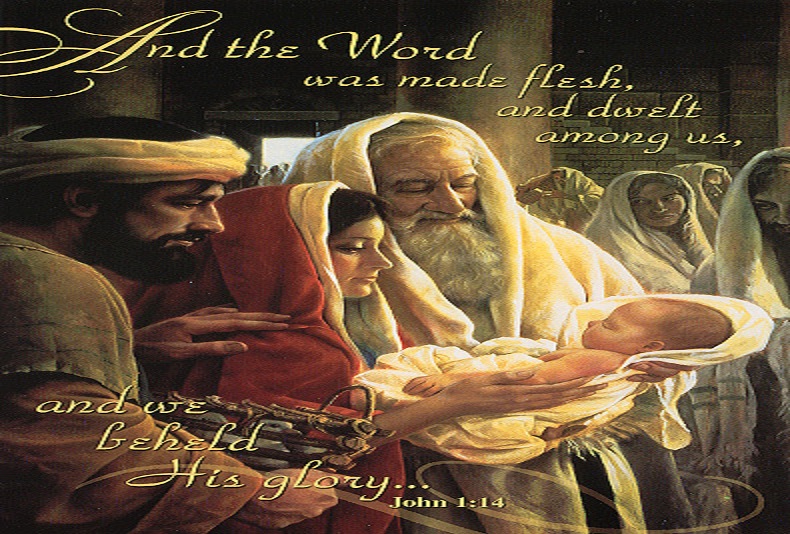
“And the Word became flesh and dwelt among us, and we beheld His glory, the glory as of the only begotten of the Father, full of grace and truth.” John 1:14

This is the Christmas story and He is the Child of Christmas. Hands handled Him, ears heard His voice, eyes gazed upon His veiled glory and they believed. Today, we too can participate in the unfolding story of the wondrous Lord who loved His people so much that He came and dwelt among us. We too can witness concerning the Word of life. Let us carry in our hearts the Child of Christmas throughout the year and let us never shrink back from the bold proclamation that Jesus Christ is Lord.

Yes, Glory to God in the highest, and on earth peace, goodwill toward men! Jesus has come.

Lord God Almighty, today I receive the greatest Gift of all; I receive the Child of Christmas. Renew in me this day the deepest desire to commit to honor Him all my days. Give me boldness to proclaim that Christ has come into the world He created. The Babe in the manger is the incarnate Word, my Lord Jesus. Glory to God in the highest for this marvelous thing You have done. Amen.


Luke 1:35 (Christmas Eve 2013)

130819_old_pine

Tuesday, 24 December 2013

And the angel answered and said to her, “The Holy Spirit will come upon you, and the power of the Highest will overshadow you; therefore, also, that Holy One who is to be born will be called the Son of God. Luke 1:35

There is a common thread and idea in the Old Testament which is found noted both explicitly and implicitly. It is that One would come to restore what Adam lost. The first hint of this coming One is in Genesis 3:15 –

“And I will put enmity Between you and the woman, And between your seed and her Seed; He shall bruise your head, And you shall bruise His heel.”

After this, countless references appear which point to Him. Right after their expulsion from the garden, children are born. From these, a single line is highlighted. Again and again, individuals are named and the stories of their lives are given to show God’s superintending hand of care upon the process of ushering in the promised Redeemer.

Abraham was called and eventually he was given the sign of circumcision. That sign was given to identify a select group whom God would use and through whom would come the promise. But even the sign itself is a picture of the coming Messiah. The Bible shows us that sin came through Adam. It then travels through the male to his offspring. As every human has both a father and a mother, every human receives Adam’s fallen nature. Circumcision pictures the cutting away of that fallen nature by cutting the male organ through which sin is transmitted. But it was only a picture; the sin still comes through the father to the child. This is evidenced in the record of those born within the covenant community.

The covenant people continued on, generation after generation. And within their group prophets continued to proclaim the coming One. Hints concerning His birthplace, His ministry, and even His nature are given. Every word of their Scriptures drips with allusions to His coming. But the prophets stopped speaking and a time of quiet came. Approximately 430 years went by and then unexpectedly, a man named Zechariah was given the promise of a son who would go before the Lord to proclaim Him to the people.

Shortly after that, the angel Gabriel appeared to a young Jewish virgin named Mary. He spoke these words to her –

“Do not be afraid, Mary, for you have found favor with God. And behold, you will conceive in your womb and bring forth a Son, and shall call His name Jesus. He will be great, and will be called the Son of the Highest; and the Lord God will give Him the throne of His father David.”

Her response was natural, “How can this be, since I do not know a man?” And his answer forms the verse we are looking at today. Suddenly, the promises and pictures all come into focus. How could the “seed of the woman” defeat the devil? The answer is that the woman, a fallen child of Adam and bearing his sin and fallen nature like any other person, will bear the Son of God. The sign of circumcision is now understandable. Sin is pictured as being cut away in the covenant people because sin is cut away through the covenant people.

Because sin travels from father to child, and because this Child will have no human father, then no sin will be transferred to Him, despite the fallen nature of the mother. She will be the receptacle through which will come the Messiah of the world. His Father being God, He will be God. His mother being a human, He will be a human. He is the God-Man.

The Child of Christmas is coming; hope for the world is to be found in Him.

Life application: The Christmas Child was born and so we celebrate His birth once a year. But the Christmas Child is eternal, so let us celebrate His life always and forever.

Glorious God Almighty – We wrap presents, anticipate gifts, eat a lot of food, and we share in family and friends. But too often we forget that the only reason we do these things is to mark the birth of the Messiah. Lord God, open hearts and minds to the truth of this day, be exalted for the wondrous work You have accomplished, and receive our thanks and praise for the greatest Gift of all, the Child of Christmas – our Lord and Savior, Jesus. Amen. 

Psalm 127 (Unless the Lord Builds the House – The Superior Word)

Psalm 127:1
Unless the Lord Builds the House
The Superior Word

 Introduction:  Every morning when I get up, I read a portion of the 119th Psalm. It’s the longest chapter in the Bible, 176 verses. But it’s broken down into 22 octaves based on the letters of the Hebrew Aleph-Bet. Again and again, the psalmist speaks of God’s word, asking for it to be his guide, his meditation, his food, and his light.

One of the verses always makes me laugh when I get to it because it describes me very well – “simple.” But God’s word can even sink into a simpleton like me. And so when I read these words, there is the comfort of knowing that God is speaking even to me –

Your testimonies are wonderful;
Therefore my soul keeps them.
130 The entrance of Your words gives light;
It gives understanding to the simple.

Yes it does. The word of God, given to us by God through a special and select nation of people, reveals His very heart and the love He has for His rebellious creatures. It is the greatest treasure on earth, and yet it sits alone and dusty – neglected by the very people He so desperately loves.

This word, this precious word was beautifully described by someone whom I would like to meet someday. He didn’t sign his name to what he had written, probably because he felt it falls short of the majesty of the book itself. But even if this true, his description is worthy of repeating…

The Bible contains the mind of God, the state of man, the way of salvation, the doom of sinners, and the happiness of believers. Its doctrines are holy, its precepts are binding, its histories are true, and its decisions are immutable. Read it to be wise, believe it to be safe, and practice it to be holy. It contains light to direct you, food to support you, and comfort to cheer you.

It is the traveler’s map, the pilgrim’s staff, the pilot’s compass, the soldier’s sword, and the Christian’s charter. Here Paradise is restored, Heaven opened, and the gates of hell disclosed.

Christ is its grand subject, our good the design, and the glory of God its end.

It should fill the memory, rule the heart, and guide the feet. Read it slowly, frequently, and prayerfully. It is a mine of wealth, a paradise of glory, and a river of pleasure. It is given you in life, will be opened at the judgment, and be remembered forever.  It involves the highest responsibility, will reward the greatest labor, and will condemn all who trifle with its sacred contents.

Text Verse: Thus says the Lord:
“Heaven is My throne,
And earth is My footstool.
Where is the house that you will build Me?
And where is the place of My rest?
For all those things My hand has made,
And all those things exist,”
Says the Lord.
“But on this one will I look:
On him who is poor and of a contrite spirit,
And who trembles at My word. Isaiah 66:1, 2

The Lord is the Creator and thus the owner of all things. His throne is heaven and His footstool is the earth. Of all of the majesty, beauty, and splendor we see in the world around us, the earth is so low in comparison to God that He terms it His “footstool.”

A footstool is a place to rest one’s feet, be they clean or dirty, it is a lowly implement in a person’s house. And yet God compares this marvelous world where we live to a mere footstool. And then, astonishingly, He goes on to tell us that of all of the grandeur of the heavens and the earth, His eyes are fixed on the poor and contrite person… who trembles at His word.

He has no regard for position, wealth, or power and yet He has esteem for the person who cares enough about His word to read it and to tremble at it. And so today, I ask you… do you tremble at His word? Do you hold this gift, this treasure, this blessing from God in high esteem?

Would you sacrifice all else – even your own life – if you were asked to compromise His word in order to keep from doing so? If so, then God looks upon you with favor. But for those who dismiss this book, who ignore its words, who diminish its power, God will judge that man and find him guilty.

God holds His word in the highest of esteem. It is the Superior Word which He has graciously granted us the honor of searching out in order to discover His very heart.

And so let us search it out… all the days of our lives, let us revere the word which reveals His Son, who in turn reveals Him to us. And so…  May God speak to us through His word today and may His glorious name ever be praised.

I. May the Lord Build this House

Unless the Lord builds the house,
They labor in vain who build it;

“I am the way, the truth, and the life. No one comes to the Father except through Me.” – Jesus

Way… What way?
I am the truth? What truth? Relative truth or absolute truth?
I am the life…What kind of life?
No one comes to the Father… Is the term “no one” being used in a general sense or in the ultimate sense?
What Father is He talking about?
What does, “through Him” mean?

Anyone? So the question here isn’t just whether you believe this Man’s words or not, but what do these words mean? But let’s suppose you know His exact intent. Do you believe Him? If so, why do you believe Him? What is it that would cause you to trust that what He is claiming is actually supportable?

Everything is established on something – a truth or a lie, something sound or something faulty, something vague or something concrete. Just because something isn’t true doesn’t mean it isn’t the basis for something else.

A politician’s platform may be based on either the truth or on lies. Depending on which, the people will respect or hate him, fear him or rejoice in him, trust him or shun him.

Scientology was made up by a frustrated author, L. Ron Hubbard, who said that the big money was in religion. And so he made up a religion out of his head and became a zillionaire. Never mind that it has no basis in any reality, people still throw themselves headlong into it for whatever crazy reason fills their head.

A building needs a foundation. The type of foundation makes all the difference in the world in how the building will stand up to time and the elements. Venice Italy was built over a marshland.

And so in order to make the city’s dwelling sound, they had to bore down to bedrock and place poles directly on the hard surface. This kept the houses structurally sound. It’s worked for generations because there was a solid foundation below.

Dams are built in the same way. If the foundation isn’t secure, then the dam will simply burst open and the people downstream will be at the mercy of a sudden flood of water. It will sweep them away in an instant.

The Aswan Dam in Egypt had no bedrock to tie to and so they had to develop a rock and clay foundation. If the Aswan dam ever gives way, Egypt will face utter destruction because almost all of her population lives along the Nile’s banks. That is the reality of a possibly faulty foundation.

Faith has to have a sure foundation as well. People can put their faith in anything they want, but unless it’s built on reality, it’s simply wasted faith. The saying, “All paths lead to God” can’t be true. The reason is because anyone can make up anything, like Scientology, and then that would have to then be a path to God.

The problem is that logical contradictions can’t both be true. In John 14:6, Jesus said, “I am the way, the truth, and the life. No one comes to the Father except through Me.” If Jesus’ words are understood in the greater context of the Bible, then either there is only one way to be reconciled to God, meaning through Him, or He was nuts.

If He was nuts, then He shouldn’t be called a “Great teacher” or a “man of God” as non-Christians love to call Him. Rather, He should be called a blasphemer and person who is more contemptible than Adolph Hitler or Joseph Stalin.

But… if He was telling the truth, then we should pay attention to Him. Not in a general, “Hey, listen to this guy” sense, but in the sense of complete devotion to His word. Not a portion of His word, not the parts that we like, but to His word – from beginning to end and without dropping anything out or adding anything in.

“I am the way, the truth, and the life. No one comes to the Father except through Me.” From the context of the Bible, we learn that if He is the way – meaning proper spirituality and fellowship with God, then there is no other.

If He is the truth, then He is absolute truth – there is no falsehood in Him. If He is the life, then He is the Source of life, the Giver of that life, the Sustainer of it, and the One who has authority to end it, or allow it to continue at His will.

If He is the Son of God, then the Father is God. And if the only way to come to that Father, who is God, is through Jesus, then there truly is no other way. This isn’t meant to scare you, but to give you the context of the Bible concerning His words.

But that only leads us to another issue. How can we know if the Bible, which provides this context, is true? How could we put our trust in the words of Jesus, if the story leading to Jesus and the Book which records His life is faulty?

This is a problem because people all over the world claim they know Jesus and yet they have no idea what His word says. Thankfully, having a relationship with Jesus, and fully understanding Jesus are two different things.

So, here we have two incorrect ways of dealing with Jesus. The first is to set out to prove or disprove the Bible before committing to Him. The message of Jesus is simple enough to accept at face value, and all of the head-knowledge in the world won’t do a thing to establish that relationship.

If a guy were to set out to determine if a particular woman was right for him as a wife by learning everything about her from beginning to end, he would never come to the point of marrying her – even if she were the perfect woman for him – because he’s still finding stuff out about her from moment to moment. There is enough information in the simple devotion to make a commitment.

Likewise we don’t need to over-analyze Jesus to the point where we never truly meet with Jesus.

But there is a second incorrect, and horrifyingly stupid way of dealing with Jesus. It is to make the commitment and then never to get to know the fullness of why the commitment was so important in the first place. Who would marry a person and then not want to know anything more about that person? Such would be a truly profane individual.

I know, I know – sometimes we find out things about our husband or wife that we wish we didn’t know, but a human spouse cannot in any way compare to our Creator. And yet, we spend more time trying to figure out which team will win the next Super Bowl than we do trying to understand the Lord God Almighty.

Speaking about a sure foundation, here are Jesus’ words from Matthew 7 –

24 “Therefore whoever hears these sayings of Mine, and does them, I will liken him to a wise man who built his house on the rock: 25 and the rain descended, the floods came, and the winds blew and beat on that house; and it did not fall, for it was founded on the rock. 26 “But everyone who hears these sayings of Mine, and does not do them, will be like a foolish man who built his house on the sand: 27 and the rain descended, the floods came, and the winds blew and beat on that house; and it fell. And great was its fall.”

So knowing who Jesus is and believing Him is necessary, but hearing His sayings and applying them to our lives is just as important. And the premise of the Bible is that Jesus is,,, He is the Word of God.

en arche en ho logos kai ho logos en pros ton theon kai theos en ho logos – In the beginning was the word, and the word was with God, and the word was God.

In other words, His sayings aren’t just the words which came off His lips on the Mount of Beatitudes. Instead, they are the words He uttered from the beginning.

His word spoke the universe into existence. His word proclaimed that there should be light. His breath filled the lungs of Adam and brought Him to life. His word established a day of rest for His people, and His word spoke to Israel from Mount Sinai.

He talked with Abraham; He spoke through the hand of Moses; His voice called out to Elijah and all the prophets, and His voice cried out from a manger for His mother’s milk. He is the One who explains the Father to us and He reveals the very heart of God.

His word is living and active and sharper than any two-edged sword. And yet… we fill our house with TV and Facebook, and ignore the true Source of life.

This little building on Superior Avenue is also a house, and it’s been given a name, a title of honor to the Word of God. It’s a pun, meant to remind you where we are, and Who we honor at the same time. It is the Superior Word. Don’t forget where we are… we’re on Superior Avenue, but don’t forget who and what we are here to honor – the Superior Word – Jesus.

And to honor Him, we must honor His word, which is the Holy Bible – it is the record of His glory. We cannot come to know our Groom in all His fullness without the book which reveals Him.

And so when you walk into this front door, you should expect this book to be opened, explained, revealed, studied, analyzed, revered, place in high honor, and never, never compromised – even if it means offense, hatred, or even death to reader or listener.

People have given their lives for it and I am willing to give mine – because it reveals Jesus, the Author and Finisher of my faith who for the joy that was set before Him endured the cross, despising the shame, and has sat down at the right hand of the throne of God.

May the Lord build this house. And in the process may the Lord, through this house, build your house. May you be established upon the Rock, so that when the waters of the flood come upon you, there is no fear that they will harm you. May the word enrich your life, fill your soul, and guide your steps.

May it be a lamp to your feet and a light to your path. May it fill your mind with delight and your heart with joy as you ponder its words. And may the Lord open it to you in a new and exciting way, each week, as you come through this door, into this house, in order to establish and build your own house.

And may the work of your hands be established in all that you do, so that when you finally lay in rest, waiting for the calling of the Lord to raise you again to life, may the knowledge and pursuit of His Superior Word be a source of eternal rewards. “You sought me in life; now I shall reward you for eternity.” May it be so.

May the Lord build the house. Because if He doesn’t, the builder has truly built in vain.

II. May the Lord Guard this City

1 (con’t) Unless the Lord guards the city,
The watchman stays awake in vain.

In ancient times, a city had high walls surrounding it. There were gates which allowed people in and out of those cities. They were shut at night, they were shut when enemies were seen in the distance, and in the case of Israel, they were often shut on the Sabbath to keep people from the temptation of trading on, and thus violating, that holy day.

On the walls of the city, within earshot of the gatekeepers, high towers were placed so that a watchman could see far into the distance. And there, like seaman on the top of a high mast at sea, the watchmen would watch. If he fell asleep, was a hired traitor, or simply got distracted by playing with his iPad, the enemy could attack and quickly overtake the city.

But this psalm tells us that even if the watchman were attentive to his duties, even if he stayed awake and alert, unless the Lord guarded the city, the watchman watched in vain. America has it’s own high walls – they are the great seas which divide us, rivers and lakes along our borders which secure us, and mountains and cliffs by which we are sheltered.

America also had walls of intelligence, surveillance, defense, and ears listening on land, at sea, and in the skies above. And yet, our walls were breached on 11 September 2001. We had violated our oaths, broken our covenants, and neglected the God who established us, and we received His warning and His chastisement.

This little building… may it be a home for watchmen and may it be guarded by the Lord. May we never depart from Him, neglect to honor Him, or fail to proclaim His Superior Word accurately and faithfully.

May the Lord’s good and Holy Spirit be with this congregation any time its doors are open. May the one behind this pulpit, be it me or any other preacher or teacher, allow the Lord to guard and guide the watchmen. Otherwise we will have stayed awake in vain.

As Paul wrote to the Thessalonians, may the same be true in this house –

Finally, brethren, pray for us, that the word of the Lord may run swiftly and be glorified, just as it is with you, and that we may be delivered from unreasonable and wicked men; for not all have faith. But the Lord is faithful, who will establish you and guard you from the evil one. 1 Thess 3

III. The Conduct of Our Lives

It is vain for you to rise up early,
To sit up late,
To eat the bread of sorrows;
For so He gives His beloved sleep.

We all labor for something. But what we labor for can be of profit to us or of no profit to us. In the immediate sense, it’s better to labor for $20 an hour than it is for $10 an hour if we’re doing the same job.

It’s better to labor with a chemical mask if you’re changing chlorine gas cylinders than it is to hope you can hold your breath long enough to finish the task. You can’t – and the death is both horrifyingly painful and pretty certain. In all things, there is a right way and a wrong way to do things…

The book of Ecclesiastes contrasts life lived under the heavens and life lived under the sun. One might think Solomon was schizophrenic unless they understood the context of what he says there. He goes back and forth making a claim about the useless nature of life, and then telling you how great life is.

Unless you understand the premise, he seems to make no sense. But man is given a choice – to spend his days in the utterly foolish attempt of gratifying himself apart from God, or living for God and under His umbrella of love, care, and protection.

The psalmist says that it is vain for you to rise up early, not that it isn’t proper or beneficial, but it is vain. If you are living your life under the sun, then all is vanity and merely chasing after the wind. Rising early to make an extra hour of wages is ultimately futile unless there is an end purpose for your labors.

Likewise, it is vain to sit up late. One can be like Edison who stayed up till the very early hours of the morning inventing and tinkering, but unless there is an end purpose to such a life, all of the invention, achievement, wealth, and pomp will end up forgotten in a wooden box decaying under the clods of the earth.

Solomon said –

13 This wisdom I have also seen under the sun, and it seemed great to me: 14 There was a little city with few men in it; and a great king came against it, besieged it, and built great snares around it. 15 Now there was found in it a poor wise man, and he by his wisdom delivered the city. Yet no one remembered that same poor man.
16 Then I said:
“Wisdom is better than strength.
Nevertheless the poor man’s wisdom is despised,
And his words are not heard.
17 Words of the wise, spoken quietly, should be heard
Rather than the shout of a ruler of fools.
18 Wisdom is better than weapons of war;
But one sinner destroys much good.” Ecclesiastes 9:13-18

What good was the poor wise man’s wisdom, but the temporary relief from the enemy. In the end, he was neither exalted nor remembered.

Again, the psalmist next tells us that it is vain to eat the bread of sorrows. We can spend all of our effort toiling for money, security, or possessions. We can do so to the point of exhaustion. Such is the eating of the bread of sorrows – all of our efforts are directed towards satisfying temporary pleasures which end with our temporary life. But there is a contrast…

The last thought of the verse says that He, the Lord, gives His beloved sleep. While the world is missing sleep because they have risen early, gone to bed late, and afflicted themselves for profit, there is a place of rest for those whom God loves. Whether we eat much or little, whether we have wealth or live simply, it is all temporary, fleeting, and destined for destruction.

But for those who live for the Lord, who call on Him and pursue Him… for them there is rest. At night when others are toiling, the minds of the faithful are meditating on God’s word, they are directed to the eternal, not the temporary, their eyes are lifted to the hills and not to the grindstone.

This is what I would hope for each of you who determine to attend the Superior Word – pursuing God through His word. By learning it here so that even in your work, you can meditate on it, you can contemplate His blessings, and you can thank Him for His Son. All the toil in the world will end, but the Word of the Lord endures forever.

IV. The Legacy We Leave Behind

Behold, children are a heritage from the Lord,
The fruit of the womb is a reward.
Like arrows in the hand of a warrior,
So are the children of one’s youth.
Happy is the man who has his quiver full of them;
They shall not be ashamed,
But shall speak with their enemies in the gate.

Suddenly, as if a complete divergence from the thought of the first two verses, these seemingly unrelated thoughts flow from the hand of the psalmist. He’s told us about the building of a house, the guarding of the city, and the conduct of our lives, and then with no seeming transition, he speaks of children.

But this is exactly as it should be. When a couple get married, the first thing they do is set about working on their house. Unless that home was built by the Lord, it will never be home. Once the home is built, it needs to be kept in guard. For every possession, there is an enemy waiting to take it.

We have a home now, but will we forget the Lord now that it’s built? All of our work will be in vain if we leave Him shut out of our lives. And so we establish our home and our defense on the Lord. But then… then we may forget Him, living in our comfort, secure with our defenses, and so we may pursue money and gain. The Lord becomes an after-thought.

It happens with cities, it happens with people, and it happens with churches. The first love is abandoned and only what can increase our standing is pursued – not the Lord who built the home, and not the Lord who defended it. But for those who are wise, they remained content with His provision, close to His word, and established well in their life under the heavens. So…

The next logical thing to pursue is children. A city will die without them. Family lines will end unless they come. And a church without children will grow old and stagnant. And so the psalmist reminds us that “Behold, children are a heritage from the Lord…”

Every person who comes into this church and finds rest is in a sense a child of this church. If this is the Lord’s church, they will be a child of the Lord.

Such fruit of the womb is a reward because they will benefit the church – in prayer, in giving, in fellowship, in times of joy and in times of sadness. They will be a part of the family of God and members of the commonwealth of Israel, with Christ as their head.

These are, according to the psalmist, “like arrows in the hand of a warrior.” When times are tough, they will pull together, not split apart. They will unite and prevail for the sake of each other and the sake of Christ. I’ve been in several churches where the pastor has left or died. In one, the people held together during a long period of waiting for the right man because they were grounded in Christ.

I’ve seen churches hire a new pastor and he has all but destroyed the underpinnings of the church. Instead of the cross of Christ, there is the expectation of a large congregation and a larger salary. The focus says Christ, but the reality is misdirection, misguided theories, and mishandling of the flock under him.

How does this happen? It is from a lack of reliance on the word. A church with ten people who hold fast to God’s word is more pleasing to God than a congregation of 30,000 who pay Him lip service on Sunday morning and ignore Him the rest of the week.

The faithful man and woman of God, the children of the church, are truly arrows in the hand of the Warrior. Christ can, and He will, use you for your good and for His glory. “So are the children of one’s youth. Happy is the man who has his quiver full of them.”

I remember one day at the beach a year or so back. A man came up and started arguing with me in the middle of the sermon. Two of the congregation got right up and headed him off to the sidelines. Another rang for the police on the telly. I was able to sit back down and finish the sermon.

On that day, we had a small congregation, but I was a happy man whose quiver was filled with children of the word. They were a defense to me and as they grow in His word, they will be a defense to souls in need of rest. I would pray today that whatever number congregate in these walls – be it few or many – that they will become a full quiver that we may not be ashamed.

The psalmist concludes his thoughts with these words, “They shall not be ashamed, but shall speak with their enemies in the gate.” The gate of the city was the place where people entered and exited, but was it was also the place where all important matters were conducted.

Any legal matter would be decided there. The king would honor the victorious returnees of a battle there at the gate. The promises of security and protection for the people would be made there as well. The people of the city founded on God, and who rely on Him for their success in every matter, is the city who is secure and unafraid.

There at the gates of such a city, the people would distinguish themselves as God’s people. Their presence would be made known. Their conduct would honor their family. The father would be exalted, the mother would be respected, there would be harmony among the people.

But there would also be valor among the children. They would be willing to defend their city, to defend their home, and to leave that home when called to attack the enemy at their gates. This is the legacy of the house built by the Lord. It is the city whose walls the Lord guards, whose efforts are directed to life under the heavens, and whose children are properly instructed in the Word of God.

Such a life is a life directed to holiness, to the honoring of Christ, to the glorification of God, and to the preservation and care of His Superior Word. If you are willing to be counted among such an elite class of souls – whose lives are dedicated to the pursuit of all that which is noble, good, and honoring, I would ask the following of you –

To daily commit in your morning to rise and offer praise to God. And then to open His word and read it, and to let it change your life for your good and for His glory. Psalm 119 says this –

My hands also I will lift up to Your commandments,
Which I love,
And I will meditate on Your statutes.

And then when you go out into the world, to work or enjoy, I would ask that you would walk with the Lord and talk with the Lord. Let every step be a step of worship to Him. Let every word be one of gratitude, praise, or edification – all things which are to be found in these verses from the 119th Psalm

My lips shall utter praise,
For You teach me Your statutes.
172 My tongue shall speak of Your word,
For all Your commandments are righteousness.
173 Let Your hand become my help,
For I have chosen Your precepts.
174 I long for Your salvation, O Lord,
And Your law is my delight.

All day long, if the Lord is on your heart and in your mind, you will be free from the sin which so easily besets and misdirects the ways of your life.

And then when your day is finished, then… comes the time to lay and to pray. It is the time to meditate on God’s word and let it transform you, even in your sleep. The 119th Psalm tells us of such a faithful servant –

Your statutes have been my songs
In the house of my pilgrimage.
55 I remember Your name in the night, O Lord,
And I keep Your law.

If you remember these things each day, and then act accordingly, you will be holy in all your conduct. The Lord will grace you with His love, lavish you with His blessings, and care for you in your afflictions. May this house of God, dedicated to His honor, so inspire you to live such a life all the days of your life.

May the Lord build this house
May the Lord guard this place
May the conduct in these walls be pleasing in His sight
And may we not be ashamed when we consider our legacy

These are the prayers of my heart for the Superior Word, and these prayers include those of you who choose to make this your spiritual home, your place of growth and fellowship, and the place where you honor the exalted name of Jesus Christ.

He is the Son of Adam in His humanity, He is the Son of God in His deity, He is the son of Abraham by promise, He is the Son of Israel in His nationality, He is the Son of David in His kingship, and He is the Lord of Creation in His being. He is Jesus, the Word of God and the Lord of this house.

If you are here today and have never understood your need for Jesus, I would ask for a few more minutes of your time. You can spend the rest of your days living your life under the sun, followed by eternity regretting that vain pursuit. Or you can spend your days living for life under the heavens and eternity having the glory of God’s light shining on you in the New Jerusalem. It is Jesus who makes that possible, so please let me explain that to you now…

Closing Verse: That which was from the beginning, which we have heard, which we have seen with our eyes, which we have looked upon, and our hands have handled, concerning the Word of life— the life was manifested, and we have seen, and bear witness, and declare to you that eternal life which was with the Father and was manifested to us— 1 John 1:1, 2

Next Week: Genesis 37:1-11 (Sheaves of the Field and Stars of the Sky) (92nd Genesis Sermon)

The Lord has you exactly where He wants you and He has a good plan and purpose for you. Call on Him and let Him do marvelous things for you and through you.

Unless the Lord Builds the House

Unless the Lord builds the house
They labor in vain who build it, I say again
Unless the Lord guards the city, then even from a mouse
The watchman stays awake and he does so in vain

It is
vain for you to rise up early
To sit up late in the night hours so deep
To eat the bread of sorrows
For so He gives His beloved sleep

Behold, children are a heritage from the Lord,
The fruit of the womb is a reward

Like arrows in the hand of a warrior, this is the truth
So are the children that come at the time of one’s youth

Happy is the man who has his quiver
And it is full of them, a feeling so great
They shall not be ashamed, the Lord will deliver
And they shall speak with their enemies in the gate

Thus says the Lord: “Heaven is My throne
And earth is My footstool, so I am blessed
Where is the house that you will build Me, Where is this home?
And where is the place of My rest?

 For all those things My hand has made
And all those things exist,” Says the Lord
“But on this one will I look: a glorious trade
On him who is poor and of a contrite spirit,
And who trembles at My word.

 Therefore whoever hears these sayings of Mine
And does them, I will liken him to a wise man
Who built his house on the rock, on the Rock divine
Who keeps My Word near to his hand

And the rain may descend, the floods come like a shock
And the winds blow and beat on that house
And it did not fall, for it was founded on the Rock

But everyone who hears these sayings of Mine
And does not do them, will be like a foolish man
He ignores the wise counsel and the Rock divine
He who built his house on the sand

And the rain descended, the floods came
And the winds blew and on that house they beat
And it fell, and great was its fall, such the shame
In the house where destruction is complete

And so finally, brethren, pray for us
That the word of the Lord may run swiftly and be glorified
Just as it is with you, as you proclaim Jesus
And carry the word of God, always at your side

Pray that we may be delivered from unreasonable and wicked men
For not all have faith, but the Lord is faithful in what has begun
He is the one who will establish you till the very end
And He will guard you always from the evil one

Praise God from whom all blessings flow
Praise Him above the heavenly host
Praise Him all creatures here below
Praise Father, Son, and Holy Ghost

Hallelujah and Amen…