Romans 8:37

130804_hooray

Sunday, 4 August 2013

Yet in all these things we are more than conquerors through Him who loved us. Romans 8:37

In verse 35, the list of “these things” was given. It included seven things which are contrary to us – tribulation, distress, persecution, famine, nakedness, peril, and sword. Because these come against us as faithful believers, “we are accounted as sheep for slaughter.” The world may laugh at our faithfulness to God even in these attacks against us and even to the point of martyrdom. But Paul says despite such mocking, “Yet in all these things we are more than conquerors…”

The word he uses for “more than conquerors” is hypernikōmen. It comes from two other Greek words – huper which we would translate as hyper, and nikao, meaning victory. The word nikao is the basis for Nike – the god of victory (and a good athletic shoe -ed. DBV Apprentice). The idea which we are given is that we are hyper-victorious “through Him who loved us.” “Through Him” implies that we are in no way victorious on our own. Without Christ, those seven words of woe would overcome us and our life-journey would be ended. But in Christ, they can’t even be considered minor setbacks.

In fact, the trials and perils we face, when faced in Christ and for Christ, only make the victory sweeter and they serve to complement the “hyper-ness” of the already supreme victory. As Paul notes in Philippians 4:13, “I can do all things through Christ who strengthens me.” Yes, in Christ we are more than conquerors.

Life application: Be sure to rightly apply Romans 8:37. When Paul says that “we are more than conquerors in Christ, he does it in a verse beginning with “yet.” To understand the context, we need to evaluate what verses are being tied to. In the case of this verse, it is tied to suffering. If you suffer, know that your suffering is already defeated. Through Christ who strengthens you, the victory is already assured.

Lord, when I wake up, there are pains in my body and so I rub on ointment. When I go to read, I need glasses. My head hurts Lord, and I take aspirin. When things aren’t right with me physically, I use that which corrects or heals my failing. How can I expect to treat my spiritual weaknesses any differently? Lord, open my heart and mind to understand Your word – the cure for all my spiritual woes. Amen.

Romans 8:36

130803_sheep

Saturday, 3 August 2013

As it is written:
“For Your sake we are killed all day long; We are accounted as sheep for the slaughter.” Romans 8:36

Today Paul returns to the fountain, Scripture itself, to continue with the previous thought. This is a quote from Psalm 44:22. The Psalm is written about the sufferings of the people of Israel, the people of God. The surrounding nations had attacked and plundered them and the psalmist cried out his plea to God about the matter. Despite what was happening, he reminded God of their faithfulness –

All this has come upon us; But we have not forgotten You, Nor have we dealt falsely with Your covenant.

Paul looks to the treatment of the New Testament saints in the same way. Despite all of the woes which could come against them as noted in 8:35, they would remain faithful to God. In 1 Corinthians 4:9, he highlights a similar note concerning the apostles –

“For I think that God has displayed us, the apostles, last, as men condemned to death; for we have been made a spectacle to the world, both to angels and to men.”

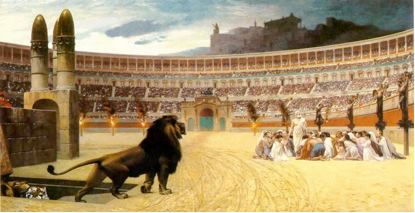
“For Your sake” means “God” and it is related to the gospel message found in Christ Jesus. Because of our obedience to this glorious display of love, “we are killed all day long.” This isn’t just hyperbole. Christians were already being singled out and martyred for their faith at Paul’s time. From Stephen, the first recorded martyr (Acts 7:60), the slaughter of Christians has gone on unabated for two millennia. The floor of the Roman coliseum is still stained with the blood which flowed there eons ago.

“All day long” is an idiom which means, “ceaselessly.” The blood flows and the people’s faith remains and is strengthened. The surety of eternal life in Christ makes such suffering not only tolerable, but acceptable to the one facing the ordeal. Because it is, “We are accounted as sheep for the slaughter.” A sheep will simply follow where it is led, without question. They don’t run away as they approach their doom. Instead, they obediently walk behind the shepherd where he leads.

The thought being relayed is that where Christ leads, be it to a life of length and green pastures, or to a slaughter house for His glory, His sheep will follow. The reason isn’t because of blind faith. The reason is because of revealed light. Christ has risen and those in Christ will rise. “What can man do to me? Christ is on my side.”

Life Application: A Christian’s life of prosperity and ease doesn’t indicate God loves that person any more than the one suffering in a dirty prison cell awaiting execution. Should the comfortable life you face suddenly come to a screeching halt and persecution comes to your door, will you still be thankful and willingly follow your Shepherd? Think about it now, who knows what tomorrow will bring.

Heavenly Father, long ago, the psalmist wrote these words –

For Your sake we are killed all day long; We are accounted as sheep for the slaughter.

The New Testament repeats them. This tells me I may have to face trials, persecution, or even death for my faith in Christ. Should this honor come my way, I will be obedient. Where the Shepherd leads, I will follow. Amen.

Romans 8:35

130802_collesium

Friday, 2 August 2013

Who shall separate us from the love of Christ? Shall tribulation, or distress, or persecution, or famine, or nakedness, or peril, or sword? Romans 8:35

Another verse well worth committing to memory is found in Romans 8:35. Paul has just explained that there is none who can condemn those who have faith in Christ. He died for our sins and was raised for our justification. And even more, He is there at the right hand of God interceding for us. Because of this, another rhetorical question is proposed, “Who shall separate us from the love of Christ?” The only possible answer is, “No one.” Any alternative would be unthinkable.

To help us think this though clearly, a list of possibilities is given which would normally separate the living –

Tribulation, Greek thlipsis – This generally denotes something which applies external pressure. If one stands on a watermelon, the melon will scrunch and explode. External pressures on us cause us to fold in, either physically or mentally, until we finally lose control. No matter what presses upon us, what it leads to is temporary; it has no eternal bearing on our state before God.

Distress, Greek stenochōria – This could be equated to being stuck in a tight, confining place. If one were buried alive, this would be a word which might be used. There is no freedom of movement, but only the confinement which cause anxiety. In 2 Corinthians 7:5, Paul speaks of the distress he faced – “Outside were conflicts, inside were fears.” The external conflicts caused the internal fears. However, even though we may enter into dire, confining straights, Christ shall lead us to broad spaces where there will be eternal freedom of movement. See Psalm 18:19, for example.

Persecution, Greek diōgmos – If we walk in life and have others constantly attempting to overtake us and harm us, we are facing persecution. The intent is to destroy in name, in character, or even in person. Such is the fate of many in the world today as the Islamic and secular world attacks, reviles, and kills Christians because of their faith in the work of Jesus. No matter what they say or do, Christ is our Advocate and He is our place of refuge. There should be no fear of what the world can do. It is but a light affliction.

Famine, Greek limos – This is the complete deprivation of what is needed to remain alive. It is a lack of food; it is a lack of water; it is the deficiency of nutrition which can only lead to death. Though we may lack food or water, there is a place awaiting us where there shall be no lack. “They shall neither hunger anymore nor thirst anymore; the sun shall not strike them, nor any heat…” Revelation 7:16

Nakedness, Greek gymnotēs– This isn’t speaking of a state of immodesty, but rather a state of deprivation of the necessities for protection. It is the state of being without any clothing at all. Imagine the anguish of being stripped bare in the midst of the heat of the desert or during the falling of a heavy wet snow. There can only be one end to such treatment, misery followed by death. However, in Christ, we are granted eternal garments with which to cover ourselves. See Revelation 3:5, for example.

Peril, Greek kindynos – This is anything which would cause danger or risk. If we walk into the ocean, maybe we will step on something with a poison barb. If we flee in haste, maybe we will slip and break a limb. If we cut ourselves maybe an incurable infection will result. Peril includes anything which is a result of the curse pronounced so long ago upon creation. Whatever is against us as human beings and which could harm us, it will be forgotten someday when we are delivered into the paradise God has prepared for His people. Revelation 21:3 tells us that in the future, there shall be no more curse.

Sword, Greek machaira – This is surely speaking of the state of martydom that many Christians have faced, are facing, and will continue to face. The term “the edge of thesword” in Hebrew is actually “the mouth of the sword.” The sword is a consuming instrument which is never satisfied. It’s hunger is only for more death. However, should you – O Christian – face the sword, it can only lead you through the Door and into the world where death is swallowed up in victory. Christ has prevailed over such things. Fear not.

Life application: There are a multitude of things which can harm us or kill us, but none of them can prevail over us. In Christ, the battle is already won. If you desire to have your faith strengthened today, take time to read Hebrews 11 which tells of the faith of those who have gone before.

Heavenly Father, I have the assurance that no matter what trial or struggle comes against me, there is a better hope than this temporary, earthly walk. I know that no distress, peril, persecution, or want can keep me from the promises You have made. And so I place my life in Your capable hands, knowing that You shall lead me to waters of rest. Amen.


Romans 8:34

130801_christ_on_throne

Thursday, 1 August 2013

Who is he who condemns? It is Christ who died, and furthermore is also risen, who is even at the right hand of God, who also makes intercession for us.  Romans 8:34

In the preceding verse it was implied through a rhetorical question that no one could bring a charge against God’s elect because it is God who justifies. In continuation of our surety over the forces which would presume to come against us, Paul now asks his next question, “Who is he who condemns?” Like the previous question, the answer demands a “No one!” And then comes the explanation, “It is Christ who died.”

Christ died for us. He became our substitute. His death paid our penalty, carried away our sin, and restored to us a propitious relationship with God. His righteousness has been imputed to us! Sin no longer separates us from the One who created us. So who then could condemn us? It’s simply not possible. And there is more…

“Furthermore” Christ “is also risen.” His death and resurrection take us back to Romans 4:25 –

It was He, “who was delivered up because of our offenses, and was raised because of our justification.”

Not only died Christ pay our penalty, carry away our sins, and restore our relationship to God, but He was raised for our justification. The resurrection proves these things for the soul who believes. This is why Paul ties the resurrection in with our calling on Jesus (Romans 10:9). Who would call on a dead Lord? But we don’t call on a dead Lord. Instead, we call on the risen Christ “who is even at the right hand of God, who also makes intercession for us.”

Christ died for our sins, was raised for our justification, and is now performing His functions as our Mediator and our Advocate. He is interceding for us from the position of authority, symbolized by the term “right hand of God.” This doesn’t mean God has body and is sitting on an actual throne with Jesus sitting on another throne next to Him. Rather, Jesus is in the position of God’s authority.

Because He has done all these things, and because all authority has been granted to Him – who has done all these things for us – then how could another condemn us? It isn’t possible. We are in Christ and fully protected from any external force which would dare attempt to do so. Such is the honor and blessing of being a child of God.

Life application: No person, no demon, no devil can condemn you. There is a far higher and greater power who has you completely safe and secure in the palm of His hand. When you feel the accusation of Satan telling you that you aren’t worthy, remind him that though that may be true, Jesus is worthy and you are in Him. No charge can stand against God’s elect.

Lord, sometimes Satan tells me that I am unworthy of the blessings you’ve bestowed upon me. And I know it is true, but I remind him that though I am unworthy, I am in You – My faith is in You, my trust is in You, my hope is in You. Though I am unworthy by myself, in You I have all the rights of a child of God. Thank You Lord for bestowing upon me that which I do not deserve. Thank you for Jesus. Amen.

Romans 8:33

130731_gavel

Wednesday, 31 July 2013

Who shall bring a charge against God’s elect? It is God who justifies. Romans 8:33

As if a lawyer in a courtroom, Paul argues his case – “Who shall bring a charge against God’s elect?” Because God is the ultimate authority, who would even dare to do so? In the United States, we have what is known as the “presidential pardon.” If a person is convicted of some crime, the US President has the authority to grant a pardon for that crime. Once the pardon is accepted by the person who has been named (and he can in fact turn it down), the crime is completely erased from the record. No one can ever come to them again and bring that charge against them. The highest authority of the land has approved it and it is gone completely and forever.

Every person on earth has likewise been granted a pardon before God. It is incumbent on them to receive it by calling on Jesus as Lord. When the conditions are met, the pardon is granted. As God is the Creator, He is the highest authority of all. Therefore no person, no spirit, no demon or devil, can bring a charge against one who has been so forgiven. They are the elect of God and have been cleansed by the most purifying substance of all, “the precious blood of Christ, as of a lamb without blemish and without spot” (1 Peter 1:19).

In Christ’s work in fulfillment of the law, in His death, and in His resurrection “it is God who justifies.” The lost soul is found, the sentence is pardoned, the declaration is pronounced – “Not guilty.” This is the force and intent of what the Bible teaches. And, as an interesting note that no further explanation is needed on this matter, this is the last of the 13 times the word for “justify” is used in Romans.

Again, if one thinks this through with clarity of reasoning, it should be obvious that this implies eternal salvation. If a man is justified before God, will God -who is outside of time – change His mind about what has transpired? Of course not. The translation of this verse even covers that base because in the Greek it can be stated in the form of a question as well as a statement of fact, “Who shall bring a charge against God’s elect?  Shall God who justifies?”

It is absurd in the highest sense to think that God would be fickle enough to condemn the same person He has justified. Eternal salvation is the only obvious conclusion to what has occurred in the pardoned soul.

Life application: Looking at what occurs in the believer from a legal standpoint – and it is a heavenly court by which we will be judged – we can know with absolute certainty that God is perfectly fair in His decisions and that those decisions bear eternal weight. Call on Jesus and rest in His eternal graces.

O God, too often we act as if You could somehow act in an unjust or unrighteous manner. How slow we are to think through Your unchanging and perfect nature. I know that everything You do is in accord with Your nature and that You are perfectly fair in how You conduct all things. I rest in this as a great comfort. You have promised peace through Your Son and so in receiving Him, I have peace. Amen.