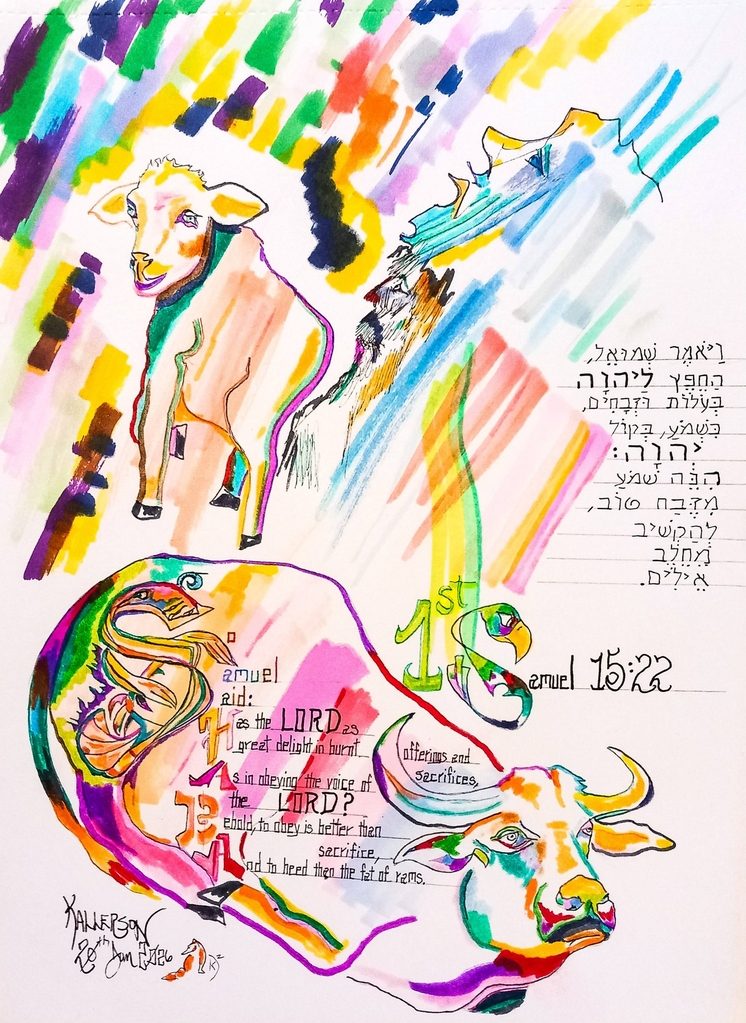
1 Samuel 9:1-18 (Saul – Select and Good, Part I)

Artwork by Douglas Kallerson

1 Samuel 9:1-18
Saul – Select and Good, Part I

(Typed 14 July 2025) While sermon typing, I find it fun to compare translations to see how they vary and how they have been copied or diverged from over time.

As is often the case, there are several anomalies found in the Hebrew of the verses today. When they arise, translators should do their best to make a translation that makes sense while, hopefully, reflecting the original as much as possible.

Translations often lean heavily on the work of previous translations. That can be seen when looking at a line of translations that spans many years. Four translations that I will often check were published in this order:

Coverdale Bible of 1535
Bishop’s Bible of 1568
Geneva Bible of 1587
King James Version of 1611

The Coverdale surely referred to previous Bibles that I don’t have access to. However, it is evident that the three others referred to the Coverdale in their translations, each making changes as they went.

From time to time, the earlier version will be correct, and for some inexplicable reason, a later translation will diverge from that. In the case of the Coverdale Bible, this happened several times just in these verses.

Text Verse: “But you must continue in the things which you have learned and been assured of, knowing from whom you have learned them, 15 and that from childhood you have known the Holy Scriptures, which are able to make you wise for salvation through faith which is in Christ Jesus.” 1 Timothy 3:14,15

Translations generally get the feel for the overall content, even if they occasionally divert from a proper rendering of the original. I am currently reading a paraphrase, the Living Bible, given to me one day after my 15th birthday. And yet, it’s the first time I have read it.

That may be a good thing because a paraphrase is not a translation. Who knows how I would have developed if I had started reading the Bible with it? But despite being a paraphrase, it is fun to read, and it certainly gets across the sense of what is being conveyed.

However, to know exactly what the Lord is telling us, a paraphrase is not sufficient. Quite often, people will argue over a point of theology or doctrine from a particular translation, demanding that their view is correct, but the translation itself is completely rong.

This is why I love doing sermons directly from the Hebrew. My analysis may be wrong, but the translation is word-for-word from the original and it will thus have a much better chance of being correct.

As for the Coverdale Bible, there are at least two times in this passage that they were spot on in their translation, but later translations diverged from it. In one case, the Bishop’s and the Geneva followed the Coverdale, but the KJV sadly departed from it.

In one case, nobody followed the Coverdale even though it is exactly translated. The reason I mention this is to pique your interest in the word. Study it, compare translations, and think about what you discover. Let the word fill you with its wonder as you seek to be closer and closer to understanding exactly what God is telling us in this marvelous gift.

So much excitement is to be found in His superior word. And so, let us turn to that precious word once again, and… May God speak to us through His word today, and may His glorious name ever be praised.

I. The Jennies (verses 1-9)

There was a man of Benjamin

vayhi ish mibin yamin – “And it was, man from son right.” The written Hebrew is different than the oral tradition. It reads, “And it was, man from son right.” The words ben and yamin are separated. The oral reads, “And it was man from Benjamin.”

Based on the final clause of this verse, the written is to be preferred. The name Benjamin will, at times, be presented differently in the narrative. When it is, I will translate it as the Hebrew reads.

Benjamin means Son of the Right (hand). It can also mean Son of the South because the right in Scripture corresponds to the south, aligning with the direction in which the tabernacle/temple was situated in relation to the land.

1 (con’t) whose name was Kish the son of Abiel, the son of Zeror, the son of Bechorath, the son of Aphiah,

ushemo qish ben aviel ben tseror ben bekorath ben aphiah – “And his name Kish, son Abiel, son Zeror, son Bechorath, son Aphiah.” The listing here is not the same as the one found in Chronicles. For example, it says in this verse that Kish is the son of Abiel. In 1 Chronicles 8 & 9, it says that Kish is the son of Ner.

Such variances in genealogies are not uncommon, and they often reflect the intent of the chronicler as much as anything else. Names within genealogies may be left out for some reason. If so, then it could be that Saul is the son of Kish, the son of Ner, the son of Abiel.

It could be that Kish’s father had two names, Ner and Abiel. It could also be that Kish died and Ner, his brother, raised Saul after that. Such differences do not necessarily imply any contradiction or error in the text.

Kish could have several meanings. It could be Snaring, Ensnared, or Bird Catcher, coming from qush, to lay a snare. It may also mean Bow, coming from qesheth, a bow.

Abiel means Father of Strength, God is Father, or El (God) is My Father. Zeror means either Besieged or Bundle, coming from tsarar, to besiege or bind up, or Pebble (like Peter), coming from tsarar, to be sharp as in a flint rock. Bechorath means First Birth or First Born.

Aphiah is only found here in the Bible. It is derived from puakh, to blow with the breath or air. The word is not common and is usually used in connection with uttering lies or deceit, breathing out contempt or exasperation, etc. It thus means Exhale, Blowing, Utterer, etc.

Returning to Kish for the narrative, it again says…

1 (con’t) a Benjamite, a mighty man of power.

Rather: ben ish yemini gibor khayil – “son man right – powerful valor.” By placing the word “man” between “son” and “right,” it demands a translation of “son man right,” not Benjamin. He is described with the word khayil, which can mean wealth, strength, etc. Valor is a good catchall translation. Of Kish, it says…

And he had a choice and handsome son whose name was Saul.

velo hayah ven ushemo shaul bakhur vatov – “And to him, it was son, and his name Saul – select and good.” As is the usual custom in such listings, this person is the focus of the narrative. The same type of focus was seen in 1 Samuel 1:1, where Elkanah was introduced, his genealogy was given, and then the point of naming him was identified in verse 2 by naming Hannah and Peninnah.

Saul means Asked, as in Asked of or Asked for, coming from shaal, to ask. As with the name Horeb, the mountain where the law was received, and which is spelled the same as kherev, sword, Saul’s name is identical to Sheol, the pit or place of the dead. That should be remembered when evaluating the surrounding narrative.

The name Saul, Asked, is generally associated with a firstborn who was “asked” for. The thought is similar to the name of Samuel sh*mu*el (Asked from God) where the word shaal became a part of his name –

“And it will be to revolvings the days, and she will conceive, Hannah, and she will bear son, and she will call his name Samuel. ‘For from Yehovah I asked [shaal] him.’” 1 Samuel 1:20

The name Saul is the same as the name of Saul, who is Paul in the New Testament. Both are from the tribe of Benjamin. Selecting someone named Saul is certainly purposeful, forming a pun. In Chapter 8, it said –

“And he said, Samuel, all words Yehovah unto the people, the ‘askers [shaal] from him a king.’” 1 Samuel 8:10

The people asked for a king, and they are being given what they “asked” for. Of Saul…

2 (con’t)There was not a more handsome person than he among the children of Israel.

veein ish mibene Yisrael tov mimenu – “And not man from sons Israel good from him.” These words explain the “select and good” of the previous clause. Saul wasn’t just select and good. Rather, he was select and the goodest of the good, being gooder than the rest. So goodly, he was the best. And why?…

2 (con’t) From his shoulders upward he was taller than any of the people.

mishikhmo vamalah geboah mikal ha’am – “From his shoulders and upward higher from all the people.” The people asked for a king. The Lord is giving them what they asked for, and He is doing it in a manner that they would expect. An externally prime specimen will be designated to lead Israel’s armies.

Concerning his selection, background information is provided to help understand the man, the situation, and the time in which Israel exists…

Now the donkeys of Kish, Saul’s father, were lost.

vatovadnah ha’athonoth leqish avi shaul – “And they wandered, the jennies to Kish, father Saul.” The donkeys are specifically athon, female donkeys. In English, the word jenny is used to describe a female donkey. The word athon comes from the same root as ethan, perennial, ever-flowing, or permanent. The sense is that of the ever-patient nature of the animal, being docile.

3 (con’t) And Kish said to his son Saul, “Please take one of the servants with you, and arise, go and look for the donkeys.”

vayomer qish el shaul beno qakh na itekha eth akhad mehanearim vequm lekh baqesh eth ha’athonoth – “And he said, Kish unto Saul his son, ‘You must take, I pray, with you one from the servants, and you must arise, and you must walk, and you must seek the jennies.’” The JFB Commentary notes that this is not unusual, as donkeys were left to roam in the grazing season. If they roamed out of sight, someone would head out to find them.

That Kish had donkeys and servants speaks to some amount of wealth. Donkeys were not lowly animals at this time. They served many uses, and even princes and kings rode them. In Numbers 22, Balaam rode on one of these jennies. Because the donkeys are out of view, using imperative verbs signifies that to lose them permanently would mean a loss of valuable property. So the directive is given…

So he passed through the mountains of Ephraim and through the land of Shalisha, but they did not find them.

vayaavor behar ephrayim vayaavor beerets shalishah velo matsau – “And he traversed in Mount Ephraim, and he traversed in land Shalisha, and not they found.” Gibeah in Benjamin is where Saul started. Mount Ephraim extended that far to the south.

Saul heads somewhat northerly into the land of Shalisha. This is the only time it is mentioned in Scripture. It is derived from shalosh, three, or shalash, to do the third time. As such, it signifies Threeland, Three, Third, Triangular, etc. Therefore, it is likely a place where three valleys joined or three wadis met, or something similar.

Ephraim means Twice Fruitful and Ashes. In Scripture, a har, mountain, is a lot of something gathered. In typology, it is synonymous with a large but centralized group of people.

4 (con’t) Then they passed through the land of Shaalim, and they were not there.

vayaavru beerets shaalim vaayin – “And they traversed in land Shaalim, and naught.” Shaalim is also found only here in Scripture. It is derived from shual, a fox. It signifies Foxes or Place of Foxes.

The word shual comes from shoal, hollow hand, or handful, and the meaning extends to this. The connection is that foxes dig out a hollow to live in. In the gospels, Jesus said, “Foxes have holes and birds of the air have nests, but the Son of Man has nowhere to lay His head” (Matthew 8:20). In Luke, it says –

“On that very day some Pharisees came, saying to Him, ‘Get out and depart from here, for Herod wants to kill You.’
32 And He said to them, ‘Go, tell that fox, “Behold, I cast out demons and perform cures today and tomorrow, and the third day I shall be perfected.”’ 33 Nevertheless I must journey today, tomorrow, and the day following; for it cannot be that a prophet should perish outside of Jerusalem.” Luke 13:31-33

The significance of a fox is that of a hole digger, and thus, one who is there to trip others up.

4 (con’t) Then he passed through the land of the Benjamites, but they did not find them.

Rather: vayaavor beererts yemini velo matsau – “And he traversed in land Right, and not they found.” Whether this means Benjamin or not, it is not what is stated. Only the word yemini, right, is given. The Brenton Septuagint says Jamin, Smith’s says, “the Jaminite,” several ancient versions from the 1500s, Coverdale’s, the Bishop’s, and the Geneva, rightly transliterate as Iemini.

With the introduction of the KJV, the incorrect “Benjamite” was introduced, which has been repeated in all other modern translations except the New Heart English Bible, which says Jaminites. However, the word is singular, not plural.

When they had come to the land of Zuph,

The words are emphatic: hemah bau beerets tsuph – “They, they came in land Zuph.” This is probably the same land as the name of the man, Zuph, noted in 1 Samuel 1:1 –

“And was, man one, from the Ramathaim Zophim, from Mount Ephraim. And his name Elkanah, son Jeroham, son Elihu, son Tohu, son Zuph – Ephrathite.” 1 Samuel 1:1

In other words, the land is being identified with this man, from whom Samuel descended. Zuph comes from tsuph, dripping, and signifying the honeycomb. That comes from tsuph, to overflow. Thus, it means Honeycomb or Overflow.

5 (con’t) Saul said to his servant who was with him, “Come, let us return, lest my father cease caring about the donkeys and become worried about us.”

veshaul amar lenaaro asher imo lekha venashuvah pen yekhdal avi min haathonoth vedaag lanu – “and Saul, he said to his servant who with him ‘You must walk-ward, and let us return, lest he will cease, my father, from the jennies and he dreaded to us.’” Saul and his servant had been rambling the countryside long enough that he was concerned that his father might dread some calamity had befallen them.

Therefore, he says they should head toward home. A new word, daag, to be afraid, is introduced. All of its seven uses cumulatively give the notion of a sense of dread that one frets over.

And he said to him, “Look now, there is in this city a man of God,

vayomer lo hineh na ish elohim baiyr hazoth – “And he said to him, ‘Behold, I pray, man God in the city, the this.” They are in the land of Zuph, thus the unnamed city would be Ramah, Samuel’s residence as noted in 1 Samuel 7:17. Rather than identifying Samuel as Israel’s judge, the servant calls him a man of God…

6 (con’t) and he is an honorable man; all that he says surely comes to pass.

vehaish nikhbad kol asher yedaber bo yavo – “And the man being weighty: all that he will speak, coming, it will come.” The servant is the one who knows about Samuel and his abilities. Saul seemed to be completely unaware of him. As such, this reveals that in choosing him to be the leader of the nation, a complete novice concerning the political and spiritual state will be selected.

As the servant is aware of Samuel and his capabilities, he provides a reasonable suggestion…

6 (con’t) So let us go there; perhaps he can show us the way that we should go.”

atah nelakhah sham ulay yagid lanu eth darkenu asher halakhnu aleha – “Now, let us walk there. If not, he will cause to declare to us our way which we walked upon-ward.” He is making a logical assessment of the situation. If all that the man speaks comes to pass, then he may be able to direct them concerning the way they should go.

Then Saul said to his servant, “But look, if we go,

The NKJV, following the KJV, is incorrect. Saul agrees: vayomer shaul lenaaro vehineh nelekh – “And he said, Saul, to his servant, ‘And behold! We will walk.” Their going is not an if. It is decided. However, Saul is concerned about a matter of propriety when they get there…

7 (con’t) what shall we bring the man?

u-mah navi laish – “And what we will cause to bring to the man?” The man is a man of God. As such, he represents God concerning their request. Therefore, there is the implied necessity to follow through with the command of Exodus 34:20, which says, “And none shall appear before Me empty-handed.

7 (con’t) For the bread in our vessels is all gone, and there is no present to bring to the man of God. What do we have?”

ki halekhem azal mikelenu uteshurah ein lehavi leish ha’elohim mah itanu – “For the bread, it is vanished from our vessels, and presentation naught to cause to bring to man the God. What with us?” Saul introduces the word teshurah, a noun found only here. It is derived from shur, to travel about (i.e. as a harlot or a merchant).

Therefore, the idea is a welcoming or arrival gift. For a single word, “presentation” is close. Saul does not want to come before the man of God empty-handed, but they have eaten all their bread. He had nothing else of value to offer, so he asked the servant…

And the servant answered Saul again and said, “Look, I have here at hand one-fourth of a shekel of silver. I will give that to the man of God, to tell us our way.”

vayoseph hanaar laanoth eth shaul vayomer hineh nimtsa veyadi reva seqel kaseph venathati leish ha’elohim vehigid lanu eth darkenu – “And he caused to add, the servant, to answer Saul. And he said, ‘Behold! Being found in my hand fourth shekel silver. And I gave to man the God, and he will cause to declare to us our way.’”

The servant excitedly reveals what he has, calling Samuel “man the God.” Using the article is expressive. It refers to the one true God in relation to man. It is used to reveal those who are in a right relationship with Him, or to contrast those who are not in a right relationship with Him.

It is debated how one would determine a fourth of a shekel. Some think the piece of silver was divided into four corners by a cross. If it needed to be subdivided, it would be cut along the cross. Others think it was merely a set weight of silver.

As for the number, if there is a fourth, there is a whole comprised of four parts. Four is the number of creation and material completeness. Thus, it is the world number, and the “city” number. Silver signifies redemption.

Next, a parenthetical statement is presented…

(Formerly in Israel, when a man went to inquire of God, he spoke thus: “Come, let us go to the seer”; for he who is now called a prophet was formerly called a seer.)

lephanim beYisrael koh amar ha’ish belekhto lidrosh elohim lekhu venelekha ad ha’roeh ki lanavi hayom yiqare lephanim ha’roeh – (“To faces, in Israel, thus he spoke, the man in his walking to inquire God, ‘You must walk, and let us walk until the seer.’ For to the prophet, the day, he will be called to faces ‘the seer.’”) The word ro’eh, seer, is introduced. It is derived from ra’ah, to see. Thus, it signifies a seer.

Despite that, it is surprisingly first used in a statement referring to the past, noting the word had fallen out of use. It will only be seen in this sense five times in this chapter. It will be seen only one more time after that when referring to a vision in Isaiah 28.

Almost all scholars say the words of this verse are a gloss. But that seems unnecessary. Rather, it is a statement of fact. Samuel was called a navi, a prophet, in 1 Samuel 3 –

“And it will know, all Israel, from Dan and until Beer-Sheba, for being faithful, Samuel, to prophet to Yehovah.” 1 Samuel 3:20

The word prophet will be used to describe him and others as the narrative continues. And more, it is found in almost all books of the Old Testament, from Genesis on. Because of the rarity of the word ro’eh, seer, this parenthetical thought is given to explain why the word seer is used in this chapter regarding Samuel.

Understanding this parenthetical statement, the narrative will resume in a moment…

Looking for jennies without success

But finding much more as we go

Is the Lord with us? We don’t need to guess

Because we are His, it certainly is so

Vainly searching, they remain out of sight

Those jennies just can’t be found

But the Lord knows everything’s alright

As your feet plod along the ground

When you feel it’s time to head back

Because the goal is still out of sight

You find the Lord has had you on track

In the end, everything turns out alright

II. A Man of Benjamin

10 Then Saul said to his servant, “Well said; come, let us go.”

vayomer shaul lenaaro tov devarekha lekha nelekhah – “And he said, Saul, to his servant, ‘Good, your word! You must walk-ward! Let us walk!’” Saul’s excited demeanor is clearly seen in his three abrupt statements. He was worried about his father, but he was also worried about going home to his father without the jennies. Therefore, this seemed like a perfect resolution to the dilemma they were facing…

10 (con’t) So they went to the city where the man of God was.

vayelekhu el ha’iyr asher sham ish ha’elohim – “And they walked unto the city which there man the God.” The name of the city remains unstated. However, it is most likely Ramah, the home of Samuel. This can be deduced from the fact that the servant knew he would be in the city. More logical reasons lie ahead…

11 As they went up the hill to the city,

hemah olim bemaaleh ha’iyr – “They, ascending in ascent the city.” The city is elevated, making Ramah, Lofty or High Place, a suitable candidate for the location. While ascending…

11(con’t) they met some young women going out to draw water, and said to them, “Is the seer here?”

The words bear emphasis: vehemah matseu nearoth yotseoth lishov mayim vayomeru lahen hayesh bazeh ha’roeh – “and they, they found damsels coming out to draw waters. And they said to them, ‘Being in this the seer?’” As they ascended, they passed girls going down to a well or spring to get water.

Probably not wanting to climb the entire ascent for nothing, they stopped to ask if the seer was there. It is another indication that this is Ramah. The question would be pointless otherwise. They are asking for “the seer,” not “a seer.” The one they seek is identified with the location…

12 And they answered them and said, “Yes, there he is, just ahead of you.

vataanenah otham vatomarnah yesh hineh lephanekha – “And they answered them, and they said, ‘Being! Behold! To your faces.’” The meaning is that their faces were pointed in the right direction so they should continue. Samuel was before them, and they were not wasting their effort continuing the ascent. In fact, they need to get moving…

12 (con’t) Hurry now; for today he came to this city,

It doesn’t say “this city,” as if it were a city he was visiting. Rather: maher atah ki hayom ba la’iyr – “You must hurry now, for the day he came to the city.” It is a city he has returned to. This means that he either just returned from his annual circuit where he judged (1 Samuel 7:16, 17), or for whatever reason, he went to some other place and has now just returned. The reason for his return begins to be seen in the next words…

12 (con’t) because there is a sacrifice of the people today on the high place.

ki zevakh hayom laam babamah – “For sacrifice, the day, to the people in the height.” No reason for the sacrifice is stated. Some say it was a festival day, others the monthly New Moon. What seems likely, based on what will be said later, is that the sacrifice has been specifically called for the arrival of Saul.

The sacrifice would be made babamah, in the height. The city was on a high place, but there was a place even higher where sacrifices were made. This gives additional credence to it being Ramah, also called Ramathaim, Double Height, in 1 Samuel 1:1.

13 As soon as you come into the city, you will surely find him before he goes up to the high place to eat.

The words contain a paragoge: kevoakhem ha’iyr ken timtseun otho beterem yaaleh habamathah leekhol – “According to your coming the city, thus you will (surely) find him in ‘before he ascends to height-ward to eat.’” The paragoge, coming from the young ladies, probably sounded like, “For sure, you will find him…”

The words suggest that the girls knew Saul was coming, as if Samuel had told the city a guest would arrive and there would be a sacrifice upon his arrival. Samuel is waiting until he arrives. Once he did, Samuel would escort him to the height…

13 (con’t) For the people will not eat until he comes, because he must bless the sacrifice;

ki lo yokhal ha’am ad boo ki hu yevarekh ha’zevakh – “For not it will eat, the people, until he comes. For he will bless the sacrifice.” The sense that Samuel is waiting for Saul before he blesses the sacrifice continues. Otherwise, one would think he would have simply gone up when everyone else did.

13 (con’t) afterward those who are invited will eat.

akhare ken yokhelu haqeruim – “After thus they will eat, the called.” Only after Samuel ascends will those called eat. There is an order of propriety that has been set forth based on the sacrifice and Samuel’s required presence at it.

13 (con’t) Now therefore, go up, for about this time you will find him.”

The girls give an imperative and again use a paragoge: veatah alu ki otho khehayom timtseun otho – “And now, you must ascend. For it, according to the day, you will (surely) find him.” Everything about the girls’ words is urgent and demands that Saul and his servant rush…

14 So they went up to the city. As they were coming into the city, there was Samuel, coming out toward them on his way up to the high place.

Rather and emphatically: vayaalu ha’iyr hemah baim betokh ha’iyr vehineh shemuel yotse liqratham laaloth habamah – “And they ascended the city. They – coming in midst the city, and behold! Samuel coming out to encounter them to ascend to the height.” They ascended to the height of the city and entered it. As they came into its midst, meaning inside the gate, Samuel came out to meet them.

Everything about the encounter is based on the anticipation of Saul’s arrival. Samuel has been waiting for them. Only now would he, along with them, make the ascent to the height. Samuel means Asked from God.

15 Now the Lord had told Samuel in his ear the day before Saul came, saying,

The words of verses 15 and 16 are parenthetical: veYehovah galah eth ozen shemuel yom ekhad liphne vo shaul lemor – “(And Yehovah, he denuded ear Samuel, day one to faces coming Saul, to say…” The abrupt and precise nature of everything that has been described concerning Saul’s trek up the hill and into the city has been intentionally laid out based on these words.

Samuel was not at the city. The day before, the Lord told him that Saul would be coming to the city. It explains why he returned. It explains why a sacrifice was planned and people were waiting for him. It explains why the girls were aware of the situation and spoke to Saul and his servant with paragoges and an imperative. It also explains why it says Saul and his servant came to the city and entered its midst (meaning coming inside the gate).

The Lord uncovered the ear of Samuel, revealing to him who was coming, when he would arrive, and what to do…

16 “Tomorrow about this time I will send you a man from the land of Benjamin, and you shall anoint him commander over My people Israel,

kaeth makhar eshlakh elekha ish meerets Binyamin umeshakhto lenagid al ami Yisrael – “According to the time, tomorrow, I will send unto you man from land Benjamin. And you anointed him to commander upon My people, Israel.” One day earlier, Samuel was told that Saul would arrive at the city at that same time the following day.

The person would be a Benjamite (Son of the Right Hand). It is this person, known to Samuel in advance of his arrival, that he was to anoint as the nagid, commander, over Israel. Though he will be the king, the principal task of his kingship is to be a military figure.

This is the first use of the word in Scripture. It is derived from nagad, to declare. Therefore, it signifies that which is in front, as in a commander, a prince of the people, a noble, etc. It is a word used to describe the coming Messiah in Daniel 9:25 and the antichrist in Daniel 9:26.

16 (con’t) that he may save My people from the hand of the Philistines; for I have looked upon My people, because their cry has come to Me.”

vehoshia eth ami miyad pelishtim ki raithi eth ami ki baah tsaaqato elay – “And he caused to save My people from hand Philistines. For I saw My people. For it came, his shriek, unto Me.)” The Philistines, the Weakeners, are those who have afflicted Israel. Because of this, the people cried out to the Lord, desiring a king to lead them and break the chains of their enemies.

The Lord responded by selecting Saul, a nobody from the smallest tribe in Israel, to lead them. With the parenthesis ended, the narrative continues…

17 So when Samuel saw Saul, the Lord said to him, “There he is, the man of whom I spoke to you.

u-shemuel raah eth shaul veYehovah anahu hineh ha’ish asher amarti elekha – “And Samuel, he saw Saul. And Yehovah, He answered him, ‘Behold! The man whom I spoke unto you.” Removing the parenthetical verses, the harmony of the narrative can be seen –

14 And they ascended the city. They – coming in midst the city, and behold! Samuel coming out to encounter them to ascend to the height. … 17 And Samuel, he saw Saul. And Yehovah, He answered him, “Behold! The man whom I spoke unto you. This – he will enclose in My people.” 18 And he approached, Saul, Samuel in midst the gate. And he said, “You must cause to declare-ward, I pray, to me, where this – house the seer?”

The Lord spoke, and Samuel heard. This type of communication can only be guessed at, but it is clear that it happens immediately and without any preparation. It is also as clear as if it were spoken by someone standing next to him, even if only he heard it. The Lord directed Samuel to Saul, confirming his selection…

17 (con’t) This one shall reign over My people.”

Rather: zeh yatsor beami – “This – he will enclose in My people.’” The word atsar signifies to enclose. If there is a plague, the Lord can enclose the people, protecting them from it. If you want someone to stay for a meal instead of leaving, you will enclose them, keeping them around.

Saul is the one to enclose Israel, keeping the people safe from their enemies as he fights outward against them. Samuel is made aware of this as the Lord speaks in His ear. At the same time…

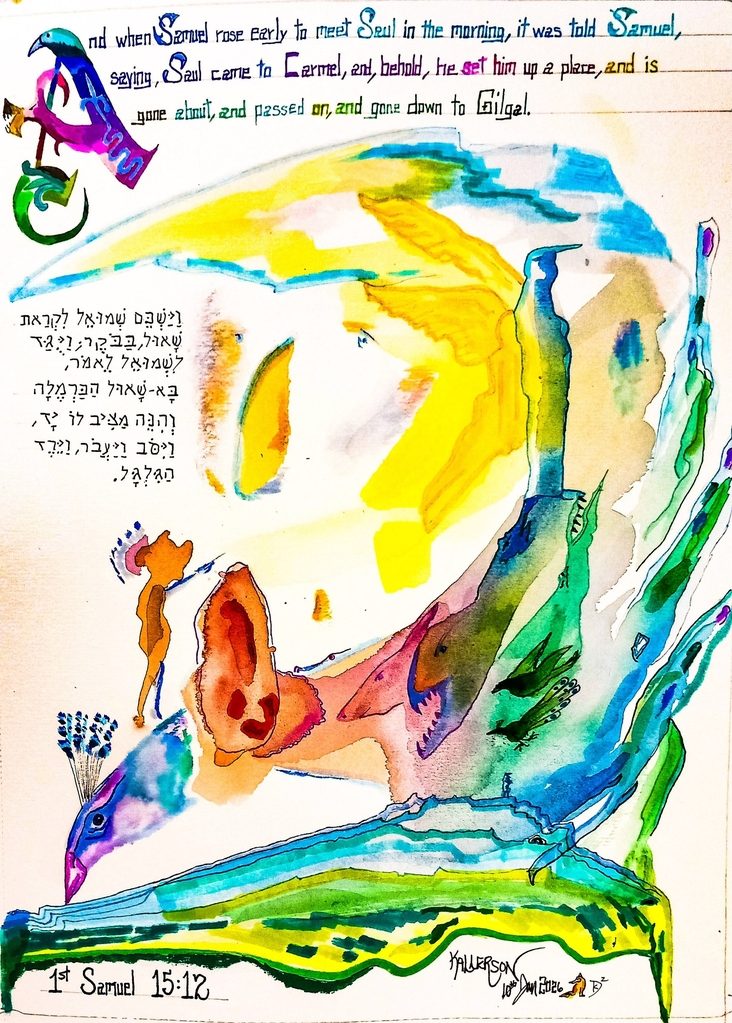
*18 (fin) Then Saul drew near to Samuel in the gate, and said, “Please tell me, where is the seer’s house?”

vayigash shaul eth shemuel betokh hashaar vayomer hagidah na li ey zeh beith ha’roeh – “And he approached, Saul, Samuel in midst the gate. And he said, ‘You must cause to declare-ward, I pray, to me, where this – house the seer?’” Samuel walked up to the gate where Saul and his servant entered. The meaning is that the timing was perfectly arranged so that as Saul entered the city, Samuel entered the gated area at the exact same time.

Saul, showing his complete naivete at the appearance of Samuel, whose hair had never been cut due to the vow Hannah made years earlier, asked him where the seer’s house was. He had no idea who Samuel was or what his function was. He is set, however, to find out.

This is where we will stop for the day. Hopefully, we’ll finish the chapter next week and have a suitable explanation for the given detail.

It is apparent from the verses we looked over that the Lord directed everything to come out as it did. The donkeys got lost, Saul and his servant looked in various places without finding them, they were out of bread and needed to get home, and yet, the servant who came with him knew about the seer and had enough to give him a presentation.

The Lord knew these things would take place. Meanwhile, Samuel was getting back to the city, ready for the meeting, and setting everything up for when it occurred. Saul had free will to do the things he did, and yet, God was able to have things turn out exactly as He determined.

This is also the case with each one of us. He looked into our hearts, knew the decision we would make for Him, and directed our lives to the point where we would do so. All the while before and since then, we have made our own choices, some of which were or continue to be beneficial or detrimental to us.

The best thing we can do as we walk in this life is keep the Lord on our minds, talk to Him frequently, and study His word diligently. In doing this, we will continue down the right path that He set before us. When we don’t, He will be there at the end to clean us up.

We will never be abandoned by Him, but we can stray from Him. Saul is being called to lead Israel. Eventually, he will stray, and a new direction under David will come about. But as we enter into Saul’s life, I feel confident that the Lord never abandoned him.

Let us learn the lessons of Saul’s life, good and bad, so that we can avoid the pitfalls and rejoice in the victories as we apply what we know about him to our own lives. More on Saul to come. Pay attention as we go!

Closing Verse: “The steps of a good man are ordered by the Lord,
And He delights in his way.” Psalm 37:23

Next Week: 1 Samuel 9:19-27 He is set to be king, that is understood, yes, it’s true… (Saul, Select and Good, Part II) (17th 1 Samuel Sermon)

The Lord has you exactly where He wants you. He has a good plan and purpose for you. He is the One who abases the haughty and exalts the humble. He regards the lowly, and the proud He knows from afar. So yield yourself to Him, trust Him, and believe His word. In this, He will do great things for you and through you.

1 Samuel 9:1-18 (CG)

9 And it was, man from son right. And his name Kish, son Abiel, son Zeror, son Bechorath, son Aphiah: son man right – powerful valor. 2 And to him, it was son, and his name Saul – select and good. And not man from sons Israel good from him. From his shoulders and upward higher from all the people.

3 And they wandered, the jennies to Kish, father Saul. And he said, Kish unto Saul his son, “You must take, I pray, with you one from the servants, and you must arise, and you must walk, and you must seek the jennies.” 4 And he traversed in Mount Ephraim, and he traversed in land Shalisha, and not they found. And they traversed in land Shaalim, and naught. And he traversed in land Right, and not they found.

5 They, they came in land Zuph, and Saul, he said to his servant who with him “You must walk-ward, and let us return, lest he will cease, my father, from the jennies and he dreaded to us.”

6 And he said to him, “Behold, I pray, man God in the city, the this. And the man being weighty: all that he will speak, coming, it will come. Now, let us walk there. If not, he will cause to declare to us our way which we walked upon-ward.”

7 And he said, Saul, to his servant, “And behold! We will walk. And what we will cause to bring to the man? For the bread, it is vanished from our vessels, and presentation naught to cause to bring to man the God. What with us?”

8 And he caused to add, the servant, to answer Saul. And he said, “Behold! Being found in my hand fourth shekel silver. And I gave to man the God, and he will cause to declare to us our way.”

9 (To faces, in Israel, thus he spoke, the man in his walking to inquire God, “You must walk, and let us walk until the seer.” For to the prophet, the day, he will be called to faces ‘the seer.’)

10 And he said, Saul, to his servant, “Good, your word! You must walk-ward! Let us walk!” And they walked unto the city which there man the God.

11 They, ascending in ascent the city, and they, they found damsels coming out to draw waters. And they said to them, “Being in this the seer?”

12 And they answered them, and they said, “Being! Behold! To your faces. You must hurry now, for the day he came to the city. For sacrifice, the day, to the people in the height. 13 According to your coming the city, thus you will (surely) find him in ‘before he ascends to height-ward to eat’. For not it will eat, the people, until he comes. For he will bless the sacrifice. After thus they will eat, the called. And now, you must ascend. For it, according to the day, you will (surely) find him.” 14 And they ascended the city. They – coming in midst the city, and behold! Samuel coming out to encounter them to ascend to the height.

15 (And Yehovah, he denuded ear Samuel, day one to faces coming Saul, to say, 16 “According to the time, tomorrow, I will send unto you man from land Benjamin. And you anointed him to commander upon My people, Israel. And he caused to save My people from hand Philistines. For I saw My people. For it came, his shriek, unto Me.”)

17 And Samuel, he saw Saul. And Yehovah, He answered him, “Behold! The man whom I spoke unto you. This – he will enclose in My people.” 18 And he approached, Saul, Samuel in midst the gate. And he said, “You must cause to declare-ward, I pray, to me, where this – house the seer?”


1 Samuel 9 (NKJV)

There was a man of Benjamin whose name was Kish the son of Abiel, the son of Zeror, the son of Bechorath, the son of Aphiah, a Benjamite, a mighty man of power. And he had a choice and handsome son whose name was Saul. There was not a more handsome person than he among the children of Israel. From his shoulders upward he was taller than any of the people.

Now the donkeys of Kish, Saul’s father, were lost. And Kish said to his son Saul, “Please take one of the servants with you, and arise, go and look for the donkeys.” So he passed through the mountains of Ephraim and through the land of Shalisha, but they did not find them. Then they passed through the land of Shaalim, and they were not there. Then he passed through the land of the Benjamites, but they did not find them.

When they had come to the land of Zuph, Saul said to his servant who was with him, “Come, let us return, lest my father cease caring about the donkeys and become worried about us.”

And he said to him, “Look now, there is in this city a man of God, and he is an honorable man; all that he says surely comes to pass. So let us go there; perhaps he can show us the way that we should go.”

Then Saul said to his servant, “But look, if we go, what shall we bring the man? For the bread in our vessels is all gone, and there is no present to bring to the man of God. What do we have?”

And the servant answered Saul again and said, “Look, I have here at hand one-fourth of a shekel of silver. I will give that to the man of God, to tell us our way.” (Formerly in Israel, when a man went to inquire of God, he spoke thus: “Come, let us go to the seer”; for he who is now called a prophet was formerly called a seer.)

10 Then Saul said to his servant, “Well said; come, let us go.” So they went to the city where the man of God was.

11 As they went up the hill to the city, they met some young women going out to draw water, and said to them, “Is the seer here?”

12 And they answered them and said, “Yes, there he is, just ahead of you. Hurry now; for today he came to this city, because there is a sacrifice of the people today on the high place. 13 As soon as you come into the city, you will surely find him before he goes up to the high place to eat. For the people will not eat until he comes, because he must bless the sacrifice; afterward those who are invited will eat. Now therefore, go up, for about this time you will find him.” 14 So they went up to the city. As they were coming into the city, there was Samuel, coming out toward them on his way up to the high place.

15 Now the Lord had told Samuel in his ear the day before Saul came, saying, 16 “Tomorrow about this time I will send you a man from the land of Benjamin, and you shall anoint him commander over My people Israel, that he may save My people from the hand of the Philistines; for I have looked upon My people, because their cry has come to Me.”

17 So when Samuel saw Saul, the Lord said to him, “There he is, the man of whom I spoke to you. This one shall reign over My people.” 18 Then Saul drew near to Samuel in the gate, and said, “Please tell me, where is the seer’s house?”


1 Samuel 8:1-22 (Hear the Voice of the People)

Artwork by Doug Kallerson

1 Samuel 8:1-22
Hear the Voice of the People

(Typed 7 July 2025) Over the years, lots of friends and acquaintances have come by the house to ask advice about various things. Knowing I’m a preacher, when people are in difficult straits, they think I may have an answer or solution to their problems.

They come with life problems, family problems, money problems, divorce problems, and so much more. Because I’m a preacher, you would think they would have an inkling that I would talk to them from a biblical perspective. But their inkle meter is often broken.

They present their issue, I respond with what the Bible says or from a biblical perspective if the issue isn’t exactly presented in the Bible, and let them know that this is how the Lord would have them respond.

After all these years, I approximate that 95% (or more) of the people who came by leave without taking to heart what I told them. People are looking for an easy answer that solves their troubles and doesn’t require them to get closer to God. They are looking for a quick prayer, a quick fix, and then get back to life, doing whatever they had been doing.

Some amount of time later, they are still struggling with the same issue. Maybe the divorce has been settled and they are currently working on another marriage that they can end just as badly, or whatever.

Text Verse: O Lord, I know the way of man is not in himself;
It is not in man who walks to direct his own steps.” Jeremiah 10:23

We think that we direct our own steps in life, but we either follow the steps of the Lord, or sin within us directs our steps in another direction. None of us can truly direct our own path as we would like without adherence to Him or suffering consequences for not doing so.

The people of Israel, represented by their leaders, came to Israel’s judge, Samuel. They stated their desire for a new direction. However, it is the same old direction they’ve followed for hundreds of years, meaning rejecting the Lord and wanting to do things their own way.

Samuel spends careful time telling them what the results of their decision will be. It is an otherwise unstated plea for them to reconsider. But Israel, like most of those I have talked to over the years, doesn’t want to heed the word of the Lord.

The word is written down for us to consider and apply to our lives. But instead of going there, we as humans are usually looking for something or someone to lead us down an easy path of theological mediocrity. The Lord is there for us, and most want to pay lip service to Him while doing things their own way and according to their own desires.

Israel’s problem is reflective of the human condition in general. That is why the stories in the Bible resonate so well with us. But are we going to pay heed and apply what they tell us to our lives? The wise will. All others will continue down whatever path they think will be the quickest route to temporary supposed happiness.

Such lessons as this are to be found in His superior word. And so, let us turn to that precious word once again, and… May God speak to us through His word today, and may His glorious name ever be praised.

I. The Verdict of the King (verses 1-9)

Now it came to pass when Samuel was old

vayhi kaasher zaqen shemuel – “And it was according to which he was aged, Samuel.” The text gives no hint of Samuel’s age, just that he is aged. Despite this, commentaries give numerous suggestions on why he must be one age or another. But this isn’t the focus of the narrative and is irrelevant. It is rather focused on…

1 (con’t) that he made his sons judges over Israel.

vayasem eth banav shophetim leyisrael – “and he set his sons – judging to Israel.” As noted in the introduction to the book, Samuel is the last God-appointed judge of Israel. However, to assist him in his old age, he appointed his sons as judges while he retained overall authority.

It is because of this appointment that a new direction in the leadership and governmental structure of Israel will take place. As for his sons…

The name of his firstborn was Joel, and the name of his second, Abijah;

vayhi shem beno habekor yoel veshem mishnehu aviyah – “And it was, name his son the firstborn Joel, and name his second Abijah.” Although there are various possibilities for the meaning of Joel, surely the intent here is that it is derived from an abbreviated form of Yehovah and the word el, God. Thus, it means something like Yehovah is God.

This appears to be the intent because the name of the next son is Abijah, My Father is Yehovah, or Yehovah is Father. Samuel chose a name for each son that speaks of the character or nature of the Lord. In 1 Chronicles 6:28, Joel is listed as Vashni rather than Joel.

Various suggestions have been given concerning this. Some think it is a second name, as often occurs in Scripture. Some think his name dropped out, and the word vashni is a corruption of “and the second” when referring to Abijah. Some think it is a third son not mentioned in Samuel.

The name Vashni is not a regular Hebrew name. Jones’ Dictionary of Old Testament Names thinks it is derived from Arabic and indicates Gift of God, but using this logic, it would be more closely translated as Yehovah is Generous.

As for the sons’ positions…

2 (con’t) they were judges in Beersheba.

shophetim biveer shava – “judging in Beersheba.” Beersheba is the southernmost point in the land and quite distant from where Samuel is. Due to his age, he probably decided that they should judge from there so that he would not have to travel there if a need arose. Rather, he would tend to the needs of the northerly tribes. Beersheba means Well of Seven and Well of Oath.

But his sons did not walk in his ways;

Rather: velo halekhu vanav bedarko – “And not they walked, his sons, in his way.” The written Hebrew says, “in his way,” while the oral says, “in his ways.” Why they felt the singular should be amended is hard to figure. It is probably to align with the plural seen in verse 5.

It is true that the term “in his ways” is used at other times, usually referring to the ways of Yehovah, while “in his way” or a variation of it is less common, but the clear meaning is that Samuel had one way, one proper path, on which he walked. The sons had various ways that diverted from this. Those paths included…

3 (con’t) they turned aside after dishonest gain, took bribes, and perverted justice.

More precisely: vayitu akhare habatsa vayiqhu shokhad vayatu mishpat – “and they stretched after the plunder, and they took donation, and they caused to stretch verdict.” They didn’t just turn aside after dishonest gain. Instead, they stretched after betsa, plunder.

This gives the sense of reaching as far as they can anytime something caught their eye. They went out of their way to obtain it. Men like this were forbidden to be appointed to a position of integrity –

“Moreover you shall select from all the people able men, such as fear God, men of truth, hating covetousness [betsa]; and place such over them to be rulers of thousands, rulers of hundreds, rulers of fifties, and rulers of tens.” Exodus 18:21

The taking of donations (bribes) was expressly forbidden in the law on several occasions –

“You shall not pervert justice; you shall not show partiality, nor take a bribe, for a bribe blinds the eyes of the wise and twists the words of the righteous.” Deuteronomy 16:19

Lastly, stretching the verdict is a way of saying that they showed favoritism, stretching their judgment on behalf of one party for whatever reason suited them. This was also expressly forbidden in the law –

“Not you shall cause to stretch verdict, your destitute, in his dispute.” Exodus 23:6 (CG).

These sons saw the opportunities their positions afforded them and used them to take advantage of the people in various ways in order to enrich themselves in power, position, and wealth. It is because of this that the people desired a change…

Then all the elders of Israel gathered together and came to Samuel at Ramah,

vayithqabetsu kol ziqne Yisrael vayavou el shemuel ha’ramathah – “And they will gather themselves all aged Israel, and they came unto Samuel the Ramah-ward.” The elders of Israel were noted as far back as during the time in Egypt (Exodus 3:16). Under Moses, there was eventually a numbered set of men, seventy, from the elders (Numbers 11:16).

It isn’t known if that number is referred to here or if it is just a regular body of elders from each of the tribes. Whatever the composition is, they have gathered to Samuel at the main place where he judged, in Ramah, in order to secure a change in how the nation was to be led.

The Ramah means The Lofty Place.

In defense of their position, they set forth two arguments why it is necessary…

and said to him, “Look, you are old, and your sons do not walk in your ways.

vayomeru elav hineh atah zaqanta u-vanekha lo halekhu bidrakhekha – “And they said unto him, ‘Behold! You, you were aged, and your sons not they walked in your ways.” The first reason given is that Samuel is aged. In fact, the matter is stated emphatically. Even if true, it is an irrelevant statement. Whatever system is decided upon, any leader will get old.

The only way to get around that would be to set age limits on any future leader, an idea not entertained by the men. The second reason given is that his sons didn’t walk in the ways of Samuel. This could be handled in another way according to the law.

The Lord had set judges over the people for hundreds of years. In their times of need, they were appointed to deliver the people. In times of peace, they judged matters for the people. Although it will be made explicit later, even here it can be seen that this is not a rejection of Samuel but of the One who appointed him as judge. This is understood from the next words…

5 (con’t) Now make us a king to judge us like all the nations.”

atah simah lanu melekh leshaphetenu kekhal hagoyim – “Now set-ward to us king to judge us according to all the nations.’” The reason they want a king is that he will judge them. They are looking for a royal rule to assume the judicial governance of the people. The proposition is, once again, not based on reason. A king will get old like any other judge.

Not always, but having a king also normally implies a dynasty where sons rule in the place of their fathers. But this is what they say they are upset about with Samuel’s sons. They don’t judge fairly like Samuel does. If they think having a king will be any different, they aren’t paying attention to human nature.

Their true motive is exposed in the second half of their words, “according to all the nations.” It is what the Lord expected, in advance, concerning the desire of the people. In Deuteronomy 17, it says –

“When you come to the land which the Lord your God is giving you, and possess it and dwell in it, and say, ‘I will set a king over me like all the nations that are around me,’ 15 you shall surely set a king over you whom the Lord your God chooses; one from among your brethren you shall set as king over you; you may not set a foreigner over you, who is not your brother.” Deuteronomy 17:14, 15

Despite the Lord knowing this would be their desire, the words “according to all the nations” show a distinct rejection of the Lord. Israel was not like all the nations. Even hundreds of years later, the Lord informed them of this –

“What you have in your mind shall never be, when you say, ‘We will be like the Gentiles, like the families in other countries, serving wood and stone.’” Ezekiel 20:32

Asking for a king was an allowance, but it was not what the Lord intended. If it were, He would have suggested it. Instead, they are asking for this new direction. However, this doesn’t mean the event won’t fit the overall plans and intents of the Lord.

In asking for a king, the people will have to go through a learning process to meet the intended goal, the Lord has already determined. They will get what they ask for, but it will be a long and arduous journey as they discover the ramifications of their request.

It should be noted that the impetus for this request is based upon what will transpire in 1 Samuel 11 when Nahash the Ammonite comes against Jabesh Gilead. This can be discerned from what Samuel says to the people in 1 Samuel 12:12. There, it says that they requested a king at that time. As for the immediate result of the petition…

But the thing displeased Samuel when they said, “Give us a king to judge us.”

vayera hadavar beene shemuel kaasher ameru tenah lanu melekh leshaphetenu – “And it spoiled, the word, in eyes Samuel according to which they said, ‘Give-ward to us king to judge us.’” This would be upsetting for a multitude of reasons. The first is that they didn’t ask if the Lord would approve of the matter. Rather, they asked Samuel to give them a king to be set before them.

A second reason would be that this removes the Lord from the final decision concerning matters. The king may have a prophet and advisers to counsel him concerning what to do, but it is the king who decides if it will be done.

Third, this is an implicit indictment concerning the abilities of Samuel. His advanced age, implying an inability to adequately lead, has been referred to. His choice in appointing his sons is seen as a failure in the people’s eyes, and his status as a judicial leader who possessed no royal authority is implied to be a defective means of leadership by the people. But the people had asked…

6 (con’t) So Samuel prayed to the Lord.

vayithpalel shemuel el Yehovah – “And he will intercede himself, Samuel, unto Yehovah.” The people never asked for prayer, nor have they acknowledged the Lord in their words. However, Samuel knew that he could not just give the people a king without the Lord’s guidance. As such, he did what he knew was appropriate in this regard…

And the Lord said to Samuel, “Heed the voice of the people in all that they say to you;

vayomer Yehovah el shemuel shema beqol ha’am lekhol asher yomeru elekha – “And He said, Yehovah, unto Samuel, ‘Hear in voice the people to all which they will say unto you.’” The Lord, without any hesitation or additional qualification, tells Samuel to hear what the people have asked. The implication is “to hear and respond accordingly.” His next words clarify why Samuel should not be disturbed by the request…

7 (con’t) for they have not rejected you,

ki lo othekha maasu – “For not you they spurned.” Samuel was concerned that this had happened because of him. This is evident in the following three statements –

Moses: “Let me set upon me king according to all the nations.”
The elders: “Now set-ward to us king to judge us according to all the nations.’”
Samuel: “Give-ward to us king to judge us.”

In Deuteronomy, Moses spoke in the singular concerning Israel collectively (let me set). Using the same word, sum, to set, when the elders came to Samuel, they spoke as a group of elders over a group of people (set-ward to us). Samuel, knowing Moses allowed this, must have thought, “They think I am a failure. Therefore, they are asking me to natan, give, them a king according to Moses’ allowance.”

The Lord, however, corrects his thinking. In using Moses’ words, Israel is claiming authority from Moses, who spoke on behalf of the Lord. Samuel isn’t giving them anything. Israel is placing itself under a king. They are merely asking Samuel to be the one to appoint a king based on the decision they have already made. The implied meaning is…

7 (con’t) but they have rejected Me, that I should not reign over them.

ki othi maasu mimelokh alehem – “For Me they spurned from reigning upon them.” Samuel wasn’t the lawgiver. Moses was. And Moses’ authority ultimately stemmed from the authority of the Lord. Therefore, they are rejecting the authority of the Lord by asking for a king to rule over them.

The Lord did not tell them to appoint a king over themselves. Rather, He said that a king had to meet certain requirements. This decision, notes the Lord, is…

According to all the works which they have done since the day that I brought them up out of Egypt, even to this day

kekhal hamaasim asher asu miyom haalothi otham mimitsrayim vead hayom hazeh – “According to all the actions which they did from day I caused to ascend them from Egypt and until the day, the this.” Simply put, this means, “They have always been this way.” The Lord brought them out of Egypt. When He did, at the first stop in the wilderness after crossing the Red Sea, they were moaning against the Lord.

When they arrived at Sinai, no sooner had they been presented with the Ten Commandments than they turned around and fashioned the golden calf. The stubborn, rebellious attitude remained unchanged in them even until the day they came before Samuel to request a king.

8 (con’t) —with which they have forsaken Me and served other gods—so they are doing to you also.

vayaazvuni vayaavdu elohim akherim ken hemah osim gam lakh – “and they loosened Me and they served gods, others. Thus they doing also to you.” To loosen means to forsake, as in being bound together but letting go and walking away. Israel was called by the Lord. They accepted the call and were bound to Him, and yet, every chance they got to be with another, they left Him and followed other gods.

As such, the “doing also to you” isn’t referring to forsaking Samuel. Rather, they are forsaking the Lord by asking Samuel to set a king before them. Despite this, the Lord says…

Now therefore, heed their voice. However, you shall solemnly forewarn them,

veatah shema beqolam akh ki haed taid bahem – “And now, you must hear in their voice. Surely for causing to testify, you will cause to testify in them.” The NKJV adequately explains the intent. Samuel is to hearken unto their request. But before he does, he is to warn them, in advance, of the consequences of their decision…

9 (con’t) and show them the behavior of the king who will reign over them.”

vehigadta lahem mishpat ha’melekh asher yimlokh alehem – “and you caused to declare to them verdict the king who he will reign upon them.” The verdict of the king refers to the legal rights the king will claim as the sovereign over the people. In essence, his word would become the law of the land, and so the people needed to know what to expect once a king was selected.

We want a king! Someone to lead us
We want to be like everyone else
Having a king will be a giant plus
When we put the Lord on a shelf

We know what we want and what is right
Give it to us, so we say
Our lives are in such a plight
And we no longer want it to be this way

*

They will get what they think they desire
But it won’t really be that way
When they receive the Spirit’s fire
They will know their true King on that day

II. Israel’s Demotion (verses 10-22)

10 So Samuel told all the words of the Lord to the people who asked him for a king.

vayomer shemuel eth kal divre Yehovah el haam hashoalim meito melekh – “And he said, Samuel, all words Yehovah unto the people, the ‘askers from him a king.’” This refers not to what has been said, but what will be said. The Lord told Samuel what a king would expect from the people. Samuel will set forth the Lord’s words as a solemn warning before a king is named…

11 And he said, “This will be the behavior of the king who will reign over you:

vayomer zeh yihyeh mishpat ha’melekh asher yimlokh alekhem – “And he said, ‘This, it will be, verdict the king who he will reign upon you.’” This demonstrates that “the words of the Lord” of the previous verse were not referring to what was recorded in verses 7-9, but what will be said concerning the king –

v. 10 – “and you will cause to declare to them verdict the king who he will reign upon them.”
v. 11 – “This, it will be, verdict the king who he will reign upon you.”

Therefore, as a witness against the people when they adamantly push forward with their request, Samuel explains to them that…

11 (con’t) He will take your sons and appoint them for his own chariots and to be his horsemen, and some will run before his chariots.

Rather, it is singular: eth benekhem yiqakh vesam lo vemerkavto uvepharashav veratsu liphne merkavto – “Your sons he will take, and he set to him in his chariot and in his steeds, and they ran to faces his chariot.” Unlike the judges who lived in an unassuming manner, riding their own donkeys and dwelling among the people, the king would surround himself with pomp and separate himself from the people.

Instead of a donkey, he would have a chariot with steeds. And to tend to these things, he would take for himself a tribute from the people, some of their own sons. After they tended to his chariot and steeds, these sons would run before the chariot as a demonstration of his grand authority.

There is a bit of irony in the words. They said to Samuel, “set-ward to us king to judge us.” Once the king is set, he will then take their sons and set them “to him.” That thought continues next…

12 He will appoint captains over his thousands and captains over his fifties,

velasum lo sare alaphim vesare khamishim – “And to set to him commanders thousands and commanders fifties.” This is still referring to the king taking of the people’s sons for his own purposes, including placing them wherever he desired, such as in the military or in the general labor force. The latter is seen, for example, in 1 Kings 4:7 –

“And Solomon had twelve governors over all Israel, who provided food for the king and his household; each one made provision for one month of the year.”

The meaning is that instead of having one’s sons at home to assist in the farming, they would be taken as labor for the king’s harvest, or for the king’s battles, as seen in the next words…

12 (con’t) will set some to plow his ground and reap his harvest, and some to make his weapons of war and equipment for his chariots.

velakharosh kharisho veliqtsor qetsiro velaasoth kele mikhamto u-khele rikhbo – “and to plow his ploughing, and to reap his harvest, and to make implements his battle, and implements his chariot.” The king would tend to his own needs at the expense of the sons of his people. Whoever suited his eye for meeting his desired purposes would be involuntarily enlisted to do so. And more…

13 He will take your daughters to be perfumers, cooks, and bakers.

veeth benotekhem yiqakh leraqakhoth u-letabakhoth u-leophoth – “And your daughters he will take to perfumers, and to cooks, and to bakers.” The lesser jobs, not requiring the strength of a man, would not be left to his household. Rather, he would also select daughters from the people, making them serve the royal house.

In this clause is a word found only here in Scripture, tabakhah, a female cook. It comes from the noun tabakh, a butcher, cook, or bodyguard. That is derived from the verb tabakh, to slaughter (animals or men).

Further, not only will the king conscript sons and daughters…

14 And he will take the best of your fields, your vineyards, and your olive groves, and give them to his servants.

veeth sedothekhem veeth karmekhem vezetekhem hatovim yiqakh venathan leavadav – “And your fields and your vineyards and your olives – the good, he will take and he gave to his servants.” The words indicate an utter disregard for the rights and rules established under the law concerning personal property.

The kings of the surrounding nations exercised such forceful confiscations, and the kings of Israel were sure to follow suit, taking what they desired from those who could not refuse. And more…

15 He will take a tenth of your grain and your vintage, and give it to his officers and servants.

vezarekhem vekarmekhem yasor venathan lesarisav velaavadav – “And your seed and your vineyards he will tithe, and he gave to his eunuchs and to his servants.” The Lord mandated tithing from the people. For two of those years, that tithe was eaten by the people in a celebration before the Lord. On the third year, the tithe was to be given entirely to the care of the priests, Levites, and poor.

However, a king would exact a tithe from everything the people produced. It would be an ongoing compulsory tax which, if spent properly, would be suitable to run the nation, protect its citizens, and bring prosperity to all. But instead, this would most likely be squandered by enriching those the king desired to favor. Also…

16 And he will take your male servants, your female servants, your finest young men, and your donkeys, and put them to his work.

veeth avdekhem veeth shiphkhothekhem veeth bakhurekhem hatovim veeth khamorekhem yiqakh veasah limlakhto – “And your servants and your maidservants and your selected – the good, and your donkeys, he will take, and he made to his deputyship.” The Greek reads cattle instead of selected, there being one letter difference between the two in the Hebrew. This seems unnecessary even if possible and convenient.

The Hebrew marks off the first three categories with the words “the good.” It makes no sense to assume that the king would take good cattle and not also define the donkeys as such. Rather, referring to three categories of people all designated as “the good” seems appropriate.

All of these would be taken for the king’s service in whatever manner they were best suited. Further…

17 He will take a tenth of your sheep.

tsonekhem yasor – “Your flock he will tithe.” The word tson is derived from an unused root signifying to migrate. Thus, it refers to flocks such as sheep and goats. A tithe of these would be taken from the people along with everything else. Every aspect of their agricultural existence would be subject to the king’s grasping hand.

17 (con’t) And you will be his servants.

The words are emphatic: veatem tihyu lo laavadim – “and you, you will be to him to servants.” The meaning is that the king’s hand would be so heavy on the people that they would spend their time and effort serving the king.

The reason for the emphasis is seen in the “what should have been” nature of the words of the Lord –

“For My servants, they, whom I caused to bring them from land Egypt. Not they will be sold as servant” Leviticus 25:42 (CG).

The people were the servants of the Lord, but through choosing a king, they would sell themselves to be his servants. Therefore…

18 And you will cry out in that day because of your king whom you have chosen for yourselves, and the Lord will not hear you in that day.”

Rather, the Lord will hear, but He will shut His ears to the noise: u-zeaqtem bayom ha’hu mil’liphne malkekhem asher bekhartem lakhem velo yaaneh Yehovah etkhem bayom ha’hu – “And you shrieked in the day, the it, from to faces your king whom you selected to you, and no He will answer, Yehovah, you in the day, the it.”

The meaning of the phrase “from to faces your king” is “from before your king.” It is a way of saying, “You will cry out to Yehovah as you groan before your king (whom you selected for yourselves, by the way ), and Yehovah will not answer.” It is the old “You made your bed, now lie in it” thought. And yet, after all this…

19 Nevertheless the people refused to obey the voice of Samuel;

vaymaanu ha’am lishmoa beqol shemuel – “And they refused, the people, to hear in voice Samuel.” People think the grass is always greener elsewhere, and yet, when presented with evidence that it really isn’t so, they refuse to heed the warning. This is what is going on here.

Whether the elders retired and debated, presented the options and explanations to the people at a national assembly, or simply responded to Samuel immediately isn’t stated. The warning is immediately followed by their refusal to highlight the impetuous nature of the people.

19 (con’t) and they said, “No, but we will have a king over us,

vayomeru lo ki im melekh yihyeh alenu – “And they said, ‘No! For lo! King, he will be upon us!’” The sad part of their response is that they already had a king. They lived under a benevolent monarchy, as witnessed by the words of Exodus 19 –

“Now therefore, if you will indeed obey My voice and keep My covenant, then you shall be a special treasure to Me above all people; for all the earth is Mine. And you shall be to Me a kingdom of priests and a holy nation.’ These are the words which you shall speak to the children of Israel.” Exodus 19:5, 6

A kingdom implies having a king. Israel failed to recognize this. Their desire was…

20 that we also may be like all the nations,

The words are emphatic: vehayinu gam anakhnu kekhal ha’goyim – “And we became, also we, according to all the nations.” What a great idea! Let’s take a demotion and impose immense burdens upon ourselves in the process –

“Also today the Lord has proclaimed you to be His special people, just as He promised you, that you should keep all His commandments, 19 and that He will set you high above all nations which He has made, in praise, in name, and in honor, and that you may be a holy people to the Lord your God, just as He has spoken.” Deuteronomy 26:18, 19

The Lord told them that they would be high above the nations. Instead, they want to be just like all the other nations. Israel wanted to trade the kingdom of the all-powerful, all-gracious Yehovah for one run by an arm of flesh extending from a person who would tend to himself and his own needs before all else. Smart move, folks!

20 (con’t) and that our king may judge us and go out before us and fight our battles.”

ushephatanu malkenu veyatsa lephanenu venilkham eth milkhamotenu – “And he judged us, our king, and he went to our faces and he battled our battles.” The Lord has already done these things for them. He judged them through His appointed designees. He also fought their battles for them and said that He would continue to do so –

“When you go out to battle against your enemies, and see horses and chariots and people more numerous than you, do not be afraid of them; for the Lord your God is with you, who brought you up from the land of Egypt. So it shall be, when you are on the verge of battle, that the priest shall approach and speak to the people. And he shall say to them, ‘Hear, O Israel: Today you are on the verge of battle with your enemies. Do not let your heart faint, do not be afraid, and do not tremble or be terrified because of them; for the Lord your God is He who goes with you, to fight for you against your enemies, to save you.’” Deuteronomy 20:1-4

21 And Samuel heard all the words of the people, and he repeated them in the hearing of the Lord.

vahyishma shemuel eth kal divre ha’am vedaberem beazene Yehovah – “And he heard, Samuel, all words the people, and he spoke them in ears Yehovah.” Whether they believed that Samuel spoke to the Lord or not, all they could focus on was that they were not content with the state of things.

Samuel spoke to the Lord what was already known to Him. But this was a necessary process to work through so that every t was crossed and every i was dotted. With his words to the Lord complete…

22 So the Lord said to Samuel, “Heed their voice, and make them a king.”

vayomer Yehovah el shemuel shema beqolam vehimlakhta lahem melekh – “And He said, Yehovah unto Samuel, ‘Hear in their voice and you caused to reign to them king.’” This is now the third time the Lord has told Samuel to hear their voice –

v.7 – “And He said, Yehovah, unto Samuel, ‘Hear in voice the people to all which they will say unto you. For not you they spurned. For Me they spurned from reigning upon them.’”

v.9 – “And now, you must hear in their voice. Surely for causing to testify, you will cause to testify in them, and you will cause to declare to them verdict the king who he will reign upon them.”

The matter has been officially decided. What must next take place is for a king to be selected. Therefore…

*22 (fin) And Samuel said to the men of Israel, “Every man go to his city.”

vayomer shemuel el anshe Yisrael lekhu ish leiro – “And he said, Samuel unto men Israel, ‘You must walk, man to his city.’” Saying this immediately subdues any thought of the people hastily choosing a king and having Samuel appoint him over the nation.

With the elders there, it would seem like a great idea to choose one from among themselves or one of their children. It may be that someone would stand up and volunteer, stating his qualifications and looking for a movement of others to support his effort.

In dismissing the people, Samuel is exercising his authority before any such thing could take place.

Having looked over the verses, we can step back and see that the direction of the narrative changes from here. Thus, there is little room for typology in the chapter. The first few verses do give a snapshot of things at the end of the age.

Samuel, Asked from God and signifying the state of grace, is aged. It is a good representation of the end of the church age. His two sons are mentioned, Yehovah is God, and My Father is Yehovah. They are judging in Beersheba. That has been seen to be typologically representative of the tribulation.

The names’ meanings are what would be expected of the tribulation, where Israel will have temple worship once again. Hence, the names are connected to Yehovah. It is a claim that He, not Jesus, is the end of God’s revelation of Himself.

However, Israel, not satisfied with these sons judging, comes to Samuel the Ramah-ward, meaning toward the Lofty Place. As seen in earlier sermons, it is anticipatory of the Lofty Place where believers are placed in Christ, but these sons are not placed there as they are not sons of grace.

This is the typology to be gleaned from the passage. After that, the verses focus on the people’s wanting a king until the end of the chapter.

A broad brushstroke of the history of Israel in relation to the law has been presented based on stories from the final years of the time of the judges. This chapter has been provided as part of a transition into a new era of Israel’s history.

From there, more typological hints of what God is doing in redemptive history can be presented in the ongoing history of Israel. Therefore, Chapter 8 of 1 Samuel begins to provide this necessary link between the two.

And more, it is a chapter that shows us how important it is for the Lord’s people to make themselves intimately familiar with God’s word. If the people knew what the word said and accepted it as God’s word, they would know they already lived under the authority of a King.

They would know that He was with them, judging them through His appointed leaders, and fighting their battles for them. But they may not have even known these things because they didn’t know His word.

It is easy for us to find fault in them for this, but considering that very few copies of the written oracles of God existed at this time, we should rather consider our own position before the Lord. We live in a time where the word is available to almost every person on the planet.

Not only can we get our own hard copy of it for the price of a cup of coffee (or less!), but we can easily access more than fifty versions of it in a mere moment through an internet search. We can study it in our native language, in the original languages, etc.

We don’t need to point our fingers at Israel. The Bible already does that for us. But is it pointing at us, too? Are we being responsible with the greatest of all gifts by storing up the knowledge of it in our minds?

When we face life’s big decisions, are we suitably aware of what the word says to use it to guide what we do? Let us consider this. In coming forward to ask for a king, Israel failed to do so. Let us learn from this and not follow suit as we live our lives before the Lord.

Closing Verse: “But He knows the way that I take;
When He has tested me, I shall come forth as gold.
11 My foot has held fast to His steps;
I have kept His way and not turned aside.
12 I have not departed from the commandment of His lips;
I have treasured the words of His mouth
More than my necessary food.” Job 23:10-12

Next Week: 1 Samuel 9:1-18 He had it all, that was understood… (Saul – Select and Good, Part I) (16th 1 Samuel sermon)

The Lord has you exactly where He wants you. He has a good plan and purpose for you. He is the One who abases the haughty and exalts the humble. He regards the lowly, and the proud He knows from afar. So yield yourself to Him, trust Him, and believe His word. In this, He will do great things for you and through you.

1 Samuel 8 (CG)

And it was according to which he was aged, Samuel, and he set his sons – judging to Israel. 2 And it was, name his son the firstborn, Joel, and name his second Abijah – judging in Beersheba.

3 And not they walked, his sons, in his way, and they stretched after the plunder, and they took donation, and they caused to stretch verdict. 4 And they will gather themselves all aged Israel, and they came unto Samuel the Ramah-ward. 5 And they said unto him, “Behold! You, you were aged, and your sons not they walked in your ways. Now set-ward to us king to judge us according to all the nations.”

6 And it spoiled, the word, in eyes Samuel according to which they said, “Give-ward to us king to judge us.” And he will intercede himself, Samuel, unto Yehovah. 7 And He said, Yehovah, unto Samuel, “Hear in voice the people to all which they will say unto you. For not you they spurned. For Me they spurned from reigning upon them. 8 According to all the actions which they did from day I caused to ascend them from Egypt and until the day, the this, and they loosened Me and they served gods, others. Thus they doing also to you. 9 And now, you must hear in their voice. Surely for causing to testify, you will cause to testify in them, and you will cause to declare to them verdict the king who he will reign upon them.”

10 And he said, Samuel, all words Yehovah unto the people, the ‘askers from him a king.’ 11 And he said, “This, it will be, verdict the king who he will reign upon you: Your sons he will take, and he will set to him in his chariot and in his steeds, and they will run to faces his chariot. 12 And to set to him commanders thousands and commanders fifties, and to plow his ploughing, and to reap his harvest, and to make implements his battle, and implements his chariot. 13 And your daughters he will take to perfumers, and to cooks, and to bakers. 14 And your fields and your vineyards and your olives – the good, he will take and he will give to his servants. 15 And your seed and your vineyards he will tithe, and he will give to his eunuchs and to his servants. 16 And your servants and your maidservants and your selected – the good, and your donkeys, he will take, and he will make to his deputyship. 17 Your flock he will tithe, and you, you will be to him to servants. 18 And you will shriek in the day, the it, from to faces your king whom you selected to you, and no He will answer, Yehovah, you in the day, the it.”

19 And they refused, the people, to hear in voice Samuel. And they said, “No! For lo! King, he will be upon us! 20 And we will be, also we, according to all the nations. And he will judge us, our king, and he will go to our faces and he will battle our battles.”

21 And he heard, Samuel, all words the people, and he spoke them in ears Yehovah. 22 And He said, Yehovah unto Samuel, “Hear in their voice and you will cause to reign to them king.”

And he said, Samuel unto men Israel, “You must walk, man to his city.”


1 Samuel 8 (NKJV)

8 Now it came to pass when Samuel was old that he made his sons judges over Israel. The name of his firstborn was Joel, and the name of his second, Abijah; they were judges in Beersheba. But his sons did not walk in his ways; they turned aside after dishonest gain, took bribes, and perverted justice.

Then all the elders of Israel gathered together and came to Samuel at Ramah, and said to him, “Look, you are old, and your sons do not walk in your ways. Now make us a king to judge us like all the nations.”

But the thing displeased Samuel when they said, “Give us a king to judge us.” So Samuel prayed to the Lord. And the Lord said to Samuel, “Heed the voice of the people in all that they say to you; for they have not rejected you, but they have rejected Me, that I should not reign over them. According to all the works which they have done since the day that I brought them up out of Egypt, even to this day—with which they have forsaken Me and served other gods—so they are doing to you also. Now therefore, heed their voice. However, you shall solemnly forewarn them, and show them the behavior of the king who will reign over them.”

10 So Samuel told all the words of the Lord to the people who asked him for a king. 11 And he said, “This will be the behavior of the king who will reign over you: He will take your sons and appoint them for his own chariots and to be his horsemen, and some will run before his chariots. 12 He will appoint captains over his thousands and captains over his fifties, will set some to plow his ground and reap his harvest, and some to make his weapons of war and equipment for his chariots. 13 He will take your daughters to be perfumers, cooks, and bakers. 14 And he will take the best of your fields, your vineyards, and your olive groves, and give them to his servants. 15 He will take a tenth of your grain and your vintage, and give it to his officers and servants. 16 And he will take your male servants, your female servants, your finest young men, and your donkeys, and put them to his work. 17 He will take a tenth of your sheep. And you will be his servants. 18 And you will cry out in that day because of your king whom you have chosen for yourselves, and the Lord will not hear you in that day.”

19 Nevertheless the people refused to obey the voice of Samuel; and they said, “No, but we will have a king over us, 20 that we also may be like all the nations, and that our king may judge us and go out before us and fight our battles.”

21 And Samuel heard all the words of the people, and he repeated them in the hearing of the Lord. 22 So the Lord said to Samuel, “Heed their voice, and make them a king.”

And Samuel said to the men of Israel, “Every man go to his city.”


1 Samuel 7:10-17 (The Stone of the Helper, Part II)

Artwork by Douglas Kallerson


1 Samuel 7:10-17
(The Stone of the Helper, Part II)


(Typed 30 July 2025) The verses in this sermon will complete an amazing journey, taking us typologically through dispensations of God’s redemptive plan. They convey truths that are presented logically so that things can be highlighted.

Some details are confusing unless laid out meticulously, but once they are, they resolve all kinds of difficulties that have arisen in the minds of scholars.

The way this is done is similar to many other passages in Scripture. For example, Genesis 1 gave a synopsis of the order of creation. However, there also needed to be a more detailed explanation so that we could understand why things are the way they are.

To do this, God gave us details of the sixth day of creation in Genesis 2, which flows logically into Genesis 3. Similarly, the narrative from the ending of 1 Samuel 3 through the end of 1 Samuel 7 somewhat follows this pattern, but it is a little more complicated.

Once you see how everything is presented, though, you will have a better understanding of why it was presented this way. It is orderly, fills in many necessary details, and allows us to see into the future concerning what God is doing.

Text Verse: “Let your conduct be without covetousness; be content with such things as you have. For He Himself has said, ‘I will never leave you nor forsake you.’ So we may boldly say:
‘The Lord is my helper;
I will not fear.
What can man do to me?’” Hebrews 13:5, 6

The Hebrew words even ha’ezer mean Stone the Helper. The word even, stone, is used to describe the Lord at times, such as Genesis 49:24, where He is called the Stone of Israel. The Lord is called our Help or Helper in both testaments of the Bible.

One is a concrete image, the Stone. If someone asks you to describe the Lord in your life, you might say, “He is my Stone of Permanency.” People would understand that you mean an immovable stone.

The other is less concrete. If you ask someone to close his eyes and think of the Lord as his Helper, he might think of Him reaching down and grabbing him as he was drowning or boosting him over a wall he couldn’t quite scale. That, however, describes His actions, rather than an image of who He is.

Both types of thinking are helpful in grasping who the Lord is, because at times, understanding who He is relies on knowing what He does, what His thought process is like, or what His innate attributes are. He Helps. He is like a Stone. He is immortal. Each of these is a different aspect of how God is portrayed in the Bible.

Pay attention to these things. Revel in what you contemplate. And hold fast to such truths. As you go through life, you will need to consider the various presentations of God based on whatever situation you may be in or in how you are called to present Him for others to understand.

Such great truths as these are to be found in His superior word. And so, let us turn to that precious word once again, and… May God speak to us through His word today, and may His glorious name ever be praised.

I. Stone the Helper (verses 10-12)

10 Now as Samuel was offering up the burnt offering, the Philistines drew near to battle against Israel.

vayhi shemuel maaleh ha’olah u-phelishtim nigeshu lamilkhamah beyisrael – “And it was, Samuel causing to ascend the burnt offering, and Philistines they were approached to the battle in Israel.” This verse explains and expands upon what was said in the previous verse –

“And he took, Samuel, lamb – milk, one. And he caused to ascend burnt offering, whole, to Yehovah. And he shrieked, Samuel, unto Yehovah for Israel. And He answered him, Yehovah.” 1 Samuel 7:9

While the Philistines were approaching, Samuel offered the lamb and called out to the Lord for deliverance. Yehovah responded. That is explained in the next words…

10 (con’t) But the Lord thundered with a loud thunder upon the Philistines that day,

vayarem Yehovah beqol gadol bayom ha’hu al pelishtim – “And He caused to tumble, Yehovah, in voice great in the day, the it, upon Philistines.” This is the same word introduced in 1 Samuel 1:6 when Peninnah would vex Hannah, mocking her because of her barren womb. It signifies to tumble, meaning to violently agitate.

Likewise, it was used again in Hannah’s prayer, pretty much describing what is happening in this verse –

Yehovah:
They will sink – He causing to grapple upon Him.
In the heavens – may He cause to tumble [raam].
Yehovah:
He will judge extremity earth,
And He will give strength to His King,
And may He cause to rise horn His Messiah.” 1 Samuel 2:10

Saying He thundered assumes that He did this actively, like with a storm or other elements to confuse the Philistines. It may be that this occurred through the heat of battle. However the Lord tumbled the Philistines, His actions were effective…

10 (con’t) and so confused them that they were overcome before Israel.

vayhumem vayinagephu lipne Yisrael – “And He confused them, and they were smitten to faces Israel.” The word hamam is used. It has been seen at other times during great battles or events. It is derived from hum, to make an uproar. Thus, it is an onomatopoetic word referring to the loud hum of battle.

In this case, it is the Philistines who are confused and disorganized through the resounding voice, the hamam, of the Lord. Because of the great confusion of the Philistines, Israel seized the initiative…

11 And the men of Israel went out of Mizpah and pursued the Philistines,

vayetseu anshe Yisrael min ha’mitspah vayirdephu eth pelishtim – “And they went, men Israel, from the Mizpah, and they pursued Philistines.” Israel saw that the line of the Philistines had been broken. Therefore, leaving The Watchtower, they chased after them. As they did…

11 (con’t) and drove them back as far as below Beth Car.

vayakum ad mitakhath leveith kar – “And they struck them until from under to Beth Car.” This is the only mention of Beth Car in Scripture. Its location is unknown, but saying “from under to Beth Car” seems to indicate that it was on a hill above the path of flight used by the Philistines.

The meaning of the name is debated. The word kar has various meanings, including a type of domesticated animal, like a lamb, a battering ram, a pasture, or even a camel’s saddle. It is derived from the verb karar, to dance, but more specifically to twirl, found only in 2 Samuel 6.

Each of the meanings of kar gives the sense of accumulation, as in something circular that amasses as the circle is formed. The name is thus variously defined as House of a Lamb, House of Battering Rams, etc. Abarim goes to the source verb and says House of Accumulation. More simply, it could mean House of Twirling, as in forming a circular motion.

Because of the rout, it next says…

12 Then Samuel took a stone and set it up between Mizpah and Shen,

vayiqakh shemuel even akhath vayasem ben ha’mitspah u-ven ha’shen – “And he took, Samuel, stone one, and he put between the Mizpah and between the Shen.” Samuel set up a commemorative stone because of the events that took place. The location is between The Watchtower and The Shen, a place only mentioned here. Shen is identical to shen, a tooth. Thus, it literally means The Tooth.

The word shen is derived from shanan, to whet or sharpen. Intransitively, it means to pierce. In Deuteronomy 6:7, it is used to indicate the inculcation of instruction, as in “teach diligently,” but that is more of a paraphrase.

The idea in that verse of Deuteronomy is inculcating the commands into the children, but by using this word, it includes the idea of sharpness. It is as if the process of instilling the commands is so personal that the parent is cutting into the child and inscribing them into his heart and mind.

To get the sense, the word is used in Psalm 73:21 –

When my heart was embittered,
And I was pierced [shanan] within. Psalm 73:21 (NAS)

This was the responsibility of the parents, inscribing the commands of the law in the children. Paul uses a similar thought in Ephesians –

“And you, fathers, do not provoke your children to wrath, but bring them up in the training and admonition of the Lord.” Ephesians 6:4

This place, The Shen, was probably a pointed rock that stood out prominently like a tooth. As for the stone Samuel set up…

12 (con’t) and called its name Ebenezer, saying, “Thus far the Lord has helped us.”

There is an article which defines the stone: vayiqra eth shemah even ha’azer vayomar ad henah azaranu Yehovah – “and he called its name Stone the Helper. And he said, ‘Until hither He helped us, Yehovah.’” The stone is named Ezer, Helper. This is where it is named, but it was referred to in verse 4:1, anticipating this event –

“And he went out, Israel, to encounter Philistines to the battle. And they inclined upon the stone, the Ezer.” 1 Samuel 4:1

The use of two articles, the stone, the Ezer, shows that it was named previously. Samuel named it here in Chapter 7, but as it is referred to in Chapter 4, it shows that the narrative there was an insert. If you recall, the first words of Chapter 4 merged with the words of verse 7:3.

As an example, there is the story of Joseph being sold off to Egypt by his brothers in Genesis 37. Then the story of Judah and Tamar comprises Genesis 38. The narrative then returns to the life of Joseph in Egypt in Genesis 39.

Information needs to be inserted somewhere to explain events as they occur and which bear on redemptive history. Israel rejected the Lord after Jesus completed His work. The information about that and about what happened until the time Israel will accept Jesus in the future has been inserted between the opening clause of 4:1 until 7:3.

At verse 7:3, the narrative about Israel interacting with Samuel resumed. This will be explained more fully as the verses are evaluated. For now…

A twirling has taken place
It is recorded in a book
In it, you will find God’s face
Open it up and take a look

A story was compiled for us
Leading us from one point and back again
The word is about our Lord Jesus
He is the Redeemer, the Savior of men

Be sure to see how it is laid out
Look into it and see what has been amassed
The details will make you whoop and shout
Yes, its contents are an amazing blast

II. And He Judged Israel (verses 13-17)

13 So the Philistines were subdued, and they did not come anymore into the territory of Israel.

vayikaneu ha’pelishtim velo yasephu od labo bigvul Yisrael – “And they were humbled, Philistines, and not they added again to come in border Israel.” As noted in 1 Samuel 4:1, it is possible that this statement aligns with Judges 13:1 –

“Again the children of Israel did evil in the sight of the Lord, and the Lord delivered them into the hand of the Philistines for forty years.”

The narrative of Samson went through Judges 16. After his time, the Philistines continued to come into the borders of Israel until this point of Samuel’s time of judging. The statement is given as a fact. The Philistines were humbled, and after this, they no longer came across Israel’s border.

These words are not contradictory to what is next said, nor of verse 15…

13 (con’t) And the hand of the Lord was against the Philistines all the days of Samuel.

vatehi yad Yehovah ba’pelishtim kol yeme shemuel – “And it was, hand Yehovah, in the Philistines all days Samuel.” The “days Samuel” are interpreted by some scholars as the time of his judging Israel until the time when Saul became king. This is incorrect.

Verse 7:15 will say that Samuel judged Israel for his entire life. That would be inclusive of the time after Saul was anointed. There continued to be engagements with the Philistines during Saul’s time and into the time of David.

The words don’t mean that there were no battles with the Philistines. Rather, the Lord was against the Philistines all the days of Samuel, including when they warred against Israel. Embraced in this…

14 Then the cities which the Philistines had taken from Israel were restored to Israel, from Ekron to Gath;

vatashovenah hearim asher laqekhu phelishtim meeth Yisrael leYisrael meeqron vead gath veeth gevulan – “And they returned, the cities – which they took, Philistines, from Israel – to Israel, from Ekron and until Gath and their border.” This does not mean that Ekron and Gath were returned to Israel.

The word “from” appears to mean that there were cities in Israel that had been taken by the Philistines. These cities, up to the borders of Ekron and Gath, were restored to Israel.

Ekron comes from aqar, to pluck up or uproot. But that is from the same as eqer, an offshoot or descendant. Hence, the name could mean either Offshoot or Uprooted. Gath means Winepress.

The restoration of the cities and land next continues to be explained…

14 (con’t) and Israel recovered its territory from the hands of the Philistines.

hitsil Yisrael miyad pelishtim – “He caused to snatch, Israel, from hand Philistines.” Israel was able to reacquire all that was lost to the Philistines as they continued pushing back the Philistines to the borders of Ekron and Gath.

14 (con’t) Also there was peace between Israel and the Amorites.

vayhi shalom ben Yisrael u’ven ha’emori – “And it was peace between Israel and between the Amorite.” The Amorite is only mentioned in this verse in 1 Samuel. At times, like the word Canaanite, it is a general term for the inhabitants of the land. That is probably the intent here. A similar use was seen in Judges 6:10.

Though the statement may indicate that this peace resulted from the Amorites seeing the defeat of the Philistines and not wanting to be subdued in a similar manner, it may simply be a way of saying that not only were the Philistines no longer a threat, but there was no threat from the other inhabitants as well.

The latter seems likely because nothing has been said about them since Judges 11. Therefore, the statement would essentially mean, “Israel found peace throughout all its territory.”

Amorite means Renown.

15 And Samuel judged Israel all the days of his life.

vayishpot shemuel eth Yisrael kol yeme khaiyav – “And he judged, Samuel, Israel all days his livings.” This is a clear indication that even though Saul will be anointed and reign as king, Samuel will continue to judge Israel. This included judging Saul, as will be seen in his future interactions with him.

Therefore, it can be assumed that until the death of Samuel, the king held a military authority while Samuel continued as the highest judicial authority. He also served as prophet and even conducted mediatorial duties. Only after his death would these offices be separately and more precisely defined.

16 He went from year to year on a circuit to Bethel, Gilgal, and Mizpah,

v’halakh mide shanah beshanah vesavav beith el vehagilgal veha’mitspah – “And he walked from day year in year, and he revolved – Bethel and the Gilgal and the Mizpah.” The NKJV appears to be a proper paraphrase of the intent of the Hebrew. Each year at a set time, Samuel would head out on a circuit to each of these locations in order to judge the people.

Bethel means House of God. It is certain that this location is the city known as Bethel in the territory of Benjamin, the same spot which was visited by Jacob as he fled from Esau. There is no reason to assume it is referring to the place where the ark was, which would make it the “house of God” rather than Bethel.

Gilgal is from the same as gilgal, wheel. It signifies a circle, generally of stones. There are many such circles still in Israel today. There are three locations with this name in the Bible, but it is likely this is the spot referred to in Joshua, where Israel first set up camp after crossing the Jordan.

The name literally means The Wheel or The Rolling Away, but due to the Lord’s proclamation in Joshua 5, it metaphorically and typologically means The Liberty –

“Then the Lord said to Joshua, ‘This day I have rolled away the reproach of Egypt from you.’ Therefore the name of the place is called Gilgal to this day.” Joshua 5:9

As seen earlier, the Mizpah means The Watchtower. This is likely the Mizpah located in the land of Benjamin as well.

From year to year, Samuel would go to these three places on a circuit…

16 (con’t) and judged Israel in all those places.

veshaphat eth Yisrael eth kal hameqomoth ha’eleh – “And he judged Israel all the spots, the these.” The locations were suitable for people to easily come and receive his judgments. They are, however, located in a more southerly area of the land of Israel. Thus, his judging was rather localized, as was the case with the other judges.

17 But he always returned to Ramah, for his home was there.

utheshuvato ha’ramathah ki sham beito – “And his recurrence the Ramah-ward. For there his house.” In the first clause, there is a new word, teshuvah. It signifies a recurrence. This can be either in location or time. In Job 21, it even signifies the repetition of responses in a conversation.

In this case, it means that after going to judge each town in his circuit, he would head home toward Ramah, the place where his house was. This was where his father was from, also called Ramathaim Zophim in 1 Samuel 1:1.

The Ramah means The Height or The Lofty Place. As with the other three locations…

17 (con’t) There he judged Israel,

vesham shaphat eth Yisrael – “And there, he judged Israel.” As such, Samuel judged Israel in four locations, but mainly from his home in Ramah. Also…

*17 (fin) and there he built an altar to the Lord.

vayiven sham mizbeakh leYehovah – “And he built there altar to Yehovah.” At some point, Shiloh stopped being the place where the tabernacle was located. It could be that when the Philistines took the ark, Shiloh fell into disuse.

It doesn’t seem likely that it was destroyed by the Philistines because that is where Eli and his family were. Nothing is said of the Philistines destroying it. Whatever the case was with the tabernacle, the ark rested in Kiriath Jearim.

Despite the lack of information, we have this note concerning Samuel building an altar. This would have been constructed according to the law of the altar given in Exodus 20 –

“Then the Lord said to Moses, ‘Thus you shall say to the children of Israel: “You have seen that I have talked with you from heaven. 23 You shall not make anything to be with Me—gods of silver or gods of gold you shall not make for yourselves. 24 An altar of earth you shall make for Me, and you shall sacrifice on it your burnt offerings and your peace offerings, your sheep and your oxen. In every place where I record My name I will come to you, and I will bless you. 25 And if you make Me an altar of stone, you shall not build it of hewn stone; for if you use your tool on it, you have profaned it. 26 Nor shall you go up by steps to My altar, that your nakedness may not be exposed on it.”’” Exodus 20:22-26

With the verses complete, we can now look at why the Lord included the details of this chapter…

The time is yet ahead
When they shall know their Lord
No longer in their sins, dead
This is revealed in the word

Their history has been troubled
Because they didn’t know the Lord
At times, their punishment was doubled
Because they failed to heed the word

But a time lies ahead for Israel
When this will be forever ended
What a glorious story to tell
When their relationship with the Lord is mended

III. Pictures of Christ

Chapter 6 detailed the catastrophe of what occurred at Beth Shemesh, where the people looked into the Ark, and the Lord struck fifty thousand and seventy men of the people. That was explained as pointing to the period of time when Israel would suffer the punishment of “looking at the law” without the atoning blood of Christ.

In other words, Israel rejected the lesson of the Weakeners that was provided in the previous account, assumed that they were acceptable to God through the Law of Moses, and rejected the atonement that only Jesus can provide.

The ark was typologically given to prefigure Jesus. He is the One who embodies the law. The blood sprinkled on the mercy seat, anticipating His shed blood, is what protects believers from the consequences of law violation

Because of what happened, messengers were sent to Kirjath Jearim, telling them to come down and take it with them. It formed a picture of Jesus having been rejected by Israel. The picture is that of the church being offered Christ as its Head.

Chapter 7 began with the men of Kirjath Jearim taking the ark. It signifies the acceptance of Jesus’ work by the church. The ark was taken to the house of Abinadab in the hill. Abinadab, Father of Liberality, is a reference to the willing and generous nature of the Father to share the work of His Son with all –

“For the Scripture says, ‘Whoever believes on Him will not be put to shame.’ 12 For there is no distinction between Jew and Greek, for the same Lord over all is rich to all who call upon Him. 13 For ‘whoever calls on the name of the Lord shall be saved.’” Romans 10:11-13

Saying Abinadab’s house was “in the hill” is a way of tying this generosity to Christ’s cross. The word givah, hill, is identical to givah, Gibeah. Both are etymologically connected to Gabbatha. It was used many times in Judges as a typological representation of Christ’s work, culminating in His judgment and cross.

The liberality of this extends to the liberality of what results from accepting it –

“Blessed be the God and Father of our Lord Jesus Christ, who has blessed us with every spiritual blessing in the heavenly places in Christ, just as He chose us in Him before the foundation of the world, that we should be holy and without blame before Him in love, having predestined us to adoption as sons by Jesus Christ to Himself, according to the good pleasure of His will, to the praise of the glory of His grace, by which He made us accepted in the Beloved.” Ephesians 1:3-6

Verse 1 continued with the words, “And Eleazar, his son, they will consecrate to guard Ark Yehovah.” Eleazar means Whom God Helps. In the final Judges 20 sermon, a person with the same name pictured Jesus the High Priest. The symbolism remains the same here. It is exactingly reflected in the words of Hebrews –

“As He also says in another place:
‘You are a priest forever
According to the order of Melchizedek’;
who, in the days of His flesh, when He had offered up prayers and supplications, with vehement cries and tears to Him who was able to save Him from death, and was heard because of His godly fear, though He was a Son, yet He learned obedience by the things which He suffered. And having been perfected, He became the author of eternal salvation to all who obey Him, 10 called by God as High Priest “according to the order of Melchizedek.” Hebrews 5:6-10

Verse 2 said that the days the ark was there increased. It is a way of saying, “a long time.” That is a great description of the church age while Israel remains under punishment and without the Lord.

The noted time period, twenty years, wasn’t the time the ark was at this location, but the time that “groaned, all house Israel, after Yehovah.” It was during this period that the state of Israel was described by the Pulpit Commentary.

They were merely commenting on what those twenty years would have been like, but listen to their words again and think of the state of Israel for the past two thousand years. What they say could not better describe Israel’s situation –

“The words dwell wearily upon the length of this mournful period, during which Israel was in a state of subjection to the Philistines, with its national life crushed to the ground, and its strength wasted by unjust exactions and misrule. For though the Philistines gave up the ark, there was no restoration of the national worship, nor did they abandon the political fruits of their victory at Eben-ezer. But quietly and calmly Samuel was labouring to put all things right. It was the principle of the theocracy that Jehovah punished his subjects for their sins by withdrawing his protection, and that on their repentance he took again his place at their head as their king, and delivered them.” Pulpit Commentary

The spiritual meaning of twenty in the Bible is expectancy. It is an exact description of Israel’s past two thousand years. They have held fast to the idea of the coming Messiah this whole time, not realizing they missed Him when He came. And so, they remain lamenting after the Lord until this day.

The narrative completely changed direction in verse 3. But to understand the flow of the book, we have to go back and revisit the end of Chapter 3, where I promised to explain how it all fits together.

The narrative of Eli ended in Chapter 3 with verse 18. From there, three points of fact about Samuel were introduced. After that, Chapter 4 began with a single clause about Samuel and then went back to the narrative beginning with the ark being captured. That goes from 4:1b until 7:2. As such, the words form a long parenthetical insert, ending with the church age (verses 7:1, 2).

The church age ends with the rapture. It is at that time that the narrative that began in 3:19 resumes. 3:19-21 provided information about Samuel, which takes place after the church age –

Points of fact concerning Samuel:
3:19 And he will grow, Samuel. And Yehovah, He was with him. And not he caused to fall from all His words, ground-ward. 20 And it will know, all Israel, from Dan and until Beer-Sheba, for being faithful, Samuel, to prophet to Yehovah. 21 And He will cause to add, Yehovah, to be seen in Shiloh. For He was denuded, Yehovah, unto Samuel in Shilo in word Yehovah.

The meaning is that Samuel, Asked from God and signifying the seed of grace (Christ and those in Him), will eventually be recognized by all of Israel. The words from Dan to Beersheba speak of the totality of Israel, just as in Judges 20.

Because this comes after the rapture, it is inclusive of the tribulation period. Dan represents the time of and after the rapture, something hinted at by James 5:9, where he says the Judge stands at the door. Beersheba refers to the seven years of the tribulation initiated by the antichrist, as was the case in the story of Genesis 26 and Judges 20.

During this period, Yehovah “will cause to add” to be seen in Shiloh (Tranquility), meaning the state of those who have come to Christ. This is because the Lord revealed (denuded) Himself unto the seed of grace in Shilo (the time before the giving of the Spirit, indicated by the missing letter hey (h) on Shiloh during the tribulation. That is what the state of being under the law is: a time lacking grace.

It is at that time that the words of 7:3 resume the narrative. The details of 4:1b to 7:2 had to be stated somewhere. Looking at it in this manner exactingly resolves all of the seeming conflicts and contradictions referred to by scholars throughout the centuries.

Verse 7:3, after reintroducing Samuel, then went on to say, “If in all your heart you returning unto Yehovah, you must cause to turn aside gods the foreign from your midst, and the Ashtaroth. And you must cause to erect your heart unto Yehovah. And you must serve Him to His separation. And may He cause to snatch away, you, from hand Philistines.”

According to the dispensational model, this is just what is expected to happen at the end of the tribulation. Remember the meaning of Ashtaroth! One Law. Israel is being told to have no other gods (something they have a lot of now) and to remove the ONE LAW!

Jesus fulfilled the law. It is not what God wants for Israel. Rejecting Jesus and sticking to Moses is exactly what caused all of their troubles for the past two millennia. Instead, they are collectively told to “erect your heart unto Yehovah. And you must serve Him to His separation.” It is Jesus Christ, plus nothing, to whom they are to direct their hearts!

In doing that, Israel will be saved from the hand of the Weakeners. Verse 4 said this is just what they did. In verse 5, they were told to gather at the Mizpah. As in Judges, Mizpah signifies that the Lord is watching over the process of what transpires.

There, Israel gathered and poured out water before the Lord and fasted. It is the national contrition referred to, particularly in the book of Zechariah where the people will acknowledge their sin before the Lord.

“And I will pour on the house of David and on the inhabitants of Jerusalem the Spirit of grace and supplication; then they will look on Me whom they pierced. Yes, they will mourn for Him as one mourns for his only son, and grieve for Him as one grieves for a firstborn. 11 In that day there shall be a great mourning in Jerusalem, like the mourning at Hadad Rimmon in the plain of Megiddo.” Zechariah 12:10, 11

Verse 6 ended with the words that Samuel judged the sons of Israel in the Mizpah. It is also just what will occur at this time according to the dispensational model. Naturally, there will be an upheaval at this time when the Weakeners, those who refuse to come to Christ and insist on law observance, will come against those who have received Christ. That is reflected in verses 7 and 8.

Because of this, it says that Samuel took a lamb – milk one, and offered it. This type of lamb is noted only here and in Isaiah 65:25. It signifies one that is spotted. The word comes from tala, to patch or cover with pieces. That word was used six times in Genesis 30 when referring to the spotting of Jacob’s flocks.

That was a picture of the growth of the church based on Paul’s epistles, which detail the work of Christ. This is the same thought here. Paul’s letters will be accepted by Israel, and his words will be returned in their hearts as an offering to God. The fact that it is a milking lamb signifies acceptance of the milk of the word as well.

In accepting the full revelation of the word, last week’s sermon ended with, “And He answered him, Yehovah.” The Lord will accept those who accept Him. Because of this, verse 10 began the verses today noting that Yehovah caused to tumble upon the Philistines, the Weakeners.

The meaning is that this unsound doctrine is rejected by the Lord and will be overthrown. Israel then chased after them and drove them back to Beth Car, House of Twirling. It signifies a circular motion while accumulating. It is the same symbolism as the agalah, the cart, of Chapter 6. It refers to the circular nature of the Bible.

As it turned in redemptive history, it accumulated, book after book, until it returned to its beginning. The idea is “The detailed record, from paradise to paradise.”

With this victory, it next said in verse 12, “And he took, Samuel, stone one, and he put between the Mizpah and between the Shen.” The meaning of Shen is Tooth, but that is derived from shanan, to whet or sharpen. Intransitively, it means to pierce.

It is a noun, thus indicating to sharpen, to pierce, and to inculcate through instruction. All three thoughts coalesce in one verse in Scripture when referring to… Scripture –

“For the word of God is living and powerful, and sharper than any two-edged sword, piercing even to the division of soul and spirit, and of joints and marrow, and is a discerner of the thoughts and intents of the heart.” Hebrews 4:12

Understanding this, verse 12 continued with Samuel calling the stone Stone the Helper, saying, “Until hither He helped us, Yehovah.” A truer statement could not be said of Israel at the end of the tribulation period. From beginning to end, He has been their Stone, the Helper, even when they failed to recognize it.

Verse 13 noted that the Philistines (Weakeners) did not come again into the border of Israel. Adam Clarke, who almost wholly dismisses typology as a biblical doctrine, commented on this verse. Despite not believing in any future typological pictures, his words perfectly match the state of Israel at that time –

“They came no more into the coast of Israel – Perhaps a more signal victory was never gained by Israel; the Lord had brought them low, almost to extermination; and now, by his miraculous interference, he lifts them completely up, and humbles to the dust their proud oppressors. God often suffers nations and individuals to be brought to the lowest extremity, that he may show his mercy and goodness by suddenly rescuing them from destruction, when all human help has most evidently failed.” Adam Clarke

For Israel, it is the end of the nightmare of law observance being shoved down their throat since its fulfillment by Christ. The Lord will stand against it as long as the seed of Grace, pictured by Samuel, continues.

Verse 14 noted the returned cities from Ekron to Gath. Ekron means Uprooted and Offshoot. It is a double entendre. Those who remain under law observance will be uprooted, but those who acknowledge Christ alone will have their sins uprooted. They will be the offshoot of their response to the law or the Lord.

Gath signifies Winepress. It refers to the judgment at the end of the tribulation period. All that belongs to Israel on that day, as promised in the prophets, will once again be restored to them in preparation for the millennium. Verse 14 also mentioned peace between Israel and the Amorite, Renown.

As seen in Judges 1, the name can be used positively about believers or negatively about nonbelievers. In this case, it is referring to those who have their renown because of Christ. All believers will be in a state of peace at that time.

Verse 16 noted that Samuel judged Israel all the days of his life, going from Bethel (House of God) to the Gilgal (The Liberty) to the Mizpah (The Watchtower). It is reflective of the all-encompassing work of Christ from heaven, in freedom from law, and with the supervision of God over His people.

Verse 17 finished with the note concerning Samuel returning Ramah-ward where his house is. From there, he judged Israel, and it is where he built an altar.

The Ramah is The Height (meaning The Lofty Place). As in previous sermons, it signifies the position the Lord places believers because of their faith in Him. Building an altar there is a picture of the Lord Jesus in His humanity.

To understand the significance, you are encouraged to go back and watch the Exodus 20:18-26 sermon entitled “The Earthen Altar” –big fun for you tonight. It is an exceptionally fitting end to the chapter, highlighting the humanity of the Lord Jesus who took on the sin of the world to redeem fallen man. Israel will finally understand this someday and call out to Him for salvation.

With these verses complete, a snapshot of Israel’s history, which also typologically concerns the relationship of the Lord and the church during this dispensation, has been presented. These chapters have set forth propositions that need to be understood. They have set forth truths which are to be believed. And they have repeatedly revealed the problem with law and our need for grace.

From here, 1 Samuel will develop in dispensational theology. It was necessary that these points be presented for a fuller and more complete understanding of what God is doing in redemptive history. There has been enough overlap with other such accounts to ensure we know the accuracy of what has been presented.

And yet, there has been enough new information to continue to instruct us on what God is doing and why. Above all, the message of Jesus’ work and His fulfillment of the law is on prominent display. Please learn the lesson of law versus grace.

One will lead to alienation, the other to salvation. Hold fast to the grace of God which is found in Jesus Christ our Lord. This is what will bring you to a state of harmony with God once again.

Closing Verse: “We then, as workers together with Him also plead with you not to receive the grace of God in vain. For He says:
‘In an acceptable time I have heard you,
And in the day of salvation I have helped you.’
Behold, now is the accepted time; behold, now is the day of salvation.” 2 Corinthians 6:1, 2

Next Week: 1 Samuel 8:1-22 Until it is done, we will from verse to verse leaple… (Hear the Voice of the People) (15th 1 Samuel Sermon)

The Lord has you exactly where He wants you. He has a good plan and purpose for you. He is the One who abases the haughty and exalts the humble. He regards the lowly, and the proud He knows from afar. So yield yourself to Him, trust Him, and believe His word. In this, He will do great things for you and through you.

1 Samuel 7:10-17 (CG)

10 And it was, Samuel causing to ascend the burnt offering, and Philistines they were approached to the battle in Israel. And He caused to tumble, Yehovah, in voice great in the day, the it, upon Philistines. And He confused them, and they were smitten to faces Israel. 11 And they went, men Israel, from the Mizpah, and they pursued Philistines. And they struck them until from under to Beth Car. 12 And he took, Samuel, stone one, and he put between the Mizpah and between the Shen, and he called its name Stone the Helper. And he said, “Until hither He helped us, Yehovah.”

13 And they were humbled, Philistines, and not they added again to come in border Israel. And it was, hand Yehovah, in the Philistines all days Samuel. 14 And they returned, the cities – which they took, Philistines, from Israel – to Israel, from Ekron and until Gath and their border. He caused to snatch, Israel, from hand Philistines. And it was peace between Israel and between the Amorite.

15 And he judged, Samuel, Israel all days his livings. 16 And he walked from day year in year, and he revolved – Bethel and the Gilgal and the Mizpah. And he judged Israel all the spots, the these. 17 And his recurrence the Ramah-ward. For there his house. And there, he judged Israel. And he built there altar to Yehovah.


1 Samuel 7:10-17 (NKJV)

10 Now as Samuel was offering up the burnt offering, the Philistines drew near to battle against Israel. But the Lord thundered with a loud thunder upon the Philistines that day, and so confused them that they were overcome before Israel. 11 And the men of Israel went out of Mizpah and pursued the Philistines, and drove them back as far as below Beth Car. 12 Then Samuel took a stone and set it up between Mizpah and Shen, and called its name Ebenezer, saying, “Thus far the Lord has helped us.”

13 So the Philistines were subdued, and they did not come anymore into the territory of Israel. And the hand of the Lord was against the Philistines all the days of Samuel. 14 Then the cities which the Philistines had taken from Israel were restored to Israel, from Ekron to Gath; and Israel recovered its territory from the hands of the Philistines. Also there was peace between Israel and the Amorites.

15 And Samuel judged Israel all the days of his life. 16 He went from year to year on a circuit to Bethel, Gilgal, and Mizpah, and judged Israel in all those places. 17 But he always returned to Ramah, for his home was there. There he judged Israel, and there he built an altar to the Lord.


1 Samuel 7:1-9 (The Stone of the Helper, Part I)

Artwork by Douglas Kallerson

1 Samuel 7:1-9
The Stone of the Helper, Part I

(Typed 23 July 2025) In the account today, there are things that don’t seem to make sense to scholars. In fact, some find them completely inexplicable. Because of this, a multitude of explanations have arisen to try to make sense of what is being said.

John Lange gives a lengthy commentary on the matter, citing other scholars and explaining their views. His commentary is long and complicated, and I will explain it as simply as possible.

What he writes is worth reading, but his conclusions are incorrect. The other scholars he cites know there is a problem with the information as given, and they come up with various explanations, which are also incorrect. I am assuming that what I propose is correct.

If that is the case, what would be the reason that these great scholars have not figured out how to reconcile the narrative, which is obviously confusing and which doesn’t logically flow as it is presented in the narrative?

Text Verse: “Behold, we heard of it in Ephrathah;
We found it in the fields of the woods.
Let us go into His tabernacle;
Let us worship at His footstool.
Arise, O Lord, to Your resting place,
You and the ark of Your strength.” Psalm 132:6-8

The words of the text verse refer to the ark. The psalm saying, “We found it in the fields of the woods” is a reference to where it is now in the Samuel narrative, Kirjath Jearim. The psalmist was remembering the time when David had the ark moved from there.

The reason the scholars cannot figure out why the text is the way it is and how to reconcile its peculiarities is that they are not looking for Jesus. None of their analyses attempts to fit Him into the picture. Instead, they are looking at the account as literal history (which it is) and attempting to analyze it solely from that perspective.

But as I have said many times, there are innumerable things that happened in Israel that are not recorded. Despite all of the history that occurred there, God chose only a few stories, and the word doesn’t tell us why this story was chosen while that one wasn’t.

Wait. Yes, it does. Luke 24:27 says concerning Jesus, “And beginning at Moses and all the Prophets, He expounded to them in all the Scriptures the things concerning Himself.” Jesus, in John 5:39, says, “You search the Scriptures, for in them you think you have eternal life; and these are they which testify of Me.” Paul, speaking of the account of Sarah and Hagar said, “which things are symbolic” (Galatians 4:24).

God selected real events before and during Israel’s history so that we could understand Jesus, future history in relation to Jesus, etc. Unless we stand back and look at these stories as typological representations, we will not be able to understand why the text is often so complicated.

This is why translators often change what the text is saying. Most don’t do so with malicious intent, but they feel that what is literally stated is incomprehensible. Only when thinking about what is going on from a greater perspective, meaning what God is telling us about Jesus and what is going on in redemptive history, will we find that what was seemingly incomprehensible is actually reasonable.

In Chapters 3 and 4, I made some assumptions about what is presented here in Chapter 7. At the time, it was guesswork because I had not evaluated what was said here. Were my suppositions correct? You can decide after hearing the explanation of Chapter 7.

That starts in just seconds. Great things are to be found in His superior word. And so, let us turn to that precious word once again, and… May God speak to us through His word today, and may His glorious name ever be praised.

I. And They Served Yehovah (verses 1-4)

Then the men of Kirjath Jearim came and took the ark of the Lord,

vayavou anshe qiryath yearim vayaalu eth aron Yehovah – “And they came, men Kirjath Jearim, and they caused to ascend Ark Yehovah.” Kirjath Jearim was mentioned in the previous chapter. After the people of Beth Shemesh looked into the ark, the Lord struck them greatly. Because of that, Chapter 6 closes out saying –

“And the men of Beth Shemesh said, ‘Who is able to stand before this holy Lord God? And to whom shall it go up from us?’ 21 So they sent messengers to the inhabitants of Kirjath Jearim, saying, ‘The Philistines have brought back the ark of the Lord; come down and take it up with you.’” 1 Samuel 6:20, 21

The narrative continues as the men who were summoned from Kirjath Jearim come and accept the Ark of Yehovah as petitioned. As noted, Kirjath Jearim means City of Forests or City of Honeycombs. With the ark in their possession, it next says…

1 (con’t) and brought it into the house of Abinadab on the hill,

vayaviu otho el beith avinadav bagivah – “And they caused to bring it unto house Abinadab in the hill.” The glaring omission of what tribe Abinadab belonged to is purposeful. Scholars insist he must have been from the tribe of Levi, or it “would be a gross violation of the Law” (Barnes, et al.).

It is irrelevant what tribe he belonged to. Not naming his tribe is purposeful. Abinadab comes from av, father, and nadav, willing, as in “willing to share,” generous, etc. As such, it means something like My Father is Generous, Father of Liberality, etc.

As for the location of the house, it says bagivah. The meaning is either “in the hill” or “in the Gibeah.” The latter was proposed by the Coverdale Bible of 1535. One Catholic version also uses that.

Either way, the word givah, hill, is etymologically connected to Gabbatha. It was typologically used in this manner on several occasions in the book of Judges. With the ark brought to this house in this location, it next says…

1 (con’t) and consecrated Eleazar his son to keep the ark of the Lord.

veeth Eleazar beno qideshu lishmor eth aron Yehovah – “And Eleazar, his son, they will consecrate to guard Ark Yehovah.”  Bucking against most others, the JFB Commentary says, “He was not a Levite, and was therefore only set apart or appointed to be keeper of the place.”

They may be right, but as noted above, what tribe they belonged to is purposefully left out of the narrative. All it says is that this son of Abinadab was consecrated to guard the ark. Eleazer means Whom God Helps.

So it was that the ark remained in Kirjath Jearim a long time;

The expression is unusual: vayhi miyom sheveth ha’aron beqiryath yearim vayirbu ha’yamim – “And it was from day dwelling the ark in Kirjath Jearim, and they increased – the days.” The ark was taken from Israel’s open possession, and the days it was gone were purposefully increased, each being added with no known time when the cycle would end.

Of this time, and without making any typological connections to its significance, the Pulpit Commentary says the following –

“The words dwell wearily upon the length of this mournful period, during which Israel was in a state of subjection to the Philistines, with its national life crushed to the ground, and its strength wasted by unjust exactions and misrule. For though the Philistines gave up the ark, there was no restoration of the national worship, nor did they abandon the political fruits of their victory at Eben-ezer. But quietly and calmly Samuel was labouring to put all things right. It was the principle of the theocracy that Jehovah punished his subjects for their sins by withdrawing his protection, and that on their repentance he took again his place at their head as their king, and delivered them.” Pulpit Commentary

Despite not making any typological connections, their words exactingly reflect the typological future being hinted at. As for the ark’s stay at this location…

2 (con’t) it was there twenty years.

The NKJV inserts the word “there” without italicizing it. The word does not belong. Further, the subject is not the ark but the number of days. The verb is masculine plural, corresponding to the word “days”: vayihyu esrim shanah “And they were twenty years.”

This clause does not describe the amount of time the ark is at the house of Abinadab. This is proven from 2 Samuel 6 when David has it brought from there to take it to Jerusalem. Rather, the words anticipate the next clause. However, the ark will be mentioned again in 1 Samuel 14:18 –

“And Saul said to Ahijah, “Bring the ark of God here” (for at that time the ark of God was with the children of Israel).”

Despite this, 2 Samuel 6 notes that the ark was still at the house of Abinadab until the time of David.

As for the number twenty, Bullinger says –

“TWENTY is the double of ten, and may in some cases signify its concentrated meaning. But its significance seems rather to be connected with the fact that it is one short of twenty-one, 21 – 1 = 20; that is to say, if 21 is the three-fold 7, and signifies Divine (3) completion as regards spiritual perfection (7), then twenty, being one short of 21, it would signify what Dr. Milo Mahan calls expectancy.” E. W. Bullinger

During this twenty-year period of expectancy, it next says…

2 (con’t) And all the house of Israel lamented after the Lord.

Again, the verb is masculine plural: vayinahu kal beith Yisrael akhare Yehovah – “And they were groaned, all house Israel, after Yehovah.” The word nahal is introduced. It is a rare word signifying to groan or bewail. The days that multiplied and became years were a point of bewailing to the house of Israel.

And now, we come to a pivotal point in the narrative that was noted in Chapter 3…

Then Samuel spoke to all the house of Israel,

“Then” is a time marker not stated or implied in the words: vayomer shemuel el kal beith Yisrael – “And he said, Samuel unto all house Israel.” The words don’t logically follow in thought after the previous verse. A scholar named Otto Thenius understood this and stated there is a gap between the two verses. Despite this, Keil and Lange disagree. They say the five-fold repetition of the word “and” distinctly connects them.

I have no idea what Thenius’ solution to or analysis of the gap is, but in Chapter 3, I suggested that the final three verses were not given as a chronological marker that occurs before the events of Chapters 4-6. Rather, they were simply points of fact –

1) Samuel grew and the Lord was with him, and He caused none of his words to fall groundward, 2) All Israel, from Dan to Beersheba, knew that Samuel had been established a prophet of the Lord, and 3) Yehovah appeared again in Shiloh and he was denuded (made fully known) unto Samuel “in Shilo in word Yehovah.”

Dropping the “h” in Shiloh was purposeful and instructive, telling us that typology is being conveyed. It is our job to figure out why such changes are made. I also noted that the opening clause of Chapter 4 actually belongs chronologically after the events of Chapters 4 through 6, which were a parenthetical insert –

Points of fact concerning Samuel:
3:19 “And he will grow, Samuel. And Yehovah, He was with him. And not he caused to fall from all His words, ground-ward. 20 And it will know, all Israel, from Dan and until Beer-Sheba, for being faithful, Samuel, to prophet to Yehovah. 21 And He will cause to add, Yehovah, to be seen in Shiloh. For He was denuded, Yehovah, unto Samuel in Shilo in word Yehovah.”

Narrative of Samuel’s interaction with Israel:
4:1 “And it is, word Samuel, to all Israel. (…) 7:3 And he said, Samuel, unto all house Israel, to say, “If in all your heart you returning unto Yehovah, you must cause to turn aside gods the foreign from your midst, and the Ashtoreth. And you must cause to erect your heart unto Yehovah. And you must serve Him to His separation. And may He cause to snatch away, you, from hand Philistines.”

Though confusing, this is similar to what occurred in the book of Judges. This parenthesis explains the abrupt change between verses 2 and 3 here, and why Keil and Lange are incorrect. The consecutive “and” is perfectly explained by adjoining the first clause of verse 4:1 with this narrative in verse 7:3.

We are being shown information that belongs to one dispensation or another that has to be inserted somewhere. The way the narrative is laid out is precise and purposeful, even if it is a bit complicated.

Remembering that Samuel thus far has pictured the Seed of Grace, (he is the son of Hannah, Grace), the entire picture, as it is laid out, makes complete sense. Samuel, the Seed of Grace, speaks to Israel…

3 (con’t) saying, “If you return to the Lord with all your hearts, 

lemor im bekhal levavkhem atem shavim el Yehovah – “to say, ‘If in all your heart you returning unto Yehovah.” The words imply that Israel is not right with the Lord. They have no relationship with Him, and are instead following other gods.

As such, things are not going well for them. That will be seen as the verse continues. In order to correct that, Samuel is calling for them to return their hearts to Yehovah and act in accord with the change…

3 (con’t) then put away the foreign gods and the Ashtoreths from among you,

Rather: hasiru eth elohe ha’nekhar mitokh’khem veha’ashtaroth – “you must cause to turn aside gods the foreign from your midst, and the Ashtaroth.” The people were following various gods, not the One true God. These gods are defined by the word nekhar, signifying foreign or strange.

Also noted is the Ashtaroth. It is a proper noun. The word Ashtaroth (not Ashtoreths) is plural. However, the reason why it is considered singular as a name is, as Abarim explains, “to reflect an intense veneration of one.”

The etymology of the name is rather complicated, but Abarim defines it as Unity of Instruction or One Law. Samuel continues, saying…

3 (con’t) and prepare your hearts for the Lord, and serve Him only;

vehakhinu levavkhem el Yehovah veivduhu levado – “And you must cause to erect your heart unto Yehovah. And you must serve Him to His separation.” One cannot serve the Lord and other gods. This is similar to what is seen in Paul’s words in Acts –

“…testifying to Jews, and also to Greeks, repentance toward God and faith toward our Lord Jesus Christ.” Acts 20:21

The meaning of “repentance toward God” is reconsidering who God is. Samuel is saying, “Give up on the other gods and the Ashtaroth and establish their (pl.) national heart (heart is singular) unto Yehovah…

3 (con’t) and He will deliver you from the hand of the Philistines.”

Rather, the verb is a jussive: veyatsel ethkhem miyad pelishtim – “And may He cause to snatch away, you, from hand Philistines.” It is not saying that the Lord will do it. Instead, it is a petition from Samuel, stated in a softened but authoritative manner for Him to do it.

Philistines means Weakeners.

With Samuel’s words stated to Israel, there is a response…

So the children of Israel put away the Baals and the Ashtoreths,

vayasiru bene Yisrael eth habealim veeth ha’ashtaroth – “And they caused to turn aside, sons Israel, the Baals and the Ashtaroth.” The foreign gods of the previous verse are now called ha’bealim, the Baals. The word signifies a lord or master. Thus, it is an identification with foreign gods, accepting them as lords or masters over them.

Just as Samuel instructed, the people did. They reconsidered what they were doing and mentally turned from it, giving up on the false lords and the Ashtaroth…

4 (con’t) and served the Lord only.

vayaavdu eth Yehovah levado – And they served Yehovah to His separation.” The words “to His separation” mean to Him alone. All other gods and allegiances are separated and thus excluded.

The Philistines want to get you
They want to possess your very soul
There is nothing they won’t do
To wield over you total control

This is what they want, nothing less
And they will do it by weakening your will
If they get it, your life will be a mess
For you, it will be a sad, bitter pill

Eyes on Jesus! Fix them on Him alone
Don’t let the Philistines ruin your soul
If they weasel in, your joy will be blown
And your life will spin out of control

II. In the Mizpah (verses 5-9)

And Samuel said, “Gather all Israel to Mizpah, and I will pray to the Lord for you.”

vayomer shemuel qivtsu eth kal Yisrael ha’mishpathah veethpalel baadkhem el Yehovah – “And he said, Samuel, ‘You must gather all Israel the Mizpah-ward, and I will intercede myself for you unto Yehovah.’” Samuel calls a national gathering of the people.

It is possible that he called only the elders who stand as representatives of their clans. Or it could be that the entire congregation came together as at the time of a pilgrim feast. Either way, the point is that the people were to gather and Samuel would be among them and intercede for them.

The Mizpah means The Watchtower.

In response to Samuel’s petition…

So they gathered together at Mizpah,

vayiqavetsu ha’mitspathah – “And they were gathered the Mizpah-ward.” If this is a literal watchtower and not merely a location, it would then explain why it says Mizpah-ward. You can only fit so many people into an edifice. The people would be gathered toward that location, assembling in the general area. Once they were in the area of the Mizpah, they…

6 (con’t) drew water, and poured it out before the Lord.

vayishavu mayim vayishpekhu liphne Yehovah – “and they drew waters, and they poured to faces Yehovah.” Without an explanation of the intent of this ritual, which is not found elsewhere, only speculation can be made as to its significance. However, the upcoming clauses give a hint of the matter.

Water has various meanings in Scripture, including life, death (when poured out, as in the dissolution of life), cleansing, judgment, the Spirit, etc.

An ancient paraphrase says, “They poured out their heart like water in penitence before the Lord.” This is probably much of the intent. In Lamentations, it says –

“Arise, cry out in the night,
At the beginning of the watches;
Pour out your heart like water before the face of the Lord.
Lift your hands toward Him
For the life of your young children,
Who faint from hunger at the head of every street.” Lamentations 2:19

Lamentations ties the state of the heart when it is poured out to water. In the next clause, lifting of hands is a sign of petition “for the life of your young children.”

As such, the pouring of the heart like water would be a sign of contrition and penitence to include seeking spiritual cleansing. The water was drawn and then poured out…

6 (con’t) And they fasted that day,

vayatsumu bayom ha’hu – “and they fasted in the day, the it.” The word tsum signifies to not eat, and thus to fast. It comes from a primitive root signifying “to cover over.” As such, it is as if the people covered their mouths to purposefully not eat.

For all we know, it could mean they actually covered their mouths as an open display of their fast. Fasting signifies denial and mourning. The only other time it has been seen so far was in Judges 20 –

“Then all the children of Israel, that is, all the people, went up and came to the house of God and wept. They sat there before the Lord and fasted that day until evening; and they offered burnt offerings and peace offerings before the Lord.” Judges 20:26

Based on this state of contrition, which probably included mourning as in Judges, it can be assumed that drawing and pouring out the water is likewise a sign of mourning and contrition. This seems even more likely when considering the next words…

6 (con’t) and said there, “We have sinned against the Lord.”

vayomeru sham khatanu leYehovah – “And they said there, ‘We have sinned to Yehovah.’” Their words are an acknowledgement of their sin against the Lord. As such, pouring the water and fasting are connected to that.

Both water and food are necessary to sustain oneself. And so, one might say, “I have laid my very existence before You. It is an existence that, like water, will disappear in the dust of the earth without Your intervention. And as a man without food, I will perish. I have sinned against you, and I acknowledge that.”

6 (con’t) And Samuel judged the children of Israel at Mizpah.

vaayishpot shemuel eth bene Yisrael ba’mitspah – “And he judged, Samuel, sons Israel in the Mizpah.” The verb is imperfect. Therefore, it doesn’t mean he became a judge at this time. Nor does it mean that he judged Israel at this time or only at this time.

Rather, as will be seen in verse 15, where the verb is imperfect, it means that Samuel conducted his judging at the Mizpah. This is supplemented by his judging at Bethel and Gilgal, as to be noted in verse 16. He called the assembly there, and from that time on, it became a place where he judged the people.

Now when the Philistines heard that the children of Israel had gathered together at Mizpah,

The word “when” gives a false sense of the intent: vayishmeu phelishtim ki hitqabetsu vene Yisrael ha’mitspatah – “And they heard, Philistines, for they gathered themselves, sons Israel the Mizpah-ward.” The words are a statement of fact. The Philistines heard that Israel had gathered.

At this time, Israel was under the authority of the Philistines. Therefore, it is likely that they assumed the gathering was for the purpose of revolting against Philistine rule. If for this or some other reason, the gathering of the people elicited a response…

7 (con’t) the lords of the Philistines went up against Israel.

vayaalu sarne phelishtim el Yisrael – “And they ascended, axles Philistines, unto Israel.” This doesn’t mean only the leaders of the Philistines. It means that they mustered the people under them as a fighting force, joining with the other leaders and those they mustered. Because of the sizable force set to wage war…

7 (con’t) And when the children of Israel heard of it, they were afraid of the Philistines.

vayishmeu bene Yisrael vayiru mipene phelishtim – “And they heard, sons Israel, and they feared from faces Philistines.” The people had not come prepared for battle. They were called by Samuel for a public assembly. This doesn’t mean they weren’t armed, as will be seen in verse 10. However, it was not something they expected when they were called to gather.

Even if their intent was to fight the Philistines, seeing that all five of their enclaves were coming would mean they had a sizeable force to engage. Therefore, the people were afraid.

So the children of Israel said to Samuel, “Do not cease to cry out to the Lord our God for us,

vayomeru vene Yisrael el shemuel al takharesh mimenu mizeoq el Yehovah elohenu – “And they said, sons Israel unto Samuel, ‘Not may you cause to be silent from us from shrieking unto Yehovah our God.” The NKJV is a suitable paraphrase. They want Samuel to purposefully and continuously call out to the Lord on their behalf. If they have to engage in battle, they desire his constant intercession.

This is a much different attitude than the time they faced the Philistines in Chapter 4, where the people treated the ark as a talisman for victory. The ark is not in sight. Rather, they are trusting that the Lord will respond because of Samuel’s petition, regardless of its location…

8 (con’t) that He may save us from the hand of the Philistines.”

veyoshienu miyad pelishtim – “And He will cause to save us from hand Philistines.” In verse 3, Samuel told the people to put away the hindrances to serving the Lord, erect their heart toward Him, and serve Him only. In doing this, Samuel said, “And may He cause to snatch away, you, from hand Philistines.”

As noted then, it wasn’t a claim that He would save them from their hands. Being a jussive, it was a petition stated in a softened, authoritative manner. Because of that, the people have asked Samuel to cry out to the Lord for a hopeful response to his previous words. To begin that process, it next says…

And Samuel took a suckling lamb

vayiqakh shemuel teleh khalav ekhad – “And he took, Samuel, lamb – milk, one.” A particular lamb, taleh, is introduced here. It will only be seen again in Isaiah 65:25, where it says that the wolf and the lamb shall feed together. It is derived from tala, to patch or cover with pieces. The idea is probably a lamb born with mottled colors.

This root occurs eight times. Six are in the account of Jacob having spotted animals which are contrasted to Laban’s flocks. Once it is seen in Joshua 9 concerning patched sandals which made those who wore them look like they had traveled a long time, when in fact they were from just down the road.

The last use is in Ezekiel 16, where the people took their fine garments given to them by the Lord and mottled them on high places, playing the harlot with other gods. What appears to be the case, then, is that there is a contrast in the lives of the people as they turned to Him, and Samuel is using this lamb to indicate that to the Lord.

They had foreign gods and the Astaroth, but now they sought only the Lord through contrition and Samuel’s intercession.

Adding the word “milk” signifies it was a young lamb, still drinking its mother’s milk. That would mean a lamb up to about four months old. However, Leviticus says –

“When a bull or a sheep or a goat is born, it shall be seven days with its mother; and from the eighth day and thereafter it shall be accepted as an offering made by fire to the Lord.” Leviticus 22:27

Having procured this young lamb, it next says…

9 (con’t) and offered it as a whole burnt offering to the Lord.

vayaaleh olah kalil leYehovah – “And he caused to ascend burnt offering, whole, to Yehovah.” Samuel is not of the priestly line, but he has interceded to the Lord for the people. That is an intercessory function generally conducted by priests.

However, in 1 Kings 8, Solomon prayed to the Lord at the dedication of the temple. This and other such examples appear to indicate that praying in such a manner extended beyond a priestly duty alone.

Samuel is also making an offering to the Lord, something designated for priests to do. However, both Gideon and Manoah were also instructed to offer a sacrifice to the Lord. As such, it appears Samuel, as Israel’s judge, has been given dispensation to do so as well.

It is possible, but otherwise unstated, that he directed a priest to perform the offering, something that would still be credited to him. Regardless of that, it next says…

9 (con’t) Then Samuel cried out to the Lord for Israel,

vayizaq shemuel el Yehovah bead Yisrael – “And he shrieked, Samuel, unto Yehovah for Israel.” With the offering made, Samuel then complied with the request of the people from verse 8, where they petitioned him to continuously cry out to the Lord for them. Having cried out, it next says…

*9 (fin) and the Lord answered him.

vayaanehu Yehovah – “And He answered him, Yehovah.” The people’s actions mingled with the acknowledgment of their sins, combined with Samuel’s offering and shrieks to the Lord, have brought the Lord’s attention and response to the situation.

This is where we will end the verses today, anticipating interesting things as the narrative continues. If you have been considering what has been explained and the meanings of various things in relation to the Lord and future events, you may have an idea of what the narrative is pointing to.

If not, consider it until next week, and the Lord willing, we’ll find a resolution concerning everything as the Lord has laid it out in His word.

Remember that these stories are in here for a reason that extends beyond just a literal historical account of Israel’s history and their interactions with the Lord. Jesus, Paul, and the other New Testament authors said as much.

Through His word, God is providing information for us to consider, understand His will and actions, and for us to act upon at times as well. When you read the Bible, you are mentally interacting with God through His word.

Therefore, take advantage of this wonderful tool of instruction each day. You will be renewed, and God will certainly be pleased with you. May it guide your steps and comfort your souls always.

Paul, in our closing verse, will give us instruction concerning our lives as we walk before the Lord. The way that we will be able to comply with what he says is by reading and heeding the word.

Closing Verse: “I beseech you therefore, brethren, by the mercies of God, that you present your bodies a living sacrifice, holy, acceptable to God, which is your reasonable service. And do not be conformed to this world, but be transformed by the renewing of your mind, that you may prove what is that good and acceptable and perfect will of God.” Romans 12:1, 2

Next Week: 1 Samuel 7:10-17 With the Lord, it will go well, it is true… (The Stone of the Helper, Part II) (14th 1 Samuel Sermon)

The Lord has you exactly where He wants you. He has a good plan and purpose for you. He is the One who abases the haughty and exalts the humble. He regards the lowly, and the proud He knows from afar. So yield yourself to Him, trust Him, and believe His word. In this, He will do great things for you and through you.

1 Samuel 7:1-9 (CG)

1 And they came, men Kirjath Jearim, and they caused to ascend Ark Yehovah. And they caused to bring it unto house Abinadab in the hill. And Eleazar, his son, they will consecrate to guard Ark Yehovah.

2 And it was from day dwelling the ark in Kirjath Jearim, and they increased the days. And they were twenty years. And they were groaned, all house Israel, after Yehovah.’’

———————
The main narrative resumes from 1 Samuel 4:1

3 And he said, Samuel, unto all house Israel, to say, “If in all your heart you returning unto Yehovah, you must cause to turn aside gods the foreign from your midst, and the Ashtaroth. And you must cause to erect your heart unto Yehovah. And you must serve Him to His separation. And may He cause to snatch away, you, from hand Philistines.” 4 And they caused to turn aside, sons Israel, the Baals and the Ashtaroth. And they served Yehovah to His separation.

5 And he said, Samuel, “You must gather all Israel the Mizpah-ward, and I will intercede myself for you unto Yehovah.” 6 And they were gathered the Mizpah-ward, and they drew waters, and they poured to faces Yehovah, and they fasted in the day, the it. And they said there, “We have sinned to Yehovah.” And he judged, Samuel, sons Israel in the Mizpah.

7 And they heard, Philistines, for they gathered themselves, sons Israel the Mizpah-ward. And they ascended, axles Philistines, unto Israel. And they heard, sons Israel, and they feared from faces Philistines. 8 And they said, sons Israel unto Samuel, “Not may you cause to be silent from us from shrieking unto Yehovah our God. And He will cause to save us from hand Philistines.”

9 And he took, Samuel, lamb – milk, one. And he caused to ascend burnt offering, whole, to Yehovah. And he shrieked, Samuel, unto Yehovah for Israel. And He answered him, Yehovah.


1 Samuel 7:1-9 (NKJV)

1 Then the men of Kirjath Jearim came and took the ark of the Lord, and brought it into the house of Abinadab on the hill, and consecrated Eleazar his son to keep the ark of the Lord.

So it was that the ark remained in Kirjath Jearim a long time; it was there twenty years. And all the house of Israel lamented after the Lord.

Then Samuel spoke to all the house of Israel, saying, “If you return to the Lord with all your hearts, then put away the foreign gods and the Ashtoreths from among you, and prepare your hearts for the Lord, and serve Him only; and He will deliver you from the hand of the Philistines.” So the children of Israel put away the Baals and the Ashtoreths, and served the Lord only.

And Samuel said, “Gather all Israel to Mizpah, and I will pray to the Lord for you.” So they gathered together at Mizpah, drew water, and poured it out before the Lord. And they fasted that day, and said there, “We have sinned against the Lord.” And Samuel judged the children of Israel at Mizpah.

Now when the Philistines heard that the children of Israel had gathered together at Mizpah, the lords of the Philistines went up against Israel. And when the children of Israel heard of it, they were afraid of the Philistines. So the children of Israel said to Samuel, “Do not cease to cry out to the Lord our God for us, that He may save us from the hand of the Philistines.”

And Samuel took a suckling lamb and offered it as a whole burnt offering to the Lord. Then Samuel cried out to the Lord for Israel, and the Lord answered him.


1 Samuel 6:13-21 (The Return of the Ark, Part II)

Artwork by Douglas Kallerson

1 Samuel 6:13-21
The Return of the Ark, Part II

(Typed 16 June 2025) There are not many verses to go over today, just eight. And yet, several of the verses are so odd in their terminology that even the best scholars say things like, “The Hebrew text here is hopelessly corrupt” (Ellicott).

You can expect this from the yahoos at Cambridge, but to find that most commentaries agree with the sentiment is a little disheartening.

But take heart! There is nothing wrong with them. Despite being complicated, in understanding why God says things a certain way, we will find that there is no corruption. The words flow smoothly, make very specific points, and beg us to consider why the wording is as it is.

Text Verse: “But we all, with unveiled face, beholding as in a mirror the glory of the Lord, are being transformed into the same image from glory to glory, just as by the Spirit of the Lord.” 2 Corinthians 3:18

When someone says that the words of a verse must be in error, that should make us slow down and ask why that would be the case. If something is so obscure that it doesn’t make sense, I figure it was supposed to be that way.

For example, from time to time, I will purposefully mispell words for effect. I will also intentionally misapplicate a term or a phrase to get you to stop and wonder why I said what I said.

Sometimes, I will go the whole ten yards in such a manner because I have something at the end of the comment to direct you to. If we look at obscurities in the Bible from this perspective, attempting to align them with something God is showing us from elsewhere in Scripture, we may find that He is working to peak our interest to figure out what He is pointing us to.

So, when God punts the ball to you in this way, have your glove ready and shoot for the basket! You might score a goal.

Really interesting stuff is to be found in His superior word. And so, let us turn to that precious word once again, and… May God speak to us through His word today, and may His glorious name ever be praised.

I. Mourning the Whopping (verses 13-18)

13 Now the people of Beth Shemesh were reaping their wheat harvest in the valley; and they lifted their eyes and saw the ark, and rejoiced to see it.

u-veith shemesh qotserim qetsir khitim ba’emeq vayisu eth enehem vayiru eth ha’aron vayishmekhu liroth – “And Beth Shemesh reaping harvest wheat in the valley. And they lifted their eyes, and they saw the ark. And they brightened up to see.” Beth Shemesh, House of the Sun, is located within the border of Judah. It was designated as a priestly city in Joshua 21:16.

The type of valley, the emeq, comes from amoq, depth. Figuratively, it means to be profound, such as in deep thoughts. It would be a long, broad, deep valley where grain fills the area.

The time of the wheat harvest in Israel is in late spring and early summer, around the time of Pentecost. Specifically, it is in May and June. Backdating this, it means that the battle in which the ark was taken would have been around October or November.

Wheat is considered the finest of the grains in the Bible. Jesus used wheat to represent Himself in John 12:24, where He metaphorically says, “unless a grain of wheat falls into the ground and dies, it remains alone; but if it dies, it produces much grain.”

While the people were in the fields reaping, they looked up and saw the cart with the cows pulling it and the ark on top of it.

It would have been an amazing sight. Because of it, the narrative notes that their eyes brightened. Today, we might say their eyes popped out in surprise. They watched the ark until…

14 Then the cart came into the field of Joshua of Beth Shemesh, and stood there;

veha’agalah baah el sedeh yehoshua beith hashimshi vataamod sham – “And the cart, it came unto field Joshua – Beith the Shemesh. And it stood there.” All the details about the ark’s return are purposeful. It came to Beth Shemesh and then to a particular field (sadeh), the field of Joshua, Yehovah is Salvation. Please note that in the Bible, only here and in verse 18, is the location called beith ha’shmimshi, House the Shemesh, or House the Sun. Both times, it is preceded by “field Joshua.” Upon arriving at this particular spot, it came to a halt and stood…

14 (con’t) a large stone was there.

vesham even gedolah – “And there stone, whopping.” The fact is stated for us to consider. The Lord is essentially instructing the people by directing the cows to stop right by this whopping stone. And they immediately understood what they were to do…

14 (con’t) So they split the wood of the cart and offered the cows as a burnt offering to the Lord.

vayvaqeu eth anshe ha’agalah veeth haparoth heelu olah leYehovah – “And they cleaved woods the cart. And the cows, they caused to ascend burnt offering to Yehovah.” The Lord purposefully stopped the ark at this stone. The people of Beth Shemesh, therefore, deduced that He intended for them to offer the cows on it in gratitude for the ark’s return. Therefore, this is what they did.

The cart (agalah) and the cows (parah) were used for the burnt offering at the stone (even) of Joshua (Yehovah is Salvation). Each thing is part of a story being conveyed.

15 The Levites took down the ark of the Lord and the chest that was with it,

vehalviyim horidu eth aron Yehovah veeth ha’argaz asher ito – “And the Levites caused to descend Ark Yehovah and the pannier which with it.” The people understood that the care of the ark was the responsibility of the Levites. As Beth Shemesh was designated as a priestly city, these would have been priests. Despite that, they are given the broader term Levites because of their tribal affiliation.

This task was given to them, and so it was they who took the ark and the pannier off the cart. Levi means Attached. It was the pannier…

15 (con’t) in which were the articles of gold, and put them on the large stone.

asher bo khele zahav vayasimu el ha’even ha’gedolah – “which in it articles gold, and they put unto the stone, the whopping.” The articles were placed on the stone. They were the acknowledgment from the Philistines of their guilt before the Lord. Once the site was prepared…

15 (con’t) Then the men of Beth Shemesh offered burnt offerings and made sacrifices the same day to the Lord.

veanshe beith shemesh heelu oloth vayizbekhu zevakhim bayom ha’hu leYehovah – “And men Beth Shemesh caused to ascend burnt offerings, and they sacrificed sacrifices in the day, the that, to Yehovah.” These offerings would be separate from the cows that were burnt for the guilt of the Philistines. The people would have brought their own animals to sacrifice and burn before the Lord.

16 So when the five lords of the Philistines had seen it, they returned to Ekron the same day.

I put an opening parenthesis here which will be explained later: vakhamishah sarne phelishtim rau vayashuvu eqron bayom ha’hu – “(And five axles Philistines, they saw, and they returned – Ekron, in the day, the it.” These five leaders took the time to watch the events unfold. This allowed them to give a full report to their people, assuring them that the offering had been accepted by Israel and then offered to the Lord through the burnt offering.

This assured them that what had come upon them was a result of Israel’s unfaithfulness, that they had no right to it, and that giving it back to Israel was the proper course of action.

Ekron comes from aqar, to pluck up or uproot. But that is from the same as eqer, an offshoot or descendant. Hence, the name could mean either Offshoot or Uprooted.

17 These are the golden tumors which the Philistines returned as a trespass offering to the Lord: one for Ashdod, one for Gaza, one for Ashkelon, one for Gath, one for Ekron;

veeleh tekhore ha’zahav asher heshivu phelishtim asham leYehovah leashdod ekhad leazah ekhad leashqelon ekhad legath ekhad leeqron ekhad – “And these, boils the gold, which they caused to return, the Philistines – guilt – to Yehovah. To Ashdod, one. To Gaza, one. To Ashkelon, one. To Gath, one. To Ekron, one.” The listing is provided to show that all five major cities acknowledged their guilt before the Lord. They are returning their guilt in the form of images of their boils.

This is the second and last use of the word tekhor, boil. It was used in verse 11 and now here.

Ashdod means Fire of Beloved. Gaza (Azah) is a feminine form coming from az, strong. It signifies Strong or Strong Place. The change from Azah to Gaza is because of the pronunciation of the letter ayin at the beginning of the name. It has a strong sound towards the back of the throat.

From there, the Greek translates this hard ayin with the letter gamma in an attempt to closely reproduce the sound. With the g sound introduced, it has carried forward into our modern English name, Gaza.

Ashkelon comes from shaqal, to weigh, as in weighing money. The -on (vav-nun) at the end localizes it. Hence, it is Weighing Place or Market. Gath means Winepress.

18 and the golden rats, according to the number of all the cities of the Philistines

veakhbere ha’zahav mispar kal are phelishtim – “And mice, the golden, number all cities Philistines.” These were the five golden mice suggested by the diviners in verse 6:4. They, along with the five golden buboes, which are images of the boils, were placed in the pannier when the cart was readied to be returned. These five rats were…

18 (con’t) belonging to the five lords, both fortified cities and country villages,

The NKJV jumbles the clauses a bit: lakhameshet ha’seranim meir mivtsar vead kopher haperazi – “To the five, the axles, from city fortification, and until village, the rustic.” The listing of types of cities and the word “all” in the previous clause causes confusion. Keil, in an attempt to eliminate this, says –

“The priests had only proposed that five golden mice should be sent as compensation, as well as five boils (1 Samuel 6:4). But the Philistines offered as many images of mice as there were towns and villages in their five states, no doubt because the plague of mice had spread over the whole land, whereas the plague of boils had only fallen upon the inhabitants of those towns to which the ark of the covenant had come. In this way the apparent discrepancy between 1 Samuel 6:4 and 1 Samuel 6:18 is very simply removed.” Keil

There is no reason to assume this. The five mice represent the entire Philistine enclave. The reason for the additional words is to signify exactly that. It is saying that the offering was to cover everything within their borders, from large city to unwalled village. From there…

18 (con’t) even as far as the large stone of Abel

vead avel ha’gedolah – “and until Mourning the Whopping.” The words “and until” signify the scope of the atonement. All of the cities were listed, but there is a time reference conjoined to the locational reference. Both are included in the words “and until.” Keil, however, says –

“But ועד (even unto) is quite unsuitable here, as no further local definition is required after the foregoing הפּרי כּפר ועד [vead kopher ha’perazi], and it is impossible to suppose that the Philistines offered a golden mouse as a trespass-offering for the great stone upon which the ark was placed. We must therefore alter ועד [vead: and until] into ועד [veed: and witness]: ‘And the great stone is witness (for ועד in this sense, see Genesis 31:52) to this day in the field of Joshua the Bethshemeshite,’ sc., of the fact just described.”

He is saying that it should read that the stone is a witness rather than a location. It is true that this is a possible translation, making it an explanation. Here is the difference:

To the five, the axles, from city fortification, and until village, the rustic, and until Mourning the Whopping, which they caused to deposit upon her Ark Yehovah until the day, the this, in field Joshua – Beth Shemesh (as a location).

To the five, the axles, from city fortification, and until village, the rustic. And witness: Mourning, the whopping, which they caused to deposit upon her Ark Yehovah until the day, the this, in field Joshua – Beth Shemesh (As a witness).

Keil’s explanation would be ingenious if it referred to a witness for the return of the ark from the Philistines rather than the extent of the atonement for the land of the Philistines. However, the boundary was already defined by the Philistines in verse 9 –

“And you will see: If road its boundary will ascend – Beit Shemesh – He! He did to us the evil, the whopping, the this. And if not, and we will know, for not His hand it touched in us. Mishap, it, it became to us.” V. 6:9

Therefore, it is certainly referring to both the location and the timing of the event. The cows with the ark stopped at the whopping stone in the field of Joshua, thus ending the control of the ark by the Philistines both locationally and in time.

As for the final designation, “Mourning, the Whopping,” that is my translation and is at odds with all other translations, but it is correct. To understand the various translational differences, an explanation is needed.

The word is avel. It can mean one of several things due to the plastic nature of the word, as you will see below. First, however, some think it is a misspelling of even, the stone where the cows stopped, as some translations make it. That is always a convenient explanation –

אבן – even
אבל – avel

The NKJV leaves the idea of the stone alone but calls the stone Abel, making it a name. The reason for this is in the next clause, where it says it is the stone where the ark was placed. They are actually correct, but the translation doesn’t resolve anything for the reader because they punted and transliterated the word from avel to Abel.

The word avel may signify a meadow. Such a root signifies to be grassy, and thus a meadow as in Judges 11:33. It also may be the same as avel, seen in Genesis 50:11. If so, it means mourning. The HAW Theological Wordbook identifies it from another root as meaning Stream or Brook.

The answer to why this is Mourning the Whopping is so simple it’s hard to figure why translations don’t identify it as such. The next verse will provide the resolution. For now…

18 (con’t) on which they set the ark of the Lord, which stone remains to this day in the field of Joshua of Beth Shemesh.

A closing parenthesis goes here. Also, the NKJV inserts a great deal not in the text, but it does help clarify what is going on: asher hinikhu aleha eth aron Yehovah ad hayom hazeh bisdeh yehoshua beith ha’shimshi – “which they caused to deposit upon her Ark Yehovah until the day, the this, in field Joshua – Beth the Shemesh.)”

This means the stone is called avel (Mourning). It is at the border of the land of the Philistines. Thus, the guilt offering covers the entire Philistine enclave, even to the point where the ark was returned to Israel at this location. But why is the stone called mourning? That is seen in the next verse…

Serving the law is a trap that leads to death
As surely as addiction will kill you
It is like being stuck on crystal meth
In the end comes your just due

God has done it all through Jesus Christ0
Observing the law will only offend
Through His shed blood alone, has sin been priced
Anything else will lead to a bad end

“The gospel is too simple, too easy,” you say
“I have to earn my way apart from Christ!”
It won’t happen, friend, no how, no way
Through Jesus alone is your soul to be priced

I. Wound Whopping (verses 19-21)

19 Then He struck the men of Beth Shemesh, because they had looked into the ark of the Lord.

vayakh beanshe beith shemesh ki rau baaron Yehovah – “And He caused to strike in men Beth Shemesh, for they looked in Ark Yehovah.” The context tells us the words are referring to the Lord, but the last direct reference to Him (not the ark) was in verse 15, where the men of Beth Shemesh made sacrifices to Him.

This then shows that Keil’s change of “and until” to “and witness” is not correct. The reference was to both the “territory of” as well as “the time with” the ark in relation to the Philistines. The narrative continues with what occurred after the sacrifice to Him.

Of the reason why the people died, Keil says that combining the word “look” with “in” “means to look upon or at a thing with lust or malicious pleasure; and here it no doubt signifies a foolish staring.”

Cambridge says, “The priests of Beth-shemesh must have known that even the Levites were forbidden to look upon the furniture of the Holy of Holies upon pain of death (Numbers 4:19-20), but instead of hastening to cover it with befitting reverence, they left it exposed to the public gaze.”

These and other such references are incorrect. The text says they looked “in” the ark, not “at” the ark. And the word “look” with “in” does not mean “with lust or malicious pleasure.” It means to look in. Nothing else.

What they did comprised the greatest offense that the people could commit and justifies the calamity they brought upon themselves. The tablets of the law were inside the ark. They were written by the finger of God as a summary of the Law of Moses.

These were placed inside the ark, secreted away. It reveals the absolute holiness of the law before God. In essence, “This is My standard. It is what is expected at all times. But I know that you cannot meet it. Therefore, I am placing these in My ark. Each year, atonement will be made for the infractions you commit. The blood of the atonement, which is sprinkled on the mercy seat, will be the covering for your sins in My eyes.”

The meaning is that if the blood of atonement (the covering) is not seen by the Lord, there is no atonement, no covering for their imperfection in relation to the perfection expected in the presence of God. By lifting the mercy seat, they had symbolically removed God’s mercy from that which witnesses to their failings. There could be only one penalty for such blasphemy. The thought is exactingly expressed in the words of the first Passover –

“Now the blood shall be a sign for you on the houses where you are. And when I see the blood, I will pass over you; and the plague shall not be on you to destroy you when I strike the land of Egypt.” Exodus 12:13

With no covering of blood, death is to be expected, therefore…

19 (con’t) He struck fifty thousand and seventy men of the people,

vayakh baam shivim ish khamishim eleph ish – “And He caused to strike in the people seventy man fifty thousand man.” There is a wide variety of change in these numbers depending on the source text. There are also innumerable explanations as to what the meaning is.

One possibility says that seventy men died and fifty cattle died. The reason is that the word eleph, thousand, is the same as the word for herd or oxen. This is suggested because it is thought impossible that fifty thousand in one city could be struck.

However, it doesn’t say that. It says first that He caused to strike in men Beth Shemesh. It next says He caused to strike in the people, which is then stated as seventy man fifty thousand man. That could mean seventy people who looked in the ark and fifty thousand of Israel in general, regardless of location.

The point is that two sets of numbers, regardless of the details, have been provided. It is these numbers, seventy and fifty thousand, that are the focus of the narrative.

Seventy or “…7 x 10 signifies perfect spiritual order carried out with all spiritual power and significance. Both spirit and order are greatly emphasized” (Bullinger).

Fifty thousand is the product of fifty and tens. Fifty “is the number of jubilee or deliverance. It is the issue of 7 x 7 (72), and points to deliverance and rest following on as the result of the perfect consummation of time” (Bullinger).

Of the number ten, Bullinger says, “Completeness of order, marking the entire round of anything, is, therefore, the ever-present signification of the number ten. It implies that nothing is wanting; that the number and order are perfect; that the whole cycle is complete.”

Of this terrible but self-inflicted disaster…

19 (con’t) and the people lamented because the Lord had struck the people with a great slaughter.

The words explain the meaning of the name of the stone: vayitavelu ha’am ki hikah Yehovah baam makah gedolah – “And they mourned themselves, the people, for He caused to strike, Yehovah, in the people – wound whopping.” The word aval, to mourn, is used. One can see the connection to the word used in verse 18 –

אבל – evel/avel: Mourning
אבל – aval: to mourn

The event is what gave the name. The naming of the stone preceded the reason for its naming. This has already been seen in 1 Samuel with the stone Eben the Ezer. It is a common occurrence in Scripture. The parentheses, when rightly placed, explain the matter. Despite this, Lange and Keil object –

“Kimchi’s explanation of אָבֵל as the name [the Heb. word means “mourning”] given to the stone on account of the mourning made there (1 Samuel 6:19) is a fanciful expedient, which has also no support in the context, since nothing is afterwards said of a mourning at this stone.” Lange

“The conjecture of Kimchi, that this stone was called Abel (luctus), on account of the mourning which took place there (see 1 Samuel 6:19), is extremely unnatural. Consequently there is no other course left than to regard אבל as an error in writing for אבן, according to the reading, or at all events the rendering, adopted by the lxx and Targum.” Keil

Keil decides to change the word of God to suit his analysis. Lange’s note that “nothing is afterwards said of a mourning at this stone” disregards the entire premise for the naming of the stone, something that occurs hundreds of times in Scripture.

An event takes place, and from it, a person or place is given a name. This is at least the fourth time we have seen this occur so far in 1 Samuel: Samuel, Ebenezer, Ichabod, and now Mourning. Several other likely instances have also been explained.

The people realized that what they did caused the Lord to strike them. The place was named based on the event, but the lesson they learned brought them to understand the nature of Yehovah…

20 And the men of Beth Shemesh said, “Who is able to stand before this holy Lord God?

vayomeru anshe veith shemesh mi yukhal laamod liphne Yehovah ha’elohim ha’qadosh hazeh – “And they said, men Beth Shemesh, ‘Who he will to stand to faces Yehovah, the God, the holy, the this?’” The people thought they would look into the ark and see the tablets placed there so long before by Moses. It would be a great story to tell the grandkids someday.

However, by uncovering them, they removed the only barrier between them and the absolute holiness of God as revealed in those two tablets. What He had done in writing them was an extension of His very being –

“Now it was so, when Moses came down from Mount Sinai (and the two tablets of the Testimony were in Moses’ hand when he came down from the mountain), that Moses did not know that the skin of his face shone while he talked with Him. 30 So when Aaron and all the children of Israel saw Moses, behold, the skin of his face shone, and they were afraid to come near him. 31 Then Moses called to them, and Aaron and all the rulers of the congregation returned to him; and Moses talked with them. 32 Afterward all the children of Israel came near, and he gave them as commandments all that the Lord had spoken with him on Mount Sinai. 33 And when Moses had finished speaking with them, he put a veil on his face. 34 But whenever Moses went in before the Lord to speak with Him, he would take the veil off until he came out; and he would come out and speak to the children of Israel whatever he had been commanded. 35 And whenever the children of Israel saw the face of Moses, that the skin of Moses’ face shone, then Moses would put the veil on his face again, until he went in to speak with Him.” Exodus 34:29-35

Israel is being schooled through their interactions with the Lord in relation to the Law of Moses. Each thing recorded in the Bible from their history was intended to teach them about who He is, their nature in relation to Him, and to point them to their need for Christ.

Instead, rabbinic commentaries obscure the intent, hide the truth of what is happening, exalt the people as if they are special and have acceptable access to God, and they diminish His glory in the process. The word, however, is telling them otherwise…

20 (con’t) And to whom shall it go up from us?”

veel mi yaaleh mealenu – “And unto who it will ascend from upon us?” Like the Philistines, the people of Beth Shemesh know that they cannot stand before God and His holiness, and so they ask where the ark can be taken so that it is no longer among them…

21 So they sent messengers to the inhabitants of Kirjath Jearim,

vayishlekhu malakhim el yosheve qiryath yearim – “And they sent messengers unto ‘inhabiting Kiriath Jearim.’” It doesn’t say why they chose Kiriath Jearim instead of sending it back to Shiloh, but what matters is what the text says. Kirjath Jearim means City of Forests or City of Honeycombs.

*21 (fin) saying, “The Philistines have brought back the ark of the Lord; come down and take it up with you.”

lemor heshivu phelishtim eth aron Yehovah redu haalu otho alekhem – “to say, ‘They caused to return, Philistines, Ark Yehovah. You must descend, and you must cause to ascend it unto you.’” Without any further explanation, the chapter ends with these words.

The ark is at Beth Shemesh. They have had calamity heaped upon them because of what they did, and they want the ark moved. Therefore, the appeal is made that it be taken from them in the lowland to a place of higher elevation.

The number is set at two
They form a whole. My word, it contains
No other number will do
But in these two, is the severing of your chains

They provide what you need
To find and be granted eternal life
So study up, and do it with speed
In them is found the ending of strife

It is not one, five, seven, or three
No, the testaments are numbered at just two
In them are words to make you free
Just these two suffice. Nothing else will do

III. Christ in the Contents

The account is a logical step that follows the previous passages. Chapter 4 referred to the time when Christ came, fulfilled the law, and ended the Aaronic priesthood, symbolized by the death of Eli, Hophni, and Phinehas.

The state of Israel at that time was declared to be Inglorious. The land was denuded of its glory when the ark was taken by the Philistines. It appeared that the Weakeners had prevailed. However, Chapter 5 showed that they were plagued because they possessed the Ark.

That chapter was set forth as a proposition. In essence, “What would be the case if the Weakeners possessed Jesus?” It shows that it could not be. Thus, a plan was devised to return the ark to Israel. The period of time it was with them was seven months.

Seven is the number of spiritual perfection, completeness, and divine completion. It represents the Holy Spirit’s work, the culmination of God’s plans. It is a sign of divine worship and obedience.

Typologically, this is the time between Christ’s death and resurrection. With the proposition of what it would be like if the Weakeners retained the ark, the account brings the ark back to Israel with the acknowledgment of what occurred to them.

They were instructed to not return it emptily, meaning without acknowledging they had no right to it and that it was the Lord who caused their woes. Thus, they were to return their guilt to the Lord. Only in doing this would they be healed. As such, they were told to send back images of their buboes and of the rats from each of the axles, meaning leaders.

The buboes and rats signify uncleanness under the law. The same word concerning the buboes, ophalim, was used in the written Hebrew of Deuteronomy as designated by Moses –

“The Lord will strike you with the boils of Egypt, with tumors, with the scab, and with the itch, from which you cannot be healed.” Deuteronomy 28:27

The mice are noted in Leviticus –

“These also shall be unclean to you among the creeping things that creep on the earth: the mole, the mouse, and the large lizard after its kind.” Leviticus 11:29

The akbar, mouse, is derived from the same word as spider, akkavish. The word gives the sense of entangling, just as a mouse weaves together its nest. This is the type of person who is spoken of by both Paul in Galatians 5:1, 2–

“Stand fast therefore in the liberty by which Christ has made us free, and do not be entangled again with a yoke of bondage. Indeed I, Paul, say to you that if you become circumcised, Christ will profit you nothing.”

The mouse is the person who weaves the law into the grace of Christ, and thus rejects Him. This is exactly what the Weakeners would do. They are acknowledging this by returning the ark along with the images of their guilt. In admitting such fault, it said in verse 5, “And you will give to God Israel glory.”

This means that they are taking the weight of their supposed deeds and giving God the weight (glory) He is due, something exactingly described in verse 6, “And why you will enweigh your heart according to which they enweighed, Egypt and Pharaoh, their heart?”

Next, verse 7, says “you must take and you must make cart new, one.” The peculiar and specific wording points to the Bible. The cart, agalah, comes from agol, circle or round. Thus, it is a turning. This is something seen in a previous Genesis sermon. The Bible is like a wheel. It is that which revolves from the beginning to the end, bringing about that which has been.

The thought of “From paradise to paradise” gets the point across. It starts there, and it ends there. The revolution is what gets one back to where things began. There is one cart, the number of unity and primacy. It means there is no second.

And yet, it is then given two milking cows. Two is the number of division. There is a contrast and yet a confirmation of a whole. The cow, parah, is derived from parar. The root signifies to break, annul, etc. In this case, the two cows signify the two testaments as evidenced by the term milking. The two testaments are what provide the milk of the word (1 Peter 2:2) to God’s people.

The Bible (the cart) is hitched to the milking cows. Thus, it is a single unit. The purpose of the Bible with two testaments is to break man’s fallen state under the authority of the devil.

However! There were those gender discords concerning the cows, where they were spoken of in the masculine. There is one word of God, a masculine noun in both Hebrew and Greek, even if there are two testaments. The female testaments comprise a single masculine unit that has never been yoked.

With the inclusion of the New Testament, there is a new, single cart. The word was incomplete without it. The idea of something new being offered to God is repeatedly seen. An animal that was worked was not suitable to offer to God. Jesus sat on a donkey that had never been ridden, He was laid in a tomb that had never been used, etc.

An unyoked cow is an animal that has never been worked. The symbolism of this was exactingly described in the passage concerning the Red Heifer. The idea of a yoke on an animal is subjection. On a person, it conveys the idea of degradation.

The thought looks to Christ, who, though born under the yoke of the law, was born sinless under it. In other words, the law is a yoke because of sin. For one who is sinless and who remains sinless, there is no yoke of bondage; there is no subjugation to sin. This is why Jesus said to the people –

“Come to Me, all you who labor and are heavy laden, and I will give you rest. 29 Take My yoke upon you and learn from Me, for I am gentle and lowly in heart, and you will find rest for your souls. 30 For My yoke is easy and My burden is light.” Matthew 11:28-30

In addition to His state under the law, not being yoked is also explained in Christ’s voluntary service before the Lord. As a yoke implies bondage and forced labor, an animal that has never been yoked has lived free from such constraints. Such was true with Christ, as the author of Hebrews explains –

Previously saying, “Sacrifice and offering, burnt offerings, and offerings for sin You did not desire, nor had pleasure in them” (which are offered according to the law), then He said, “Behold, I have come to do Your will, O God.” He takes away the first that He may establish the second. 10 By that will we have been sanctified through the offering of the body of Jesus Christ once for all. Hebrews 10:8-10

Christ voluntarily came to do God’s will, and He voluntarily placed Himself under the law. His sacrifice replaced these very sacrifices which are mentioned under the law, because His covenant replaced the covenant through which they came. What could never actually bring God pleasure is replaced by that which pleased God the most.

Verse 8 had the interesting expression, “And you will take Ark Yehovah and you will give it unto the cart.” It perfectly described Jesus, the fulfillment of the ark typology. He is placed in the Word of God because He is the Word of God.

Understanding this, the test was to separate the cows’ sons from them, put the guilt (the images) in the pannier, and see if it would ascend its boundary to Beth Shemesh, House of the Sun. It is a reference to the work of Jesus, as described in Malachi 4.

In that sermon, it said, “Christ’s coming is equated to a Righteousness Sun that shone over Israel. The people could not meet the demands of the law, but He could and did. His work fulfilled all righteousness (the extremities of the Righteousness Sun) for the people, thus healing them from the infection of sin that separated them from God.”

That is just what is asked for by the Philistines when they returned the ark. When the cows were let go, they ignored their primal instincts and headed straight for Beth Shemesh. It is precisely what the Bible asks us to do. We are to go to what Christ did, not what we might do, as the cure for our sin.

Verse 13 referred to the time of year, the wheat harvest. Pentecost occurs at the time of the wheat harvest, but this does not specifically refer to that. Rather, the wheat harvest follows the barley.

Barley (seorah), for reference, comes from sear, hair. It is the crop of hairy ears. Hair signifies awareness, particularly an awareness of sin. It is the time of the law. The wheat harvest follows that, and thus represents the time of grace. First, Christ fulfills the law, and then comes grace. Jesus metaphorically used wheat to refer to Himself in John 12 –

“Most assuredly, I say to you, unless a grain of wheat falls into the ground and dies, it remains alone; but if it dies, it produces much grain.” John 12:24

Beth Shemesh is provided here as evidence of the completed work of Christ. In Malachi, it focused on the righteousness aspect of the sun, not the sun itself. The righteousness defines the sun. More exactly, righteousness itself is equated to a sun.

To understand this, think of the song “Peace Train” by Cat Stevens. He equates peace to a train that ran throughout the land. The completion of Christ’s work is a Righteousness Sun rising over the people who fear the name of the Lord.

The symbolism is not only the acknowledgment of Christ’s death, which any Judaizer will avow, but of His resurrection. It proves He is God and that He has fulfilled and annulled the law. That is why the cows came unto “field Joshua – House THE Sun.” 

As seen elsewhere, the field is typologically given as a reference to the world. Joshua, the Lord is Salvation, anticipates Jesus, the Lord (Yehovah) who is Salvation (Yeshua). Remembering that the term, House the Sun is seen only these two times in the Bible, and that it is only stated after the name of Joshua, it is telling us that only through Jesus (Yehovah incarnate) is salvation to be found. 

Everything in the thought pictures Jesus, what He has done, or how it applies to His people: the field of Joshua, the whopping stone, the ark, the cart, the cows, the atonement, all of it.

The offering to the Lord is a way of saying, “Everything is complete in Christ. It is all offered to You.” Specifically noting that the articles of gold were placed on the stone and that the things sent from the Philistines were made into this offering is saying that if they give up their law observance, the plague (the guilt) would be removed from them. Their atonement cannot come from themselves, but only from Christ.

Seeing this, it says the Philistine leaders returned to Ekron that same day. The meaning is Uprooted (aqar). It is a double entendre. Those who remain under law observance will be uprooted, but those who acknowledge Christ alone for salvation will have their sins uprooted. They will be the offshoot (eqer) of their response to the law or the Lord.

The listing of the five cities is a typological hint that there is grace upon any and all of the Philistines if they come to Christ and give up on law observance. We are being provided an object lesson in what is on God’s mind concerning this most important subject

Verse 18 introduced the stone Mourning the Whopping. It was given in anticipation of what would occur. What is being conveyed is that the ark, Jesus, was resurrected and presented to Israel. The Weakeners, meaning those who try to weaken the faith of others by mandating law observance and telling them what they need to do to be right with God, have been dealt with. Thus, the closing of the parenthesis.

However, the people of Israel, symbolized by the people of Beth Shemesh who had been presented the Ark (Christ), ignored His work on their behalf. It is reflected in the two sets of numbers which describe the people being struck, seventy and fifty. The numbers were previously explained.

They point to the period of time when Israel would suffer the punishment of “looking at the law” without the atoning blood of Christ.

In other words, Israel rejected the lesson of the Weakeners just provided, assumed that they were acceptable to God through the Law of Moses, and rejected the atonement that only Jesus could provide. This is typologically represented in the ark and its Leviticus 16 Day of Atonement rites.

If His atonement is removed from the Law, only death will result. This will continue until Israel comes to God through Him. That is seen in the messengers being sent to the inhabitants of Kirjath Jearim, City of Forests or City of Honeycombs. As seen in previous sermons, Abarim says –

“The verb יער (ya’ar) isn’t used in the Bible and it’s a complete mystery what it might have meant. Noun יער (ya’ar) is the common word for forest or thicket, and the identical noun יער (ya’ar) means honeycomb. It is, of course, perfectly possible that these two nouns are not two but one, describing something general like a thing that consists of many elements, which contain energetic nutrients (either fruits or honey) …” Abarim

Therefore, this is an explanation of the church, a group derived from many people, each filled with individual fruit of the Spirit. This is supportable by the comparison of Israel to a forest in Micah 7:14 –

“Tend Thy people with Thy staff, the flock of Thy heritage, That dwell solitarily, as a forest [ya’ar] in the midst of the fruitful field; Let them feed in Bashan and Gilead, as in the days of old” (JPS Tanakh).

In other words, the Ark, Jesus, is being offered to the church during this dispensation. The account of the Philistines having the ark and returning it to Israel has been provided to show the choices that people might make in regard to Jesus, law observance, and cleansing from sin because of the latter.

It has also been given to show the effects of the work of Christ in relation to Israel at this time. Along with that, other lessons have been carefully highlighted. The truth that there is one source from God concerning His word (cart new, one) is seen. It is the number of unity and primacy. The number excludes all difference.

Thus, the Koran is proven false. The Bhagavad Gita is proven false. And so forth. But the fact that there are two, and only two, testaments (the cows hitched to the cart) within the Bible is also seen. The apocrypha is excluded. The Book of Mormon is to be rejected. The Talmud is also heresy. None of these are sanctioned by God as His word.

In this account, the Philistines (Judaizers, Hebrew Roots, Sabbatarians, etc.) are proven wrong, but they can be forgiven if they give up on a claim to Christ’s work. Israel is seen to be in a bad spot without the atonement of Christ.

But the church is clearly set forth in the presentation. The ark (Jesus) has been offered to them. The opening verses of Chapter 7 will show that the offer is accepted.

We are being shown what is on God’s mind. And that what, above all, is a Who. We are being shown how to be right once again with Him through what He has personally done in uniting with humanity in the body of Christ.

Nothing else can restore us to Him because Christ is One and God is One. Christ is God incarnate. He is the only One who can cover our sins so that God can find us acceptable. Without Jesus, our sin covering is removed, and our sin before God is exposed.

Let us learn the lesson provided in this marvelous portion of God’s word. Look to Jesus, trust in Jesus, and hold fast to Jesus alone. Don’t insert yourself or your futile attempt to impress God through law observance. Christ already did that for you. Amen.

Closing Verse: “Therefore, my brethren, you also have become dead to the law through the body of Christ, that you may be married to another—to Him who was raised from the dead, that we should bear fruit to God.” Romans 7:4

Next Week: 1 Samuel 7:1-9 It’s a great story to tell, and we will tell it till its done… (And He Judged, Samuel, Part I) (13th 1 Samuel Sermon)

The Lord has you exactly where He wants you. He has a good plan and purpose for you. He is the One who abases the haughty and exalts the humble. He regards the lowly, and the proud He knows from afar. So yield yourself to Him, trust Him, and believe His word. In this, He will do great things for you and through you.

1 Samuel 6:13-21 (CG)

13 And Beth Shemesh reaping harvest wheat in the valley. And they lifted their eyes, and they saw the ark. And they brightened up to see. 14 And the cart, it came unto field Joshua – Beith the Shemesh. And it stood there. And there stone, whopping. And they cleaved woods the cart. And the cows, they caused to ascend burnt offering to Yehovah. 15 And the Levites caused to descend Ark Yehovah and the pannier which with it, which in it articles gold, and they put unto the stone, the whopping. And men Beth Shemesh caused to ascend burnt offerings, and they sacrificed sacrifices in the day, the that, to Yehovah. 16 (And five axles Philistines, they saw, and they returned – Ekron, in the day, the it.

17 And these, boils the gold, which they caused to return, the Philistines – guilt – to Yehovah. To Ashdod, one. To Gaza, one. To Ashkelon, one. To Gath, one. To Ekron, one. 18 And mice, the golden, number all cities Philistines. To the five, the axles, from city fortification, and until village, the rustic, and until Mourning the Whopping, which they caused to deposit upon her Ark Yehovah until the day, the this, in field Joshua – Beth the Shemesh.)

19 And He caused to strike in men Beth Shemesh, for they looked in Ark Yehovah. And He caused to strike in the people seventy man fifty thousand man. And they mourned themselves, the people, for He caused to strike, Yehovah, in the people – wound whopping.

20 And they said, men Beth Shemesh, “Who he will to stand to faces Yehovah, the God, the holy, the this? And unto who it will ascend from upon us?” 21 And they sent messengers unto ‘inhabiting Kiriath Jearim,’ to say, “They caused to return, Philistines, Ark Yehovah. You must descend, and you must cause to ascend it unto you.”


1 Samuel 6:13-21 (NKJV)

13 Now the people of Beth Shemesh were reaping their wheat harvest in the valley; and they lifted their eyes and saw the ark, and rejoiced to see it. 14 Then the cart came into the field of Joshua of Beth Shemesh, and stood there; a large stone was there. So they split the wood of the cart and offered the cows as a burnt offering to the Lord. 15 The Levites took down the ark of the Lord and the chest that was with it, in which were the articles of gold, and put them on the large stone. Then the men of Beth Shemesh offered burnt offerings and made sacrifices the same day to the Lord. 16 So when the five lords of the Philistines had seen it, they returned to Ekron the same day.

17 These are the golden tumors which the Philistines returned as a trespass offering to the Lord: one for Ashdod, one for Gaza, one for Ashkelon, one for Gath, one for Ekron; 18 and the golden rats, according to the number of all the cities of the Philistines belonging to the five lords, both fortified cities and country villages, even as far as the large stone of Abel on which they set the ark of the Lord, which stone remains to this day in the field of Joshua of Beth Shemesh.

19 Then He struck the men of Beth Shemesh, because they had looked into the ark of the Lord. He struck fifty thousand and seventy men of the people, and the people mourned because the Lord had struck the people with a great slaughter.

20 And the men of Beth Shemesh said, “Who is able to stand before this holy Lord God? And to whom shall it go up from us?” 21 So they sent messengers to the inhabitants of Kirjath Jearim, saying, “The Philistines have brought back the ark of the Lord; come down and take it up with you.”