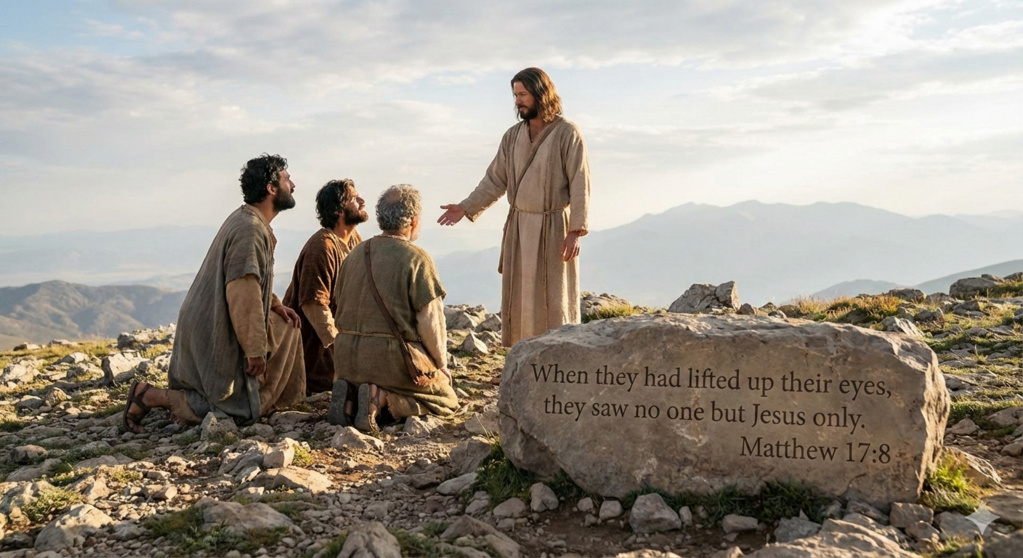
Matthew 16:16

Monday, 2 February 2026

Simon Peter answered and said, “You are the Christ, the Son of the living God.” Matthew 16:16

Note: You can listen to today’s commentary courtesy of our friends at the “Bible in Ten” podcast. (Click Here to listen)

You can also read this commentary, scrolling with music, courtesy of our friends at “Discern the Bible” on YouTube. (Click Here to listen), or at Rumble (Click Here to listen).

“And answering, Simon Peter, he said, ‘You, You are the Christ, the Son of God, the living’” (CG).

In the previous verse, Jesus, in a question bearing emphasis, asked the disciples who they say He is. A response is given in a similar emphatic form. Matthew begins this statement with, “And answering, Simon Peter, he said.”

Simon Peter is generally the one to step forward and speak for the others. He was a bit impetuous, and he was not sound in backing up his faith at times, such as on the night of Jesus’ crucifixion and at the time when Judaizers had come to Antioch. At that time, he waffled in his convictions, withdrew from the Gentiles, and had to be sharply rebuked by Paul for his stand, as recorded in the book of Galatians.

However, he was able to clearly express his thoughts to Jesus about who the disciples agreed Jesus was, saying, “You, You are the Christ.”

The emphatic “You, You” is given as a response to Jesus’ carefully structured question. The word Christ is the same as the Hebrew mashiakh, Messiah, both of which mean “anointed.” This was both a recurring thing and a unique thing, depending on the situation.

Kings were anointed for their position. The high priest was anointed for his. Even Cyrus is called the Lord’s anointed in Isaiah 45:1. It was as if the Lord had personally anointed Cyrus with oil to accomplish a particular task. These and other examples of anointing meant the person was a messiah, a Christ.

However, Peter’s words were indicative of One on a completely different level. There was to be a particular Messiah who would come, anointed of God, to fulfill a role that none other could fulfill. This Messiah was to be the specific representative of God on earth.

It is true that various scholars and sects had varying opinions about what this would mean, but it was generally agreed within society that One was coming who would be Israel’s redeemer, leading them to a golden “messianic” age where they would lead the nations of the world.

At the time of the Roman Empire, the people thought this Messiah’s role would include casting off the Roman oppression and putting Israel over Rome and all other foes. It is certain that none of them, even these disciples, saw Jesus’ role as One who would die for the sins of the people.

It is equally certain that none of these people actually believed that the Messiah would be God incarnate. He may be a “god” to the people, but not Yehovah in the flesh. This was a totally unknown aspect of who Jesus would be.

And more, they never, in a thousand lifetimes, would have thought that His messiahship would level the field for Gentiles as well as Jews, offering them the same benefits in the commonwealth of Israel that they would receive. Such an idea would have been totally repugnant to them.

As such, Peter’s statement, though true, was not something that meant a whole lot in regard to Jesus’ actual ministry and mission. It was a truth, it was an anticipation of Jesus being the fulfillment of their Scriptures, but it was an almost wholly misunderstood proclamation.

And that is fine. Jesus would slowly reveal this to them, including things that would only be understood after His work was complete and He ascended to heaven. In some cases, like speaking to Gentiles such as Cornelius in Acts 10, it would cause confusion in their minds and generate hostility among one another. The Council of Jerusalem in Acts 15 clearly reveals this. As for Peter’s words, he continues with, “the Son of God, the living.”

As noted, this doesn’t mean they understood Jesus to be God incarnate. The term “son of the God” is something that was applied to people throughout the Jewish Scriptures, beginning in Genesis 6:2. Even Gentiles were called “sons of the God” in Job 1:6 and 2:1. It is a title that indicates sonship in an adoptive sense.

Peter’s proclamation is an indication that Jesus is One who is set apart in a preeminent position, even if it was still misunderstood exactly what that meant. One other point is that this was something that was already known to Peter quite some time before –

“One of the two who heard John speak, and followed Him, was Andrew, Simon Peter’s brother. 41 He first found his own brother Simon, and said to him, ‘We have found the Messiah’ (which is translated, the Christ). 42 And he brought him to Jesus.
Now when Jesus looked at him, He said, ‘You are Simon the son of Jonah. You shall be called Cephas’ (which is translated, A Stone).” John 1:40-42

As such, this proclamation of Peter is an adamant assertion of something he and the other disciples already knew. However, Jesus asked it to form the basis of another proclamation that needed to be made at this time.

Life application: The most important question any person can ever answer is, “Who is Jesus to you?” In fact, it is a great question to ask when you are about to evangelize someone. The answer to the question will mean where a person spends their eternal existence.

If someone says, “I don’t know,” he needs careful instruction. If he says that Jesus was a “good person,” though true, it tends to imply that they have been indoctrinated by liberal ideology to accept Jesus as someone who will illuminate one’s path, but who is on the same level as Buddha, Muhammad, or Gandhi.

If the person says, “Jesus is the Savior,” that still needs to be further defined. Jehovah’s Witnesses and Mormons will say Jesus is the Savior, but their understanding of what that means is so vastly different from what is biblical that they are referring to “another Jesus” who proclaims “another gospel.”

Jesus is the Yehovah Elohim, the Lord God, in human form, nothing less. If this is not accepted and believed, they are following the wrong Jesus. Be sure to be precise and properly instruct others on who He is and what He means to the people of the world. There is no other subject that is as important as this.

Lord God, may we carefully convey the message of who Jesus is to those we interact with. Help us to be bold in our proclamation while being correct in our doctrine concerning Him and what He has done. The world needs Jesus! May we be responsible in telling others about Him so that they may be saved. Amen.


Matthew 16:15

Sunday, 1 February 2026

He said to them, “But who do you say that I am?” Matthew 16:15

Note: You can listen to today’s commentary courtesy of our friends at the “Bible in Ten” podcast. (Click Here to listen)

You can also read this commentary, scrolling with music, courtesy of our friends at “Discern the Bible” on YouTube. (Click Here to listen), or at Rumble (Click Here to listen).

“He says to them, ‘And you, whom you say Me to be?’” (CG).

In the previous verse, the disciples answered Jesus’ question concerning who people say He is. They answered, saying that some say John the Baptist or Elijah. Others, however, said He was Jeremiah or one of the prophets. Now that Jesus has been told the general speculation floating around about Him, “He says to them, ‘And you, whom you say Me to be?’”

The emphatic nature of the question sets the disciples apart from the others, such as, “Yes, that is fine, but what I am most curious about is who you…  you say I am!” He is looking to see where their understanding of Him rests. But it isn’t that He didn’t already know. Rather, He is getting them to think through what they already know and verbally proclaim it.

They have seen the miracles, and they have heard the wisdom of His instructions. They already know what they think about Jesus, but the information needs to be unpackaged and properly presented. Once that is out, they can then reinforce that belief, build upon it, and more boldly proclaim it.

Life application: If you ever want to get your thoughts straightened out about something, maybe something you didn’t even know you wanted straightened out, have someone interview you.

For example, a college student is told that one of his assignments is to interview three people from three different religions, asking them what they believe and why. The student decides to interview a Muslim, an orthodox Jew, and a Christian radio host.

When he interviews them, he has a list of various questions about their faith, why they do certain things, how they perceive God, etc. It is with all certainty that all three of them will come away with more information about themselves than they ever realized.

The Muslim is a Muslim because his parents were Muslims. He does XX and XX because that is what he grew up doing. Asked where the basis of that comes from, he has no idea. Asked if it is found in the Koran, he admits he has no idea. Rather, he has never read it.

The same is true with the other two as well. They have gone through life never thinking about why they believe what they believe. They just KNOW it is right… well, they think. After the interview, they have no idea exactly why they believe what they believe. Even the Jew spent more time defending his faith from a personal viewpoint than from a valid, researchable, and verifiable source.

The Jew said, “We Jews get along really well with Catholics. We are always going to functions with Catholics.” When asked why, his answer was, “We’re a lot alike. Jews and Catholics live for this life. They let the rabbi or priest take care of the next life for us.”

He had never thought that through before, but now he is forced to think through why he associates with some and not with others. Hopefully, he will see how exceedingly dangerous his position is. Letting someone else take care of your eternal state! Didn’t Jim Jones do that for his flock in Guyana?

Don’t be afraid to put yourself under the microscope and have your views challenged. And don’t be afraid to ask probing questions of others that may help them realize how tenuous their position on faith really is.

People need Jesus. If you can’t defend why you believe in Jesus when asked about Him, you will not be a very good representative for His cause. So have someone interview you. Their questions are bound to be like others’ questions. You will be preparing yourself for the inevitable questions that people really want answers to. This is what Jesus has done with His disciples. Now they must stand up and explain themselves. How will that go?

Lord God, help us to find ways of properly unpackaging our thoughts so that we know what we actually think and believe. We may know something, but not know why we know it or how to properly defend it. It may even be that we know something that is actually indefensible. Help us to get all of this sorted out. To Your glory, we pray. Amen.


Matthew 16:14

Saturday, 31 January 2026

So they said, “Some say John the Baptist, some Elijah, and others Jeremiah or one of the prophets.” Matthew 16:14

Note: You can listen to today’s commentary courtesy of our friends at the “Bible in Ten” podcast. (Click Here to listen)

You can also read this commentary, scrolling with music, courtesy of our friends at “Discern the Bible” on YouTube. (Click Here to listen), or at Rumble (Click Here to listen).

“And they said, ‘These, indeed, John the Immerser, and others Elijah, and others, Jeremiah or one of the prophets.’” (CG).

In the previous verse, Jesus questioned His disciples concerning who men say He is. Matthew next records, “And they said, ‘These, indeed, John the Immerser.’”

These words seem confused, just as with Herod’s words in Matthew 14:2, when he said, “This, he is John the Immerser! He, he is aroused from the dead, and through this the miracles work in him!” How could a person who is essentially the same age as John be John if John was only executed a relatively short time before?

Two answers could fit. Either John was raised to life, appearing in a different form, or this is what is known as metempsychosis, or soul transmigration, where a soul can enter into another body. Whatever was on the minds of those who held to this view, they claimed that Jesus was John. Next, it says, “and others Elijah.”

This belief was seen in some with the same mentality as that found in John 1 –

“Now this is the testimony of John, when the Jews sent priests and Levites from Jerusalem to ask him, ‘Who are you?’
20 He confessed, and did not deny, but confessed, ‘I am not the Christ.’
21 And they asked him, ‘What then? Are you Elijah?’
He said, ‘I am not.’
‘Are you the Prophet?’
And he answered, ‘No.’
22 Then they said to him, ‘Who are you, that we may give an answer to those who sent us? What do you say about yourself?’” John 1:19-22

Based on the words of Malachi 4:5, there was the anticipation of Elijah returning to Israel. Jesus even said that John was Elijah to come in Matthew 11:14, meaning that he came to fulfill that promised role.

This was the anticipation of the people of Israel, and so it was a logical extension of the communal thought that permeated the culture. When Jesus came, they thought, “This must be him!” Understanding that, Matthew continues with, “and others, Jeremiah or one of the prophets.”

There is a difference in the word “others” that is not evident in the translation. We have one word that must be further explained, whereas the Greek has two separate words. The first, allos, others, before “Elijah” means others of the same kind. This others, the word heteros, means others of another kind.

In other words, there are those with the expectation of someone coming to fulfill Scripture. They didn’t understand that John the Immerser was the precursor of Jesus the Messiah. So both categories, defined by the word allos, were thinking about Elijah, directly or indirectly.

On the other hand, the second group, defined by heteros, are just making unfounded guesses, without any scriptural support, as to who Jesus might be. Therefore, they have gone back to Jeremiah or some other prophet, seen a trait in that person as recorded in Scripture, and think he must have come back in the person of Jesus.

Life application: Elijah didn’t die. He was taken to heaven in a whirlwind, as recorded in 2 Kings 2:11. Therefore, the Bible can say without any contradiction that Elijah will return. However, it is not the case with John the Immerser, who was beheaded.

Hebrews 9:27 says that it is appointed for men to die once, after which comes the judgment. Moses appearing with Jesus on the Mount of Transfiguration does not mean that he has received the judgment and can now return again to be one of the two witnesses in Revelation 11.

A point was being made about Jesus being the fulfillment of the law (Moses) and the prophets (Elijah), as well as a point being made about Jesus having power over the living (Elijah) and the dead (Moses).

When we die, the chance we have for restoration with God is finished. If we die in Christ, we will be raised to eternal life. If we die apart from Christ, we will be raised for condemnation. This is what the Bible proclaims.

Don’t expect any loopholes for yourself or loved ones. Be sure to tell people about Jesus. But also be sure you are right with Jesus. This life is our chance to get the matter of Jesus settled.

Lord God, help us to be wise and discerning in this life, not only with our own relationship with You, but also with those we interact with. Help us to share the good news of restoration with those we encounter while there is time. May this be our priority at all times. Amen.


Matthew 16:13

Friday, 30 January 2026

When Jesus came into the region of Caesarea Philippi, He asked His disciples, saying, “Who do men say that I, the Son of Man, am?” Matthew 16:13

Note: You can listen to today’s commentary courtesy of our friends at the “Bible in Ten” podcast. (Click Here to listen)

You can also read this commentary, scrolling with music, courtesy of our friends at “Discern the Bible” on YouTube. (Click Here to listen), or at Rumble (Click Here to listen).

“And Jesus, having come to the allotments – Caesarea, the Phillipi, He entreated His disciples, saying, ‘Whom they say, the men, Me to be, the Son of Man?’” (CG).

In the previous verse, the disciples finally clued in to what Jesus was trying to teach them. His words about the leaven of the Pharisees and Sadducees were speaking of their evil doctrine. Matthew now continues the narrative of their time after arriving on the eastern shore of the Sea of Galilee, saying, “And Jesus, having come to the allotments – Caesarea, the Phillipi.”

A new word, Kaisareia, Caesarea, is introduced. It is derived from Kaisar, Caesar, a Latin word referring to the title of the Roman Emperor. Caesarea refers to two places in the area of Israel. The first is this location, Caesarea Philippi. Of this location, Albert Barnes says –

“There were two cities in Judea called Caesarea. One was situated on the borders of the Mediterranean (See the notes at Acts 8:40), and the other was the one mentioned here. This city was greatly enlarged and ornamented by Philip the tetrarch, son of Herod, and called Caesarea in honor of the Roman emperor, Tiberius Caesar. To distinguish it from the other Caesarea the name of Philip was added to it, and it was called Caesarea Philippi, or Caesarea of Philippi. It was situated in the boundaries of the tribe of Naphtali, at the foot of Mount Hermon.”

Having come to this general area, “He entreated His disciples, saying, ‘Whom they say, the men, Me to be, the Son of Man?’” Translations consider His words in one of two ways. One is “Whom do men say that I am? The Son of Man?”, or “Whom do men say that I, the Son of Man, am?”

The latter is correct. Jesus has referred to Himself as the Son of Man nine times already, making this the tenth. Peter’s answer will also show that He is not asking if people say He is the Son of Man. Rather, He is asking what He, the Son of Man, is called by others. He is preparing them for a great pronouncement by asking this probing question first.

Life application: Jesus came to His own country in Matthew 13:53-58. He was rejected by them. In Matthew 14:1-12, the account of the beheading of John the Baptist was given. That was followed by the feeding of the five thousand in Matthew 14:13-21.

Jesus then walked on the sea, as is recorded in Matthew 14:22-33. From there, they came to the area of Gennesaret, at which time He fully saved all who simply touched Him. In Matthew 15:1-20, it then noted the traditions of the Jews which Jesus condemned, explaining that what comes out of a man is what defiles, not what enters into him.

That was then followed by His journey to the allotments of Tyre and Sidon, where the faith of the Canaanite woman was noted, and her daughter was saved. After that, Jesus went around the Sea of Galilee to the eastern side of it. There, He healed many and eventually fed four thousand. After feeding them, they crossed the Galilee, coming to the region of Magdala.

While there, He was accosted by the Pharisees and Sadducees who looked for a sign from heaven. He told them no sign would be given but the sign of Jonah. Once that was complete, they once again crossed the Sea of Galilee to the eastern side, being instructed on the leaven of the Pharisees and Sadducees. Now in the account, they have remained on this eastern side and gone north to the area of Caesarea Philippi.

This crisscrossing of the land and the Sea of Galilee all has a purpose. Jesus’ movements are being used as a walking instructional tool in what God is doing in redemptive history. It is good to stop and reconsider where He has gone and where He is at any given time. By considering these things, we can follow what God is doing in reconciling the world to Himself through Jesus.

Each area visited, each topographical marker that is mentioned, and each thing Jesus does is being woven into a marvelous tapestry for us to ponder and learn from. Keep paying attention to the details, both from a micro and macro viewpoint. God is telling us a story of humanity’s long trek back to Him, and it is all centered on Jesus.

Lord God, it would make no sense for You to send Your Son into the world unless there was something to be gained from it. His life of trials and burdens, culminating in His cross and resurrection, tells us that there is a great plan that has been put in place to bring Your people to a place we cannot even imagine at this time. We are grateful to be on this journey because of Jesus! Thank You for the sure hope we possess. Amen.


Matthew 16:12

Thursday, 29 January 2026

Then they understood that He did not tell them to beware of the leaven of bread, but of the doctrine of the Pharisees and Sadducees. Matthew 16:12

Note: You can listen to today’s commentary courtesy of our friends at the “Bible in Ten” podcast. (Click Here to listen)

You can also read this commentary, scrolling with music, courtesy of our friends at “Discern the Bible” on YouTube. (Click Here to listen), or at Rumble (Click Here to listen).

“Then they comprehended that not He said to caution from the leaven – the bread, but from the teaching – the Pharisees and Sadducees” (CG).

In the previous verse, Jesus explicitly told the disciples that He didn’t speak to them about bread, but about the leaven of the Pharisees and Sadducees. With His words spoken to them, the light bulb came on. Matthew says, “Then they comprehended.”

Jesus took the disciples through an instructional process to help them learn how to think clearly. Instead of just saying what He was talking about, He asked them questions that would help them to think through the matter.

With the questions complete, He then told them what He was talking about while still using the leaven metaphor. From there, they would have to make the final leap from the metaphor to the matter He was addressing, which was, “that not He said to caution from the leaven – the bread.”

They now know it isn’t leaven of bread. Jesus told them He was referring to the leaven of the Pharisees and Sadducees. As Pharisees and Sadducees are not loaves walking around, either leavened or unleavened, Jesus had to be referring to something else while using a metaphor.

With this understood, they were able to deduce that it wasn’t really leaven He was addressing, “but from the teaching – the Pharisees and Sadducees.”

This is their lightbulb moment. Jesus has successfully schooled them on a matter while giving them a warning about that matter. What the Pharisees and Sadducees had asked from Jesus was hypocritical, wicked, and adulterous according to Jesus’ words to them.

Understanding this, Jesus then let the disciples know that such people, who ask for signs when there are already signs galore to confirm what they had wanted, are false teachers. As false teaching comes from a sinful heart, their doctrine itself is sinful.

Jesus told the disciples to beware of their doctrine, meaning concerning the things of God, because the source of what they taught was corrupt. This is essentially the message Jesus conveys to them. It is somewhat analogous to what He said to them earlier concerning false prophets –

“From their fruits you will recognize them. Not any, they gather from thorns a grape or from thistles figs? 17Thus, every good tree, it produces good fruit. And the rotten tree, it produces evil fruit. 18Not, it can, a good tree, bad fruit produce, nor a rotten tree good fruit produce. 19Every tree not producing good fruit, it is exscinded, and it is cast into fire. 20Hence, from their fruits you will know them.” Matthew 7:16-20

Life application: These leaders in Israel were to be obeyed in accordance with the law. Jesus will make this explicit in Matthew 23. However, the disciples were told to beware of what they taught, as it was an infection that would only lead people away from a sound relationship with God.

Nothing has changed with Israel’s religious leaders since then. The rabbis teach what is contrary to what God has determined, meaning salvation by faith through grace, as is found in the gospel of Jesus Christ. This is what God is doing. If they are teaching contrary to that, they are not teaching what God is doing.

This is such a sad situation for the people that many rabbis over the years have been proclaimed the Messiah. Today in Israel, there are billboards and banners along the highways proclaiming one person or another is the Messiah.

Until they get this right, as a nation, they will remain under the curse of the law. However, isn’t this what has happened in Christian circles many times as well? Throughout church history, a litany of false teachers has claimed they were God’s representative on earth.

There are people who have started aberrant cults and sects. There are those who claim the Messiah is alive today and he lives in the Philippines, Russia, Miami, and elsewhere. Why is this the way it is? It is because in both Israel and throughout the rest of the world, people don’t take the time to learn the Bible.

In not knowing the Bible, we cannot know if what we are being told is true or not about what God is doing. All we have to lean on is what we are told and whatever discernment we possess. Unfortunately, quite often those who claim the “gift” of discernment are the ones lacking even a modicum of it.

It is important for us to read the Bible. It has been given to keep us from being led down the primrose path. Be sure to use wisdom, pick it up, and read it!

Lord God, You have said in Your word that there is a proper path leading to restoration with You. If there is a proper path, then not being on it will not lead to that restoration. Help us to be wise and discerning concerning such things. May we be willing to put in the effort necessary to hold fast to You alone by knowing how to do so through Your word. Amen.