Acts 16:7

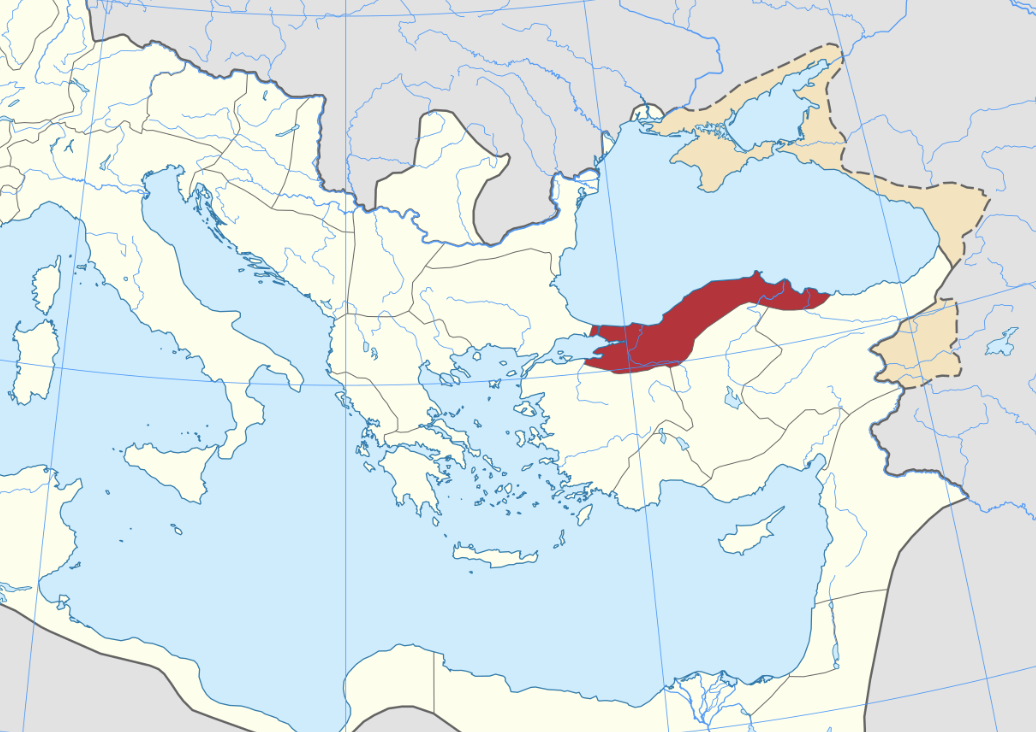
Bithynia.

Tuesday, 18 April 2023 

After they had come to Mysia, they tried to go into Bithynia, but the Spirit did not permit them. Acts 16:7

Note: You can listen to today’s commentary courtesy of our friends at “Bible in Ten” podcast. (Click Here to listen)

You can also read this commentary, with music, courtesy of our friends at “Discern the Bible” on YouTube. (Click Here to listen), or at Rumble (Click Here to listen).

In the previous verse, Luke recorded that Paul and his company had gone through Phrygia and the region of Galatia. However, the Holy Spirit had stopped them from preaching in Asia. With that remembered, it now says, “After they had come to Mysia.”

The meaning is not that they came “into Mysia,” which was a province of Asia minor. Rather, the word kata is used. It signifies “over against.” They had come as far as (over against) Mysia. Mysia was a district in northwest Anatolia that adjoined the Sea of Marmara on the north and the Aegean Sea to the west.

From this point in their journey, it then says that “they tried to go into Bithynia.” Bithynia was a region, a kingdom, and a Roman province also located in the northwest area of Asia Minor. It bordered the Sea of Marmara, the Bosporus, and the Black Sea. Mysia was to its southwest. The men attempted to go into this region, “but the Spirit did not permit them.”

In the previous commentary, various suggestions of what this meant were given. This does not appear to be an active manifestation of God, such as when the Egyptians were actively hindered from coming near Israel by the pillar of cloud as those fleeing passed through the Red Sea.

Rather, what seems likely is that they simply were unable to successfully travel through this area for some unknown reason. They were hindered in their travels and took it as a sign from God that it was not His intention for them to go into this area yet. Rather, there were other areas He would have them evangelize first. This appears certain from the contents of verse 16:9.

As a side note, some manuscripts say, “the Spirit of Jesus” rather than “the Spirit.” If that is the true original, then it is a unique phrase, found only here in Scripture. If it is not original, it may have come from a margin note that later found its way into those manuscripts. Such a rare phrase is not unheard of. For example, the phrases “the Spirit of Christ,” “the Spirit of His Son,” and “the Spirit of Jesus Christ” are also seen in the New Testament.

The inclusion of the name of Jesus, if a later insertion, may have come about to avoid anyone thinking “These men were hindered by an evil spirit.” To clarify the matter, a scribe may have made an insertion with the name Jesus which was later assumed to be part of the original. As always, such things should not cause the reader to assume that we have a fallible word. Rather, it should encourage us to contemplate the matter and think about why such things have come about.

Life application: To understand the difficulty of accurately translating a verse from the original to English, or how an insertion for clarity could later be thought of as original, we can take a very simple sentence from the Bible, Genesis 1:1, and make a comparison of a few translations. First, the original says –

b’reshit bara Elohim eth ha’shamayim v’eth ha’arets

a direct translation would be –

“In beginning created Elohim the heavens and the earth.”

Note that the two uses of eth in the Hebrew are not translatable. Rather, the word is an untranslatable mark of the accusative case, being generally used to point out more definitely the object of a verb or preposition.

A few translations of this verse are –

In the beginning God created the heaven and the earth. (KJV)
In the beginning, God created the universe. (ISV)
In the beginning God created the heavens and the earth. (NIV)
In the beginning God created heaven, and earth. (Douay-Rheims)
In [the] beginning God created the heavens and the earth, (LSV)
In the beginning God (Elohim) created [by forming from nothing] the heavens and the earth. (Amplified)
In the beginning God formed the heavens and the earth. (SLT)

These are but a few of the variations of this verse. Notice how the KJV says “heaven” instead of “heavens.” Later, they will translate the exact same word as “the air” (Genesis 1:26, etc.), “the heavens” (Genesis 2:1, etc.), or some other variant. Being a plural word, their translation is wrong in Genesis 1:1. Further, the word “the” before beginning is not in the Hebrew and should be italicized as is normal with that translation for inserted words.

The word elohim at times means “gods” as in something other than the true God. Thus, the Amplified Bible both translates the word and includes it in parenthesis for clarity. It also explains the meaning of the word bara as an act of creation ex nihilo.

The SLT says “formed” without any explanation. Therefore, one might assume that the matter already existed, and God simply formed the universe from that preexisting matter. But another word, yatsar, is used to describe such a process, such as in the forming of man from the dust.

By looking over the differences in such translations, one can learn quite a bit about what is going on in the minds of the translators. But remember, this is a very simple sentence. Imagine how varied translations can be in longer or more complicated verses! Don’t rush into judging translations until you have studied and thought through what is going on.

The study of Scripture is something that we can and should spend our whole lives pursuing. Be pleased to spend your time wisely and consider what God is telling us in this precious word! Study! Consider! Seek out! There is so much treasure to be found here.

Thank You, O God, for the wonderful word You have given us. And thank You for those who have taken the time to translate it so that we can have a sense of what the original languages are telling us. Help us to consider this word all our days, pondering its secrets and learning from its truths. To Your glory, we pray. Amen.



Acts 16:6

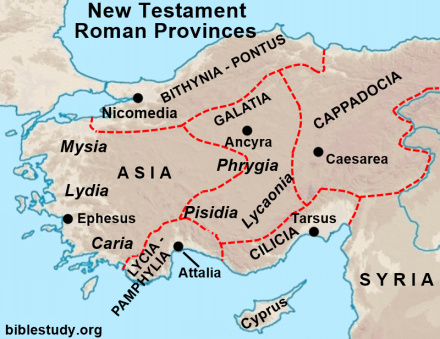
Roman provinces including Phrygia and Galatia.

Monday, 17 April 2023

Now when they had gone through Phrygia and the region of Galatia, they were forbidden by the Holy Spirit to preach the word in Asia. Acts 16:6

Note: You can listen to today’s commentary courtesy of our friends at “Bible in Ten” podcast. (Click Here to listen).

You can also read this commentary, with music, courtesy of our friends at “Discern the Bible” on YouTube. (Click Here to listen), or at Rumble (Click Here to listen).

The previous verse noted the strengthening of the churches that Paul and his team visited and how their numbers increased daily. With that, it now says, “Now when they had gone through Phrygia.”

Phrygia was mentioned along with many other areas in Acts 2:10 at the initial outpouring of the Holy Spirit. Those from there who had come to faith in the Lord at that time would surely have gone back and met together, telling others about their faith in the Lord. Phrygia was the largest of the provinces of Asia Minor. Bithynia was to its north, Pisidia and Lycia were to its south, Galatia and Cappadocia were more easterly, and Lydia and Mysia were in a westerly direction.

Paul and his company traveled throughout this district, probably helped by a listing of the locations where believers were – as recorded and maintained by those in Jerusalem. This is speculation, but it is likely. With that, it next says, “and the region of Galatia.”

Rather, the word translated as Galatia is an adjective, “and the Galatian region.” This was, as noted, east of Phrygia. Of this area, Albert Barnes says –

“The region was formerly conquered by the Gauls. They settled in it, and called it, after their own name, Galatia. The Gauls invaded the country at different times, and no less than three tribes or bodies of Gauls had possession of it. Many Jews were also settled there. It was from this cause that so many parties could be formed there, and that so much controversy would arise between the Jewish and Gentile converts.”

The area will be noted again in Acts 18:23 and then the district will be noted in 1 Corinthians, Galatians, 2 Timothy, and 1 Peter. It is the location where the church of the Galatians that brought so much frustration and heartache to Paul is located. As Gentiles, they had turned from the faith of Christ and to the imposition of circumcision. As such, they were making themselves debtors to the whole law (Galatians 5:3).

For now, and with their travels through the region complete, it next says, “they were forbidden by the Holy Spirit.” Nothing is said of how this occurred. Some think it was by direct revelation, such as speaking to Paul. However, Luke will normally detail such intimate occurrences.

It could be that they could not find safe travel, guides to lead them, enough resources to effectively set out, or whatever. They knew they were being led by the Spirit and so obvious hindrances to their forward motion would indicate being frustrated to proceed by the Spirit. This is only conjecture, but Luke’s careful recording of such things seems to necessitate that this is what is meant. What they were unable to do was “to preach the word in Asia.”

This may make the thought above even more specific. It could be that they started into the area and simply had no effective evangelization at all. This would mean the area was not yet ready to accept what they would later openly acknowledge. Whatever the situation, this is not Asia as we think of in modern times. It is an area of the Roman empire already mentioned in Acts 2:9. Barnes notes that it is the area of proconsular Asia, also called Ionia. Again, he provides more detailed information on the area –

“Of this region Ephesus was the capital; and here were situated also the cities of Smyrna, Thyatira, Philadelphia, etc., within which the seven churches mentioned in Revelation 1-3 were established. Cicero speaks of proconsular Asia as containing the provinces of Phrygia, Mysia, Carla, and Lydia.”

Life application: The area of Asia will be evangelized later in Acts, being noted many times before the book closes out. It will also be mentioned in 1 & 2 Corinthians, 2 Timothy, 1 Peter, and Revelation. For whatever reason, the team was unable to evangelize the area at this time. More frustrations on where to go will arise in the next verses, but eventually, a different direction for them to travel will be made evident.

The Lord is all-knowing, and He knows what is best, when it is best, and every detail associated with how to proceed at such times for the best result. Therefore, if you are encountering a time of frustration in proceeding with something concerning evangelism, it may simply not be time for it to happen. Instead, look for another opportunity and wait on the Lord’s timing for what you had initially planned.

There are many places that were once unwilling to hear the gospel message that later accepted it wholeheartedly. There are missionaries who died while on the mission field with no converts. And yet, that occurs in areas where great success eventually was realized. Events like this show us that God is in control of what is going on and that His will is being worked out through us and our actions.

So don’t get frustrated if you seem to be hitting a wall in your efforts. The mission team that Paul was leading certainly faced impenetrable walls as they went. And yet, they picked up and moved on, knowing that the Lord was guiding their steps. Remember this, and don’t let setbacks stop you altogether. The Lord will lead as you continue. We can be sure of this, even if we cannot be sure of the “what and when” of the events ahead.

Glorious Lord, we know that You have planned out the paths to be taken so that the whole world will be evangelized. It has been a long and often difficult track for many, but Your plan is being realized. As this is so, help us in our own efforts to know which way to turn so that Your will for us will be realized in our actions. Amen.


Acts 16:5

Steep wooden bridge.

Sunday, 16 April 2023

So the churches were strengthened in the faith, and increased in number daily. Acts 16:5

Note: You can listen to today’s commentary courtesy of our friends at “Bible in Ten” podcast. (Click Here to listen).

You can also read this commentary, with music, courtesy of our friends at “Discern the Bible” on YouTube. (Click Here to listen), or at Rumble (Click Here to listen).

The previous verse noted that Paul and his companions went through the cities and delivered the decrees of the council. With that, it now says, “So the churches were strengthened in the faith.”

The verb, being imperfect, gives the sense of continuance. Thus, it more appropriately reads, “So the churches were strengthening in the faith.” In other words, it wasn’t just that they were strengthened for the moment and then may have started to slide backward. Rather, because of the decrees of the council, they felt a freedom that encouraged them, and they continued strengthening as time passed by.

This would be especially so when considering that the matter that was resolved dealt with them personally. Being Gentiles, any Scripture that they possessed would have highlighted the role of Israel and the Jewish people. To impose upon them the Law of Moses and circumcision would be to rob them of their culture and identity while leaving them among their own culture and people.

But with the decision of the council, they would remain within the Christian faith but still be just who they were within their culture. The demands of the Judaizers would have robbed them of this. It would have started with circumcision, gone onto law observance, and soon enough they would be told how they still didn’t fit in because they didn’t speak or act like the other Jewish people.

This is no stretch of the analysis at all. This even happened among the Jewish people as was evidenced in Acts 6 –

“Now in those days, when the number of the disciples was multiplying, there arose a complaint against the Hebrews by the Hellenists, because their widows were neglected in the daily distribution.” Acts 6:1

If this type of prejudice arose among the Jews just because they didn’t speak Hebrew or Aramaic, how much more would this become an issue with the Gentiles? The legalistic demands on them would never end. But with the encouragement of the letter and the words of these missionaries, they would continue to strengthen day by day in their faith. And more, others would see and be encouraged to join. As it says, they “increased in number daily.”

With each passing day, and with the freedom from the fear of death found in Christ and freedom from the bondage of the law, the churches would realize that every answer to the longing of the human soul was to be found in a rightly established faith in Christ. This would appeal (and for two thousand years has appealed) to those who “through fear of death were all their lifetime subject to bondage” (Hebrews 2:15).

Life application: Even today, reading the Old Testament might leave a non-Jewish person wondering what part or role they could have in the redemptive plans of God. If all there was of Scripture was the Old Testament, no answer to the problem of sin would have come, but more, only a total identity with national Israel – conforming to their standards and cultural practices – would bring about any state of communion with God as He is presented there.

But more, there would only be identity with a group of people who had CONSTANTLY failed to measure up to the strict demands of their God. Yes, His grace and mercy upon them are evident, but so is His wrath and indignation. The bondage of the Jewish people, which they failed to realize hung over them, would be evident to anyone who properly studied their Scriptures.

As such, anyone joining them would have to be a person who was filled with the pride of saying, “I can do what they have failed to do. I can please God through adherence to His law.” When this occurs, as it does to this day with such people, their religion is one based on self. Despite the supposed piety of saying, “I follow the God of Israel and keep His Torah,” there is nothing pious in the statement. The actions are based on self.

Only when one submits to Christ and says, “Jesus Christ has made me right with God,” is there any true freedom at all. He has done it, He continues to do it, and He will carry us through to the very end. It is all about what Jesus has done. Put self aside! Trust in the work of Jesus. And then, forever and ever, praise the glorious name of Jesus Christ our Lord – to the glory of God.

Lord God, thank You for Jesus Christ our Lord who alone has the power to save us and to keep on saving us, despite ourselves. Yes, O God, thank You for Jesus Christ our Lord. Hallelujah and Amen.


Acts 16:4

Wooden bridge. Virginia.

Saturday, 15 April 2023

And as they went through the cities, they delivered to them the decrees to keep, which were determined by the apostles and elders at Jerusalem. Acts 16:4

Note: You can listen to today’s commentary courtesy of our friends at “Bible in Ten” podcast. (Click Here to listen).

You can also read this commentary, with music, courtesy of our friends at “Discern the Bible” on YouTube. (Click Here to listen), or at Rumble (Click Here to listen).

In the previous verse, Timothy was taken and circumcised by Paul. With that now accomplished, the narrative continues, saying, “And as they went through the cities.”

Rather, the verb is imperfect, “they were going through the cities.” There is a sense of ongoing action as the team travels from city to city. They have already been through the areas of Syria and Cilicia as was seen in Acts 15:41. They had come to Derbe and Lystra in Acts 16:1. So they are continuing on from there. Verse 16:6 will note Phrygia and the region of Galatia, so it is the general area that they are now going through.

Anywhere there was already an established church, they made sure to stop because, as it next says, “they delivered to them the decrees to keep.” Again, the verb is imperfect, saying, “they were delivering to them the decrees to keep.”

In each city where there was a church, they were careful to stop and provide the judgment that had previously been rendered. The narrative may imply that a sufficient number of certified copies of the edict had been prepared and that each church was given its own.

Even if not, the decrees were transmitted to them in a suitable manner. The word translated as “decrees” is dogma. It is now seen for only the second time, the first being in Luke 2:1. Of it, Albert Barnes states –

“It properly means a law or edict of a king or legislature. In this instance it was the decision of the council in a case submitted to it, and implied an obligation on the Christians to submit to that decision, since they had submitted the matter to them. The same principles, also, would be applicable everywhere, and the decision, therefore, at Jerusalem became conclusive.”

As for providing copies or maybe making a copy from a single original, with Silas accompanying the team, he stood as a representative of the council at Jerusalem (Acts 15:22).  And so, he could vouch for its contents “which were determined by the apostles and elders at Jerusalem.”

The council was the final human authority on such matters at this time. As such, their decision stood as a witness against any Judaizers that would come in and try to bully the Gentiles into being circumcised and observing the Law of Moses. This was necessary as is evidenced by the trouble that had come about in Antioch. It is the same trouble that Paul agonizes over in his letter to those in Galatia.

At such an early time in the church, the heresy of law observance was at the forefront of issues that were infecting the minds of believers. Personally carrying the contents of the council was, therefore, a matter of critical importance for ensuring the purity of the gospel.

Life application: There is no council of apostles and elders in Jerusalem today. When the apostles were all dead, that was the end of the authority of this body in deciding matters concerning the church. This is a clear and poignant point that tells us of the importance of Scripture for the guidance of the church.

Despite the claims of the Vatican’s “Holy See,” no set council or body has been bestowed the authority over such matters when the body of believers in Jerusalem faded away. And none is needed. The writings of the apostles were saved and compiled into the New Testament. It now stands as the sole authority for deciding matters concerning the faith.

No pope, council, conference, synod, or congregation has the right to make any ruling that does not comply with what is stated in Scripture. If a matter is raised that is not addressed in Scripture, then there is freedom to decide how to handle it. But that decision should not be considered as authoritative and binding, as if it is on the same level as Scripture.

Care must be taken to keep Scripture alone as the divinely inspired authority for matters of the faith. Anything else is to be considered as a guideline for those who meet in a church, but it is a guideline that can be changed as the situation demands. Scripture, on the other hand, cannot be.

This is an important lesson we must learn. Because there is no “council in Jerusalem,” and because God has not left the church to run willy-nilly in every direction, we can – and must – conclude that He has given us a suitable standard by which we can determine necessary matters of the faith. That standard is the Holy Bible.

Glorious God Almighty, may we carefully consider how important it is to maintain the Bible in its proper place in our lives. It is the final authority for all matters relating to our relationship with You. Help us to never trifle with its sacred contents, but to carefully consider it and obediently apply it to our lives. Amen.


Acts 16:3

Horses.

Friday, 14 April 2023

Paul wanted to have him go on with him. And he took him and circumcised him because of the Jews who were in that region, for they all knew that his father was Greek. Acts 16:3

Note: You can listen to today’s commentary courtesy of our friends at “Bible in Ten” podcast. (Click Here to listen).

You can also read this commentary, with music, courtesy of our friends at “Discern the Bible” on YouTube. (Click Here to listen), or at Rumble (Click Here to listen).

The words now continue to refer to Timothy who was introduced in Acts 16:1. Of him, it next says, “Paul wanted to have him go on with him.”

Nothing says how this came about. It could have been Paul wanting to take more people as assistants. It might be Paul recognizing Timothy’s character and ability to share the gospel. It even might be Timothy who initiated the idea, asking if he could accompany them on their journeys. The reason is less important than the fact that Paul agreed with Timothy’s character and that his presence would benefit their journey. Because of this, Luke next records, “And he took him and circumcised him.”

This seems to fly in the face of Paul’s letter to those in Galatia. In that letter, Paul completely dismisses the necessity for circumcision. He says –

“Yet not even Titus who was with me, being a Greek, was compelled to be circumcised.” Galatians 2:3

“Stand fast therefore in the liberty by which Christ has made us free, and do not be entangled again with a yoke of bondage. Indeed I, Paul, say to you that if you become circumcised, Christ will profit you nothing. And I testify again to every man who becomes circumcised that he is a debtor to keep the whole law. You have become estranged from Christ, you who attempt to be justified by law; you have fallen from grace. For we through the Spirit eagerly wait for the hope of righteousness by faith. For in Christ Jesus neither circumcision nor uncircumcision avails anything, but faith working through love.” Galatians 5:1-6

This event appears to contrast with the decision of the council recorded in Acts 15. The entire point of calling the council was because the Judaizers wanted the Gentiles to be circumcised according to Moses and to observe the law. That was rejected by the council. As these things are true, there must be a reason for the circumcision of Timothy. And sure enough, that reason is given in the next words, “because of the Jews who were in that region.”

The Jews were opposed to Paul every step of the way. Timothy being uncircumcised would only exacerbate the problems Paul faced. Timothy, and in turn Paul and those with him, would be faced with more strife and hostility than would otherwise arise because of the enmity of the Jews. The precept follows with Timothy as it was stated by Paul in 1 Corinthians 9 –

“For though I am free from all men, I have made myself a servant to all, that I might win the more; 20 and to the Jews I became as a Jew, that I might win Jews; to those who are under the law, as under the law, that I might win those who are under the law; 21 to those who are without law, as without law (not being without law toward God, but under law toward Christ), that I might win those who are without law; 22 to the weak I became as weak, that I might win the weak. I have become all things to all men, that I might by all means save some. 23 Now this I do for the gospel’s sake, that I may be partaker of it with you.” 1 Corinthians 9:19-23

Paul’s thoughts concerning the circumcision of Timothy, while leaving Titus and all other Gentiles uncircumcised, came down to the issue of Timothy’s maternal heritage. His mother being a Jewess. This would mean nothing in and of itself “for they all knew that his father was Greek.”

Timothy was not circumcised because of this. His father was a Gentile and Timothy was raised without being circumcised. And yet, he was raised knowing the Scriptures, customs, and ways of the Jews. Paul’s modus operandi was to always go to the synagogue of the Jews first. This would not have been possible for Timothy, and indeed the entire cohort, if Timothy was uncircumcised.

The whole thought comes down to, “What is the most productive way of evangelizing the people we meet?” As Charles Ellicott rightly says, “The act was spontaneous, and men may rightly concede as a favour, or as a matter of expediency, what they would be justified in resisting when demanded as a matter of necessity.”

Timothy’s Jewish mother offered him an exceptional chance to be a participant in the evangelization of the Jews. But without circumcision, that could never occur. On the other hand, Paul completely resisted the circumcision of Titus because there would be no benefit for him, for Paul, for the sake of the Jews, and most importantly, for the preaching of the gospel. In fact, it would negate the gospel. Such is not the case with Timothy. There was nothing of harm and everything to be gained from performing this expedient measure upon him.

Life application: The key point of what is seen in this verse is the furtherance of the gospel. Even today, there are males born to Jewish mothers that have not been circumcised. They have a right to perform aliyah, moving to Israel, because of their maternal heritage, but if they were not circumcised, this would be a problem.

The same would be true with that person being a believer in Christ and wanting to evangelize the Jews. This is his burning desire, but if he were not circumcised, it would immediately put up an almost impenetrable wall between him and the Jews he talked to. And so, without ever considering law observance, being circumcised would be the natural course of action to take in order to meet the Jews he was evangelizing on their own level.

The fact is that Timothy was saved already. He had not observed the law. He was admitted into the fellowship of believers. He surely participated in the Lord’s Supper. He was probably baptized upon belief (though this is not stated, it can be inferred). Therefore, his uncircumcised state has nothing (zero, zip, nada) to do with his salvation or continued salvation. That alone tells us all we need to know.

Now that he is going out into the mission field with Paul, an expedient measure is taken to help with their evangelistic efforts. It is for this, and for no other reason, that Timothy is now being circumcised. Don’t be led astray by people who use this verse (and they are out there) to “prove” you must be circumcised in order to be saved. Timothy was already saved. Nothing can be added to the fully efficacious work of Jesus Christ in making that happen – not in Timothy and not in you.

Heavenly Father, may we think clearly and rationally about our state in Christ. May we never attempt to “add” to our justification through our own works. Help us to stand on the purity of the gospel that we are saved by grace through faith in the finished, final, full, and forever work of Jesus Christ our Lord. Amen.