
Acts 6:9

The horses at Las Colinas.

Thursday, 31 March 2022

Then there arose some from what is called the Synagogue of the Freedmen (Cyrenians, Alexandrians, and those from Cilicia and Asia), disputing with Stephen. Acts 6:9

Note: You can listen to today’s commentary courtesy of our friends at “Bible in Ten” podcast. (Click Here to listen).

You can also read this commentary, with music, courtesy of our friends at “Discern the Bible” on YouTube. (Click Here to listen), or at Rumble (Click Here to listen).

The previous verse referred to the faith and power of Stephen as he did great wonders and signs among the people. Now, another group is introduced. Luke states, “Then there arose some.”

Because of the wording, one can assume they either have arisen to join, or to argue against, Stephen. Stephen is the main character of the narrative, and these now to be mentioned are brought in to define the narrative further. Those who have arisen are said to be “from what is called the Synagogue of the Freedmen.”

A short explanation of who these men are is given by Vincent’s Word Studies –

“In Jerusalem, and probably in other large cities, the several synagogues were arranged according to nationalities, and even crafts. Thus we have in this verse mention of the synagogues of the Cyrenians, Alexandrians, Cilicians, and Asiatics. Libertines is a Latin word (libertini, freedmen), and means here Jews or their descendants who had been taken as slaves to Rome, and had there received their liberty; and who, in consequence of the decree of Tiberius, about 19 a.d., expelling them from Rome, had returned in great numbers to Jerusalem. They were likely to be the chief opponents of Stephen, because they supposed that by his preaching, their religion, for which they had suffered at Rome, was endangered in Jerusalem.”

However, Albert Barnes provides much more information on this designation –

———-

  1. The word is Latin, and means properly a ‘freedman,’ a man who had been a slave and was set at liberty. Many have supposed that these persons were manumitted slaves of Roman origin, but who had become proselyted to the Jewish religion, and who had a synagogue in Jerusalem. This opinion is not very probable; though it is certain, from Tacitus (Ann., lib. 2:c. 85), that there were many persons of this description at Rome. He says that 4,000 Jewish proselytes of Roman slaves made free were sent at one time to Sardinia.
  2. A second opinion is, that these persons were Jews by birth, and had been taken captives by the Romans, and then set at liberty, and were thus called ‘freedmen’ or ‘liberties.’ That there were many Jews of this description there can be no doubt. Pompey the Great, when he subjugated Judea, sent large numbers of the Jews to Rome (Philo, In Legat. a.d. Caium). These Jews were set at liberty at Rome, and assigned a place beyond the Tiber for a residence. See Introduction to the Epistle to the Romans. These persons are by Philo called “libertines,” or ‘freedmen’ (Kuinoel, in loco). Many Jews were also conveyed as captives by Ptolemy I. to Egypt, and obtained a residence in that country and the vicinity.
  3. Another opinion is, that they took their name from some ‘place’ which they occupied. This opinion is more probable from the fact that all the “other” persons mentioned here are named from the countries which they occupied. Suidas says that this is the name of a place. And in one of the fathers this passage occurs: ‘Victor, Bishop of the Catholic Church at Libertina, says, unity is there, etc.’ from this passage it is plain that there was a place called ‘Libertina.’ That place was in Africa, not far from ancient Carthage. See Dr. Pearce’s Commentary on this place.

———-

Whatever the exact meaning of the name, the group was comprised of “Cyrenians, Alexandrians, and those from Cilicia and Asia.”

The Cyrenians are those who dwelt in Cyrene in Africa, a location west of Egypt. This is where Simon of Cyrene, who carried Jesus’ cross in Matthew 27:32 was from.

Alexandrians are those who dwelt in Alexandria in Egypt. A great deal of Jews lived there inhabiting large sections of the city. This is the location where the Greek translation of the Bible, the Septuagint or LXX, came from.

Cilicia was in Asia Minor, a province on the seacoast, located at Turkey’s south, north of Cyprus. Its capital, Tarsus, is where the Apostle Paul came from – as is recorded in Acts 9:11 (and as is noted elsewhere). As such, it makes it appear likely that Paul attended this synagogue and participated in what will be said in this verse.

Finally, Asia is noted. This is not Asia as we think of it today. Rather, it is the same as was referred to in Acts 2:9. It is a term that may refer to a jurisdiction according to the layout of the provinces of Rome. Of this location, Vincent’s Word Studies says –

“Not the Asiatic continent nor Asia Minor. In the time of the apostles the term was commonly understood of the proconsular province of Asia, principally of the kingdom of Pergamus left by Attalus III. to the Romans, and including Lydia, Mysia, Caria, and at times parts of Phrygia. The name Asia Minor did not come into use until the fourth century of our era.”

It is from this synagogue, filled with people from these various locations, that men arose “disputing with Stephen.”

The word translated as “disputing” essentially means “to examine together.” It is rendered as “question,” “debate,” “discuss,” “argue,” and so on. It does not necessarily indicate any animosity, but it can. Or it can be a debate that eventually leads to an argument. It is probable that Stephen voiced his words concerning Jesus, and they came back against him in a debate that will eventually lead to the forming of a charge against him. It is to be noted again (as stated in the previous verse) that Stephen was “full of faith and power,” and he “did great wonders and signs among the people.”

This is a key thought that certainly set in motion the debate.

Life application: In Christianity, there are Calvinists, there are Free Grace proponents, there are Baptists, Presbyterians, and Episcopalians. In fact, there are so many sects and divisions within the church that it is almost impossible to know them all, much less what they all believe.

Because of this, there are obviously disagreements between them concerning valid points of doctrine. In the end, there can only be one completely correct idea about any particular point. Is Jesus God? Yes or No. Is salvation eternal? Yes or No. Does man have free will to choose Christ? Yes or No. And so on.

The Bible is the source of our knowledge of who Jesus is. It is where we are to build our doctrine from. Anything that is said about our theology and doctrine must find its source there or be in accord with what is said there. If it isn’t, then it is something that came out of the head of man.

The more one knows the Bible, the less likely it is that he will be duped into believing something incorrect. It is still possible, but it is less likely. For those who do not know Scripture, the probability is that they will be more easily led astray from what is sound.

Read your Bible. Think about what you have read. Study theology after you know your Bible. And set your doctrine in accord with the Bible. It is important.

Glorious God Almighty, You have provided us with a source of knowledge in order for us to know You, to know what You are doing, and to know why You have done those things. How can we neglect such a great and precious treasure? Help us, Lord, to make Your word our priority all the days of our lives. Amen.


Acts 6:8

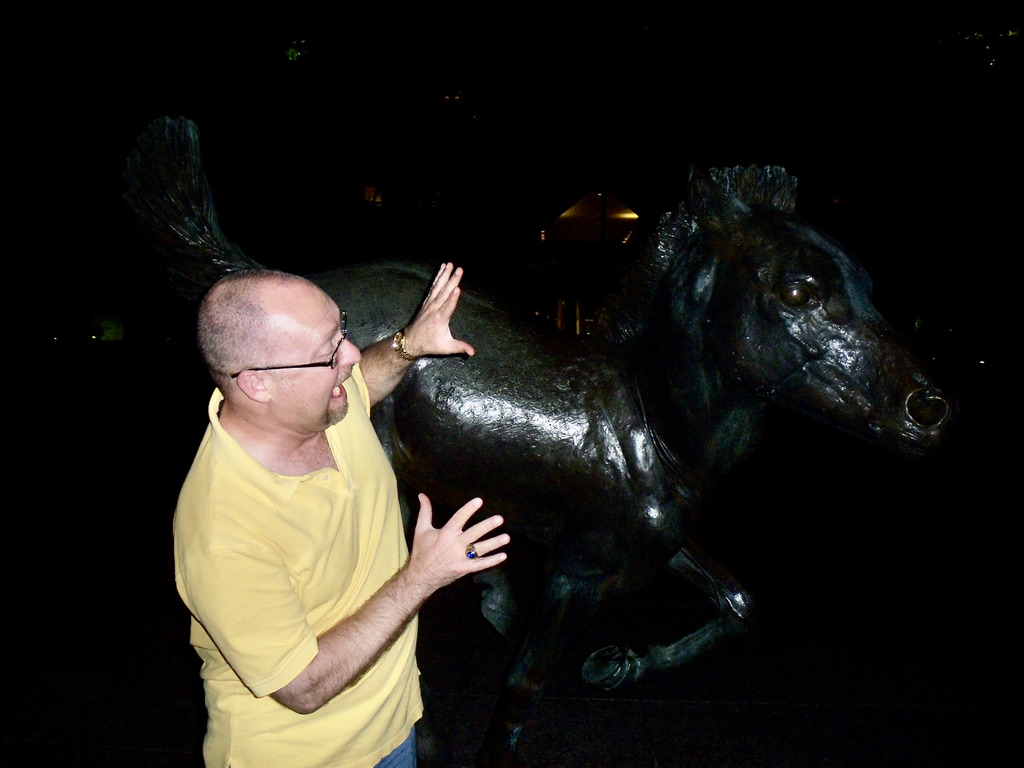
Stephen Kane is fraidy as he approached the Horses at Las Colinas.

Wednesday, 30 March 2022

And Stephen, full of faith and power, did great wonders and signs among the people. Acts 6:8

Note: You can listen to today’s commentary courtesy of our friends at “Bible in Ten” podcast. (Click Here to listen)

You can also read this commentary, with music, courtesy of our friends at “Discern the Bible” on YouTube. (Click Here to listen), or at Rumble (Click Here to listen).

The previous verse spoke of the multiplication of the number of disciples. It also referred to the fact that many of the priests were obedient to the faith. The words now bring in Stephen again who was introduced as one of the seven in verse 6:5, saying he was a man full of faith and the Holy Spirit. Of him, it reconfirms this saying, “And Stephen, full of faith and power.”

It is of note that some manuscripts say “grace” rather than “faith” here. The word “faith” is more suited to verse 6:5, confirming that thought. Either way, he is carefully described here, being singled out from the other six chosen with him. The narrative will continue focusing on him throughout Chapter 6 and Chapter 7. As noted, saying that he is full of faith and power is given to parallel verse 6:5 –

And they chose Stephen, a man full of faith and the Holy Spirit…
And Stephen, full of faith and power…

As such, the “power” is set in parallel to “the Holy Spirit.” That is then further defined by saying that he “did great wonders and signs.”

The verb is imperfect. More rightly, it should be rendered saying he “was performing great wonders and signs.” It wasn’t that he simply did these things once, or a year ago, or when he was a certain age. Rather, it is speaking of him doing them during the entire time of the record set before us, and he continued doing them as well. Luke’s words further define his doing these things as being “among the people.”

It is an important inclusion. Stephen didn’t just do these things in the courts of a king. Nor did he do them in a traveling show for money. He was among the people and his actions were personally witnessed by them. What he did is not defined, but it can be supposed that it included miraculous healings and the like.

Or it could be that the coming words concerning him define what he did – that he was a great and effective orator. No matter what, so full of faith and of the Holy Spirit was he that he was able to do great things right among the people.

Life application: From time to time it is good to remember that being filled with the Holy Spirit is a passive thing. One is prepared to receive the Spirit. If a cup has a lid on it, it must have the lid removed in order for it to be filled. But the cup simply sits there and is filled. It happens passively. The cup doesn’t reach up and start filling itself.

Likewise, we need to be prepared for the reception of the Spirit. The way to do this is to have our lives opened up for His coming. Stephen was a man of faith. If we lack faith, we will not receive the Spirit. One can sing praises to God in a church band, but if he doesn’t believe in God (he was simply hired to sing for $150.00 a gig), then there is nothing about him that would allow the Spirit to fill him.

If we prepare ourselves through true faith, and if we live our lives in accord with the word and in a state of being opened up to God, then we will be filled. The more opened we are (through faith, love of God, appreciation for His goodness, in praising Him, in telling others about Him, and so on), the more we will be filled.

Let us live our lives totally in tune with God as He is presented in Scripture. Let us think on Him at all times. Let us overflow with His goodness in praise, prayer, and thanks! Be filled with the Spirit by being open receptacles prepared to receive Him.

Lord God, how good it is to read Your word, to think on You and Your goodness, to hold fast to You even in times of trial and difficulty. How good it is to know You in the most intimate of ways. Fill us with all of who You are, O God. Amen.


Acts 6:7

The horses at Las Colinas.

Tuesday, 29 March 2022

Then the word of God spread, and the number of the disciples multiplied greatly in Jerusalem, and a great many of the priests were obedient to the faith. Acts 6:7

Note: You can listen to today’s commentary courtesy of our friends at “Bible in Ten” podcast. (Click Here to listen)

You can also read this commentary, with music, courtesy of our friends at “Discern the Bible” on YouTube. (Click Here to listen), or at Rumble (Click Here to listen).

The words now follow immediately after the choosing of seven men to handle the daily distribution. There appears to be no logical connection between the two, and so it seems as if Luke is simply moving on to a new matter now that the previous issue has been resolved.

However, Acts 6:5 and Acts 6:8 both mention Stephen. And it is he who is the focus of the narrative through all of Acts 7. As such, it appears that Luke is implicitly tying what he will now say into the ministry and testimony of Stephen. With that noted, the verse begins with, “Then the word of God spread.”

The word translated as “spread,” signifies growing or increasing. It is an imperfect verb signifying an ongoing process. For example, the same verb in the same form is used in Luke 1 to describe the growing up of John the Baptist from a child into a man strong in the spirit.

The effect of the apostles has been rather profound, but because of their being Galileans, they were looked down on by those who were more educated (see Acts 2:7). Stephen has been noted as “a man full of faith and the Holy Spirit.” In the next verse, he will be noted as “full of faith and power.” And in Acts 7, he will demonstrate intimate knowledge of Scripture and of the history of his people.

Thus, it may be that Luke is now connecting some of the present growth to the efforts and knowledge of Stephen. Next, Luke records, “and the number of the disciples multiplied greatly in Jerusalem.”

At this time, Jerusalem remains the central hub of the faith. It is a logical place for the apostles to remain because there were three annual pilgrim feasts to the city. All people were to come and rejoice in the presence of the Lord during these feasts. During the rest of the year, the city was still full and bustling with activity, and evangelism would be ongoing. With the addition of more people, especially people like Stephen, the number of believers would, in fact, greatly multiply. It is a natural consequence of such things. Concerning this growth come Luke’s next words, saying, “and a great many of the priests were obedient to the faith.”

This is a key point in the development of the faith, meaning the body of believers in Jesus. It is based on the faith, meaning acceptance of the gospel by the priests. The word translated “obedient” is exactly right. It signifies “to obey.” But the underlying meaning is “to believe” or “to have faith.” In other words, the priests “have faith” in “the faith.”

This is not double talk, but it is exactly what is being presented. For example, Hebrews explicitly demonstrates this –

“For who, having heard, rebelled? Indeed, was it not all who came out of Egypt, led by Moses? 17 Now with whom was He angry forty years? Was it not with those who sinned, whose corpses fell in the wilderness? 18 And to whom did He swear that they would not enter His rest, but to those who did not obey19 So we see that they could not enter in because of unbelief.” Hebrews 3:16-19

The account that is cited by the author is that of Numbers 14, where the spies returned from Canaan and gave the people a bad report. The people failed to believe God, and thus they did not obey. Despite many poor translations that use the word “command” in that Numbers passage, there was no direct command spoken forth.

Rather, the word of the Lord said the people would enter, and the people simply failed to believe. Instead, they feared because of the negative report and failed to trust the Lord who had already proven Himself to them, time and again. It was because of their unbelief that they failed to enter into the promised rest.

These priests have now “obeyed” by believing. And it appears based on the placement of the verse that Stephen is to be considered a large part of this coming about.

Life application: Far too often, people take words and concepts out of their intended context, thus forming a pretext. The word “obey” has a meaning, but the substance behind that must be properly understood. If one is commanded to do something, then obedience is expected. That is the context.

However, if someone is told that they should simply trust and accept that another will safely guide him through the waters of disaster, then “obey” takes on a more subtle meaning. There was no command. Instead, there is only a hope that faith will be demonstrated.

God does not “command” anybody into salvation. He also does not “regenerate” people in order for them to believe. He set forth His proposition, and He asks us to believe: “I have sent My Son into the world. He has fulfilled the law and died for the sins of the world. I ask you to simply trust that and be saved.” That is the proposition. Obedience to it is “to believe.”

To add to that by stating that we must first believe His commands – whatever ones we decide upon – is to damage the simple message of obedience to faith (the gospel), and it is thus a false message, not given by God. It is a false gospel.

Be sure to understand these nuances of what is stated, and then effectively communicate them to others when presenting the gospel. If you tell someone that he does not have free will, and that a person must first be regenerated in order to believe (Calvinism), that person will have no idea what you are talking about, because what you are saying both makes no sense and it is unbiblical.

If you tell someone that they must obey Jesus in order to believe, and then start telling them that he has to observe the Sabbath, get circumcised, stop eating pork, quit cussing, and etc., you are presenting a false gospel of works. The gospel is about Jesus –

“that Christ died for our sins according to the Scriptures, and that He was buried, and that He rose again the third day according to the Scriptures.” 1 Corinthians 15:3, 4

Explain this message to them, and don’t turn “obey” into something that doesn’t exist or something that is unintended. Keep it simple and you will be doing what God has done and expects us to do. Despite all of the complicated theology in Scripture, the gospel is the simplest message of all. Don’t add to it or change it! If you do, then it is no longer the gospel.

Heavenly Father, thank You for the simplicity of the gospel. You have taken the thing that has complicated all other things, meaning sin, and You have made the resolution to it so simple that even a young child can understand it. And it is rightfully simple. We are prone to complicate things. And so, You have laid it out for us, and done so in the most wonderful way. You sent Jesus to do it all. All we need to do is believe. Hallelujah and Amen.


Acts 6:6

Horses at Las Colinas, Texas.

Monday, 28 March 2022

whom they set before the apostles; and when they had prayed, they laid hands on them. Acts 6:6

Note: You can listen to today’s commentary courtesy of our friends at “Bible in Ten” podcast. (Click Here to listen)

You can also read this commentary, with music, courtesy of our friends at “Discern the Bible” on YouTube. (Click Here to listen), or at Rumble (Click Here to listen).

The previous verse saw the selection of the seven men who were to be responsible for the daily distribution, with the selection complete, it next says, “whom they set before the apostles.”

The choice had been made by the multitude, deciding that these seven met the requirements of being of good reputation and full of the Holy Spirit. To confirm the selection, the men were brought before the apostles and were set there awaiting their consecration. With that complete, it says, “and when they had prayed.”

It can be assumed that this is the apostles, but it may be praying by all – both those to be ordained and the apostles who would ordain. Assuming it is the apostles praying over them, it next says, “they laid hands on them.”

This is the first time this act is noted since the establishment of the church. It is something that occurred when Paul was commissioned in Acts 9 –

“And Ananias went his way and entered the house; and laying his hands on him he said, ‘Brother Saul, the Lord Jesus, who appeared to you on the road as you came, has sent me that you may receive your sight and be filled with the Holy Spirit.’” Acts 9:17

It is also something Paul refers to concerning the establishment of authority elsewhere as well, such as when Timothy was consecrated –

“Do not neglect the gift that is in you, which was given to you by prophecy with the laying on of the hands of the eldership.” 1 Timothy 4:14

Also, Paul says this to Timothy concerning the continuance of such a practice –

“Do not lay hands on anyone hastily, nor share in other people’s sins; keep yourself pure.” 1 Timothy 5:22

This act is a symbolic one of both petitioning God through prayer as well as the transferring of authority through the laying on of hands. Ultimately, it is the Lord who recognizes or rejects a person, but there is to be an open acknowledgment of the transfer of authority to others in this manner. This remains the case to this day because of the inclusion of the practice in Paul’s pastoral epistles. Hebrews 6 also notes this practice, calling it a doctrine of elementary principle –

“Therefore, leaving the discussion of the elementary principles of Christ, let us go on to perfection, not laying again the foundation of repentance from dead works and of faith toward God, of the doctrine of baptisms, of laying on of hands, of resurrection of the dead, and of eternal judgment.” Hebrews 6:1, 2

Life application: Though the book of Acts is descriptive, the noting of the practice of prayer and the laying on of hands by Paul tells us that it is something that is expected throughout the church age. As such, it is not something to be ignored. Further, those in the congregation have a right to know how and where the person who pastors them was so ordained.

This is especially important because anyone can buy an ordination certificate right on the internet for a few dollars. No qualifications are needed except to give someone else your money. This is not a suitable way of recognizing or establishing authority. Rather, a dignified process should be in place to monitor candidates, evaluate their abilities, and then proceed with the ordination process.

Having said this, there is not an “unbroken line of succession” from the apostles in any particular denomination. The Roman Catholics, Anglicans, and so on claim that the same line of those ordained by the apostles still exists in their ordination process. As such, they claim a special calling rests upon them. If that were so, these denominations wouldn’t be filled with perverts and miscreants.

Ordination does not mean “holy.” It is simply an act by which authority is conferred. That authority may be completely tainted. Despite this, it is still an act that should be performed by any church that faithfully follows Jesus, holds to the word of God, and wants to continue its line of authority in another generation of faithful servants.

Lord God, You alone decide who is a faithful and just servant of Yours. And yet, You have given us the right to choose men who will carry on in positions of authority in Your church. And so, may we be faithful to carefully evaluate those we consider, and then when they are ordained, pray for Your blessing and for their endurance in the arduous task that they have been called to. May it be so to Your glory. Amen.


Acts 6:5

Mustangs at Las Colinas – Dallas, Texas.

Sunday, 27 March 2022

And the saying pleased the whole multitude. And they chose Stephen, a man full of faith and the Holy Spirit, and Philip, Prochorus, Nicanor, Timon, Parmenas, and Nicolas, a proselyte from Antioch, Acts 6:5

Note: You can listen to today’s commentary courtesy of our friends at “Bible in Ten” podcast. (Click Here to listen)

You can also read this commentary, with music, courtesy of our friends at “Discern the Bible” on YouTube. (Click Here to listen), or at Rumble (Click Here to listen).

The apostles’ instructed that seven men should be selected to attend to the daily distribution while they would continue with the duties of their ministry. With that noted, Luke next records, “And the saying pleased the whole multitude.”

This doesn’t mean that the apostles required their approval, but that the decision of the apostles was a good, just, and fair one that was agreeable to all who heard it. With this happily rendered decision, it next says, “And they chose Stephen.”

Stephen is the first to be noted of the seven chosen. The reason for noting him first will become evident as the narrative continues. His name (Stephanos in the Greek) means “Crown.” The word stephanos is used in the New Testament when referring to the crown of thorns on Jesus’ head, as well as the various crowns Paul, Peter, and James refer to in their writings. Revelation also uses the word eight times. Of this person, he is next described as “a man full of faith and the Holy Spirit.”

This statement will be more fully realized later in this chapter and throughout Acts 7. He had a deep-seated faith in the truth of God in Christ as it is realized in the Person of Jesus. He understood Scripture well enough to be able to clearly see that everything written there was leading to Jesus, and that Jesus was the fulfillment of it all. Further, later in this chapter, and as Stephen will speak before the people, the filling of the Holy Spirit for performing signs and wonders, as well as faithfully speaking about the scriptural writings, will become evident.

Next, it says, “and Philip.” His name means “Horse Loving.” He will be noted again in Acts 21 as the evangelist with four daughters who prophesied. Also, as the name was a common one, he may or may not be the same person who preached in Samaria in Acts 8 and then later in the same chapter who met with the Ethiopian eunuch. Next, it notes the following men: Prochorus, Nicanor, Timon, Parmenas.

They are known by their names only and nothing further is noted of them. The name Prochorus literally means “Before the Dancing,” or “Before the Chorus,” but the intent may be “Choir Director.” Nicanor literally means “Man of Victory,” but it may indicate something like “Victorious,” or “Conqueror.” Timon means “Valuable,” or “Honoring.” Parmenas means “Near-Stayer.” One might paraphrase it as the “Guy Close By.” Finally, the list ends, saying, “and Nicolas, a proselyte from Antioch.”

The name means “Victor Over the People.” A proselyte is a non-Jew that has been circumcised and has adopted the religious practices of the Jews.

All of the names are Greek. Although this does not mean they are all Hellenistic Jews, it could mean that. Many Hebrews Jews had both a Hebrew name and another name, usually a Greek one. Whether they are all Hellenists or not, the Greek names show an affinity for the Hellenists. As such, they would be well-suited to be a part of the daily distribution where the Hellenistic widows had been previously overlooked. The selection shows wisdom because of this.

Life application: The selection of these men to serve is specifically given to reveal that the problem had been handled, that the decision was appealing to everyone, and that their particular selection was agreeable because they identified with those who had been previously neglected.

However, the first requirement was already stated in the previous verses. They were first and foremost to be of good reputation and full of the Holy Spirit. It is a lesson that has been almost wholly ignored in our modern world. People of ability have traditionally been chosen because of their abilities first and foremost. It is true that many people of ability have been overlooked because of their race, culture, gender, and so on. But in today’s woke world, those characteristics are being placed above ability.

As such, businesses, companies, schools, the military, and governments at all levels are being filled with people who are wholly unqualified for their duties. People are promoted because of skin color, even if they don’t have the reasoning of a rabbit. They are promoted because of their gender, even though they could not find their way out of a public bathroom. And they are selected for high-level positions because they have moral leanings comparable to Nero.

When the biblical model is ignored, a society cannot endure. The world is heading down the exact same path that it followed before the flood of Noah. Wickedness is pervading every aspect of society, and the strong and determined hand of judgment will come upon the world because of it. As Christians, we are not to accept nor tolerate these things. We are to keep ourselves from being molded into society’s corrupting image. Instead, we are to work as best we can to have society return from the path it has chosen to one of reason and right morals.

Stand firm on what the Bible reveals. Hold fast to its instruction and be pleasing to the Lord who has so directed it to be.

Lord God, Your word is not something we can compromise on. We must hold to its moral precepts and stand fast on what You have revealed. Help us in this. The world is devolving into wickedness and immorality, and it is so easy to be swept along with that tide. May we stand fast on the Rock of our salvation and proclaim the better way! Yes, help us in this Lord God. Amen.