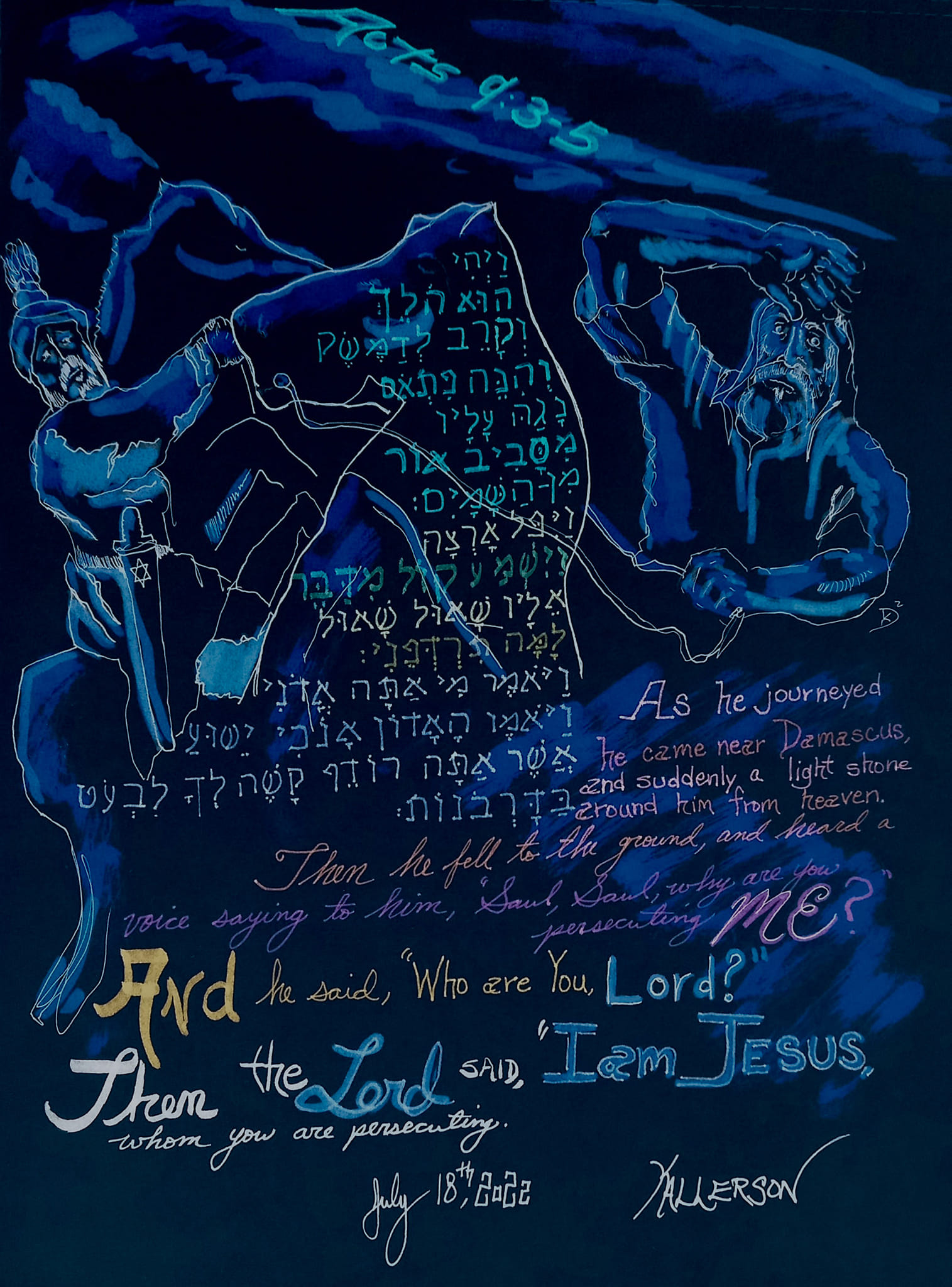
Acts 9:4

Artwork by Doug Kallerson.

Tuesday, 19 July 2022

Then he fell to the ground, and heard a voice saying to him, “Saul, Saul, why are you persecuting Me?” Acts 9:4

Note: You can listen to today’s commentary courtesy of our friends at “Bible in Ten” podcast. (Click Here to listen)

You can also read this commentary, with music, courtesy of our friends at “Discern the Bible” on YouTube. (Click Here to listen), or at Rumble (Click Here to listen).

The previous verse told of the light from heaven that shone around Paul as he was nearing Damascus. Now, a voice accompanies that brilliant light. The NKJV is not very precise in its translation. Comparing a more literal translation will show its weakness –

Then he fell to the ground, and heard a voice saying to him, “Saul, Saul, why are you persecuting Me?” (NKJV)

“And having fallen upon the ground, he heard a voice saying to him, ‘Saul, Saul, why do you persecute Me?’” (CG)

With that noted, the verse can be looked over, beginning with, “And having fallen upon the ground.”

Some suppose that this means Paul was on a horse, mule, donkey, or camel. But there is nothing to suggest this. Jesus is said to have fallen upon the ground in Mark 14:35 while in the Garden of Gethsemane. The same words are used in that account as now in Acts, and it is clear that he was walking with the disciples at the time.

And so, whether on horse or simply walking by foot, Paul was overwhelmed with the brightness of the glory that shone around him and he fell to the ground. The sentiment is not at all uncommon in either testament. In the Old Testament, for example, when Daniel was confronted with the glory of the Lord, it says –

“And I, Daniel, alone saw the vision, for the men who were with me did not see the vision; but a great terror fell upon them, so that they fled to hide themselves. Therefore I was left alone when I saw this great vision, and no strength remained in me; for my vigor was turned to frailty in me, and I retained no strength. Yet I heard the sound of his words; and while I heard the sound of his words I was in a deep sleep on my face, with my face to the ground.” Daniel 10:7-9

In the New Testament, Peter saw a miracle of the Lord and it overwhelmed him –

“But Simon answered and said to Him, ‘Master, we have toiled all night and caught nothing; nevertheless at Your word I will let down the net.’ And when they had done this, they caught a great number of fish, and their net was breaking. So they signaled to their partners in the other boat to come and help them. And they came and filled both the boats, so that they began to sink. When Simon Peter saw it, he fell down at Jesus’ knees, saying, ‘Depart from me, for I am a sinful man, O Lord!’” Luke 5:5-8

Peter’s encounter was one of seeing the effects of the Lord’s power, and yet in comprehending the scope of the miracle, he fell down before the Lord who had performed it. Other such encounters are noted in Scripture. In Paul’s case, as he lay on the ground, it says, “he heard a voice.”

In Paul’s personal recounting of the event, he says, “I heard a voice speaking to me and saying in the Hebrew language.” As a side note, the word used to describe the language can mean Hebrew or Aramaic. It would have been the common language of the land at the time which was quite different than the Hebrew found in the Old Testament. This is evident from various other passages in the gospels and elsewhere in Acts. Regardless of that, Jesus spoke to Paul in his native tongue “saying to him, ‘Saul, Saul, why do you persecute Me?’”

The repetition of the name is a way of showing emphasis and also, at times, personal affinity. Such repetitions are found throughout Scripture in both Testaments. An example from each –

“Then they came to the place of which God had told him. And Abraham built an altar there and placed the wood in order; and he bound Isaac his son and laid him on the altar, upon the wood. 10 And Abraham stretched out his hand and took the knife to slay his son.
11 But the Angel of the Lord called to him from heaven and said, ‘Abraham, Abraham!’
So he said, ‘Here I am.’” Genesis 22:9-11

“And the Lord said, ‘Simon, Simon! Indeed, Satan has asked for you, that he may sift you as wheat. 32 But I have prayed for you, that your faith should not fail; and when you have returned to Me, strengthen your brethren.’” Luke 22:31, 32

The Lord is making a personal, emphatic, and targeted call to Saul. It is personal by calling him by name. It is emphatic because he calls it twice. And it is targeted because of the accusation leveled at him, “Why do you persecute Me?”

The One, as yet unknown to Saul, directly accuses him of persecution, and He indicates that it is a persecution against His own being. He does not say, “Saul, Saul, why are you persecuting My people?” Rather, he says, “Me.” If thought through, it is another clear indication of eternal salvation. The people of the Lord are “in” the Lord. An attack against them is an attack against Him. And alignment with Him brings the believer into union with Him in a permanent covenantal relationship.

Life application: It is important to understand the relationship that existed between Saul (Paul) and Jesus until this point. He was a law-observant Pharisee. Not only that, he was one while the temple still stood, and the rites and sacrifices for purification from sin were still being practiced. And yet, Paul was an enemy of Jesus because he had not come to participate in the New Covenant established in Jesus’ blood.

Hebrews 7:18, 8:13, and 10:9 indicate that the law is set aside, obsolete, and annulled in Christ. Colossians 2:14 tells us that the law is nailed to the cross. Obviously, nobody walked up to Jesus’ cross and nailed a copy of the law to it. Rather, the words of Paul are given in metaphor. Christ is the embodiment and fulfillment of the law. Jesus was crucified on the cross. The law (Jesus’ fulfillment of it) was crucified on the cross. Jesus died on the cross. The law was made obsolete (abolished – Ephesians 2:15) in His death.

If Paul was an enemy of Jesus Christ (the only way to salvation – John 14:6), and yet he was a law-observant Jew living within the framework of the rites of the law, then it tells us – clearly and unambiguously – that no person can be saved by adherence to the law of Moses. But this is what the doctrine of dual covenantalism teaches.

It is a doctrine held by the Roman Catholic Church and various figures within Christianity today. Roman Catholicism’s statement on this says, “From the Christian confession that there can be only one path to salvation, however, it does not in any way follow that the Jews are excluded from God’s salvation because they do not believe in Jesus Christ as the Messiah of Israel and the Son of God” (Source: The Gifts and the Calling of God Are Irrevocable (Rom 11:29) by Commission for Religious Relations with the Jews).

Likewise, there are innumerable sects and cults within Christianity that espouse partial or total adherence to the Law of Moses as the means of salvation, ignoring the finished work of Jesus. Be sure to think about what is presented in the church you attend and consider the words of the pastor or leadership. This includes attending through videos or livestream. Such teachings are not a part of the gospel, and they must be identified so that they can be rejected.

Hold fast to the truth that God has sent His Son into the world, that He has established a New Covenant in His blood, and the only way to be saved is through belief in what He has done. Be ready to both teach this and defend this truth.

Lord God, it should not be surprising to us that there is only one way to be reconciled to You. It should be overwhelming to our minds that there is even one way. We are fallen, we have disobeyed, and we are the sinners. And yet, while we were enemies, You sent Christ into the world to save us. Thank You that there is a path to reconciliation with You. Thank You for Jesus Christ our Lord. Amen.
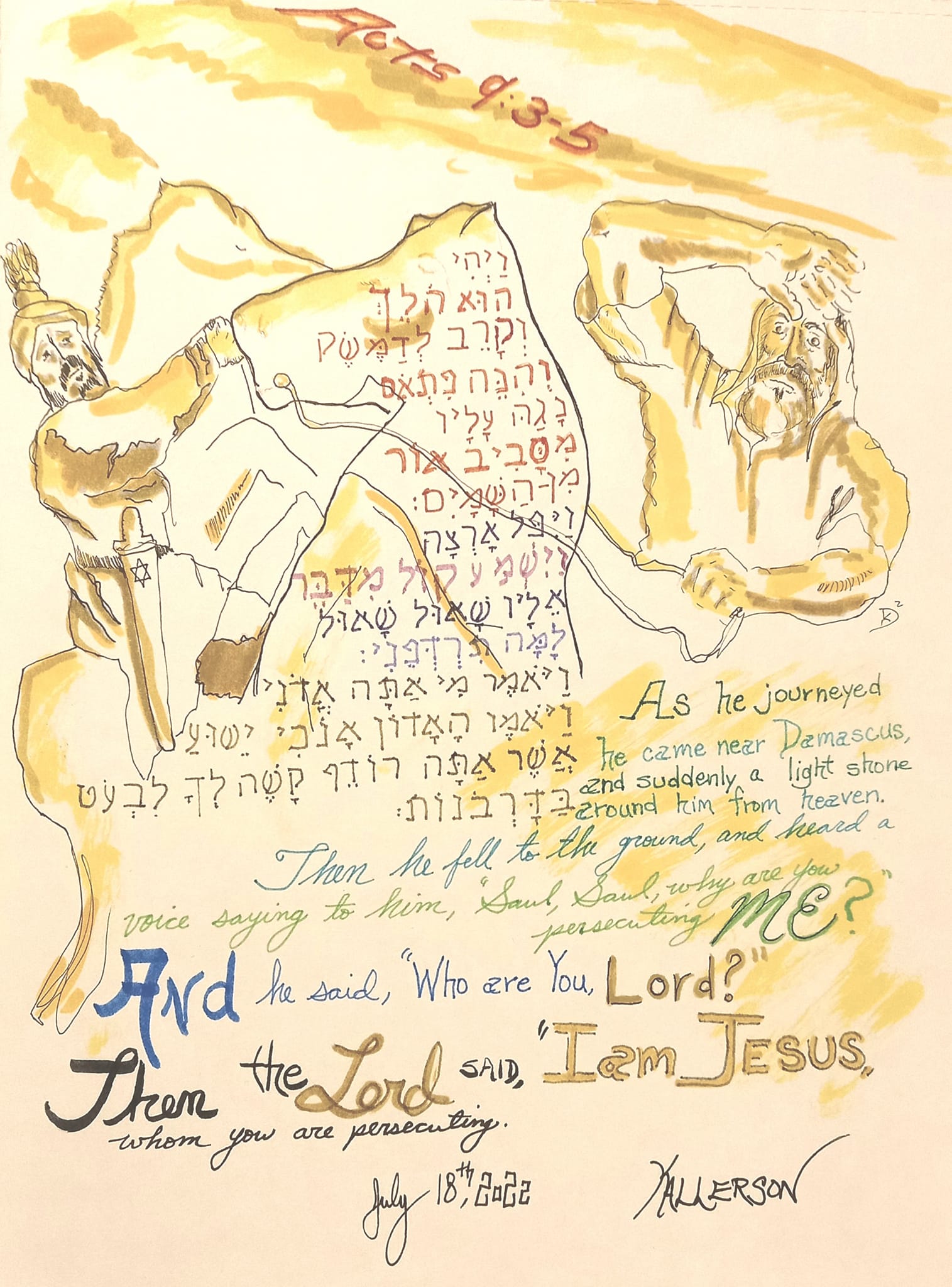



Acts 9:3

Artwork by Doug Kallerson.

Monday, 18 July 2022

As he journeyed he came near Damascus, and suddenly a light shone around him from heaven. Acts 9:3

Note: You can listen to today’s commentary courtesy of our friends at “Bible in Ten” podcast. (Click Here to listen)

You can also read this commentary, with music, courtesy of our friends at “Discern the Bible” on YouTube. (Click Here to listen), or at Rumble (Click Here to listen).

The previous verse had Paul preparing for a journey to Damascus in order to bring back believers of the Way for trial in Jerusalem. Now that thought continues, saying, “As he journeyed.”

Concerning the route he would have taken, Charles Ellicott says –

“The route by which the persecutor and his companions travelled was probably that taken by the Roman road, which extended from Jerusalem to Neapolis (Sychar, or Shechem), thence to Scythopolis, and so by the shores of the Sea of Galilee and Cæsarea Philippi, and thence under the slopes of Hermon, to Damascus. … It is, however, possible that he may have taken the road by the Jordan valley by which Galilean pilgrims sometimes travelled in order to avoid Samaria; but the former was beyond all question the most direct and best frequented road.”

With that, the Greek next says “it came to pass.” This is omitted by the translators, but it can be seen in the BLB translation –

“Now in proceeding, it came to pass as he draws near to Damascus, suddenly also a light from heaven flashed around him.”

Somewhere along the journey, it came to pass as “he came near Damascus.” The meaning of the name of the city depends on several things. Abarim defines it –

“The Hebrew term for Damascus, namely דמשק (dammasq), means something like The Beginning Of Salvation. The Chronicler’s slightly adapted term for Damascus, namely דרמשק (darammasq) means Period Of Salvation or perhaps more precise Full Turn In The Pattern Of Salvation. The Greek name Damascus means Tameness or somewhat more positive Synchronicity.”

Damascus is outside of Israel’s borders which is appropriate for the calling that will occur. The apostle to the Gentiles will receive his calling outside of the set borders of Canaan, but still within the area of land originally promised to Abraham in Genesis 15:18. That promise extends the land as far as the River Euphrates. It was there, in the Gentile land close to Damascus that Paul was traveling, “and suddenly a light shone around him from heaven.”

The word translated as “shone” is found only here and in Acts 22:6. It signifies to flash around like lightning. Acts 26 will further explain the intensity of this light –

“While thus occupied, as I journeyed to Damascus with authority and commission from the chief priests, 13 at midday, O king, along the road I saw a light from heaven, brighter than the sun, shining around me and those who journeyed with me.” Acts 26:12, 13

The magnificence of the light outshined the radiance of the sun. With this ultra-intense display of the glory of the Lord now stated, the narrative will continue in the verses ahead.

Life application: There are commentaries that will attempt to diminish the magnitude of what occurred with Saul (Paul), saying things like he was driven mad while considering his acts of persecution, and this is what produced the vision that happened in his mind. Nothing of the sort is even hinted at. And more, the effects of the light upon his eyes will demonstrate that this was not just an internalized event. Rather, it is an actual appearance of the glory of the Lord as He revealed Himself to Saul.

We need to always consider the words of Scripture in the context in which they are given. In the case of this theophany, there is no doubt about how it occurred. At the same time, we need to not be duped by people that claim they have their own visions of God. There is no need for such visions today, and it would be contrary to the word itself that they should occur.

Paul was chosen to be an apostle of Jesus, and the events that surround his conversion were necessary for the validation of his ministry, both for himself and for those who would interact with him, such as the other apostles. People’s conversions now occur in accord with what is written in Scripture, and those who are placed in the ministry have the words of Scripture to explain their requirements. There is no need for any extra validations of such things, and none should be expected.

Logically, if God is going around giving visions of Himself to people today, there is no need for the word of God in their lives. And yet, it is the word of God that reveals to us what we need to do in order to be saved, to live out our lives in accord with His will, and to appoint to the ministry those we deem to have satisfactorily met its requirements for the position.

Don’t look to the sensational when the Bible itself is sufficient for our lives, doctrine, and conduct. Let us be content with this wonderful treasure God has given us.

Yes, Lord God! What a treasure Your word is! May we hold fast to it as the rule and guide of our lives as we live them out before You. Help us to apply its precepts to our lives and to seek out the mysteries in it all our days. Amen.


Acts 9:2

Memorial Hall. Texas Capitol.

Sunday, 17 July 2022

and asked letters from him to the synagogues of Damascus, so that if he found any who were of the Way, whether men or women, he might bring them bound to Jerusalem. Acts 9:2

Note: You can listen to today’s commentary courtesy of our friends at “Bible in Ten” podcast. (Click Here to listen)

You can also read this commentary, with music, courtesy of our friends at “Discern the Bible” on YouTube. (Click Here to listen), or at Rumble (Click Here to listen).

This verse should be taken together with the previous verse. Together, they say, “Then Saul, still breathing threats and murder against the disciples of the Lord, went to the high priest and asked letters from him to the synagogues of Damascus, so that if he found any who were of the Way, whether men or women, he might bring them bound to Jerusalem.” With that noted, verse 2 now begins with, “and asked letters from him.”

It is from the high priest that the letters are being requested, demonstrating both the authority granted to Paul as well as the great zeal he had in identifying and bringing an end to any who were practicing their faith in the Lord Jesus.

As such, these letters would give him authority in any religious matters of the Jewish people. It is the religion under the Law of Moses that established them as a nation. As the worship and religious rites of Israel to serve Yehovah their God were considered religio licita (permitted religion) by the Romans, the high priest would have authority over the Jewish people in such matters as fell within his religious jurisdiction. With that understood, Luke continues noting that the letters were “to the synagogues of Damascus.”

Damascus is considered the most ancient city in the world. At the time of Paul, many Jews lived there, and Josephus notes that at the time of Emperor Nero, a full ten thousand Jews were slaughtered there, showing how great the number was.

As noted, the Jewish nation was established under the principles of the Law of Moses. As such, the people of that nation were accountable as Jews to the authority of the high priest in this regard. Therefore, letters to the synagogues would bear the high priest’s authority over any who attended those synagogues, or who were simply affiliated with them. Paul notes in 2 Corinthians 11:32 that Aretas was the king at the time. As for the letters, they were to give Paul authority, “so that if he found any who were of the Way.”

The Greek reads tēs Hodou – “the Way.” Some translations incorrectly say, “this way,” as if it is referring to one of many ways, but this is not correct. It is a designation concerning the early faith, prior to the introduction of the now more commonly used term “Christian.” It is the same word, hodos, or way, that is found in John 14:4-6 –

“’And if I go and prepare a place for you, I will come again and receive you to Myself; that where I am, there you may be also. And where I go you know, and the way you know.’
Thomas said to Him, ‘Lord, we do not know where You are going, and how can we know the way?’
Jesus said to him, ‘I am the way, the truth, and the life. No one comes to the Father except through Me.’”

Thus, “the Way” is an expression of faith that Jesus is the One way to be reconciled to God the Father. It is applicable to all people, Jews and Gentiles (see Acts 19, e.g.). As for Paul’s plans for those in Damascus, it was all-inclusive, “whether men or women.”

Paul was uninterested in what reason a person followed the Lord. He was also uninterested in their gender, as if a woman’s faith was less important than a man’s. His attitude was set on eradication of the faith without regard to any lesser divisions that may have been seen among believers. As such, it was his set determination to find them and arrest them so that “he might bring them bound to Jerusalem.

Once in Jerusalem, there would be a trial to determine guilt and punishment. This is seen in Paul’s words of Acts 26 –

“This I also did in Jerusalem, and many of the saints I shut up in prison, having received authority from the chief priests; and when they were put to death, I cast my vote against them. 11 And I punished them often in every synagogue and compelled them to blaspheme; and being exceedingly enraged against them, I persecuted them even to foreign cities.” Acts 26:10, 11

Life application: How do you personally feel about faith in Jesus Christ? Do you believe that He is one of many ways to approach God? Are there people in your circle of life that believe this? If so, when you talk to them, do you let them know that the Bible says otherwise? Are you willing to stand on Jesus’ words that He is the only way to restoration with God and that none can be restored apart from Him?

If you are willing to equivocate on this fundamental truth, what else will you waffle on? If you say you are a follower of Jesus (a Christian, a born-again Christian, a follower of the Way, or whatever) and yet you will not defend the most basic premise of the faith, then what Jesus are you following? His words cannot be picked at random. The Bible is the only source for our faith in Him. As such, we must either accept it (in the proper context) or we have rejected it. If we reject the Bible, then we have no basis for our faith at all.

Think reasonably about your faith, and then determine that if you truly believe the message of Jesus, you will put every effort into coming to know Him from His word. It will be well worth it when you stand before the Lord on the day when you are called before Him to give an account of your life.

Lord God, help us to think clearly about who You are, about what You have done, and how Jesus is the way in which You have done so. And more, help us to consider that it is the Bible that tells us about Jesus. And so, Lord, help us to take the time each day to study this precious word, and then to also apply it to our walk before You. Amen.


Act 9:1

Memorial Hall. State Capital, Texas.

Saturday, 16 July 2022

Then Saul, still breathing threats and murder against the disciples of the Lord, went to the high priest Acts 9:1

Note: You can listen to today’s commentary courtesy of our friends at “Bible in Ten” podcast. (Click Here to listen).

You can also read this commentary, with music, courtesy of our friends at “Discern the Bible” on YouTube. (Click Here to listen), or at Rumble (Click Here to listen).

The previous verse closed out Chapter 8, explaining how Philip was found at Azotus, and how he preached in all the cities until he came to Caesarea. With that noted, the narrative now returns to its focus that also began in Chapter 8. And so, with the intervening verses about the work of the apostles complete, Luke begins Chapter 9 with, “Then Saul.” He was last mentioned at the beginning of Chapter 8, saying –

“Now Saul was consenting to his death.
At that time a great persecution arose against the church which was at Jerusalem; and they were all scattered throughout the regions of Judea and Samaria, except the apostles. And devout men carried Stephen to his burial, and made great lamentation over him.
As for Saul, he made havoc of the church, entering every house, and dragging off men and women, committing them to prison.” Acts 8:1-3

Saul was bloodthirsty as Chapter 8 began, and nothing has changed in his demeanor with this new chapter, as Luke notes that he was “still breathing threats and murder.”

The Greek word translated as “breathing” is found only here, empneó. It signifies “to inhale.” Ironically, the KJV translated it just the opposite and incorrectly says, “breathing out.” It is the “element from which he drew his breath” (Thayer’s). Also, the Greek word translated as “threats” is singular, not plural. As such, the words should read that he was “still breathing in threat and murder.” The very breath that he inhaled animated him into a ravaging animal “against the disciples of the Lord.”

Paul later acknowledges this conduct during his trial before King Agrippa in Acts 26 –

“Indeed, I myself thought I must do many things contrary to the name of Jesus of Nazareth. 10 This I also did in Jerusalem, and many of the saints I shut up in prison, having received authority from the chief priests; and when they were put to death, I cast my vote against them. 11 And I punished them often in every synagogue and compelled them to blaspheme; and being exceedingly enraged against them, I persecuted them even to foreign cities.” Acts 26:9-11

As for his statement that he “received authority from the chief priests,” that is next recorded by Luke, saying he “went to the high priest.” The verb is an aorist participle and should read, “having gone to the high priest.” That sets up the continued words of the coming verse. For now, Paul has gone to the high priest with a purpose and intent. All of this is leading to the greatest moment of his life, and one that will affect the lives of billions of people in the millennia to come.

Life application: Understanding the meaning behind the words used in the biblical narrative can really give you a sense of what is actually going on in the mind of the person being described. For example, the word above, empneó, is from en (in) and pneó (to breathe). Think about how different translations change your mind about what is being said –

Breathing out murderous threats (NIV).
Breathing out threats and murder (BLB).
Uttering threats with every breath (NLT).
Breathing threats and murder (BSB).
Breathing threatening and slaughter (ASV).
Full of menace and the fury of murder (Aramaic).
Spewing death threats (ISV).
Whose every breath was a threat of destruction (Weymouth).
Breathing in threat and murder (CG).

Most of these are outwardly directed. You would think that Paul is coming against the people and yelling out to them how he was going to destroy them. Many of them have “threats” in the plural. That gives the sense of repeated threats as if it is going on and on. The NIV (and others) combine the two separate words (threat and murder) into one that describes the other. Each of these will change your perception of what is going on.

However, in understanding the meaning of the base words that form the new word, it being from en (in) and pneó (to breathe), you can then see that even if Paul’s actions are directed toward others, the impulse behind them is something that is first animating him to be that way. This is the root of Paul’s problem. Until that is cured, there can be no change in him. The very breath that animates him is angry and hostile. As this is so, it will then be that way when he breathes out as well.

Don’t be afraid to do word studies. In fact, take time to do so. The richness of the source of words can completely change your perception of what is actually being conveyed. Translators do their best to convey intent, but unless they are willing to do such word studies (a somewhat time-consuming and laborious task), they may not convey to you what is actually going on. And so, take time to do your own studies if a particular passage especially appeals to you. It is well worth the time you put into it.

Lord God, what a wonderful treasure Your word is. It is rich and alive and filled with magnificent insights about the nature of man, the corrective measures for his defects, and how You apply those measures to mold us into Your image. Help us to seek out the riches of Your word all the days of our lives. Amen.


Acts 8:40

More WWII war heroes. Texas sure had a lot of brave men.

Friday, 15 July 2022

But Philip was found at Azotus. And passing through, he preached in all the cities till he came to Caesarea. Acts 8:40

Note: You can listen to today’s commentary courtesy of our friends at “Bible in Ten” podcast. (Click Here to listen).

You can also read this commentary, with music, courtesy of our friends at “Discern the Bible” on YouTube. (Click Here to listen), or at Rumble (Click Here to listen).

In the previous verse, Philip was caught away from the eunuch and the eunuch went on his way rejoicing. With that noted, Luke continues with, “But Philip was found at Azotus.” This was a distance of about thirty miles, and nothing is said of him anywhere else. He was on the desert road to Gaza, and then he was found at Azotus.

Without any doubt, Luke is trying to convey a sequence of events in a manner that demonstrates something out of the ordinary. If he meant that Philip traveled to Azotus, he would have plainly said that, just as he did four times in this chapter alone while –

———————————

Then Philip went down to the city of Samaria and preached Christ to them. (8:5)

Now when the apostles who were at Jerusalem heard that Samaria had received the word of God, they sent Peter and John to them, 15 who, when they had come down, prayed for them that they might receive the Holy Spirit. (8:14, 15)

So when they had testified and preached the word of the Lord, they returned to Jerusalem, preaching the gospel in many villages of the Samaritans. (8:25)

Now an angel of the Lord spoke to Philip, saying, “Arise and go toward the south along the road which goes down from Jerusalem to Gaza.” This is desert. 27 So he arose and went. (8:26, 27)

———————————

As for Azotus, it is known in the Old Testament as Ashdod. That comes from the verb shadad which signifies dealing violently with, despoiling, devastating, and so on. As such, it means something like “Ravager.” It was a city of the Philistines in Old Testament times. It is a coastal town, and a part of modern Israel today. It is Israel’s sixth-largest city, and it is about 20 miles south of Tel Aviv.

After being found in Azotus, Luke continues the narrative, saying, “And passing through.”

Again, Luke’s narrative gives details about Philip’s travels that he did not give in the previous words. Luke has written clearly and precisely concerning the movements of Philip with the exception of the words about his miraculous transportation from Gaza to Azotus

To attempt to dismiss the miraculous intent of the account then diminishes the precision of Luke’s other words that carefully document the movement of Philip and others elsewhere. In other words, it makes Luke look like a less careful chronicler of events than he truly is. The lack of wording here is not a failing of his recording of what happened. Rather, it is a remarkable choice of wording to show exactly what did happen. With that in mind, Luke returns to the carefully worded accounting of Philip’s continued evangelization, saying, “he preached in all the cities.”

The verb here is imperfect. It reads, “he was preaching in all the cities.” Philip didn’t just pass by small cities. Nor did he withhold preaching in some. Rather, as he went, he was actively preaching. It is the same careful attention given to describe the movement of Peter and John in verse 8:25 (noted above). Also, it is the same word already used four times in Acts 8, euaggelizó. Philip, Peter, and John had all been evangelizing as they traveled from one major city to another. As for Philip, this continued “till he came to Caesarea.”

Luke’s care concerning the details is minute, and yet, they were specifically left out in Philip’s travel from the area of Gaza to Azotus. In other words, the main city of Ashkelon lies between Gaza and Azotus (Ashdod). Along that way are small, populated areas that could be described as “cities.” But Luke never mentions them. The language is purposefully blank to indicate a miraculous transport from one location to another.

Philip was taken from the area of Gaza, purposefully taken over the entire area of a major city with smaller surrounding cities, and was deposited in Azotus.

Life application: Of the movement of Philip from Gaza to Azotus, Albert Barnes says, “It does not mean here that there was any miracle in the case, but that Philip, after leaving the eunuch, came to or was in Azotus.” Charles Ellicott and others likewise try to justify Philip’s travel as having been in a state of ecstasy and not knowing what he was doing as he traveled all the way from Gaza to Azotus. Or they give some other similar explanation.

However, doesn’t that insert much more into the narrative than would have been overlooked by Luke? Stated differently, and as was noted above, it actually diminishes the careful attention that Luke always provides. If Philip was in a state of ecstasy, Luke would have said so. If he omitted that, it would then demonstrate a failing on his part to not say so.

The reason for dealing so minutely with what occurred is because if you give careful study to the doctrine of the rapture, you will eventually be told that “the church never taught the doctrine of the rapture until the 1800s.” There are several problems with this. First, it doesn’t matter when a point of biblical doctrine is introduced. If it is true, it is true.

John Calvin’s teachings, which are held to by the same people that say the rapture is a new doctrine, didn’t come about until John Calvin started teaching them, a couple hundred years before the time of Darby. And so, to claim that Calvin is right, and Darby is wrong based on the time of the introduction of the particular doctrine is a fallacy known as “Chronological Snobbery,” or simply a chronological fallacy. But more, John Calvin’s doctrine, in many ways, is entirely incorrect.

Secondly, it is not true that the rapture was first taught in the 1800s. In fact, it is explicitly taught in 1 Corinthians 15 and 1 Thessalonians 4 by the apostle Paul. It is referred to elsewhere in the New Testament, and it is typologically hinted at in the Old Testament.

Luke’s carefully detailed account of Philip’s harpazó (his being caught away) is not a blundering account of omission. Rather, it is a purposeful account of omission. It is given to show us that God can remove a person in a moment from one place to another for His own purposes. There is a time when He will do this with all of His true believers in a moment, in the twinkling of an eye.

Take time to blink your eyes as fast as you can for a second. If you just did that, you blinked three to five times in one second. The blink of an eye occurs in about 1 tenth of a second which is 100 milliseconds.

Get ready. When Jesus calls His people home, it will happen so fast that we won’t know it has happened until it is over. Jesus is coming. Be ready.

Heavenly Father, it is true that some believers deny that there will be a rapture. But Your word tells us that their denial is wrong. Won’t they be surprised on that day! And won’t we all be elated when we realize what happened! May that day be soon. Amen.