Acts 9:39

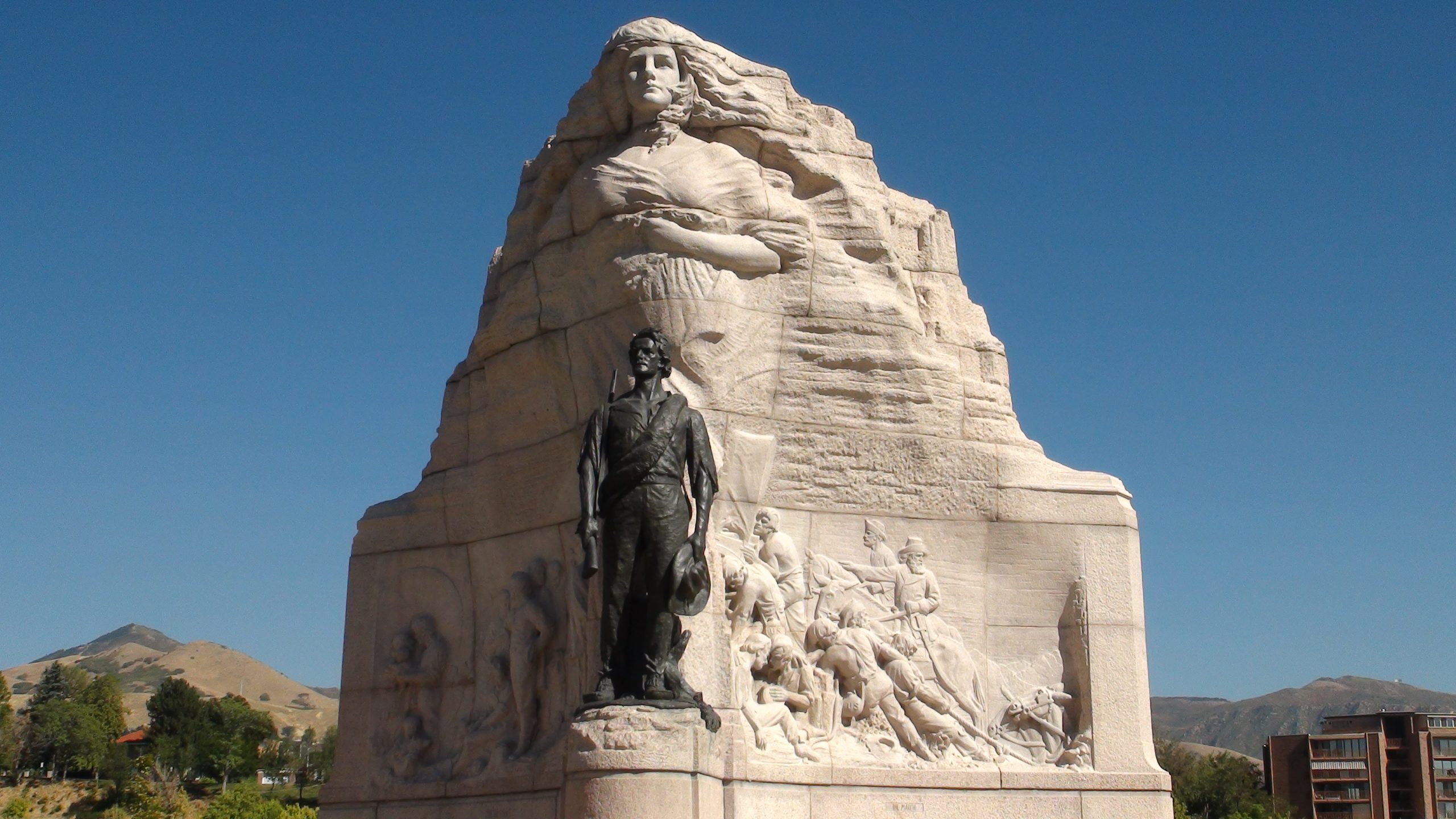
Some crazy mormon ideal set in stone at capitol building, Salt Lake City.

Tuesday, 23 August 2022

Then Peter arose and went with them. When he had come, they brought him to the upper room. And all the widows stood by him weeping, showing the tunics and garments which Dorcas had made while she was with them. Acts 9:39

Note: You can listen to today’s commentary courtesy of our friends at “Bible in Ten” podcast. (Click Here to listen).

You can also read this commentary, with music, courtesy of our friends at “Discern the Bible” on YouTube. (Click Here to listen), or at Rumble (Click Here to listen).

In the previous verse, the saints in Joppa sent two men to Peter in Lydda imploring him to come with them to Joppa. Now, that continues with, “Then Peter arose.” It is a present participle. The Greek reads, “Then Peter, having arisen.”

The narrative Luke presents brings the reader into it, carefully allowing it to unfold as it is being read. Peter was willing to go with them. Therefore, in having arisen, he “went with them.” His willingness to go with them would have alleviated any unnecessary delays as they could take him directly to the location without the possibility of him getting lost on the way or in the city.

As for the journey, it would not have been too long because the cities were near one another. The current driving distance is 16 miles. Assuming they had animals, it would be a few hours of riding at most. Even walking at a normal pace takes about 4 hours to go that distance. Luke next records, “When he had come, they brought him to the upper room.”

There is a sense of urgency here. Nothing is said about stopping to have a meal, wash their feet, or any of the other things that normally would occur after traveling 15+ miles. Instead, Luke notes that he is immediately brought to where Tabitha had been laid. Next, whether they were already in the room or whether they came up with him, it notes, “And all the widows stood by him weeping.”

Tabitha had been a faithful soul and a caring provider to many. That alone would have endeared her to others. Her death would have been a source of loss to anyone who was close and shared in her life. But these women were also the recipients of her good deeds. This is seen in the next words. They were “showing the tunics and garments.”

It is improbable that they carried up a display of the things she had made. Rather, it appears that they were showing her works as they wore them. In essence, “She made these just for me.” This is implied in the Greek which is in the middle voice. The middle voice is used to denote that the subject is both an agent of the action and somehow concerned with it. In other words, these ladies were most probably modeling the garments for Peter to understand the greatness of the efforts put forth by Tabitha.

The types of clothing noted by Luke include the chitón, which is a garment worn close to the skin. It could be an undergarment, a shirt, a coat, and so on. The second is the himation. This is a garment worn over the chitón, such as a robe. It would often be made of wool, having openings for the head and arms. It would be a more loosely fitting garment. Of these, Luke notes that they were clothes “which Dorcas had made while she was with them.”

The word translated as “which” means “as many as,” and the verb is imperfect. It gives the sense of it being a continuous habit of making. It’s not just that she made them for these ladies, but she went out of her way to make them anytime a need arose. A literal translation of this last clause would be “as many as Dorcas was making while she was with them” (YLT).

The care she had for those she tended to is evident in all that is documented about her by Luke.

Life application: Paul was torn between departing and being with the Lord and staying to minister to others –

“But if I live on in the flesh, this will mean fruit from my labor; yet what I shall choose I cannot tell. 23 For I am hard-pressed between the two, having a desire to depart and be with Christ, which is far better. 24 Nevertheless to remain in the flesh is more needful for you.”  Philippians 1:22-24

Tabitha (Dorcas) obviously was one of the saints and was therefore free from this body of death. However, those behind certainly wanted her back. Paul notes that her state with Christ would have been “far better” if she did not come back. And yet, that was the desire of those who had lost her.

Elsewhere, Paul says, “But I do not want you to be ignorant, brethren, concerning those who have fallen asleep, lest you sorrow as others who have no hope.” Death is a part of the human existence. Until the rapture people will continue to die. The mourning we experience as believers is one of personal loss, not one of permanent loss.

If we can remember this, our times of loss should at the same time include a sense of joy for the one who has departed. Jesus Christ came to provide us with hope. To understand this more fully, take time today to read the account of the death of Lazarus in John 11. There, we see the surety of our hope because of who Jesus is.

In Christ is victory over death. If we can remember this and keep it with us at all times, it should help us in two major ways. The first is to spur us on to a more perfect desire to tell the unsaved about Jesus and to keep them in prayer for their hearts and eyes to be opened. The second is that when death enters into our sphere of life, if it is a believer who has died, we can have confidence that they are now in a “far better” state than remaining with us.

Heavenly Father, help us to be attentive to the terminal state of existence that we as humans live in. May we carefully remember that our days are short and that without Jesus, there is no hope for those who depart this life. Give us hearts that are caring about this so that we will not be negligent in our responsibilities concerning proclaiming the good news of Jesus. Amen.


Acts 9:38

Some mormon statue at the state Capitol, Utah.

Monday, 22 August 2022

And since Lydda was near Joppa, and the disciples had heard that Peter was there, they sent two men to him, imploring him not to delay in coming to them. Acts 9:38

Note: You can listen to today’s commentary courtesy of our friends at “Bible in Ten” podcast. (Click Here to listen).

You can also read this commentary, with music, courtesy of our friends at “Discern the Bible” on YouTube. (Click Here to listen), or at Rumble (Click Here to listen).

In the previous verse, Tabitha is said to have died. With that remembered, Luke next records, “And since Lydda was near Joppa.” The verb is a present participle, “And Lydda being near Joppa.” Luke is describing the narrative as if it is ongoing. Understanding that, he continues with, “and the disciples had heard that Peter was there.” Again, the verbs are present tense, “and the disciples having heard that Peter is there.”

Tabitha has died, it is understood that Peter is in Lydda and Lydda is not that far away. Luke is weaving his words together to join his reader in the narrative as it continues. The sadness of the situation, the loss that has been experienced, and the immediate pressing nature of the situation is highlighted by the use of his words.

Because of this state, Luke next records, “they sent two men to him.” Many scholars tie in the coming internment with the urgency of the request while, at the same time, denying that Peter was being called for the purpose of a hoped-for miracle. In other words, an example of the reasoning is that Peter’s presence was needed “to comfort those that were concerned in the great loss of so good a woman” (Matthew Poole).

If this was the case, it would hardly matter if Tabitha was buried or not. Comfort can be provided if a body is above ground or in the grave. It is obvious that they have hope that Peter can, in fact, appeal to the Lord for a miracle. It would make no sense to rush Peter to Joppa unless this was the possible outcome. But the next words give just that sense of urgency, saying they were “imploring him not to delay in coming to them.”

The verse ahead will clearly show that Tabitha was not someone Peter knew well, if at all. And yet, he is being summoned to come quickly. However, just a few verses ago, it said –

“And Peter said to him, ‘Aeneas, Jesus the Christ heals you. Arise and make your bed.’ Then he arose immediately. 35 So all who dwelt at Lydda and Sharon saw him and turned to the Lord.” Acts 9:34, 35

The word had gone out all around the surrounding area that Peter had accomplished this miracle. It was understood from Jesus’ ministry that He had not only healed but that He had also raised the dead. The anticipation is that Jesus, through the apostleship of Peter, might again perform such a miracle.

Life application: Luke’s words are meticulously recorded to show an ongoing narrative, one thing often leading to the next. This is certainly the case here. The final note concerning the healing of Aeneas going out in a great manner was provided for just this reason, meaning it was intended to lead into the next section of the narrative.

Likewise, if you come to the end of this passage about Tabitha and look it over, you will see a connection to the next section. This is not uncommon in Scripture and such clues show that what is being detailed is not a haphazardly recorded account, but a purposeful compilation intended to lead us through the narrative to a more perfect understanding of what God has done in order to establish His church.

Pay attention to such cues because they will help provide a clearer sense of why things are occurring at the times they occur. Acts is a vital part of God’s word, even if it is not prescribing things for us to do. It is showing us that God’s hand was with His church as it began, and thus we can know that His hand continues with His church today.

The miracles, for example, helped establish a sense of surety within the church until the word was written. Those same miracles can provide us with the exact same sense of surety now that the word has been received.

Lord God, we can look to the wonderful things You have done for Your people in the past as are recorded in Your word. Now, we can have faith that what is provided there is true and reliable, and we can have confidence in the future concerning Your guiding hand being with us. Thank You for the surety Your word provides us as we continue forward in time, awaiting the fulfillment of all the things it promises are yet ahead. Amen.


Acts 9:37

Buffalo thingy. Utah Capitol.

Sunday, 21 August 2022

But it happened in those days that she became sick and died. When they had washed her, they laid her in an upper room. Acts 9:37

Note: You can listen to today’s commentary courtesy of our friends at “Bible in Ten” podcast. (Click Here to listen).

You can also read this commentary, with music, courtesy of our friends at “Discern the Bible” on YouTube. (Click Here to listen), or at Rumble (Click Here to listen).

The verse now is speaking of Tabitha (Dorcas) of the previous verse. It noted that she was full of good works and charitable deeds. Luke now continues with, “But it happened in those days.”

Without going ahead, “those days” means that it was during the time that Peter was in the vicinity. The narrative was focused on him and Aeneas. What is happening now is to be assumed (and later made explicit) that this is during that time period “that she became sick.”

Luke, a physician, doesn’t give any specifics. This shows that no determination was made how this happened. Otherwise, he would have given his usual careful observations. Rather, he gives the main point that some malady had overtaken her. She was “sick and died.”

Her death is given as a recorded fact. There is no reason to assume anything other than this occurred. Those who argue that this was a swoon or the like do so against the plainly stated facts. Further, to argue for this when they were not present is to argue that the account is factual and simply needs to be tweaked to allow for their own presuppositions and biases concerning the matter.

Further, it is the height of arrogance to make a claim about the narrative that is contrary to what is plainly stated when they were not there. Being dead is a state that is not hard to determine, and people have identified it for all of human history. If there are exceptions where a misdiagnosis was made, the burden of proof is on the one making the claim to prove it. As this cannot be done, the record of her death must stand as it is written. With that in mind, it next says, “When they had washed her.”

This was a traditional part of the burial process. It is a demonstration of care and respect for the person’s memory as she is prepared for her final internment. Matthew Poole says, “They washed the dead, and anointed them, to fit them for their burying, and especially to show their hope of the resurrection; which some think St. Paul alludes unto, 1 Corinthians 15:29.”

This is actually an important point. Matthew Poole’s note about anointing the dead is correct, but nothing is said of that here. It is actually a clue that they have a hope that has not yet been expressed in the account. That will be seen in the coming verses.

People tend to the corpses of their dead all over the world. It may be there is a sense of hope in an afterlife (such as the Egyptians) or for some other reason but including 1 Corinthians 15:29 is not correct. That is not at all the intent of Paul’s words. He clearly says in the same passage “that flesh and blood cannot inherit the kingdom of God; nor does corruption inherit incorruption” (1 Corinthians 15:50).

The bodies that believers now possess are destined to return to the dust of the earth, just as the early Genesis account tells us. When Daniel was told that many of those who sleep in the dust will be raised, it confirms this. The bodies that we now possess will not be the bodies we will possess at the resurrection. The washing of Tabitha was a note of respect and a point of closure for those left behind. With that noted, the verse ends with “they laid her in an upper room.”

This would be out of sight of any who came by the house except for those who would purposefully go up to view her one last time. The custom in the Middle East was to always bury a person as quickly as possible, usually within the same day. Any chance to pay one’s last respects would have to come within that short timeframe.

Life application: Unless the rapture happens, we are all going to die physically. This is a part of the way things are at this time. There is not a moment of guarantee that when we wake up in the morning, we will be alive by evening. And there is no guarantee that going to bed will be followed by getting up the next morning.

We must be prepared, right now, to meet our Maker. As Jesus is the One who makes reconciliation with Him possible, it is our responsibility to receive His offer of peace and reconciliation now. And more, it is our responsibility to tell others about what God has offered. Our date with death’s destiny is assured. When it will come is known to God alone. Let us be wise and be prepared for that day and let us prepare others – as best as we can – for that day as well.

Lord God, thank You that because of Jesus Christ, we have the sure, certain, and blessed promise of the resurrection to eternal life that You have promised to all those who believe. May we be responsible to tell others about this joy that we possess while we have the time. Prompt us in this, O God. Amen.


Acts 9:36

Utah Capitol.

Saturday, 20 August 2022

At Joppa there was a certain disciple named Tabitha, which is translated Dorcas. This woman was full of good works and charitable deeds which she did. Acts 9:36

Note: You can listen to today’s commentary courtesy of our friends at “Bible in Ten” podcast. (Click Here to listen)

You can also read this commentary, with music, courtesy of our friends at “Discern the Bible” on YouTube. (Click Here to listen), or at Rumble (Click Here to listen).

While Peter was still in Lydda, Luke now brings a new development into the narrative at a new location, beginning with, “At Joppa.”

Joppa (Hebrew: Yafo) is a port city found four times in the Old Testament and ten in the new. The name comes from yaphah, to be fair or beautiful, and so it means Beautiful. It is the city from which Jonah went in order to obtain a ship going to Tarshish. For the city today, Wikipedia says of this location –

“Jaffa, in Hebrew Yafo (Hebrew: יָפוֹ, Yāfō (help·info)) and in Arabic Yafa (Arabic: يَافَا) and also called Japho or Joppa, the southern and oldest part of Tel Aviv-Yafo, is an ancient port city in Israel. Jaffa is known for its association with the biblical stories of Jonah, Solomon and Saint Peter as well as the mythological story of Andromeda and Perseus, and later for its oranges. Today, Jaffa is one of Israel’s mixed cities, with approximately 37% of the city being Arab.”

Today, the population of Joppa is about 46,000. It is in this location that Luke continues, saying, “there was a certain disciple named Tabitha.” This is an Aramaic name coming from a word meaning “gazelle.” Hence, her name means “Gazelle.” Of her, Luke next says, “which is translated Dorcas.”

Dorcas (Greek Dorkas) means the same thing, Gazelle. That comes from a Greek word meaning “to see clearly,” because the gazelle is an animal with bright, large eyes. Having two names is not uncommon in the Bible. In her case, being in Joppa which was a port town, there would be many Greek-speaking people. Therefore, to accommodate both, she was probably known by either her Aramaic name (the language of Israel at the time) or by her Greek name (the standard language of trade and commerce in the Roman Empire at the time). Of her, Luke next says, “This woman was full of good works.”

The meaning is obvious, but Charles Ellicott gives insight into Luke’s writing style by saying this of her –

“The form of the expression may be noticed as characteristic of St. Luke, and his favourite formula for conveying the thought of a quality being possessed in the highest degree possible. So we have ‘full of leprosy’ in Luke 5:12, ‘full of grace’ and ‘full of faith’ in Acts 6:5; Acts 6:8. (Comp. also Acts 13:10; Acts 19:28.)”

In the case of Tabitha, Luke uses the word agathos to describe her works. It is a common word signifying that which is intrinsically good. It is what finds its origin in what is provided by God, and it finds its empowerment from Him. For example, Jesus speaks of a tree that bears “good fruit.” One can see the root of the modern name Agatha in it.

Along with this, Luke continues, saying of her, “and charitable deeds which she did.” The verb is imperfect showing that her good deeds were ongoing – “which she was doing.” It wasn’t that she was known for something good that she had done, but she was known for her constant doing of good things. The Greek word used to describe these good deeds signifies beneficence or alms. They were deeds of charity that defined her as a person who was doing what she did without any strings attached.

Life application: Luke is careful to refer to Tabitha in two ways: full of good works and charitable deeds. One can be full of good works that are self-serving, and one can be full of charitable deeds that are sloppy or not well thought out. However, when one does good things and is charitable as well, it shows a person who is careful, methodical, and who is generous simply because it is his or her nature.

The Bible’s inclusion of this description of Tabitha tells us that her conduct was right in the eyes of Luke, but it also tells us that it is right in the eyes of God who inspired Luke to write these things. She was being evaluated and the record of her life has been documented.

Likewise, we are also being evaluated, and the attitude and conduct we put forth are being remembered. Someday, we will have our life and actions judged –

“Now if anyone builds on this foundation with gold, silver, precious stones, wood, hay, straw, 13 each one’s work will become clear; for the Day will declare it, because it will be revealed by fire; and the fire will test each one’s work, of what sort it is. 14 If anyone’s work which he has built on it endures, he will receive a reward. 15 If anyone’s work is burned, he will suffer loss; but he himself will be saved, yet so as through fire.” 1 Corinthians 3:12-15

“Therefore we make it our aim, whether present or absent, to be well pleasing to Him. 10 For we must all appear before the judgment seat of Christ, that each one may receive the things done in the body, according to what he has done, whether good or bad.” 2 Corinthians 5:9, 10

If our purpose for doing things is amiss, our rewards will be diminished. And if the quality of our works is shoddy, the same will be true. Let us strive with our hearts set on the Lord in order to perform well and to produce that which is exemplary. In this, the Lord will be pleased and will return to each of us a full reward.

Heavenly Father, help us to be faithful and careful stewards of the time and talents You have given to us. And Lord, we are flesh and bone. Give us strength to meet our desire to perform and give us the inner drive to meet the strength You have provided. May there be a full display of careful attention to our deeds and actions before You. Amen.


Acts 9:35

State Capitol, Salt Lake City, Utah.

Friday, 19 August 2022

So all who dwelt at Lydda and Sharon saw him and turned to the Lord. Acts 9:35

Note: You can listen to today’s commentary courtesy of our friends at “Bible in Ten” podcast. (Click Here to listen)

You can also read this commentary, with music, courtesy of our friends at “Discern the Bible” on YouTube. (Click Here to listen), or at Rumble (Click Here to listen).

The previous verse told of the healing of Aeneas by Peter. Because of that, Luke now records, “So all who dwelt at Lydda and Sharon.”

The Greek has an article before “Sharon.” It is “the Sharon.” It refers to a larger district. The name Lydda has already been explained. Sharon (Greek: Sarón) is found only here in the New Testament, but it comes from Sharon, a location named seven times in the Old Testament. It comes from yashar – to be straight, level, or right. Hence, Sharon means “Plain.” Even in the Old Testament, the name is often prefixed by an article, “the Sharon.” Therefore, it refers to “the Plain.” Wikipedia says of the location today –

“The Sharon plain (Hebrew: השרון HaSharon Arabic: سهل شارون Sahel Sharon) is the central section of the Israeli coastal plain. The plain lies between the Mediterranean Sea to the west and the Samarian Hills, 15 km (9.3 mi) to the east. It stretches from Nahal Taninim, a stream marking the southern end of Mount Carmel in the north, to the Yarkon River in the south, at the northern limit of Tel Aviv, over a total of about 90 km (56 mi). The level of the Sharon plain is connected to the level of the Mediterranean Sea by the Sharon Escarpment.”

It is good to know this because it means that what had happened to Aeneas has impacted not just people in a couple small towns, but in a vast area. It is those dwelling in Lydda and the Sharon who “saw him and turned to the Lord.”

The meaning is obvious. The people saw the man, they understood the miracle, and they became believers in Jesus as the Messiah. What may be the case for such a large area to be impacted in this way is that the people of the plain traveled through Lydda for selling goods and shopping on the coast or for some other reason. As they did, they would see the man who had previously been paralyzed and would want to know what happened.

With that, the explanation of his healing would be carried back to those living in the plain area, describing the miracle and telling others that it was Jesus who had accomplished it. Despite the large area, this is not unlikely. The people of the plain would have things they grew and needed to sell and so traveling through various towns with their agricultural products would be the obvious thing to do.

Life application: From small to great things. The Lord accomplished a miracle through Peter in healing a bedridden man. This was in a town that is hardly mentioned in the Old Testament except in a minimal way. In the New Testament, it is simply a village that Peter is passing through where some believers obviously lived.

Those believers would probably have told others about Jesus after their conversion, maybe at the time of the coming of the Holy Spirit in Acts 2, or at some other annual feast in Jerusalem. But with Peter’s arrival and the healing of Aeneas, there would now be something to back up what these people had been saying all along. The miracle provided proof of what these believers already knew to be true.

And so with a single healing in a small town, an entire district hears and believes. Aeneas didn’t need to do anything but be healed. The others simply needed to tell what they believed. With the change in Aeneas, the gospel message has been confirmed.

Today, if there has been a change in your life, or someone else’s life that you know of, that single conversion can be used to confirm the power of the gospel to many. “He was a drug addict and now he is the finest employee I have ever had!” “She was a real run around, but then she met Jesus. What a change in her!”

And even if your conversion wasn’t as noticeable as this, it is still a change that can be told to others. God can take your witness and grow it into a great harvest. But people need to hear about it in order for that to happen. Let the world know that the gospel has power and that this power is proven in your own life.

Lord God, how marvelous was the day when we realized what Christ had done for us. Thank You for the wonderful change that has taken place. We were on the way to condemnation, and then came Jesus! Now, we have a hope of eternal joy in Your presence. Thank You, O God, for Jesus Christ our Lord. Amen.