Acts 14:6

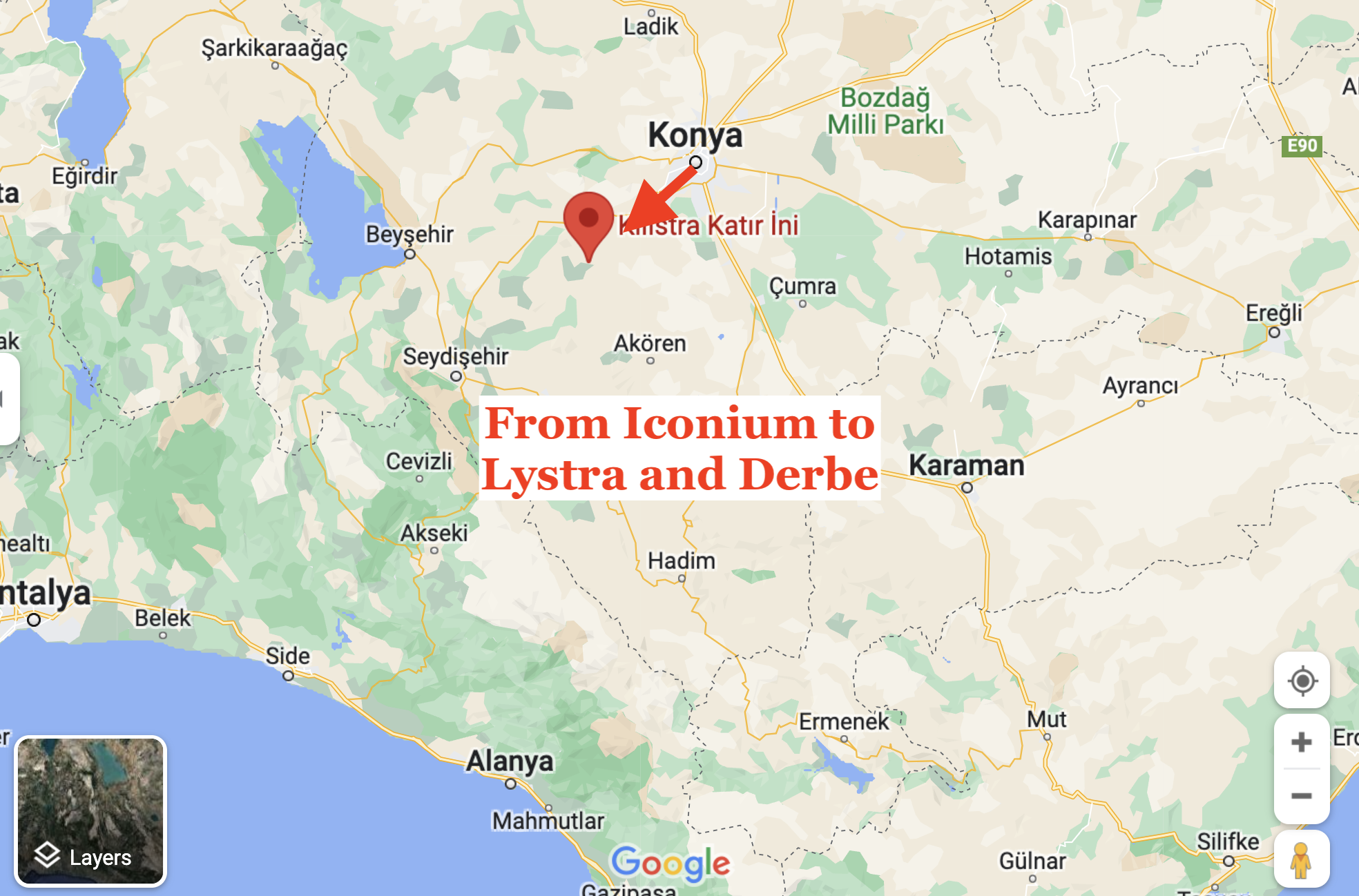
Directions according to Wikipedia. Which could mean anything…

Tuesday, 7 February 2023

they became aware of it and fled to Lystra and Derbe, cities of Lycaonia, and to the surrounding region. Acts 14:6

Note: You can listen to today’s commentary courtesy of our friends at “Bible in Ten” podcast. (Click Here to listen)

You can also read this commentary, with music, courtesy of our friends at “Discern the Bible” on YouTube. (Click Here to listen), or at Rumble (Click Here to listen).

Note: the NKJV doesn’t do a great job of translating this verse. Instead, it should read, “having become aware, they fled to the cities of Lycaonia, Lystra and Derbe, and the surrounding region” (CG). This will be used for the commentary.

With trouble brewing in Iconium and a violent attempt made by both the Gentiles and the Jews to stone Paul and Barnabas, the verse begins with, “having become aware.”

Without telling the details, we see that Paul and Barnabas somehow were apprised of the plotting of those opposed to their message. Because of this, “they fled to the cities of Lycaonia.”

Of this area, Charles Ellicott provides a remarkable description –

“The very name Lycaonia, interpreted traditionally as Wolf-land (the local legend derived it from Lycaon, who had been transformed into a wolf), represented but too faithfully the character of the inhabitants. The travellers were also losing the protection which a Roman citizen might claim in a Roman province, Lycaonia, which had been annexed in A.D. 17 to the Roman province of Galatia, having been assigned by Caligula to Antiochus, King of Commagene. So wild a country was hardly likely to attract Jewish settlers; and there is no trace in St. Luke’s narrative of the existence of a synagogue in either of the two cities. For the first time, so far as we know, St. Paul had to begin his work by preaching to the heathen. Even the child of a devout Jewish mother had grown up to manhood uncircumcised (see Note on Acts 16:3).”

This is the only time that the area of Lycaonia is mentioned in Scripture. As stated by Ellicott, the name comes from lukos, a wolf. Even to this day, the name inspires movies about people that have transformed into wolves. Of this area, two main cities are named, “Lystra and Derbe.”

Both names are introduced here. The meaning of the names isn’t certain. Along with visiting these cities, the apostles also evangelized “the surrounding region.” Charles Ellicott continues his narrative of the area, saying –

“Of the two towns named, Lystra was about forty miles to the south-east of Iconium, Derbe about twenty miles further to the east. The former, which lies to the north of a lofty conical mountain, the Kara-dagh (=Black Mountain) is now known as Bin-bir-Kilisseh, i.e., ‘the thousand and one churches,’ from the ruins that abound there. The addition of ‘the region that lieth round about’ suggests the thought that the cities were not large enough to supply a sufficient field of action. The work in the country villages must obviously—even more than in the cities—have been entirely among the Gentiles. Among the converts of this region, and probably of this time, we may note the names of Timotheus of Lystra (see Note on Acts 16:1), and Gaius, or Caius, of Derbe (Acts 20:4).”

Of the actions of these apostles, it is common to read commentaries that say their travels are in accord with Matthew 10:23 –

“When they persecute you in this city, flee to another.”

This sounds appealing. The apostles were persecuted in Iconium and so they took the words of the Lord to heart and went to evangelize another city. Unfortunately, this fails to consider the continued words of the same verse from Matthew –

“For assuredly, I say to you, you will not have gone through the cities of Israel before the Son of Man comes.”

The entire context of the passage from Matthew refers to Israel. The continued words of Matthew 10:23 clearly indicate that Israel was the subject of the command. Therefore, it is wholly inappropriate to use this verse in Acts as a fulfillment of the apostles’ obedience to the command of Matthew 10:23. Rather, they are doing what the Lord instructed as is recorded in Acts 1:8 –

“But you shall receive power when the Holy Spirit has come upon you; and you shall be witnesses to Me in Jerusalem, and in all Judea and Samaria, and to the end of the earth.”

These men had been sent out as missionaries and they are doing what missionaries are to do in the context of the church age. As apostles, they bore an additional set of gifts and abilities as the word was being established. Now that it has been compiled, the word is the tool to be used for the evangelization of the nations.

Life application: On the morning of preparing this commentary, a video was received entitled “Iranians Meeting Jesus in Dreams, Experiencing Radical Transformation.” If this were true, there would be no need to evangelize. But the Bible says otherwise.

How convenient it is to say that Jesus is popping into people’s heads at night and converting them. It sure takes the pressure off those who are too timid (or too lazy) to do what the Bible instructs.

God has given us the tools we need to evangelize the world, He has empowered us to do so, and yet we sit and watch videos that are contrary to the very message that we are supposed to be proclaiming. Someday, all will have to stand before the Lord and give an account of what they did with their time.

Those who make up false stories of visions, dreams, and conversations with Jesus will have to face Him someday. Be wise and discerning. Get out and tell others about the good news of Jesus Christ. This is how people are evangelized. It will not come about any other way.

Heavenly Father, help us to be reasonable in our approach to Your word. May we not take liberties with it that are contrary to its message. Rather, help us to accept it as written, follow through with what is instructed, and be willing to share the good news with those we encounter. It is what You have instructed. May we be obedient to Your word. Amen.




Acts 14:5

Another interesting shell pattern in the marble floor of the Vermont State Capitol.

Monday, 6 February 2023

And when a violent attempt was made by both the Gentiles and Jews, with their rulers, to abuse and stone them, Acts 14:5

Note: You can listen to today’s commentary courtesy of our friends at “Bible in Ten” podcast. (Click Here to listen).

You can also read this commentary, with music, courtesy of our friends at “Discern the Bible” on YouTube. (Click Here to listen), or at Rumble (Click Here to listen).

The previous verse revealed a division within the city where a part sided with the disbelieving Jews and a part sided with the apostles. That now comes to a head, saying, “And when a violent attempt was made.” Here, a new and rare word comes into Scripture, hormé. It will only be seen again in James 3:4 where the pilot of a ship desires to turn it by use of a rudder. It signifies a violent impulse.

One can see the heated anger of those opposed to the message of the apostles. They were certainly yelling out just as people yell out today, “How dare you say there is only one way to God!” The inability of man to yield himself to another in order to be saved is almost ubiquitous. These people could not accept what Paul and Barnabas had been teaching because they could not accept that they were so fallen that they needed God Himself to intervene in their salvation. And this sudden, violent impulse was “by both the Gentiles and Jews.”

This is how it has continued since the time of the apostles. All around the world, the masses have rejected the simplicity of the gospel and the doctrine that says, “Jesus is sufficient to save. Come to Jesus and you will be saved.” It is fought against by Jews, and it is fought against by Gentiles. If one stood in the halls of the US government today and proclaimed, “There is one and only one way to be saved,” the chambers would fill with angry cries of scorn and derision. This is the case now, and it was the case in Iconium. As it says, “with their rulers.”

The rulers could just see their supposed power fleeing away as a portion of their city bowed the knee to Jesus and not to them. Those who had accepted the gospel had been freed from the bondage and oppression they faced. There was a complete change in them that told these rulers they had lost their supreme authority to direct the minds and affairs of the Christians. And so, this angry multitude gathered together and with a sudden impulse came “to abuse and stone them.”

The sense is, “You are condemning us with your words of exclusivity. You are taking away our positions of power and authority. You are proclaiming a complete break from the way things have been. And we don’t like it.” They had rejected the grace of Christ and they were set to remove those who had proclaimed it. This is how it was for Paul and Barnabas. This is how it was for those who followed them in their newfound faith. And this is how it has continued to be anywhere the true gospel is proclaimed. It is a message of total inclusivity for any who believe, and it is a message of total exclusivity, for those who fail to believe.

Life application: There are those in the church who diminish the pure gospel, which is by faith alone through grace alone, claiming that one must make Jesus the Lord of his life before he can be saved (Lordship salvation), or that one must demonstrate works to prove that he is saved. If there are no works, that person is not saved (Calvinism and others in varying degrees). There are those who say one must repent of sin before a person can be saved (adding works to the gospel).

To trust in the pure gospel by faith is to simply say, “I believe that Jesus died for my sins” (implying the person has sin and is acknowledging that), that He was buried (with my sins), and that He was raised because of my justification (Romans 4:25). I accept this and believe that I have been granted God’s forgiveness.”

For those with such views as mentioned above, they cannot believe that “grace” means “grace” and that “faith” alone truly saves, even if they say they believe this. And so, they attack those who hold to the simple gospel by using pejoratives such as “easy believism.”

As also noted above, the inability of man to yield himself to another in order to be saved is almost ubiquitous. And more, it is considered so objectionable that even those who were saved by grace through faith in the first place then add works into their own gospel presentations. “Yes, it worked for me, but it certainly won’t work for others.”

As is clearly the case, “easy believism” is anything but. It is the hardest thing of all to accept. This is why the crowd rushed upon Paul and Barnabas. They held to a religious expression that says, “There is more than one way to be saved and it includes my goodness or my deeds that will impress God. He wouldn’t dare condemn someone as important as me.”

This is a lie of the devil, and it has been effective in every religious expression ever devised by man. Only when one understands that man is inherently flawed, fallen without the possibility of fixing the situation on his own, and needing to trust solely in the merits of Christ, can he be saved. This is the message of God in Christ, and it is the most difficult of all things for man to accept. There is nothing easy about belief. The Bible testifies to this from the first pages to its last.

But this is what God asks of you. Trust Him first, then give up your sin. Trust Him first, then do good works. Trust Him first, then make Him Lord of your life. Everything has an order and the order for salvation starts with God’s grace being worked out in you through your faith. Trust.

Lord God, may we stand firm on the simple gospel. You have done the work; people need to simply believe that it is so. May we never add to the purity of what You have proclaimed. People need Jesus first. Everything else follows after that. Thank You for the simplicity and beauty of what You have done for us. Thank You for Jesus Christ our Lord! Amen.


Acts 14:4

Swirly lines and chandelier. Vermont State Capitol.

Sunday, 5 February 2023

But the multitude of the city was divided: part sided with the Jews, and part with the apostles. Acts 14:4

Note: You can listen to today’s commentary courtesy of our friends at “Bible in Ten” podcast. (Click Here to listen).

You can also read this commentary, with music, courtesy of our friends at “Discern the Bible” on YouTube. (Click Here to listen), or at Rumble (Click Here to listen).

After the Jews poisoned the minds of the brethren, the previous verse noted that Paul and Barnabas stayed in Iconium for a long time speaking boldly. Along with their words, the Lord granted them signs and wonders to be done by their hands. With that, it next says, “But the multitude of the city was divided.”

The Greek word is schizó, a schism. This shows that the signs and wonders were not enough to convince those who simply refused to believe. And more, those who believed did so based on hearing the word of God, as Acts 14:1 plainly noted –

“Now it happened in Iconium that they went together to the synagogue of the Jews, and so spoke that a great multitude both of the Jews and of the Greeks believed.”

It is obvious that the signs and wonders, then, were given to edify those who believed, but they also were intended as a sign to those who did not believe, something that actually hardened their hearts as happened with Pharaoh in Egypt and as is seen elsewhere. This is what Paul poignantly indicates in 1 Corinthians 11 –

“Therefore tongues are for a sign, not to those who believe but to unbelievers; but prophesying is not for unbelievers but for those who believe. 23 Therefore if the whole church comes together in one place, and all speak with tongues, and there come in those who are uninformed or unbelievers, will they not say that you are out of your mind? 24 But if all prophesy, and an unbeliever or an uninformed person comes in, he is convinced by all, he is convicted by all. 25 And thus the secrets of his heart are revealed; and so, falling down on his face, he will worship God and report that God is truly among you.” 1 Corinthians 11:22-25

Because of the faith of those who believed, and because of the hardness of those who refused to believe, “part sided with the Jews, and part with the apostles.” This is not at all unlike what will occur in Thessalonica –

“And some of them were persuaded; and a great multitude of the devout Greeks, and not a few of the leading women, joined Paul and Silas. But the Jews who were not persuaded, becoming envious, took some of the evil men from the marketplace, and gathering a mob, set all the city in an uproar and attacked the house of Jason, and sought to bring them out to the people.” Acts 17:4, 5

The Jews have a knack for placing themselves carefully within a society in order to influence its workings. This is not just in the times of ancient Rome, but it has continued, even until today. As Lionel Blue said, “Jews are just like everyone else, only more so.” In other words, whatever they put their hand to, it will be just like others, but with a boost of steroids added in. This trait resulted in their ability to divide Iconium, and it was based on their rejection of the name of Jesus. It was a division that began in their own land as He walked among them –

“So there was a division among the people because of Him. 44 Now some of them wanted to take Him, but no one laid hands on Him.” John 7:43, 44

Life application: There are innumerable people who believe that God continues to provide signs and wonders in the world today, coming to people in their sleep and telling them they need Jesus, or appearing to people in the deep recesses of the jungle and telling them that missionaries are coming who need to be listened to.

These stories are as common as lies from the left, but are they based on reality? It has been clearly shown that the signs and wonders that Paul and Barnabas exhibited did not convert the Jews, nor did they convert the Gentiles who sided with the Jews. Rather, they are a sign to them and will stand as a testimony against them. But those who believed did so based on the word of God that was spoken to them.

This is exactly how Paul says people are converted today. Sharing the gospel and the word is the means, the mode, and the method by which man can be saved. The Bible, the word of God expressed on pages of paper stamped with ink, is the sign to the world that condemnation already exists in humanity. It is the word that documents how we got in this mess, it is the word that explains what God has been doing to get us out of it, and it is the word that reveals His coming in human flesh in the Person of Jesus to make it possible for man to be saved.

To claim that God is going around His completed word to effect His purposes is self-defeating. It means that the very purpose that the word was compiled for isn’t effective in accomplishing what it was intended to do. Those who spread these falsities diminish the work of God in Christ, they diminish the work of God through the word, and they are trusting in the words of man rather than the words of God. It is not a good place to be.

All men, saved and unsaved, will stand before God for judgment. Those who are unsaved will have the Bible to speak against them. Those who are saved will have the Bible to judge their faith and their deeds. On that day, the word of God alone will be the standard. Why would anyone believe that it is any different now? Have faith in the word, speak out the word, and share the gospel with those who are perishing. God has chosen this method for man to be saved. Trusting that He will show up in someone’s sleep is simply punting to Him the ball you should be carrying.

O God, help us to think clearly about how we handle Your word and what our responsibilities are in relation to it. Help us not to get drawn into the lies and deceit of those who make things up out of their own heads. Instead, help us to have confidence in Your word and to stand on it as it is written. In this, we will be effective in doing what You have instructed us to do. Amen!


Acts 14:3

Fancy chandelier in Vermont State Senate. Probably soaked the taxpayers pretty good.

Saturday, 4 February 2023

Therefore they stayed there a long time, speaking boldly in the Lord, who was bearing witness to the word of His grace, granting signs and wonders to be done by their hands. Acts 14:3

Note: You can listen to today’s commentary courtesy of our friends at “Bible in Ten” podcast. (Click Here to listen).

You can also read this commentary, with music, courtesy of our friends at “Discern the Bible” on YouTube. (Click Here to listen), or at Rumble (Click Here to listen).

In the previous verse, it noted that the Jews of Iconium stirred up the Gentiles and poisoned the minds of the brethren. With that, Luke continues with the words, “Therefore they stayed there a long time.”

Unlike in Antioch of Pisidia, it appears the Jews in Iconium were not as quickly riled up as those in Antioch. And so, Paul and Barnabas stayed. These Gentiles had believed (Acts 14:1). As such, they were counted as saved and in need of proper instruction and discipleship, just as the Lord had instructed. Without being threatened, they stayed and provided just that.

It is certain that if they were expelled, but a church had been set up first, Paul would have written to them instead. This is what happened in Galatia, for example. The Judaizers went in and poisoned the minds of the believers. Because of this, Paul wrote to them words of correction. It also will happen in Antioch of Syria in Acts 15. In that case, a council will be held to resolve the matter. No matter what, Paul did his utmost to ensure that those he evangelized received proper instruction. As for their time in Iconium, Paul and Barnabas were “speaking boldly in the Lord.”

The Greek reads epi, or “upon the Lord.” Their words were reliant upon the Lord. The word translated as “speaking boldly” has only been seen thus far in Acts 9:27-29 when referring to the words of Paul –

“But Barnabas took him and brought him to the apostles. And he declared to them how he had seen the Lord on the road, and that He had spoken to him, and how he had preached boldly at Damascus in the name of Jesus. 28 So he was with them at Jerusalem, coming in and going out. 29 And he spoke boldly in the name of the Lord Jesus and disputed against the Hellenists, but they attempted to kill him.”

The word signifies to be frank and confident in what is said. This would obviously be the case if they were reliant upon the Lord for their words. It was as if the Lord was speaking through them. This is poignantly seen in the next words, “who was bearing witness to the word of His grace.”

The words are in the singular and the reference is to Jesus. The Greek literally reads, “the [One] testifying upon the word of the grace of Him.” Paul and Barnabas were reliant upon the Lord and so the Lord testified through His word of grace. That testifying was accomplished by “granting signs and wonders to be done by their hands.”

This was for the set purpose of establishing the truth of the gospel among these believers because their minds had been poisoned by the Jews. The Lord promised that His apostles would be given everything they needed to accomplish their task. The book of Acts bears this out. When it was necessary to establish their authority or to continue their work, the Lord worked miracles through them. But this was not an authority that came at their will. Instead, it came from His.

In the case of those at Iconium, there was a need for this to come about, and the Lord worked accordingly, validating the ministry of Paul and Barnabas and the reliability of His word as expressed through them.

Life application: Notice that the words above say that the Lord was “granting signs and wonders to be done.” There are times when the apostles healed or raised the dead. And there were times when they could not do these things. The gifts were at the will of the Lord, and they came to provide validation of the work of the Lord or the fact that His word was being properly expressed through these apostles.

Today, this type of thing is wholly unnecessary. There is no need for a validation of the Lord because the word of the Lord has been given. It would be contradictory to both the word and to the process of salvation, which is by grace through faith, to provide such things today.

There is also no need for a validation of the veracity of a ministry or a preacher today. The word provides for those things as well. If those who are listening to a teacher or preacher want to know if what they are hearing is true or not, they simply need to go to the word and study up.

Unfortunately, that takes time, effort, and contemplation. These are things that people do not want to give. It demonstrates a failing in the hearer, not in the process as given by the Lord. It is so much easier to say, “I got a sign from the preacher,” or “I received a prophetic word from Pastor Providence.” That is easy, it takes any burden off the individual, and life can go on in ignorant bliss. But, again, this is contradictory to the word itself.

This does not mean the Lord does not work the miraculous in response to prayer, but the results will always be left for the faithful to accept, by faith, that it was the Lord who accomplished what occurred.

Those who believe the Lord is working in overt miracles, signs, and wonders today have failed to think through the process of what God is doing in the world. Why would He give his word just to go around the word He has given? He would not. There is a purpose for these demonstrations of His workings in redemptive history, and they find their end in the completed canon of Scripture, the Holy Bible. Learn the word and you will do well, avoiding the pitfalls and traps that have brought harm to innumerable souls.

Thank You for Your word, O God. It is just what we need to convey the message of the gospel to the world, and it is fully sufficient to do so. You are working through people who are willing to expend themselves for this purpose, and You are validating Your presence among those who believe through the word You have provided. What more do we need to accomplish this awesome task? Only for You to be with us in the process. And we know You are. Your word tells us it is so. Amen.


Acts 14:2

Left side of room, probably the senate. Vermont State Capitol.

Friday, 3 February 2023

But the unbelieving Jews stirred up the Gentiles and poisoned their minds against the brethren. Acts 14:2

Note: You can listen to today’s commentary courtesy of our friends at “Bible in Ten” podcast. (Click Here to listen).

You can also read this commentary, with music, courtesy of our friends at “Discern the Bible” on YouTube. (Click Here to listen), or at Rumble (Click Here to listen).

Paul and Barnabas are in Iconium, having gone together to the synagogue of the Jews. In speaking there, it said in the previous verse that a great multitude both of Jews and Greeks believed. Now, the narrative continues, saying, “But the unbelieving Jews.”

The word translated as “unbelieving” is apeitheó. It signifies “to refuse to be persuaded.” It is, therefore, the withholding of belief. It is a word that is often translated as disobedient. But in the case of the word of the Lord, the two thoughts are really synonymous. To not believe the word of the Lord is to be disobedient to the word of the Lord, even if there is no command involved. This is because the word of the Lord is fixed.

If something is certain to be the word of the Lord, such as the message Paul and Barnabas are conveying, then to not believe is to disobey. To believe, but not act is also to disobey. To believe and to act is to be obedient. If something is presented which is not the word of the Lord, the Book of Mormon, for example, to believe is to be disobedient to the Lord.

The parameters are already set, such as Galatians 1:6-8. There, we have been told that any other gospel than the one preached by the apostles, and which is now recorded in Scripture, is anathema. Therefore, we are to reject it. In the case of these Jews in Iconium, they have heard the true gospel and they have been disobedient by not believing it. Because of this, they “stirred up the Gentiles.”

Here is a word used for the second and last time in Scripture, epegeiró. It signifies “to rouse upon.” In other words, their influence is used upon the minds of the people to stir them up against the message that has been conveyed. The only other time it was used was in Acts 13:50 where the same thing occurred –

“But the Jews stirred up the devout and prominent women and the chief men of the city, raised up [epegeiró] persecution against Paul and Barnabas, and expelled them from their region.”

The apostles gained a foothold among the Gentiles through the presentation of the gospel, and the Jews – probably out of jealousy – then troubled the minds of the Gentiles, twisting the words of Scripture against the truth. As it next says, “and poisoned their minds.”

The word translated as “poisoned” signifies “to harm.” The Jews damaged the minds of the Gentiles. They had believed and then they were told what they believed was false. This is just what Paul writes about in 1 Thessalonians 2 –

“For you, brethren, became imitators of the churches of God which are in Judea in Christ Jesus. For you also suffered the same things from your own countrymen, just as they did from the Judeans, 15 who killed both the Lord Jesus and their own prophets, and have persecuted us; and they do not please God and are contrary to all men, 16 forbidding us to speak to the Gentiles that they may be saved, so as always to fill up the measure of their sins; but wrath has come upon them to the uttermost.” 1 Thessalonians 2:14-16

In that case, they forbid Paul and his companions from speaking to the Gentiles. In this case, they have called into question what was spoken to the Gentiles. But the same attitude is behind both. As for the poisoning of the minds of the Gentiles, Luke next records that it is “against the brethren.”

The attack is personal. Rather than directly attacking the message, they have maligned the integrity of the believers in some way. Maybe they said they were unqualified. Maybe they said they were heretics. Whatever the reason, personal attacks were levied against them. The next verse will show that the Lord was with them. He was there to defend the word that was being carried by His apostles.

Life application: Nothing has changed in the past two millennia. There are those who attack those who carry the true gospel, and there are those that defend it. Sometimes, it is necessary for someone who is rightly teaching the Bible to include a verbal attack against the false teacher as well, explaining why the person is not to be trusted. In such cases, that attack should be based upon a deviation from the word.

In other words, an unjustified attack is known as an ad hominem fallacy. The words mean “to the man.” Such attacks are directed at the person instead of their doctrine. This is improper. One might say, “Pastor Joe is a false teacher. He lives in a million-dollar house and drives a Mercedes Benz.”

Those things are irrelevant. They say nothing about the doctrine of the person. Unless the amount of wealth a person has or the lifestyle he leads is somehow connected to his false teaching, it is simply a red herring intended to harm the person without any reason behind it. However, if the doctrine of Pastor Joe is incorrectly centered on money to make him rich, and if that can be substantiated, then calling this out is justified. All such things must be based on the word. If they are, then what is wrong is properly highlighted.

This was seen in the previous chapter where Luke recorded that “the Jews stirred up the devout and prominent women and the chief men of the city.” He was highlighting that the intent of the Jews was to maintain control over the wealth and influence of these people. From the context, it can be inferred that they already had this control, and they simply didn’t want to lose it.

Have care in how you deal with such things. Once one enters into fallacious attacks or diversions, the argument is tainted. Ask yourself, “Does this have any bearing on the word?” If it does not, do not bring it up, or do not allow it to affect you if others have brought it up.

Lord God, help us to think clearly and rationally as we evaluate Your word and how it is presented by others. Also, help us to rightly defend it, not getting caught up in improper discussions or misdirection away from what is right. May we consider all things in light of what You have presented in Your word, allowing it to be the standard for our thoughts and conduct. Amen.