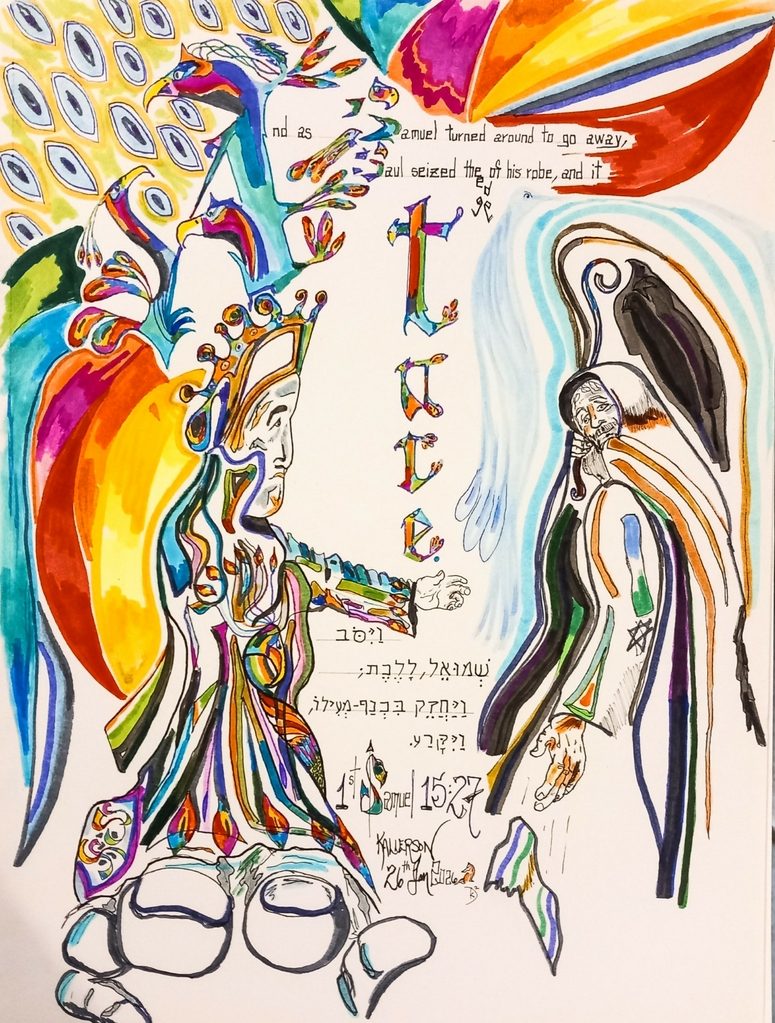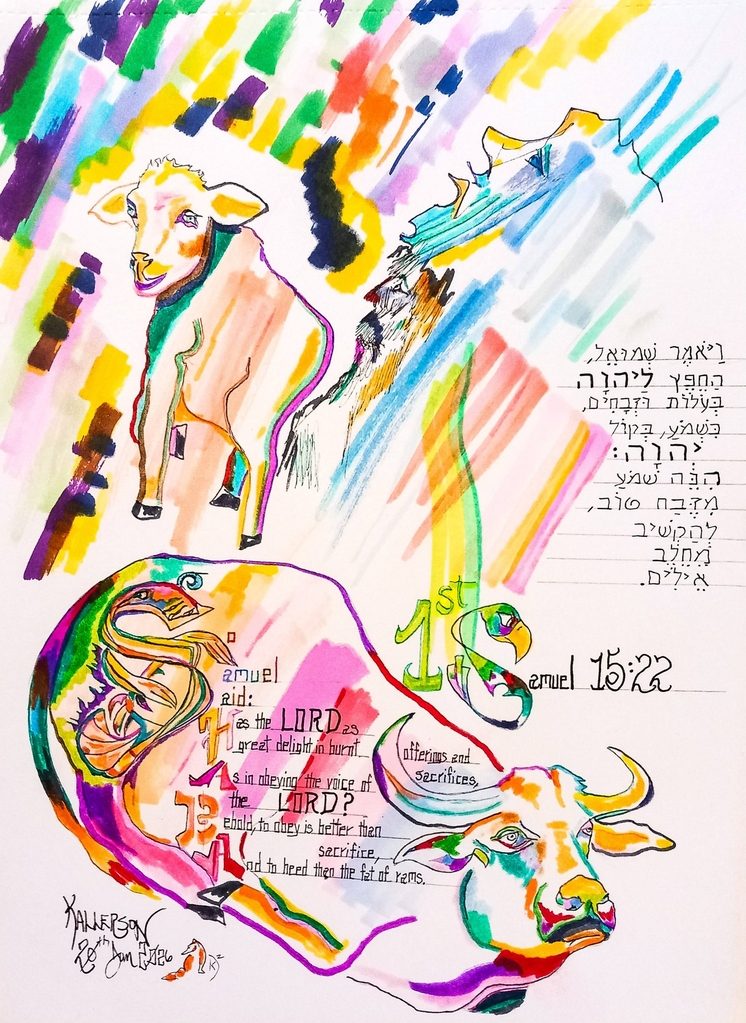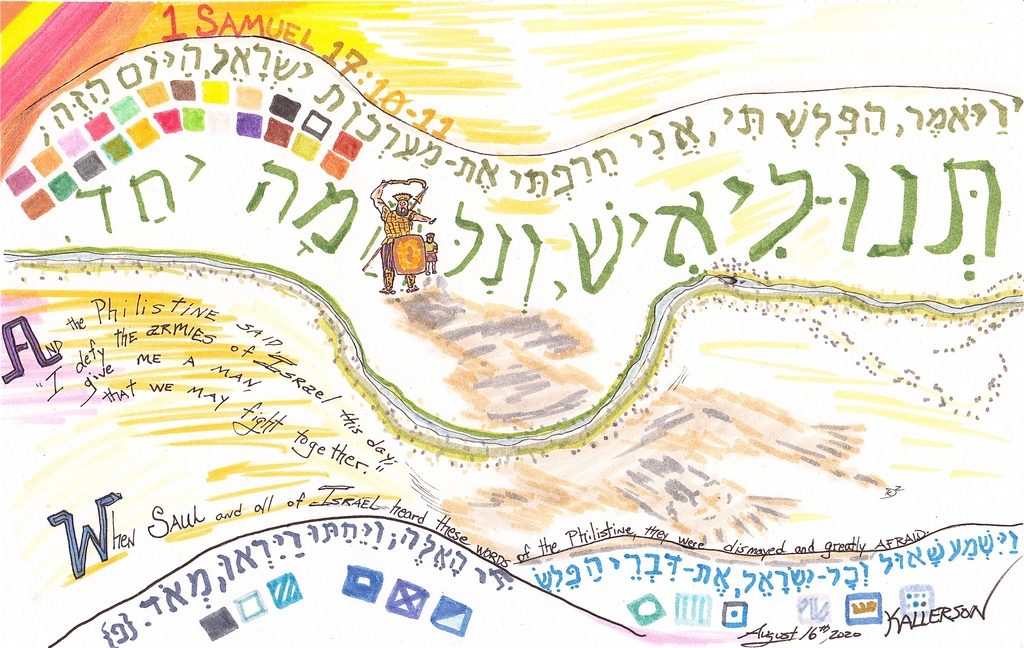
1 Samuel 17:1-11 (David and Goliath, Part I)

Artwork by Douglas Kallerson

1 Samuel 17:1-11
David and Goliath, Part I

(Typed 17 November 2025) 1 Samuel 17 is one of the most stirring and memorable passages in all of Scripture. It sets the tone for the life of David, who becomes king in Israel. It also demonstrates the concepts of faith in the Lord and trust in His guiding hand in a way that is almost unmatched in the pages of the Bible.

But more, it deals with one of the most beautifully messianic, or Christological, passages in the Bible as well. Great themes of the redemptive narrative are contained within it, revealing what God would do, based on what He promised to do, in a unique and beautiful way.

The context of the passage is necessary to understand what occurs here. In Chapter 15, King Saul disobeyed the Lord, failing to follow through with His command to utterly destroy the Amalekites, devoting them and all of their possessions to God through destruction.

Instead, it said, “And he commiserated, Saul, and the people, upon Agag, and upon best the flock, and the cattle, and the doubles, and upon the lambs, and upon all the good, and not he acquiesced – caused to anathematize them. And all the deputyship – disesteemed and being wasted, it they caused to anathematize” 1 Samuel 15:9 (CG).

Because of this, Samuel came to Saul and said, “Because you spurned word Yehovah, and He spurned you from king” 1 Samuel 15:23 (CG). Then, in Chapter 16, the Lord said to Samuel –

“Until when you mourning yourself unto Saul, and I spurned him from reigning upon Israel? You must fill your horn – oil, and you must walk. I will send you unto Jesse – House the ‘My Bread.’ For I saw in his sons: to Me – king” 1 Samuel 16:1 (CG).

Samuel obeyed, and David, the son of Jesse, was selected and anointed. After that, it noted, “And Spirit Yehovah, it veered from with Saul. And it affrighted him, breath evil from Yehovah” 1 Samuel 16:14 (CG).

In order to calm the distressing spirit, David was selected to play the harp for Saul. That is where the chapter ended. As was seen, the thoughts were not necessarily chronological, but categorically placed in this order. That is where we enter Chapter 17.

Text Verse: “Also the neighbor women gave him a name, saying, “There is a son born to Naomi.” And they called his name Obed. He is the father of Jesse, the father of David.” Ruth 4:17

David is noted more than 930 times in Scripture between Ruth 4:17 and Revelation 22:16. He isn’t mentioned in the verses today, but they set up the scenario for us to see and understand why he was considered so great throughout the rest of the Bible.

The scene is the Valley of the Elah, a beautiful valley lined with low mountains, in the middle of which is a ravine. On my trip to Israel with my mom in 2003, it was one of my most cherished stops. While there, I whipped out the Bible and read the passage we will be looking at for the next few weeks.

Everyone gathered around and listened – almost the whole tour group. Afterwards, many of them came up and thanked me. What astonished me is that nobody else brought a Bible, including the tour guides who had conducted almost 70 tours. To me, it seemed like a no-brainer – go to Israel, take your Bible.

Apparently, I’m in the minority, but I cannot even fathom why. The central point of faith for every true Christian on the planet is Jesus Christ. And the only way to know Him is to know the Bible. None of Scripture makes sense without Him, and all of it makes complete sense when viewed from His life.

If you don’t believe this, just look at Israel. They have absolutely no idea what their own Scriptures say because they don’t know who Jesus is in relation to what those Scriptures are saying. And the truth is that if anyone picked up only the Old Testament without the New Testament, it really wouldn’t make much sense.

But in knowing Jesus, every single story comes into clear focus. This is a certain truth that is discovered when you pick up and read His superior word. And so, let us turn to that precious word once again and… May God speak to us through His word today and may His glorious name ever be praised.

I. Valley of the Elah (verses 1 & 2)

Now the Philistines gathered their armies together to battle,

vayaasphu phelishtim eth makhanehem lamilkhamah – “And they gathered, Philistines, their camps to the battle.” Philistine comes from the verb palash, to roll, as in an act of mourning. In this state, a person will roll in the dust or ashes because of their intense grief. Thus, the name signifies Griever, Burrower, or something akin to that.

However, this can also be interpreted as an active action. Thus, it would be those who cause grief. Hence, the name Weakeners would be the result. This use is explained by Abarim –

“The name Philistine comes from the verb פלש (palash), which originally described the digging of burrows in river banks by rodents such as rats. By doing so, these creatures weaken the shore and may ultimately cause it to collapse.” Abarim

They are first mentioned in Genesis 10 in the Table of Nations. They are noted in the area of Canaan as early as Genesis 21 at the time of Abraham. They are believed to be displaced descendants of the Minoans who entered the land of Canaan and gained a foothold there.

They lived along the coastal areas, but they gathered their armies inland for battle against Israel. As it next says…

1 (con’t) and were gathered at Sochoh, which belongs to Judah;

vayeasephu sokhoh asher lihudah – “And they were gathered – Sochoh, which to Judah.” Sochoh comes from the verb suk, to hedge or fence up. Thus, it means Hedge or Fence. One commentary says it comes from the noun sek. If so, it would mean Thorn, which is less likely.

This area belongs to Judah, meaning Praise. Thus, the Philistines are seeking to expand into Israelite territory. In this clause, Sochoh is spelled שֹׂכֹ֖ה. From this point, the account becomes more specific…

1 (con’t) they encamped between Sochoh and Azekah, in Ephes Dammim.

vayakhnu ben sokhoh u-ven azeqah beephes damim – “And they inclined between Sochoh and between Azekah in Ephes Dammim.” In this clause, the name Sochoh is spelled with an additional letter, a vav: שׂוֹכֹ֥ה.

Azekah comes from the verb azaq, a word used only once, in Isaiah 5:2. It signifies to dig about, or till –

“Now let me sing to my Well-beloved
A song of my Beloved regarding His vineyard:
My Well-beloved has a vineyard
On a very fruitful hill.
He dug it up [azaq] and cleared out its stones,
And planted it with the choicest vine.
He built a tower in its midst,
And also made a winepress in it;
So He expected it to bring forth good grapes,
But it brought forth wild grapes.” Isaiah 5:2, 3

Ephes Dammim comes from two words signifying “to cease” or “come to an end,” and the plural of the word “blood.” Thus, it means something like “The Boundary of Blood Drops.” James Strong also defines it as “The Two Extremities,” meaning the soles of the feet or the ankles, but I have no idea why. 

Boundary of Blood Drops probably refers to the fact that this is the boundary where there was constant warfare between Israel and her brutal neighbors. This is the only time the name Ephes Dammim is seen in Scripture. Elsewhere, such as in 1 Chronicles 11:13, it is known as Pas Dammim.

This area is about sixteen miles southwest of Jerusalem. It is also thirteen miles west of Bethlehem, the place from which David came.

And Saul and the men of Israel were gathered together,

veshaul veish Yisrael neesphu – “And Saul, and man Israel, they were gathered.” Although David was anointed, Saul was still the king of Israel, despite disobeying the word of the Lord. He has been told that his rule will end and the kingdom will be granted to another. Saul, or Shaul, comes from the verb shaal, meaning to inquire or ask for.

Thus, it means Asked. However, without the later-added vowel points, it is identical in spelling to the word sheol, the place of the dead: שאול. Because of this, one can imagine the grave calling out for the souls of humanity, asking them to come and join it.

The army of Israel came together because of the Philistines threat. After that…

2 (con’t) and they encamped in the Valley of Elah,

vayakhanu beemeq ha’elah – “and they inclined in Valley the Elah.” In order to face the Philistines, Saul and his army come to, and encamp at emeq ha’elah, Valley of the Terebinth. There are several words translated as valley in Scripture. This one, emeq, comes from amoq, signifying deep. Thus, it is a broad depression.

Elah comes from ayil, a ram. Thus, it denotes strength. It signifies an oak or a terebinth, trees known for their strength. There is an article before Elah, Valley of the Terebinth. With both camps properly settled into their respective locations, it next says…

2 (con’t) and drew up in battle array against the Philistines.

vayaarkhu milkhamah liqrath pelishtim – “And they arranged battle to encounter Philistines.” One can feel the tension when such words are presented. There are two camps, each confident in its abilities. The Philistines are the aggressors. The Israelites would have sued for peace if they thought they could not match the forces that had come against them.

Therefore, either the Philistines will realize their mistake and back out of the encounter, or there is only the anticipation of a battle which is sure to come.

Here they come again! The Philistines are looking for war
They have camped between Sochoh and Azekah in Ephes Dammim
They have it out for us, and they are pretty sore
They are like buzzing wasps, or so it would seem

But with Saul leading the many ranks of Israel
Surely this will be a quick rout, and we will be home soon
We’ll all sit around the table, our stories to tell
And maybe write a war song with a catchy tune

Here we are, camped on one side of the ravine
With the ranks of the Philistines on the other side
But now! There is someone standing in between
By the look of him, our quick victory may be denied

II. The Middleman (verses 3-11)

The Philistines stood on a mountain on one side,

u-phelishtim omedim el ha’har mizeh – “And Philistines standing upon the mount from this.” This tells us that the valley is sided with mountains. On one mountain, the Philistines are standing, facing Israel. In Scripture, a har, mountain, is a lot of something gathered. In typology, it is synonymous with a large but centralized group of people. Like the Philistines…

3 (con’t) and Israel stood on a mountain on the other side,

veyisrael omedim el ha’har mizeh – “And Israel standing unto the mount from this.” On the opposite side of the valley is another mountain where Israel is standing on its slope, facing the Philistines. Between them lies a natural border…

3 (con’t) with a valley between them.

vehagay benehem – “And the ravine between them.” Here, a word which is also unfortunately translated as “valley” is completely different than that of verse 2. The emeq, or valley, is a broad and deep valley between the mountains. In this verse, the gai, a ravine or gorge, is narrow and precipitous.

Thus, we have a natural border between the two forces, which is, at times, running with water. It is a ravine within a valley. This explains how these two armies could stand against one another for an extended period of time without actually engaging in battle.

First, crossing any distance to the ravine would leave them exposed to archers. Once at the ravine, those crossing would be at a continued disadvantage as they traversed the gorge. Depending on its depth, while they crossed through it, the opposing forces, being stationed on the other side, would easily destroy them as they struggled down one side and up the other.

The word gai, ravine, comes from gevah, meaning exaltation. Figuratively, it speaks of arrogance or pride. That comes from gaah, exaltation, or triumph.

With this ravine between the forces, the Philistines begin to make the first move in the battle…

And a champion went out from the camp of the Philistines,

Rather: vayetse ish ha’benayim mimakhanoth pelishtim – “And he went out, man – the middleman, from camps Philistines.” The use of the plural “camps” signifies various divisions of camps that formed the entire camped army. From these camps, one comes forward. To describe him, the word benayim, middleman, is used. It will only be seen in the Bible here and in verse 23.

The word is the plural of bayin, a space or interval, used in verse 1 and translated as “between.” This word signifies a double space or double interval.

He is the one to step forward, thus leaving a space between himself and his own army, and between himself and the opposing army. Therefore, he is the middleman and thus the champion of the armies allied against Israel. In this capacity, he is the one to challenge the opposing army to a single combat to decide the entire battle. He is…

4 (con’t) named Goliath,

galeyath shemo – “Goliath his name.” His name comes from galah, to uncover or remove, but it also means to lead away into exile. The word was first used in Genesis 9:21, where it says of Noah, “Then he drank of the wine and was drunk, and became uncovered [galah] in his tent.”

It is often used in Leviticus and Deuteronomy to refer to uncovering the nakedness of another. At times, it speaks of the Lord revealing himself. Thus, in the case of Goliath, his name means Uncoverer, or Exposer.

But the secondary meaning, exile, also applies because when one is exiled, he is left open and exposed in that state. To call him Exiler is not inappropriate. However, the primary meaning of Exposer carries the weight of the meaning of his name. He is the one who intends to expose the weakness of Israel. He is…

4 (con’t) from Gath,

migath – “from Gath.” Gath comes from the noun gath, winepress. His description continues, saying…

4 (con’t) whose height was six cubits and a span.

gaveho shes amoth vazereth – “His elevation six cubits and span.” Here is a new word in Scripture, govah, height. The word signifies excellency, elation, grandeur, and so forth. It can also figuratively signify haughty. In this case, it speaks of his literal height, which is six cubits and a span.

EW Bullinger defines the meaning of the number –

“Six is either 4 plus 2, i.e., man’s world (4) with man’s enmity to God (2) brought in: or it is 5 plus 1, the grace of God made of none effect by man’s addition to it, or perversion, or corruption of it: or it is 7 minus 1, i.e., man’s coming short of spiritual perfection. In any case, therefore, it has to do with man; it is the number of imperfection; the human number; the number of MAN as destitute of God, without God, without Christ.” Bullinger

A cubit, or ammah, is a unit of measurement that is the length of the forearm below the elbow. It comes from em, mother. Thus, it is the mother measurement. Its exact length is debated, but it is about 16-18 inches.

The zereth, span, is a rare word seen just seven times in the Bible. It comes from zarah, to scatter or winnow. Thus, it is the distance between the tip of the little finger and the end of the outstretched thumb, as if the fingers are scattered.

If you spread your hand in that fashion and place it on your arm at the tip of your middle finger, and then do the same where your hand ended, you will see that it ends at your elbow. In other words, a span is one-half a cubit.

Assuming the cubit is 16 inches, multiplied by 6, plus 8 inches, he would be 104 inches. Divide that by 12, and this guy is around 8’ 7” tall. He would probably be a descendant of Anak. Very few of them remained, but this is stated in Joshua 11 –

“And at that time Joshua came and cut off the Anakim from the mountains: from Hebron, from Debir, from Anab, from all the mountains of Judah, and from all the mountains of Israel; Joshua utterly destroyed them with their cities. 22 None of the Anakim were left in the land of the children of Israel; they remained only in Gaza, in Gath, and in Ashdod.” Joshua 11:21, 22

These Anakim lived among the Philistines and are regarded as Philistines. The account continues to describe this champion…

He had a bronze helmet on his head,

vekhova nekhosheth al rosho – “And helmet, bronze, upon his head.” The kova, helmet, is introduced into the Bible. It comes from an unused root meaning to be high or rounded (as in arched). It is a variant of qova, helmet, which will be used in verse 38 of this chapter. The difference between the two is the initial letter, either a kaph or a quph.

Bronze mainly symbolizes judgment, but also endurance. Such judgment can be positive or negative. If positive, it results in purification and justification. If negative, it results in punishment or even death.

However, positive judgment for a sinful person requires the death of an innocent in his place. Therefore, the positive judgment still carries a negative aspect.

5 (con’t) and he was armed with a coat of mail,

veshiryon qasqasim hu lavush – “And breastplate, scales, he wrapped.” The word qasqeseth means scales. It is only seen elsewhere in the dietary laws of Leviticus, Deuteronomy, and Ezekiel 29:4. Each use refers to scales, thus some translations rightly call it “scale armor.” Of this, Charles Ellicott says –

“This armour has been sometimes understood as ‘chain armour,’ but it is more probable that the Philistine armour was made of metal scales, like those of a fish, whose defensive coat was, no doubt, imitated at a very early date by this warlike race, who dwelt on the sea-shore, and whose life and worship were so closely connected with the great sea. This coat of mail, or corselet, was flexible, and covered the back and sides of the wearer.”

Next, the detailed information about Goliath says…

5 (con’t) and the weight of the coat was five thousand shekels of bronze.

u-misqal hashiriyon khamesheth alaphim sheqalim nekhosheth – “And weight breastplate five thousands shekels bronze.” The word shekel comes from shaqal, to suspend or poise. Therefore, it probably signifies a weight, as if suspended. One thousand shekels would weigh a bit more than 25 pounds. Therefore, five thousand shekels would be a bit more than 125 pounds. Next…

And he had bronze armor on his legs

u-mishkhath nekhosheth al raglav – “And frontlet, bronze, upon his feet.” A word used only here in the Bible is mitskhah, translated as frontlet. It comes from an unused root meaning to be conspicuous. Thus, it is bronze armor that covered the feet, but probably extended over his shins, as the greaves of a knight’s armor. Further…

6 (con’t) and a bronze javelin between his shoulders.

vekidon nekhosheth ben kethephav – “And javelin, bronze, between his shoulders.” The word translated as javelin is kidon. It comes from the word kid, meaning calamity or misfortune. It is used elsewhere and translated as either a spear or a javelin, such as in Joshua 8 –

“Then the Lord said to Joshua, ‘Stretch out the spear [kidon] that is in your hand toward Ai, for I will give it into your hand.’ And Joshua stretched out the spear [kidon] that was in his hand toward the city.” Joshua 8:18

Because it is kept between his shoulders as a quiver would be, it is a smaller weapon than the sword he also carried, which will be noted in verse 45.

It could have been either on his back or on the front. If it were long enough, it would be kept on his back. If it were shorter, for close-in fighting, it might be on the front. The exciting details continue…

Now the staff of his spear was like a weaver’s beam,

vekhats khanitho kimnor oregim – “And arrow his spear according to beam, weavers.” There is a variation between the written and the spoken text here concerning the word staff. The written uses the word khets, a piercer. As such, it signifies an arrow. The spoken uses the word ets, wood.

This shaft is described as kimnor oregim, or “beam, weavers.” The size of a weaver’s beam, both in thickness and in length, is unknown, as they vary greatly. However, the fact that it is described as such tells us that it was certainly very thick, or there would have been no point in conveying this.

Further, it would have been rather long. One commentator notes that “it is conjectured that, in proportion to the stature of Goliath, his spear must be twenty-six feet long” (John Gill). If this is so, it would have to be thick enough to stay straight, even with a great weight at the end of it, as is next noted…

7 (con’t) and his iron spearhead weighed six hundred shekels;

velaheveth khanito shes meoth sheqalim barzel – “And flame his spear six hundreds shekels iron.” The word laheveth, flame, signifies the part of the spear that flashes like a flame, thus its head. This flame is said to be made of barzel, iron, which in the Bible represents strength, be it in binding together, in government, in hard service, in bondage, etc.

Six hundred shekels is about 15 pounds. With the added weight of the wood, the spear would be extremely heavy to carry along with the sword, javelin, and all of the body armor. Amazingly, this is how he was arrayed.

The khanith, spear, was introduced in Chapter 13. It is from khanah, to incline (and thus to camp) or decline (as the sun in the afternoon). The connection is that a spear is for thrusting, like pitching a tent. That is from the same root as khanan, to stoop or bend in kindness to an inferior, as in God dealing graciously with someone.

There is more to the word, though. It is the same word as the feminine form of the word grace, khen, the word from which Hannah, Grace, is ultimately derived.

All of this detail concerning Goliath is to show that he was not only a huge man, but also extremely strong, being able to wear an immense amount of weight in armor and weapons. And more, the armor and weapons mean that he was both heavily defended and exceptionally well-armed.

It is worthy of note that some claim that Goliath must be a picture of the Antichrist based on the first number of the weights of each implement noted in verses 6 and 7: 6, 6, and 6. However, that has been passed along without those teaching it checking. The first numbers are 6, 5, and 6.

Others try to justify this by using two of the numbers, conveniently leaving out the third, saying he had 6 pieces of armor. This not only fudges the numbers, but it is also incorrect:

Helmet
Breastplate
Frontlet (2, because there is one on each leg)
Javelin
Spear

Shield (borne by the lifter)

One could say the use of the single “frontlet” signifies only one item. That is a reasonable proposition, but why would only his height and the weight of the tip of his spear be counted while not counting the weight of the breastplate?

Unfortunately, instead of verifying before passing on information, such sensational things become supposed standards that don’t match what the Bible is telling us. Sometimes, in our attempt to find “the key” to a passage, we may be a bit overzealous in our interpretation of it.

The description of Goliath and his armament has been given to make a complete contrast to the one he will eventually face in battle. In addition to all of his own personal armament, we read of one more thing accompanying him…

7 (con’t) and a shield-bearer went before him.

venose ha’tsinah holekh lephanav – “And lifter the shield walking to his faces.” The tsinah, shield, is introduced. It comes from the word tsen, meaning a thorn or barb. It is a guard against that which pierces. Cambridge, citing the scholar Layard, says –

“The archers, whether on foot or in chariots, were accompanied by shield-bearers, whose office it was to protect them from the shafts of the enemy. The king was always attended in his wars by this officer; and even in peace, one of his eunuchs usually carried a circular shield for his use. This shield-bearer was probably a person of high rank as in Egypt.” Layard

With all of Goliath’s strength, protection, offensive weapons, and secondary assistance, the Exposer is ready to challenge the enemy to battle. What will he uncover concerning the state of Israel?…

Then he stood and cried out to the armies of Israel,

vayaamod vayiqra el maarkhoth Yisrael – “And he stood, and he called unto arrangements Israel.” The word maarakah signifies an arrangement, thus its plural, used here, means ranks or battle lines. This giant dude stepped forward and called out to the entire army of Israel, who are formed on the other side of the ravine, readied for battle…

8 (con’t) and said to them, “Why have you come out to line up for battle?

The translation is spot on: vayomer lahem lamah thetseu laarokh milkhamah – “and he said to them, ‘To why will you come out to arrange – battle?” His words are a taunt. “I have stepped forward, and you are all arranged for battle. But why would you enter into battle against us? I am one man who represents all of the people behind me. One of you should come out and fight me. So far, no one has stepped out of your ranks.”

The fact that he had to call out shows that nobody was willing to come forward. And so, he taunts a bit more…

8 (con’t) Am I not a Philistine, and you the servants of Saul?

halo anokhi hapelishti veatem avadim leshaul – “Not I the Philistine? And you, servants to Saul!” He sets forth both national pride and faith in a leader as a challenge. He has declared himself “the Philistine,” while they are Israel.

Further, Goliath is not a king, but Saul, who leads Israel, is. If Saul hasn’t stepped forward, then who else is likely to? His words are chosen to dishonor the nation, the king, and also each individual who fails to step forward and meet his challenge.

But what is more important, and has as yet been left unstated, is that this is an attack against the God of Israel. The name Israel means He Strives with God. Who will strive with his God to defend the name that he bears? Is there even one who will come forward to meet the champion of the Philistines?

8 (con’t) Choose a man for yourselves, and let him come down to me.

beru lakhem ish veyered elay – “You must eat, to you, man, and he descended unto me.” The word, barah, normally translated as choose or select, is perplexing. It means “to eat,” and it is always translated that way except here. The context is obvious, even if the word’s meaning isn’t.

It comes from a word bar, grain of any kind. That is from barar, to clarify, purify, polish, choose, etc. Thus, the grain, when winnowed, is cleaned up. The connection between these words is found in Ecclesiastes 3:18, where this root is used –

“I said in my heart, ‘Concerning the condition of the sons of men, God tests them [barar], that they may see that they themselves are like animals.’”

In this, man can discern something. Goliath is asking them, using this word in an odd way, to discern who is capable of coming against him. In the use of this word, he could be making a pun.

If so, it would be, “Do you all have enough confidence to eat one of yours for strength? Then let him come down to me!” In essence, “If whoever is sent is enough to feed all of you as an army, fine.  However, I assure you, it is he who will be my meal.”

Again, this is an attack against Saul. If the king won’t come out to battle, then they should choose someone more fit than he is to come and fight, making the decision for him.

Saul had fought against and driven back the Philistines in the recent past, and yet now he must be tiring. Surely someone competent could come take his place. And so, Goliath petitions for someone capable of coming down and facing him…

If he is able to fight with me and kill me, then we will be your servants.

im yukhal lehilakhem iti vehikani vehayinu lakhem laavadim – “If he will be able to battle with me, and he caused to strike me, and we became to you to servants.” Goliath is obviously taunting them, intending to embarrass Israel.

If either side felt they could win the battle, they would have engaged in it. But the layout of the land made it impossible to say who would win or how many would die in the process. And whichever side engaged first would be at a disadvantage.

Therefore, it was Goliath’s day to shine. Nobody else in the Philistine ranks was moving forward, and no opposing individual would come forward. He knew this. And so, to embarrass them by showing that no one could kill him, he taunts, “I’m just one man. If one of you kills me, we will be your servants!”

The temptation is given first, knowing that it would not be met with a response. After the temptation, then comes the warning…

9 (con’t) But if I prevail against him and kill him, then you shall be our servants and serve us.”

veim ani ukhal lo vehikitiv vihithem lanu laavadim vaabadtem othanu – “And if I, I will be able to – him, and I caused to strike him, and you became to us to servants, and you served us.” In what would be a certain defeat in a clash between the two men, the army of Israel would thus be defeated.

The only option left to either side is to continue to wait while Israel endures the tauntings of Goliath. If they picked up and left, the Philistines would move forward and gain ground. And so, the stalemate would, for now, remain. But not without continued tauntings…

10 And the Philistine said, “I defy the armies of Israel this day;

vayomer hapelishti ani kheraphti eth maarkhoth Yisrael hayom ha’zeh – “And he said, the Philistine, “I, I expose arrangements Israel the day, the this.” The verb kharaph is translated as to taunt, reproach, defy, and so on. However, it comes from the noun khoreph, harvest time, or autumn, as in the time of a gathered crop.

Thus, his words are as if he has stripped the ranks of Israel as a reaper would strip the fields at harvest, laying them bare and exposing them. Such a taunt is intended to show that he knows nobody will come forward. They are like the sheaves in the field that are easily cut down. If not, prove it! To do so…

10 (con’t) give me a man, that we may fight together.”

The verb is imperative: tenu li ish venilakhamah yakhad – “You must give to me man, and let us be fought unitedly.” To allow them to prove they aren’t chicken, he states his demand. Ignoring Saul, who will no doubt refuse to come, or even choose a person, he is asking “all of you” (it is plural) to give him a man.

In his words, we see that he is taunting everyone, he is taunting all together, and he is pitting them against one another. Nobody will even be willing to say, “Hey, I might not be able to beat you, but this guy can!” No one is confident enough in himself, or in anyone else.

11 When Saul and all Israel heard these words of the Philistine,

vayishma shaul vekhal Yisrael eth divre hapelishti ha’eleh – “And he heard, Saul and all Israel, words the Philistine, the these.” The battle was obviously unwinnable by either side when pitting army against army, and because of the ravine that ran between them.

Therefore, the only option to end the stalemate would be a solitary battle between the two forces’ best. The champion of the Philistines came forward and defied the king of Israel and every individual soldier of Israel. Indeed, he also implicitly defied the God of Israel because His name is upon them.

However, instead of trusting in the Lord, we see a sad conclusion to our verses for today…

*11 (fin) they were dismayed and greatly afraid.

vayekhatu vayiru meod – “And they were prostrated, and they feared vehemently.” The word khathath, discouraged, was introduced in Deuteronomy 1:21. Its principal meaning is to prostrate. It is translated as shattered, dismayed, beaten down, affrighted, and so on. It has been used five times since it was introduced –

  1. “Look, the Lordyour God has set the land before you; go up and possess it, as the LordGod of your fathers has spoken to you; do not fear or be discouraged [khathath].” Deuteronomy 1:21 (Moses speaking to the people when they originally stood at the door to Canaan).
  2. “And the Lord, He isthe One who goes before you. He will be with you. He will not leave you nor forsake you; do not fear nor be dismayed [khathath].” Deuteronomy 31:8 (Moses speaking to Joshua just prior to him taking over the leadership of Israel).
  3. “Have I not commanded you? Be strong and of good courage; do not be afraid, nor be dismayed [khathath], for the Lordyour God iswith you wherever you go.” Joshua 1:9 (The Lord speaking to Joshua after the death of Moses).
  4. “Now the Lordsaid to Joshua: ‘Do not be afraid, nor be dismayed [khathath]; take all the people of war with you, and arise, go up to Ai. See, I have given into your hand the king of Ai, his people, his city, and his land.’” Joshua 8:1 (The Lord speaking to Joshua after Israel resolved the matter of Achan).
  5. “Then Joshua said to them, ‘Do not be afraid, nor be dismayed [khathath]; be strong and of good courage, for thus the Lordwill do to all your enemies against whom you fight.’” Joshua 10:25 (Joshua encouraging Israel after the defeat of the five kings).

In all five examples, the Lord is the One who provides the victory if the people will simply trust Him and follow His lead. All five instances were recorded in Israel’s history. And all five times, the word dismayed was joined to the thought of being fearful: Do not be afraid and do not be discouraged.

Here, exactly the opposite is seen. The people are not only discouraged, but they are also greatly afraid. The key point that we are to see from this passage is that all of Israel failed.

They failed to remember the Scriptures given for their admonishment, and thus they failed to trust the Lord who gave them the word. He assured them that they would prevail if they trusted Him.

It is a sad note to end on, but it is only the beginning of this marvelous chapter that details the heroic deeds of a shepherd boy in the Valley of the Elah.

So far, we have gotten a bit of background and mechanical information needed to determine what is going on. We have also been readied for the introduction of a very special figure into the narrative.  He will be presented as soon as we continue our journey through the chapter next week.

For now, the main lesson I want you to consider is that God wants us to trust Him. He is there with us even if the enemy we face is large, well-defended, and well-armed. In comparison to the Lord, the enemy is nothing.

But in order for us to trust the Lord as we should, we have to know Him as He is. Muslims certainly trust their false god, Allah. Anyone willing to blow up himself and a bunch of other people in order to supposedly gain entrance into paradise has trust in what he thinks is true.

The Japanese were told the same thing in WWII as they flew airplanes into the side of warships. People all over the world trust in one “god” or another. The problem isn’t trust. Rather, it is misdirected trust. That needs to be straightened out.

The God of the Bible, the one true God, isn’t like those other false gods. Instead of asking us to do something for Him, He promises to accomplish the work for us instead. All He asks of us is to know who He is, and in knowing Him, to then trust Him.

The problem is sin, and sin came through the lies of the devil. In order to correct that, God promised to destroy the works of the devil and, in turn, the power of the devil. Eventually, the devil will be cast out of our presence forever, where he will endure an eternal swim in the Lake of Fire.

God has accomplished all of this through the Person and work of Jesus Christ. As we continue through this chapter, keep remembering this. Keep asking, How does this point to Jesus? In the end, the story of David is a part of the story of the coming Messiah – our Lord Jesus Christ.

It is He who will get us to those fair shores of the better land which God has prepared for us. Let us trust Him to do so. Through this, God will be pleased to call us His children.

Closing Verse: “I, Jesus, have sent My angel to testify to you these things in the churches. I am the Root and the Offspring of David, the Bright and Morning Star.” Revelation 22:16

Next Week: 1 Samuel 17:12-27 Jesse sent David on a journey, and you may ask “whyeth,” so I will explain it to you… (David and Goliath, Part II) (36th 1 Samuel sermon)

The Lord has you exactly where He wants you. He has a good plan and purpose for you. He is the One who abases the haughty and exalts the humble. He regards the lowly, and the proud, He knows from afar. So yield yourself to Him, trust Him, and believe His word. In this, He will do great things for you and through you.

1 Samuel 17:1-11 (CG)

1 And they gathered, Philistines, their camps to the battle. And they were gathered – Sochoh, which to Judah. And they inclined between Sochoh and between Azekah in Ephes Dammim. 2And Saul, and man Israel, they were gathered, and they inclined in Valley the Elah. And they arranged battle to encounter Philistines. 3And Philistines standing unto the mount from this. And Israel standing unto the mount from this. And the ravine between them.

4And he went out, man – the middleman, from camps Philistines. Goliath his name, from Gath. His elevation six cubits and span. 5And helmet, bronze, upon his head. And breastplate, scales, he wrapped. And weight breastplate five thousands shekels bronze. 6And, frontlet, bronze upon his feet. And javelin, bronze, between his shoulders. 7And arrow [k.] his spear according to beam, weavers. And flame his spear six hundreds shekels iron. And lifter the shield walking to his faces. 8And he stood, and he called unto arrangements Israel, and he said to them, “To why will you come out to arrange – battle? Not I the Philistine? And you, servants to Saul! You must eat, to you, man, and he descended unto me. 9If he will be able to battle with me, and he caused to strike me, and we were to you to servants. And if I, I will be able to him, and I caused to strike him, and you were to us to servants, and you served us.” 10And he said, the Philistine, “I, I expose arrangements Israel the day, the this. You must give to me man, and let us be fought unitedly.” 11And he heard, Saul and all Israel, words the Philistine, the these. And they were prostrated, and they feared vehemently.


1 Samuel 17:1-11 (NKJV)

1 Now the Philistines gathered their armies together to battle, and were gathered at Sochoh, which belongs to Judah; they encamped between Sochoh and Azekah, in Ephes Dammim. And Saul and the men of Israel were gathered together, and they encamped in the Valley of Elah, and drew up in battle array against the Philistines. The Philistines stood on a mountain on one side, and Israel stood on a mountain on the other side, with a valley between them.

And a champion went out from the camp of the Philistines, named Goliath, from Gath, whose height was six cubits and a span. He had a bronze helmet on his head, and he was armed with a coat of mail, and the weight of the coat was five thousand shekels of bronze. And he had bronze armor on his legs and a bronze javelin between his shoulders. Now the staff of his spear was like a weaver’s beam, and his iron spearhead weighed six hundred shekels; and a shield-bearer went before him. Then he stood and cried out to the armies of Israel, and said to them, “Why have you come out to line up for battle? Am I not a Philistine, and you the servants of Saul? Choose a man for yourselves, and let him come down to me. If he is able to fight with me and kill me, then we will be your servants. But if I prevail against him and kill him, then you shall be our servants and serve us.” 10 And the Philistine said, “I defy the armies of Israel this day; give me a man, that we may fight together.” 11 When Saul and all Israel heard these words of the Philistine, they were dismayed and greatly afraid.
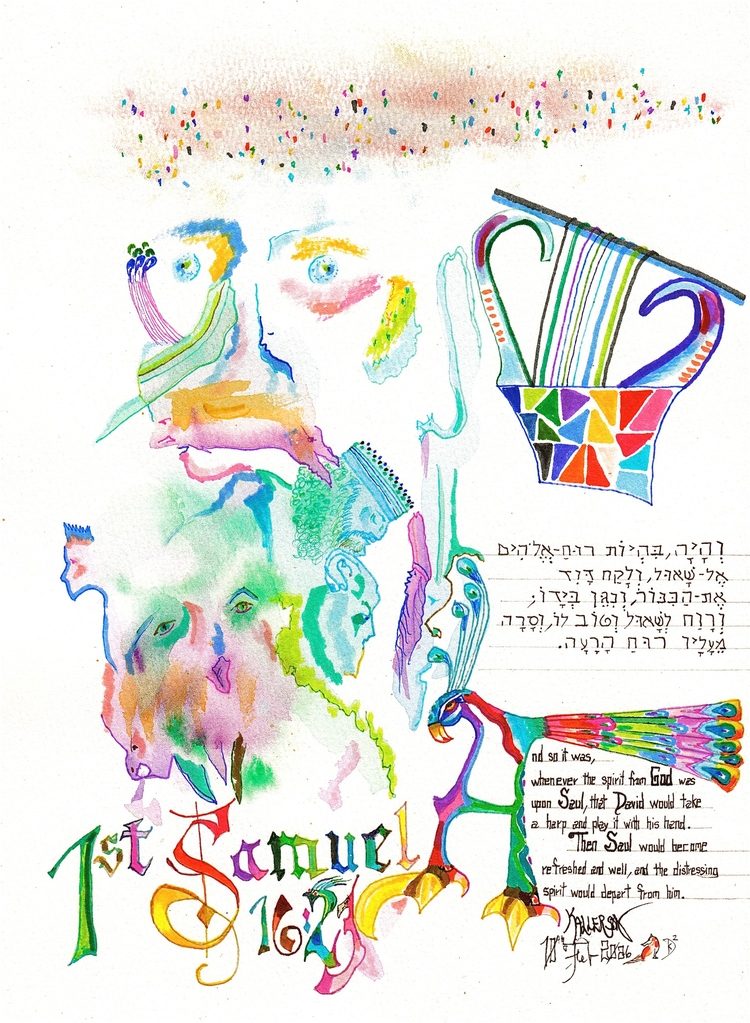
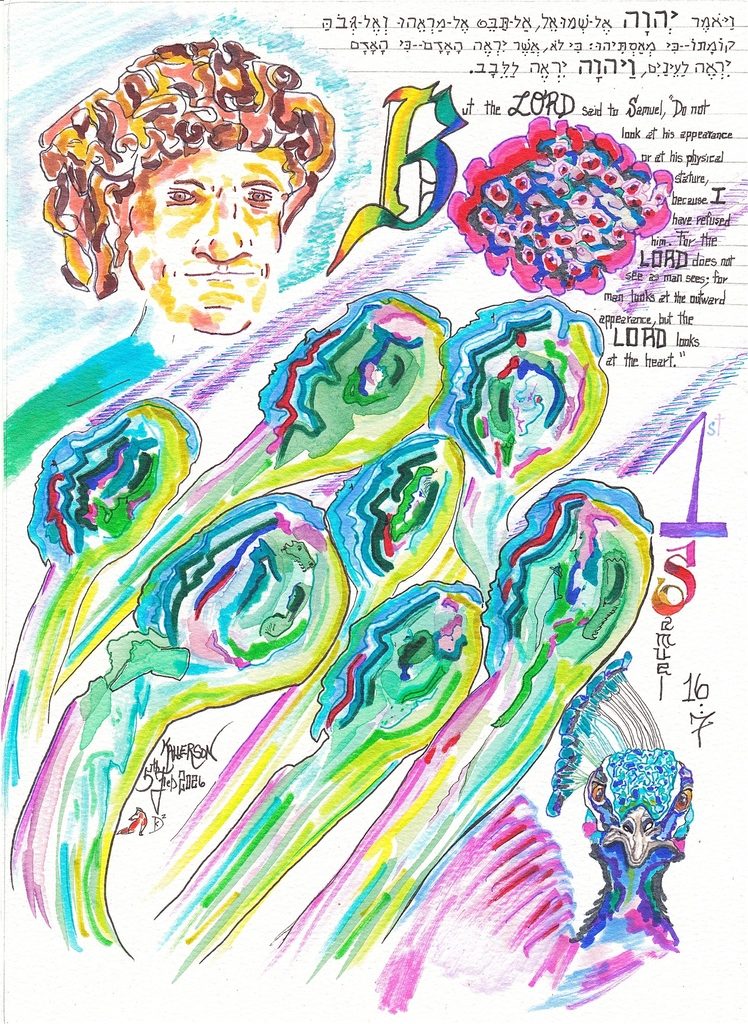
 

1 Samuel 16:14-23 (Arise! Anoint Him! Part II)

Artwork by Douglas Kallerson

1 Samuel 16:14-23
Arise! Anoint Him! Part II

(Typed 10 November 2025) In this passage, Saul discovers the price of being disobedient to the Lord. He probably never figured things would change so completely. However, this is what the Lord determined was right.

This is not to say that every unhappy thing that occurs to us came directly from the Lord. We live in a fallen world and suffer the consequences of sin. We have to adapt to the changes we face as we get older, suffer from accidents or external attacks, and encounter health-related issues that can come in an almost infinite variety of ways.

For Saul, the reason for his declining mental state is explicitly stated. The Spirit of the Lord departed from him, and something else replaced that influence. In order to adjust to this difficulty, it is suggested that music help control and calm his mental state.

It has been known for as long as man has walked on the earth that music nearly instantly calms a restless mind and lifts a heavy heart. Slow, soothing songs lower stress hormones and ease a racing pulse. This gives your brain the same relief as a deep breath.

Upbeat tunes spark dopamine, the feel-good chemical our bodies naturally produce. Singing or drumming delivers a quick sense of victory that pushes back sadness.

Text Verse: To the Chief Musician. A Song. A Psalm. Intro to Psalm 66

Many psalms begin with the words, “To the Chief Musician.” The meaning is that the psalms were set… anyone? To music. Although some of them may have been slow and contemplative, one would be hard-pressed to say that they all were.

One read through the 150th Psalm tells you that if the Levites had modern guitars and amplifiers, the people would be praising the Lord with them. Seeing David whirl and spin before the Lord when the ark was brought to Jerusalem tells us that rejoicing before the Lord includes dancing that would make those in Victorian England run to prayer closets, hoping to escape the supposed sure coming of the wrath of God.

Along with music, lyrics, such as those found in the psalms, allow us to borrow someone else’s words to ease pain we can’t even properly describe. They can guide us back toward hope that we thought was wholly elusive.

In today’s passage, David is called to play for Saul. David was God’s choice to replace Saul as king. His music was certainly a part of the reason for this.

Playing an instrument sharpens memory and focus, and it trains the mind to stay active. It directs the individual to unite in thought, emotion, and intent with the subject of the music. In David’s psalm, he was uniting with the Lord in this way.

Many of the psalms were meant for corporate worship. It is known that a shared chorus or concert melts loneliness and weaves voices together into an instant state of belonging.

Because of the benefits of music, we don’t need a therapist to begin changing our mental state. If we listen to music, tap a rhythm, or hum along with others, we can change our attitude and focus. It’s free, safe, and always ready to be our first step back to peace.

We see this in the account of Samuel, and we can infer it from other passages in Scripture as well. Wonderful things such as this are to be found in His superior word. And so, let us turn to that precious word once again, and… May God speak to us through His word today, and may His glorious name ever be praised.

I. Knowing Thrumming (verses 14-17)

These verses need to be considered parenthetical and actually belong after verse 18:1a. This has already occurred several times in 1 Samuel.

There are several reasons for this, but the description of David here and in verse 17 gives a strong hint. It would also explain why Saul’s condition came upon him as it did.

14 But the Spirit of the Lord departed from Saul,

veruakh Yehovah sarah meim shaul – “And Spirit Yehovah, it veered from with Saul.” This is the Spirit that first came upon him in verse 10:10 –

“And they came there, the hill-ward, and behold, company prophets to meet him. And it surged upon him, Spirit God. And he prophesied himself in their midst.” 1 Samuel 10:10

It again surged upon Saul in verse 11:6, meaning that the Spirit was available to him all the time. It was a pressing force when action was needed. That Spirit, however, departed from Saul…

14 (con’t) and a distressing spirit from the Lord troubled him.

u-viatatu ruakh raah meeth Yehovah – “And it affrighted him, breath evilnessfrom Yehovah.” The word ruakh has three separate and distinct translations: spirit, wind, and breath. The context of each use determines its meaning. There is overlap in how people perceive what is being presented. The corresponding Greek word, pneuma, carries the same three meanings.

Determining what word to translate pneuma as requires the same thought process as the Hebrew ruakh. In the Greek, the only exception to this is when the word is preceded by the definite article, thus indicating the Holy Spirit.

All translations say “spirit” in the second clause. The question is, are the clauses set in parallel or in contrast? The first clause is universally agreed to be the Spirit of Yehovah (also God) in these verses. The differences would be –

And Spirit Yehovah, it veered from with Saul.
And it affrighted him, spirit evil from Yehovah.

And Spirit Yehovah, it veered from with Saul.
And it affrighted him, wind evil from Yehovah.

And Spirit Yehovah, it veered from with Saul.
And it affrighted him, breath evil from Yehovah.

The word “from” shows this is probably an active agent. Benson, et al, says, “That is, by God’s permission, who delivered him up to be buffeted by Satan.” That inserts what is unstated, but it is not out of the question. An example of a secondary agent used in this manner is found in 1 Kings 22:19-23.

The word breath is a possibility. In Ezekiel 37, it says –

“Thus says the Lord God to these bones: ‘Surely I will cause breath [ruakh] to enter into you, and you shall live. I will put sinews on you and bring flesh upon you, cover you with skin and put breath [ruakh] in you; and you shall live. Then you shall know that I am the Lord.’” Ezekiel 37:5, 6

Likewise, in Isaiah, it says –

“The voice said, ‘Cry out!’
And he said, ‘What shall I cry?’
‘All flesh is grass,
And all its loveliness is like the flower of the field.
The grass withers, the flower fades,
Because the breath [ruakh] of the Lord blows upon it;
Surely the people are grass.” Isaiah 40:6, 7

These and other such instances make breath a possibility. As for translating it as “spirit,” in Hosea 11, it says –

“For He, between brothers, He will cause to fruit
It will come, east wind [ruakh] – Yehovah
From wilderness, ascending.
And it will pale, his well,
And it will parch, his fountain.
He will plunder, depository, every vessel delightfulness.” Hosea 11:15 (CG)

The east wind, a wind of turmoil, destruction, and trouble in the Bible, is said to come from Yehovah. Though the term “evil wind” is not used, the meaning is synonymous in relation to those who receive it.

Therefore, there is precedent for the use of a wind directed from Yehovah that causes trouble. Outside of what happens to Saul, there is no evil spirit sent directly from the Lord.

The word translated as “affrighted” in this clause, baath, is introduced. It signifies to fear. In this case, it is what causes the fear. The Topical Lexicon rightly says, “It is never a mild uneasiness; it is a jolt of fear that immobilizes, unnerves, or drives one to desperate action. The concept is closely linked with the felt reality of divine judgment or the crushing weight of impending calamity.”

This is something that suddenly comes upon Saul and causes him mental anguish.

15 And Saul’s servants said to him, “Surely, a distressing spirit from God is troubling you.

vayomeru avde shaul elav hineh na ruakh elohim raah mevaitakha – “And they said, servants Saul, unto him, ‘Behold, we pray, breath God, evilness, affrighting you.’” The evil breath from Yehovah is now called “breath God evil.” The servants perceive this as an evil breath of God. Verse 23 will confirm this is so.

The question now is whether this evil breath is something of God that is placed upon Saul or is it a breath that causes evil in Saul. It should be taken as an axiom that in God, there is no evil. However, be it God or the Lord, something that is sent will cause what we perceive as evil, even if it suits His good purposes –

“If it will be blown, shophar in city,
And people not they will shudder?
If there will be evil in city,
Yehovah, not He did?” Amos 3:6 (CG)

In Amos, the question is rhetorical, but did Yehovah actively cause the evil, or was it allowed through the attack of the enemy? The answer is that it was allowed. As such, there is precedent for this concerning God in this verse in Samuel as well. As for Saul, to alleviate this problem, a suggestion is made…

16 Let our master now command your servants, who are before you, to seek out a man who is a skillful player on the harp.

yomar na adonenu avadekha lephanekha yebaqshu ish yodea menagen ba’kinor – “You will say, we pray, our lord – your servants to your faces – you will seek man knowing thrumming in the harp.” As explained before, the words “to your faces” is the Hebrew idiom which means “before you.” The servants who stand before Saul recommend a thrummer upon the harp to ease Saul’s distress. The reason for this is…

16 (con’t) And it shall be that he will play it with his hand when the distressing spirit from God is upon you, and you shall be well.”

vehayah biyoth alekha ruakh elohim raah venigen beyado vetov lakh – “And it was, in being upon you breath God, evilness, and he thrummed in his hand, and good to you.” These words led me to decide upon breath rather than wind. One would think a wind would come to a person while a breath would come upon him, as if it resided in him but manifested itself at times.

The words breath, wind, and spirit are almost interchangeable. The sense will not be lost when thought through, regardless of which word is used. However, as God is the source and there is no noted intermediary, I am hesitant to use the word spirit.

It is practically written into our makeup that sounds can affect our mood. Music is something that soothes us and mentally refreshes us, a condition known as Autonomous Sensory Meridian Response. On the contrary, a child’s incessant moaning or the grating of fingernails on a chalkboard will bring about a state of misophonia in many people.

The suggestion by the servants is hopeful, anticipating a positive response to Saul’s condition. The word translated as thrumming, is new, nagan. It signifies to beat a tune with the fingers, particularly when playing on a stringed instrument.  Saul accepts their suggestion…

17 So Saul said to his servants, “Provide me now a man who can play well, and bring him to me.”

vayomer shaul el avadav reu na li ish metiv lenagen vahaviothem elay – “And he said, Saul, unto his servants, ‘You must see, I pray, to me man ‘causing to make well to thrum,’ and you cause to bring unto me.’” Saul agrees, using an imperative. It is as if he says, “You really need to go get me a guy that can do this and bring him back to me directly.” Because of this, a recommendation will be made…

Thrumming a tune to ease the soul
Soundness returns to the mind
It’s a help when things spin out of control
Or when the world is unkind

A tune to take the cares away
Or remind you of times in the past
Music to encourage you throughout the day
And to make your evening a total blast

Music is a gift found in the word
It speaks of psalms, hymns, and also songs
Let music fill you with knowledge of the Lord
Through guitars, trumpets, and even gongs

Make a resounding sound to the Lord anytime
Or sing to Him a melody so sublime

II. He Thrummed in His Hand (verses 18-23)

18 Then one of the servants answered and said, “Look, I have seen a son of Jesse the Bethlehemite,

Rather: vayaan ekhad mehanearim vayomer hineh raiti ben leyishai beith ha’lakhmi – “And he answered, one from the lads, and he said, ‘Behold! I saw son to Jesse – House the ‘My Bread’.’” This is the second of four times the term beith ha’lakhmi or House the ‘My Bread” is seen.

As with the Lord’s words in verse 1, it is specifically worded this way. James Strong sees it as a patrial, as noted in verse 1. If so, it would be like saying, “House ‘the bread-ite,’” Thus, one would think it would be consistently used as such.

But it is used only four times, and only in the books of Samuel, while the standard Bethlehem is used ten times in the same books. This seems to negate that idea.

My suggestion to resolve this is that the youth speaking is one of David’s brothers, mentioned already, and who will be noted again in Chapter 17. This would explain why both David and this person use the term.

It was first used by the Lord in 1 Samuel 16:1 when referring to this family. It is then used by two of Jesse’s sons, acknowledging the Lord’s designation. Thus, Bethlehem is the House where their bread comes from. Hence, “House the ‘My Bread.’” This is speculation, but it would fit with the idea that these verses are parenthetical and belong after Chapter 17.

Jesse means My Husband. It also means Yehovah Exists. As such, the name Jesse contains the weighty notion that human marriage reflects divine revelation.

If this is one of David’s brothers, he would know David had been anointed as king, something he would not want revealed. It would also explain why he knows what he knows about David, saying…

18 (con’t) who is skillful in playing, a mighty man of valor, a man of war, prudent in speech, and a handsome person; and the Lord is with him.”

yodea nagen vegibor khayil veish milkhamah unevon davar veish toar veYehovah imo – “knowing thrum and powerful valor, and man battle, and being discerned – word, and man – form, and Yehovah with him.’” This individual was intimately aware of David’s abilities and qualities, including that Yehovah was with him. That could be a general statement, but a brother who saw him anointed would certainly know this.

Again, his identity as a brother is speculation. Regardless, his description of David is enough to cause Saul to act…

19 Therefore Saul sent messengers to Jesse, and said, “Send me your son David, who is with the sheep.”

vayishlakh shaul malakhim el Yishai vayomer shilkhah elay eth David binkha asher batson – “And he sent, Saul, messengers unto Jesse. And he said, ‘You must send-ward unto me David your son who in the flock.” The words are imperative and given as a command to Jesse.

David is with the tson, flock, but he is being summoned to attend to Saul. The word tson comes from a root meaning to migrate. This provides another clue that it could be David’s brother. He would know that David was the one to tend Jesse’s flock. David means Beloved. In response…

20 And Jesse took a donkey loaded with bread, a skin of wine, and a young goat, and sent them by his son David to Saul.

vayiqakh Yishai khamor lekhem venod yayin ugedi izim ekhad vayishlakh beyad David beno el shaul – “And he took, Jesse, jack – bread, and skin wine, and kid goats, one. And he sent in hand David, his son, unto Saul.” Jesse loaded David up with supplies as an offering to Saul.

Bread, lekhem, signifies dependence on God, sustenance, and life itself.

Wine, yayin, symbolizes the merging together of cultural expressions into a result. The thing that ought to happen can happen, symbolized by wine. It is as if an act of reasoning is occurring, and an intended result is realized.

The animal is described as a gedi, a kid. That comes from an unused root signifying to cut off. As an example –

“Then he turned to her by the way, and said, ‘Please let me come in to you’; for he did not know that she was his daughter-in-law.
So she said, ‘What will you give me, that you may come in to me?’
17 And he said, ‘I will send a young goat [gedi] from the flock.’
So she said, ‘Will you give me a pledge till you send it?
18 Then he said, ‘What pledge shall I give you?’
So she said, ‘Your signet and cord, and your staff that is in your hand.’ Then he gave them to her, and went in to her, and she conceived by him. 19 So she arose and went away, and laid aside her veil and put on the garments of her widowhood.
20 And Judah sent the young goat [gedi] by the hand of his friend the Adullamite, to receive his pledge from the woman’s hand, but he did not find her. 21 Then he asked the men of that place, saying, ‘Where is the harlot who was openly by the roadside?’
And they said, ‘There was no harlot in this place.
22 So he returned to Judah and said, ‘I cannot find her. Also, the men of the place said there was no harlot in this place.
23 Then Judah said, ‘Let her take them for herself, lest we be shamed; for I sent this young goat [gedi] and you have not found her.’” Genesis 38:16-23

It is understood that the goat is what finishes a matter.  The next word, izim, signifies goats. It is the term used for the sin offering, including that mandated on the Day of Atonement in Leviticus16:5. Once loaded up and sent…

21 So David came to Saul and stood before him. And he loved him greatly, and he became his armorbearer.

vayavo David el shaul vayaamod lephanav vayeehavehu meod vayhi lo nose khelim – “And he came, David, unto Saul. And he stood to his faces. And he cherished him, vehemently. And he was to him lifting vessels.” Here is another indication of the flow of the narrative. David came to Saul and Saul cherished him. In Chapter 18, it says –

“And it was according to his finish to speak unto Saul, and soul Jehonathan, it was tied in soul David. (Insert 1 Samuel 16:14-23) And they cherished him – Jehonathan, according to his soul. 2 And he took him, Saul, in the day, the it, and no he gave to return house his father.” 1 Samuel 18:1, 2

The written Hebrew in verse 18:1 reads “they.” The oral, not understanding the flow of the narrative, says, “he.” When things are placed as suggested, the narrative flows properly, and it removes all of the complications and seeming contradictions found in Chapter 17.

22 Then Saul sent to Jesse, saying, “Please let David stand before me, for he has found favor in my sight.”

vayishlakh shaul el Yishai lemor yaamad na david lephanay ki matsa khen beenay – “And he sent, Saul, unto Jesse, to say, ‘He will stand, I pray, David, to my faces. For he found graciousness in my eyes.’” This request is perfectly in line with what was just stated about the flow of the narrative. Saul is pleased with David and informs Jesse that he wishes his son to be in his presence henceforward. Therefore…

23 And so it was, whenever the spirit from God was upon Saul, that David would take a harp and play it with his hand.

vehayah bihiyoth ruakh elohim el shaul velaqakh David eth ha’kinor venigen beyado – “And it was, in coming breath God unto Saul, and he took, David, the harp, and he thrummed in his hand.” Notice that it says “breath God” without the adjective “evil” included. We can see how the three translations of the word ruakh coalesce here.

There is the initiator of the process, the spirit, the means by which the change is made. There is the medium in which the process moves, the wind. And there is what is being moved, the breath. These terms are used without precision in order to describe what is going on. The breath of God is sent unto Saul.

Seeing verse 18:10 will add more insight, “And it was from morrow, and it sent, breath God, evil unto Saul, and he prophesied himself in midst the house.” The breath of God that Saul carries with him would cause him evil in his being. It’s not that God sent evil, but that Saul’s state, based on God’s breath, is what causes the evil in him to appear.

Whenever this came about, David would thrum to pacify his state…

23 (con’t) Then Saul would become refreshed and well,

veravakh leshaul vetov lo – “And it revived to Saul, and good to him.” A new word is seen here, ravakh, to breathe freely. Saul was all tensed up, unable to breathe freely. When he heard the music, he unwound and was able to breathe properly again. David’s playing eased him, causing him to lighten up in his mind and loosen up in his being, restoring him to normalcy. Therefore…

*23 (fin) and the distressing spirit would depart from him.

vesarah mealav ruakh ha’raah – “And it veered from upon him breath, the evilness.” It is as if the breath of God that caused the evil condition to arise in him would turn off the path he was on, allowing him to continue without it.

One can think of a schizophrenic taking his meds and being restored to clear thinking. The tendency remains in him, but it is controlled because of the calming effects of the medicine. Such was the music of David’s thrumming to Saul.

This verse gives two more reasons why I prefer breath to spirit. The first is the new word in the previous clause, where Saul is granted freedom to breathe apart from the “evil breath.” Also, Adam Clarke, in his comments on verse 14, said –

“It has been said:
‘Music hath charms to sooth the savage breast.’

This has been literally proved: a musician was brought to play on his instrument while they were feeding a savage lion in the tower of London; the beast immediately left his food, came towards the grating of his den, and began to move in such a way as to show himself affected by the music. The musician ceased, and the lion returned to his food; he recommenced, and the lion left off his prey, and was so affected as to seem by his motions to dance with delight. This was repeatedly tried, and the effects were still the same.” Clark 16:14

If an animal is afflicted with the same angry demeanor but is calmed by music, would it be appropriate to attribute that to the Spirit of God? Rather, it is the breath in the lion, ultimately from God, which affects his demeanor.

A time of transition can be filled with grief
As one thing passes from one hand to another
But a patient soul can offer relief
And be kind in the process, like one’s brother

Saul’s time as king will have to end
And when it does, another will take his place
Is his successor an enemy or friend?
Will Saul ever accept David’s face?

God chose David to replace king Saul
A man who understood the Lord’s will well
He will faithfully adhere to the call
And honor Saul as king until rings his funeral bell

III. From Saul to David, Types of Christ

The contents of this chapter have been placed categorically to instruct us on what God is doing. The information concerning Saul’s condition logically follows the anointing of David, even though it is not chronologically how things happened.

Things are placed this way to show us the transition of the kingdom from Saul to David. This had to happen in order to fulfill God’s redemptive purposes.

It is good to note now that after verse 13, Samuel, Asked from God, takes on a new meaning. Instead of asking from God for sons of grace (Jesus and His people), his name now predominantly means asked from God for the Seed of Grace (Jesus).

Saul, Asked, will also take on a new meaning. Instead of picturing those who seek the truth, he is Asked, the man without the Spirit, Asked of Sheol (which is identical to his name), calling out for the souls of men, while men ask to be freed from the curse of Sheol. It is a double entendre.

In other words, his name reveals that the pit, at this time, is the true leader of the people. He represents the state of those destined for the pit.

The serpent deceived the first man, and all were destined to follow their leader to the same place. One might even view him as a type of inherited sin, leading the people looking for redemption in the wrong direction. The pit asks for, and receives, those destined to perish. Can this be corrected?

In verse 1, the Lord spoke to Samuel about mourning over Saul. The pit is rejected from “reigning upon Israel.” The pit is the state of man without Jesus. The Lord tells Samuel, “You must fill your horn – oil.”

The horn is a symbol of prominence and power. Having oil in it for anointing indicates the presence of the power of the Holy Spirit being specially highlighted in a particular place.

It anticipates Jesus, the Anointed of God, bearing all His prominence and power. Samuel is sent to Jesse – House the ‘My Bread.’ Jesse, Yehovah Exists, is a reference to the deity of Christ. To understand the full significance of the Hebrew meaning of House the ‘My Bread,’ go back and review the lengthy analysis in verse 1.

The kingdom will belong to the Son of Yehovah, Christ, in His incarnation. Samuel is told that in order to avoid suspicion, he is to take an eglat baqar, heifer of the herd. This indicates circular and to seek. It refers to the word being searched out to determine who this king will be.

Jesse is to be invited to the feast. At that time, the Lord will provide the instruction and whom to anoint. The sacrifice is a slaughter intended for a feast, something anticipated in the coming of Christ, not for atonement, but life in Christ.

In verse 4, it specifically mentions Bethlehem. It is a direct connection to the birthplace of Jesus, the Bread of Life.

In that verse was the parenthetical thought, “(And they shuddered, elders the city, to meeting him.)” That provides a marvelous connection to Matthew 2:3, “And Herod the king, having heard, he was agitated, and all Jerusalem with him.”

As Herod didn’t exist and Jerusalem wasn’t a part of the picture yet, the parenthetical words provide the connection that would be missed. In verse 5, Jesse, Yehovah Exists, (the subject based on the parenthesis), asks if Samuel had come in peace. It gives the sense of Luke 2:14 –

“Glory to God in the highest,
And on earth peace among people with whom He is pleased.” Luke 2:14 (NASB)

With the attendees gathered, Samuel went through the process of identifying the one to be anointed as prescribed by the Lord. Three are named, Eliab, My God Is Father, looks to the Pharisees in Israel who claimed that God is their father (John 8:42).

Abinadab looks to the Sadducees, who felt they were in a right state with the Lord, as noted in Matthew 26:63-65. Shammah looks to the scribes who were repeatedly spoken against by Jesus in the gospels because of their hypocritical stands against the truth of God.

These “greats” of the house were passed up in favor of another. In like manner, the other sons of Jesse were rejected, totaling seven, the number of spiritual perfection. After inquiry, Samuel discovers there is another son. Though not stated, he is the eighth, the number of resurrection and regeneration. It marks the beginning of a new era or order.

The spiritually perfect time has come, and a new era is to be introduced with this final son who is “keeping in the flock.” The word tson, flock, comes from a root signifying to migrate.

Jesus is the one who migrates through the word in typology as seen in the people, the flock, mentioned in various passages. Likewise, one can think of the migration of people in search of Christ, just as they are in search of food.

In verse 12, David was brought in and described as admoni, red. This points to Jesus who bears the redness of Adam. His eyes were noted as yapheh, a word meaning to be bright, and thus beautiful. It refers to Christ’s bright spiritual state, focus, and understanding. Also, his roi, visage is good. It speaks of Christ’s suitability as a Man.

After that, Samuel was told by the Lord to anoint him. Humanity has asked from God for a Man to fulfill the necessary role as His Anointed, and Jesus is the response to the eons of humanity leading to Him.

In verse 13, Samuel, Asked from God, anointed David, Beloved, in the midst of his brothers. It is the first time his name is mentioned in 1 Samuel. At that time, the Spirit of the Lord came upon him from that day forward. It is what God did to Jesus in the midst of the people of Israel –

“The Spirit of the Lord is upon Me,
Because He has anointed Me
To preach the gospel to the poor;
He has sent Me to heal the brokenhearted,
To proclaim liberty to the captives
And recovery of sight to the blind,
To set at liberty those who are oppressed;
19 To proclaim the acceptable year of the Lord.” Luke 4:18, 19

Finally, in verse 13, it said that Samuel went Ramah-ward. It reflects heading to the Lofty Place where those who hold to grace alone, even after salvation, will be exalted. They anticipate what they possess but which they have not yet actually attained.

In verse 14, the new passage concerning Saul began. This is where the typology of the names of Samuel and Saul changes.

Though these verses chronologically belong after Chapter 17, they are rightly placed here to show the contrast of Saul with David and to begin the next series of stories predominantly using David to further the redemptive narrative.

The Spirit Yehovah departed from Saul, and the evil breath from Him affrighted him. Because of this, it was suggested that someone familiar with thrumming the kinor, the harp, be sought out. The kinor is the first instrument mentioned in Scripture.

It is seen 42 times throughout most of the Old Testament, demonstrating “the instrument’s continuity from the dawn of human culture through the post-exilic community.” It is a “melodic conduit for human response to divine revelation” (Topical Lexicon). It is symbolic of both judgment and restoration.

The number 42 is the number connected with the Antichrist. However, it is also a number related to the Lord’s opposition to this force. Bullinger says, “Its factors are six and seven (6×7=42), and this shows a connection between man and the Spirit of God, and between Christ and Antichrist.”

One can see the battle between Sheol and man raging as he looks for relief from his determined end. The focus on the “breath” in this passage takes the reader back to Genesis 2 –

“And the Lord God formed man of the dust of the ground, and breathed into his nostrils the breath of life; and man became a living being.” Genesis 2:7

Man was given the breath of life, but because of sin’s death sentence, it is an evil breath that man now possesses. Therefore, the war between the spirit of Antichrist and the Spirit of God in Christ Jesus, the Man who came in the appearance of fallen Adam, is highlighted.

In verse 18, it was noted that the son of Jesse, Yehovah Exists, was of House the ‘My Bread.’ It speaks of the Incarnation of Jesus, God’s Bread of Life. David was noted as “knowing thrum and powerful valor, and man battle, and being discerned – word, and man – form, and Yehovah with him.”

A more accurate set of words about Jesus would be hard to find. He is the One who knows judgment and restoration (thrum). He is the epitome of powerful valor. He is the Man of battle. He, the Word of God, is discerned in word. He is a Man of form. And Yehovah is with Him.

Saul then sent messengers to get David, “who in the flock.” Jesus was of the flock of Israel. He would be the appropriate One to tend to the need that has been presented.

Because of the request, Jesse took a khamor, a jack, a male donkey, signifying a red one. In past sermons, it has pictured Jesus, the Red One.

He was loaded with bread, life’s sustenance. He also took wine, the cultural expression that leads to the Messiah. Along with that, he took a “kid goats.” The symbolism is the cutting off of sin by the goat of atonement, anticipating Jesus, who was the fulfillment of the Day of Atonement goat sacrifice. He is what finishes the matter of sin.

This is presented by Jesse to Saul. Jesus is the Lord’s offering to man who needs relief from the call of Sheol. From there, the final verses noted the acceptance of Saul concerning David and how David began his service to Saul to alleviate him of his “breath God” that afflicted him.

Verses 14 through 23 were categorically placed here to show how Jesus was anticipated in the Sheol-destined people of Israel. If this event had been placed where it chronologically belonged, it would have made no sense from a redemptive standpoint.

Thus, like other times this occurred, God is giving us information in a step-by-step manner so that we can understand what He is doing in redemptive history.

And all of it centers on Jesus Christ. The details are enough to thoroughly convince us that God has a plan, that it is being slowly and methodically worked out, and that it will come to a satisfactory conclusion in due time.

The intricacy of how things are laid out is complicated, so much so that I don’t know of anyone else who has come up with the layout as presented. Albert Barnes and a Dr. Warburton (as cited by Adam Clarke) were close, but misplaced where the verses resume in Chapter 18.

However, discovering that both of these scholars realized that these events came after Chapter 17 gives me confidence that what I have presented is correct. There are good reasons why both Barnes and Warburton were a bit off. When we arrive at Chapter 18, the structure will be made clear.

For now, get ready for the wonderful details of how David will take his anointing that was detailed in this chapter and use it in an exceptional way to glorify God as we enter into Chapter 17 next week. Until then, be sure to read your Bible, love what it conveys, and cherish the One it proclaims with all your heart and soul.

Closing Verse: “Inasmuch then as the children have partaken of flesh and blood, He Himself likewise shared in the same, that through death He might destroy him who had the power of death, that is, the devil, 15 and release those who through fear of death were all their lifetime subject to bondage.” Hebrews 2:14, 15

Next Week: 1 Samuel 17:1-11 Into these verses we will carefully spieth until they are done… (David and Goliath, Part I) (35th 1 Samuel Sermon)

The Lord has you exactly where He wants you. He has a good plan and purpose for you. He is the One who abases the haughty and exalts the humble. He regards the lowly, and the proud, He knows from afar. So yield yourself to Him, trust Him, and believe His word. In this, He will do great things for you and through you.

1 Samuel 16:14-23 (CG)

The following verses are a parenthetical insert that chronologically belong after 1 Samuel 18:1a

———————

14And Spirit Yehovah, it veered from with Saul. And it affrighted him, breath evilness from Yehovah. 15And they said, servants Saul, unto him, “Behold, we pray, breath God, evilness, affrighting you.” 16You will say, we pray, our lord – your servants to your faces – you will seek man knowing thrumming in the harp. And it was, in being upon you breath God, evilness, and he thrummed in his hand, and good to you.

17And he said, Saul, unto his servants, “You must see, I pray, to me man ‘causing to make well to thrum,’ and you cause to bring unto me.”

18And he answered, one from the lads, and he said, “Behold! I saw son to Jesse – House the ‘My Bread,’ knowing thrum and powerful valor, and man battle, and being discerned – word, and man – form, and Yehovah with him.”

19And he sent, Saul, messengers unto Jesse. And he said, “You must send-ward unto me David your son who in the flock.” 20And he took, Jesse, jack – bread, and skin wine, and kid goats, one. And he sent in hand David, his son, unto Saul. 21And he came, David, unto Saul. And he stood to his faces. And he cherished him, vehemently. And he was to him lifting vessels. 22And he sent, Saul unto Jesse, to say, “He will stand, I pray, David, to my faces. For he found graciousness in my eyes.” 23And it was, in coming breath God unto Saul, and he took, David, the harp, and he thrummed in his hand. And it revived to Saul, and good to him. And it veered from upon him breath, the evilnress.

———————

1 Samuel 16:1-13 (Arise! Anoint Him! Part I)

Cool stuff. Artwork by Douglas Kallerson.

1 Samuel 16:1-13
Arise! Anoint Him! Part I

(Typed 3 November 2025) As we know, first impressions can be completely out of whack with the reality of who a person really is. This is especially true if we are willing to accept people with whom we think we could never agree.

It’s also true with inanimate things. We may see a place, a restaurant, a little town, etc., and think, “What a dive.” And yet, we may find the restaurant has the best food in the universe and that the little town has more charm than Grace Kelly.

People come to this church, and their first impression is, “It’s a strip mall! I bet this won’t be a great place to attend.” Most of us have heard a story from someone who thought the Superior Word would be Loserville.

And yet, the compliments after attending have been many. Some even give assurances that the next time they are in town, they will come again. Many times, I have heard people exclaim how wonderful the congregation is. Someday, maybe they will give the same compliment about the preacher… someday, maybe. J

Samuel is going to meet David in this chapter. Before he does, he will go through a process of evaluating his brothers. His first impression will not be right, and the Lord will correct his thinking.

Text Verse: “So God created man in His own image; in the image of God He created him; male and female He created them.” Genesis 1:27

We are all prone to basing our opinions about people and things based on first impressions. Goliath did that, and it cost him the whole shootin’ match. One of the fundamental truths in Christianity is that all people bear God’s image.

Because of this, when we look down on someone else without knowing him, it is a failure to see the image of God in him. This shouldn’t be. James 3:9 says this explicitly, basing his statement on Genesis 1:27.

How we judge people later on, when we get to know them, will be based on their character. Normally, we should reserve making such judgments until we have an idea about who they are and what they are like.

It is true that some people’s actions allow us to know a great deal about them. But even then, we may find that they are acting out in an attempt to hide pain, trials, feelings of worthlessness, and so forth.

So let us reserve judgment as best we can when it is possible to do so. We may find surprising things by withholding what we might first think. Who knows, you may even find the storefront church you decided to attend turned out to be a place full of great folks, like those at the Superior Word.

Being careful to view others as God’s image bearers who need to be evaluated prudently is an important tenet found in His superior word. And so, let us turn to that precious word once again, and… May God speak to us through His word today, and may His glorious name ever be praised.

I. He Will See to the Heart (verses 1-7)

Now the Lord said to Samuel, “How long will you mourn for Saul, seeing I have rejected him from reigning over Israel?

vayomer Yehovah el shemuel ad mathay atah mitabel el shaul vaani meastiv mimelokh al yisrael – “And he said, Yehovah, unto Samuel, ‘Until when you mourning yourself unto Saul, and I, I spurned him from reigning upon Israel?’” This takes the reader back to the final words of the previous chapter –

“And not he added, Samuel, to see Saul until day his death. For he bewailed himself, Samuel, unto Saul. And Yehovah, He was sighed for He caused to reign, Saul, upon Israel.” 1 Samuel 15:35 (CG)

Despite Saul’s disobedience, Samuel had grown in affection for Saul. The entire situation deeply pained him, probably to the point where he returned home and moped around the place. Therefore, the Lord has to wake him out of his slumberous state. The Lord had rejected Saul, and that was that.

Samuel means Asked from God. Saul means Asked, but the spelling of his name is identical to Sheol.

1 (con’t) Fill your horn with oil, and go;

male qarnekha shemen velekh – “You must fill your horn – oil, and you must walk.” To Samuel, the meaning would be obvious. It was time to anoint a new king over Israel. The imperative verbs are intended to spur Samuel to action. He was lollygagging around while the Lord was initiating a new direction in the redemptive narrative.

In Scripture, the qeren, horn, is a symbol of prominence and power. By extension, having oil in it for anointing indicates the presence of the power of the Holy Spirit which is then specially highlighted in a particular place. This leads to the thought of dignity and honor.

Notice the difference between the two:

(And Yehovah, he denuded ear Samuel, day one to faces coming Saul, to say, 16 “According to the time, tomorrow, I will send unto you man from land Benjamin. And you anointed him to commander upon My people, Israel. And he caused to save My people from hand Philistines. For I saw My people. For it came, his shriek, unto Me.”) … And he took, Samuel, flask the oil, and he poured upon his head, and he kissed him and he said, “Not for He anointed you, Yehovah, upon His inheritance to commander? 1 Samuel 9:16 & 10:1 (CG)

And he said, Yehovah unto Samuel, “Until when you mourning yourself unto Saul, and I, I spurned him from reigning upon Israel? You must fill your horn – oil, and you must walk. I will send you unto Jesse – House the ‘My Bread.’ For I saw in his sons: to Me – king.” 1 Samuel 16:1 (CG)

A flask is made by a man. A horn comes from an animal created by God, even if prepared by man. The pakah, flask, is only seen again in the anointing of Jehu as king over Israel. Like Saul, he was anointed for a particular task but not as the ruler of the dynasty leading to the Messiah. However, this instance is different…

1 (con’t) I am sending you to Jesse the Bethlehemite.

No translation I know of gets the meaning: eshlakhakha el Yishai beith ha’lakhmi – “I will send you unto Jesse – House the ‘My Bread.’” The definite article placed after beith, house, demands such a rendering. The words are broken down as –

beith – house
ha – the definite article
lakhmi – my bread, eater, warrior, bread-ite (as in House the ‘Bread-ite’)

The final word without the vowel points is identical to “my bread,” found 8 times in Scripture. It is also identical to the name Lakhmi found in 1 Chronicles 20:5. That name signifies either Warrior or Eater. Both are derived from lekhem, bread.

Lekhem is derived from lakham, to feed on. By implication, it signifies to battle, as if a warrior is feeding on the souls of his enemy as he strikes them with the mouth of his sword.

Therefore, the name in this verse, which is found only four times in Scripture, all in 1 Samuel, means either House the Eater, House the Warrior, House the Bread-ite, or House, the ‘My Bread.’ Being the ancestor of Jesus, who is the Bread of Life (John 6:35), the meaning is clear. All four of these merge into one thought: God’s Messiah.

Three of the names are simple enough to understand in their relationship to Christ Jesus. However, the name House the Eater may be confusing since we haven’t been in Leviticus for a while. From the sermon on Leviticus 10:8-20 entitled Absolute Zero given on 9 July 2017, which is 8 years, 6 months, and 30 days (or 3136 days) ago as of 8 February 2026, this is what was said concerning verse 10:17 –

“In the eating of the sin offering, they [the priest] actually bore the guilt of the congregation, thus making atonement for them.

The blood was never taken into the holy place. If that had happened, then the animal would have been handled in a different way. But the blood had merely been cast out upon the altar of burnt-offering. In the eating of the flesh, they therefore actually took the sin of the congregation upon themselves for the purpose of canceling it, or making expiation for it.”

One can see the role of Christ as the “Eater” of our sin, devouring it and eliminating it once and for all. It highlights the doctrine of eternal salvation, right in the book of Leviticus.

Jesse means Yehovah Exists. But it also means My Husband. As such, the name Jesse contains the weighty notion that human marriage reflects divine revelation.

Notice that the Lord only gives the name of the father of the family. It would have saved effort to name the son of Jesse who would be selected, but that would leave out critical information that would reveal more of God’s redemptive plans. As such…

1 (con’t) For I have provided Myself a king among his sons.”

ki raiti bevanav li melekh – “For I saw in his sons: to Me – king.” Without a moment’s hesitation, one can see the dual meaning of these words. God is selecting a king to replace Saul, but He is also selecting a king for a kingdom that will rule Israel forever. Two excellently stated points on this clause are –

“The language is remarkable, and intimates a difference between this and the former king. Saul was the people’s choice, the fruit of their wayward and sinful desires for their own honor and aggrandizement. The next was to be a king who would consult the divine glory, and selected from that tribe to which the pre-eminence had been early promised (Ge 49:10).” JFB Commentary

“…the one was given in wrath, and the other in love; the one was to the rejection of God as King, the other to the rejection of Saul by the will of God.” John Gill

Both are spot on concerning the contrast between the two anointings. The Lord gave the people Saul when they rejected Him as their king.  Next, He gives them what He wants through appointing the Davidic line leading to Jesus to (😝tee hee 😝) once again rule them as the King! The thought is breathtakingly astonishing.

Considering that Saul’s name in Hebrew is identical to Sheol, it is as if the Lord is handing them a choice concerning life or death. Speaking of Saul…

And Samuel said, “How can I go? If Saul hears it, he will kill me.”

vayomer shemuel ekh elekh veshama shaul vaharagani – “And he said, Samuel, ‘How I will walk? And he heard, Saul, and he killed me!’” Samuel anointed Saul as king. Despite his authority as the prophet and judge of the Lord, the king had the military ability to strike anyone. This is seen later in the history of the kings when a prophet came to correct King Amaziah –

“Therefore the anger of the Lord was aroused against Amaziah, and He sent him a prophet who said to him, ‘Why have you sought the gods of the people, which could not rescue their own people from your hand?’
16 So it was, as he talked with him, that the king said to him, ‘Have we made you the king’s counselor? Cease! Why should you be killed?’
Then the prophet ceased, and said, ‘I know that God has determined to destroy you, because you have done this and have not heeded my advice.’” 1 Chronicles 25:15, 16

Soldiers are normally dedicated to their leaders. If Saul killed Samuel, they would be hesitant to stand against him. Samuel’s fear, even at this early stage, is justified. Therefore…

2 (con’t) But the Lord said, “Take a heifer with you, and say, ‘I have come to sacrifice to the Lord.’

vayomer Yehovah eglath baqar tiqakh beyadekha veamarta lizboakh leYehovah bathi – “And He said, Yehovah, ‘Heifer, herd, you will take in your hand, and you said, “To sacrifice to Yehovah I came.”’” This is not a lie. If the Lord told him to take the heifer to sacrifice, and he does, then the word of the Lord is fulfilled. Even if there is another reason for going, that doesn’t negate the truth of this directive.

Like concealing of Saul’s anointing from the people of Israel, David’s anointing is to be kept from Saul, the leader of Israel.

The type of animal is an eglath baqar, heifer of the herd. The word eglah is a female calf, coming from egel, a male calf. They are derived from the same root as agol, circular, due to their frisking around. The word baqar, herd, is from a root signifying to plough or break forth. Figuratively, it means to seek out or inquire.

Using the sacrifice as a ruse to conceal the main purpose tells us that Samuel probably did this at other times in various locations. As such, it would be a common event that would not raise suspicion. Along with a general sacrifice, three things are to occur…

Then invite Jesse to the sacrifice,

veqaratha leyishai bazavahk – “And you called to Jesse to the sacrifice.” The first directive. The sacrifice is a zabakh, a slaughter. However, it signifies doing so for a sacrifice, which is then followed by a feast of the animal. Unlike the burnt offering, for example, which is wholly burnt to the Lord, it is a word used for all sacrifices eaten at a feast.

Being a feast offering, the animal belongs to Samuel, and he has the right to invite anyone he desires. Jesse is to be invited.

3 (con’t) and I will show you what you shall do;

veanokhi odiakha eth asher taaseh – “and I will cause to know, you, what you will do.” The second directive. The Lord will give the instructions at the time He determines. Next…

3 (con’t) you shall anoint for Me the one I name to you.”

u-mashakhta li eth asher omar elekha – “and you anointed to Me whom I will say unto you.” The third directive. The choice will be made by Yehovah. Samuel is not to act until the Lord speaks.

So Samuel did what the Lord said, and went to Bethlehem.

vayaas shemuel eth asher diber Yehovah vayavo beith lakhem – “And he did, Samuel, what He said, Yehovah, and he went – Bethlehem.” In obedience, Samuel got his horn, filled it with oil, obtained a heifer of the herd, and headed to Bethlehem, House of Bread, but with a secondary meaning of House of Battle (War).

4 (con’t) And the elders of the town trembled at his coming,

vayekherdu ziqne ha’ir liqrato – “(And they shuddered, aged the city, to encounter him.)” In contrast to all other translations, I have set this clause off as parenthetical. It is a statement of fact, but unless apart, it complicates the ongoing narrative. The reason they shudder is that Bethlehem was not on the normal rounds of Samuel –

“And he judged, Samuel, Israel all days his livings. 16 And he walked from day year in year, and he revolved – Bethel and the Gilgal and the Mizpah. And he judged Israel all the spots, the these. 17 And his recurrence the Ramah-ward. For there his house. And there, he judged Israel. And he built there altar to Yehovah.” 1 Samuel 7:15-17

If there was a need to meet Samuel, one would normally go to him, not the other way around. Therefore, there must be a pressing, and quite possibly distressing, reason for Samuel to come. If the people knew about the rift between him and Saul, they might suppose it to be the cause of worse tidings.

4 (con’t) and said, “Do you come peaceably?”

The addressee is in the singular: vayomer shalom boekha – “And he said, ‘Peace, you come?’” The elders were mentioned in the previous clause. As such, one would think it would be “And they said, ‘Peace, you come?’” This is unless one spoke for the whole. That is not unprecedented. But if the narrative continues with the previous clause as parenthetical, Jesse is the subject –

And you called to Jesse to the sacrifice, and I cause to know you what you will do. And you anointed to Me whom I will say unto you.” 4 And he did, Samuel, what He said, Yehovah, and he went – Bethlehem. … And he said, “Peace, you come?” 5 And he said, “Peace. To sacrifice to Yehovah I came. You must sanctify yourselves and come with me in the sacrifice.” And he consecrated, Jesse and his sons. And he called to them to the sacrifice.

And he said, “Peaceably; I have come to sacrifice to the Lord.

vayomer shalom lizboakh leYehovah bathi– “And he said, ‘Peace. To sacrifice to Yehovah I came.’” Samuel’s response is to Jesse’s question. “I have come in peace for the purpose of offering a feast sacrifice.” Therefore…

5 (con’t) Sanctify yourselves, and come with me to the sacrifice.”

hitqadeshu uvathem iti bazavakh – “You must consecrate yourselves, and you came with me in the sacrifice.” Not only has Samuel come to conduct a sacrifice, but he has done so with the intent of having Jesse participate in it…

5 (con’t) Then he consecrated Jesse and his sons,

vayqadesh eth Yishai veeth banav– “And he consecrated, Jesse and his sons.” This explains the previous clause. Samuel told them they must consecrate themselves, a statement of fact. Samuel is the one to direct, oversee, and/or perform this function. With that completed…

5 (con’t) and invited them to the sacrifice.

vayiqra lahem lazavakh – “And he called to them to the sacrifice.” Whatever the process for consecration, once it was complete, Jesse and his sons were then called to participate in the sacrifice, an idea implied in “to the sacrifice.” Upon their arrival…

So it was, when they came, that he looked at Eliab

vayhi bevoam vayar eth Eliav – “And it was, in their coming, and he saw Eliab.” Eliab is noted as the firstborn in 1 Samuel 17:13. His name means God is Father, or My God is Father. Jesse probably invites them to attend in birth order so that he can introduce them as they sit. Samuel notes Eliab excitedly…

6 (con’t) and said, “Surely the Lord’s anointed is before Him!”

vayomer akh neged Yehovah meshikho – “and he said, ‘Surely, afront Yehovah His anointed.’” Samuel thought this was the guy. It can be inferred that Saul was the firstborn of Kish (maybe his only son) from 1 Chronicles.

Eliab, being introduced first, would alert Samuel that he was the firstborn. The assumption, along with his appearance and height (which is implied in the next verse), would have supposedly made him a prime candidate. Such thinking, however, was erroneous…

But the Lord said to Samuel, “Do not look at his appearance or at his physical stature, because I have refused him.

vayomer Yehovah el shemuel al tabet el marehu veel gevoakh qomatho ki meastihu – “And He said, Yehovah, unto Samuel, ‘Not may you cause to gaze unto his appearance and unto elevation his height. For I spurned him.’” This is the error in thinking that Samuel and the people made previously –

“And they ran, and they took him from there. And he stood himself in midst the people. And he soared from all the people, from his neck and upward. 24 And he said, Samuel, unto all the people, ‘You saw whom He selected in Him, Yehovah. For naught according to him in all the people.’
And they caused to shout, all the people, and they said, ‘May he live, the king!’” 1 Samuel 10:23, 24

The assumption was, like Arnold Schwarzenegger’s biceps, that bigger is better. Saul was the tallest, so he must be a great guy. It is what is known as a source, or genetic, fallacy. However, the Lord’s thinking is never fallacious.

This tells us that His selection of Saul was one intended to teach the people a lesson and fulfill any necessary typology or relevant patterns the Bible deals with. However, it was not a selection of who best met the ideal of a sound king for His people…

For the Lord does not see as man sees; for man looks at the outward appearance, but the Lord looks at the heart.”

The clause is elliptical, rightly indicated by the NKJV: ki lo asher yireh ha’adam ke ha’adam yireh laenayim veYehovah yireh lalevav – “For not which he will see, the man. For the man, he will see to the eyes, and Yehovah, He will see to the heart.” God created man. He is aware of every aspect of every human. Our outward appearance is irrelevant to Him.

People take offense at the words of Leviticus, as if the Lord looks positively or negatively at people based on such considerations –

“Speak to Aaron, saying: ‘No man of your descendants in succeeding generations, who has any defect, may approach to offer the bread of his God. 18 For any man who has a defect shall not approach: a man blind or lame, who has a marred face or any limb too long, 19 a man who has a broken foot or broken hand, 20 or is a hunchback or a dwarf, or a man who has a defect in his eye, or eczema or scab, or is a eunuch.” Leviticus 21:17-20

This has nothing to do with the externals as indicated in 1 Samuel. Rather, two things were being taught to Israel. The first was the holiness of God in relation to sin, of which such defects are manifest in humanity. Second, it was that these men were types of Christ in His priestly duties.

Externals, such as those being dealt with in 1 Samuel, have no bearing on how the Lord looks at people. That is seen throughout the Old Testament, such as in Isaiah 56, when referring to the eunuch whose heart was obedient to the Lord.

“Do not let the son of the foreigner
Who has joined himself to the Lord
Speak, saying,
“The Lord has utterly separated me from His people”;
Nor let the eunuch say,
“Here I am, a dry tree.”
For thus says the Lord:
“To the eunuchs who keep My Sabbaths,
And choose what pleases Me,
And hold fast My covenant,
Even to them I will give in My house
And within My walls a place and a name
Better than that of sons and daughters;
I will give them an everlasting name
That shall not be cut off.” Isaiah 56:3-5

A King is coming to shepherd My flock
He will be humble and true of heart
In honoring Me, He will always take stock
And from My laws, He will not depart

Israel will not know Him at first
They will reject Him, thus turning from Me
But for His people, He will thirst
Waiting for them to receive Him, patiently

A shepherd King will rule Israel
And will bring many more into His flock
“He has done all things well”
And Israel will, in Him, finally take stock

II. He Anointed Him (verses 8-13)

So Jesse called Abinadab, and made him pass before Samuel.

vayiqra Yishai el avinadav vayaavirehu liphne shemuel – “And he called, Jesse, unto Abinadab. And he caused to traverse him to faces Samuel.” The wording gives the sense of a fashion show. To traverse means to cross. As such, he is coming into Samuel’s presence, crossing before him, and then passing to the other side.

Abinadab comes from av, father, and nadav, willing, as in “willing to share,” generous, etc. As such, it means Father of Liberality. As for Abinadab, well, he didn’t make the cut…

8 (con’t) And he said, “Neither has the Lord chosen this one.”

vayomer gam bazeh lo bakhar Yehovah – “And he said, ‘Also in this, not He selected, Yehovah.’” The communication to Samuel is immediate and completely understandable. However it came about, it was as clear as if it were audible. Like Eliab, Abinadab is rejected. Therefore…

Then Jesse made Shammah pass by. And he said, “Neither has the Lord chosen this one.”

vayaaver Yishai shamah vayomer gam bazeh lo bakhar Yehovah – “And he caused to traverse, Jesse, Shammah. And he said, ‘Also in this, not He selected, Yehovah.’” Shammah also doesn’t measure up. Jesse’s curiosity meter must have been set to max by this point.

Shammah is derived from shamem, desolate, stupefy (in a negative sense), make amazed, etc. That is from a primitive root signifying to stun. It means something like Desolation, Astonishment, or Horror. Abarim says, Appalling Desolation.

Having turned down these three, Jesse still has a quiver full to go. Therefore, they continue…

10 Thus Jesse made seven of his sons pass before Samuel.

vayaaver Yishai shivat banav liphne shemuel – “And he caused to traverse, Jesse, seven his sons to faces Samuel.” 1 Chronicles 2:13-15 lists only seven sons of Jesse, including David. This likely means that one died, although there are other explanations for this, such as one being the son of a concubine.

Regardless, seven have been noted at this time. Seven is the number of spiritual perfection. All seven were evaluated. However…

10 (con’t) And Samuel said to Jesse, “The Lord has not chosen these.”

vayomer shemuel el Yishai lo bakhar Yehovah baeleh – “And he said, Samuel, unto Jesse, Not He selected, Yehovah, in these.’” It is not known how much Samuel revealed to Jesse. Whether he told him the reason for the anticipated selection or that he said the Lord was looking for a particular person without regard to the reason is debated.

Either way, Samuel tells Jesse that none of these sons is the one selected. Therefore, he asks an obvious question…

11 And Samuel said to Jesse, “Are all the young men here?”

vayomer shemuel el Yishai khathamu ha’nearim – “And he said, Samuel, unto Jesse, ‘They completed, the lads?’” Samuel had to be wondering what was going on. He had asked for Jesse’s sons to pass before him as instructed by the Lord. And yet, the Lord kept turning each down, one after another.

Knowing that the Lord cannot be wrong leads Samuel to the one avenue not yet taken. For whatever reason, one of Jesse’s sons had not been brought before Samuel. The ball is again in Jesse’s court…

11 (con’t) Then he said, “There remains yet the youngest,

vayomer od shaar haqatan – “And he said, ‘Yet he left, the diminutive.’” The eighth son is like an afterthought to Jesse. “Oh yeah, I have one more. He’s the youngest of the lot. I… kind of forgot about him. My bad.”

11 (con’t) and there he is, keeping the sheep.”

vehineh roeh batson – “And behold! Pasturing in the flock.” The “behold” isn’t a place indicator as the NKJV implies. Rather, it is being used as a diminutive about David. “Not only is he the little guy, but he’s just a keeper of the flock. No need to concern yourself with that guy!”

The tson, flock, comes from an unused root meaning to migrate.

Despite Jesse’s dismissive attitude, Samuel disagrees…

11 (con’t) And Samuel said to Jesse, “Send and bring him.

vayomer shemuel el Yishai shilakhah veqakhenu – “And he said, Samuel, unto Jesse, ‘You must send-ward, and you must take him.” Samuel now knows that not all the sons have been presented. He also knows that the Lord had not chosen any of the first seven.

Therefore, the little guy out with the sheep must be called before the process can be considered complete…

11 (con’t) For we will not sit down till he comes here.”

Rather: ki lo nasov ad boo poh – “For not we will revolve until his coming here.” In other words, they will all sit around (savav) the table for the sacrificial meal. Once they sat, plates of food would revolve (savav) through the hands of those seated there. Therefore…

12 So he sent and brought him in.

vayishlakh vayviehu – “And he sent, and he caused to bring him.” Nothing is said of David being consecrated, but this isn’t a problem. Either he was consecrated before being brought in, or he didn’t eat the sacrificial meal. It doesn’t say he did, so that is a possibility. Either way, we can’t conclude that he wasn’t consecrated, only that he was brought in.

12 (con’t) Now he was ruddy, with bright eyes, and good-looking.

vehu admoni im yepheh enayim vetov roi – “And he, red, with beautiful eyes and good visage.” Other than being red, I’m really close on this one…

The first word used to describe David, admoni, is the same as that used of Esau in Genesis 25:25. The word comes from the same root as the verb adom, to be red. It can speak of the hair or the complexion.

Either way, the connection to Esau and what he typologically signified shouldn’t be missed. To understand why, take a break later and watch the sermons on Esau and Jacob from Genesis 25 and 27.

Next, David’s eyes are noted as yapheh, beautiful. This is from the verb yaphah, to be bright. Thus, to be beautiful. In the Bible, the eye is used to indicate one’s spiritual state, focus, and understanding.

It is used in reference to seeing spiritual truths or being blind toward them. This leads to the moral character or intentions of a person, such as referring to a good eye or a bad eye to indicate one’s level of generosity.

Lastly, his visage is considered good, as in pleasing.

12 (con’t) And the Lord said, “Arise, anoint him; for this is the one!”

The abruptness of each clause provides its own emphasis: vayomer Yehovah qum meshakehu ki zeh hu – “And He said, Yehovah, ‘You must arise! You must anoint him! For this he!’”

One can see the response to the three directives of verse 3 –

1And you called to Jesse to the sacrifice, 2and I cause to know you what you will do, 3and you anointed to Me whom I will say unto you.

1Arise! 2Anoint him! 3For this he!

Think about what has happened. Saul is rejected, while David is accepted. Saul was the tallest, soaring above the others, but from the littlest tribe. David is the diminutive one of Jesse, but from the biggest tribe. Saul was the firstborn, while David was the youngest. Saul was out looking for his father’s jennies, unclean animals. David was tending his father’s sheep, clean animals. And more…

13 Then Samuel took the horn of oil and anointed him in the midst of his brothers;

vayiqakh shemuel eth qeren ha’shemen vayimshakh otho beqerev ekhav – “And he took, Samuel, horn the oil, and he anointed him in midst his brothers.” It is clear that the family knows there is a purpose for David, whether Samuel told them what it was or not. Despite the view of some scholars, it seems unlikely that Samuel would have withheld this knowledge and yet anointed him in front of them.

Another contrast to Saul is seen in this clause. Saul was alone with Samuel when he was anointed. David is openly anointed before his brothers. When this took place…

13 (con’t) and the Spirit of the Lord came upon David from that day forward.

vatishlakh ruakh Yehovah el David mehayom ha’hu vamaelah – “And it surged, Spirit Yehovah, unto David from the day, the it, and upward.” Again, another difference between the two is seen. Saul was given three signs before he received the Spirit. Here, the Spirit surges unto David from that day, meaning at the moment of his anointing. With that accomplished…

*13 (fin) So Samuel arose and went to Ramah.

vayaqam shemuel vayelekh haramathah – “And he arose, Samuel, and he walked the Ramah-ward.” Samuel’s job is complete as regards anointing the new king. As such, he returned homeward to Ramah, Lofty Place.

There are contrasts between Saul and David, but the truth is that Saul was selected by the Lord, accomplished the Lord’s will in some regard, and pictured Jesus in a limited way.

Also, it was the Lord’s intention that there would be a king before David in order to continue the pattern of the second replacing the first, which is predominantly displayed in Scripture.

A new direction will be seen as the focus of 1 Samuel transitions from Saul to David, highlighting the latter from this point forward. The way God has structured Scripture is intended to get us to consider each story from many angles.

One of the commentaries I read while studying for this sermon noted –

“Wordsworth curiously considers these three successive unctions of David figurative of the successive unctions of Christ: conceived by the Holy Ghost in the Virgin’s womb; then anointed publicly at his baptism; and finally, set at God’s right hand as King of the Universal Church in the heavenly Jerusalem.” Charles Ellicott

Although I am not sold on that analysis and will have to consider it as the narrative continues, I never would have thought of it, not in a million billion thousand years. Wordsworth may be right. If not, we can be sure there is still a reason.

In all such things, we should challenge our minds as to why they are recorded. Make notes! Reread things as they come to mind. Be sure to ask the Lord to help you in your study and consideration of the word.

When you do, you will be rewarded. The Lord wants His word to be understood. Make a study of the word your daily habit. Start today! As for 1 Samuel 16, we’ll be back next week, the Lord willing, to finish up the chapter and see what all the detail is pointing to.

Until then, be blessed in all you do. Include the Lord in each thing that comes your way, and you will find a blessing in it. And be sure not to make rash judgments about those you encounter based on first impressions.

Let your first impressions of others be filled with grace. You may find that those you encounter will surprise you.

Closing Verse: “I have found My servant David;
With My holy oil I have anointed him,
21 With whom My hand shall be established;
Also My arm shall strengthen him.” Psalm 89:20, 21

Next Week: 1 Samuel 16:14-23 What a surprise! Nothing grim, it’s true… (Arise! Anoint Him! Part II) (34th 1 Samuel Sermon)

The Lord has you exactly where He wants you. He has a good plan and purpose for you. He is the One who abases the haughty and exalts the humble. He regards the lowly, and the proud, He knows from afar. So yield yourself to Him, trust Him, and believe His word. In this, He will do great things for you and through you.

1 Samuel 16:1-13 (CG)

And he said, Yehovah, unto Samuel, “Until when you mourning yourself unto Saul, and I, I spurned him from reigning upon Israel? You must fill your horn – oil, and you must walk. I will send you unto Jesse – House the ‘My Bread.’ For I saw in his sons: to Me – king.”

2And he said, Samuel, “How I will walk? And he heard, Saul, and he killed me!”

And He said, Yehovah, “Heifer, herd, you will take in your hand, and you said, ‘To sacrifice to Yehovah I came.’ 3And you called to Jesse to the sacrifice, and I will cause to know, you, what you will do, and you anointed to Me whom I will say unto you.”

4And he did, Samuel, what He said, Yehovah, and he went – Bethlehem. (And they shuddered, aged the city, to encounter him.) And he said, “Peace, you come?”

5 And he said, “Peace. To sacrifice to Yehovah I came. You must consecrate yourselves, and you came with me in the sacrifice.” And he consecrated, Jesse and his sons. And he called to them to the sacrifice.

6And it was, in their coming, and he saw Eliab, and he said, “Surely, afront Yehovah His anointed.”

7And He said, Yehovah, unto Samuel, “Not may you cause to gaze unto his appearance and unto elevation his height. For I spurned him. For not which he will see, the man. For the man, he will see to the eyes, and Yehovah, He will see to the heart.”

8And he called, Jesse, unto Abinadab. And he caused to traverse him to faces Samuel. And he said, “Also in this, not He selected, Yehovah.” 9And he caused to traverse, Jesse, Shammah. And he said, “Also in this, not He selected, Yehovah.” 10And he caused to traverse, Jesse, seven his sons to faces Samuel. And he said, Samuel, unto Jesse, “Not He selected, Yehovah, in these.” 11And he said, Samuel, unto Jesse, “They completed, the lads?” And he said, “Yet he left, the diminutive. And behold! Pasturing in the flock.”

And he said, Samuel, unto Jesse, “You must send-ward, and you must take him. For not we will revolve until his coming here.” 12And he sent, and he caused to bring him. And he, red, with beautiful eyes and good visage. And He said, Yehovah, “You must arise! You must anoint him! For this he!” 13And he took, Samuel, horn the oil, and he anointed him in midst his brothers. And it surged, Spirit Yehovah, unto David from the day, the it, and upward. And he arose, Samuel, and he walked the Ramah-ward.


1 Samuel 16:1-13 (NKJV)

Now the Lord said to Samuel, “How long will you mourn for Saul, seeing I have rejected him from reigning over Israel? Fill your horn with oil, and go; I am sending you to Jesse the Bethlehemite. For I have provided Myself a king among his sons.”

And Samuel said, “How can I go? If Saul hears it, he will kill me.”

But the Lord said, “Take a heifer with you, and say, ‘I have come to sacrifice to the Lord.’ Then invite Jesse to the sacrifice, and I will show you what you shall do; you shall anoint for Me the one I name to you.”

So Samuel did what the Lord said, and went to Bethlehem. And the elders of the town trembled at his coming, and said, “Do you come peaceably?”

And he said, “Peaceably; I have come to sacrifice to the Lord. Sanctify yourselves, and come with me to the sacrifice.” Then he consecrated Jesse and his sons, and invited them to the sacrifice.

So it was, when they came, that he looked at Eliab and said, “Surely the Lord’s anointed is before Him!”

But the Lord said to Samuel, “Do not look at his appearance or at his physical stature, because I have refused him. For the Lord does not see as man sees; for man looks at the outward appearance, but the Lord looks at the heart.”

So Jesse called Abinadab, and made him pass before Samuel. And he said, “Neither has the Lord chosen this one.” Then Jesse made Shammah pass by. And he said, “Neither has the Lord chosen this one.” 10 Thus Jesse made seven of his sons pass before Samuel. And Samuel said to Jesse, “The Lord has not chosen these.” 11 And Samuel said to Jesse, “Are all the young men here?” Then he said, “There remains yet the youngest, and there he is, keeping the sheep.”

And Samuel said to Jesse, “Send and bring him. For we will not sit down till he comes here.” 12 So he sent and brought him in. Now he was ruddy, with bright eyes, and good-looking. And the Lord said, “Arise, anoint him; for this is the one!” 13 Then Samuel took the horn of oil and anointed him in the midst of his brothers; and the Spirit of the Lord came upon David from that day forward. So Samuel arose and went to Ramah.


1 Samuel 15:27-35 (Anathematize the Sinners, Part III)

1 Samuel 15:27-35
Anathematize the Sinners – Amalek, Part III

In 1 Samuel, the Hebrew word nakham, to sigh, is found four times. All four of those uses are in Chapter 15. The first was in verse 11 where I argued against the standard translation of most versions, which use the verbs relent, repent, regret, etc.

Those give a bit of the sense, but the meaning is fuller than that. In fact, other uses of the word convey a completely different meaning, such as comfort, appease, consolation, etc. Those are so disparate that it is hard to see any connection.

However, if every instance of the 108 uses of nakham in Scripture is translated as sigh, the underlying meaning will be more understandable in each case.

As noted in the comments on 1 Samuel 15:11, the Lord doesn’t actually regret His decisions. They are made in accordance with His foreknowledge and predetermined plan. However, the verses in the passage today give us seemingly contradictory thoughts –

v.29 – And also Refulgency Israel, not He will cheat, and not He will be sighed. For not man, He, to be sighed.

v.35 – And Yehovah, He was sighed for He caused to reign, Saul, upon Israel.

What do we do when such thoughts appear contradictory? Why would the Bible say one thing about the Lord and then just a few verses later say exactly the opposite? It would be foolish to think that the Bible would have a contradiction within just six verses. So, how would you handle what is presented?

Text Verse: “And He sent, the God, Messenger to Jerusalem to cause to ruin her, and according to causing to ruin, He looked, Yehovah, and he was sighed [nakham] upon the evil. And He said to the Messenger, the ‘causing to ruin,’ ‘Abundant! Now, you must cause to slacken your hand. And Messenger Yehovah standing with threshing floor Ornan the Jebusite.” 1 Chronicles 21:15

So how can it be that the Lord will “not be sighed” and yet the Lord is sighed? The answer lies in our relationship with Him. When Samuel said the Lord will not be sighed, he was stating a truth which in ancient Greek was known as theopropeō, meaning in a manner befitting God. We would say theomorphically.

When we read that God sighed, that is known as anthrōpopathōs, after the manner of human passion. The word we commonly use today is “anthropomorphic.” The Bible assigns to God human attributes. God does not change. He is. However, we change in relation to Him.

When we see a change in the events occurring in the redemptive narrative, such as Saul losing the kingship, it is because God knew Saul would change in relation to Him. In order to explain the change in events so that we can readily understand what has happened, the change is ascribed to God.

If you keep this in mind as you read Scripture, you will have a better sense of what God’s word is conveying to you. There are no contradictions. Rather, the word contains verbal accommodations to help us process what is going on.

Great things such as anthropomorphism are to be found in His superior word. And so, let us turn to that precious word once again, and… May God speak to us through His word today, and may His glorious name ever be praised.

I. Now You Must Enweigh Me (verses 27-35)

The final verses of the previous passage said –

“And he said, Saul unto Samuel, ‘I sinned. For I traversed mouth Yehovah and your words. For I feared the people, and I heard in their voice. 25 And now, you must lift, I pray, my sin. And you must return with me. And I prostrated myself to Yehovah.’

26 And he said, Samuel unto Saul, ‘Not I will return with you. For you spurned word Yehovah, and He spurned you, Yehovah, from being king upon Israel.’” 1 Samuel 15:24-26

Having completed his words to Saul…

27 And as Samuel turned around to go away, Saul seized the edge of his robe, and it tore.

Rather: vayisov shemuel lalekheth vayakhazeq bikhnaph meilo vayiqara – “And he turned, Samuel, to walk, and he caused to seize in extremity his robe, and it was rent.” Inserting the name Saul does an injustice to the account. It is a quick and convenient addition, but it misses the point.

Who is the nearest antecedent? Samuel. He finished speaking to Saul, turned, and as he was turning, Samuel seized the extremity of Saul’s robe. The causative verb indicates that the action is not accidental but purposeful. He is giving Saul an object lesson to remember.

This would likely have been the tzitzith mandated in Numbers 15:38. In Deuteronomy 22, speaking of these tassels, Moses uses the term gedilim. Both indicate what is carefully described in Numbers 15 –

“Again the Lord spoke to Moses, saying, 38 ‘Speak to the children of Israel: Tell them to make tassels on the corners of their garments throughout their generations, and to put a blue thread in the tassels of the corners. 39 And you shall have the tassel, that you may look upon it and remember all the commandments of the Lord and do them, and that you may not follow the harlotry to which your own heart and your own eyes are inclined, 40 and that you may remember and do all My commandments, and be holy for your God. 41 am the Lord your God, who brought you out of the land of Egypt, to be your God: I am the Lord your God.’” Numbers 15:37-41

Samuel is conveying that Saul’s actions failed to honor the Lord. Instead, he did what his own heart and eyes were inclined to do. Tearing Saul’s robe is a symbolic act that would leave him no doubt that Samuel, and by extension, the Lord, was through with him.

Something similar occurs in 1 Kings 11 –

“Now it happened at that time, when Jeroboam went out of Jerusalem, that the prophet Ahijah the Shilonite met him on the way; and he had clothed himself with a new garment, and the two were alone in the field. 30 Then Ahijah took hold of the new garment that was on him, and tore it into twelve pieces. 31 And he said to Jeroboam, ‘Take for yourself ten pieces, for thus says the Lord, the God of Israel: ‘Behold, I will tear the kingdom out of the hand of Solomon and will give ten tribes to you…” 1 Kings 11:29-31

It is the prophet in both cases who performs the symbolic action that points to a truth already decided in God’s plans. But just in case Saul has become too dull to understand…

28 So Samuel said to him, “The Lord has torn the kingdom of Israel from you today,

vayomer elav shemuel qara Yehovah eth mamlekhuth Yisrael mealekha ha’yom – “And he said unto him, Samuel, ‘He rent, Yehovah, kingdom Israel from upon you the day.’” The action of Samuel tearing Saul’s rob adds poignancy and potency to the words. It is an intentional, not accidental, act. The Lord has decided and this is what will come to pass. And more…

28 (con’t) and has given it to a neighbor of yours, who is better than you.

u-nethanah lereakha ha’tov mimekha – “And he gave her to your associate – the good from you.” Like a city, a kingdom is a feminine entity. Saying “it” is fine, but using the feminine conveys the sense more appropriately. It is the people who form a kingdom under a king. Saul has lost his right to rule God’s people.

Therefore, someone else will be selected to whom the kingdom will be given. As noted in a previous sermon, this was not by chance or something unexpected that had to be reworked into God’s plans now that Saul had failed.

Instead, it was already known that the rule would go to Judah. Because in Genesis 49, it was to Judah that the promise of Shiloh’s coming was made. Along with that explicit note, innumerable typological hints of this have been provided.

God knew in advance that Saul’s kingdom would not continue. However, it was a necessary step in the process of His redemptive plans. The decision for his rule to end and another to assume the kingdom has now been openly displayed to Saul in the tearing of his robe. As a confirmation of this, Samuel continues…

29 And also the Strength of Israel

vegam netsakh Yisrael – “And also Refulgency Israel.” A new noun, ascribed as a name of the Lord, is used, netsakh, a goal. Strong’s describes it as “The bright object at a distance travelled towards.” This is the only time it is directly applied to the Lord in this manner. However, the word is used elsewhere to describe what belongs to Him –

“Yours, O Lord, is the greatness,
The power and the glory,
The victory and the majesty [netsakh];
For all that is in heaven and in earth is Yours;
Yours is the kingdom, O Lord,
And You are exalted as head over all.” 1 Chronicles 29:11

The word “strength” doesn’t convey this idea at all. Some translations say “glory,” but there is a word for that. Other translations include Refuge, Preeminence, Triumpher, Eternal One, Glorious One, Excellency, Hope, Majestic God, etc.

The word netsakh is often translated as “forever,” but to say “goal” more correctly satisfies the intent. A goal can include the sense of forever, but that is the state in which the goal may exist, such as when pursuing God. In the case of the deity of God in Christ, Paul says –

“…who alone has immortality, dwelling in unapproachable light, whom no man has seen or can see, to whom be honor and everlasting power. Amen.” 1 Timothy 6:16

Therefore, to maintain the idea of the goal, which is described by the unapproachable light, I selected the word refulgency, the quality of being bright and sending out rays. Next, Samuel says that He…

29 (con’t) will not lie nor relent.

lo yeshaqer velo yinakhem – “not He will cheat, and not He will be sighed.” The word shaqar includes lying, but it contains a fuller sense. It can indicate dealing falsely in action as well as word. The Lord will do neither. His words will always be truthful, and His actions will be in line with His words.

Also, He will never sigh, meaning breathe strongly over a matter, be it from frustration, sorrow, consternation, etc. Such an expression can be applied to Him so we understand such a situation, but it does not actually apply to Him…

29 (con’t) For He is not a man, that He should relent.”

ki lo adam hu lehinakhem – “For not man, He, to be sighed.” Various words are translated as man in the Hebrew canon. In this case, Samuel uses the word adam, coming from adom, to be red. The use of adam speaks of humanity having been created by God. Unlike man, God is uncreated.

Therefore, His being is perfect and unchanging. In contrast, humanity is temporal and has potential to change. Where man waffles in his convictions, God remains steadfast. Therefore, His will in a matter will not change, even if He allows man to change in relation to Him, thereby seemingly to indicate a change in Him.

Saul finally gets it and concedes the point. Despite that, he continues to only think of himself…

30 Then he said, “I have sinned;

vayomer khatathi – “And he said, ‘I sinned.’” It is a single Hebrew word. Thus, we can take the expression as an admission in state only, but not in remorse. In other words, “Yeah, yeah, so I sinned…” Saul is simply not getting the scope of his transgression or the weight of the matter that has been presented to him. Therefore, he continues seeking self-aggrandizement…

30 (con’t) yet honor me now, please, before the elders of my people and before Israel,

atah kabedeni na neged ziqne ami veneged Yisrael – “Now you must enweigh me, I pray, afront elders my people, and afront Israel.” Losing the kingdom doesn’t necessarily mean losing the kingship. His kingdom will not continue after him, but he remains the anointed king during his life.

As such, to maintain that state, he seeks to be honored by Samuel in the presence of the people. Otherwise, they may sense the rift between them and bring his kingship to an end. How much more if they saw that the tzitzith of Saul’s garment had been torn off.

Saul’s use of an imperative verb appears to be based on fear of the outcome if Samuel doesn’t come with him. The use of imperative continues, saying…

30 (con’t) and return with me, that I may worship the Lord your God.”

veshuv imi vehishtakhavethi leYehovah elohekha – “And you must return with me, and I prostrated myself to Yehovah your God.” Saul has done a changeup switcheroo in his terminology from verse 25 –

v.25 – “And now, you must lift, I pray, my sin. And you must return with me. And I prostrated myself to Yehovah.”
v.30 – “And you must return with me, and I prostrated myself to Yehovah your God.”

He no longer asks for his sin to be lifted, and instead of saying Yehovah, he says, “Yehovah your God.” He understands that the Lord’s decision is final, but he can still appeal to the humanity in Samuel. His appeal is understood and acknowledged…

31 So Samuel turned back after Saul, and Saul worshiped the Lord.

vayashav shemuel akhare shaul vayishtakhu shaul leYehovah – “And he returned, Samuel after Saul. And he prostrated himself, Saul, to Yehovah.” Despite Saul’s petition being selfish, it is one that Samuel could hardly neglect. He had anointed Saul. To reject Saul at this time would indicate a rejection of the anointing that still rested on him.

That may seem trivial, but what would his anointing of the next king matter in the eyes of the people if Samuel could walk away from his anointed king at this time? The validity of the Lord’s anointed king would be called into question.

Thus, the people could brazenly appoint their own king and assume their chosen potentate was as worthy as whoever Samuel had anointed. They had already rejected the Lord as a king to rule them. The next step of rejecting the Lord’s anointed would be simple after that.

Despite this, there was also a failure of Saul to attend to in order for the kherem that was demanded by the Lord to be fulfilled. The people failed in regard to the animals, but Samuel will not tolerate it in regard to Amalek personally…

32 Then Samuel said, “Bring Agag king of the Amalekites here to me.”

vayomer shemuel hagishu elay eth agag melekh amaleq – “And he said, Samuel, ‘You must cause to near unto me Agag, king Amalek.’” It’s hard to know what was on Agag’s mind when the summons was made. He was spared by Saul, and now he is told that the Lord’s prophet wanted to see him.

It is unlikely he was worried about death. One would think that was a matter for Saul. Therefore, the request may have even emboldened Agag to think he had some value to Samuel since he was kept alive. Therefore…

32 (con’t) So Agag came to him cautiously.

Rather: vayelekh elav agag maadanoth – “And he walked unto him, Agag, delightedly.” The word maadanoth, a delight or delicacy, is rare in the Bible, this being the second of only four uses. It is derived from adan, to be soft or pleasant. The only use of that word is in Nehemiah 9:25, where it is used reflexively to indicate delighting oneself.

This, rather than cautiously, is the intent. The word is used adverbially to indicate that Agag is delightedly going to see the prophet. This meaning is seen in Proverbs –

“You must chastise your son,
And he will cause to rest you,
And he will give delights to your soul.” Proverbs 29:17 (CG)

Agag’s soul is delighted, and so he walks to Samuel delightedly. The reason for this is…

32 (con’t) And Agag said, “Surely the bitterness of death is past.”

vayomer agag akhen sar mar ha’maveth – “And he said, Agag, ‘Surely, it veered, bitter – the death.’” The NKJV gives a good sense, but the Hebrew is stronger, “the death.” Thus it personifies death. It is as if Agag was walking along the road heading to death (because of the battle), but then the bitterness of death took a turn off that path, leading to delight in its place.

However, in his arrogant stride, he failed to realize he never left the original path he was on…

33 But Samuel said, “As your sword has made women childless, so shall your mother be childless among women.”

Rather: vayomer shemuel kaasher shikelah nashim kharbekha ken tishkal minashim imekha – “And he said, Samuel, ‘According to which it miscarried women, your sword, thus it will miscarry, from women, your mother.’” The certain meaning, lost in all translations, is as I have rendered it. Only a few ancient Jewish commentaries got the intent.

The verb form is known as a qal. Its aspect is imperfect. There are two possible paradigms in this aspect –

It will miscarry…
She will be miscarried…

Notice the difference –

According to which it miscarried women, your sword, thus it will miscarry, from women, your mother.
According to which it miscarried women, your sword, thus she will be miscarried, from women, your mother.

The word sword is feminine. So the subject of the second clause could refer either to the sword or to the mother. There are two reasons why it is sword. The first is that it is the main subject and also the appropriate antecedent. The word from is being used as a comparative between the miscarrying of women and the mother.

Agag’s mother is being caused to metaphorically miscarry because of Agag’s pending death. The second option allows this, but then it loses the parallelism to the first clause.

The second reason is because of what is about to happen to Agag…

33 (con’t) And Samuel hacked Agag in pieces before the Lord in Gilgal.

vayshaseph shemuel eth agag lipne Yehovah bagilgal – “And he hewed, Samuel, Agag to faces Yehovah in the Gilgal.” A unique word, one that would have been loved by Gomer Pyle, is found here: shasaph. It signifies to hew to pieces. The implication is that Saul used Agag’s own sword to hew him.

Because of the use of this word, it seems that Samuel not only struck and killed him, but sacrificially parted him in some undescribed manner. And thus ended the life of Agag…

34 Then Samuel went to Ramah, and Saul went up to his house at Gibeah of Saul.

vayelekh shemuel ha’ramatah veshaul alah el beitho givath shaul – “And he walked, Samuel, the Ramah-ward. And Saul, he ascended unto his house – Gibeah Saul.” Once the meeting was complete, the two parted ways, each heading homeward. Ramah signifies Lofty Place. Gibeah means Hill.

35 And Samuel went no more to see Saul until the day of his death.

velo yasaph shemuel liroth eth shaul ad yom motho – “And not he added, Samuel, to see Saul until day his death.” There was a complete parting of the two. In 1 Samuel 19, Saul will go to where Samuel is in Naioth. However, there is no indication they met, and there was no conversing between them.

Saul went there to kill David. However, the Spirit of God came upon him in the presence of Samuel, causing him to strip and lie before Samuel, prophesying. No actual meeting between the two took place.

35 (con’t) Nevertheless Samuel mourned for Saul,

ki hithabel shemuel el shaul – “For he bewailed himself, Samuel, unto Saul.” Samuel had developed a close bond with Saul. The affection he felt for him is reflected in these few words. Despite this, because of the Lord’s decision and because of his obedience to the will of the Lord, the separation between the two was permanently maintained by Samuel.

*35 (fin) and the Lord regretted that He had made Saul king over Israel.

veYehovah nikham ki himlikh eth shaul al Yisrael – “And Yehovah, He was sighed for He caused to reign, Saul, upon Israel.” As noted in the introduction, these words are anthropomorphically ascribed to the Lord for us to understand and empathize with the events that have taken place.

The Lord tolerated the selection of Saul as an object lesson to Israel that the tallest and seemingly most prime of the people was not the only consideration in selecting a king. Rather, a deep love for the Lord and a desire, even if failingly, to follow His ways is what is of prime consideration to Him.

You saved me, and yet I sin
It’s troubling that it is this way
I keep failing… think I’m done in
The Lord will drop me for sure… maybe today

 Sometimes I even do wrong intentionally
It’s like the Imp of the Perverse deep down inside
There he is, poking and prodding at me
For sure, I’m a goner, the Lord can’t abide

*

Yes, you have a streak that is wrong
Just like My people, Israel
But I have kept them all along
And because of Jesus, you are safe from hell

II. The Lord’s Patience and Eternal Salvation

Chapter 15 is given to reveal the difference between merely seeking the Lord and obeying Him. As noted in verse 1, “There is no hint of time, as the word ‘also’ [NKJV] implies.” It is a narrative that is selected from the lives of Samuel and Saul as they interact with one another before the Lord.

Saul, Asked, pictures those seeking the truth, even to the point of being saved. Saul’s typological salvation has already been seen previously.

But is that enough to be pleasing to the Lord from that point on? Or does the Lord suffer us in our salvation when we are disobedient? Seeing the nation of Israel for its 3500-year history should answer the question. But it still needs to be addressed for those who are in Christ.

In verse 1, Samuel, Asked from God, picturing the seed of Grace (Jesus and those in Him), says to Saul that the Lord sent him to anoint him as king over His people. Having reminded him of that, the imperative words that he must hear Yehovah’s voice, meaning being obedient to them, are required.

Verse 2 lets Saul know that the Lord considered the ways of Amalek (those who are disconnected from the body and strive to disconnect people from the body) when they attacked Israel as they ascended from Egypt. Egypt signifies Double Trouble. That is indicative of life bound by sin and without God. Man is born in sin, and he cannot redeem himself. Thus, he is in double trouble.

Saul’s job is to eliminate this foe, Amalek, totally anathematizing them and all they had. Samuel’s listed items left no room for anything but total anathematization. A comparable note from Paul is given concerning those – any and all – who deviate from the gospel –

“I marvel that you are turning away so soon from Him who called you in the grace of Christ, to a different gospel, which is not another; but there are some who trouble you and want to pervert the gospel of Christ. But even if we, or an angel from heaven, preach any other gospel to you than what we have preached to you, let him be accursed. As we have said before, so now I say again, if anyone preaches any other gospel to you than what you have received, let him be accursed.” Galatians 1:6-9

Verse 4 noted the men were numbered in the Telaim, the spotted lambs. The word is ultimately derived from tala, to cover with pieces, as in patching. In Genesis, it was used to picture the acceptance of the doctrine of the grace of Christ outlined in Paul’s epistles.

The number of those selected was two hundred thousand and ten thousand from Judah. These reflect those who have entered the New Covenant from Israel and Judah, as noted in Jeremiah 31:31. The numbers, however, are the main issue. Two is the number of division or difference (Israel and Judah), twenty is expectancy, two hundred is insufficiency.

Bullinger notes that ten, a multiple of both numbers given, signifies completeness of order where nothing is wanting, the number and order are perfect, and the whole cycle is complete. Being “footed” signifies their guidance and moral walk (Topical Lexicon).

Summed up, their guidance and moral walk, though adhering initially to the doctrines of grace in Christ, were insufficient throughout this entire cycle of redemption. That is what is explained in the chapter concerning their actions.

When they came to Amalek City (verse 5), it said that “he caused to grapple, riv, in the valley, nakhal, valley.” The word valley is derived from the verb nakhal, which means to inherit. This means that they contended with the word of the Lord in their inheritance, their state of salvation. This begins the explanation of what occurred.

Verse 6 noted the Kenite, Acquire. It speaks of those who have Acquired (Kenite) salvation through Christ’s fulfillment of the Law of Moses. They are united to Him by affinity through His imputed righteousness. These are to be spared.

The destruction is to be on the Amalekites. They are The People Who Wring Off. They are those who are disconnected from the body and strive to disconnect the body. The Lord wants them excised from among the people.

The clause that says they were struck by Saul from Havilah to Shur which is facing Egypt escapes me. My best guess is that it speaks of completely destroying the Amalekites, meaning those they picture, in their doctrine with evidence presented to them from throughout Scripture (Havilah to Shur). That, however, is total speculation, even if it matches the typological purpose of the battle.

I conclude this from the likely meaning of Havilah and Shur, and the known meaning of Egypt: Circle, Wall, and Double Trouble. There is Scripture, there is the end of the argument, and that faces the place where man is in sin, without God.

Despite Israel’s success in battle, they sadly took Agag, Rooftop, alive. Abarim notes, “since a society was a ‘house,’ its ‘rooftop’ referred to that society’s governing council.”

As such, Agag pictures the apex of those who come against God’s people, attempting to sever them from the body. In other words, he symbolizes the prime false doctrine of what Amalek, those who wring off the head, signifies.

He was taken alive while the rest were anathematized with the mouth of the sword. In other words, the law, which they supposedly held to, was found to condemn them because it is what points to Christ. It is not an end in itself.

Along with Agag, the people also kept the best of the animals, but the author used different words to describe them than those initially used.

It is a note of disobedience in adhering to the word. It is what people do all the time when they misuse Scripture for their own purposes, pulling verses out of context in order to form a pretext. It said that Saul was unwilling to anathematize them.

It is exactly what Paul rebuked Peter for in Galatians. Paul said that those who present a false gospel were to be anathema. An example of this disobedience is given concerning what Peter did in Galatians 2:11-21.

Because of this, the Lord said in verse 11, “I was sighed, for I caused to reign, Saul, to king.” It is not those who are merely saved that are pleasing to God, but those who are obedient in their salvation.

God covenanted with all who are saved, and they will remain saved. However, He finds no pleasure in those who fail to live in faithful obedience. That is the continued warning and admonition to the seven churches in Revelation 2 and 3.

For this reason, it said, “And it burned to Samuel, and he shrieked unto Yehovah all the night.” How many of you have been so upset about the state of believers’ lives that you shout out to the Lord about it? Hopefully, all of us would have such an attitude.

Verse 12 noted that Saul went Carmel-ward and erected a monument to himself. Carmel, Vineyard of God, is explained by Paul, saying, “you are God’s field” (1 Corinthians 3:9). It doesn’t say he went to Carmel, just toward it.

The meaning appears to be that those who are like Saul want to erect a name for themselves among God’s people, but they are unwilling to go all the way in obedience.

After Saul built his monument, he revolved, traversed, and went to the Gilgal, the Liberty. This means that he went there to honor himself as king, despite being disobedient to the word. It is something people like this are famous for.

In verse 13, Saul proclaimed to Samuel that he had done what the Lord commanded. Samuel, however, noted to Saul the voice of the flock, tson, to migrate, and cattle, baqar, to seek. The doctrines of Amalek, migrating through the word and searching it out in an inappropriate way, were not eliminated.

Rather, they were assimilated as if they were acceptable offerings to the Lord. In verse 16, Samuel told Saul that he was to slacken up and let him speak. Saul answered with a plural response, we, for him to speak. The people wanted to hear what the issue was. However, Samuel redirected his words solely towards Saul.

The Lord’s words through Samuel reminded Saul that even when he was little in his own eyes, he was appointed the head of Israel’s tribes. In other words, those seeking the truth, meaning those of faith, are set in the preeminent position in Israel.

They were given the word and expected to obey it, destroying all that Amalek stands for. Instead, they failed. Think of Peter in Galatians 2. This is the theme being presented. There is one gospel, one truth, and the focus is to be on that. There can be no accommodation of another gospel. All false doctrines must be eliminated.

Samuel continued speaking to Saul, asking why he didn’t obey the word of the Lord. Instead, he swooped down on the booty of the enemy. If this doesn’t sound like much of the church in the world, it would be hard to say what did.

False doctrines are mixed in, accommodations are made, and leaders, even if saved, swoop down on these things in order to ingratiate themselves. Despite this, Saul protested, “Which I heard in voice Yehovah!”

He couldn’t even state a complete thought to defend himself. It is like multitudes of people who have no idea what the word of the Lord says, or they misrepresent the word of the Lord, attempting to defend themselves based on… the word of the Lord!

Saul even boasted of his disobedience while trying to defend himself, saying that he brought Agag when he anathematized Amalek. If Agag is an Amalekite, then he didn’t anathematize Amalek.

It is like the Catholic Church. They subdue their enemies and then incorporate the main doctrine of those same enemies into their doctrines. Think of it as, “I conquered the Lord’s enemies by assimilating what made them enemies into our doctrine!” The thinking is erratic, confused, and unholy.

The greatest example of this is found in those who came to Christ, who triumphed over the law, but who then place that same enemy, meaning the law, as the pinnacle of their doctrine. This is exactly what Saul is doing by sparing Agag and the best of the animals.

In verse 22, Samuel rebuked him for his supposed great acts –

  1. Behold! *Hearing – from +sacrifice, good!
  2. To @‘causing to hearken’ – from #fat rams!


  1. For +sin divination – *bitterness.
  2. And #nothingness and teraphim – @causing to peck.

Saul’s actions are completely unacceptable. As noted at that time, “Israel failed to hear the word of faith. They were cut off and exiled. Those in the church who fail to heed the word of faith will likewise be cut off (if not saved) or lose all rewards (if they were saved and then turned to false doctrines).”

Verse 23 conveyed the words that Saul was spurned from being king. Because of that (verse 24), Saul admitted his transgression, blaming his attitude on the people, exactly like Peter when he feared “those who were of the circumcision.”

In verse 26, Samuel refused to budge and noted a second time that Saul had been spurned from being king. Verse 27 said that Samuel turned to walk, and when he did, he seized the extremity of Saul’s robe, rending it.

Those who are the seed of grace will not be led by the weak and peevish who cannot properly uphold the doctrines of the Lord. Rather, as verse 28 points out, those who will lead the people are those who are better than that.

What is being seen here is a contrast between Saul and the one who will replace him. These are types, not concrete ones, but examples. This is why verse 1 was given without regard to time. There has to be a time when David will take the lead role in the redemptive narrative.

When he does, he will be used as an example of the kind of believer the Lord favors. This chapter anticipates the coming switch from Saul to David. This is why verse 29 noted that the Lord will not cheat or be sighed. It is because he is not a man that such could happen.

The Lord determined from the beginning that Saul would be the first king, and that he would then be followed by David. In using the lives of these two men, He is showing us what pleases Him, even when both categories may be saved.

Saul, after hearing the words of finality concerning his kingship, still asked selfishly for Samuel to honor him. Samuel did so. However, he also directed that Agag be brought to him.

The idea here is still honoring those who are saved, but it ensures that their wrong beliefs are eradicated. This is a recurring theme in Paul’s letters.

Next, Agag came to Samuel in a delighted fashion. Think of a saved, right-thinking believer going to a church that has incorporated false doctrine, like law observance, and destroying that doctrine. This is the intent. It is what Paul did in Antioch when Peter was there playing the hypocrite, and it is what we are called to do.

At that time, Samuel said to Agag, “According to which it miscarried women your sword, thus it will miscarry from women, your mother.” In other words, Samuel is using the law (kherev, sword, which is identical to Horeb, the mountain of the law), to destroy the very doctrine of the offender, symbolized by Agag.

It is what we do every week at the Superior Word. We analyze the law, from Moses through Malachi, to defeat the false doctrines of those who refuse to come to Christ alone for salvation. The typology, if nothing else, confirms the translation in contrast to all others, which makes the miscarried woman the subject instead of the sword.

It is the sword itself, the law, which is used to destroy the enemies of God’s people who are supposedly trusting in the law. The picture has been seen many times, and it will continue to be seen repeatedly.

Therefore, it said, “And he hewed, Samuel, Agag to faces Yehovah in the Gilgal.” Agag, Rooftop, the prime false doctrine of what Amalek signifies, is hewn before the Lord in “the Liberty.” The doctrine of law observance cannot live in the presence of the gospel of grace.

In verse 34, it noted that Samuel went Ramah-ward. He is heading to the Lofty Place where those who hold to grace alone, even after salvation, will be exalted. They are anticipating what they possess, but what they have not yet actually attained.

Saul went to his house in Gibeah of Saul. Gibeah is etymologically connected to Gabbatha. This is a note of Saul’s salvation, despite his disobedience.

To understand that, take time to read 1 Corinthians 3:9-15 and 2 Corinthians 5:9-11. Verse 35 completed the chapter by saying that Saul and Samuel were separated henceforth, but that Samuel mourned for Saul. Along with that, the Lord sighed that He caused to reign, Saul, upon Israel.

It is a note that those who are saved and hold to proper doctrine are not to fellowship with those who hold to improper doctrine. It is a stern but sad admonition. We may mourn over their decision to cling to false doctrine and try to correct them, but there can be no harmony between the two.

Further, the Lord has saved and will continue to save them, but they are a disappointment to Him as they reject the grace they once so gladly received.

The chapter is clear and obvious in what it proclaims. It has continuously been the main focus of 1 Samuel. What is it that pleases God? It is not adherence to the law that Jesus fulfilled. That is a disgrace and a disappointment to the Lord for those who have at one time believed the gospel.

For those who never believed, the implication is obvious. There is no room in God’s economy for them. They will be anathematized and destroyed. Just think of the hacking Agag got! What a sad, mournful thought. Jesus is right there in Scripture, waiting for people to simply trust Him, and then to continue to trust Him apart from their own merits.

Let us learn that lesson and hold fast to it. Is it worth tolerating that which God will not tolerate and fellowshipping with those whose lives and actions are abhorrent to Him? Do we desire to give up on all of heaven’s riches to accommodate that which God finds deplorable?

Look at how Paul addressed Peter, calling him back to sound and reasonable doctrine after his gross violation of the grace he had been bestowed. Think on these things, apply the lesson to your lives, and honor God through holding fast to the doctrine of grace found when He gave Christ for our restoration. Amen.

Closing Verse: “And I testify again to every man who becomes circumcised that he is a debtor to keep the whole law. You have become estranged from Christ, you who attempt to be justified by law; you have fallen from grace. For we through the Spirit eagerly wait for the hope of righteousness by faith.” Galatians 5:3-

Next Week: 1 Samuel 16:1-13 The choice is wise, not just a whim – that’s how it’s done… (Arise! Anoint Him! Part I) (33rd 1 Samuel Sermon)

The Lord has you exactly where He wants you. He has a good plan and purpose for you. He is the One who abases the haughty and exalts the humble. He regards the lowly, and the proud, He knows from afar. So yield yourself to Him, trust Him, and believe His word. In this, He will do great things for you and through you.

1 Samuel 15:27-35 (CG)

27 And he turned, Samuel, to walk, and he caused to seize in extremity his robe, and it was rent. 28 And he said unto him, Samuel, “He rent, Yehovah, kingdom Israel from upon you the day. And he gave her to your associate – the good from you. 29 And also Refulgency Israel, not He will cheat, and not He will be sighed. For not man, He, to be sighed.”

30 And he said, “I sinned. Now you must enweigh me, I pray, afront elders my people, and afront Israel. And you must return with me, and I prostrated myself to Yehovah your God.” 31 And he returned, Samuel after Saul. And he prostrated himself, Saul, to Yehovah.

32 And he said, Samuel, “You must cause to near unto me Agag, king Amalek.” And he walked unto him, Agag, delightedly.

And he said, Agag, “Surely, it veered, bitter – the death.”

33 And he said, Samuel, “According to which it miscarried women, your sword, thus it will miscarry, from women, your mother.” And he hewed, Samuel, Agag to faces Yehovah in the Gilgal.

34 And he walked, Samuel, the Ramah-ward. And Saul, he ascended unto his house – Gibeah Saul. 35 And not he added, Samuel, to see Saul until day his death. For he bewailed himself, Samuel, unto Saul. And Yehovah, He was sighed for He caused to reign, Saul, upon Israel.


1 Samuel 15:27-35 (NKJV)

27 And as Samuel turned around to go away, Saul seized the edge of his robe, and it tore. 28 So Samuel said to him, “The Lord has torn the kingdom of Israel from you today, and has given it to a neighbor of yours, who is better than you. 29 And also the Strength of Israel will not lie nor relent. For He is not a man, that He should relent.”

30 Then he said, “I have sinned; yet honor me now, please, before the elders of my people and before Israel, and return with me, that I may worship the Lord your God.” 31 So Samuel turned back after Saul, and Saul worshiped the Lord.

32 Then Samuel said, “Bring Agag king of the Amalekites here to me.” So Agag came to him cautiously.

And Agag said, “Surely the bitterness of death is past.”

33 But Samuel said, “As your sword has made women childless, so shall your mother be childless among women.” And Samuel hacked Agag in pieces before the Lord in Gilgal.

34 Then Samuel went to Ramah, and Saul went up to his house at Gibeah of Saul. 35 And Samuel went no more to see Saul until the day of his death. Nevertheless Samuel mourned for Saul, and the Lord regretted that He had made Saul king over Israel.


1 Samuel 15:13-26 (Anathematize the Sinners – Amalek, Part II)

Artwork by Douglas Kallerson.

1 Samuel 15:13-26
Anathematize the Sinners – Amalek, Part II

(Typed 20 October 2025) Most of us know the old idiom, “You got caught with your hand in the cookie jar.” It became popular around WWII when it became common for people to keep their money in a cookie jar.

If someone took some of the money without the owner’s approval, he might get caught. Hence, the “getting caught” part. Today, the idiom extends to children who literally get caught with their hands in the jar, or to people who get caught taking anything they have no right to.

With the advent of cheap home security, office, warehouse, etc., cameras, there is a lot more getting caught going on in the world today. Despite getting caught, some people, even with chocolate chip goo all over their faces, will still deny what they did.

And even with the evidence presented directly to them, such as a video, some will continue to work around the situation, denying what they did was as it seems. In 1 Samuel 15, Saul will get caught with his hand in the cookie jar. He will deny any wrongdoing. And when presented with the evidence of his misdeeds, he will attempt to justify his actions.

Imagine having your face all smeared in cookie goo and then having it recorded in God’s word for everyone to read. Would we act differently if we thought our own misdeeds were going to be exposed to the whole world?

Text Verse: “Against You, You only, have I sinned,
And done this evil in Your sight—
That You may be found just when You speak,
And blameless when You judge.” Psalm 51:4

When David became king, he got caught with his hand in the proverbial cookie jar as well. When confronted with what he did, he didn’t try to hide it. Rather, he immediately said, “I have sinned against the Lord.” Along with that, he took the time to confess his wrongdoing to the Lord in a psalm.

His error and how he handled it is on prominent display in the same book that Saul’s is. The world has access to both stories because what they did is recorded. But what a difference in how the two men handled their sin, and how they are perceived by God’s people to this day.

Not only did David not hide what he did, but there is no hint of him justifying his wrongdoing, either to Nathan the prophet or to the Lord in the psalm. If we are honest with ourselves and others, we will admit that each of us is prone to wrongdoing. The effects of sin run deeply in even the greatest saint.

How we respond to our wrongdoings is important. This is a lesson that is on prominent display in His superior word. And so, let us turn to that precious word once again, and… May God speak to us through His word today, and may His glorious name ever be praised.

I. You Swooped Unto the Booty (verses 13-19)

13 Then Samuel went to Saul,

vayavo shemuel el shaul – “And he went, Samuel, unto Saul.” Samuel was probably in his hometown of Ramah. When he arose in the morning, he was told that Saul had first gone to Carmel and then to Gilgal. As Gilgal is close to the Jordan, it would be about fifteen miles from Ramah to Gilgal. This would be about a five-hour walk.

Samuel means Asked from God. Saul means Asked. However, Saul is identical in spelling to Sheol, the pit. It is a point to remember. As he approaches, meeting Saul…

13 (con’t) and Saul said to him, “Blessed are you of the Lord! I have performed the commandment of the Lord.”

vayomer lo shaul barukh atah leYehovah haqimothi eth devar Yehovah – “and he said to him, Saul, ‘Blessed you to Yehovah. I caused to arise word Yehovah.’” The proclamation itself shouts out that his words are a lie. It is a guilty person who greets another and immediately proclaims his innocence.

Saul doesn’t ask why Samuel has come, although it could be assumed that Samuel would come according to the instruction given in 1 Samuel 10:8. Saul had gathered at Gilgal according to the words of that verse. However, the last time they gathered the people in this manner, it said –

“And it was according to his finish to cause to ascend the burnt offering, and behold, Samuel, coming, and he went, Saul, to meet him to bless him.

11 And he said, Samuel, ‘What you done?’ And he said, Saul, ‘For I saw for dispersed, the people, from upon me, and you, not you came to appointment the days, and Philistines being gathered Michmash.’ 12 And I said, ‘Now they will descend, Philistines, upon me the Gilgal, and faces Yehovah not I rubbed, and I contained myself, and I caused to ascend the burnt offering.’

13 And he said, Samuel, unto Saul, ‘You were silly. Not you guarded command Yehovah your God which He enjoined you. For now – He caused to establish, Yehovah, your kingdom upon Israel until vanishment. 14 And now – your kingdom, not it will rise. He searched, Yehovah, to Him man according to His heart, and He enjoined him, Yehovah, to commander upon His people, for not you guarded which He enjoined you, Yehovah.’” 1 Samuel 13:10-14

Saul had not carefully guarded the Lord’s command. Samuel immediately called him out for it. This time, Saul preempted Samuel, calling out a blessing, as if that would stop any negative comments in their tracks.

Without being prompted, Saul then claimed that he had “cause to arise word Yehovah.” In other words, establish the word as if it stood firm. Unfortunately, little voices were calling out, highlighting Saul’s deceit…

14 But Samuel said, “What then is this bleating of the sheep in my ears, and the lowing of the oxen which I hear?”

vayomer shemuel u-meh qol ha’tson ha’zeh beazenay veqol ha’baqar asher anokhi shomea – “And he said, Samuel, ‘And what voice the flock, the this, in my ears, and voice the cattle which I hearing?’” Samuel’s words highlight Saul’s disobedience. The word of the Lord was to anathematize all living things. Nothing was to be excepted.

The animals of Amalek, bleating and lowing, proclaimed the ironic truth. They could not have highlighted the truth of Saul’s misdeeds more poignantly than the donkey of Balaam when it rebuked him for beating her.

The two types of animals mentioned here are the tson, flock, a word coming from a root meaning to migrate, and the baqar, cattle, which comes from the verb baqar, to seek or search out. Despite their barnyard rebukes to his transgressions, Saul gets his shovel and digs himself a bit deeper in the manure pile…

15 And Saul said, “They have brought them from the Amalekites; for the people spared the best of the sheep and the oxen,

vayomer shaul meamaleqi hevium asher khamal ha’am al metav ha’tson veha’baqar – “And he said, Saul, ‘From Amalekite they caused to bring them which he commiserated, the people, upon best the flock and the cattle.’” It is the same word Samuel spoke to Saul, khamal, to commiserate –

“And not you will commiserate upon him. And you will cause to die from man until woman, from suckling and until being suckled, from ox and until sheep, from camel and until donkey.” 1 Samuel 15:3

The rest of the words explained what “commiserate upon him” meant. Exactly what Saul was told not to do, he did. However, instead of acknowledging that as the leader, he was responsible for the actions of his people, he punted the blame to them, saying “he commiserated, the people.”

These are not the words of a strong leader but of a peevish simp, unwilling to lead and direct those under him in accord with the word of the Lord.

As for the name Amalek, it is derived from the word am, people, and malaq, to nip or wring off the head of a bird with or without severing it from the body. They are The People Who Wring Off. They are those who are disconnected from the body and who strive to disconnect the body.

Saul blamed his own people for what happened between them and Amalek. And worse, he next attempts to take their evil actions, of which he implicitly approved by allowing them to be done, and says it was intended for a holy purpose…

15 (con’t) to sacrifice to the Lord your God;

lemaan zevoakh leYehovah elohekha – “to end purpose sacrifice to Yehovah your God.” The ludicrous nature of Saul’s words is evident in what happened to peace (thank) offerings. When they were presented to the Lord, it says, “The flesh of the sacrifice of his peace offering for thanksgiving shall be eaten the same day it is offered” (Leviticus 7:15).

In other words, there are parts of the animal that were reserved for holy purposes. The rest of the animal was returned to the offeror for him to eat. The people had taken the best of the flock and herd to have a giant party, roasting and dining on the plundered animals of Amalek, exactly what the Lord had forbidden. Saul pretends this is ok, though, saying…

15 (con’t) and the rest we have utterly destroyed.”

veeth hayother hekheramnu – “and the remaining, we caused to anathematize.” In other words, “We kept all the good stuff to sacrifice to Yehovah (well, and to party with), and everything else (the not so good stuff), we dedicated to the Lord by anathematizing it.”

The entire thought is revolting and unholy. The false-hearted actions of Ananias and Sapphira could not excel Saul’s deceitfulness and disdain for the word of the Lord. But like Peter, who called them out for what they did, Samuel has words for Saul…

16 Then Samuel said to Saul, “Be quiet! And I will tell you what the Lord said to me last night.”

vayomer shemuel el shaul khereph veagidah lekha eth asher diber Yehovah elay ha’layelah – “And he said, Samuel unto Saul, ‘You must cause to slacken, and let me cause to declare to you what He spoke, Yehovah, unto me the night.’” The word khereph, to slacken, gives the sense of idleness, desisting, fainting, etc.

Saul is excitedly defending the indefensible. Samuel tells him to let it go, slacken his stand and pay heed to his words, words which are, in turn, the word of the Lord…

16 (con’t) And he said to him, “Speak on.”

The written and the oral Hebrew are not the same: vayomeru lo daber – “And they said [k.] to him, ‘You must speak.’” The written is plural, “And they said.” The oral is singular, “And he said.” Of this discord, Keil, et. al., say, the written “is evidently a copyist’s error.” It takes more to assume that than it takes to assume the text is correct.

A first read through such an error would be caught by the copyist. Rather, the oral fails to understand the context. Saul is standing there with his troops, not alone. In verse 15, Saul said, “And the remaining, we caused to anathematize.”

Samuel addresses Saul, the one speaking for the whole. However, they all want to know what is being conveyed. It is a common reaction when a group is presented with a matter relevant to all. Even though Samuel is addressing Saul, the issue pertains to those with him…

17 So Samuel said, “When you were little in your own eyes, were you not head of the tribes of Israel?

The words are highly emphatic: vayomer shemuel halo im qaton atah beenekha rosh shivte Yisrael atah – “And he said, Samuel, ‘Not if, diminutive, you, in your eyes – head scepters Israel, you?’” The emphasis tells us that, despite more than just Saul asking him to speak on, Samuel redirects the conversation back to Saul alone.

We don’t know the tone of Samuel’s voice, but he is repeating the word of the Lord. For all we know, the Lord could be excoriating him with sarcasm –

“Well, well, well! Wasn’t it… surely it was! You were so small in your own eyes. You didn’t see yourself as worthy to lead Israel’s leaders – yes you!”

It is a reminder of the day of his calling –

“And he answered, Saul, and he said, ‘Not son right, I? From least scepters Israel? And my family the little from all families, scepters Benjamin? And why you spoke according to word, the this?’” 1 Samuel 9:21

The thought, based on the Lord’s words, would then be, “And you were right! You proved yourself this day to be as unworthy as you thought you were! You are a “son right” and what you have done is completely wrong!”

17 (con’t) And did not the Lord anoint you king over Israel?

This is not a question but a firm proclamation: vayimshakhakha Yehovah lemelekh al Yisrael – “And He anointed you, Yehovah, to king upon Israel!” Despite Saul’s feeling of unworthiness, the Lord gave him the chance to excel and become more than he thought of himself. The opportunity and the offering were his.

What he did with it was also his to decide. And what Saul did proved that he was not a suitable king to rule the Lord’s people. To validate that, the evidence is laid before him…

18 Now the Lord sent you on a mission, and said, ‘Go, and utterly destroy the sinners, the Amalekites,

vayishlakhakha Yehovah bedarekh vayomer lekh vehakharamtah eth ha’khataim eth amaleq – “And He sent you, Yehovah, in road, and He said, ‘You must walk, and you caused to anathematize the sinners – Amalek.” The word kherem, anathematize, can mean only one thing. Saul failed to follow through with the Lord’s intent. He was to engage Amalek and destroy them.

The specific reason for this is that they are “the sinners.” Saying it this way is rather rare. It is a way of saying their sin is preeminent in the eyes of the Lord –

“And men Sodom wicked, and sinners to Yehovah, vehemently.” Genesis 13:13 (CG)

The terminology used was intended to highlight the necessity for following through with the command…

18 (con’t) and fight against them until they are consumed.’

venilkhamta vo ad kalotham otham – “And you were fought in them until they finish them.” Saul wasn’t just to fight Amalek and destroy their ability to wage war again. Nor was he to merely fight them and chase them out of Israel. Rather, he was to destroy them until there was not an Amalekite left breathing. But this didn’t take place…

19 Why then did you not obey the voice of the Lord?

velamah lo shamata beqol Yehovah – “And to why not you heard in voice Yehovah?” The NKJV is correct. To hear means more than to simply listen. It means to hearken by acting upon what was heard. Saul failed to do this. And more, the lack of acting was an intentional act of disobedience…

19 (con’t) Why did you swoop down on the spoil, and do evil in the sight of the Lord?”

vatat el hashalal vataas ha’ra beene Yehovah – “And you swooped unto the booty, and you did the evil in eyes Yehovah.” A new and rare word is seen, iyt, to swoop down on as a raptor might do to a mouse. It will only be seen here and in 1 Samuel 25:14.

Saul is being equated to a bird of prey, an unclean bird, that swoops down on its spoil. Such a bird fixes its eyes on the goal before it to the exclusion of all else. This is how Saul conducted himself, taking his eyes off the Lord, closing his ears to the word of the Lord, and fixating on nothing but the prey he intended to tear apart and devour.

Despite that, Saul shovels out more of what he is standing in, proving himself even more foolish…

What is it about that five-letter word?
What is so difficult that we can’t get it right?
Do we not trust the word we have heard?
Anything but GRACE… and so we put up a fight

We fight against God, not trusting His offer
We ignore what is so clearly stated in His word
Our own deeds are what we try to proffer
Ignoring the message of GRACE that we heard

Somehow, we have to insert ourselves into it
That place where we do not belong
We fight against the cross, failing to commit
By GRACE through faith alone… No!
Works shall be our song

I. He Spurned You (verses 20-26)

20 And Saul said to Samuel, “But I have obeyed the voice of the Lord,

The response is unusual. Saul uses a relative pronoun to begin his defense: vayomer shaul el shemuel asher shamati beqol Yehovah – “And he said, Saul unto Samuel, ‘Which I heard in voice Yehovah!’” It seems that his words form an ellipsis, such as, “I have done that ‘which I heard in voice Yehovah!’”

Without knowing the intonation, facial expression, and so forth, it is hard to tell if he is being coy, confused, shocked, smarmy, angry, or something else. As such, we can’t dogmatically read into the narrative anything about what is being conveyed. Whatever his intent, he continues with his protestation…

20 (con’t) and gone on the mission on which the Lord sent me, and brought back Agag king of Amalek; I have utterly destroyed the Amalekites.

veelekh baderekh asher shelakhani Yehovah vaavi eth agag melekh amaleq veeth amaleq hekheramti – “And I walked in the road which He sent me, Yehovah. And I caused to bring Agag, king Amalek, and Amalek I caused to anathematize.” An obvious point that either eludes Saul or that he is purposefully ignoring, is that Agag, king of Amalek is also an Amalekite.

If he were to anathematize Amalek, as he himself admits, then he could not have done so by leaving Agag alive.

Agag is from either agag, a verb meaning to violently blaze, or it is connected to gag, a rooftop. Various suggestions are Flaming, High, Very Sublime, Rooftop, or Apex.

Saul next continues with his illogical or obdurate words. Based on verse 24, I would go with the latter…

21 But the people took of the plunder, sheep and oxen, the best of the things which should have been utterly destroyed, to sacrifice to the Lord your God in Gilgal.”

vayiqakh ha’am mehashalel tson u-baqar reshith ha’kherem lizboakh leYehovah elohekha bagilgal – “And he took, the people, from the booty: flock and cattle, first, the devoted to sacrifice to Yehovah your God in the Gilgal.” Saul goes from the first person to the third, pinning the responsibility for what happened on the people. Notice how the pronouns cunningly change –

“Which I heard in voice Yehovah. And I walked in the road which He sent me, Yehovah. And I caused to bring Agag, king Amalek, and Amalek I caused to anathematize. 21 And he took, the people, from the booty: flock and cattle, first, the devoted to sacrifice to Yehovah your God in the Gilgal.”

The problem is that Agag should have been killed, so blaming the people for keeping the flocks makes little difference. And that, despite the fact that he is their king. Blaming them for taking from the booty doesn’t absolve him of wrongdoing.

Further, saying “the Lord your God,” to Samuel seems to imply that Saul is supposedly trying to rectify his past wrong, “I have done this so that you can offer the sacrifices to the Lord which I incorrectly did in the past. You are the Lord’s representative, and these sacrifices are for you to offer to Him accordingly.”

If this is his intent, it is a pathetic one by feigning obedience to the command he once violated (1 Samuel 13), as if it justifies his actions in this engagement against Amalek. But two rongs don’t make a rite. The animals were kherem, anathematized. As such, they belonged to the Lord through kherem. They could not be offered because they did not belong to the people.

The Gilgal signifies The Rolling, but the intended meaning is derived from the account of Joshua 5:9, where the Lord “rolled away the reproach of Egypt.” Thus, it means The Liberty.

So far, Saul’s words demonstrate weakness mixed with futile deflection. Samuel understands this and redirects the conversation back to the main point…

22 So Samuel said:
“Has the Lord as great delight in burnt offerings and sacrifices,
As in obeying the voice of the Lord?

vayomer shemuel ha’khephets leYehovah beoloth uzevakhim kishmoa beqol Yehovah – “And he said, Samuel, ‘The pleasure, to Yehovah, in burnt offerings and sacrifices according to hearing in voice Yehovah?’” It is a rhetorical question. Whether or not Saul is sincere in his words, he has failed to consider what most pleases the Lord. The nature of the question is to alert him to what is misdirected in his actions.

The answer to the question should be evaluated by each of us. What is it that pleases the Lord and which, when accomplished, places a person in right standing with Him?

The question’s importance is based on the same deficiency in thinking that Paul spends an inordinate amount of time in his epistles attempting to correct.

Burnt offerings and sacrifices were mandates of the law. Does the Lord find more pleasure in people who do deeds of the law, or in those who hear and obey his voice? The thought will be considered after hearing Samuel’s response to his own question…

22 (con’t) Behold, to obey is better than sacrifice,
And to heed than the fat of rams.

hineh shemoa mizevakh tov lehaqshiv mekhelev elim – “Behold! Hearing – from sacrifice, good! To ‘causing to hearken’ – from fat rams!” The word from is being used as a comparative, indicating a superlative followed by a diminutive.

Hearing (meaning obeying) is more important than sacrifice and, actively “causing to hearken,” meaning hearing and acting, is above the fat of rams, meaning the sacrificial part of the ram offered to the Lord as indicated in the law –

“Then he shall offer from the sacrifice of the peace offering an offering made by fire to the Lord. The fat that covers the entrails and all the fat that is on the entrails, the two kidneys and the fat that is on them by the flanks, and the fatty lobe attached to the liver above the kidneys, he shall remove; and Aaron’s sons shall burn it on the altar upon the burnt sacrifice, which is on the wood that is on the fire, as an offering made by fire, a sweet aroma to the Lord.” Leviticus 3:3-5

Saul could argue all day long that he acted in accord with the law, but the divine response would come back every time that his sacrifices and offerings were contemptible because they weren’t made in accordance with obeying through hearing and acting.

The word in both clauses is shama, to hear, but indicating obedience. This was seen, for example, in Numbers 14, the account which caused Israel to remain in the wilderness for forty years, and which typologically anticipated their second (the Roman) exile –

“Then the Lord said: ‘I have pardoned, according to your word; 21 but truly, as I live, all the earth shall be filled with the glory of the Lord— 22 because all these men who have seen My glory and the signs which I did in Egypt and in the wilderness, and have put Me to the test now these ten times, and have not heeded [shama] My voice, 23 they certainly shall not see the land of which I swore to their fathers, nor shall any of those who rejected Me see it.’” Numbers 14:20-23

That failure to obey (the act of hearing) is from the exact same account that the author of Hebrews uses to correct the thinking of the Hebrew people today –

“For who, having heard, rebelled? Indeed, was it not all who came out of Egypt, led by Moses? 17 Now with whom was He angry forty years? Was it not with those who sinned, whose corpses fell in the wilderness? 18 And to whom did He swear that they would not enter His rest, but to those who did not obey19 So we see that they could not enter in because of unbelief.” Hebrews 3:16-19

The author of Hebrews does exactly what the Lord did in Numbers. He equates hearing with obedience and not hearing with unbelief. It is the sin that Saul has committed, and it is the sin that those in the church commit every time they reinsert the law into their New Covenant theology.

Israel failed to hear the word of faith. They were cut off and exiled. Today, those in the church who fail to heed the word of faith will likewise be cut off (if not saved) or lose all rewards (if they are saved but turn to false doctrines). This is the lesson being taught in this passage about Saul and his faithless reaction to the word of the Lord. This is because…

23 For rebellion is as the sin of witchcraft,
And stubbornness is as iniquity and idolatry.

ki khatath qesem meri veaven u-teraphim haphtsar – “For sin divination – bitterness. And nothingness and teraphim – causing to peck.” Samuel’s use of ki, for, signifies parallelism, but his words are actually inverse parallelism –

“Behold! Hearing – from sacrifice, good! To ‘causing to hearken’ – from fat rams!”

  1. Behold! *Hearing – from +sacrifice, good!
  2. To @‘causing to hearken’ – from #fat rams!


  1. For +sin divination – *bitterness.
  2. And #nothingness and teraphim – @causing to peck.

The word meri, means bitterness. Figuratively, it signifies rebellion, but translating as bitterness is more precise. It is as if one takes the word of the Lord and, instead of assimilating it and acting on it, he finds it bitter. As such, it is something to be spit out. Because of this, the sacrifice is equated to the sin of divination.

In the second clause, causing to hearken is contrasted to causing to peck (urging until annoyance), while the fat of rams is equated to nothingness and teraphim. The words are brilliantly structured to get the point across that what Saul has done is completely unacceptable. Therefore…

23 (con’t) Because you have rejected the word of the Lord,
He also has rejected you from being king.”

yaan maasta eth devar Yehovah vayimasekha mimelekh – “Because you spurned word Yehovah, and He spurned you from king.” The word yaan signifies to heed, but it is used adverbially to indicate a reason or cause for something.

Spurning Yehovah’s words is the reason why He spurns Saul in his kingship. As such, the word maas, spurn, is set in contrast to shama, hear –

*Behold! Hearing – from sacrifice! And to ‘causing to hearken’ – from fat rams! [shama]

*Because you spurned word Yehovah, and He spurned you from king. [maas]

Everything about the word of the Lord through Samuel is precisely stated, getting to the very heart of what the Lord expects from His people and what the result of rejecting that expectation means.

24 Then Saul said to Samuel, “I have sinned, for I have transgressed the commandment of the Lord and your words,

vayomer shaul el shemuel khatathi ki avarti eth pi Yehovah veeth devarekha – “And he said, Saul unto Samuel, ‘I sinned. For I traversed mouth Yehovah and your words.’” To traverse means to go to the other side. When one hears the word of the Lord, he acts upon it, remaining in accord with the will of the Lord. When he traverses the word, he positionally moves out of the will of the Lord.

Saul acknowledges this is what he has done. After finally coming to this point of resigned acceptance, he explains why he did what he did, thus acknowledging that he knew all along that it was wrong. The problem was that his lack of faith in the word of the Lord was less than his desire to please men…

24 (con’t) because I feared the people and obeyed their voice.

ki yarethi eth ha’am vaeshma beqolam – “For I feared the people, and I heard in their voice.” Saul was afraid of those he was supposed to lead. Instead of having faith in the word of the Lord, he acted in order to please them over Him. This is exactly what Paul refers to when writing the Galatians –

“I marvel that you are turning away so soon from Him who called you in the grace of Christ, to a different gospel, which is not another; but there are some who trouble you and want to pervert the gospel of Christ. But even if we, or an angel from heaven, preach any other gospel to you than what we have preached to you, let him be accursed. As we have said before, so now I say again, if anyone preaches any other gospel to you than what you have received, let him be accursed.
10 For do I now persuade men, or God? Or do I seek to please men? For if I still pleased men, I would not be a bondservant of Christ.” Galatians 1:6-10

To show that this is exactly what Paul refers to, he then speaks in Galatians 2 of Peter doing exactly what Saul did –

“Now when Peter had come to Antioch, I withstood him to his face, because he was to be blamed; 12 for before certain men came from James, he would eat with the Gentiles; but when they came, he withdrew and separated himself, fearing those who were of the circumcision. 13 And the rest of the Jews also played the hypocrite with him, so that even Barnabas was carried away with their hypocrisy.” Galatians 2:11-13

Both men, Saul and Peter, traversed the word of the Lord and had to be called out for their lack of faith. As for Saul…

25 Now therefore, please pardon my sin,

Rather: veatah sa na eth khatathi – “And now, you must lift, I pray, my sin.” Samuel cannot pardon [shalakh: to send] sin. Saul is asking him to lift it, meaning the consequences of it, from him. In other words, “I know that I have sinned and that you are miffed with me. You probably want nothing to do with me, but don’t have that attitude. Instead…”

25 (con’t) and return with me, that I may worship the Lord.”

veshuv imi veeshatkhaveh Yehovah – “And you must return with me. And let me prostrate myself to Yehovah.” Saul is looking for Samuel to overlook his sin so that he can prostrate himself before the Lord. Samuel would thus be the intercessor on Saul’s behalf. But even this request has an ulterior motive, which will be revealed in verse 30. Samuel, however, is determined to ignore the plea…

26 But Samuel said to Saul, “I will not return with you, for you have rejected the word of the Lord,

vayomer shemuel el shaul lo ashuv imakh ki maastah eth devar Yehovah – “And he said, Samuel unto Saul, ‘Not I will return with you. For you spurned word Yehovah.’” The words are similar to verse 23, but there is a subtle difference –

Because (yaan) you spurned word Yehovah
For (ki) you spurned word Yehovah

The first one speaks of consequences of an action: “Because you did this, He will do that.” The second one refers to principles for an action: “I will not go for this reason.”

Samuel will not agree to Saul’s request because Saul treated the word of the Lord with contempt. It would be inappropriate for him to accompany Saul. His presence would be an implicit sign to the people that what Saul did was acceptable. To continue the ethical reason for not going, he says…

*26 (fin) and the Lord has rejected you from being king over Israel.”

vayimasekha Yehovah mihyoth melekh al Yisrael – “and He spurned you, Yehovah, from being king upon Israel.” Continuing his thought from the first clause, Samuel is not referring to consequences, but principles –

…and He spurned you from king
…and He spurned you, Yehovah, from being king upon Israel.

If you are aware of the account of David’s transgression, you might question why there are differences in the outcome of each of them. Albert Barnes rightly explains the matter –

“How was it that these repeated confessions were unavailing to obtain forgiveness, when David’s was? Because Saul only shrank from the punishment of his sin. David shrank in abhorrence from the sin itself Psalm 51:4.” Albert Barnes

Barnes is right. It explains why the Lord continued to love David, despite the horrifying things he did. God understands our weaknesses. It is how we respond to them when they overtake us that explains who we really are.

Peter denied the Lord three times, but he was restored. He then implicitly did it again in Antioch when Paul had to call him out for his actions as recorded in Galatians. But we know that the Lord understood the deep-seated remorse Peter surely felt for his conduct because he continued to minister as an apostle.

The word repent is used to describe what we are supposed to do when we do wrong. Unfortunately, the modern sense of the word has been so manipulated over the years that it does not have the same meaning it once did.

When someone says, “You need to repent of your sins” in order to be saved, people think they have to completely stop sinning before they are saved. This, unfortunately, is the intent of most people who say it, and it is certainly implied by those who hear it.

But such a thought makes our salvation up to us. This is not the gospel. Thus, it is why I never hand out a tract that has the word repent in it. It is not because the word in its original meaning is wrong. Rather, it is how the word is perceived in modern thought.

The Greek word metanoeó signifies to think differently or afterwards. In other words, to reconsider. It is not the act that is changing but the mind. David’s mind was harmed by the knowledge of what he did. He reconsidered what he had done, acknowledging his transgression.

Saul has not reconsidered his wrongdoing. Instead, he regretted the fact that he got caught and that there were consequences for what he did. As an example, a person might get caught stealing jewels. His reaction might be to get upset that he must now go to jail, interrupting his exciting life.

On the other hand, he might hear about the place he robbed going out of business and the family losing their home in the process. In this, his heart is broken and he mourns over what he did, deciding he will do his utmost to never harm someone like that again. There is a world of difference between the two reactions.

As I said, God knows our weaknesses. He empathizes with us when our heart is rightly directed toward him. Saul’s heart has failed to measure up to this standard, and the Lord, who reads the hearts and minds of man, knows it.

As we go through life failing the Lord and others, we should reconsider our actions and determine that we will do our utmost to live for Him. If we fail, the Lord reads our hearts, and He is keenly aware of our struggle.

Our salvation is not up to us to procure through what we do. Rather, Jesus took care of that at the cross. We procure salvation by faith in what He did. Be sure to get this right. It will save you a lifetime of neurosis as you live in His presence, cleansed by His precious blood once and forever.

Thank God for His tender mercies toward those whose hearts are receptive to what He has done for us. Thank God for Jesus. Amen.

Closing Verse: “For we do not have a High Priest who cannot sympathize with our weaknesses, but was in all points tempted as we are, yet without sin.” Hebrews 4:15

Next Week: 1 Samuel 15:27-35 Better than 50 chicken dinners… with no check! Just you wait and see… (Anathematize the Sinners – Amalek, Part III) (32nd 1 Samuel Sermon)

The Lord has you exactly where He wants you. He has a good plan and purpose for you. He is the One who abases the haughty and exalts the humble. He regards the lowly, and the proud, He knows from afar. So yield yourself to Him, trust Him, and believe His word. In this, He will do great things for you and through you.

1 Samuel 15:13-26 (CG)

13 And he went, Samuel, unto Saul, and he said to him, Saul, “Blessed you to Yehovah. I caused to arise word Yehovah.”

14 And he said, Samuel, “And what voice the flock, the this, in my ears, and voice the cattle which I hearing?”

15 And he said, Saul, “From Amalekite they caused to bring them which he commiserated, the people, upon best the flock and the cattle to end purpose – sacrifice to Yehovah your God. And the remaining, we caused to anathematize.”

16 And he said, Samuel unto Saul, “You must cause to slacken, and let me cause to declare to you what He spoke, Yehovah, unto me the night.”

And they said [k.] to him, “You must speak.”

17 And he said, Samuel, “Not if, diminutive, you, in your eyes –head scepters Israel, you? And He anointed you, Yehovah, to king upon Israel! 18 And He sent you, Yehovah, in road, and He said, ‘You must walk, and you caused to anathematize the sinners – Amalek. And you were fought in them until they finish them.’ 19 And why not you heard in voice Yehovah? And you swooped unto the booty, and you did the evil in eyes Yehovah.”

20 And he said, Saul unto Samuel, “Which I heard in voice Yehovah! And I walked in the road which He sent me, Yehovah. And I caused to bring Agag, king Amalek, and Amalek I caused to anathematize. 21 And he took, the people, from the booty: flock and cattle, first, the devoted to sacrifice to Yehovah your God in the Gilgal.”

22 And he said, Samuel, “The pleasure, to Yehovah, in burnt offerings and sacrifices according to hearing in voice Yehovah? Behold! Hearing – from sacrifice, good! To ‘causing to hearken’ – from fat rams! 23 For sin divination – bitterness. And nothingness and teraphim – causing to peck. Because you spurned word Yehovah, and He spurned you from king.”

24 And he said, Saul unto Samuel, “I sinned. For I traversed mouth Yehovah and your words. For I feared the people, and I heard in their voice. 25 And now, you must lift, I pray, my sin. And you must return with me. And let me prostrate myself to Yehovah.”

26 And he said, Samuel unto Saul, “Not I will return with you. For you spurned word Yehovah, and He spurned you, Yehovah, from being king upon Israel.”


1 Samuel 15:13-26 (NKJV)

13 Then Samuel went to Saul, and Saul said to him, “Blessed are you of the Lord! I have performed the commandment of the Lord.”

14 But Samuel said, “What then is this bleating of the sheep in my ears, and the lowing of the oxen which I hear?”

15 And Saul said, “They have brought them from the Amalekites; for the people spared the best of the sheep and the oxen, to sacrifice to the Lord your God; and the rest we have utterly destroyed.”

16 Then Samuel said to Saul, “Be quiet! And I will tell you what the Lord said to me last night.”

And he said to him, “Speak on.”

17 So Samuel said, “When you were little in your own eyes, were you not head of the tribes of Israel? And did not the Lord anoint you king over Israel? 18 Now the Lord sent you on a mission, and said, ‘Go, and utterly destroy the sinners, the Amalekites, and fight against them until they are consumed.’ 19 Why then did you not obey the voice of the Lord? Why did you swoop down on the spoil, and do evil in the sight of the Lord?”

20 And Saul said to Samuel, “But I have obeyed the voice of the Lord, and gone on the mission on which the Lord sent me, and brought back Agag king of Amalek; I have utterly destroyed the Amalekites. 21 But the people took of the plunder, sheep and oxen, the best of the things which should have been utterly destroyed, to sacrifice to the Lord your God in Gilgal.”

22 So Samuel said:

“Has the Lord as great delight in burnt offerings and sacrifices,
As in obeying the voice of the Lord?
Behold, to obey is better than sacrifice,
And to heed than the fat of rams.
23 For rebellion is as the sin of witchcraft,
And stubbornness is as iniquity and idolatry.
Because you have rejected the word of the Lord,
He also has rejected you from being king.”

24 Then Saul said to Samuel, “I have sinned, for I have transgressed the commandment of the Lord and your words, because I feared the people and obeyed their voice. 25 Now therefore, please pardon my sin, and return with me, that I may worship the Lord.”

26 But Samuel said to Saul, “I will not return with you, for you have rejected the word of the Lord, and the Lord has rejected you from being king over Israel.”