Exodus 6:1-13
I Will Rescue and I Will Redeem
Introduction: Before we start looking at the verses today, I want to share with you a chiasm that I found while preparing this sermon. It comprises all of Exodus 6:1-11. If it seems like there is repetition in the verses we’re looking at, it’s because there is. They are specifically formed to highlight what the Lord is going to do and why.
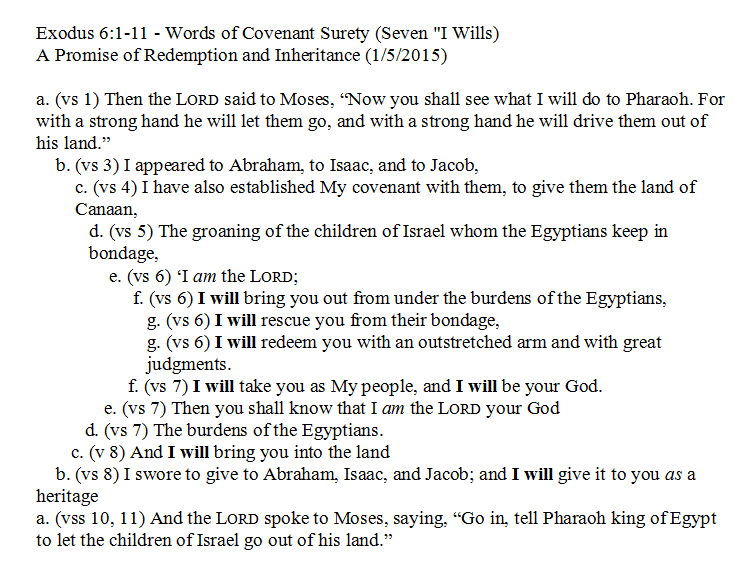
The Chiasm is centered on two parallel thoughts – 1) I will rescue you, and 2) I will redeem you. But even more than that, it encompasses seven “I wills” spoken by the Lord. Time has borne out that the Lord fulfilled His word exactly as He stated.
The last of the seven “I wills” is that He would give the land of Israel to the people as a heritage. Some could claim that this promise failed because they have been kicked out of it twice. Or they might incorrectly state that this promise is fulfilled in the church, not Israel. But both of these would be incorrect.
The land was given to Israel. When they remained obedient to the Lord, it was their land and they could use it. When they were disobedient, it was their land and they could not use it; like a parent withholding a toy from a child. It belongs to them, but they cannot use it until their behavior is corrected. But either way, the land has remained God’s gift to Israel.
Additionally, Israel is Israel and the church is the church. Crossing the two lines only confuses one’s theology. Regardless as to how one feels about Israel, God’s promises to them stand. Those promises, going all the way back to Abraham, are repeated in today’s verses. Now is the time for them to begin to be fulfilled.
We’ll see this as we research out the verses ahead of us today.
Text Verse: “Now therefore, our God,
The great, the mighty, and awesome God,
Who keeps covenant and mercy:
Do not let all the trouble seem small before You
That has come upon us.” Nehemiah 9:32
Trouble has befallen Israel, and the burdens have seemed beyond their ability to bear, even more so since Moses spoke to them the first time. And Pharaoh has already hardened his heart against Moses once as well.
Now he is being told to once again speak to both Israel and Pharaoh. Without understanding the reasons for the first seeming failure, he will feel that he is wholly unqualified for the task set before him.
We too may feel this way about the challenges we face, but it is absolutely certain that if we are in Christ and we are being obedient to Him, whatever seems to be hindering us is there for a reason. Knowing this then must surely help take the stress off of the moment.
Let us be determined that the end we are working towards is being directed by Him, and our steps are carefully selected to meet His final goal. It is a continuing theme of the Bible that speaks to us, so let us apply this truth to our lives at all times. It is a truth found in God’s superior word. And so let’s turn to that precious word once again and… May God speak to us through His word today and may His glorious name ever be praised.
I. The Land Grant of Canaan (verses 1-4)
The last words of the previous chapter were those of Moses. He was practically in a state of desperation over the treatment he had received from the officers who were over the people of Israel. They complained against him because he caused them to receive the same grief that the common people had suffered.
Despite their leadership status, they had been first and foremost lumped in with their own people. It formed a picture of the future when the political and spiritual leaders of Israel will be in bed with the anti-Christ, thinking that they will be safe from persecution through their faithfulness to the one-world religion and government – something that is beginning to happen before our eyes in today’s world.
But they will find this to be false. They will be persecuted as Jews because they are Jews. And so they will come to understand that they need true deliverance as well. Their false hope in the antichrist will prove to be just that… false hope.
After all that occurred, Moses was distraught and he cried out to the Lord with these finishing words of chapter 5 –
“So Moses returned to the Lord and said, ‘Lord, why have You brought trouble on this people? Why is it You have sent me? 23 For since I came to Pharaoh to speak in Your name, he has done evil to this people; neither have You delivered Your people at all.'” Exodus 5:22, 23
That appeal to the Lord has now set up the response of the Lord which is found in our first verse of the day…
1 Then the Lord said to Moses, “Now you shall see what I will do to Pharaoh.
In response, the Lord promises action “Now.” There was a delay which Moses didn’t understand, but taken in the context of the previous chapter, it is clear. The people weren’t ready to be delivered. The officers over them had their allegiances tied to Pharaoh, not toward the people under them.
Until they realized that they were no different, but instead needed the Lord, the affliction continued. This precept is found explicitly stated by Peter, who is writing to the Jews of the end times, and so the pattern fits perfectly. Here’s what he said –
“The Lord is not slack concerning His promise, as some count slackness, but is longsuffering toward us, not willing that any should perish but that all should come to repentance.” 2 Peter 3:9
Sure enough, he had withheld action until repentance was possible. There was a need to refine the people in preparation for the exodus. The account shows us that even after the exodus, many of the people continuously rebelled against the Lord. They had seen all of His wonders, and yet their hearts continuously turned back to Egypt at the slightest experience of discomfort.
As this is so, how much worse would they have acted if the Lord hadn’t allowed them time to more fully rely on Him. It is the constant theme of the workings of the Lord, He does things that at first seem hard to understand, but later become clear. This is why even on the night before the crucifixion, He had to tell His disciples to trust Him.
His words in John 13:7 can be applied to His actions before the people here at the time of the Exodus –
“What I am doing you do not understand now, but you will know after this.”
The ways of the Lord are perfect, and His timing is always exact in order to meet His intended purposes. Pharaoh would be dealt with, it would be now, and Moses would see it with his own eyes.
1 (con’t) For with a strong hand he will let them go, and with a strong hand he will drive them out of his land.”
Some translations make it seem that the “strong hand” He is speaking of could be the hand of Pharaoh as he drives the people from the land. This is certainly not the intent. Rather it is the work of the Lord which is being referred to. The NIV translates this very clearly by saying –
“Now you will see what I will do to Pharaoh: Because of my mighty hand he will let them go; because of my mighty hand he will drive them out of his country.”
It is a less literal translation, but it is certainly a more accurate one. The strong hand of the Lord on behalf of His people is seen time and again in Scripture. A great parallel to this is found in Jeremiah. There the Lord again promises to redeem the people and return them to the land of Israel –
“For the Lord has redeemed Jacob,
And ransomed him from the hand of one stronger than he.
12 Therefore they shall come and sing in the height of Zion,
Streaming to the goodness of the Lord—
For wheat and new wine and oil,
For the young of the flock and the herd;
Their souls shall be like a well-watered garden,
And they shall sorrow no more at all.” Jeremiah 31:11, 12
2 And God spoke to Moses and said to him: “I am the Lord.
This verse follows the same pattern that was seen back in Exodus 3:1. There it said, “..when the Lord saw that he turned aside to look, God called to him from the midst of the bush.” In other words, the term “God” and “Lord” are used in the same verse.
However, the translation is much, much better rendered as “I am Yehovah” instead of “I am the Lord.” Otherwise, when we get to the next verse, it won’t have the same effect and force. As readers of English versions, the word “lord” can be used in many ways, but the name Yehovah means only one thing.
For the most part, I have no problem with the name Yehovah being translated as LORD, but there are times when clarity demands the name be given. This is one of those times. He is declaring His name. It is the same name He gave at the burning bush, and it is a declaration to Moses that He will perform what He has spoken.
3 I appeared to Abraham, to Isaac, and to Jacob, as God Almighty, but by My name Lord I was not known to them.
What this means is that the way that God expressed Himself to Abraham, Isaac, and Jacob was as El Shaddai, or God Almighty. His words to them were words of covenant faithfulness and great fruitfulness. The title Yehovah wasn’t actually unknown to them, but the full import and weight of the name wasn’t understood.
Now He has revealed it as more than a title; it is His name. As a name expresses behavior and being, it signifies that He is the Existent One. It appears that the reason He waited until this time to finally reveal His name in this way was because of the idolatry and polytheism which surrounded Israel and to which even Israel had fallen prey to.
By now proclaiming Himself as the Existent One, He was revealing to them the truth that there is but One God and that He was it. No other god is a god, but is rather a false god. The Lord waited for over 2500 years of human existence to reveal Himself in this way for a reason.
That reason is that this group of people is being prepared for an encounter with Him where He will reveal His holiness to them. They will learn that this One true God has certain standards which He cannot compromise. In order for the world to learn this, He will use this group of people as an object lesson to learn from.
Before that meeting takes place, however, this One true God will prove Himself against the false gods of Egypt. The ten plagues on the ten false god’s of Egypt are emblematic of the final destruction of all the false gods of the world in the end times. Each step of how God reveals Himself is taken with purposeful care.
4 I have also established My covenant with them, to give them the land of Canaan, the land of their pilgrimage, in which they were strangers.
It needs be understood that the words of promise encompass everything from verse 2 to verse 8. God appeared to the fathers as El Shaddai and He established the covenant with them. That covenant was to give them the entire land of Canaan which was the land of their pilgrimage.
They never possessed the land, but rather lived there as strangers. God gave Abraham the reason why they couldn’t possess the land at that time, which was because the Amorites who lived there had not yet reached their full level of iniquity.
In His grace, He gave them 400 years before bringing in Israel to destroy them and assume the land as their own. And before that would occur, Pharaoh and Egypt would be judged as well. But again, this is given not only as a historical account, but as a lesson of the work of Christ all the way through to the end times.
God promised to never destroy the world by flood again even though the inclination of man’s heart is evil all the time. Instead, God will judge the world through the plagues of Revelation and the land of Canaan will be where Christ returns to; He being the true Israel returning to the land of promise. Every story in the Bible is used to show us patterns of future history.
The Land of Israel is for the people of God
It is defiled by those who are unholy
And so may God’s people in righteousness trod
When they enter His land, so may it be
Let all of God’s people walk rightly each day
Let each of us be examples for others to see
In our actions, let us holiness display
And may justice spread out like branches of a tree
This we petition, and for this we pray
O God, let us always walk in Your holy way
II. I Have and I Will (verses 5-9)
In verse 5, the Lord will say “I have” twice. And then from verses 6-8, He will say “I will” seven times. The Lord is aware and the Lord will perform.
5 And I have also heard the groaning of the children of Israel whom the Egyptians keep in bondage, and I have remembered My covenant.
This is almost a repetition of the thought which came at the end of Exodus 2. There, just before the account of Moses leading his flocks to Horeb, which was a picture of the rapture of the church, and which was immediately followed by the account at the bush, it said this –
“Then the children of Israel groaned because of the bondage, and they cried out; and their cry came up to God because of the bondage. 24 So God heard their groaning, and God remembered His covenant with Abraham, with Isaac, and with Jacob. 25 And God looked upon the children of Israel, and God acknowledged them.” Exodus 2:23-25
The Lord is giving Moses a full accounting of what has transpired, even from the time of Abraham until the time of his own calling. Moses asked why all the trouble had come upon the people since he arrived in Egypt, and he reminded the Lord that nothing had been done about it.
Without explaining the reason directly, he has indirectly shown Moses that there is a time and a place for everything and that the proper time had now arrived. Certain things had to happen which Moses was unaware of and he needed to trust that all was occurring as it should. It is an appeal to Moses to have faith.
6 Therefore say to the children of Israel: ‘I am the Lord; I will bring you out from under the burdens of the Egyptians, I will rescue you from their bondage, and I will redeem you with an outstretched arm and with great judgments.
The redemption, or purchase, of the people of Israel is mentioned for the very first time in this verse, and it will continue to be used throughout Scripture. This is actually accomplished in two separate ways. The first here is noted in the great judgments that the Lord will perform.
They will go from slavery to the Egyptians to being servants of God through these judgments. This is the first time that these judgments are referred to, and the word will be used sixteen times in the Old Testament. God will use such judgments both for and against Israel and others in the future as He deals with their sin.
The second way Israel will be redeemed is when they are led through the Red Sea and are forever delivered from the death that pursued them. It is, in essence, being “purchased anew.” (Ellicott)
These two types of redemptive acts picture our own salvation by first being delivered from the power of the devil and then being delivered from the presence of sin. It is a pattern which Paul explains in the book of Romans.
Finally, one more term is used in this verse for the first time. It is the “outstretched arm” of the Lord. It is a term that will be used repeatedly concerning the Lord in the Bible after this and it makes an obvious picture.
When a man desires to show His strength or to defeat an enemy, he will stretch his arms out. In this one stance, he will both defend some and work against others. This is what the Lord says he will do with His outstretched arm. He will redeem Israel and destroy Egypt.
7 I will take you as My people, and I will be your God.
Later in Exodus 19, the term segullah will be used to describe Israel. They are considered a peculiar possession who belong to the Lord. He has taken them as His people in order to fulfill the promises that He made to Abraham, Isaac, and Jacob.
However, this idea of the Hebrews being a special possession to God doesn’t in any way imply that He had abandoned the rest of the people on earth. Throughout the Old Testament, and even in the New before Christ’s cross, people are noted as joining to God, or being given particular favor by Him.
The selection of Israel is a demonstration of God’s wisdom for a multitude of reasons. One was to have a people set aside to usher in the Messiah. Another was to show that a chosen people, who were set apart to live under God’s standards, were still unable to meet those standards.
Through Israel, the world would learn two important lessons. 1) The law cannot save anyone. Instead it only shows how utterly sinful sin is, and 2) It was used to show the world their absolute need for Christ, who was to come through the very people who proved these two points.
In this selection of Israel to be God’s people, He is fulfilling His promises and He is also demonstrating what His name implies, which is that He is able to perform His spoken word. Their later unfaithfulness in no way negates His faithfulness. In fact, it only highlights it as He has remained faithful to them all along.
7 (con’t) Then you shall know that I am the Lord your God who brings you out from under the burdens of the Egyptians.
In performing His word, the people will know that He is, in fact, the One He claims to be, and that He has done exactly what He said He would do. But again, there is the immediate understanding of these words and there is a prophetic fulfillment of them. If these verses only pertained to Israel, then it would actually be a failure of the greater plan of redemption.
Abraham’s promise was one based on faith, and it was given long before he was circumcised. The pattern of being redeemed based on faith then must pertain to all people and not just Israel. It must ultimately be based on the work of the Messiah. And in this verse is a picture of that.
Verses 6 & 7 contain the very last two uses in the Bible of the word siblah, which is translated as “burdens.” All six have been in the book of Exodus. This word siblah comes from another word sabal. It is a word used to describe the work of the Messiah in Isaiah 53:4 and 53:11 –
Surely He has borne our griefs
And carried our sorrows;
Yet we esteemed Him stricken,
Smitten by God, and afflicted. Isaiah 53:4
&
He shall see the labor of His soul, and be satisfied.
By His knowledge My righteous Servant shall justify many,
For He shall bear their iniquities. Isaiah 53:11
This word, siblah, is being used for the last time to show that the burdens are lifted in the work of the Lord. And so it is with Christ. The burden of our sins is taken from us when we call on Him. Although these stories might seem distant and quaint, they are words which are near and right now. They picture the eternal gospel which proclaims that the Lord, not our deeds, is what rescues us.
I have carefully noted this unique word, siblah, in each account in which it was used, and now you know why. Our burdens are lifted in Christ, all pictured here in Exodus.
8 And I will bring you into the land which I swore to give to Abraham, Isaac, and Jacob; and I will give it to you as a heritage:
The imagery of the Hebrew is much more exciting than the English. It says, nasathi eth yadi – “I have lifted up my hand.” Yes, to lift one’s hand implies to “swear,” but in many translations we miss the action and the mental pictures which the Hebrew portrays.
Three promises have now been given concerning what the Lord will do. The first is that He will deliver His people from bondage. The second is to take the Hebrew people as His own; in essence, to adopt them. And the third is to bring them into the land of Canaan and give it to them as a heritage.
This is true at the time of the Exodus, and it is true of the end times which Exodus pictures. But it is also true in the greater picture of the Lord and His church, who are those who have crossed over from death to life. Let’s see it from the New Testament. He has promised to deliver us from bondage to sin which ends in death, and He has done it. Hebrews 2 says –
“Inasmuch then as the children have partaken of flesh and blood, He Himself likewise shared in the same, that through death He might destroy him who had the power of death, that is, the devil, 15 and release those who through fear of death were all their lifetime subject to bondage.” Hebrews 2:14, 15
He has promised to adopt us as His people and He has done it. Galatians 4 says –
“But when the fullness of the time had come, God sent forth His Son, born of a woman, born under the law, 5 to redeem those who were under the law, that we might receive the adoption as sons.” Galatians 4:4, 5
And He has promised us heaven, and it is accomplished, we are just waiting on its actualization. Ephesians 2 tells us this is so –
“But God, who is rich in mercy, because of His great love with which He loved us, 5 even when we were dead in trespasses, made us alive together with Christ (by grace you have been saved), 6 and raised us up together, and made us sit together in the heavenly places in Christ Jesus.” Ephesians 2:4-6
This exodus story shows us history, but it also shows us the present and the future. It is the continuing pattern of the Bible –
“That which has been is what will be,
That which is done is what will be done,
And there is nothing new under the sun.” Ecclesiastes 1:9
8 (con’t) I am the Lord.’”
Ani Yehovah – “I (am) Yehovah.” “My name is my guarantee. What I have said is inviolable because I am the Existent One. My words cannot fail because I encompass time. What I have spoken is already performed and is merely waiting for your present to catch up with that future where I already exist.”
9 So Moses spoke thus to the children of Israel; but they did not heed Moses, because of anguish of spirit and cruel bondage.
Proverbs says, “Hope deferred makes the heart sick” (Proverbs 13:12). The first time they heard the news from Moses, the Bible says that –
“…the people believed; and when they heard that the Lord had visited the children of Israel and that He had looked on their affliction, then they bowed their heads and worshiped.” Exodus 4:31
At that time, Moses presented to the people the three signs which He was granted from the Lord. Those signs, accompanied by the word of the Lord, were all the people needed to believe. But the signs were forgotten and the word lost its significance. Now, instead of hope, they don’t even heed.
And the reason is because of the anguish of the spirit. In Hebrew the words are kotzer ruach which is literally a “shortness of spirit” or a “shortness of breath.” The suffering was so continuous and burdensome that there wasn’t time for the people to breathe, much less revive their spirits.
It is an exacting picture of what could be expected in the end times. As the world falls apart, there will be few who will remember the promises of the Lord, but the Lord would ask for them to persevere, even through the times of despondency.
Where is your hope and in whom do you place your trust?
What will you do when the world around you shatters?
Place your hope in the Lord, who is faithful and just
Abiding in His truth is, in the end, all that matters
To place your hope in man is like air passing through a vent
To place your hope in money is a terrible dark pit
When man has failed you and your money is all spent
What meaning is found in your life? Please don’t do it
Instead, place your hope in the Lord, so I say
You will be found safe and secure for all eternity
Place your hope in the Lord, Yes! Do it today!
And then watch history unfold, great things you will see
III. Who will Heed The Word of the Lord? (verses 10-13)
10 And the Lord spoke to Moses, saying,
At times, verse numbers are given which don’t seem to make sense. Why would it stop in the middle of a sentence and begin a new verse? Six other times in this chapter alone, this type of introduction is used and all six of them contain a complete sentence.
And the last time is in verse 28 which is a recap of this verse, and yet it isn’t divided as this one is. Only this once is the sentence divided into two verses. What seems to be the reason is that it shows a contrast between what was just said and what is coming.
The people of Israel didn’t heed Moses in the last verse and yet Moses is instructed to speak to Pharaoh in the next verse. The words “And the Lord spoke to Moses, saying” are given for our benefit. Everything that was spoken from verse 2 to verse 8 is what the Lord said.
Verse 9 tells us that Moses repeated it to Israel and they didn’t heed. And now, without any other words between the directives, the next thing Moses will hear is another command to do something even more difficult that what he just did. Therefore, this portion of a sentence is more pertinently highlighted by being offset from the words to come, which are…
11 “Go in, tell Pharaoh king of Egypt to let the children of Israel go out of his land.”
The last time Moses went before Pharaoh to speak the word of the Lord, he said, “Thus says the Lord God of Israel: ‘Let My people go, that they may hold a feast to Me in the wilderness.’” Now, no reason is given and no limitations on where they would go are made. Instead it is a fixed demand to let them go out of His land.
What becomes clear in this is what the Lord said to Moses before he departed for Egypt in Exodus 4:21 –
“But I will harden his heart, so that he will not let the people go.”
The first visit to Pharaoh was a mild request which could have been easily granted. No signs were given and no power was displayed before Pharaoh. By coming in this manner, the Lord has already hardened Pharaoh’s arrogant heart to any future demands.
Now, when a demand rather than a request is made, it will certainly be met with greater resistance. And as the plagues come, they will come from lesser to greater plagues. Each step is calculated to only harden Pharaoh’s heart further and thus magnify the work of the Lord.
Unfortunately for Pharaoh, he should have been more lenient at the beginning and saved himself the wrath of God at the end. It is a valuable lesson for all people. As Ellicott says about this –
“If we refuse a light cross, a heavier cross is laid on us. If we will not close with the Sybil on the first occasion, she offers us a worse bargain on the second.” Charles Ellicott
12 And Moses spoke before the Lord, saying, “The children of Israel have not heeded me. How then shall Pharaoh heed me,
The people of Israel had seen the signs of the Lord. They had been convinced once of the surety that their freedom was at hand. And yet they had forgotten those things and were left in the shortness of their breath as their bondage continued.
As this was so, and as both Moses and the Lord knew this, the question to the Lord is all the more pertinent. Certainly one who didn’t believe the first time, and who was both insolent and deaf to that command, would respond even more negatively than those who at first openly welcomed His words.
But this is exactly what was intended by the Lord. Moses has just failed to see it from the Lord’s vantage point.
12 (con’t) for I am of uncircumcised lips?”
In verse 4:10, Moses said he was “slow of speech and slow of tongue.” His words here expand on that. He says he is “of uncircumcised lips.” It is as if he had a foreskin over his mouth which hindered his tongue. It is a claim that his speech makes him unqualified to perform the duty he has been directed to perform.
In Genesis 17, any person who was uncircumcised was outside of the covenant of God. In Leviticus 19, fruit which was unacceptable as food was considered uncircumcised. In Leviticus 26, hearts that are uncircumcised are hearts which are guilty before the Lord. And in Jeremiah 6:10, an uncircumcised ear is one which will not heed the word of the Lord.
To be circumcised means to be right, acceptable, and pure. And so to be uncircumcised meant that his words would be considered impure and unacceptable. Because Aaron has already been assigned as his speaker, Moses has now made the assumption that even what he transmits to Aaron is defiled and thus it is the reason why both Israel and Pharaoh have rejected his words.
Said differently, Moses is intimating that he has a defect which is actually a moral hindrance to the plans and words of the Lord. His petition isn’t because of a fear of personal danger, but of being the cause of failure in what the Lord intended. It is the honor of the Lord that he is concerned about.
This is exactly the same sentiment found in Isaiah 6 –
“In the year that King Uzziah died, I saw the Lord sitting on a throne, high and lifted up, and the train of His robe filled the temple. 2 Above it stood seraphim; each one had six wings: with two he covered his face, with two he covered his feet, and with two he flew. 3 And one cried to another and said:
‘Holy, holy, holy is the Lord of hosts;
The whole earth is full of His glory!’
4 And the posts of the door were shaken by the voice of him who cried out, and the house was filled with smoke.
5 So I said:
‘Woe is me, for I am undone!
Because I am a man of unclean lips,
And I dwell in the midst of a people of unclean lips;
For my eyes have seen the King,
The Lord of hosts.'” Isaiah 6:1-5
Like Isaiah, Moses had personally experienced the majesty of the Lord and he assumed that he had failed him. The command to speak to Pharaoh brought him to a new low as he only contemplated more failure would come from him.
*13 Then the Lord spoke to Moses and Aaron, and gave them a command for the children of Israel and for Pharaoh king of Egypt, to bring the children of Israel out of the land of Egypt.
Without any prior introduction of Aaron in this account, and no mention of him since near the end of the previous chapter, he is suddenly named in this verse. Moses spoke, the Lord heard, and the Lord acted.
To show Moses that he is qualified for the task, he now speaks to both Moses and Aaron together. And he does it not just for speaking to the obstinate Pharaoh, but to the disheartened children of Israel. It is a command to both parties and it is to be carried out.
In both verse 11 and this verse, Pharaoh is called “king of Egypt.” And yet the title wasn’t given in verse 1 or verse 12. Why would this be? The reason is that in verse 11 and here, the children of Israel are mentioned. In other words, there is a contrast which the Bible is asking us to see.
Though Pharaoh is the king of Egypt, he is not the king of Israel. Thus the title is specifically mentioned when they are mentioned. This follows perfectly with the idea of the kingdom of Christ in contrast to the kingdom of this world, ruled by the devil. This contrast is made between the two until the final pages of the Bible when it says in Revelation –
“The kingdoms of this world have become the kingdoms of our Lord and of His Christ, and He shall reign forever and ever!” Revelation 11:5
Following little hints like the terminology used when speaking of or to Pharaoh shows us greater patterns of what God has done and what He continues to do in the world. Never be afraid to stop and think on these types of things because what may seem unimportant never is. And what seems like a passing thought can often lead to the greatest of discoveries.
Our verses for today have ended and yet they continue on in our lives from moment to moment. The pictures of the Lord, Moses, and Israel, and their interactions with Pharaoh picture our own interaction between Christ and the devil.
If we remember that the eternal truths found in these ancient stories are given to remind us of that, they become all the more relevant to our own lives, and the lives of those around us who still have not called out to Christ.
We are either under the rule and authority of the devil in his world of sin, pictured by Pharaoh and the kingdom of Egypt, or we are under the rule and authority of Christ. Someday, just like Egypt, this world will be destroyed through judgment. Those who don’t belong to Christ will be destroyed with it.
If you’ve never made a commitment to the Lord, stop rebelling and start yielding. Open your heart, open your eyes, and call out to Him. He is mighty to save. Let me tell you how you can receive Christ, even today…
Closing Verse: “Cast your burden on the Lord,
And He shall sustain you;
He shall never permit the righteous to be moved.” Psalm 65:22
Next Week: Exodus 6:14-30 (The Family of Moses and Aaron ) (17th Exodus Sermon)
The Lord has you exactly where He wants you. He has a good plan and purpose for you. Even if a deep ocean lies ahead of You, He can part the waters and lead you through it on dry ground. So follow Him and trust Him and He will do marvelous things for you and through you.
I Will Rescue and I Will Redeem
Then the Lord said to Moses
Now you shall see what I will do to Pharaoh
With a strong hand he will drive them out of his land
With a strong hand he will let them go
And God spoke to Moses this word
And said to him: “I am the Lord
I appeared to Abraham, to Isaac, and to Jacob, as God Almighty
To their eyes, this is how I was shown
But by My name Lord
To them I was not known
I have also established My covenant with them
To give them of Canaan the land
The land of their pilgrimage
In which they were strangers beforehand
And I have also heard the groaning
Of the children of Israel
Whom the Egyptians keep in bondage
And I have remembered My covenant as well
Therefore say to the children of Israel:
I am the Lord; I will bring you out
From under the burdens of the Egyptians
I will rescue you from their bondage, no doubt
And I will redeem you, I will not hesitate
With an outstretched arm and with judgments great
I will take you as My people and I will be your God
Then you shall know that I am the Lord
Your God who brings you out from under
The burdens of the Egyptians, this is my sure word
And I will bring you into the land
Which I swore to give to Abraham, Isaac, and Jacob too
And I will give it to you as a heritage:
I am the Lord, this I will certainly do
So Moses spoke thus to the children of Israel
But they did not heed Moses because
Of anguish of spirit and cruel bondage
This is what being disheartened does
And the Lord spoke to Moses, saying
“Go in, tell Pharaoh, Egypt’s king
To let the children of Israel, as I am relaying
Go out of his land, tell him to do this thing
And Moses spoke before the Lord, saying
“The children of Israel have not heeded me
How then shall Pharaoh heed me, I am praying
For I am of uncircumcised lips as you already see
Then the Lord spoke to Moses and Aaron
And gave them a command
For the children of Israel, and for Pharaoh king of Egypt
To bring the children of Israel out of Egypt the land
Once again, the words have been carefully selected
To show us of the great work of the Lord
In each word and in each verse can be detected
Greater pictures found in His superior word
O God, with such attention and such care
How could we quickly pass through without careful note?
When you have been so meticulous everywhere
And in every word You did Your wisdom upon us dote
Grant us hearts that desire to see every detail
Grant us eyes that can see Your precious Son
Even if we have to go slow as a snail
Let us not miss a thing, no – not even one!
Thank You for this wonderful book
And all the joy it reveals to us
Remind us daily to open it and upon its pages look
And to seek out there our precious Lord Jesus
Hallelujah and Amen…