1 Corinthians 15:34

150328_governor_office

Saturday, 28 March 2015

 Awake to righteousness, and do not sin; for some do not have the knowledge of God. I speak this to your shame. 1 Corinthians 15:34

Paul now sums up the entire passage of 1 Corinthians 15 thus far. After this, he will head in a slightly different direction while still speaking of the resurrection. But here, after concluding his defense of the resurrection, he provides a stinging rebuke intended to keep the Corinthians (and thus us!) from heading down the path of doubt or heresy again.

In doing so, he begins with “Awake.” The Greek word is eknepho. It is used only this once in the New Testament and can be rightly translated as “sober up!” It is indicates awakening as if from a drunken stupor. When someone is tired, they may be naive about a matter but still able to think clearly. However, when in a drunken stupor, right thinking isn’t possible. He had given all of the evidences and defenses necessary concerning the resurrection. Now they needed to soberly process them.

He continues on with “to righteousness.” This is an adverb and so the thought is more appropriately rendered, “Sober up righteously.” He is asking them to come to a state of sound doctrine and to live by it. In order to do so, he further implores them by saying, “and do not sin.” The implication here (which should be taken as an axiom) is that bad doctrine is sin.

When one is presented with proper doctrine, and they either reject it or are unwilling to take the time to understand it, they err. Nobody will be able to say, “I just didn’t have time to learn the truth.” Man finds time for every unnecessary thing on earth, but fails to make time for knowing, fellowshipping with, and being obedient to his Creator. This is sin.

To confirm that “do not sin” is tied to proper doctrine, he next says, “…for some do not have the knowledge of God.” In particular, he is speaking about those in verse 12. There he said that “some among you say that there is no resurrection of the dead.” As the resurrection is one of the principle doctrines of the faith, to believe such rubbish, or to teach it, is sin.

People come along all the time making unfounded statements about Christianity, either purposefully or out of incompetence. To listen to such people can only lead down Heresy Highway and then on to Apostasy Avenue. And so to be caught up in their lies shows a true dullness of mind. In order for them to realize this, he says, “I speak this to your shame.” He is speaking to the entire church at Corinth, but also to each individual. And because his words are recorded in the Bible, he is speaking to all churches and all individuals.

We are all individually responsible for our doctrine. It is true that teachers are more so (see James 3:1), but everyone should at least know the basics of the faith. When a cult comes knocking at the door, there should be enough knowledge of Scripture to tell them to beat it and stop teaching falsities.

Life application: What is of most value to you in this life? Everything we possess and everything we do is temporary and will eventually disappear into obscurity… except our relationship with the Lord. And the only way to properly understand this relationship is through knowing Scripture. If you aren’t reading it and studying it constantly, you are showing great disrespect to the Lord who gave it to you.

The most precious treasure I could ever own sits by my bed getting dusty. And yet I wouldn’t allow such neglect if my car was getting rusty. The book which holds all of the answers that I need; this is ignored for other things… I pass it by with speed. The word of God which will be opened on that great Judgment Day; it is carelessly overlooked so that I can play. Forgive me for such neglect; in my soul great sin I detect. Please O God help me get my priorities right; and to pursue Your word as my highest delight. Amen.



1 Corinthians 15:33

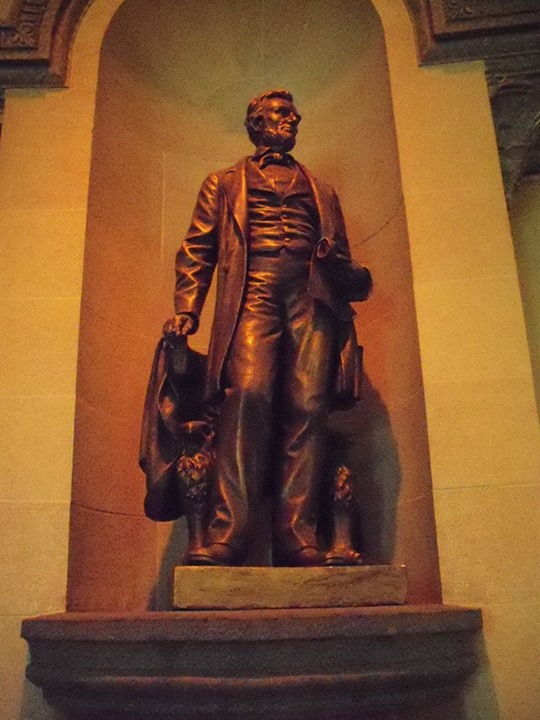
150327_abe

Friday, 27 March 2015

 Do not be deceived: “Evil company corrupts good habits.” 1 Corinthians 15:33

This verse refers all the way back to verse 12, which Paul then went on to argue against for the next many verses. There in verse 12 he asked, “Now if Christ is preached that He has been raised from the dead, how do some among you say that there is no resurrection of the dead?” From there, he defended the truth of a literal, bodily resurrection. In order for them to stop listening to contrary arguments which can only pervert the simplicity of the gospel, he tells them first, “Do not be deceived.”

Anything which is not in line with the gospel that was presented to them (see 1 Corinthians 15:1-8) is to be considered a deception. If one were to listen to such nonsense, it could only negatively affect them. In order to help them understand this, he says “Evil company corrupts good habits.” This is an iambic line from Thais by Menander. It would have probably been a commonly quoted maxim by those in Corinth and so Paul uses it to help them remember the warning.

In this quote, the word for “company” includes the idea of communications as well as associations. We pick up bad habits from those we closely align ourselves with. Also in this quote, the word “habits” comes from the Greek word homiliai. It is only used this once in the New Testament and it refers to a place where one is accustomed to hang out or sit at. In the plural then, it leads to the thought of morals, manners, and character.

Life application: In 1 Corinthians 5:9-11, Paul indicates that we can associate with worldly people who act in a manner which is not Christ like. However, he now shows that becoming too closely attached to them, or anyone who would draw us away from the truth of Christ, is not healthy. There must be a appropriate balance in our associations in order to stay strong and properly attuned to the things of Christ.

Lord, grant me the wisdom to know how closely I can associate with others without compromising my walk with You. I live in this world, but I don’t want to be overcome by it. Help me to know when it is time to separate from conduct which could weaken my walk with You, and give me the will to follow through with what I know to do. Thank You Lord for watching over me in this way. Amen!


1 Corinthians 15:32

150326_stairway_lampstand

Thursday, 26 March 2015

If, in the manner of men, I have fought with beasts at Ephesus, what advantage is it to me? If the dead do not rise, “Let us eat and drink, for tomorrow we die!” 1 Corinthians 15:32

This completes Paul’s thoughts which are tied to verse 29 concerning the difficult words “baptized for the dead.” In that verse, he noted “…if the dead do not rise at all? Why then are they baptized for the dead?” He again ties in the same thought concerning the dead rising now. In preparation for that, he explains what he meant in the preceding verse which said, “I die daily.”

Putting it in the form of a question, he asks, “If, in the manner of men, I have fought with beasts at Ephesus, what advantage is it to me?” First, “in the manner of men” is speaking of his mortal nature. It is a nature which can and will die. It could come about by any event, from a mild infection turning into a greater one, to a sudden heart attack, or even to an external disaster such as being run over by a stampede of bulls.

Life is tenuous and it can end in a myriad of ways. And so to stress the foolish nature of living a life for Christ if the dead do not rise, he uses a real-life example which could have lead to his death and which was not accidental, but purposeful. That example is fighting “with beasts at Ephesus.” It is unknown here whether Paul is speaking of literal beasts, or if he is speaking figuratively. The book of Acts, and his other writings, tells us nothing of him fighting with literal beasts, and so this is probably a figurative term for people who fought rabidly against him. This type of speaking is common in the world and even in the Bible. In just one psalm, there are three examples of it –

“Many bulls have surrounded Me;
Strong bulls of Bashan have encircled Me.
13 They gape at Me with their mouths,
Like a raging and roaring lion.” Psalm 22:12, 13

“For dogs have surrounded Me;
The congregation of the wicked has enclosed Me.” Psalm 22:16

“Deliver Me from the sword,
My precious life from the power of the dog.
21 Save Me from the lion’s mouth
And from the horns of the wild oxen!” Psalm 22:20, 21

Paul even comments that he was “delivered from the lion’s mouth” in 2 Timothy 4:17, certainly speaking metaphorically. Additionally, as a Roman citizen, he would not have been subject to fighting beasts in an amphitheater. Therefore, the probability is that he is speaking figuratively. This then would be in contrast to “in the manner of men” that he opened this verse with.

Regardless of this, whether real beasts or enemies with the characteristics of beasts, if he willingly put his life in peril in such a manner, knowing that the dead do not rise, it would be an utterly foolish gesture. If life is tenuous on a good day, how much more so when one eagerly steps into harms way; and that for a cause which he would have known to be false.

Rather than such a foolish waste, it would be so much better to follow another path – “Let us eat and drink, for tomorrow we die!” If the dead are not raised, then this life is all we have. Wouldn’t it be better to party the time away and do all the things that we wanted to regardless as to whether they were moral and proper? Wouldn’t it be better to get all one could get, experience all one could experience, and live life to the fullest? If this one life is it, then why not make the best of it.

And to show even more forcefully that this is the case, he cites a portion of Isaiah 22. In that passage, Isaiah speaks of Jerusalem being hemmed in by enemies, ready to be destroyed. For the people inside, they made a choice. Rather than reaching out to God in repentance because of their sin which caused the destruction to come, and rather than asking for His powerful hand to have mercy and save them, they turned to tables full of food for one last delightful meal. Here is the account, which contains the verse cited by Paul –

“And in that day the Lord God of hosts
Called for weeping and for mourning,
For baldness and for girding with sackcloth.
13 But instead, joy and gladness,
Slaying oxen and killing sheep,
Eating meat and drinking wine:
‘Let us eat and drink, for tomorrow we die!’
14 Then it was revealed in my hearing by the Lord of hosts,
“Surely for this iniquity there will be no atonement for you,
Even to your death,” says the Lord God of hosts.” Isaiah 22:12-14

The utterly disrespectful attitude of those in Jerusalem was so brazen that the Lord said their sin would never be atoned for. Even if they lived through the siege, they would never be forgiven. Paul uses their words as the ultimate example of futility in a life without hope of the resurrection. If there is no resurrection, then there is also no atonement. If there is no atonement, then the prospects of meeting God are to be considered utterly futile. Only condemnation awaits the departed soul.

This line of reasoning by Paul explains the difficult meaning of “baptized for the dead” in verse 29. “What will they do who are baptized for the dead, if the dead do not rise at all?” The answer is, “They will perish like all flesh.” Without the resurrection, there is no hope at all. But because Christ is risen, there is hope and therefore there is a reason to put oneself in harm’s way. With Christ, every action we take has purpose if it is done in the hope of the resurrection.

Life application: Instead of “Let us eat and drink, for tomorrow we die,” our attitude should be “Let us rejoice, for our souls live… even if we die.”

O my wondrous God! As I think on the resurrection of Christ and what it means for me, I lose all fear in this life. What can man do to me? What can sickness take from me? What heartache can I not endure? All of these things are temporary and will be replaced with joy everlasting. Every tear shall be wiped away as eternity unfolds before me. What can steal my joy? Notta thing! No fear here. I am in Christ. Amen!


1 Corinthians 15:31

150325_marble_column

Wednesday, 25 March 2015

I affirm, by the boasting in you which I have in Christ Jesus our Lord, I die daily. 1 Corinthians 15:31

The difficulty of verse 29 is partially explained in this verse. Paul noted those who are “baptized for the dead.” He tells us now, as an affirmation (“I affirm”) a note concerning the surety of hope that the believer possesses in Christ. This follows directly from his words of verse 30 which told us that he stood “in jeopardy every hour.” As follow-on to that, he says, “…by the boasting in you which I have in Christ Jesus our Lord, I die daily.”

The “boasting” he notes concerning the Corinthians is noted in 2 Corinthians 9:3 also. They are his converts and the people of the church he helped to establish. He had suffered greatly for them, placing his life in jeopardy for their sake as much as for the sake of any other churches he was involved in. They were as children to a father to him.

This boast of Paul is then noted as “in Christ Jesus our Lord.” Those who have called on Christ are “in” Christ. They have moved from death to life. And yet, he says “I die daily.” He put himself on the line for their sake through many trials and sufferings. Of these trials and sufferings, any could result in his actual death, and so he metaphorically says, “I die daily.” What would be the point of such a life if the hope of the resurrection wasn’t true? And thus, what would be the point of baptism in that hope?

The very nature of baptism is a picture of death in Christ and then being raised to newness of life. Being submersed pictures His death and thus our participation in that. Being raised pictures His resurrection and thus our participation in that. Therefore, Paul’s comment that he “dies daily” has no true and lasting consequences because ultimately he is “in Christ” and he already possesses eternal life.

When those who follow him in his example are baptized, they are so baptized in this same hope. He will continue to explain this in the coming verse.

Life application: If you have received Christ, and you truly believe that you have been granted eternal life, then why should the prospect of facing death in this life really matter? Yes, the thought of physical death can be unnerving, but if our hope in Christ is sure, it is not the end of the story. Should we face death, let us demonstrate the faith we possess in a manner worthy of the promise tied to that faith.

O God! My heart is steadfast and I will not be moved. No matter what trials I face, I will not lose heart, nor will my faith in Christ be diminished. Jesus has overcome death and He will return to raise me up as well some wondrous day, and so even the great enemy of death has no mastery over me. Should he come for me today, I will consider it a welcome rest until I awake to see my Lord’s glorious face. No fear here! Amen.


1 Corinthians 15:30

150324_up_into_rotunda

Tuesday, 24 March 2015

And why do we stand in jeopardy every hour? 1 Corinthians 15:30

Paul now delivers an added note of surety concerning the truth of the resurrection by beginning with the words “And why….” This then is tied to the previous verse concerning being “baptized for the dead, if the dead do not rise at all.” Contrasting “the dead” of the previous verse, he now says “we.” In this, he is speaking of the work of the apostles who risked life and limb in the spreading of the message of Christ.

These men, and those who had heard and decided to follow their path, were known to “stand in jeopardy every hour.” Their lives were constantly threatened as they carried on the work of sharing the gospel. He will conclude this line of reasoning with 1 Corinthians 15:32, but there is much more concerning the difficult lives of the apostles recorded in Acts and in extra-biblical documents as well. Further, in 2 Corinthians 11, Paul writes concerning many of the difficulties he personally faced –

“…..in labors more abundant, in stripes above measure, in prisons more frequently, in deaths often. 24 From the Jews five times I received forty stripes minus one. 25 Three times I was beaten with rods; once I was stoned; three times I was shipwrecked; a night and a day I have been in the deep; 26 in journeys often, in perils of waters, in perils of robbers, in perils of my own countrymen, in perils of the Gentiles, in perils in the city, in perils in the wilderness, in perils in the sea, in perils among false brethren; 27 in weariness and toil, in sleeplessness often, in hunger and thirst, in fastings often, in cold and nakedness— 28 besides the other things, what comes upon me daily: my deep concern for all the churches. 29 Who is weak, and I am not weak? Who is made to stumble, and I do not burn with indignation?” 2 Corinthians 11:23-29

His question is basically, “What would be the point of going through all of this if the resurrection wasn’t true?” It would make no sense. Wouldn’t it be better to follow any path than this one! But they did follow it, because the path ultimately leads to Christ Jesus and the truth that we too shall be resurrected, just as He was, if in fact we believe the gospel message. The real question then should be, “How could somebody not be willing to stand in jeopardy every hour?”

Life application: With Christ, there is hope; without Christ there is none. Be willing to put yourself at risk for the truth of Christ and the sanctity of His superior, most precious word.

Lord God, there are people who would question the sanity of those who are willing to give their lives for the gospel message. Why would anyone put themselves at harm in a hostile world for this word? But Lord, the real question is, “How is it possible that a true Christian would not be willing to stand in jeopardy every moment for it?” Without this message, there is only eternal separation from You. Give me the heart’s desire to be willing to speak out, even at the cost of my own life, for the truth of Your word. Amen.