
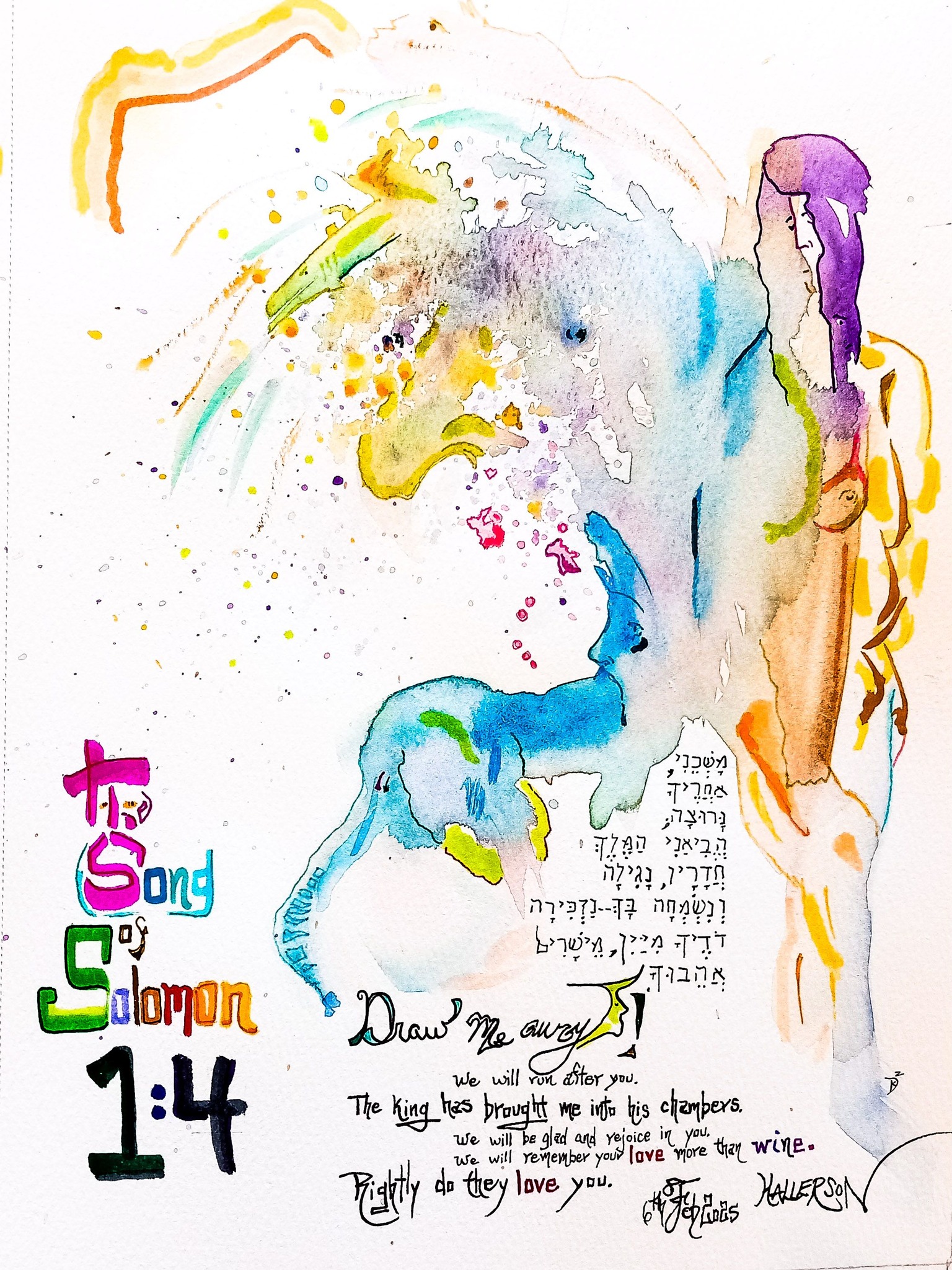
Artwork by Douglas Kallerson
Song of Songs 1:4-6
Draw Me!
(Typed 11 November 2024 – Veteran’s Day). From time to time, I bring up some odd doctrine that is floating around out there in Christian circles. One such doctrine is that of the supposed Black Hebrew Israelites.
Like the Mormons, they claim that they are descendants of the biblical Israelites. But they go further and claim that the Hebrews of the Bible were actually black. They say that those in Israel today are Edomites who have no right to the land.
By pulling verses out of context, they have formed an entire theology that has nothing to do with biblical or historical reality. And yet, if you take them to the Bible to show them where they are wrong, it is like dealing with people in any other cult. They will not only fail to see reason, but they will also get belligerent with you.
Quite often, these people are violent, not only in their theology but in their conduct. But what they propose goes beyond the single idea of religion. It is more a set identifier like being Jewish is. Being Jewish is what identifies Jews before anything else.
Likewise, their idea is that you can be a Black Hebrew Israelite and be a member of any religion. The main thing for them is their blackness and that they supposedly descend from the biblical Jews of the Bible.
The utterly ridiculous nature of the claim is found in several books of the Bible where the Jews are identified, quite clearly, as being light-skinned. At times, it is even contrasted to being dark-skinned to make the point more relevant.
Text Verse: “I drew them with gentle cords,
With bands of love,
And I was to them as those who take the yoke from their neck.
I stooped and fed them.” Hosea 11:4
In Hosea, the Lord says He drew Israel. In the verses today, the woman speaking to her beloved calls out for him to draw her. Then she will speak about a perceived defect that she possessed, about which she is unashamed.
What is it that will cause the Lord to draw people to Himself? Is it skin color? Is it national or cultural status? Or is it simply that we are human, and the Lord calls us because of that? The Bible never speaks of the Lord drawing alligators or birds. Rather, animals are excluded.
Why would some people, like the Mormons or the Black Hebrew Israelites, claim something that they obviously are not? The main reason must be that people think that by co-opting some trait or another God will like them more.
But that is entirely unnecessary. How you look, how many fingers you have, the school you went to, the culture you belong to, or any other category that could separate you within humanity cannot affect how God will perceive you, acknowledge you, or favor you.
This is true with being a Jew or a Gentile. It is true with being black, white, red, yellow, brown, purple, or blue (although if you are one of the latter two, you should probably go to the doctor). These things don’t matter to God.
There is just one thing that causes God to, which is how you respond to the call of the gospel of Jesus Christ. Everything else is unimportant. You are a human. There is no need to try to coopt something in humanity that you don’t have. Just be yourself and come to Christ. In doing so, God will favor you.
This is a certain truth that is to be found in His superior word. And so, let us turn to that precious word once again, and… May God speak to us through His word today, and may His glorious name ever be praised.
I. They Love You (verse 4)
4 Draw me away!
mashkheni – “Draw me!” The verb mashakh here is in the form of an imperative. In essence it is like a positive command or instruction. Hence, the use of the exclamation point for effect.
It is an appeal by the woman to be drawn into the love expressed in the previous verses. She desires loving intimacy with the man and expresses that she wants him to make it happen.
How different that is from the Calvinistic view of being called by God. They stand firmly (and incorrectly) on John 6:44 claiming that man has no choice or free will, in the process of the relationship that is established between God and man –
“Jesus therefore answered and said to them, ‘Do not murmur among yourselves. 44 No one can come to Me unless the Father who sent Me draws him; and I will raise him up at the last day.’” John 6:43, 44
Removing Jesus’ words from the surrounding context, Calvinism says that the process is initiated by God, must be continued (actually forced) by God, and is then completed by God, at which point the individual can exercise free will.
This is known as monergism, coming from mono, one, and erg, work. God alone works in the process of salvation, apart from any action (meaning inherent faith) by man and apart from any will in man.
In essence, as if God were speaking, “There is a person who I want to save. I will actively draw him to Myself, change him apart from his will, and this will cause him to call on Me to be saved.”
To understand this, it says in John 3:3 –
“Jesus answered and said to him, ‘Most assuredly, I say to you, unless one is born again, he cannot see the kingdom of God.’”
Calvinism teaches that being born again is not the same as being saved. Rather, it is a step in the process. God decides who He will save. He then regenerates that person to believe (he is born again). The person then believes and is saved.
Thus, they add an unwarranted step into their doctrine of salvation, meaning the free will of believing is granted by God, but only after God gives new birth.
The Bible never speaks of such a thing. It is contrary to the entire nature of what Scripture says. Rather, being born again is equated with being saved, not a step in the process of salvation. Using John 6:44 in the manner Calvinists do ignores the context of what Jesus was saying.
In John 5, Jesus spoke of the witnesses that testify of Him, four in particular. The witness was to Israel, the stewards of the oracles of God. In that passage, Jesus says –
“If I bear witness of Myself, My witness is not true. 32 There is another who bears witness of Me, and I know that the witness which He witnesses of Me is true. 33 You have sent to John, and he has borne witness to the truth. 34 Yet I do not receive testimony from man, but I say these things that you may be saved. 35 He was the burning and shining lamp, and you were willing for a time to rejoice in his light. 36 But I have a greater witness than John’s; for the works which the Father has given Me to finish—the very works that I do—bear witness of Me, that the Father has sent Me. 37 And the Father Himself, who sent Me, has testified of Me. You have neither heard His voice at any time, nor seen His form. 38 But you do not have His word abiding in you, because whom He sent, Him you do not believe. 39 You search the Scriptures, for in them you think you have eternal life; and these are they which testify of Me. 40 But you are not willing to come to Me that you may have life.” John 5:31-40
John the Baptist came to fulfill the role and ministry of Elijah by testifying to the coming of Christ. When he came, he witnessed to Israel, but so did the words of Scripture which told of his coming –
“Remember the Law of Moses, My servant,
Which I commanded him in Horeb for all Israel,
With the statutes and judgments.
5 Behold, I will send you Elijah the prophet
Before the coming of the great and dreadful day of the Lord.
6 And he will turn
The hearts of the fathers to the children,
And the hearts of the children to their fathers,
Lest I come and strike the earth with a curse.” Malachi 4:4-6
The amount of drawing of Israel to Jesus is incomprehensible, and yet, they were not drawn to Him. They rejected (implying free will) the testimony of John –
“And when all the people heard Him, even the tax collectors justified God, having been baptized with the baptism of John. 30 But the Pharisees and lawyers rejected the will of God for themselves, not having been baptized by him.” Luke 7:29, 30
They rejected the works of Jesus which testified to who He is. They rejected the testimony of the Father who sent Him and who spoke of Him in their own oracles. They rejected the words of those oracles which were given by God through Moses, and which were then built upon by the prophets who were under the Law of Moses throughout the years –
“I do not receive honor from men. 42 But I know you, that you do not have the love of God in you. 43 I have come in My Father’s name, and you do not receive Me; if another comes in his own name, him you will receive. 44 How can you believe, who receive honor from one another, and do not seek the honor that comes from the only God? 45 Do not think that I shall accuse you to the Father; there is one who accuses you—Moses, in whom you trust. 46 For if you believed Moses, you would believe Me; for he wrote about Me. 47 But if you do not believe his writings, how will you believe My words?” John 5:41-47
God the Father did draw these people through the Scriptures, but they – by an act of free will – rejected what those writings revealed.
The woman speaking to her love says, “Draw me!” She wants to be drawn, stating it as an imperative. And what does Jesus say in John 12? It is the call for His people to express their free will in a similar manner –
“‘Now My soul is troubled, and what shall I say? “Father, save Me from this hour”? But for this purpose I came to this hour. 28 Father, glorify Your name.’
Then a voice came from heaven, saying, ‘I have both glorified it and will glorify it again.’
29 Therefore the people who stood by and heard it said that it had thundered. Others said, ‘An angel has spoken to Him.’
30 Jesus answered and said, ‘This voice did not come because of Me, but for your sake. 31 Now is the judgment of this world; now the ruler of this world will be cast out. 32 And I, if I am lifted up from the earth, will draw all peoples to Myself.’ 33 This He said, signifying by what death He would die.” John 12:27-33
In John 12, God the Father again witnessed, as did the Scriptures where these things are a recorded witness. The work of the Son, His being lifted up, likewise witnesses. These are what “draw” us to God. But we have to 1) hear the word, and 2) be willing to be drawn.
A person who never hears the message of Jesus will never be drawn. A person who comes to Scripture with the intent of tearing it apart or attempting to prove it is false will not be drawn unless he is willing to accept that he could be wrong. Like the leaders of Israel, the free will of such a person has set itself against the witnesses God has provided.
However, if a person hears the word, he can be drawn. If he comes to Scripture and says, “If this is truly Your word, draw me to Yourself through it,” then the witnesses can be effective. As Scripture hinges on the cross of Jesus Christ, it is through the cross that He draws all men to Himself.
The call by the woman, “Draw me!” is an indication that she longs, even demands, to be drawn. Her free will is what allows her to call out to be drawn. The “Song the songs” is titled as it is because it is a song explaining the greatest expression of love, the cross of Jesus Christ.
We are learning how to appropriate what that act signifies through the words of the woman, “Draw me!” In the introduction to the book last week, I said, “Seeing these parallels, and understanding that the Song of Songs is read during the Passover each year, we can and should look for a suitable explanation as to why this is so.”
The words of the woman tell us why the book is read during the Passover. It is because the Passover anticipates the cross of Jesus Christ –
“Your glorying is not good. Do you not know that a little leaven leavens the whole lump? 7 Therefore purge out the old leaven, that you may be a new lump, since you truly are unleavened. For indeed Christ, our Passover, was sacrificed for us. 8 Therefore let us keep the feast, not with old leaven, nor with the leaven of malice and wickedness, but with the unleavened bread of sincerity and truth.” 1 Corinthians 5:6-8
Jesus said that when He was raised up He would draw all men to Himself. That means that the cross, His crucifixion, is how that would happen. This drawing would be based on an act of free will by those who hear of it.
Above all, the “Song the songs” is a book about the process of finding the intimate love with God that is possible through His cross. When that is found…
4 (con’t) We will run after you.
The words contain a cohortative: akharekha narutsah – “After you, we shall run.” The words have gone from the singular, “Draw me!” to the plural, “…we shall run.” Various suggestions are given to explain this.
It may be the woman alone speaking in the plural out of modesty. It may be a chorus of the daughters of Jerusalem witnessing the love spectacle. John Gill interestingly mixes the two thoughts and says –
“We; both I thy spouse, and the virgins my companions. And this change of numbers teaches us that the spouse in this book is one great body, consisting of many members, of whom therefore he speaks sometimes in the singular, and sometimes in the plural number.” John Gill
Either way, the intent is clear. In calling out to be drawn, there is the free will acknowledgment and the pursuit of the man will result.
Imagine a person standing on a mountain, looking out at the majesty of the panorama before him, knowing that a great and loving God had to have put it all together. He calls out, “I don’t know who You are or how to find You, but draw me to You! If You do, I will run after You.”
It could be that he is there alone and calls it out in the plural: “I know that if you draw me, we will run after you,” meaning, “I and everyone I tell will run after you.”
It could be that there are people with him, his family for example. They hear his words and they all call out, “We will run after you.”
Or it could be that there are people with the man and he speaks for them, knowing what they would also do, “Draw me, and we (all) will run after you.”
The point, regardless of which scenario is correct, is that there is a desire to be called and a willingness to then respond to the call.
As a side note, many scholars and translations since the time of Luther have diverted from the structure of the Hebrew to something like, “Draw me after you and let us run together!” (NASB 1995).
This would be redundant. The words “Draw me!” imply “after you” or “to you.” The reason for this incorrect change is explained by Cambridge –
“…it is difficult to see who are meant by we. By taking the words as suggested we get the maiden and her deliverer as subjects, and the next clause then does not require to be taken as a hypothetical clause, as it must be if after thee is connected with run.”
So, let us change the word of God because it is difficult. That is convenient. But the words are sufficiently understood when the Subject of the intent behind them, meaning God in Christ, is understood.
At this point, we are not seeing typology, but rather the expression of perfect love as God intends us to see it when we consider the words in light of Jesus. We may not experience perfect love among ourselves, but we can hope for it when drawn by the perfect expression of God’s love. In being drawn, we will run after Him. In so doing…
4 (con’t) The king has brought me into his chambers.
heviani hamelekh khadarav – “Brought me, the king, his chambers.” The man, heretofore unidentified, is now noted as “the king.” Thus, it speaks of Solomon as noted in verse 1.
The substance of the words is debated. Ellicott, in agreement with others, says the words are –
“…in accordance with a common Hebrew idiom, where an hypothesis is expressed by a simple perfect or future without a particle … to be understood, “Even should the king have brought me into his chambers.”
The reason for this supposition is so that the coming clauses, again going from singular to plural, make sense. But there is nothing to suggest this. The words are simple and direct. The king has brought the woman into his chambers and she is elated by the honor.
Without overextending the intent of the words, what is said is not unlike that of Ephesians 2 –
“But God, who is rich in mercy, because of His great love with which He loved us, 5 even when we were dead in trespasses, made us alive together with Christ (by grace you have been saved), 6 and raised us up together, and made us sit together in the heavenly places in Christ Jesus, 7 that in the ages to come He might show the exceeding riches of His grace in His kindness toward us in Christ Jesus.” Ephesians 2:4-8
A call to be drawn has been expressed, followed by a note that those who are called will run after their loved one. In response to that, the woman is brought into the chambers of the king. This is what happens to believers. As soon as the person receives Jesus, he is spiritually raised up and seated in the heavenly places, represented by the chambers of the king.
With the action taken by the king, the words again go from the singular to the plural. And they are again highlighted by cohortative verbs…
4 (con’t) We will be glad and rejoice in you.
Both verbs are cohortative: nagilah v’nishm’kha bakh – “We shall twirl and we shall rejoice in you.” The word gil comes from a primitive root meaning to spin around. This is an act caused by any strong emotion, but it is generally expressed in joy. In Psalm 2, that is probably not the case –
“Serve Yehovah in fear and twirl in trembling” (CG).
In the case of those now speaking, however, it is a twirling of joy. The words “in you” are masculine. And so, we have the same idea as that expressed in the first two clauses. There is the woman speaking in the singular followed by a plural chorus addressing the king. It leaves us with the same possibilities expressed before.
Regardless of the actual “who” of the song, it is hard to not see at least the possibility of the singular representing an entity expressed in a plural, as noted by John Gill. If so, it mirrors the state of the church where a singular is also expressed as a plural.
4 (con’t) We will remember your love more than wine.
The verb is again cohortative: nazkirah dodekha miyayin – “We shall remember your loves from wine.” The word “from” is rightly expressed as “more than.” Hebrew often uses the “m” prefix as a comparative, which is similar to how we might say, “From all the women in the world, you are the most beautiful.”
In this case, as in verse 2, the word loves is plural and signifies loving affections, like his kisses. His affections, bestowed upon the woman, are remembered more than wine (which is set forth as an example of that which is memorable).
Thus, to understand the meaning of what is being conveyed, refer back to the comments about verse 2. Because of the king’s loving affections and their superlatively desirable nature…
4 (con’t) Rightly do they love you.
Rather: mesharim ahevukha – “Evennesses – they loved you.” The noun meshar comes from the verb yashar which means to be straight or even. Thus, it means evenness. However, here, and at all other times, it is given in the plural – evennesses. Thus, if taking it adverbially, it would signify “rightly.”
The words complete the pentastich and the clause is set in parallel to the ending clause of the previous pentastich which formed verses 2 and 3 –
“Upon thus, maidens love you.”
Evennesses – they loved you.”
As before, the plural may simply be the woman referring to people in general and thus actually about herself –
Verse 3 – Because of the things I just expressed, maidens love you. I am a maiden, and this is why I love you.
Verse 4 – This is why they rightly loved you. I am a maiden and this is why I have loved you.
I know You are there, so draw me unto You
Show me the way that knowing You can be done
When I find that out, this is what I will do:
I will come speedily. After You, I will run
My will is that I know You perfectly
In my imperfect state, can it be done?
You can make it possible. I know you can, surely
And when You do, after You I will run
I have heard the word set forth by You
The word about the giving of Your Son
In Him is perfect love, unfailing and true
And so, because of Him, after You I will run
II. Keeping the Vineyards (verses 5 & 6)
5 I am dark, but lovely,
O daughters of Jerusalem,
sh’khorah ani v’navah b’noth y’rushalim – “Black, I, and beautiful, daughters Jerusalem.” The word shakhor signifies black. But the woman is speaking figuratively. Thus, though not literal, saying dark gets the idea across. The woman is of Israel and, therefore, she is naturally light to olive-skinned. This is evident from verse 6.
The thought is similar to that of Lamentations 4 –
“Her Nazirites were brighter than snow
And whiter than milk;
They were more ruddy in body than rubies,
Like sapphire in their appearance.
8 Now their appearance is blacker than soot;
They go unrecognized in the streets;
Their skin clings to their bones,
It has become as dry as wood.” Lamentations 4:7, 8
The Nazirite’s whiteness was a point of exaltation, but their appearance as soot reflected the state of God’s disapproval of the people, including the once lofty Nazirites.
However, this woman now states that she is black and beautiful, not being ashamed of her darkened state. And more, she proclaims this to the daughters of Jerusalem, as if it is actually a point of boasting. They are city girls who reveled in the light skin they possessed.
And yet, despite her blackness, the reason for which will be explained in verse 6, she proclaims her beauty with boldness.
In this, there is an unnatural state in which the woman is found. And yet, she has been the object of affection of the king. The parallel to the Lord’s redeemed is notable. Despite having the stain of sin, believers are accepted by God.
As with Christ who came in the likeness of men meaning fallen man (Philippians 2:7), even though He was not fallen, we walk in the world with the appearance of fallen man even though we are the Lord’s redeemed and are no longer being imputed sin (2 Corinthians 5:19).
The favor of the king, regardless of outer appearance, is what matters. Thus, the woman could say she was black and yet lovely. Likewise, we can say that we are stained with sin and yet redeemed by the Lord. As for her blackness, she next says it is…
5 (con’t) Like the tents of Kedar,
k’ahole qedar – “According to tents Kedar.” Kedar was a son of Ishmael, as noted in Genesis 25:13. The name Qedar means dark, coming from qadar, to be dark or gloomy or to mourn. As such, he was probably an especially dark person.
At some point, this line of Ishmael took up the Bedouin style of living, dwelling in dark tents made from black goat hair. To this day, the Bedouins live in these same black tents which stand out against the surrounding sands.
The psalmist equates these same tents of Kedar to a state of gloom in his life –
“Woe is me, that I dwell in Meshech,
That I dwell among the tents of Kedar!
6 My soul has dwelt too long
With one who hates peace.
7 I am for peace;
But when I speak, they are for war.” Psalm 120:5-7
It is debated if the words of the previous clause are to be taken sequentially in parallel thoughts or whether they stand together. The woman had said, “Black, I, and beautiful.”
Does the black of the tents describe the first part of that clause only: Black, I? If so, then the “beautiful” is reserved for the next clause. If not, then the tents of Kedar are both dark and beautiful.
If she is only speaking of black here, then her previous words would mean something like, “I am ugly and beautiful at the same time. First, I am ugly like the tents of Kedar.” Either way, she equates her blackness to these tents, boasting in the color rather than finding shame. Next, that boast is raised to an even higher level with her next words…
5 (con’t) Like the curtains of Solomon.
kirioth sh’lomoh – “According to curtains Solomon.” If this is only referring to the word beautiful, then she has made a contrast –
Black – According to the tents of Kedar.
And beautiful – According to the curtains of Solomon.
If not, then she has made a comparison –
Black, I, and beautiful – According to both the tents Kedar (a supposed negative) and the curtains Solomon (a contrasting positive).
Without knowing what Solomon’s curtains looked like, it would be hard to be dogmatic about this. However, because of the parallelism found in the song, I think she is making a contrast. Otherwise, using only one comparison would be necessary. By having two, it appears she is making contrasting parallel thoughts.
Either way, however, she acknowledges both and is unashamed of her darkness. Despite this, she next says…
6 Do not look upon me, because I am dark,
al tiruni sheani sh’kharkhoreth – “Not seeing me, that I swarthy.” The idea behind her words appears to be, “Don’t look down on me because I am swarthy.” She uses a word found only here in Scripture, sh’kharkhoreth. It is a diminutive form of the word used in the previous verse.
She has unashamedly acknowledged that she is black. Now, she admonishes those who behold her not to look down on her because of her swarthiness. She cannot help her appearance…
6 (con’t) Because the sun has tanned me.
sheshzaphathni ha’shemesh – “That tanned me the sun.” This tells us that she is naturally light-skinned. She uses the word shazaph, to tan. Despite being swarthy, she is not naturally, and would have been recognized as such. Thus, this is not an indictment on being naturally dark-skinned. Rather, it would be considered a complaint against a light-skinned female who allowed her skin to darken.In such a case, it might be thought, “What? She isn’t happy with her natural skin?” It is a thought common in the world, such as Michael Jackson who wanted to be white while Rachel Dolezal pretended to be black. In the case of this woman, she doesn’t want anyone to think this is so. Rather…
6 (con’t) My mother’s sons were angry with me;
Rather: b’ne imi nikharu vi – “Sons my mother burned in me.” Because it says mother rather than father, innumerable scholars say that these are stepbrothers or half-brothers from a different mother. There is nothing to substantiate this. The Bible elsewhere uses this terminology –
“Let peoples serve you,
And nations bow down to you.
Be master over your brethren,
And let your mother’s sons bow down to you.
Cursed be everyone who curses you,
And blessed be those who bless you!” Genesis 27:29
“And Naomi said to her two daughters-in-law, ‘Go, return each to her mother’s house. The Lord deal kindly with you, as you have dealt with the dead and with me.’” Ruth 1:8
In the case of this verse, Lange rightly says, “like a true Hebrew daughter she is in the habit of denominating everything after her mother.”
As for the words about her brothers, every translation follows the thought of the NKJV, saying something like they were angry with her, incensed at her, or strove with her. However, the word kharar is used eleven times in the Bible and this would be the only time it had that meaning.
It simply means to burn. It is true that other similar words (e.g. kharah – to burn) can be figuratively applied to anger, but 1) why not use that more common word, and so, 2) she may simply be saying, “My brothers caused my skin to burn, darkening it.” If not, there is a huge void in her statement, leaving out the reason for their anger.
She has been using figurative language, including metaphor, concerning herself. There is no reason to assume she is not doing the same here. When something burns, it chars and blackens. In the case of her brothers, they put her out in the sun and caused her to burn. This happened because…
6 (con’t) They made me the keeper of the vineyards,
samuni noterah eth hak’ramim – “Set me keeping the vineyards.” This explains the actions of the brothers. It is not that they were angry with her. Instead, it may be that they were just too lazy to do their job and had her do it instead.
No matter what, she was placed in the role of tending the vineyards by them. This explains the reason for her having been darkened by the sun. Her unapologetic nature concerning this state is because she assumed a lead role in her home that caused it to come about.
Concerning the vineyard, in Scripture, it represents the cultural side of humanity. There are various vineyards that represent various cultures. As such, one can make a valid comparison to the mission-directed nature of the church where the various vineyards of the world, that should have been tended to by Israel, are given to the church to tend.
They failed to respect the owner of the vineyard and thus had it taken from them (Luke 20:16). But this woman, having been sent to tend to the vineyards next says…
*6 (fin) But my own vineyard I have not kept.
karmi sheli lo natar’ti – “My vineyard, that to me, not kept.” The plain sense of the words is that she is now speaking of herself. Because she has been tending to other vineyards, she has not had time to tend to herself.
The implication, however, is that she carefully tended to the other vineyards she was set over. This is what brought about her blackened skin and she asks to not be looked down on because of it. As we will see, her beloved does not hold it against her.
Although we often look at what is out of the ordinary as defective, bad, odd, unsophisticated, etc., we can turn around our thoughts about such things and look at them as positives.
A person may have been shot or burned during battle. If so, we might look away in revulsion. But if we change our attitude, we may say, “His wounds reflect his great character. He charged a hill by himself, saved dozens of men, and secured victory in the battle.”
A person may say, “My wife has had too many children and her body isn’t nice like it used to be.” Or he could turn it around and say, “My wife has borne and raised eight children. Isn’t she beautiful from all of that effort?”
It can be hard to change our views about things, finding positives where we would normally find negatives, but it can be done. In looking at imperfections as their own types of perfections because of what they represent, we can realign our thinking and find good in what we would otherwise find bad.
That is what God has done with us. We are so filled with imperfection that it is surprising He would even consider us. And yet, in our imperfection, He still sent Jesus, understanding that in our failings, He can still be exalted.
And someday, even our imperfections will be removed. We will stand before Him in a way we cannot even imagine at this time. That will only come about if we are His. So let me tell you how that is possible…
Closing Verse: “Love has been perfected among us in this: that we may have boldness in the day of judgment; because as He is, so are we in this world.” 1 John 4:17
Next Week: Song of Songs 1:7-11 We will get the enigma resolved… (A Mystery Resolved) (3rd Song of Songs sermon)
The Lord has you exactly where He wants you. He has a good plan and purpose for you. He alone is the perfect example of love – untarnished, unblemished, and completely pure and holy. He offers this love to you. So, follow Him, live for Him, and trust Him, and He will do marvelous things for you and through you.
Song of Songs 1:4-6 (CG)
4 Draw me! –
After you, we shall run.
Brought me, the king, his chambers.
We shall twirl and we shall rejoice in you.
We shall remember your loves from wine.
Evennesses – they loved you.
5 “Black, I, and beautiful, daughters Jerusalem –
According to tents Kedar,
According to curtains Solomon.
6 Not seeing me, that I swarthy,
That tanned me the sun.
Sons my mother burned in me.
Set me keeping the vineyards.
My vineyard, that to me, not kept.
Song of Songs 1:4-6 (NKJV)
4 Draw me away!
We will run after you.
The king has brought me into his chambers.
We will be glad and rejoice in you.
We will remember your love more than wine.
Rightly do they love you.
5 I am dark, but lovely,
O daughters of Jerusalem,
Like the tents of Kedar,
Like the curtains of Solomon.
6 Do not look upon me, because I am dark,
Because the sun has tanned me.
My mother’s sons were angry with me;
They made me the keeper of the vineyards,
But my own vineyard I have not kept.


