2 Corinthians 8:23

151017_battle_bronze

Saturday, 17 October 2015

If anyone inquires about Titus, he is my partner and fellow worker concerning you. Or if our brethren are inquired about, they are messengers of the churches, the glory of Christ. 2 Corinthians 8:23

The words “anyone inquires” are inserted by the translators and they may or may not convey the proper sense of what is being intended. In Greek, the idea here could more clearly be stated “As to Titus” or “Regarding Titus.” In other words, as there were factions at Corinth (which is addressed in detail in 1 Corinthians), some of the church might question Titus’ authority to conduct the affairs that he will carry on. It also could be that Paul had heaped such praise upon the others that are going with Titus (as noted in verses 18 and 22), that he felt it was necessary to also show that Titus has the same level of approval and is just as trustworthy as he noted they are.

And so to bolster Titus in the eyes of those in Corinth, he says that “he is my partner and fellow worker concerning you.” As a “partner,” Titus is placed on an equal footing with Paul at least in the labors which they conduct. As a “fellow worker,” Titus is shown to have the same end goal for the labors with which they labored. They are, in essence, a harmonious team concerning the church in Corinth.

Continuing on, he says, “Or if our brethren are inquired about, they are messengers of the churches, the glory of Christ.” If questions were to arise concerning the other brethren, Paul lets them know that they are speaking on behalf of the churches and are not working independently of them.

The word here for “messengers” is from the Greek word meaning “apostles.” In this case, it is used in the non-technical sense of “delegates.” As there is no article in front of the word “apostles,” it indicates that they are not of the chosen “apostles” who are delegates of Christ, but are rather “apostles” in the lower sense of those who are “delegates for the churches.”

Paul’s final words, “the glory of Christ,” show that these men had such favorable reputations, and were to be considered so trustworthy, that they actually displayed in themselves the glory of Christ. They brought such honor to the churches that they reflected His glory in every way.

Life application: As Paul has shown consistently in his words, it is right and proper to acknowledge those who minister on behalf of others, not just in words of praise, but in words of trust. We can say, “This person is a really nice guy,” and yet not tell the entire story that needs to be told. By adding in, “This person can be fully trusted,” they are elevated to an entirely new level in the eyes of the recipients of those words. Be ready to support those who have shown themselves faithful in this way.

Heavenly Father, glorious God – I am so thankful for those who have been placed in my path of life who have had such a strong and positive influence over me. It would be impossible to remember them all, but You know who they are and how they have molded and guided me in ways either little or great, but which have brought me to where I am as a person. Thank You for the path of life You have placed me on which has included these wonderful souls. Praise You for Your guiding hand of care in my life. Amen.




2 Corinthians 8:22

151016_sailor_with_rope

Friday, 16 October 2015

And we have sent with them our brother whom we have often proved diligent in many things, but now much more diligent, because of the great confidence which we have in you. 2 Corinthians 8:22

Again we have an unnamed brother who is being sent along with Titus and the other unnamed brother of verse 18. It is impossible to definitively identify who this is. The long list of those who have been named by past scholars shows the futility of being dogmatic about it. Some suggested names have been Tychicus, Apollos, Silas, Timothy, Trophimus, Clement, Epaenetus, Luke, Zenas, and Sosthenes. Maybe others have been named as well, but this long list shows that it really could be one of a number of people.

Regardless of who it is, he “often proved diligent in many things.” As he was known for this, he would certainly be a good choice for such a delicate mission. And he certainly wanted to go as well. The note that he was “now much more diligent” shows that he was actually excited about the challenge and was ready to get on with it. And the reason for his diligence was “because of the great confidence which we have in you.”

The confidence of Paul and the others concerning the Corinthians to step up and fulfill the promise they previously made spurred this brother on to joining in the task. He was ready to travel there and then all the way to Jerusalem, carrying this precious gift to the saints in need.

In this verse are two of only three times that the word spoudaios, or diligent, is used in the Bible. The other use was in verse 17. Charles Ellicott notes that, “It implies what we might almost call the ‘business-like’ side of the Christian type of character, and is therefore employed with special fitness here.”

Life application: Some people’s names are left out of the biblical record, and yet they have had a great impact on what occurred in the narrative. The words about them are also inspiring and praiseworthy. If you are doing a service for the Lord and yet have been unnamed and not recognized, don’t be disheartened. The same Lord who withheld the names of these faithful people from His superior word knows everything you have done and are doing for him.

Lord God, there are many people recorded for their notable deeds in the Bible, and yet their names are left out. You allowed them to remain hidden in obscurity, but showed us the great things they did at the same time. May this be an encouragement to anyone who is doing quiet deeds behind the scenes for You. Help them to understand that You know who they are, and that You are aware of each thing they do. Thank You Lord for such diligent people! Yes, please honor them openly at Your judgment seat. Amen.


2 Corinthians 8:21

151015_patriotic_wome

Thursday, 15 October 2015

…providing honorable things, not only in the sight of the Lord, but also in the sight of men.
2 Corinthians 8:21

Paul’s words here are also reflected in Romans 12:17 –

“Repay no one evil for evil. Have regard for good things in the sight of all men.”

Together, they find their source in the Greek translation of Proverbs 3:4 –

“And so find favor and high esteem
In the sight of God and man.”

Paul knew his own conscience, and he was fully aware that God knew it as well. As he said in 2 Corinthians 5:11, “…we are well known to God.” He could easily have collected all of the money, put it in a traveling bag, and headed to Jerusalem without any notion of taking a penny for himself. Upon arrival, he would have presented it to the saints there with a clear conscience within himself and before the Lord.

However, he was not the only person who was involved in the process. There were the many who gave, and there were those who would receive. If even one person had ill thoughts about how Paul would handle such a gift, then it would taint the entire process. Suppose he was robbed during the journey. Would those who had so faithfully given believe his story? Questions would surely arise in their minds as to what “really” happened to this immense gift.

And so it was his intent to always be “providing honorable things.” It is a lesson each one of us should carry with us at all times. Others are evaluating us, even if we have a clear conscience towards God. For a list of other verses which carry this or a similar idea by Paul, you can refer to Romans 14:6; 2 Corinthians 6:3, 1 Timothy 5:14; 1 Timothy 6:1; Titus 2:8.

Life application: If we believe that God is watching us and will hold us accountable for our actions, and if we actually care that this will occur, then we will tend to act in a morally proper manner. However, those around us cannot get inside our heads and discern what God can. Therefore, it is right that our external actions are guided by safeguarding principles which will keep others from making unfounded, negative deductions about our actions.

Heavenly Father, as followers of the Lord, help us to remember that even if our hearts are directed to You and our consciences are clear in dealings with others, still they don’t know us as You do. And so help our actions to be appropriate in all ways and at all times so that they will never be misinterpreted. Help us to be regarded as upright by men so that Your name will be exalted when we speak of You. Amen.


2 Corinthians 8:20

151014_victory_soldier_with_sword

Wednesday, 14 October 2015

…avoiding this: that anyone should blame us in this lavish gift which is administered by us—
2 Corinthians 8:20

This verse explains why the person is going along with Titus “who was also chosen by the churches to travel with us with this gift.” It was Paul’s explicit intent to avoid any hint of impropriety in the giving of this gift. The word for “avoiding this” is stelló. It is described by Vincent’s Word Studies –

“The verb, which occurs only here and 2 Thessalonians 3:6, means to arrange or provide for. As preparation involves a getting together of things, it passes into the meaning of collect, gather: then contract, as the furling of sails; so, to draw back, draw one’s self away.”

Paul used this particular word to show that he wanted to avoid even the smallest hint that he or anyone else would dream of misusing what had been so faithfully entrusted into their care. The thing he most wanted to do in this was to avoid the chance that “anyone should blame us in this lavish gift which is administered by us.”

The word translated as “lavish gift” is a word unique to the New Testament, hadrotés. It comes from hadros meaning “plumpness.” It then gives the idea of lavish generosity. What had already been prepared by those in Macedonia, and what was hoped for from those in Corinth, was to be a sizeable amount. Paul wanted everything concerning its handling to be done with the greatest care.

But Paul’s word concerning the “lavish gift” may also be used to continue to encourage the Corinthians on to greater giving. Remember that he has not yet received anything but a promise from them. Now he is mentally preparing them for fulfilling that promise.

Life application: Gifts to a church or ministry must be handled with the highest care. Any hint of impropriety will cause those not in the church to question Christian honesty. Those in the church may become disheartened and even walk away from the fellowship as well. Pray that those who receive from you will be scrupulous in how they handle what they have received.

Lord, if You endured the cross for a sinner like me, then surely I can endure hardships and difficulties for the sake of Your name when I interact with others. Help me to forgive easily, be careful in my words of counsel, and to act uprightly in my actions towards others. Help me Lord to be a person who will bring credit and honor to Your wonderful name. Amen.


2 Corinthians 8:19

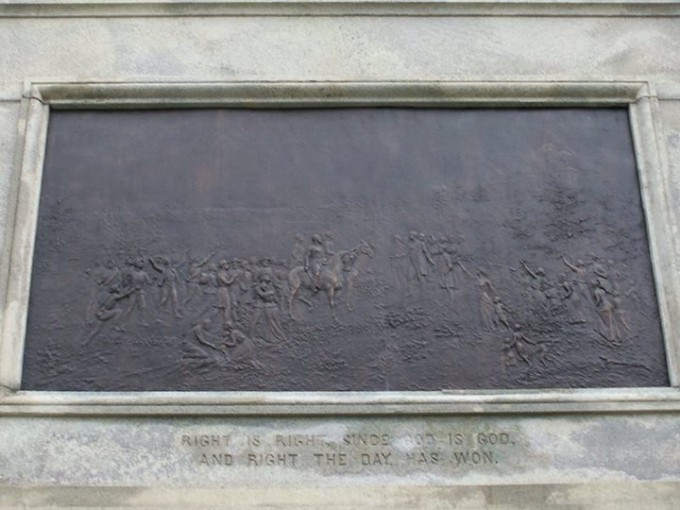
151013_bronze_of_battlefield

Tuesday, 13 October 2015

What is more, he was chosen by the churches to accompany us as we carry the offering, which we administer in order to honor the Lord himself and to show our eagerness to help. 2 Corinthians 8:19

This verse explains more about “the brother who is praised by all the churches” mentioned in the preceding verse. This brother “was chosen by the churches.” The word for choosing him is cheirotoneó . It specifically means “election by a show of hands” or “chosen by a vote.” It is only used one other time, in Acts 14:23, in the selection of elders in churches. This brother wasn’t only praised by all the churches, but he was also trusted by them as well.

Paul notes that his selection was “to accompany us as we carry the offering.” He was doing everything possible to ensure that the offering was not only collected without pressure, but also to make sure that it would be supervised and safeguarded by a group of people who could ensure there was integrity concerning its handling every step of the way.

It needs to be remembered that he is still in the process of stirring the Corinthians into action concerning their promise of giving. His words concerning this person are probably twofold then. First, they would not have to worry if the gift could be mishandled in any way because of how it was being collected and conducted to Jerusalem. Secondly, this designated representative, and in fact all involved in the process, would be aware of exactly how much was given by each church. If they didn’t meet what they promised, it would reflect negatively on them as a body.

As Paul continues, he says that the offering is one that “we administer in order to honor the Lord.” This “we” is all-inclusive of every person and each church involved in the gathering. Paul is the Apostle to the Gentiles, and those he ministered to were the fruit of his labors. They were mostly Gentiles who were tending to the needs of the saints in Jerusalem. Could there be a better way to “honor the Lord” than to meet the needs of those who were there, even during His earthy ministry and who were now in need? Thus in giving, they would be able to “show our eagerness to help.”

Life application: There are those who are older within the church. They may not be able to attend anymore because of infirmity. Wouldn’t it be honoring to the Lord for us to make visits to them in gratitude for their service to the church during their own youth? If we can remember that we meet because of their faithfulness, then it should put our visits and care for them in the proper perspective. Each time we gather, it is partly a result of their commitment to the very place where we meet.

Heavenly Father, please help us to remember those who can no longer attend the church because of age or infirmity. Give us the willing heart to stop by and visit from time to time and to share in how things are at the church they helped to maintain during their own youth. Thank you for their past faithfulness, and please help us to be equally faithful to them now. I know this would certainly be honoring to You. Amen.