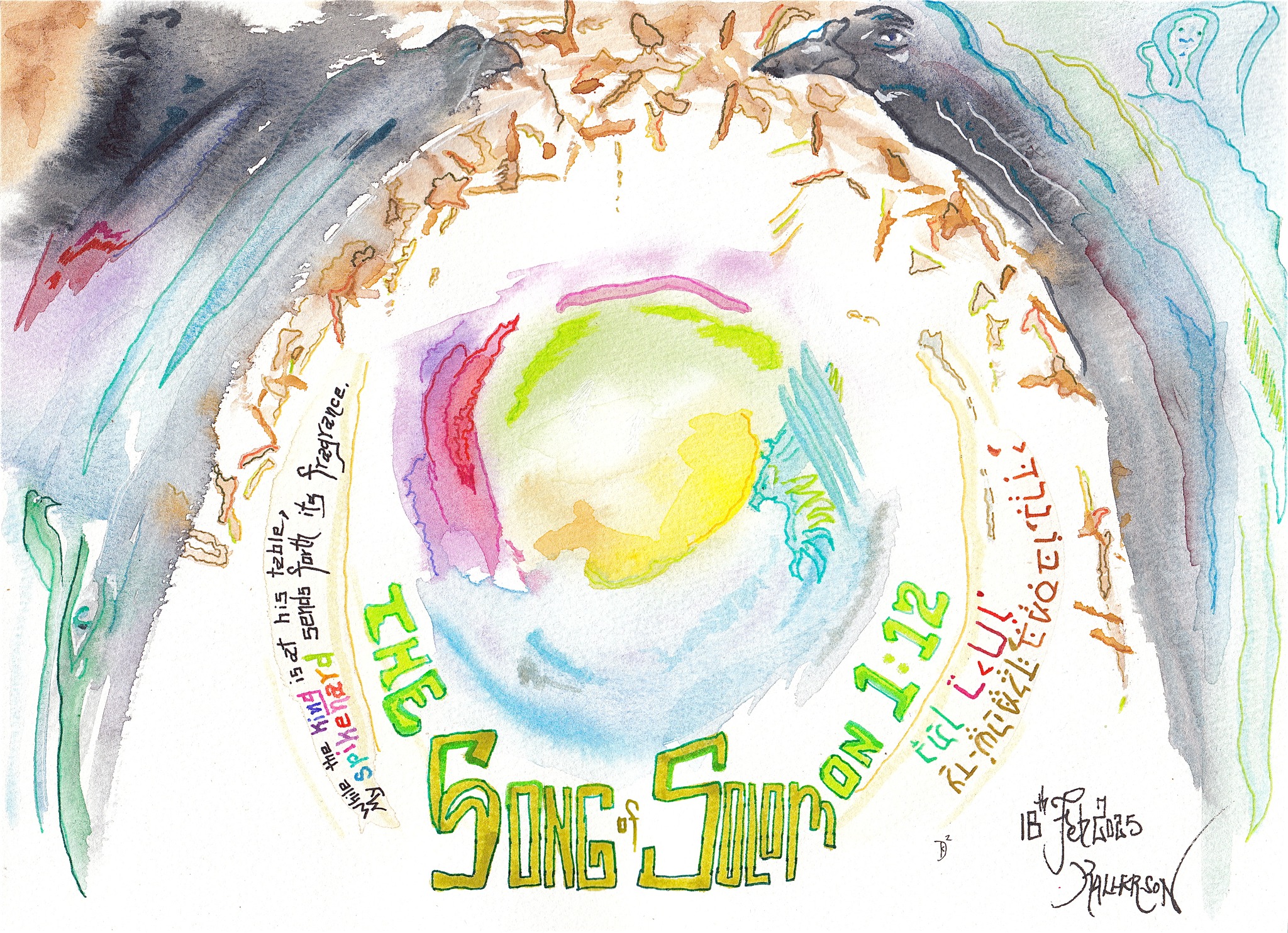
Artwork by Douglas Kallerson
Song of Songs 1:12-17
Behold You! Beautiful!
(Typed 25 November 2024) During one of my classes in college, a guest speaker came who was in the process of getting a PhD. The main subject of his dissertation was the concept of beauty. Yes, really. He was absolutely captured by the thought of what beauty actually is.
At first, seems simple enough to define. The Google definition begins with –
“Beauty is the quality of something or someone that gives pleasure to the senses or intellect, or provides meaning or satisfaction. It can be a characteristic of objects like landscapes, sunsets, and works of art, or of people who possess traits that are valued by society.”
We can shake our heads in affirmation, thinking that it has captured the essence of what beauty is. And yet, the more we consider beauty, the less we can grasp and hold onto it.
Beauty can be temporary, meaning that at a specific point, the beauty will end. Beauty can be transitory. A moment in a sunset may be stunningly beautiful, but a moment later, it no longer exists. It can also come in gradations, such as one sunset being more beautiful than another.
Beauty is said to be in the eye of the beholder. But the same beholder can find someone beautiful one moment and repulsive the next. The physical beauty of a woman, for example, stops seeming so beautiful because of some morally objectionable quality that suddenly surfaces.
Beauty can be a part of something that isn’t all beautiful, like an ugly person’s beautiful hands that make her a lot of money in advertising. Many people find spiders horrifying, but we might find what they do, spinning webs, for example, beautiful.
Text Verse: “One thing I have desired of the Lord,
That will I seek:
That I may dwell in the house of the Lord
All the days of my life,
To behold the beauty of the Lord,
And to inquire in His temple.” Psalm 27:4
The concept of what is beautiful has driven some artists to the brink of insanity as they strove to capture something beyond their ability to attain. One might capture the colors and the shapes, but there are a million nuances in the scene that cannot be captured. Van Gogh is one who searched for beauty, and some say Van Gogh’s works are beautiful.
Don McLean said that Van Gogh had a surpassing beauty of his own –
For they could not love you
But still, your love was true
And when no hope was left in sight on that starry, starry night
You took your life, as lovers often do
But I could have told you, Vincent
This world was never meant for one as beautiful as you
Some say the words of Don McLean’s song about Van Gogh are astonishingly beautiful. So, the concept of beauty can also build upon other beauty, forming something else that is beautiful.
However, we can tire of seeing the same painting or hearing the same song. As the beholder of beauty, we then have to look for something else beautiful if we want to be satisfied with beauty. But we can return to a painting or song that we tired of years ago and the beauty of it returns to us.
Time, familiarity, circumstances, and so many other things can affect our perception of beauty.
David, however, spoke of an unceasing beauty when he said, “all the days of my life.” He understood that dwelling in the house of the Lord and seeing His beauty would never be tiresome. Is that true? If so, how? What is it about the beauty of the Lord that extends beyond any other beauty?
Careful contemplation of who He is and what the Bible says about Him will give us an answer if we stop and think it through. Such great truths as this are to be found in His superior word. And so, let us turn to that precious word once again, and… May God speak to us through His word today, and may His glorious name ever be praised.
I. My Beloved to Me (verses 12-14)
12 While the king is at his table,
The words are highly debated and widely translated: ad shehamelkeh bimsibo – “Until which the king in his surrounding.” The word ad gives the sense of until, as far as, up to, etc. Saying “while” would mean “as long as he does XX.”
So either the woman is waiting until the king comes, or she is speaking of the time that he is present. Based on the next clause, I would go with the former.
The next complicated word is bimsibo, literally “in his surrounding.” The noun mesav indicates that which is around. In 1 Kings 6, it refers to the surrounding walls in the temple. In 2 Kings 23:5, it refers to the area surrounding Jerusalem.
Some say it is a divan, a round seat for the king. One would think, however, that it would say “upon the divan,” not “in the divan.” Some say it speaks of a round table where the advisers of the king sat. Rather than a round table, that could still be a divan though. The historical meaning of the word divan is a legislative body that surrounds the king. Today, we might say, “He is among his inner circle.”
I would simplify the matter and say that she is waiting for the king to come into where she is, meaning his surrounding (as in 1 Kings 6). She will wait for him there, and as she waits, she says…
12 (con’t) My spikenard sends forth its fragrance.
nirdi nathan rekho – “My nard gave its odor.” In other words, she is where the king will be, whether in his personal room, harem, etc. While she is there, she is poetically saying that her nard is wafting on the air, calling to him as it gives off its wonderful smell.
As for the perfume, nard (spikenard) is the Hebrew nerd referred to three times in the Old Testament, all in “Song the songs.” Of it, The Natural History of the Bible, page 485, says –
“Spikenard or nard is exclusively an Indian product, procured from the Nardostachys jatamansi, a plant of the order Valerianaceae, growing in the Himalaya mountains, in Nepal and Bhotan. It has many hairy spikes shooting from one root. It is from this part of the plant that the perfume is procured, and prepared simply by drying it.”
This perfume was highly esteemed in ancient times. It retained its Indian name in Hebrew, Greek, and Latin. It is referred to in the New Testament –
“Then, six days before the Passover, Jesus came to Bethany, where Lazarus was who had been dead, whom He had raised from the dead. 2 There they made Him a supper; and Martha served, but Lazarus was one of those who sat at the table with Him. 3 Then Mary took a pound of very costly oil of spikenard, anointed the feet of Jesus, and wiped His feet with her hair. And the house was filled with the fragrance of the oil.” John 12:1-3
While she sits and awaits her beloved, she thinks about him and what he is likened to in her thoughts…
13 A bundle of myrrh is my beloved to me,
ts’ror ha’mor dodi li – “Sachet the myrrh, my beloved to me.” The noun ts’ror comes from the verb tsarar, to bind, besiege, afflict (because of being hemmed in), etc. Thus, this is something bound up, such as a bag, a parcel, and so forth.
Because what is bound is myrrh, an aromatic resin used in perfuming, the word sachet exactly describes what it is bound in. This spice, mor, myrrh, comes from marar, bitter. The name gives the sense of “distilling in drops.” It was seen in Exodus 30 in making the special incense for burning in the tabernacle.
Myrrh comes from a shrub and can be obtained in one of two ways. The first is the purest form where it naturally exudes from the plant. This is the “myrrh of freedom,” or “free-flowing myrrh.” Inferior myrrh comes from incisions made in the bark.
Myrrh is fragrant to smell but bitter to taste. Looking at the uses of myrrh in the Old Testament, the prominent idea that it symbolizes is love, more especially, however, love in intimate union, but not necessarily sexual in nature.
Myrrh was presented to Christ at both His birth by the Magi, and at His death when mixed in wine to deaden His pain, something He refused.
As for this sachet of myrrh, she is saying that his presence scents her as they embrace. One can see the parallelism between her and him –
“My nard gave its odor.”
“Sachet the myrrh, my beloved to me.”
She is perfumed with nard while he, whether actually perfumed or not, is like a sachet of myrrh. Specifically, he is a sachet…
13 (con’t) That lies all night between my breasts.
beyn shaday yalin – “Between my breasts lodges.” The word lun signifies to remain, dwell, lodge, etc. At times, it signifies an overnight stay. Her beloved is likened to a sachet of myrrh that dwells between her breasts.
Thus, if he is actually present, he is making her his pillow while his fragrance mingles with hers. The words would then speak of intimacy and union. However, she may just be comparing him to such a sachet without him being present. Next, she says, using words of parallelism…
14 My beloved is to me a cluster of henna blooms
eshkol ha’kopher dodi li – “Cluster the henna, my beloved to me.” The kopher, translated here as henna, means a cover. When Noah used pitch on the ark, it was a kopher to it. When a person is ransomed, the payment is a covering over of a misdeed, a kopher.
In this case, it refers to henna which is used to form a covering over the skin. This is the known meaning because the henna plant produces blossoms in the form of a cluster. Of this blossom, John Lange’s Commentary says –
“…in respect to the fondness of oriental women for this aromatic plant the testimony of a recent traveller in the ‘Ausland,’ 1851, No. 17.0 ‘The white Henna-blossoms, which grow in clusters and are called Tamar-henna, have a very penetrating odor, which seems disagreeable to the European who is unaccustomed to it; but the Orientals have an uncommon liking for this odor, and prefer it to any other. The native women commonly wear a bouquet of Tamar-henna on their bosom.’”
With that stated, she next says…
14 (con’t) In the vineyards of En Gedi.
b’kharme ein gedi – “In vineyards En Gedi.” As seen elsewhere, the vineyard represents the cultural side of humanity. There are various vineyards that represent various cultures. In her words now, she speaks of the vineyards of En Gedi, meaning Fountain of a Kid.
The name suggests that this was a location, a spring in the wilderness, where young goats gathered. In that location, vineyards were planted, and among the vineyards, clusters of henna came up. The parallelism between the previous two verses is evident –
* Sachet the myrrh, my beloved to me,
Between my breasts lodges.
* Cluster the henna, my beloved to me,
In vineyards En Gedi.
She equates him to a sachet of myrrh resting between her breasts and as a cluster of henna in En Gedi’s vineyards. Depending on how one views her words, she is either completely poetical in her comparison, as if the sachet and cluster are only like him, or she is actually speaking of him when he lies between her breasts and when he is in the vineyards of En Gedi.
It would be unwise to stretch the intent of these verses too far, but they appear to be providing us with a picture of events in the redemptive process.
In verse 12, the woman is awaiting her beloved. As she does, the nard on her beckons him, giving off its odor. Christ was covered in nard for a particular reason –
“But one of His disciples, Judas Iscariot, Simon’s son, who would betray Him, said, 5 ‘Why was this fragrant oil not sold for three hundred denarii and given to the poor?’ 6 This he said, not that he cared for the poor, but because he was a thief, and had the money box; and he used to take what was put in it.
7 But Jesus said, ‘Let her alone; she has kept this for the day of My burial. 8 For the poor you have with you always, but Me you do not have always.’” John 12:4-8
Those who are redeemed are symbolically covered in the nard of Christ’s death. Christ’s death was a type of baptism. We are then likewise baptized into His death. Thus, we bear the fragrance of the death of Christ –
“What shall we say then? Shall we continue in sin that grace may abound? 2 Certainly not! How shall we who died to sin live any longer in it? 3 Or do you not know that as many of us as were baptized into Christ Jesus were baptized into His death? 4 Therefore we were buried with Him through baptism into death, that just as Christ was raised from the dead by the glory of the Father, even so we also should walk in newness of life.” Romans 6:1-4
This leads to the next idea –
“Now thanks be to God who always leads us in triumph in Christ, and through us diffuses the fragrance of His knowledge in every place. 15 For we are to God the fragrance of Christ among those who are being saved and among those who are perishing. 16 To the one we are the aroma of death leading to death, and to the other the aroma of life leading to life. And who is sufficient for these things?” 2 Corinthians 2:14-16
Thus, the picture of verse 12 is of those in Christ beckoning Him through their own lives, which carry the aroma of His sacrificial death. It is a reminder to Him that we are His, and we await His arrival.
In verse 13, the woman made the first of two parallel thoughts, stating that her beloved is a sachet of myrrh between her breasts. The ts’ror, sachet, is derived from tsarar, to bind. Myrrh, mor, is from marar, to be bitter. Without contestation, Christ is the binding of bitterness for the human soul.
As for the words “Between my breasts lodges,” they are poetic. Just as a sachet rests between a woman’s breasts, so the heart rests. Thus, it would not be a stretch to paraphrase the thought, “In my heart lodges” –
“For this reason I bow my knees to the Father of our Lord Jesus Christ, 15 from whom the whole family in heaven and earth is named, 16 that He would grant you, according to the riches of His glory, to be strengthened with might through His Spirit in the inner man, 17 that Christ may dwell in your hearts through faith; that you, being rooted and grounded in love, 18 may be able to comprehend with all the saints what is the width and length and depth and height— 19 to know the love of Christ which passes knowledge; that you may be filled with all the fullness of God.” Ephesians 3:14-19
After that, she compared her beloved to a cluster of henna. The word eshcol, cluster, comes from the word eshek, meaning testicle. Sin transfers from father to child. The semen, which is generated in man, is what transfers that sin.
However, this is a cluster of henna, kopher, meaning a covering, such as a ransom –
“Those who trust in their wealth
And boast in the multitude of their riches,
7 None of them can by any means redeem his brother,
Nor give to God a ransom [kophar] for him—
8 For the redemption of their souls is costly,
And it shall cease forever—
9 That he should continue to live eternally,
And not see the Pit.” Psalm 49:6-9
To understand the word more fully, look at the word kapporeth, the covering or mercy seat. Exodus 25 says –
“You shall make a mercy seat [kapporeth] of pure gold; two and a half cubits shall be its length and a cubit and a half its width. 18 And you shall make two cherubim of gold; of hammered work you shall make them at the two ends of the mercy seat [kapporeth]. 19 Make one cherub at one end, and the other cherub at the other end; you shall make the cherubim at the two ends of it of one piece with the mercy seat [kapporeth]. 20 And the cherubim shall stretch out their wings above, covering the mercy seat with their wings, and they shall face one another; the faces of the cherubim shall be toward the mercy seat [kapporeth]. 21 You shall put the mercy seat [kapporeth]on top of the ark, and in the ark you shall put the Testimony that I will give you. 22 And there I will meet with you, and I will speak with you from above the mercy seat [kapporeth], from between the two cherubim which are on the ark of the Testimony, about everything which I will give you in commandment to the children of Israel.” Exodus 25:17-22
This mercy seat, kapporeth, and the kopher of verse 13 are both derived from the same root. The word kapporeth corresponds directly to the Greek hilastérion, as seen in the Greek Old Testament and in Hebrews 9:5, which says, “and above it were the cherubim of glory overshadowing the mercy seat [hilastérion].” That same word is used by Paul when referring to Christ Jesus –
“But now the righteousness of God apart from the law is revealed, being witnessed by the Law and the Prophets, 22 even the righteousness of God, through faith in Jesus Christ, to all and on all who believe. For there is no difference; 23 for all have sinned and fall short of the glory of God, 24 being justified freely by His grace through the redemption that is in Christ Jesus, 25 whom God set forth as a propitiation [hilastérion] by His blood, through faith, to demonstrate His righteousness, because in His forbearance God had passed over the sins that were previously committed, 26 to demonstrate at the present time His righteousness, that He might be just and the justifier of the one who has faith in Jesus.” Romans 3:21-26
Thus, the cluster of henna looks to the “seed” of the covering of Christ –
“He who sins is of the devil, for the devil has sinned from the beginning. For this purpose the Son of God was manifested, that He might destroy the works of the devil. 9 Whoever has been born of God does not sin, for His seed remains in him; and he cannot sin, because he has been born of God.” 1 John 3:8, 9
From biblical symbolism, the vineyards of En Gedi can be paraphrased as “the cultural expressions of the fountain of the cut off.” The kid, gedi, comes from a root signifying to cut off. As we saw in Judges, it is what finishes a matter.
Sin is cut off in Christ. The fountain of the cut off thus refers to the Holy Spirit dwelling in those who are the seed of God because of the work of Christ. The words of the woman, who represents the redeemed of humanity, speak of the completed work of Christ.
In a world filled with sensation and delight
Nothing compares to the Lord
Every smell, taste, feel, and sight
Came through His spoken word
He is the Source of all things
And so nothing can Him excel
To see His face and hear His voice, my heart sings
On the day of the heavenly wedding bell
Oh! To be joined to the Lord for all eternity
To see Him, and in Him to delight
Until that Day, I wait a tad impatiently
Until my faith has turned into sight
II.My Querida (verses 15-17)
15 Behold, you are fair, my love!
Behold, you are fair!
The pronouns of verse 15 are feminine, meaning that a male is speaking to a female: hinakh yaphah rayathi hinakh yaphah –
“Behold you! Beautiful, my querida,
Behold you! Beautiful!”
The beloved is overtaken by her exquisite beauty. The use of the interjection, behold, emphatically draws attention to what he is about to say. Making the proclamation twice is the Bible’s way of emphatically declaring a thing.
It is as if he has lost his breath over what his eyes are feasting on. In this stunned state, he next says…
15 (con’t) You have dove’s eyes.
Rather, more emphatically: einayikh yonim – “Your eyes – doves.” The comparison is not to dove’s eyes but that she has eyes like doves – glistening, beautiful, shapely, and so forth.
The word yonah, dove, is from the same root as yayin, wine. This root signifies to effervesce. Thus, the dove is lively and animated and carries with it a sense of warmth and love.
As she blinks, he thinks of its wing flitting. As she looks left or right, he thinks of the dove darting through the air. When he looks at the whites, he sees purity, and in the pupil, he sees gentleness and innocence. He is enraptured with her, especially captivated by her dovelike eyes. With that said, the words return to the woman…
16 Behold, you are handsome, my beloved!
hin’kha yapheh dodi – “Behold you! Beautiful my beloved.” He had proclaimed her beauty and explained it to her with metaphor. Without rejecting that, she calls out that her beloved is more so than she. She does this by changing the next words from his exclamation to her…
16 (con’t) Yes, pleasant!
aph naiym – “Also, delightful!” The word aph gives the sense of ascension or addition. Not only is he beautiful as he stated she is, but she adds that he is nayim, a word signifying pleasant, delightful, lovely, etc.
It is a word that, at times, conveys both an experiential and an aesthetic sense. The experiential form of the word in a plural adjective is found in Psalm 16 –
“You will show me the path of life;
In Your presence is fullness of joy;
At Your right hand are pleasures [nayim] forevermore.” Psalm 16:11
With that, she next adds words indicating the beauty of their surroundings…
16 (con’t) Also our bed is green.
aph arsenu raananah – “Also, our bed verdant.” The word raanan comes from a root signifying to be green. Other than Psalm 92:10, it is used when speaking of vegetation, especially that which is healthy and full of life. But even in that psalm, it gives the sense of that which is luxurious or fresh –
“But my horn You have exalted like a wild ox;
I have been anointed with fresh [raanan] oil.” Psalm 92:10
Because of this, in this case, she is not speaking of an actual bed that is green in color, but of the place where they would meet, meaning a beautiful garden setting.
There, they lay on the soft grass, passing the time in one another’s presence and reveling in the beauty that surrounded them. It is what adds to the beauty of one another as they merge the exquisite beauty of the natural world with the delightful beauty of looking at one another.
That symbolism continues with the next words…
17 The beams of our houses are cedar,
qoroth bateinu arazim – “Rafters our houses – cedars.” The rafter signifies a thing meeting or fitting into another thing, as rafters do. Houses normally have lots of rafters, but an actual house is not the intent here, as is evident from the plural words “houses” and “cedars.”
While lying in the green grass, they would look up at the beams and rafters of all of the cedars above them, noticing how the branches interlocked into a canopy, one tree adjoining another forming a series of houses above them.
Think of a sense of royal abundance, having house after house as their own. With that thought stated, she next says…
*17 (fin) And our rafters of fir.
rakhitenu b’rothiym – “Our wainscoting – cypresses.” The word rahit, wainscoting, comes from rahat, which is something like a channel or watering box, such as a trough. Thus, it is a panel that would resemble a trough. From that, one gets the sense of wainscoting.
She looks around at their many houses and sees them adorned with beroth, cypress trees, as well. This is the only time this word is used in Scripture, but it is believed to be an Aramaic word akin to the word berosh, a type of wood generally translated as cypress or fir. The word is derived from beer, a well, or pit.
Seeing their large and well-formed trunks led her to think of them as the fancy wainscoting inside a palatial mansion.
There they lay, enjoying the time in their idyllic garden setting. There is enough sun to allow soft green grass to grow, and yet there is a canopy of trees above them to shade them from the heat of the sun which would otherwise be blazing down upon them.
In Isaiah 60, when referring to a temple of the future that will be built in Jerusalem, it says –
“The glory of Lebanon shall come to you,
The cypress, the pine, and the box tree together,
To beautify the place of My sanctuary;
And I will make the place of My feet glorious.
14 Also the sons of those who afflicted you
Shall come bowing to you,
And all those who despised you shall fall prostrate at the soles of your feet;
And they shall call you The City of the Lord,
Zion of the Holy One of Israel.” Isaiah 60:13, 14
The woods said to be used in this temple include those just noted by the woman in their garden palace. As such, the words may be an anticipation of the beauty of what lies ahead for the redeemed of the Lord.
His temple on earth is a type of the greater heavenly dwelling that awaits those who are His. As Paul says –
“Now, therefore, you are no longer strangers and foreigners, but fellow citizens with the saints and members of the household of God, 20 having been built on the foundation of the apostles and prophets, Jesus Christ Himself being the chief cornerstone, 21 in whom the whole building, being fitted together, grows into a holy temple in the Lord, 22 in whom you also are being built together for a dwelling place of God in the Spirit.” Ephesians 2:19-22
We are being given insights and glimpses into what is on the mind of God as He brings us closer and closer in type and picture to the heart of “Song the songs,” which is, specifically, the greatest love that exists. That love is the love of God for His Son.
However, the love of the Son includes those who are in the Son, meaning God’s redeemed. When the Lord looks at His bride, He sees only beauty. When we look at the Lord, we see the One who is surpassing in beauty, both aesthetically and experientially.
Because He is the Creator, He is the Source of all beauty. As such, any beauty that exists stems from Him and cannot compare to the surpassing beauty from which it is derived.
Likewise, in the sense of experience, the same truth applies. There is no physical, moral, or spiritual experience of beauty that can surpass the Source of those things. What we experience is only a part or portion of the whole.
Therefore, the words of the woman to her beloved rightly express the ascension of intent that must come from us when we return a compliment to the Lord. He may find us captivating, but it is only because of what He has already accomplished through Jesus in getting us to that point.
When we are returned to paradise, something we cannot even comprehend at this time, even that will be overshadowed by the glory that radiates from our Beloved.
No matter how expansive heaven is, and no matter how long we continue there, the beauty and glory we perceive in it will always continue to be outshined by the surpassing glory of the One who created it for us to fellowship with Him in it.
David understood this and proclaimed it in the 27th Psalm when he spoke of beholding the beauty of the Lord all his days. Throughout eternity, we will never tire of beholding His beauty as Jesus ceaselessly and eternally radiates out the beauty of His unseen Father to us.
Beauty is a possible state in something that exists. However, apart from God’s perfection, it is unfortunately only a possible state. But more, because of our imperfect ability to perceive how things are or what they signify, we often miss true beauty.
If you were in Israel at the time of Jesus’ crucifixion, you might have passed by numerous people dying on crosses. You wouldn’t think they were beautiful, and so when you walked by Jesus on His cross, you might turn away in horror at the mass of bleeding flesh as He was agonizingly dying.
And yet, for two thousand years, people have spoken, written, and sung about the beauty of the cross of Christ. If only you knew what you were turning away from, you might instead marvel at the infinite beauty of God’s plan of reconciliation for fallen man as it was being completed right before your eyes.
You might look at the blood seeping down the tree as an instrument of beauty, purifying humanity as His life ebbed away. You would think of the beauty of the grave that was going to receive His earthly remains, knowing that your sin was being carried in there with His lifeless body.
And you would rejoice at the beauty of the tomb’s emptiness that was just a moment in time away. You would revel in the beauty of God’s handiwork and rejoice at the glory of what He accomplished. You would say, “This cross is… beautiful.”
The perception, understanding, and acceptance of the event would define it as beautiful. True beauty is an understood perfection that transcends any accompanying real or perceived imperfections. But until the perfection is seen as such, the beauty is missed.
Therefore, may our imperfect eyes, hearts, and understandings see and appreciate the perfections of God who alone defines and reveals true, eternal beauty.
Closing Verse: “He has made everything beautiful in its time. Also He has put eternity in their hearts, except that no one can find out the work that God does from beginning to end.” Ecclesiastes 3:11
Next Week: Song of Songs 2:1-7 He is so wonderful, my precious dove… (His Banner Upon Me – Love) (5th Song of Songs sermon)
The Lord has you exactly where He wants you. He has a good plan and purpose for you. He alone is the perfect example of love – untarnished, unblemished, and completely pure and holy. He offers this love to you. So, follow Him, live for Him, and trust Him, and He will do marvelous things for you and through you.
Song of Songs 1:12-17 (CGT)
12 Until which the king in his surrounding,
My nard gave its odor
13 Sachet the myrrh, my beloved to me,
Between my breasts lodges.
14 Cluster the henna, my beloved to me,
In vineyards En Gedi.
15 Behold you! Beautiful, my querida,
Behold you! Beautiful!
Your eyes – doves.
16 Behold you! Beautiful my beloved.
Also, delightful!
Also, our bed verdant.
17 Rafters our houses – cedars,
Our wainscoting – cypresses.
Song of Songs 1:12-17 (NKJV)
12 While the king is at his table,
My spikenard sends forth its fragrance.
13 A bundle of myrrh is my beloved to me,
That lies all night between my breasts.
14 My beloved is to me a cluster of henna blooms
In the vineyards of En Gedi.
15 Behold, you are fair, my love!
Behold, you are fair!
You have dove’s eyes.
16 Behold, you are handsome, my beloved!
Yes, pleasant!
Also our bed is green.
17 The beams of our houses are cedar,
And our rafters of fir.