Exodus 31:12-18
The Law of the Sabbath
We have already had several sermons on the Sabbath. It is a theme which one would think would simply dry up so that all we would be doing is repeating the same thing. However, today’s passage is completely different than those of the past, such as Ex 16:22-26, where the Sabbath was introduced into Scripture, or Exodus 20, which dealt with the Ten Commandments, including the Sabbath.
This passage today takes us in an entirely different direction, and yet it fully supports those, and all the other passages which deal with the Sabbath. It is a temporary institution which finds its true meaning in Christ. In Him, the picture made by the Sabbath is fulfilled, and thus the Sabbath requirement is ended. Along with the new information comes a marvelous chiasm which I discovered while doing the sermon.
I will lay it out for you now, and at times we will refer to it in the sermon. Chiasms give us hidden structures which reveal what God is thinking. They help us to properly analyze difficult passages and theological concepts and they reveal what their true meaning is. This one is no different –
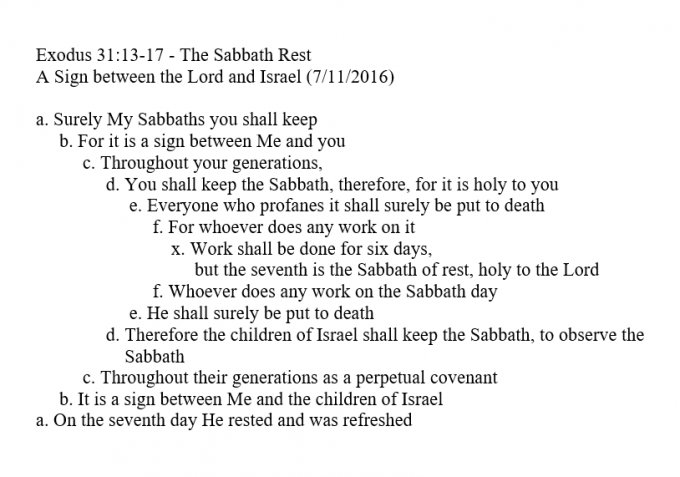
As we read the sermon text, maybe you thought, “Why is the same thing being repeated again and again?” Now you know. The Lord is revealing truths about this most important weekly day which occurred in the lives of Israel of old.
Text Verse: “Today, if you will hear His voice,
8 Do not harden your hearts as in the rebellion,
In the day of trial in the wilderness,
9 Where your fathers tested Me, tried Me,
And saw My works forty years.
10 Therefore I was angry with that generation,
And said, ‘They always go astray in their heart,
And they have not known My ways.’
11 So I swore in My wrath,
‘They shall not enter My rest.’” Hebrews 3:7-11
Before we even start with the sermon, we need to be reminded that the Sabbath was a part of the Law of Moses. The Law of Moses is, according to the book of Hebrews, obsolete, annulled, and set aside. It is, according to Paul in Colossians, “nailed to the cross.” We are not Sabbatarians here. We don’t observe an annulled precept from an annulled law in order to be pleasing to God.
Instead, we trust in the work of Christ, and we rest in His finished work – plain and simple. Working deeds of the law in order to attempt to be right with God will lead to only one sad end, separation from God. It is a self-condemning act. This truth, and quite a few others, are poignantly highlighted in today’s verses. Let’s pay heed to what is revealed there… in His Superior word. And so let’s turn to that precious word once again and… May God speak to us through His word today and may His glorious name ever be praised.
I. A Sign Between Me and You (verses 12-14)
12 And the Lord spoke to Moses, saying,
v’yomer Yehovah el Moshe lemor – “And said the Lord to Moses saying…” These words introduce the second major section of this chapter. The first began in verse 1 with a very similar phrase. With just a single word of difference, this second section now opens. What is most notable about it, is that it will close out the Lord’s discourse concerning the instructions of the tabernacle and the priestly ordination which began in verse 25:1.
In all, these 6 chapters have comprised 22 individual sermons which have discovered hundreds, if not thousands, of pictures of Christ. There has been an amazing amount of information revealed in this 40-day trip up the mountain by Moses. Even 3500 years later, new insights continue to come out of these 6 chapters of 243 verses, such as our chiasm which finally came forth at this time.
13 “Speak also to the children of Israel, saying: ‘Surely My Sabbaths you shall keep,
This final section of the instructions to Moses seems to be completely out of place. Everything to this point concerning his time on the mountain has been in regard to the building of the tabernacle and its associated rites and services. Suddenly, the law of the Sabbath is reintroduced. As I said, it was already mentioned in chapter 16 where it was first introduced.
It was then next mentioned in the giving of the 10 Commandments, specifically it being the fourth of them. Those two incidents would seem to suffice concerning this particular observance, and yet, before closing out His highly detailed discourse, these six verses are given.
After them, will be one more verse concerning the tablets of the Ten Commandments and the chapter will close. Because of this seemingly unusual placement of these seemingly out of context verses, several reasons have been suggested for their inclusion now.
- “The law of the Sabbath held a particularly prominent place” in the Ten Commandments, and so it is highlighted before they are given to Moses. (Kurtz)
- “That the holy service in the tabernacle could not supersede the observance of the Sabbath, but derived from that observance its true value.” (Kalisch)
- That the “penal edict was especially introduced as a caution in reference to the construction of the tabernacle, lest the people, in their zeal to carry on the work, should be tempted to break the divine law for the observance of the day.” (Barnes)
- “Hitherto the Sabbath had been, in the main, a positive enactment intended to test obedience (Exodus 16:4); now it was elevated into a sacramental sign between God and His people (Exodus 31:13). Having become such a sign, it required to be guarded by a new sanction, and this was done by assigning the death-penalty to any infraction of the law of Sabbath observance (Exodus 31:14-15). (Ellicott)
- None of the above (Charlie Garrett)
The first reason, that the Sabbath held an especially prominent place in the Ten Commandments, is wholly unjustified. Elevating the Sabbath above the other nine has led to both heresy and the establishment of aberrant cults. That is neither stated in, nor can it be inferred from, Scripture.
The second reason, that the service in the tabernacle could not supersede the observance of the Sabbath, would mean that the rites of the tabernacle would have to be suspended every Sabbath. And yet the directions for the service of the tabernacle mandate that they be conducted, without interruption, every day of the week. Even the ordination of Aaron and his sons was to continue on through Sabbath days.
The third reason, that of the people neglecting the Sabbath to work on the tabernacle, is just wrong. The Sabbath law has been given. For them to assume that they could work on the tabernacle in order to get it finished was not mentioned by the Lord during the instruction of these 6 chapters. In other words, the Sabbath requirement was named at the giving of the Ten Commandments. It was mandated and expected to be kept, just as all ten were.
The last view, that it was because it was elevated to a sacramental sign between God and the people is a correct precept, but that doesn’t explain the placement of it here along with the instructions for the tabernacle. It simply provides an explanation for the penalty of death for a violation of the Sabbath and goes no further.
The issue is, “Why has the Sabbath been placed here, at this time, after giving minute instructions for the building of the tabernacle, and just prior to the physical handing over of the Ten Commandments?” That is the relevant question.
The answer is that if you survive to the end of this sermon, you will be told the reason. In the meantime, you can chew on it as we go through the rest of the verses, and see if you can come to the correct answer.
As far as the use of the word Shabbat, or Sabbath, here, it is the first time that the term shabbatotay or “My Sabbaths” is found in Scripture. First, it shows the personal nature of the Sabbath in relation to the Lord. In observing the Sabbath, there is a direct connection to God’s rest which is recorded in Genesis 2 –
“Thus the heavens and the earth, and all the host of them, were finished. 2 And on the seventh day God ended His work which He had done, and He rested on the seventh day from all His work which He had done. 3 Then God blessed the seventh day and sanctified it, because in it He rested from all His work which God had created and made.” Genesis 2:1-3
Second, the word is in the plural, “Sabbaths,” because they were a regular occurrence, each week throughout the year. This is why Paul uses the same term when speaking of the “Sabbaths” in Colossians 2:16. They are many, and they are personal to the Lord. This “rest of God” is so important to Him that it will bear several unique connotations and requirements. The first is…
13 (cont’) for it is a sign between Me and you
The Sabbath is to be a sign between the Lord and His people. The word for “sign” is owth. It comes from the verb avah, which means “to sign, mark, [or] describe with a mark.” Thus this type of sign is something that points to something else.
It can point back to a memorial which represents a particular occurrence; it can point forward to something anticipated; and it can reflect something that exists which is only highlighted by the sign itself. In other words, a signature on an important document highlights the authority of the one signing the document.
The Sabbath then is merely a sign intended to highlight a reality which exists already, or which is to be anticipated at some point in the future. Further, this sign is not a temporary thing. Rather, it was intended to remain…
13 (con’t) throughout your generations,
This exact same phrase, l’dorotekem, or “throughout your generations,” has already been used nine times. Looking at those earlier instances will hopefully reveal a truth to you concerning the reason for the placement of this passage.
So far it has been used when speaking of the sign of circumcision which was given to Abraham in Genesis 17. It was used when speaking of the Passover in Exodus 12. It was used concerning the keeping of an omer of Manna in Exodus 16. It was used in the passage concerning the daily offerings at morning and between the evenings in Exodus 29.
It was used in connection with the burning of incense on the Altar of Incense at morning and between the evenings in Exodus 30. And finally, it was used concerning the use of the Holy Anointing Oil in Exodus 30.
Of these nine references to something being done “throughout your generations,” what is the common element? Well, let us ask ourselves, “Are we still required to be circumcised?” No! In fact, Paul says that if we do that in order to be justified by the law, then we are debtors to the whole law. It is a self-condemning act. Circumcision only pointed to the coming Christ.
Are we required to observe the Passover? No! “For indeed Christ, our Passover, was sacrificed for us” (1 Corinthians 5:7). Are we still holding on to a golden jar of Manna? No! Why? Because Christ has come! He said –
“Most assuredly, I say to you, he who believes in Me has everlasting life. 48 I am the bread of life. 49 Your fathers ate the manna in the wilderness, and are dead. 50 This is the bread which comes down from heaven, that one may eat of it and not die. 51 I am the living bread which came down from heaven. If anyone eats of this bread, he will live forever; and the bread that I shall give is My flesh, which I shall give for the life of the world.” John 6:47-51
What about the daily sacrifices? What about the offering of incense or the Anointing Oil? What is the common element? The common element is Christ. None of these previous things which were to be l’dorotekem, or “throughout your generations,” was permanent. They were given in anticipation of Christ.
13 (con’t) that you may know that I am the Lord who sanctifies you.
The Sabbath was a sign, to be observed throughout the generations of Israel, to point to something else. It was given as a sign for the people of Israel to know that it was Yehovah who sanctified them. Just as he blessed and sanctified the seventh day after His creative effort in Genesis, the people of Israel were to know that they were sanctified by that same God. In observing His rest, they were intimately connected to Him and sanctified by Him.
In the words of the Bible connected to the Sabbath, we find a most important truth. First, the Sabbath is given in Exodus 20:11 based on the God’s creative efforts. In Deuteronomy 5:15, the Sabbath is given based on God’s act of redemption. And in this verse, it is tied into God’s work of sanctification.
In other words, the work of all three members of the Trinity are tied up in the Sabbath. God the Creator, God the Redeemer, and God the Sanctifier. Matthew Poole notes –
“…the sabbath owns the Lord as our Creator, and as our Redeemer, and as our Sanctifier; and therefore it is no wonder God so severely enjoins the sanctification of the sabbath, and punisheth the neglect of it, it being a tacit renouncing or disowning of God the Father, the Son, and the Holy Ghost.”
14 You shall keep the Sabbath, therefore, for it is holy to you.
Of these words, Joseph Benson says –
“…it is designed for your benefit as well as for God’s honour; it shall be accounted holy by you.” Joseph Benson
It is the Lord who sanctifies Israel. The Sabbath is the property of God. For Israel it is the inheritance of God. Therefore, Israel was instructed to keep the Sabbath. The directions for the construction, services, and rites of the sanctuary were based on works. They were to work towards the Sabbath each week, and then rest in honor of the works which were performed, even though the priest’s works continued during Sabbath days.
14 (cont’t) Everyone who profanes it shall surely be put to death;
To profane the Sabbath means to defile it. That which would defile the Sabbath was defined in the Ten Commandments –
“In it you shall do no work: you, nor your son, nor your daughter, nor your male servant, nor your female servant, nor your cattle, nor your stranger who is within your gates.” Exodus 20:10
Violating these, and any other prohibitions which will be given, would then be considered profaning the Sabbath. However, as we saw in a recent sermon, the priest’s continued to work on the Sabbath and yet they were held guiltless. They did not profane it.
14 (cont’t) for whoever does any work on it, that person shall be cut off from among his people.
A distinction is especially made between being put to death and being cut off from the people. A person could be cut off from the people without being put to death. The two are not synonymous. A person who offended in such a way as to put himself out of the covenant was considered an outlaw. He was to be cut off from his people. When the offense affected the nation as a whole, then the person was to be put to death.
When a person defiled the Sabbath, they actually caused more harm than may be realized. If nothing was done about his actions, it might spur others to jealousy who were not making the same money as the one who profited from the Sabbath. Further, it would then spur them on to profane the Sabbath as well, knowing that nothing would be done about their actions.
Eventually, the infection would spread, and the people in general would come to this same conclusion. What was a sign to the people would cease being a sign. They would no longer know that it was the Lord who sanctified them, they would no longer fear the Lord, and they would quickly turn from Him to profane worship. This will be noted later today in a passage from Nehemiah.
I am the Lord who sanctifies you
In Me you shall find your rest
What I look for is faith that is true
And in this, I shall put you to the test
I am the Lord, pay heed unto Me
For I will give you a Day of rest
If you will simply trust, you will see
That in My presence you will be eternally blessed
Come unto Me, you who are weary
And in My presence there will be peaceful rest
Come unto Me, leave your life so dreary
If the land of Paradise-restored is your hope-filled quest
II. A Sabbath of Rest, Holy to the Lord (verses 15-17)
15 Work shall be done for six days, but the seventh is the Sabbath of rest, holy to the Lord.
These words of verse 15 form the middle of the chiasm. The term Shabbat Shabbaton, or “rest of restfulness,” gives the idea of complete restfulness. The Pulpit Commentary translates this as, “but in the seventh is complete rest.”
These words, Shabbat Shabbaton, are a particular term used only seven times in Scripture. It is applied to the Sabbath here and two other times – to the Day of Atonement twice in Leviticus, and to the Sabbatical year in Leviticus. Each of these is only a prefiguring shadow of the work of Christ. That the term is mentioned seven times shows us the spiritual perfection of Christ’s work.
The repetition of Shabbat in Shabbat Shabbaton, using an abstract form of the fixed noun, gives the idea of that which is superlative. Thus, the term “high Sabbath” is used of it in John’s gospel. There he says –
“Therefore, because it was the Preparation Day, that the bodies should not remain on the cross on the Sabbath (for that Sabbath was a high day), the Jews asked Pilate that their legs might be broken, and that they might be taken away.” John 19:31
It was a Sabbath, but it also occurred in conjunction with another feast day. Thus John highlighted the day. It truly was the Lord’s Sabbath as He was secreted away in a cave to rest after His great time of work culminating in what we know as the Passion.
In this, it needs to be noted that the life of Israel was working towards a Sabbath. As the verse says, “Work shall be done for six days, but the seventh is the Sabbath of rest.” Israel worked and then rested. Just as God worked, and then rested – six followed by one, Israel was to work and then rest – six followed by one.
15 (cont’t) Whoever does any work on the Sabbath day, he shall surely be put to death.
With these words, the chiasm begins its backward descent from the high point of the previous words. This clause forms two separate parts of that chiasm. The first is that of working on the Sabbath; the second is that of being put to death.
The sequence of thought is 1) The infraction – working on the Sabbath; 2) The penalty – mowt yumat, “dying he shall die.” Think about the structure of the chiasm. Line d is an explanatory sentence. Line e is the penalty for the infraction. Line f is what the infraction is.
The first half of the chiasm explains the requirement. It then gives the naming of the punishment first and then the reason for the punishment. The second half of the chiasm does the opposite. It gives the reason for the punishment, then the naming of the punishment, and then the explanatory basis for the sequence.
The middle is the anchor of the two halves.
What is the Lord showing us? If it is about Christ, as we know it is, then there is a reason for the chiastic structure. Keep thinking. The sermon is half over. Until we finish, let’s continue analyzing… The severity of the punishment which is mandated brings a few thoughts to mind. The first is, “Was this punishment ever meted out?”
The answer is that, “Yes, it was.” It is common for a precept to be laid out in the Bible and then an example of punishment for violation to be noted. For the Sabbath, the punishment is recorded in Numbers 14 –
“Now while the children of Israel were in the wilderness, they found a man gathering sticks on the Sabbath day. 33 And those who found him gathering sticks brought him to Moses and Aaron, and to all the congregation. 34 They put him under guard, because it had not been explained what should be done to him.
35 Then the Lord said to Moses, ‘The man must surely be put to death; all the congregation shall stone him with stones outside the camp.” 36 So, as the Lord commanded Moses, all the congregation brought him outside the camp and stoned him with stones, and he died.’” Numbers 14:32-36
The second question is, “Are all violations of this standard which are noted in Scripture handled with the same punishment?” The answer is, “No.” In Nehemiah 13:15, we read –
“In those days I saw people in Judah treading wine presses on the Sabbath, and bringing in sheaves, and loading donkeys with wine, grapes, figs, and all kinds of burdens, which they brought into Jerusalem on the Sabbath day. And I warned them about the day on which they were selling provisions.”
The third question is, “Are we today required to observe the Sabbath?” If so, what are we doing in church on Sunday instead of Saturday? That will be answered later.
The fourth question is, “For those who claim that the Sabbath is still in effect, meaning the Jews and aberrant cults like the Seventh Day Adventists and various messianic groups, why are they mandating the word of the Lord concerning the Sabbath, but not upholding the word of the Lord by putting their Sabbath breakers to death?” Is their disobedience in this any less damaging than failing to adhere to the requirement of the Sabbath itself?
16 Therefore the children of Israel shall keep the Sabbath, to observe the Sabbath
These words correspond to line d on the chiasm. The word “therefore” simply says “and” in the Hebrew. The sentence, although explanatory, is more a reaffirmation of the importance of the requirement than being an overall explanation of what has thus far been said.
Israel is again commanded to keep the Sabbath and to observe the Sabbath. The repetition is a stress in itself. The honoring of the Sabbath was to be as important to them as was life in the day itself. We cherish Today because it is the day we are in. It is the moment in which we exist. The observance of the Sabbath was to be just as important and cherished as that state of existence.
To understand this, I can give the example of what Jim and I do on Saturday. Every Saturday, the two of us, along with Tom Alley, do mission work in the projects. At times, people come along with us. It is not their Saturday except for the Saturday that they come. However, for Tom, Jim, and me – it is our Saturday. To not be there is the exception for us. For any others, to be there is the exception for them. Israel’s Saturday was to be their Sabbath, without exception. And it was to be…
16 (con’t) throughout their generations as a perpetual covenant.
These words correspond to line c on the chiasm. Again, the idea of the Sabbath was to continue on for the generations to come. However, as we saw earlier, the idea of something continuing throughout the generations does not mean eternally. There is a point where the practice of these generations was to end.
As long as it was in force, it was however, to be a berith olam, or a covenant perpetual. As long as the generations to whom this requirement was assigned were in existence, the requirement stood. The covenant was made at Sinai and it remained in effect until it was superseded by the New Covenant.
The word olam, or perpetual, gives the idea of “to the vanishing point.” Whatever that point was, it was to continue to it. The same term berith olam, or covenant perpetual, was given to Abraham concerning circumcision, something no longer required.
17 It is a sign between Me and the children of Israel forever;
These words correspond to line b on the chiasm. We continue to move away from the middle anchor verse, but the precept remains the same. The rest of the Sabbath is to be an owth, a sign. A sign, as I said, points to something else. It is not the thing itself, but stands as representative of the thing. The rest was to be this sign and it was to be so until the vanishing point.
17 (cont’t) for in six days the Lord made the heavens and the earth,
This is not included in the chiasm, but it explains the final line. In order for there to be rest, there was first work. As God worked six days in creating, Israel was to work six days with the creation. The six days were intended to lead to the anticipated seventh…
17 (con’t) and on the seventh day He rested and was refreshed.’”
On the seventh day, the Lord rested. Without a doubt, the Lord, meaning Yehovah, has been seen countless times already to be Jesus. He is the incarnate Word of God. He is the Lord in the flesh. In His creative efforts, He made the heavens and the earth, and then He rested. And along with that, it says He “was refreshed.”
The word is naphash. Literally, “He took breath.” This is the only time the word is used in this remarkable way in the Bible as being ascribed to the Lord. After the immense work of creation, the Lord took time to catch His breath and to admire the handiwork which He had so marvelously brought into existence.
The connection between this line of the chiasm and the first line is that it is the Sabbath which the Lord claims as His, and it is the seventh day on which He took His rest. The two are intimately and intricately tied together.
A time of rest for the weary soul
A time to stop and contemplate Jesus
Our Lord, Our God – our Aim, our Goal
The longing desire for each of us
To rest in Him, sweet and sublime
To be still in His presence, safe and secure
For the ages of ages; for all time
Blessed assurance – holy and pure
Oh! To know Christ and to seek Him more
To ponder His majesty as together we rest
Come to Him all you weak, weary, and poor
Find peace and joy, in His comfort be blessed
III. The Tablets of the Testimony (verse 18)
18 And when He had made an end of speaking with him on Mount Sinai, He gave Moses two tablets of the Testimony,
Everything that has been presented since Exodus 25:1 has been for the reception of these two tablets. After the call for the people to provide materials, the very first thing that was described to Moses was the construction of the Ark of the Testimony and then the Mercy seat. In verse 25:16, after the details for the construction of the Ark, it said, “And you shall put into the ark the Testimony which I will give you.”
Then again in verse 25:21, after the details were given for the Mercy Seat, the Lord said, “You shall put the mercy seat on top of the ark, and in the ark you shall put the Testimony that I will give you.” Every single thing after that was described for the purpose of building a tabernacle and a sanctuary for these stone tablets and then for the conduct of the services and rites associated with that sanctuary. With that speaking for instruction now complete, it says that the tablets were then given to Moses. These tablets were…
18 (con’t) tablets of stone,
lukhot eben, “tablets of stone.” The fact that they are stone is to give the idea of permanence. What is written on them is fixed and is unchanging. That there were two tablets shows something more though. Two in the Bible is the number of difference. In the number, there is a contrast, and yet there is a confirmation.
The precepts of the Ten Commandments fall under two distinct categories. The first five follow a basic pattern of filial obedience, as children to their parents. The first four were directed to God, but in them and in keeping them, they were as children honoring their heavenly Father. The fifth was specifically in honoring of one’s parents. The second set of five deal with interpersonal relationships between man and his fellow man. The contents contrast, and yet they confirm God’s expectations for man.
These two tablets, which are made of stone and which are to be secreted away in the Ark also have another defining characteristic. These were…
*18 (fin) written with the finger of God.
The tablets themselves were made by God, and the writing upon them, which was set in stone, was written by God. They are the law of God which is set and unchanging. Once written, they are set, fixed, and complete. There were 172 words which detailed God’s expectations for man to live in His presence.
However, that they were stone also showed that they could be broken. The words would still be there, but they would be violated if broken. And in fact, Moses will break the first set. And so a second set will need to be made. However, the second set will be made by Moses. This is recorded in Exodus 34:1 –
“Cut two tablets of stone like the first ones, and I will write on these tablets the words that were on the first tablets which you broke.”
Later, in the same chapter, the Lord writes on those new tablets –
“So he was there with the Lord forty days and forty nights; he neither ate bread nor drank water. And He wrote on the tablets the words of the covenant, the Ten Commandments.” Exodus 34:28
In this we are given a picture of our spiritual state. The laws are permanent, but are capable of being broken. And in fact, God knew that man would break them. God created Adam, pictured by the first set of tablets, and Adam broke God’s law.
Moses made the second set, picturing Christ, coming from the stream of humanity, and yet He never broke God’s law. In both, the law was written by God, but only in Christ does the law remain unbroken. Adam Clarke, at least partially picked up on this when he wrote concerning the giving of these tablets to Moses –
“It is evident therefore that this writing was properly and literally the writing of God himself. God wrote now on tables of stone what he had originally written on the heart of man, and in mercy he placed that before his eyes which by sin had been obliterated from his soul; and by this he shows us what, by the Spirit of Christ, must be rewritten in the mind.” Adam Clarke
The giving of this law, at the end of the directions for the sanctuary, is the fulfillment of what the sanctuary anticipated. All of the details looked forward to Christ, but without the law which Christ fulfilled, there would remain an eternal disconnect between God and man. Only when this law was placed in the Ark and covered by the Mercy Seat, could there be a restoration of that fellowship which was lost in Adam.
In the pages of the Bible, we are hardly there yet, but in type, shadow, and picture, we are getting there with each new passage which speaks of Christ, and which is leading us to Him. And so this passage and the chapter close out with these final words. But we are still missing something. We have not yet correctly answered the question which has eluded those great scholars we cited earlier.
“Why was the seemingly disconnected subject of the Sabbath placed here, in the overall theme of the preparation for the Sanctuary? John Lange came very close to answering the enigma when he said –
“It should also be observed that in 35:1 sqq. the command respecting the Sabbath recurs again, and this time precedes the order concerning the erection of the tabernacle. The Sabbath belonged as essentially to the tabernacle and the temple as the Christian Sunday to Christian worship.—A sign between me and you.” John Lange
Just after receiving the details of the sanctuary from the Lord, the subject of the Sabbath is brought up. And then, just prior to Moses conveying the details of the sanctuary which he received, he will say this to the people –
“These are the words which the Lord has commanded you to do: 2 Work shall be done for six days, but the seventh day shall be a holy day for you, a Sabbath of rest to the Lord. Whoever does any work on it shall be put to death. 3 You shall kindle no fire throughout your dwellings on the Sabbath day.” Exodus 35:1-3
The Sabbath is being intricately and intimately tied into the sanctuary. The sanctuary is where the Lord is to reside. It signifies that He is dwelling among the people. The greatest punishment of all for Israel was exile from the presence of the Lord. But this is exactly what was promised for disobedience. In that promise the Lord states the following in Leviticus 26:33-35 –
“I will scatter you among the nations and draw out a sword after you;
your land shall be desolate and your cities waste.
34 Then the land shall enjoy its sabbaths as long as it lies desolate and you are in your enemies’ land;
then the land shall rest and enjoy its sabbaths.
35 As long as it lies desolate it shall rest—
for the time it did not rest on your sabbaths when you dwelt in it.”
The reason for the Sabbath’s inclusion here is because it, like every other detail which has been given in the past six chapters, ultimately points to Christ – His Person and His work, for us. The chiasm itself hints at this.
In the Old Covenant, man worked and then rested. In the New Covenant, man rests and then works. A picture is made of the process of salvation in the two dispensations. Israel worked six days and then rested on the Sabbath. It was an anticipation of the time of rest which lay ahead when all things would be restored.
With Christ’s coming we rest on the first day of the week in honor of His finished work, and then we conduct our work week. This is why in the first half of the chiasm, line e gives the penalty – death, and then line f gives the reason for the penalty – working on the Sabbath.
Whereas in the second half of the chiasm, the order is reversed. First is noted the reason for the penalty – working, and then is given the penalty – death. Our rest is in Christ and what He has done. We have died to the law; we now live in Christ.
If we work in an attempt to please God, we are cut off from God. But if we accept Christ’s work, we are saved by grace and through faith. Works are excluded. They can only condemn, not save. The book of Hebrews explains the rest of God in great detail. In Chapter 4 we read these words –
Therefore, since a promise remains of entering His rest, let us fear lest any of you seem to have come short of it. 2 For indeed the gospel was preached to us as well as to them; but the word which they heard did not profit them, not being mixed with faith in those who heard it. 3 For we who have believed do enter that rest, as He has said:
“So I swore in My wrath,
‘They shall not enter My rest,’”
although the works were finished from the foundation of the world. 4 For He has spoken in a certain place of the seventh day in this way: “And God rested on the seventh day from all His works”; 5 and again in this place: “They shall not enter My rest.” Hebrews 4:1-5
Speaking of those who had been disobedient, the word says that “They shall not enter My rest.” But for those who have believed, verse 3 says, “For we who have believed do enter that rest.” Everything about the sanctuary centers on Jesus.
All of it points to our return to Eden and into God’s rest which is from the foundation of the world. Now, by faith in Christ we do enter that rest. Like the sanctuary itself, the Sabbath is obsolete because Christ has come. This then explains why the Sabbath is included in these sanctuary instructions. It is a part of the rites of the law; the law is fulfilled; it is set aside.
Because of this, works are excluded. And for those Jews who have missed the grace train, to this day they are still working, having failed to trust in Christ. They exist in this new dispensation, that of grace, and thus are cut off from His provision.
However, the Bible tells us of their coming day of restoration. They will finally, after 2000 years, call on Him as a nation. They will be brought into the covenant, and they will enter their time of rest. This is what we call “the millennium.” In this, we see that the Sabbath is a sign between the Lord and Israel.
The great Sabbath is coming in the final dispensation of time as we know it. The world has been at war and in strife for six thousand years, but when the nation of Israel calls out for their Messiah, He will return to them. The Sabbath is a sign between the Lord and Israel because it pictures something else. It pictures that truly wondrous time on earth when wars will cease, where –
“The wolf also shall dwell with the lamb,
The leopard shall lie down with the young goat,
The calf and the young lion and the fatling together;
And a little child shall lead them.
7 The cow and the bear shall graze;
Their young ones shall lie down together;
And the lion shall eat straw like the ox.
8 The nursing child shall play by the cobra’s hole,
And the weaned child shall put his hand in the viper’s den.
9 They shall not hurt nor destroy in all My holy mountain,
For the earth shall be full of the knowledge of the Lord
As the waters cover the sea.” Isaiah 11:6-9
This then explains the rare term of verse 18, naphash. Literally, “He took breath.” The Lord will sit on His throne in Jerusalem and will take His breath. His work will be fully complete in the restoration of all things for that marvelous millennial period.
This, however, also explains why the priests were held guiltless, even when working on the Sabbath. It pictures Christ’s continued role, at all times, as our great High Priest. The priests of Old, only pointed to the true Priest – Christ. Insightfully, Matthew Poole shows that the Sabbath of Israel was a fivefold sign to Israel –
- Commemorative, of God’s creation of and dominion over them and all other things.
2. Indicative, showing that they were made to be holy, and that their sanctification can be had from none but from God.
3. Distinctive, whereby they owned themselves to be the Lord’s peculiar people.
4. Prefigurative, of that rest which Christ should purchase for them.
5. Confirmative, both assuring them of God’s good will to them, and that as he blessed the sabbath for their sakes, so he would bless them in the holy use of it with temporal, spiritual, and everlasting blessings. Matthew Poole (amended)
He noted that it was only prefigurative of Christ and the rest that He would purchase for them. We are still awaiting the day when they will see this, but maybe one of you has yet to receive it as well. He has already done the work. All we need to do is simply reach out by faith and grab it.
If you are here and feel that you have to somehow merit God’s favor by some work or another, the Bible shows that you have missed the mark. God has done the work in Christ. Trust in that and be found pleasing to God by simple belief in His mighty deeds, accomplished by Christ and just for you…
Closing Verse: So let no one judge you in food or in drink, or regarding a festival or a new moon or sabbaths, 17 which are a shadow of things to come, but the substance is of Christ. Colossians 2:16, 17
Next Week: Exodus 32:1-10 Worshipping anything but the Lord will leave you baron… (The Golden Calf – The Testing of Aaron) (89th Exodus sermon)
The Lord has you exactly where He wants you. He has a good plan and purpose for you. Even if a deep ocean lies ahead of You, He can part the waters and lead you through it on dry ground. So follow Him and trust Him and He will do marvelous things for you and through you.
The Law of the Sabbath
And the Lord spoke to Moses, saying
These are the words He was relaying
Speak also to the children of Israel, saying:
Surely My Sabbaths you shall keep, so shall it be
For it is a sign between Me and you
Throughout your generations, as commanded by Me
That you may know that I am the Lord
Who sanctifies you, and so pay heed to My word
You shall keep the Sabbath, therefore
For it is holy to you
Everyone who profanes it shall surely be put to death
This is what you are to do
For whoever does any work on it
That person shall be cut off from among his people
So to you I submit
Work shall be done for six days
But the seventh is the Sabbath of rest, holy to the Lord
Whoever does any work on the Sabbath day
He shall surely be put to death, according to My word
Therefore the children of Israel
Shall keep the Sabbath, so shall they do
To observe the Sabbath throughout their generations
As a perpetual covenant; a covenant between Me and you
It is a sign between Me
And the children of Israel forever; thus we are enmeshed
For in six days the Lord made the heavens and the earth
And on the seventh day He rested and was refreshed
And when He had made an end
Of speaking with him on Mount Sinai, no more could Moses linger
He gave Moses two tablets of the Testimony
Tablets of stone, written with God’s finger
O God, again we come to Your word
To search it out for what You would of us expect
And in so searching we find our precious Lord
And in Him, only grace and mercy can we detect
For those who have trusted in Jesus
We have the surest hope of all
Magnificent, wondrous things He has done for us
Because upon His precious name, we did call
How can such love be, O God?
Surely it is exceeds heaven’s highest height
And so for sending Jesus we joyously applaud
Because through Him, all things are new –
Once again all things are right
Hallelujah and Amen…