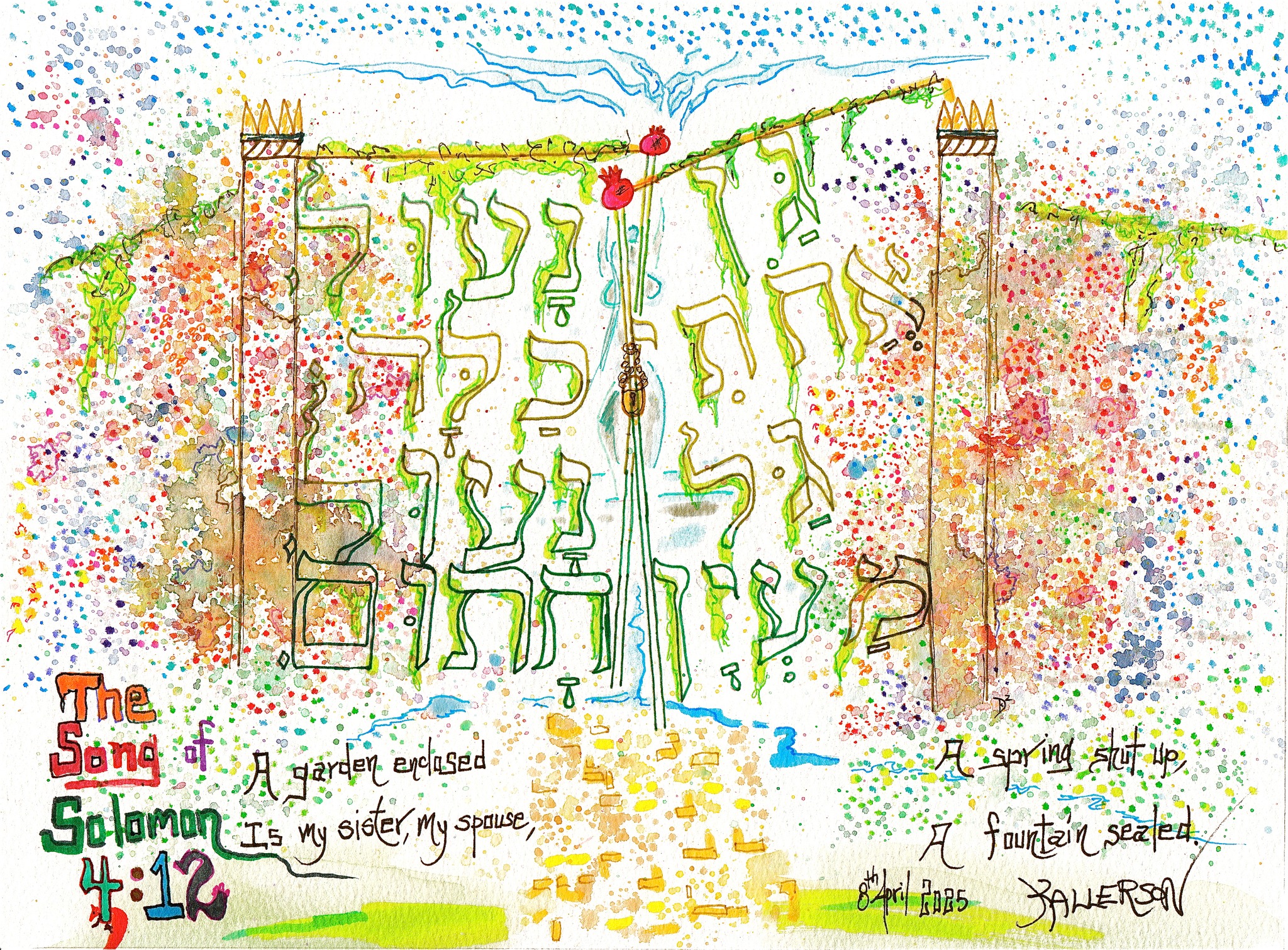
Artwork by Douglas Kallerson.
Song of Songs 4:12-16
Come My Beloved
(Typed 20 January 2025 – Inauguration day for President Donald J. Trump) President Trump took an oath to uphold the U.S. Constitution, and he was duly sworn in as the 47th President of the United States.
This fact is now sealed in the records of the United States permanently. In the verses of this sermon, Solomon says that his beloved is a “fountain sealed.” A seal is something applied externally, but it carries internal truths.
Daniel was sealed in the lion’s den. This was an external sealing that conveyed the truth that what was inside was not to be released without the appropriate authority.
Jeremiah had a purchase deed for land he obtained from his uncle. He had it sealed according to the law and custom. Inside, it contained the details of the property and sale. The seal was to remain until the time that proof was needed concerning his ownership of the land.
Likewise, God provides a seal to people when they appropriately respond to the gospel. For example, Paul says the following in our text verse…
Text Verse: “Now He who establishes us with you in Christ and has anointed us is God, 22 who also has sealed us and given us the Spirit in our hearts as a guarantee.” 2 Corinthians 1:21, 22
The seal provided by God is a way of saying, “This one is mine. Nothing can change that.” Fortunately, God is incapable of making a mistake. As He knows the future, it logically follows that God’s sealing is eternal, meaning salvation is eternal.
If this were not so, then it would mean that He made a mistake because He sealed someone with a guarantee but then changed His mind. If He knew the future, then changing His mind would mean His sealing was in error.
People who don’t understand this either have not thought the process through, or they don’t understand the nature of God. If someone acknowledges that God knows the future but then says a person can lose his salvation, it demonstrates contradictory thoughts.
In the case of the woman in the Song of Songs, Solomon says that she is a “fountain sealed.” Consider this as we go through the verses and think on what the Lord is telling us.
Eternal truths are to be found in His superior word. And so, let us turn to that precious word once again, and… May God speak to us through His word today, and may His glorious name ever be praised.
I. Frankincense, Myrrh, and Aloes (verses 12-14)
12 A garden enclosed
Rather: gan naul – “Garden locked.” Scholars generally agree upon the meaning of the words, but translators are not always scholars. Saying “enclosed” doesn’t get the full sense of what is being said.
The word is naul, to lock, bolt, fasten up etc. It can even mean to sandal because the foot is locked up when a sandal is fastened around it. As such, it is more than enclosed which doesn’t always convey the sense of locked or secure.
A garden can be enclosed but not locked up. People may be able to walk in through an opening where a path is. In this case, it is a garden that may have access points, but those access points are not readily accessible to all.
The thought of a garden takes the reader back to Eden’s idyllic perfection. When someone plants a garden, the intent is often to have it as a place of produce and abundance of some sort.
However, quite often, a garden extends beyond food for eating. There are butterfly gardens, rock gardens, flower gardens, hanging gardens, spice gardens, moss gardens, etc.
Each, depending on the type, is normally designed as much for aesthetic beauty, even if some are particularly designed with the intent of obtaining delicious tasting vegetables and fruits. For example, some are specifically planned for their aromatic smells.
Whatever the garden’s purpose, it is a place where one can go, find rest, solitude, a mentally calming environment, a place for personal productivity, and so forth. Gardens are intended to reflect their personal nature.
The garden is made by a person with a particular design that satisfies his ideas concerning structure, layout, order, harmony, etc. In this case, Solomon is speaking of a particular type of locked garden. His words are used in a metaphorical sense…
12 (con’t) Is my sister, my spouse,
akhothi khalah – “My sister – completer.” Solomon is saying that his beloved is her own garden with her own unique attributes which are locked up, meaning unshared with others. As such, he is saying she is a virgin. Nobody has violated her garden, nor do they have access to it.
As before, he provides two designations of her. She is his sister, demonstrating a similarity in intrinsic nature. It is not that she is literally a sister, but a sister in humanity, in culture, etc. Calling her khalah, completer, elevates that thought.
Despite being a sister in nature, she is also the one who perfects him and brings him to a state of fullness that didn’t exist without her. He said she is a locked garden, meaning she is chaste and undefiled. Next, to emphasize that point, he continues with…
12 (con’t) A spring shut up,
The words are needlessly debated: gal naul – “A bubbling locked.” Using the same word, naul, locked, as in the first clause, the NKJV changes the translation from enclosed to shut up. This type of switcheroo unnecessarily confuses the precise wording that Solomon is presenting.
However, the debate is not about that. Rather, it is about the word gal, translated by me as bubbling. Some think the word gal is in error. It is a word used thirty-four times, but never in this sense.
It comes from galal, to roll. As such, it is something heaped up. In Genesis 31, it is used six times when referring to a heap of piled stones that stood as a witness between Laban and Jacob. Quite a few times, it refers to the billows or waves on the sea. They are heaped up as they roll along –
“For You cast me into the deep,
Into the heart of the seas,
And the floods surrounded me;
All Your billows and Your waves [gal] passed over me.” Jonah 2:3
Because it is not used elsewhere in the manner it is here in “Song the songs,” some scholars claim it should again read gan, garden. The two Hebrew words somewhat resemble each other –
גַּן
גַּל
However, it is unlikely a scribe would make such an error, especially going from the simpler nun to the more complex rendering with a lamed. But more, it overlooks the obvious parallelism between the final two clauses.
Rather, Solomon is using this word to form an alliteration between the first and third clauses while forming parallelism between the third and fourth clauses.
As for the word itself, because it signifies to roll as in heaped up, the idea is that of a spring that bubbles. Saying spring is more literal, but it doesn’t fully explain the word, which gives the sense of not just coming forth, but doing so in a bubbling manner.
This use of the word is like what was seen in Judges 1, where a similar word, gulah, was used to describe the same thing –
“So she said to him, ‘Give me a blessing; since you have given me land in the South, give me also springs [gulah] of water.’
And Caleb gave her the upper springs [gulah] and the lower springs [gulah].” Judges 1:15
Solomon has taken the shortened form, gal, which is derived from the same word galal as is gulah, and he has formed a play on words between garden, gan, and a bubbling spring, gal. Understanding this, he next forms parallelism with the words…
12 (con’t) A fountain sealed.
mayan khathum – “Fountain sealed.” He essentially says the same thing as the previous clause but uses different words for effect. The word khathum, however, means more than just to lock. It carries the sense of being sealed, at times as with a signet or some other official marker –
“‘Men will buy fields for money, sign deeds and seal [khathum] them, and take witnesses, in the land of Benjamin, in the places around Jerusalem, in the cities of Judah, in the cities of the mountains, in the cities of the lowland, and in the cities of the South; for I will cause their captives to return,’ says the Lord.” Jeremiah 32:44
Looking at all the clauses together, one can see how Solomon carefully formed his words –
Garden [gan] locked,
My sister – completer.
*Bubbling [gal] locked,
*Fountain sealed.
The symbolism is that of his beloved being chaste and secreted away just for him. The thought is similarly expressed by Solomon in Proverbs while speaking of a woman by using the same type of metaphor –
“Drink water from your own cistern,
And running water from your own well.
16 Should your fountains be dispersed abroad,
Streams of water in the streets?
17 Let them be only your own,
And not for strangers with you.
18 Let your fountain be blessed,
And rejoice with the wife of your youth.
19 As a loving deer and a graceful doe,
Let her breasts satisfy you at all times;
And always be enraptured with her love.
20 For why should you, my son, be enraptured by an immoral woman,
And be embraced in the arms of a seductress?” Proverbs 5:15-20
Keil gives a suitable explanation for Solomon’s words –
“To a locked garden and spring no one has access but the rightful owner, and a sealed fountain is shut against all impurity. Thus she is closed against the world, and inaccessible to all that would disturb her pure heart, or desecrate her pure person.” Keil
Continuing with the garden symbolism, Solomon says…
13 Your plants are an orchard
The structure of almost all translations follows the same pattern as the NKVJ. But they do not provide the breaks necessary to see what is being said: shelakhayikh pardes – “Your shoots – paradise.” Solomon continues with the parallelism. His beloved was equated to a garden previously, now a paradise.
The word shelakh is translated elsewhere as a sword, missile, etc. It is derived from the verb shalakh, to send away, stretch out, and so forth. That which metaphorically shoots out of her is likened to a paradise.
This is a word, pardes, seen for the last of only three times in Scripture. It signifies a park. Thus, by extension, an orchard or forest. It is derived from the Persian word pairidaeza, paradise, which is how the Greek translates it. Solomon uses the word in Ecclesiastes –
“I made my works great, I built myself houses, and planted myself vineyards. 5 I made myself gardens and orchards [pardes], and I planted all kinds of fruit trees in them. 6 I made myself water pools from which to water the growing trees of the grove.” Ecclesiastes 2:4-6
This paradise is next described by him, saying…
13 (con’t) of pomegranates
With pleasant fruits,
The translation is terrible. First, including the word “of” would mean that the shoots spoken of previously are what describe the paradise, as in “a paradise of pomegranates.” But the structure that follows is ruined by such a translation.
Rather, everything that follows “paradise” is what describes it. Also, the word fruit is a collective singular word, and rather than an adjective, it is a plural noun: rimonim im peri m’gadiym – “Pomegranates with fruit – preciousnesses.”
Seeing the way I translate the two clauses will enlighten you –
“Your shoots – paradise:
Pomegranates with fruit – preciousnesses.
Hennas with nards.”
There are two categories that follow the word paradise. This clause concerning pomegranates is the first. The rimon, pomegranate, is derived from ramam, to be high or exalted. It symbolizes harvest-ready fruit and means Mature Mind or Harvest Ready.
The shoots are then defined by “with fruit – preciousnesses.” It is why the second noun is plural. The pomegranate has one type of fruit, even if it has many of them. Each of the fruit is precious. As there are many of them, they are preciousnesses.
Any other translation makes no sense. Solomon continues with…
13 (con’t) Fragrant henna with spikenard,
Both words are plural: k’pharim im n’radim – “Hennas with nards.” What is happening here is not as translations make it seem. The word “nards” is not a second plant. It describes the aromatic properties of the first plants, collectively called hennas. These will then be explained in the next verse. Here is how it all reads –
Hennas with nards:
14 Nard and saffron,
Cane and cinnamon.
But why is he saying this? It is because in Israel, they had the fragrances, but they didn’t have the plants themselves. John Lange rightly says –
“…the cyprus flower or alhenna was the only one of these plants, which was also cultivated in Palestine. The nard grass, grown only in India, is therefore simply added here for the sake of the delightfully fragrant unguent obtained from it, as in the following verse incense, calamus, cinnamon, and probably also saffron are exotic plants known to the Hebrews only from their aromatic products. The description accordingly loses itself here again in rapturous exaggerations and improbabilities in natural history, which however at the same time bear witness to an extensive knowledge of nature.” Lange
This “extensive knowledge of nature” is a great description seen in the Bible concerning Solomon –
“He spoke three thousand proverbs, and his songs were one thousand and five. 33 Also he spoke of trees, from the cedar tree of Lebanon even to the hyssop that springs out of the wall; he spoke also of animals, of birds, of creeping things, and of fish. 34 And men of all nations, from all the kings of the earth who had heard of his wisdom, came to hear the wisdom of Solomon.” 1 Kings 4:32-34
As seen in Chapter 1, the kopher, translated as henna, means a cover. In this case, it refers to henna, which is used to form a covering over the skin.
The word nards refers to the spikenard, already seen in Chapter 1, where typologically it is described and points to Christ. It was poured all over Him before His crucifixion. Being plural, it is being used as a single descriptor of each of the following scents…
14 Spikenard and saffron,
nered v’kharkom – “Nard and saffron.” We know that the word nards is referring to all of the subsequent fragrances because the word nard is now repeated in the singular. Solomon has essentially done something like this –
“Creosotes with jasmines: Jasmine and saffron, calamus and cinnamon…”
He has taken one plant that is not particularly aromatic and assigned to it many wonderful smells without any specificity. Next, he defines those smells beginning with the first wonderful smell. He then expands on that with more fragrances. As Lange rightly said, they are “rapturous exaggerations.”
The nard was just explained. Saffron, karkom, is found only here. It is derived from the Arabic kurkum, the crocus sativus. Keil says it is, “the genuine Indian safran, the dried flower-eyes of which yield the safran used as a colour, as an aromatic, and also as medicine.”
Strong’s lexicon says, “Its cultivation and trade were significant in regions such as Persia and India, and it was a symbol of beauty and love in various cultures.” Next, it says…
14 (con’t) Calamus and cinnamon,
qaneh v’qinamon – “Cane and cinnamon.” The first of these is qaneh, cane, implying sweet cane. It is elsewhere translated as a reed. It is derived from qanah, to erect. However, that by extension signifies to acquire, procure, purchase, etc. It was first used as an aromatic in Exodus 30:23 when it was included as a part of the holy anointing oil.
The next, qinamon, was also first seen in Exodus 30:23. It is from an unused root meaning “to erect.” Thus, it is applied to cinnamon bark, which is found in upright rolls. Solomon next says…
14 (con’t) With all trees
Like before, the NKJV and others seem to make the break in the rong place by saying “trees of frankincense.” Rather, Solomon is still describing the plural nards. From there, he will describe the trees: im kal atsei – “With all trees.” After this, he will continue with his list –
“With all trees –
Frankincense, myrrh, and aloes.”
14 (con’t) of frankincense,
Myrrh and aloes,
Instead: l’vonah mor vaahaloth – “Frankincense, myrrh, and aloes.” As has been seen several times, frankincense comes from lavan, white. That is derived from lavan, to be or make white or to purify. It also signifies to make bricks because bricks whiten when they are dried.
Myrrh, mor, is from marar, bitter as has been seen.
The ahalim, aloes, refers to the lignum or wood aloes. It is a tree eight to ten feet tall that has a sweet smell and provides shade. It is also the source for aromatic resins and incense. It is used when speaking of a fragrance of the Lord in the 45th Psalm –
“All Your garments are scented with myrrh and aloes and cassia,
Out of the ivory palaces, by which they have made You glad.” Psalm 45:8
Next, Solomon says…
14 (con’t) With all the chief spices—
Rather, the two final nouns are plural: im kal rashe b’samim – “With all chiefs – fragrances.” The reason for this structure is that it forms a type of parallelism, repeating what was just said –
With all trees (im kal atse) –
Frankincense, myrrh, and aloes,
With all chiefs (im kal rashe) – fragrances.
These are the chief trees, and the word fragrances sums up the naming of the trees. What I have proposed for verses 13 and 14 is like the likely explanation of what is being said. In addition to that, the translations are certainly correct, in contrast to all other available translations.
However, the structure of the translation may have been misidentified by me. It does not match any others that I have seen. Despite this, I feel it is proper and I present it to you with calm but courageous confidence.
Next, the words turn again to the waters. Most scholars attribute them to Solomon speaking of his beloved. There are no gender markers to indicate it either way. It makes little sense for it to be Solomon speaking of his beloved when properly considered.
Rather, the words are assuredly the woman speaking about Solomon…
Into My death, you also can die with Me
Into new life, you can be born
When you trust the gospel story
In garments of righteousness, you I will adorn
The fragrance of your faith is pleasing to Me
Because it reflects what I have done
By faith, you have trusted Me completely
From that moment, new life has begun
How I rejoice over you!
My precious bride, My beautiful wife
My words are faithful and true
To you I have granted eternal life
II. Gushings From Lebanon (verses 15 & 16)
15 A fountain of gardens,
mayan ganim – “Fountain gardens.” The words go back to verse 12 and reveal a contrast –
12 “A bubbling locked,
Fountain sealed.”
15 “Fountain gardens,
Well waters – living,
And gushings from Lebanon.”
Verse 12 spoke of the moral state of Solomon’s beloved. She is chaste, pure, and morally contained. The words of verse 15 refer to the spiritual state of Solomon. He is the provider who outwardly flows forth, providing abundance and life to Israel as its king.
Being a “fountain gardens,” means that his waters flow to refresh more than a single garden. Rather, he flows to all of the gardens of the Lord’s people. Next…
15 (con’t) A well of living waters,
b’er mayim khayiym – “Well waters – living.” The idea of living waters is that of continuously flowing waters. They remain constant, fresh, and unimpeded. Thus, they continually provide life for those seeking it. Next, she says…
15 (con’t) And streams from Lebanon.
v’nozlim min l’vanon – “And gushings from Lebanon.” The word nazal comes from a primitive root signifying to drip or shed by trickling. In this case, it is plural and gives the sense of gushing waters or many streams.
Coming from Lebanon means the waters are from the snow melt. Thus, they are cool, refreshing, abundant, and descending from a higher point.
As with frankincense, Lebanon comes from lavan, white. As already noted, that is derived from lavan, to be or make white or to purify. It also signifies to make bricks because bricks whiten when they are dried.
With that stated, she now calls out with vibrant, exclamatory words…
16 Awake, O north wind,
The verb is imperative: uri tsaphon – “Awake, north!” It is speaking of a stirring from the north. Though the word wind is not included, it is implied. The land heats and the winds arise as a result. From there, they move across the land. Next…
16 (con’t) And come, O south!
Again, the verb is imperative: uvoi teman – “And go, south!” The word bo can mean either to come or to go. In this case, it doesn’t seem likely that she is asking for both the north and south wind to come at the same time. This is especially true when the south wind can be very hot in Israel.
Thus, I have translated it as go. The meaning of the word go can be used as in “Go away,” or “Go, do your thing.” Therefore, nothing is lost in the translation. As a side note, the construct, uvoi, is used only four times. The other three uses indicate to go. Therefore, it is a perfectly plausible pronouncement.
16 (con’t) Blow upon my garden,
The imperative verbs continue: haphikhi gani – “Puff my garden.” The winds rising in the north and going to the south makes sense considering the word puakh, to puff. It is as if the wind is breathing across the land.
But her words ask for them to puff across her garden, meaning herself. The bride of Solomon is calling on the winds to blow over her, and she asks for this…
16 (con’t) That its spices may flow out.
yiz’lu b’samav – “Gushes its fragrances.” It is the same word just used to describe the gushing of the waters from Lebanon. She asks the wind to pick up the spices noted above that describe her and carry them to her beloved. From there, she says…
16 (con’t) Let my beloved come to his garden
yavo dodi l’gano – “Come, my beloved, to his garden.” She acknowledges that her garden is his garden. She has completely yielded to him, inviting him to come to her…
*16 (fin) And eat its pleasant fruits.
The word fruit is again singular, as in verse 13: v’yokhal peri m’gadav – “And eat fruit – his preciousnesses.” The word garden is masculine, so she could be speaking of the fruit as being of the garden in general, “its preciousnesses.”
But with a singular noun, fruit, it seems she is talking about him, saying, “his preciousnesses.” Gardens normally have more than one fruit. But he focused on only one when describing her, the pomegranate. She is repeating that back to him, “Come to your garden and eat your fruit, your preciousnesses.”
With Chapter 4 complete, there is still typology to consider. The words continue the typology of Christ from the previous sermon, where he called her “completer” four times.
The beloved provides a sense of completion to him as any bride does. The verses described what she was like in order to become this completer.
Next, he begins to describe what she is like, starting with “Garden locked. My sister – completer.” As noted, she is her own garden with her own unique attributes, but they are locked up, meaning unshared with others.
This means she is a chaste virgin. Nobody has violated her garden, nor do they have access to it. It is reflective of Paul’s words in 2 Corinthians –
“Oh, that you would bear with me in a little folly—and indeed you do bear with me. 2 For I am jealous for you with godly jealousy. For I have betrothed you to one husband, that I may present you as a chaste virgin to Christ.” 2 Corinthians 11:1, 2
The imagery of her being “Bubbling locked, Fountain sealed,” means that she is His alone, she is reserved solely for Him, and only He has access to her. That is perfectly seen in Paul’s writings, such as in our text verse. Also –
“In Him you also trusted, after you heard the word of truth, the gospel of your salvation; in whom also, having believed, you were sealed with the Holy Spirit of promise, 14 who is the guarantee of our inheritance until the redemption of the purchased possession, to the praise of His glory.” Ephesians 1:13, 14
Speaking of her shoots, meaning the redeemed within the garden, as “shoots – paradise” explains the state of the redeemed. They form a paradise, being people who are mature-minded, symbolized by the pomegranate, concerning Christ. For example, Paul says –
“However, we speak wisdom among those who are mature, yet not the wisdom of this age, nor of the rulers of this age, who are coming to nothing. 7 But we speak the wisdom of God in a mystery, the hidden wisdom which God ordained before the ages for our glory.” 1 Corinthians 2:6, 7
Next, the description “hennas with nards” looks to their state in Christ. Henna is from kophar, a covering. As noted in Chapter 1, the word is used to signify a ransom. The plural speaks of each individual as one who is ransomed by the Lord.
Likewise, the nard was poured all over Christ in preparation for His burial. As such, those who are redeemed are symbolically covered in the nard of Christ’s death. Christ’s death was a type of baptism. Believers are then baptized into His death and bear the fragrance of it –
“What shall we say then? Shall we continue in sin that grace may abound? 2 Certainly not! How shall we who died to sin live any longer in it? 3 Or do you not know that as many of us as were baptized into Christ Jesus were baptized into His death? 4 Therefore we were buried with Him through baptism into death, that just as Christ was raised from the dead by the glory of the Father, even so we also should walk in newness of life.” Romans 6:1-4
The subsequent naming of each spice carries symbolism. First, the nard. Next, the saffron was noted as being a symbol of beauty and love. The qaneh, cane, is the source of the word canon, which we use to indicate the authority of Scripture, as in the canon of Scripture.
Thus, this spice is used to indicate the word of God. It is reflective of Christ, the word of God, who both embodies and reveals it. His word is that which is used as the standard measure for the acquisition and purchase of God’s people.
The qinnamon, cinnamon, is found four times in the Bible. Two point to Christ, two point to harlotry.
The word comes from an unused root meaning to erect. Thus, there is a house being erected by the Lord for His people, and there is a false one which is being erected by the false religious system of the world for those who pursue her harlotry. One will stand forever; the other will be forever destroyed.
Each of these spices points to a truth concerning the redeemed in relation to Christ. After those, it said –
“With all trees –
Frankincense, myrrh, and aloes.”
These spices have each been described already. Frankincense symbolizes purification, but it also speaks of works. The prominent idea of myrrh speaks of bitterness and symbolizes love. More especially, however, love in intimate union, but not necessarily sexual in nature.
Finally, the aloes were noted as one of the fragrances of the Lord in Psalm 45. These each then refer to the Lord’s work, the bitterness of it, and His fragrance before God. Saying they are “all chiefs – fragrances” is a way of saying that what Christ has done is the epitome of what identifies His people.
After the words about the woman were complete, she then described Him. He is the “Fountain, gardens,” whether those of faith in the past (apart from the law), the redeemed under the law, or the redeemed after His completion of it.
He is the “Well waters – living.” As Jesus Himself said –
“Whoever drinks of this water will thirst again, 14 but whoever drinks of the water that I shall give him will never thirst. But the water that I shall give him will become in him a fountain of water springing up into everlasting life.” John 4:13, 14
These descriptions exactly define Jesus as He has revealed Himself. But she also says he is “gushings from Lebanon.” Because of the etymological similarity, the meaning of Lebanon is the same as frankincense, which speaks of Christ’s work.
The water from His works provides for His people, just as John 7 said. It is He who fulfilled God’s will, suffered for His people, and provides purification and life for them.
The last verse called on the wind. The north, tsaphon, signifies concealed. The south, teman, signifies the right hand. It is a call from the redeemed to have their own fragrances go forth openly (from the concealed) and in strength (symbolized by the right hand) for the Lord to come among them, “And eat fruit – His preciousnesses.”
It is a call for the Lord to be pleased with the fruit of those who are mature-minded, meaning having the mind of Christ by the act of receiving Him through faith.
We again see in these verses the reasons why this “Song the songs” is read each year at the Passover. As it anticipated the cross of Christ, the Passover Lamb, it is a call to share in the greatest love story ever written.
The book speaks of the union of Christ with His bride, the completer. As noted in the previous sermon, there is something about the Lord presenting the church as a bride to Himself that brings about its own state of completeness.
Otherwise, there would be no reason for Him to die on the cross and then to prepare the church as a bride for Himself. Whatever it is that He sees in His redeemed, His word has given a great number of typological anticipations of His union with it.
For example, Genesis 24 was all about this process when Abraham sent his servant to acquire a bride for Isaac. This book now is showing us that there is a fullness that can only be experienced when a man has a wife.
Transferring that thought to God in Christ, it shows us the true value He sees in His redeemed. He was willing to go through the years of redemptive history leading to Jesus, and then have Jesus go through immeasurable trials and suffering for this process to be completed.
Whatever value He sees in uniting with His redeemed, the fact is that He sees it. We are the beneficiaries of everything that lies ahead, and that state is procured by a simple act of faith in what He has done. Let us not insert ourselves into that part of the equation.
Let us trust in what He has done. In doing so, we will receive the full benefit of what He has promised to His people.
Closing Verse: “On the last day, that great day of the feast, Jesus stood and cried out, saying, ‘If anyone thirsts, let him come to Me and drink. 38 He who believes in Me, as the Scripture has said, out of his heart will flow rivers of living water.’ 39 But this He spoke concerning the Spirit, whom those believing in Him would receive; for the Holy Spirit was not yet given, because Jesus was not yet glorified.” John 7:37-39
Next Week: Our Annual Resurrection Day Message
The Lord has you exactly where He wants you. He has a good plan and purpose for you. He alone is the perfect example of love – untarnished, unblemished, and completely pure and holy. He offers this love to you. So, follow Him, live for Him, and trust Him, and He will do marvelous things for you and through you.
Song of Songs 4:12-16 (CG)
12 Garden locked,
My sister – completer.
A bubbling locked,
Fountain sealed.
13 Your shoots – paradise:
Pomegranates with fruit – preciousnesses.
Hennas with nards:
14 Nard and saffron,
Cane and cinnamon,
With all trees –
Frankincense, myrrh, and aloes,
With all chiefs – fragrances.
15 Fountain gardens,
Well waters – living,
And gushings from Lebanon.
16 Awake, north!
And go, south!
Puff my garden,
Gushes its fragrances.
Come, my beloved, to his garden,
And eat fruit – his preciousnesses.
Song of Songs 4:12-16 (NKJV)
12 A garden enclosed
Is my sister, my spouse,
A spring shut up,
A fountain sealed.
13 Your plants are an orchard of pomegranates
With pleasant fruits,
Fragrant henna with spikenard,
14 Spikenard and saffron,
Calamus and cinnamon,
With all trees of frankincense,
Myrrh and aloes,
With all the chief spices—
15 A fountain of gardens,
A well of living waters,
And streams from Lebanon.
16 Awake, O north wind,
And come, O south!
Blow upon my garden,
That its spices may flow out.
Let my beloved come to his garden
And eat its pleasant fruits.