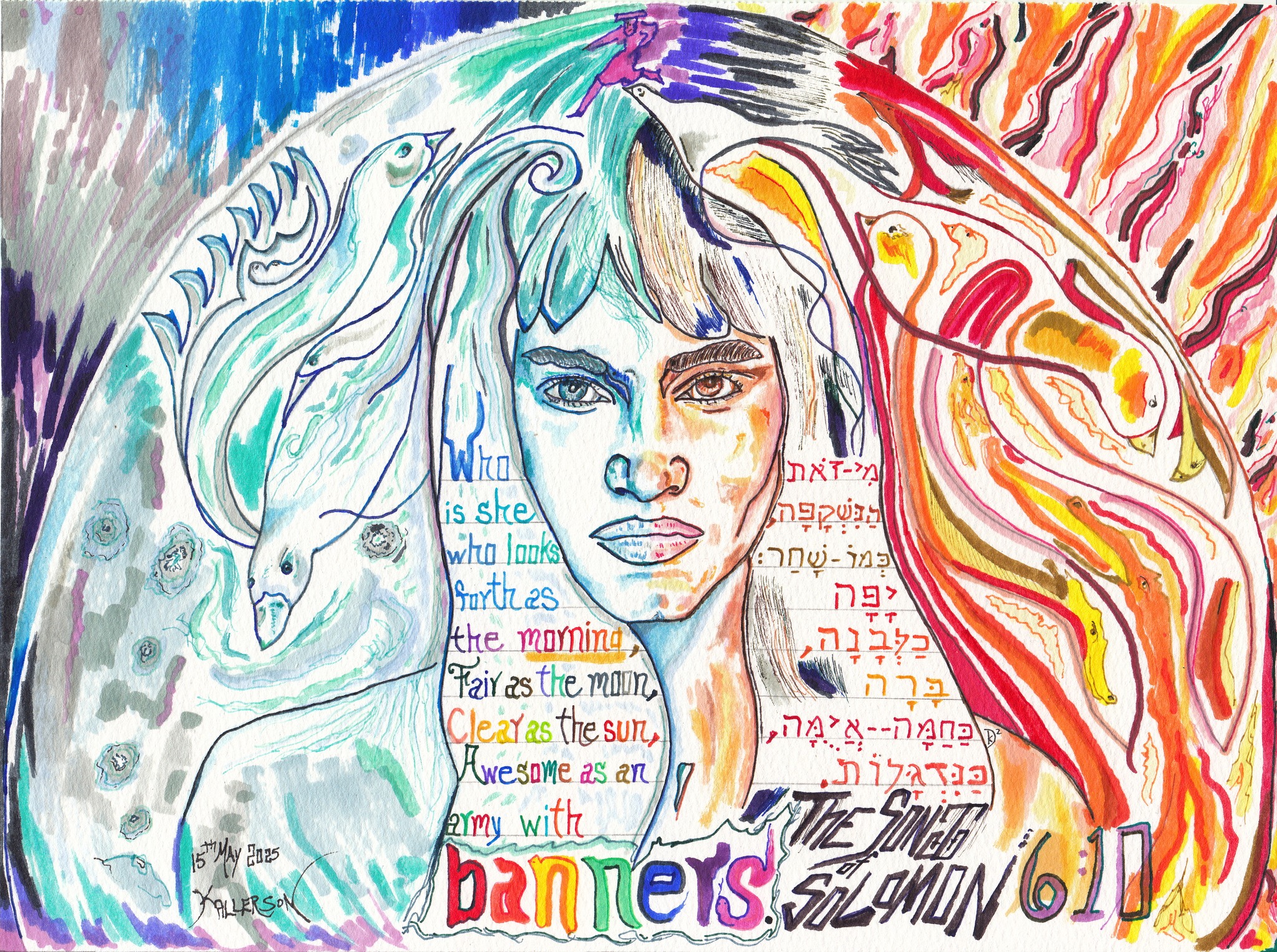
Artwork by Douglas Kallerson.
Song of Songs 6:8-13
Return, Return – the Shulamite
(Typed 17 February 2025) Having answered questions about the Bible for many years, one thing is evident: people will see what they want to see in a passage. Quite often, it is about their anticipated departure via the rapture.
People insert the rapture into innumerable passages that have nothing to do with it. But this is what we do. Frequently, we take our thoughts and ideas and insert them into the text because that excites us and reassures us that the doctrine must be true.
In this case, it is true. The New Testament explains the rapture quite clearly. Reading the words of Paul concerning the rapture, it is so clearly presented that to not accept it means it had to have been taught out of someone.
Someone who picks up the Bible and reads the passages about it may not fully understand what Paul is saying, but they will conclude that what he describes is what is anticipated to happen.
There are Old Testament hints of the rapture which are convincing enough to give us surety that based on a proper understanding of the New Testament, they are valid.
In the passage today, I see a parallel to the rapture. However, I would ask you not to make a brain squiggle based on what I present. The style of literature is poetic, so this could be me doing what I have seen others do.
What I present is an observation, not an instruction intended to convince you. When I teach that way, it is because I am convinced the matter is correct. Keep that in mind, and don’t feel that I am trying to convince you of anything, please!
Text Verse: “…that He might present her to Himself a glorious church, not having spot or wrinkle or any such thing, but that she should be holy and without blemish.” Ephesians 5:27
Keil makes a statement about verse 6:8 that is correct. It is something I have demonstrated in typology many times in the past. You will see this when I cite him. Something or someone can anticipate Christ but which is portrayed as negative in a given passage.
For example, in Joshua 8, the king of Ai was captured and hanged on a tree. That pointed to Jesus’ cross. In Joshua 10, the five kings of the Amorites were hanged on five trees. They each pointed to the work of Christ as well. And yet, these were enemies of Israel. Keil says –
“The fact is, that by a violation of the law of God (Deuteronomy 17:17), Solomon brings a cloud over the typical representation, which is not at all to be thought of in connection with the Antitype. Solomon, as Jul Sturm rightly remarks, is not to be considered by himself, but only in his relation to Shulamith. In Christ, on the contrary, is no imperfection; sin remains in the congregation. In the Song, the bride is purer than the bridegroom; but in the fulfilling of the Song this relation is reversed: the bridegroom is purer than the bride.” Keil
This is a good point about this “Song the songs.” The woman, the beloved of Solomon, is put in the highest light of perfection. Solomon, as seen in his life in the books of Kings and Chronicles, was not the greatest example of a godly king.
But God can still use him to give us hints of Christ, just as He did with the kings in Canaan. From there, we learn that it is Christ who makes us the height of perfection. Despite this, none of us is actually the height of perfection. But because of Jesus, everything changes.
That is why we can have the hope of the rapture, or for the saints of old, the resurrection. God will bring to Himself all who have looked to the Messiah in faith. The heavenly Jerusalem awaits. What a day it will be when we arrive.
It’s all to be found in His superior word. And so, let us turn to that precious word once again, and… May God speak to us through His word today, and may His glorious name ever be praised.
I. My Dove, My Perfect (verses 8-9)
The chapter began with the woman being questioned about where her beloved had gone. This was based on her marvelous description of him from Chapter 5. The other women wanted to search for him with her, but probably with the intent of moving in on her territory. She explained where she thought he had gone and that she was the only one for him with the words, “I to my beloved and my beloved to me.”
Solomon began to speak in 6:4, explaining to the woman how beautiful she was to him, repeating some of his thoughts from earlier in the book. Though the speaker is debated, whether it is Solomon or the woman, it is probable that it is still Solomon speaking.
If it is the woman, her coming words about the women would be like saying, “I am just one of so many.” If it is Solomon, he is saying, “You are the number one out of so many.” The way he expresses himself in verse 9 will tend to favor the latter. And so, his words continue with…
8 There are sixty queens
shishim hemah m’lakhoth – “Sixty they, queens.” Solomon begins a list of the women who belong to him, designating them by category. The first category is defined by the word malakh, a queen. It is the feminine form of melekh, king.
As for the designation “queens,” it is likely that these were the daughters of royalty given to him for the purposes of making alliances. For example –
“Now Solomon made a treaty with Pharaoh king of Egypt, and married Pharaoh’s daughter; then he brought her to the City of David until he had finished building his own house, and the house of the Lord, and the wall all around Jerusalem.” 1 Kings 3:1
Being of royal blood, they were used for the purposes of security or the expansion of the kingdom. And so, they are identified as such queens. Solomon next refers to another category…
8 (con’t) And eighty concubines,
ush’monim pilagshim – “And eighty concubines.” The word is pilegesh. It is supposed by some to be a compound word coming from palag, to split or divide, and nagash, to draw near or approach.
As such, it signifies that a man divides his attention between his formal wives and his lesser wives. The formal wives would have certain rights that the lesser wives did not. In the case of Solomon or any other ruler with concubines, the king divided his attention between his royal wives and his concubines.
This type of arrangement was seen in the life of Abraham –
“And Abraham gave all that he had to Isaac. 6 But Abraham gave gifts to the sons of the concubines which Abraham had; and while he was still living he sent them eastward, away from Isaac his son, to the country of the east.” Genesis 25:5, 6
With other examples like this in Scripture, such as in the lives of Saul and David, the concubine is considered a wife, belonging to one man alone, even if she is not a main wife. Therefore, it is likely that the children of such a union would be categorized differently as well.
In describing the number of queens, Solomon is probably using a specific number to express a general. In other words, there may have been 57 or 62 queens, but he has rounded it to 60. This would maintain the poetic flow.
Sixty is the product of six and ten. Six is a number stamped with the thought of human labor. It is the number of man, but especially fallen man. Of the number ten, Bullinger says –
“Completeness of order, marking the entire round of anything, is, therefore, the ever-present signification of the number ten. It implies that nothing is wanting; that the number and order are perfect; that the whole cycle is complete.” EW Bullinger
Eighty is the product of eight and ten. Bullinger defines eight as being associated with resurrection and regeneration. One can think of the idea of “new beginnings” as a simple definition of it.
As for Solomon’s harem, it also includes another category…
8 (con’t) And virgins without number.
vaalamoth ein mispar – “And maidens without number.” Using the word virgin to translate almah here may be wrong for at least a couple of reasons. First, the word, though usually associated with a young, marriable woman, of which a virgin is generally understood in such passages, doesn’t mean virgin. Rather, it is the feminine of elem, a youth or young man.
Second, if they are a part of Solomon’s harem, they are probably not virgins, unless they are new ones added to the harem for him. Once they had been with him, they would return to the harem, but not as a virgin. This is the thought of Esther 2 –
“Each young woman’s turn came to go in to King Ahasuerus after she had completed twelve months’ preparation, according to the regulations for the women, for thus were the days of their preparation apportioned: six months with oil of myrrh, and six months with perfumes and preparations for beautifying women. 13 Thus prepared, each young woman went to the king, and she was given whatever she desired to take with her from the women’s quarters to the king’s palace. 14 In the evening she went, and in the morning she returned to the second house of the women, to the custody of Shaashgaz, the king’s eunuch who kept the concubines. She would not go in to the king again unless the king delighted in her and called for her by name.” Esther 2:12-14
It could be that all the virgins of the harem became concubines once they had been with Solomon. However, it also could be that they were neither wives nor concubines, but instead, were subordinate to the other two categories. As this isn’t certain, it is best to define them as maidens.
Regardless of this, the words here express a failing in Solomon in relation to the Law of Moses. First, it was expressly forbidden for a king to have such a large body of women available to him –
“Neither shall he multiply wives for himself, lest his heart turn away; nor shall he greatly multiply silver and gold for himself.” Deuteronomy 17:17
The Bible doesn’t say at what point multiplying wives becomes a violation of the law. David had wives and concubines, and nothing negative is said about this. But nothing is said about him having his heart turned away from either the Lord or his responsibilities. On the other hand, it says this of Solomon –
“But King Solomon loved many foreign women, as well as the daughter of Pharaoh: women of the Moabites, Ammonites, Edomites, Sidonians, and Hittites— 2 from the nations of whom the Lord had said to the children of Israel, ‘You shall not intermarry with them, nor they with you. Surely they will turn away your hearts after their gods.’ Solomon clung to these in love. 3 And he had seven hundred wives, princesses, and three hundred concubines; and his wives turned away his heart.” 1 Kings 11:1-3
Solomon not only multiplied wives, but he did so by marrying women from nations that the law forbade. One can see that despite him being used as a type of Christ, this only extends to type and does not express his general character.
Because of the number of women noted here in “Song the songs,” and the number of them noted in 1 Kings 11, people claim there is an insurmountable contradiction between the two. However, this can be easily dispelled.
One possibility is that this could have been written at a much earlier stage in Solomon’s life. Acquiring 700 wives would take a long time. If he married one a month, it would take 58+ years.
Of all of the women mentioned here, meaning 60 wives + 80 concubines + innumerable maidens, he specifically turns his eyes, thoughts, and heart to just one…
9 My dove, my perfect one,
Is the only one,
Rather: akhath hi yonati thamathi – “One, she, my dove, my perfect.” He has made a contrast to all the others through these words. If this woman is his “one … dove,” then the others are not. If this one is described as “one … perfect,” then the others are not.
By jumbling the order of Solomon’s words, many translations make it seem like he describes her and then explains her in relation to her mother, who is mentioned in the next clause.
Rather, he is speaking of her as the epitome of his delight, contrasting her with those in the previous verse. His words have placed her as the superlative above all others. She is…
9 (con’t) The only one of her mother,
akhath hi l’imah – “One, she, to her mother.” Though not certain, the words tend to the idea that she was the only daughter of her mother. Thus, all her other children are boys. Some, however, say that the girl mentioned in Chapter 8 is her younger sister.
There is no reason to assume this. Those verses could refer to her when she was younger, which is what the following verses seem to imply. However, even if she had sisters, the words here could still be used to express the finest of her daughters.
The former option seems the most fitting, meaning that she is the only daughter of her mother. As such, Solomon is calling out her uniqueness in that her mother got it right with her first and only daughter. With that stated, he next says…
9 (con’t) The favorite of the one who bore her.
barah hi l’yoladtah – “Clear, she, to her bearing.” The word barah is derived from barar, which can have a variety of significations. It comes from a primitive root signifying to clarify, as if brightening something.
Therefore, it can speak of cleansing, purifying, purging, choosing, etc. The word describing the mother’s daughter is most likely not a comparison to others (favorite), but a description of her personal state (clear).
If the mother is describing her, she might say, “I only have one daughter, and she is my perfect little angel.” Solomon recognizes this and ascribes this quality to her in relation to her mother, poetically called here “her bearing.” Thus, she is the opposite of the one Solomon describes in the Proverbs –
“Vexation to his father, son dullard,
And bitterness to his bearing.” Proverbs 17:25 (CG)
Said plainly, the dullard is bitterness to his mother. On the other hand, this woman is clear to her mother. In a similar reaction when seeing her, Solomon continues with…
9 (con’t) The daughters saw her
And called her blessed,
rauha banoth vayash’ruha – “Saw her, daughters, and straighten her.” The word ashar means to be or go straight. Thus, figuratively, it signifies to make happy, bless, and so forth. When one advances, especially in a straight, even way, it is a happy state.
That is the idea one gets when reading the words of Isaiah –
“Every valley shall be exalted
And every mountain and hill brought low;
The crooked places shall be made straight
And the rough places smooth.” Isaiah 40:4
In leveling and straightening, it is a way of blessing the Lord for His coming. Therefore, rather than “calling her blessed” as the NKJV does, it would mean, “and they bless her.” The figurative use of the word is seen in the next parallel clause…
9 (con’t) The queens and the concubines,
And they praised her.
m’lakhoth u-pilagshim vayhal’luha – “Queens and concubines, and praise her.” The first clause referred to the daughters of Jerusalem, the women in general. This refers to the selected and choice in Solomon’s house. They see her and praise her. One can see the parallelism between the clauses when they are properly translated –
One, she, my dove, my perfect –
One, she, to her mother,
Clear, she, to her bearing.
Saw her, daughters, and straighten her,
Queens and concubines, and praise her.
Solomon next continues with his beautiful descriptors of his beloved…
Return! Return! We want to see you again!
We want to know what to do
Return! Return! Come back, and then…
We will be instructed by you
It can’t be too late for us
There must still be hope
Return! Return! Don’t put up a fuss
Unless you do, we just can’t cope
Hurry back to us. We have learned our lesson
We will pay heed this time if you just come back
Return! Return! Don’t keep us guessin’
On how we can get back on track
II. The Two Camps (verses 10-13)
10 Who is she who looks forth as the morning,
Though nobody translates it the way I do, the words use a verbal, a participle to describe the woman in a noun form: mi zoth hanish’qaphah k’mo shakhar – “Who this, the ‘looking according to the dawn?’” In other words, he is asking a question, but it is done in the form of an emphatic declaration concerning her appearance.
Most translations are completely wrong in how they present the words. The NIV, though a paraphrase, gives the closest sense, saying, “Who is this that appears like the dawn?” The word is the noun shakhar, coming from the verb shakhar, to dawn.
Thus it is the earliest, and to many, the most beautiful part of the day, just as the dawn begins to lighten the world. Solomon gazes upon her beauty and is enraptured by it. She is glowing. It is during this early period of the day that she is likened to being…
10 (con’t) Fair as the moon,
yaphah kal’vanah – “Beautiful – according to the moon.” At the dawning of the day, when the moon is visible, it is radiant, having a beauty about it that accentuates the lightening of the sky as it passes from total darkness until the moment of the sunrise.
In his words, he introduces a rarer word, l’vanah, to describe the moon instead of the word normally used. It is derived from laven, to be white, purify, or make bricks.
Saying “Fair as the moon” as the NKJV does misses the point. She has already been noted as being swarthy. Thus, her color is not the comparison, but the beauty of the moon in its whitened state. Likewise, some translations add the word “full” to “moon.”
This is probably not correct either. The full moon sets around dawn. He is likely referring to a crescent moon which is in the area of the dawning of the sun where the sky first begins to lighten, long before the sunrise. He is as enraptured with her within her surroundings as he is with the moon at dawn.
Solomon next notes another metaphor in regard to her beauty, also found at dawn…
10 (con’t) Clear as the sun,
barah kakhamah – “Clear – according to the sun.” At the rising of the sun, it is bright but clear. Later in the day, its light is so overwhelming that you can’t look at it. But when it is just rising, you can often look at it without anything to detract from its pure roundness and beauty.
This is the moment that Solomon equates to his beloved. When he does, he uses a rarer word, khamah, to describe the sun instead of the word normally used. It is derived from kham, hot. Thus, it refers to the heat of the sun more than its brilliance.
Having noted this aspect of her beauty, he uses another metaphor concerning this early time of day…
10 (con’t) Awesome as an army with banners?
ayumah kanidgaloth – “Threatening – according to bannered.” It is letter for letter the same as in the corresponding clause in verse 6:4. In this case, it is as if she is an army set up for battle at the dawning of the day.
They would seem threatening to any foe just waking and looking out at the masses of troops already standing in the early light, fully bannered and ready for battle. The prospect of a day of battle would be overwhelming.
This is how he presents her. It is as if he is saying, “My love, I am already defeated by you.” Next, words from the woman start a new direction in the unfolding narrative…
11 I went down to the garden of nuts
Rather: el ginath egoz yaradti – “Unto garden nut descended.” Very few translations are even close to being correct. Instead, along with other changes, they translate nut in the plural, nuts. Some, to get around this, will add in words and say something like, “nut trees.”
The Coverdale Bible of 1535 gives an early rendering that has sadly been departed from, “I wente downe in to the nutt garden…”
It is a fact that not sticking with the singular is just nuts. Despite that, the word is egoz, and it is found only here. It is believed to be a word of Persian origin. Nuts are mentioned elsewhere, such as in Genesis 43:11, but only by their kind, the pistachio and the almond.
In this verse, there is nothing further to define what type of nut (or nuts) is being referred to. Instead, it is just a nut garden. This makes the clause rather peculiar. There is nothing to compare it to in the New Testament either. However, there is more to see in the area she has descended to…
11 (con’t) To see the verdure of the valley,
The word is plural: liroth b’ibe ha’nakhal – “To see in greenesses the valley.” Based on the next two clauses, we know she is referring to the springtime. As such, she is going down to see the many variations of green among the various types of bushes and trees.
Each one would come forth and add to the display of beauty that arises at this time of year. The word is ev. It signifies green. It is found only in Job 8:12 and here, but in Job, it is in the singular. Along with the various greennesses, she is going…
11 (con’t) To see whether the vine had budded
liroth haphar’khah ha’gephen – “To see budded – the vine.” The budding of the vine is a springtime event, when the daily temperatures are consistently about 55ºF. This is typically around March. Likewise…
11 (con’t) And the pomegranates had bloomed.
henetsu ha’rimon – “Blossomed – the pomegranates.” The pomegranates blossom in the late spring in Israel. Therefore, the time she is referring to is from March until May.
We have already seen how nuts it is to mistranslate nut because when you do, it is nuts. However, what is also nuts is that the word translated as blossomed here is the word… nuts. Something nutty is going on. But this nuts is pronounced noots, so it is a bit less nutty than being completely nuts.
This word ultimately comes from a primitive root signifying to flash because of the brilliancy of the blossom. The pomegranate blossoms are a brilliant red that stand out markedly against the green leaves.
The woman continues with more curious words…
12 Before I was even aware,
My soul had made me
As the chariots of my noble people.
The words are very obscure: lo yadati naphshi samathni mark’voth ami nadiv – “Not known, my soul set me chariots my people – willing.” Depending on how you place the comma or commas to make a pause, it changes the intent.
What seems to be the case is that she didn’t even realize that she had been so set. But then the word chariots has no connector such as the, as, according to, in, among, etc. The word sum, to place or set, is translated as “make” at times, but that is not really the intent, such as –
“And I will make your descendants as the dust of the earth; so that if a man could number the dust of the earth, then your descendants also could be numbered.” Genesis 13:16
The Lord says, “And I set your seed according to the dust.” It is a done deal. It is as if He had placed the future descendants in the statement.
The word chariot, being plural, along with the next verse asking her to return, seems to make it mean “I became like a chariot.” As such, she sped away. The adjective nadiv, willing, comes from nadav, to be willing. It is a descriptor of “my people.”
With all of this information presented, it seems to say, “I didn’t know that my soul had made me like the chariots of my willing people.” In other words, the chariots of willing warriors are set on their mission. They go directly into battle without hesitation.
She had taken off without even realizing it. Therefore, this explains the fact that she had descended into the nut garden. Without even thinking about it, she made herself like a chariot and took off. That explains why the next words are spoken…
13 Return, return, O Shulamite;
The words are imperative: shuvi shuvi hashulamith – “Return! Return! – the Shulamite!” Here, she is given a pet name, “the Shulamite.” The word is only found in this verse. It is derived from the verb shalam, the same word that Solomon’s name is derived from.
It means to be safe. That can have a lot of meanings, such as making good on a vow, making amends, etc. As such, it gives the sense of peaceful, as in “all is good.”
Because it is the same root as Solomon’s name, some think that this is a play on his name and thus means, “the woman of Solomon,” meaning his wife. That makes sense and would certainly be a reason for calling her this.
I connected her travel to the city of Shunem in Chapter 3 based on scholarly notes, but it seems dubious to me that it is connected to that location. Shumen is noted in Joshua 19:18, and it is the only name that is close in name to any biblical location. Therefore, some have made this conclusion, something I didn’t consider while evaluating that passage.
Rather, the idea of calling her the Shulamite after Solomon, rather than a location, agrees with the thought of Isaiah 4 –
“And in that day seven women shall take hold of one man, saying,
‘We will eat our own food and wear our own apparel;
Only let us be called by your name,
To take away our reproach.’” Isaiah 4:1
In other words, someone today may say about Hideko, “There goes that Garrett woman,” if they knew she was my wife. This seems like a sound explanation for what is being conveyed rather than making a dubious connection between this woman called the Shulamite and a person from that city who might be called a Shunnamite.
Next, the same thought is repeated with the reason for it…
13 (con’t) Return, return, that we may look upon you!
shuvi shuvi v’nekhezeh bakh – “Return! Return! And we shall gaze in you!” She is being asked to return because of her beauty. The word translated as gaze gives more than just the sense of looking at something. Instead, it includes mentally perceiving or contemplating.
She is so stunning that they want to feast their eyes on her. That this is men speaking is understood because the next words say…
13 (con’t) What would you see in the Shulamite—
mah takhezu bashulamith – “What gaze in the Shulamite?” The verb gaze here is masculine, plural. It is said in response to the “that we may…” of the previous verse. She, or someone else, wants to know what it is that they want to see and gaze at. From there, they respond with…
13 (fin) As it were, the dance of the two camps?
kimkholath hamakhanayim – “According to dance the two camps!” Translations are all over the place, and some have nothing to do with the Hebrew. Many tie this clause in with the previous one, thus giving the sense of her explaining the question that she just asked. For example –
“Why should you gaze at the Shulammite,
As at the dance of the two companies?” NASB 1977
That does not appear to be what is going on. Rather, she or someone else asked, “What is it that you want to gaze at in the Shulamite?” This final clause provides a suitable response to that question, “We want to gaze at the Shulamite according to the dance of the two camps!”
What this means is not agreed upon either. Some, such as the NIV, transliterate the words and say Mahanaim, the name of a place in Israel that comes from Genesis 32 –
“So Jacob went on his way, and the angels of God met him. 2 When Jacob saw them, he said, “This is God’s camp.” And he called the name of that place Mahanaim.” Genesis 32:1, 2
The problem with that is that Mahanaim is mentioned 13 times in Scripture, but never with a definite article. Here, however, it says “the mahanaim.” Thus, it needs to be translated rather than transliterated. Mahanaim comes from makhaneh, camp. The plural marker at the end (im) signifies double camp or two camps.
The words probably still refer to the place, but not because of its name. Rather, because of how it got its name. There was the camp of Jacob, and there was the camp of angels. As such, there were two camps.
Therefore, “according to dance the two camps” would probably signify an earthly/heavenly dance. That is speculation, but as nothing else is said about dances in relation to Mahanaim, it seems like a logical inference that can be made.
The only other thing I can think of comes from Exodus 15, where Moses and the children of Israel sang the Song of Moses. There, it says
“Then Miriam the prophetess, the sister of Aaron, took the timbrel in her hand; and all the women went out after her with timbrels and with dances. 21 And Miriam answered them:
‘Sing to the Lord,
For He has triumphed gloriously!
The horse and its rider
He has thrown into the sea!’” Exodus 15:20, 21
Using this, however, would assume that the two camps are those of 1) Israel, and then 2) the women of Israel. However, the word meaning camp is not used there concerning the women of Israel. Therefore, this appears to be referring to the two camps of Genesis 32.
This completes the verses for today, and so now we can search out some clues about what is being said while trying not to shove meaning into the text. The first thing of note is the numbers provided regarding the queens and concubines, sixty and eighty.
It was noted that six is the number of man, especially fallen man, along with human labor. Eight is associated with new beginnings, in particular resurrection and regeneration.
These sum up the numbered court of Solomon’s women, and they appear to point to those before the cross under law (associated with labor) and those after the cross in the church (associated with the resurrection and regeneration).
Being multiples of ten, they point to the fact that nothing is wanting, the number and order are perfect, and that the whole cycle is complete.
Together, they equal one hundred forty. That is the number of a double measure of spiritual perfection according to Bullinger. In other words, all of the redeemed.
If you add in the maidens without number, that makes a nice connection to those who come out of the great tribulation –
“After these things I looked, and behold, a great multitude which no one could number, of all nations, tribes, peoples, and tongues, standing before the throne and before the Lamb, clothed with white robes, with palm branches in their hands, 10 and crying out with a loud voice, saying, “Salvation belongs to our God who sits on the throne, and to the Lamb!” … So he said to me, “These are the ones who come out of the great tribulation, and washed their robes and made them white in the blood of the Lamb. 15 Therefore they are before the throne of God, and serve Him day and night in His temple. And He who sits on the throne will dwell among them. 16 They shall neither hunger anymore nor thirst anymore; the sun shall not strike them, nor any heat; 17 for the Lamb who is in the midst of the throne will shepherd them and lead them to living fountains of waters. And God will wipe away every tear from their eyes.” Revelation 7:9, 10 & 14-17
Out of them, one is singled out. Thus, she represents the cumulative desire of Solomon just as the redeemed of the Lord from all people are included as His bride (as seen in Revelation 21).
The descriptions of the woman in verses 9 & 10 could easily be equated to notable aspects of the redeemed without any finagling.
For example, the rare word translated as moon, l’vanah, is derived from the same words as Frankincense and Lebanon, both of which have been equated to the work of Christ that is imputed to believers. Thus, the redeemed are “Beautiful – according to the moon,” or in type, “Beautiful – according to Christ’s work imputed to them.”
The words from the woman going to the garden are looking to the redemption of Christ. The vine budding occurs at the time of Christ’s crucifixion. The pomegranate blooms at the time of His resurrection.
It is similar to what was described in different terms in Chapter 2, which identified these same two times of the year. Thus, it looks to the cross and that which stems from it in the giving of the Spirit.
The really complicated words of verse 12 (which took me about two hours to evaluate) almost give a hint of the rapture and/or resurrection, where the woman was, without knowing it, set as a willing chariot of her people.
This anticipates the free will choice believers have made to come to God through Christ. They have been redeemed. After that, they have been brought to Himself. There is no point in dwelling on that, but it would explain the reason for the very difficult terminology that is so abrupt and otherwise inexplicable.
It would also explain the words of those calling out for her to return. Those who understand they missed the boat in any dispensation would gladly call out to have another chance and to join in the dance of the two camps – the earthly in Christ and the heavenly with Christ.
As I said, I wouldn’t want to shove these things into the text and be dogmatic, but the numbers, the timing of the events (being around the crucifixion and the time of Pentecost), etc., do lead to the thought that this is pointing to what God in Christ would do for those who have so faithfully trusted in Him.
Be it before the coming of the Messiah in anticipation of Him, or after His coming in our anticipation of being joined to Him, all the redeemed will someday be brought to the heavenly Jerusalem (as noted in the previous sermon) to be in the presence of God forever.
And again, the hints in this passage, like the others, point to why this “Song the songs” is read each year at the Passover by the people of Israel. Though its content is obscure, it is sufficient to clearly point to the work of Jesus.
The rest of the details concerning the woman are convincingly set forth as a description of the redeemed. Someday, Israel will understand what they have missed for so very long. God has set forth the epitome of all songs to show us His great love for those who will come to Him by faith.
You, through His word, are being implored to do so today. Trust His word by trusting in Jesus, the Subject of what God is conveying to us through Scripture.
Closing Verse: “There is a river whose streams shall make glad the city of God,
The holy place of the tabernacle of the Most High.
5 God is in the midst of her, she shall not be moved;
God shall help her, just at the break of dawn.” Psalm 46:4, 5
Next Week: Song of Songs 7:1-6 They are not at all like a bum who panhandles… (Your Steps in the Sandals) (16th Song of Songs Sermon)
The Lord has you exactly where He wants you. He has a good plan and purpose for you. He alone is the perfect example of love – untarnished, unblemished, and completely pure and holy. He offers this love to you. So, follow Him, live for Him, and trust Him, and He will do marvelous things for you and through you.
Song of Songs 6:8-13 (CG)
8 Sixty they, queens,
And eighty concubines,
And maidens without number.
9 One, she, my dove, my perfect,
One, she, to her mother,
Clear, she, to her bearing.
Saw her, daughters, and straighten her,
Queens and concubines, and praise her.
10 Who this, the ‘looking according to the dawn’ –
Beautiful – according to the moon,
Clear – according to the sun,
Threatening – according to bannered.
11 Unto garden nut descended,
To see in greenesses the valley,
To see budded – the vine,
Blossomed – the pomegranates.
12 Not known, my soul, set me chariots my people –
willing.
13 Return! Return! – the Shulamite!
Return! Return! And we shall gaze in you!
What gaze in the Shulamite?
According to dance the two camps!
Song of Songs 6:8-13 (NKJV)
8 There are sixty queens
And eighty concubines,
And virgins without number.
9 My dove, my perfect one,
Is the only one,
The only one of her mother,
The favorite of the one who bore her.
The daughters saw her
And called her blessed,
The queens and the concubines,
And they praised her.
10 Who is she who looks forth as the morning,
Fair as the moon,
Clear as the sun,
Awesome as an army with banners?
11 I went down to the garden of nuts
To see the verdure of the valley,
To see whether the vine had budded
And the pomegranates had bloomed.
12 Before I was even aware,
My soul had made me
As the chariots of my noble people.
13 Return, return, O Shulamite;
Return, return, that we may look upon you!
What would you see in the Shulamite—
As it were, the dance of the two camps?