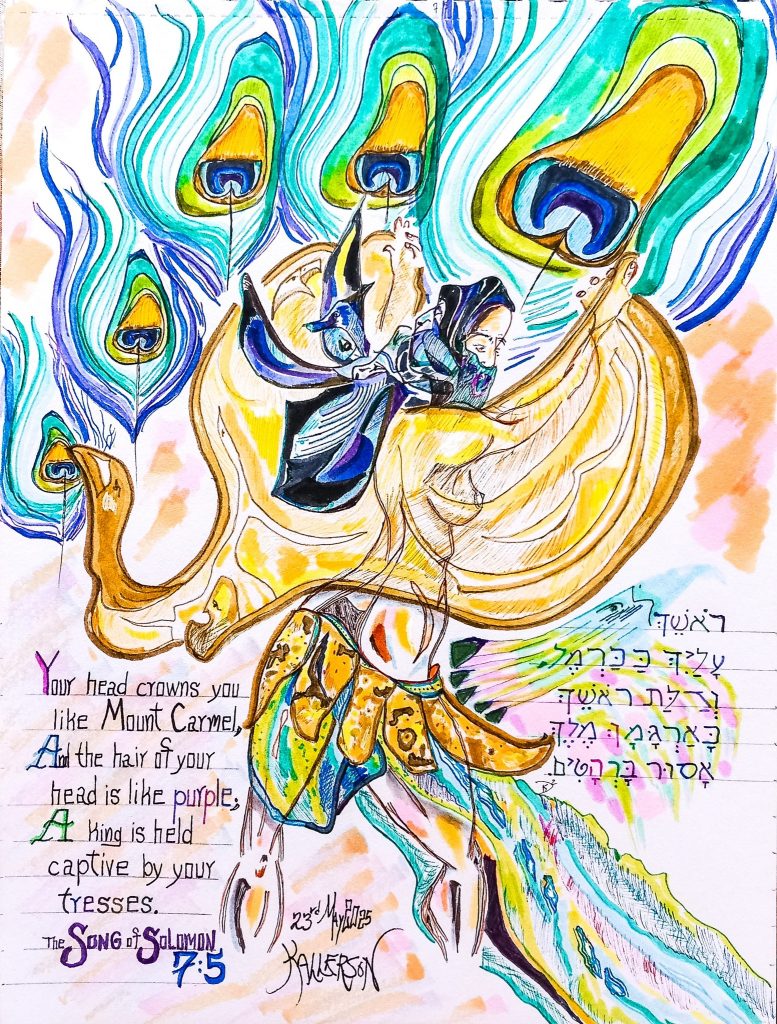
Artwork by Douglas Kallerson
Song of Songs 7:1-6
Your Steps in the Sandals
(Typed 24 February 2025) As we start today, I want to give a trigger warning. Some of the words that are explained are very expressive concerning a woman and her body parts. If you don’t want to hear them, up and out you go now!
For those watching the video, it will be even more expressive. I will have photos of a certain type of dancing woman that is intended to excite the senses. If you are watching with your wife, you should probably be careful how you view the photos I put up. If she has a rolling pin handy, be extra careful, or just don’t watch.
When I was young, there was a building in downtown Sarasota built by John Ringling of Ringling Brothers Circus. It was the John Ringling Hotel, also known as El Vernona Hotel. The main floor was owned and occupied by an Indian, Mr. Sarna. He had a restaurant, the India House, done up all in white. It was essentially a scale model of the Taj Mahal.
I dated his daughter, Shivan, for a short while in Junior High. He was quite wealthy, having earned his fortune from importing brass bells from India. Thus, the place was really magnificently adorned and accentuated.
Dad took us all to his restaurant once and I saw my first belly dancer. I was… hot under the collar and quite embarrassed. I had never seen anything like that before. However, I got to put a dollar in her waistline and nearly swooned.
Text Verse: “13 Return! Return! – the Shulamite!
Return! Return! And we shall gaze in you!
What gaze in the Shulamite?
According to dance the two camps!” Song of Songs 6:13 (CG)
When we started the Song of Songs, there were hints of Christ, but they were not like they have become. The pictures of Him and His work have been developing more as we have progressed. That was unexpected to me, and the picture in today’s passage came out beyond anything I could have imagined.
I think the reason the symbolism and typology have increasingly developed was intended to keep people from going off on every tangent imaginable and making stuff up along the way. Starting out with only minimal types and hints, God was trying to get us to avoid that.
Unfortunately, that is exactly what has happened. Throughout the church age, everything imaginable has been assigned to explain the allegory of the book. Therefore, by the time the symbolism started to take real shape, it was too late for these people to step back and see what God is actually showing us.
It’s too bad. The types and pictures are coming out now, as you will see in today’s passage, in a remarkable way today. Another problem, which I will address in a couple of our verses, is that all translations of those verses are incorrect. That may be a bold statement, but you will see it is true.
When something is translated wrongly, the information obtained from it will be wrong. Let’s get it right! Let’s get into His superior word. And so, let us turn to that precious word once again, and… May God speak to us through His word today, and may His glorious name ever be praised.
I. Your Womb – Heap Wheat (verses 1-3)
How beautiful are your feet in sandals,
Rather: mah yaphu ph’amayikh ban’alim – “How beautified your steps in the sandals.” This is not referring to her feet, but her steps as she moves in sandals. The previous verse said –
“What gaze in the Shulamite?
According to dance the two camps!”
If these words continue that thought, it is that her steps during the dance of the two camps are beautified. The verb being in the perfect aspect means that she danced the dance perfectly. A Mideastern dance is often barefoot. If sandals are worn, they would be thin and light, almost blending in with her skin.
As the verses continue, we will see that she is being described in a bottom to top evaluation, starting at her steps and ending with the hair of her head. In Chapter 4, she was given a top-downward description, beginning at her head and ending at her breasts. The next words are debated…
1 (con’t) O prince’s daughter!
bath nadiv – “Daughter willing.” Translating this as “prince’s daughter” seems to be erroneous. She was a worker in the vineyards, meaning she came from common folk. Some translations punt and simply say “daughter of Nadib,” transliterating directly from the Hebrew.
A few translations say noble daughter or noble lady, which could describe her character. It is the same word found in verse 6:12, nadiv, a word signifying voluntary or willing. That can still have various applications, but it is preferable to stick with the root meaning rather than to go with how translations have generally portrayed her here.
Translating this way forms a response to the question just set forth –
“What gaze in the Shulamite?
According to dance the two camps!”
“How beautified your steps in the sandals.
Daughter willing.”
There was the desire to be allowed to firmly and fixedly focus on the Shulamite while she danced according to the dance of the two camps. She willingly responded by beginning the dance.
Of course, this means that every other translation of the words and every commentary I read is wrong, but it provides an exacting response to what was asked. If this is correct, then the whole description of her in this passage is that of her as she dances.
Understanding the type of dance common in North Africa, the Middle East, and extending to places like India, it is exactly as one would expect.
The loose clothes that allow those watching to see much of her form, combined with the swaying movements of women in such dances (such as belly dancing), would elicit such a description as is seen here. Understanding this, it next says…
1 (con’t) The curves of your thighs are like jewels,
Again, this doesn’t appear to convey the sense. Instead: khamuqe y’rekhayikh k’mo khalaim – “Wrappings your thighs according to trinkets.” The word khamuq is found only here. It is from khamaq, to wrap, that was seen in verse 5:6. Thus, it is a wrapping, meaning the loose-fitting garments a belly dancer would wear.
If she is dressed in the Mideastern style, she has such a flowing garment that allows her thighs to be seen from time to time, but on her garment would be bands of beautifully woven ropes or studded chains that hang down from her belly and maybe even along the hems of the wrappings.
At times, these chains would be covered in all kinds of medallions or trinkets that tinkled and sparkled as she danced.
The word khali, trinket, is found only here and in Proverbs 25:12 –
“Ring gold and trinket ore,
Causing to admonish wise upon ear hearing” (CG).
It is derived from khalah, to be rubbed or worn out, which was seen in verses 2:5 and 5:8. As such, what is being described is polished and glistening, as if rubbed smooth.
Thus, “according to trinkets” would mean that the things dangling off of her wrappings, or even the wrappings themselves, were like trinkets. One could argue that this is only speaking of the thighs because most of the descriptions are of actual body parts. However, in verse 5, there is another item noted that is not a body part. Either way, what is being referred to is…
1 (con’t) The work of the hands of a skillful workman.
maaseh y’de aman – “Work hands – expert.” The word oman, expert, is found only here. It is derived from aman, to build up or support. The words still don’t definitively indicate whether it is a body part or something handmade. Despite this, I lean towards it being what is on her thighs, not her thighs themselves.
Continuing on, however, the words of Solomon move up a bit, and most of them certainly refer to her body parts…
2 Your navel is a rounded goblet;
All three words are rare but understandable: shar’rekh agan ha’sahar – “Your navel – basin, the rounded.” The navel is generally associated with the belly button, though some extend it to the whole belly, which is what Solomon is doing here. The word is shorer. It is found only here and is connected to the word shor, umbilical cord, found in Ezekiel 16 –
“As for your nativity, on the day you were born your navel cord was not cut, nor were you washed in water to cleanse you; you were not rubbed with salt nor wrapped in swaddling cloths.” Ezekiel 16:4
Both words come from sharar, to be hostile. As such, it speaks of twisting (as if interlocking in strife). Solomon is taking her belly button, the focus of delight when watching a belly dancer, and equating it to the entire belly – ooh ahh…
The next word, agan, is a bowl or basin which is also seen in Exodus and Isaiah, both of which speak of bowls or cups. The third word, sahar, is also found only here. It refers to being round or having roundness.
The three words, taken together, are referring to the entire belly that is full and rounded, as is prized in a belly dancer.
Unlike the flat-is-fashion nonsense in the world today, a full, rounded belly was and remains the epitome for those who perform such dances in the Middle East, North Africa, India, etc. Solomon’s words to her would be an amazing compliment. Today, however, the poor girl would rush in tears to the gym or Weight Watchers, maybe scarred for the rest of her life.
Despite that, Solomon continues with…
2 (con’t) It lacks no blended beverage.
al yekhsar ha’mazeg – “Not lacks the mingled.” The word mezeg is only used here as well. It comes from an unused root meaning to mingle. Saying liquor, mixed wine, blended beverage, etc., are all paraphrases. He is describing something mingled.
This will be set in parallel with another description to provide meaning, but for now, it is a beverage that would have been a nice light brown color. Again, from the description, we can know that the people of Israel had skin that went from white to golden brown, just as the surrounding Arabs do to this day.
Those who were out in the sun would have the exposed body parts further darken, similar to folks lined up like sardines out on Siesta Beach on any given day. Next, Solomon reveals how excited he is about her midriff by repeating his thoughts in parallelism…
2 (con’t) Your waist is a heap of wheat
bitnekh aremath khitim – “Your womb – heap wheat.” The words are plain on the surface. All one needs to do is look at a heap of wheat. It is light golden brown and as easy on the eyes as looking at the fur of a lion.
Solomon is looking at her rounded, golden-brown belly and is absolutely enraptured with it. But this is the point of this type of dance. It would be swaying, carefully paced, and a delight for any watching, whether male or female. Next, he says…
2 (con’t) Set about with lilies.
sugah ba’shoshanim – “Hedged in the lilies.” Another unique word is used, sug. It is derived from an identical word, sug, to turn back or retreat. Thus, it gives the sense of being hemmed or hedged in. In other words, her belly is surrounded by red in the clothes she has on.
I say red because in verse 5:13, his lips were equated to lilies. Thus, it would probably be the anemone coronaria mentioned in verse 2:1. It is a type of flower equated to the lily, which is seen in various colors, but the most prominent is red. Having said that, the color is only speculation based on verse 5:13.
Next, Solomon proceeds upwards again to repeat words from verse 4:5…
3 Your two breasts are like two fawns,
sh’ne shadayikh kishne opharim – “Two, your breasts, according to two fawns.” The words are letter-for-letter identical to the corresponding clause in verse 4:5. Repeating this shows that he is truly enamored with her breasts.
As seen before, this is a fitting descriptor to use as a metaphor. The opher is a fawn, coming from aphar, dust. Thus, it speaks of the dusty color of them. Of them, he next says…
3 (con’t) Twins of a gazelle.
taome ts’viyah – “Twins gazelle.” This is the second and last use of the word ts’viyah, a female gazelle, in the Bible. The first was in the corresponding clause in verse 4:5.
As a reminder, the ts’viy, gazelle, comes from tsavah, to amass or swell, and thus signifies “prominent.” That also leads to the idea of beauty or splendor, which is a prominent trait. As such, the word is used to describe the gazelle because of its graceful beauty.
In this case, he equates this swelling splendor to both of her breasts. This is what he is thinking when gazing at her, and he is not ashamed to describe her in this manner.
These are the same two words used in verse 4:5, but they were not copied. Rather, there is a letter difference in them. The word taome has an additional letter, a vav, in verse 4:5 that has dropped out here –
תְּאוֹמֵ֣י
תָּאֳמֵ֥י
Such a change is completely indiscernible without putting the verses side by side for comparison because the pronunciation does not change. Without modern technology, the task would be much more laborious, so the change is excitingly noted for those who come to the Superior Word for their instruction.
Solomon also omits the final words of verse 4:5 –
4:5 – Two, your breasts, according to two fawns –
Twins, gazelle,
The “pasturing in the lilies.”
7:3 – Two, your breasts, according to two fawns,
Twins gazelle.
As for his enraptured descriptions, he has more to say as he moves up more on her lovely body…
How beautiful are your steps
Those made by your feet
Each footfall preps
You for another soul to meet
And as you go out to tell
Of the good news you carry
Be sure not to rest a spell
Rather rush! Don’t you dare tarry
The word is what brings life
And it will not come without it
In a world of enmity and strife
Hurry your steps! Don’t slow up a bit
I. King – Bound in the Tresses (verses 4-6)
4 Your neck is like an ivory tower,
tsavarekh k’migdal hashen – “Your nape according to tower the ivory.” He has mentioned her neck several times already. In verse 4:4, he equated it to the Tower of David. Using the same tower imagery, he equates it here to ivory.
It is certain that the Tower of David would have been made out of the traditional limestone seen everywhere in Jerusalem. It is a light color, somewhat off-white. Looking at the Western Wall, which was built at the time of Solomon, will give you an idea of the ivory he is equating her neck to.
Solomon next moves up a tad…
4 (con’t) Your eyes like the pools in Heshbon
Rather: enayikh b’rekhoth b’khesbon – “Your eyes – pools in Heshbon.” Rather than simile, he uses metaphor. It is not that they are like pools in Heshbon, but that they are pools in Heshbon. The word berekah, pools, comes from the verb barak, to bless or to kneel. One often kneels when giving a blessing or being blessed.
As such, these would be large pools where animals kneel to drink. Heshbon is derived from khashav, to deem or consider. Thus, it means an explanation of things or intelligence. For some reason, the Latin Vulgate chose to call these fish-pools. Since then, Catholic versions and other older translations continued to give a faulty rendering.
Such a pool is typically used for one of two things: drinking or swimming. So he is either drinking in the beauty of her eyes, or he is swimming in them, completely consumed by them. These pools are next said to be…
4 (con’t) By the gate of Bath Rabbim.
al shaar bath rabim – “Upon gate Bath Rabbim.” The name comes from bath, daughter, and rav, many or great. Thus, it signifies Gate, Daughter of Multitudes or Gate, or Daughter of Great Ones. Most scholars go with the former, assuming it is where multitudes went through. However, it could be a gate named or reserved for a king, his generals, nobility, etc. For example –
“And the gatekeepers were Shallum, Akkub, Talmon, Ahiman, and their brethren. Shallum was the chief. 18 Until then they had been gatekeepers for the camps of the children of Levi at the King’s Gate on the east.” 1 Chronicles 9:17, 18
And yet, in Jeremiah 17:19, it notes the gate of the sons of the people. So it could also bear a more general meaning like this. Solomon next drops down an inch or two…
4 (con’t) Your nose is like the tower of Lebanon
apekh k’migdal hal’vanon – “Your nose – according to tower, the Lebanon.” Of this clause, Adam Clarke expresses what many must think –
“There was doubtless a propriety in this similitude also, which cannot now be discerned. If we are to understand the similitude as taken from the projecting form of the nose, even here I see nothing striking in the metaphor.” Adam Clarke
Clarke is baffled how a big protruding schnozz could be something one would praise. However, though not seemingly a great compliment, a high nose is dreamy to some people and cultures. Hers must be pretty high and thin to be equated to a tower. Maybe she is an ancestor of Jimmy Durante.
As has been seen, Lebanon comes from lavan, to be white or make bricks. The idea behind this is works because bricks are the works of man’s hands. That has been consistently seen since Genesis 11 and the Tower of Babel. Of her big honker, it next says…
4 (con’t) Which looks toward Damascus.
tsopheh pene damaseq – “Inclining faces Damascus.” The word tsaphah signifies to lean forward, as if peering into the distance. Thus, it is usually translated as watch or something similar. But saying inclined gets the idea across.
As for the name, Damascus, according to Abarim, as it is rendered here and to a Hebrew mind, it is derived from two words which would come together to mean Beginning of Salvation. Solomon next continues to the top of her head, beginning with…
5 Your head crowns you like Mount Carmel,
roshekh alayikh ka’karmel – “Your head upon you according to the Carmel.” Carmel is the highest mountain in the northern area. It is situated close to the sea near Haifa. As such, it sits like a promontory when viewed from the sea or when looking toward the sea. Thus, the words are essentially saying, “Your head fits on your shoulders majestically.”
The name means Plantation, Orchard, or Fruitful Field (Plentiful Place). Clarke calls it Vineyard of God because vineyard is kerem, which would be supplemented with the ending, el, meaning God. Next, Solomon seems to go 80s punk…
5 (con’t) And the hair of your head is like purple;
Rather: v’dalath roshekh ka’argaman – “And dangling, your head, according to the purple.” It is not “the hair of your head.” Nobody is going punk here. Rather, it is danglings in her hair. She has ribbons or hairpins adorning her tresses that are purple in color. This is a common adornment for belly dancing women.
As for the color, argaman, purple, it is a mixture of blue and red. In meaning, it thus is a combination of what those two colors signify – the law for blue, and war, blood, and/or judgment for red. Hence, a royal color because these things pertain to the dominion of a king.
5 (con’t) A king is held captive by your tresses.
Instead: melekh asur bar’hatim – “King – bound in the tresses.” The words are not saying that he is captivated by what he is seeing, although that may be true. Rather, he is saying that a king is bound up in her tresses. It is the purple color, representing a king, that he speaks of.
This royal color, purple, is being used in an explanatory manner that can only be understood by the introduction of this second clause.
Next, the word asar is never used in the sense of being captivated. Thus, this would be an outlier, but it is convenient, and so most translations copy and paste the same thing or they make a suitable paraphrase of the thought.
Some translations almost get it right, like Young’s and Smith’s literal translations, but they insert the word “the” at the beginning. In doing so, it renders the clause “The king is held captive by your tresses,” as if Solomon is speaking of himself. Some completely blow it and remove any possibility of understanding what is being conveyed.
For example, the KJV, not having a clue what is being said, copies the thought of the Greek –
“Thine head upon thee is like Carmel, and the hair of thine head like purple; the king is held in the galleries.”
With five translational errors in one verse, no reader could ever understand what is being conveyed. In fact, to read the myriads of translations available online, of which there may be hundreds, you would either end so confused and frustrated that you might jump off the Skyway bridge, or you might just close your eyes, point to a translation, and say, “Well, this is as good as any.”
The way to tell what is being said is to understand the literary device that is being used – parallelism. There are only so many styles that Solomon uses, but parallelism is the most prominent one. Evaluating the passage from that perspective is what provides the answer.
In what forms a remarkable and beautiful picture of Jesus, the words are set in reverse parallel to the previous clause –
“And *dangling, your head, +according to the purple.”
“+King – bound in the *tresses.
The purple, symbolizing a king’s royalty, and inclusive of all else that the color signifies, is dangling from her head, being bound up in the tresses of her hair.
With that explanation complete, Solomon continues with words of marvel at the beauty of his beloved…
6 How fair and how pleasant you are,
The words are verbs, not adjectives: mah yaphith u-mah naam’t – “How beautified, and how sweetened!” The verb yaphah means to be beautiful. Being in the perfect aspect, she is beautified. The verb naem means to be pleasant. As it is also in the perfect aspect, a suitable translation is sweetened.
Solomon is making an adamant, emphatic proclamation. But about what? The answer is not…
*6 (fin) O love, with your delights!
Rather, and correctly: ahavah batanugim – “Love – in the luxuries.” The noun ahavah is never used to speak of an individual. Thus, it would also be an outlier to be used as such here. And more, it would require additions, like the word “your” added by the NKJV.
Instead, it is speaking of the state of love. From there, he explains what that state entails in order to explain the verbs of the first clause.
Understanding this, the noun taanug is used. It is derived from the verb anog, signifying things like softened, a state of delight or daintiness, etc. Thus, taanug speaks of luxury. Being plural, he is saying –
“How beautified, and how sweetened!
Love – in the luxuries.”
He is thinking about everything he has seen in this unbelievably beautiful and graceful woman, along with the adornments she has on, as she danced the dance of the two camps for him. He is utterly smitten. She is beautified and sweetened. She is the state of love.
Solomon goes beyond her to the thing that she represents – love, the state of love. His love is being expressed in her shape, in her movement, in her big schnozzle, and in all that she is and does. It is also inclusive of the things she is wearing. The state of love is represented in her because of those things.
Who can’t help but get excited about this? Without proper translations of the Hebrew to understand what is going on, one cannot understand the intent of the words. But when they are rightly translated, the intent of what the Lord is conveying can be properly understood.
It appears that even those who were well-schooled in Hebrew couldn’t understand either. The Greek translation of these words goes back to about 250 BC. Seventy (or seventy-two) Hebrew scholars in Alexandria, Egypt, came together to translate the Septuagint. Their resolution –
“How beautiful art thou, and how sweet art thou, my love!”
This isn’t even close to the Hebrew. Likewise, every scholarly comment I read was off. What a tragedy! But that is corrected through a proper translation.
Not by works are you saved!
At least, not by your own
If you have tirelessly slaved
A lack of prudence you have shown
If you want works that are saving
Then trust in the works of Christ
Stop your futile efforts! Stop your slaving
That is not how your soul can be priced
Trust in what God has done through Jesus
Trust in nothing else
It is His works alone that can save us
Put your arrogance right over there… on the shelf!
III. Jesus in the Details
With the verses for today complete, we can look through them and find hints of why this is “Song the songs,” and why such a claim can be made.
The first thing to remember is what the dance itself signifies. The crowd asked what was to be gazed at in the Shulamite. The response was that she was to dance according to the two camps. As suggested, the dance depicts the earthly in Christ and the heavenly with Christ.
All of those who belong to Christ are included in the dance because all of the redeemed will someday be with the Lord. Yes, there will be a rapture and the church will be united with Christ. But this state will eventually be inclusive of all redeemed.
The dance will continue until the last moment of the final earthly dispensation. The first thing we saw in these verses was the note about how beautiful her steps were in the sandals. The words speak of the movement of the feet, not the feet themselves.
However, that movement is accomplished by the feet. Therefore, it is the movement of the feet that brings the beauty –
“How beautiful upon the mountains
Are the feet of him who brings good news,
Who proclaims peace,
Who brings glad tidings of good things,
Who proclaims salvation,
Who says to Zion,
‘Your God reigns!’” Isaiah 52:7
Paul cites this in Romans 10 and equates Isaiah’s words directly to the preaching of the gospel. It is the movement of the feet that makes the feet beautiful –
“How then shall they call on Him in whom they have not believed? And how shall they believe in Him of whom they have not heard? And how shall they hear without a preacher? 15 And how shall they preach unless they are sent? As it is written:
‘How beautiful are the feet of those who preach the gospel of peace,
Who bring glad tidings of good things!” Romans 10:14, 15
The Greek reads, “As beauteouses, the feet, the ‘evangelizing peace,’ ‘those evangelizing the ‘good.’” These are the steps, the feet that are beautiful because they are moving beautifully. Solomon next said, “daughter, willing.”
It speaks of a voluntary action. There is no such thing as forcing the gospel from either direction. There is the offer by God without coercion and the willing submission of those who preach and of those who receive.
The next words were, “Wrapping your thighs according to trinkets.” The thigh has several connotations in Scripture, but it is euphemistically used when referring to the generative parts. The trinkets are adornments, but they derive their luster from being rubbed or worn down.
The root itself speaks of being sick or afflicted. It would thus reflect the afflicted state of those evangelized who are then brought through the generative process of rebirth through the good news of Jesus.
The navel is mentioned next. It is the place where the generation goes from conception to birth, as in “Your navel – basin, the rounded.” It represents how Christ was conceived and born, and that is then equated to believers’ rebirth in Christ. That is explained by the words “Not lacks the mingled.”
The belly of the rebirth refers to the human united with the divine – Christ, the God man, of whom we will resemble, not in deity but in His divinity –
“Beloved, now we are children of God; and it has not yet been revealed what we shall be, but we know that when He is revealed, we shall be like Him, for we shall see Him as He is.” 1 John 3:2
Next, it says, “Your womb – heap wheat.” There is an outside and an inside. Solomon is describing the outside while God, the inside –
“But Jesus answered them, saying, “The hour has come that the Son of Man should be glorified. 24 Most assuredly, I say to you, unless a grain of wheat falls into the ground and dies, it remains alone; but if it dies, it produces much grain. 25 He who loves his life will lose it, and he who hates his life in this world will keep it for eternal life. 26 If anyone serves Me, let him follow Me; and where I am, there My servant will be also. If anyone serves Me, him My Father will honor.” John 12:23-26
The seed in the womb represents the redeemed who are brought out by the Seed in the womb. The womb terminology is used to refer to Christ in His mother’s womb and Christ in leaving the tomb in the “womb of the morning” at His resurrection (Psalm 110:3), the dawn of a new beginning.
The next thing about her womb is that it is “Hedged in the lilies.” We have already seen that the lily signifies beauty and splendor. It is the beautiful and majestic labors of God in Christ that adorn both Jesus and His redeemed.
Next, the verses compare her two breasts to being like two fawns, twins of a gazelle. Breasts are where milk is produced and passed on to the infant. The two breasts symbolize where the nourishment God in Christ provides for growth is derived from.
Peter explicitly ties milk to reflecting the word in 1 Peter 2:2 when he says, “as newborn babes, desire the pure milk of the word, that you may grow thereby.”
Her breasts are the two testaments. They speak of providing understanding about man, symbolized by the opher, fawn, which comes from aphar, dust. It is that from which man is derived. They also speak about that which is prominent as in the graceful beauty of those who are redeemed, symbolized by the gazelle.
In other words, the word is for man while he is alive on this earth, while anticipating the heavenly state to come. But! As noted, the word taome, twins, changed in this chapter from chapter 4. The vav, the sixth letter of the Hebrew aleph-beth has dropped out –
תְּאוֹמֵ֣י
תָּאֳמֵ֥י
The change is purposeful and personal. It tells us of our already assured heavenly state, being in Christ and fully redeemed. In other words, eternal salvation is realized in Christ!
Next, it spoke of the nape of the neck being according to an ivory tower. The nape of the neck is derived from a word signifying to bind, as when one is bound in a yoke. That is explained by the meaning of ivory seen in its various uses as wealth, trade, and luxury, along with Jesus’ description of the results of the coming completion of His work –
“Come to Me, all you who labor and are heavy laden, and I will give you rest. 29 Take My yoke upon you and learn from Me, for I am gentle and lowly in heart, and you will find rest for your souls. 30 For My yoke is easy and My burden is light.” Matthew 11:28-30
The state of the redeemed is one of enjoying the wealth, trade, and luxury of God’s eternal kingdom. The pools of Heshbon reflect what the words are based on: blessing, and an explanation or an intelligence. Abarim paraphrases the meaning of Heshbon in a way that beautifully expresses the intent, saying Library of Synthetic Wisdom.
It speaks of logic where truth is determined by recourse to experience. In other words, “when our faith is turned to sight.” It is the assured state of believers in this life that is realized in the actualization of our faith in the coming life.
The Gate of Bath Rabbim is first explained by the meaning of a gate, the place where entrance and exit occur, and which is also the place of judgment in a city. A daughter speaks of nature. In the case of the redeemed, the ecclesia, the called-out (those who belong to God in any dispensation) is a feminine noun. Thus, it is what speaks of our being “the called out.”
Finally, Rabbim speaks of either a multitude or what is great. Either way, each is a perfect reflection of God’s redeemed as seen in various passages of the Bible.
The words, “Your nose [aph] – according to tower the Lebanon,” speak of works. In Genesis 3, Adam was cursed to toil for bread “in sweat your nose [aph],” referring to the dripping of sweat from his nose as he labored.
However, the redeemed of God in Christ have their nose up, not down, and it is according to the works of Christ, symbolized by the tower of Lebanon. Time and again in this book Lebanon, frankincense, and the moon, all derived from the same root, laven, point to Christ’s works on our behalf. The nose is “Inclining faces Damascus,” meaning the Beginning of Salvation. Salvation could not come until Christ completed His work. His work, therefore, is the beginning of salvation.
Each point keeps directing our attention to Christ and the effects of what He has done, as is realized in His people.
The next point was her head “according to the Carmel.” The head of the church is Christ. The Carmel is the Vineyard of God. A vineyard has consistently reflected the cultural side of humanity. In the case of the church, it reflects the culture of the church, the people of God with Christ as its head.
And more! Then came the words –
“And dangling, your head, according to the purple.
King bound in the tresses.”
The people of the church are referred to as being in a kingdom (Romans 14:17, etc.). A kingdom implies a king. Christ is the Head of the church and thus our King. The purple, royalty, bound in her tresses, reflects the King bound as the head of the church.
Only with a proper translation of the words could we see the meaning of these pictures. Finally, Solomon finished with the universally mistranslated words –
“How beautified, and how sweetened!
Love – in the luxuries.”
It refers to Christ, who is God – “…for God is the love” 1 John 4:8 (CG). Everything that we are is because of Christ. And everything about us is a luxury in Christ. Nothing could be more beautifully expressive of our relationship with Christ and His with us because of what God has done in and through Him.
With each passing set of verses, we are seeing more clearly why “Song the songs” is the greatest song of all. If you want to understand love as God sees it, look to the cross and believe what He has done in the giving of Jesus.
By believing in His finished work, reflected in the gospel message, you will become a part of the greatest love story ever expressed. It is the love of God for His Son, Jesus Christ. But God graciously includes us in that love through a simple act of faith.
God’s grace, through our faith, is what you need to be saved and receive everything that He offers to His redeemed, and it is the only thing that will do. Man invents religion, but God has given us Christ. Faith in Him is the only true religious expression.
Look to the cross! Revel in the resurrection! Love God because He first loved you and sent Jesus to bring you back to Himself. Trust in this, and please, do it today. Amen.
Closing Verse: “For the husband is head of the wife, as also Christ is head of the church; and He is the Savior of the body.” Ephesians 5:23
Next Week: Song of Songs 7:7-13 Such great stuff – like Loobies and Noldies… (Newbies, Also Oldies) (17th Song of Songs Sermon)
The Lord has you exactly where He wants you. He has a good plan and purpose for you. He alone is the perfect example of love – untarnished, unblemished, and completely pure and holy. He offers this love to you. So, follow Him, live for Him, and trust Him, and He will do marvelous things for you and through you.
Song of Songs 7:1-6 (CG)
How beautified your steps in the sandals,
Daughter, willing.
Wrappings your thighs according to trinkets,
Work hands – expert.
2 Your navel – basin, the rounded,
Not lacks the mingled.
Your womb – heap wheat,
Hedged in the lilies.
3 Two, your breasts, according to two fawns,
Twins gazelle.
4 Your nape according to tower the ivory.
Your eyes – pools in Heshbon,
Upon gate Bath Rabbim.
Your nose – according to tower, the Lebanon,
Inclining faces Damascus.
5 Your head upon you according to the Carmel,
And dangling, your head, according to the purple.
King – bound in the tresses.
6 How beautified, and how sweetened!
Love – in the luxuries.”
Song of Songs 7:1-6 (NKJV))
How beautiful are your feet in sandals,
O prince’s daughter!
The curves of your thighs are like jewels,
The work of the hands of a skillful workman.
2 Your navel is a rounded goblet;
It lacks no blended beverage.
Your waist is a heap of wheat
Set about with lilies.
3 Your two breasts are like two fawns,
Twins of a gazelle.
4 Your neck is like an ivory tower,
Your eyes like the pools in Heshbon
By the gate of Bath Rabbim.
Your nose is like the tower of Lebanon
Which looks toward Damascus.
5 Your head crowns you like Mount Carmel,
And the hair of your head is like purple;
A king is held captive by your tresses.
6 How fair and how pleasant you are,
O love, with your delights!