Esther 8:1-17
Beauty for Ashes
The term “Beauty for Ashes” has almost become a cliché saying among Christians today. You hear it on the radio a lot, and pastors and teachers toss it around like it was a cheap five-cent phrase. But it is something that really applies to those who mourn, and yet who wait patiently on the Lord. There may be times of immeasurable sorrow and grief, such as the Jews of the Persian empire felt, but like them, there lies ahead something much better.
For Israel as a collective whole, they have frequently encountered times of national sadness. Yes, it has always been a self-inflicted wound, but it was also a temporary one. A time lies ahead when they will finally be right with the Lord, and the years of destruction will be replaced with exultation and joy. Unfortunately, this can’t be said for each and every Jew, but as a collective whole, it will be so.
For the struggling Christian, it is also a sure guarantee. We have what collective Israel has – a sure hope. No individual believer will be permanently left in a state of mourning, and the trials of this life will someday be replaced with an eternity of wonder and delight. It is coming, and so be comforted now, even if things are wholly miserable. It is coming.
Text Verse: “‘“And in that day you will say:
“O Lord, I will praise You;
Though You were angry with me,
Your anger is turned away, and You comfort me.
2 Behold, God is my salvation,
I will trust and not be afraid;
‘For Yah, the Lord, is my strength and song;
He also has become my salvation.”’” Isaiah 12:1, 2
It’s hard to acknowledge that the Lord really is angry with us. For Israel, they don’t want to admit that what has happened to them is a part of national guilt. In fact, it is considered an offense to them when it is suggested, but the same Lord who established them also told them what would keep them happy and prosperous, or what would bring them pain, suffering, and exile. It’s right there in black and white if they will just accept Him at His word.
For us, we were all enemies of God, and He was really and truly angry with us because of this. Like Israel, fallen man doesn’t want to admit this. We place ourselves on a curve, we measure ourselves against others, we rationalize away our wrongdoings, and we justify ourselves through doing good things. But the Lord really remains angry with us while our sin-debt remains unpaid.
But when we realize that the payment has been rendered, when we accept by faith that it can be applied to our account, and when we reach out for the pardon which has already been purchased, then the words of Isaiah can be applied to us individually – “Yes, Lord! I will praise You. Certainly, You were angry with me. But now Your anger is turned away, and I am comforted. Thank God for Jesus Christ. My God is my salvation.. I will trust and not be afraid.”
When we call on Jesus, we may still be on a bed of ashes. The cancer may still be eating away at our bodies, the labors of our job may not meet our wants completely, and the house may burn down in the morning, but in Christ there is a hope of beauty ahead which cannot be taken away. Israel will find this out; each redeemed of the Lord has found it out. Let us rejoice in what lies ahead, just as Israel is to rejoice in our passage today. The Lord is good to His undeserving people. Yes, let us rejoice in this. It’s all to be found in His superior word. And so let’s turn to that precious word once again and… May God speak to us through His word today and may His glorious name ever be praised.
I. Not Revoked, But Annulled (verses 1-8)
On that day King Ahasuerus gave Queen Esther the house of Haman, the enemy of the Jews.
The last verse of Chapter 7 said, “So they hanged Haman on the gallows that he had prepared for Mordecai. Then the king’s wrath subsided.” It is on this same day that the house of Haman was confiscated, as was the custom for all executed criminals. Being the property of the royal crown, it was now granted to Esther by the king. The irony is almost palpable.
Haman had determined to destroy the Jews. In their destruction, the plunder of their property would come about. However, he himself was destroyed, and his property was plundered for the benefit of a Jewess. This would have included everything connected to the man such as servants, accumulated wealth, position, and so on. This is certain because no definite article is placed in front of the word “house.” Instead, it says, beit haman, or “house of Haman.” It is comparable to speaking of the house of David, meaning not just a physical house, but everything associated with David. What belonged to Haman, all which made him who he was, transferred to Esther. This then is confirmed with the next words…
1 (con’t)And Mordecai came before the king, for Esther had told how he was related to her.
The words are not just a form of introduction, such as, “Dear king, I want to introduce you to my cousin.” Rather, Mordecai is related to Esther. And more, he has proven himself a benefactor of the king. As the king has granted to Esther beit haman, or the “house of Haman,” there must be someone to fill the role of caring for what has been granted to her, including his position within the empire. As Haman was in royal authority, someone of the queen’s house will be chosen to fill that now-vacated position. How do we know this is correct? We simply continue with the narrative…
2 So the king took off his signet ring, which he had taken from Haman,
The tabaath, or signet ring, of the king is removed. This is in anticipation of it being granted to another. As we saw before, the word comes from taba, meaning “down,” or “to sink.” Thus, it is a ring which is used to press down into wax or clay in order to impress a seal. It was given to Haman in verse 3:10. With his demise, it was reacquired by the king. However, the king will now pass it on to another.
2 (con’t) and gave it to Mordecai;
This ends another set of two’s. In 3:10, the king took off his signet ring and gave it to Haman so that he possessed the king’s authority, including the issuance and authentication of an edict in the king’s name. There, it was given to a Gentile, Haman the Amalekite. Here it is given to a Jew, Mordecai. The first time it was for the destruction of the Jews; now, it will be for their salvation. They contrast, but they confirm that God sets up rulers and he deposes rulers in order to accomplish His purposes.
As a side note concerning this word; tabaath was first used in Genesis 41:42 concerning the signet ring of Pharaoh. That was taken from his hand and granted to Joseph. It was a marvelous picture of the authority of Christ. If you don’t remember that, go brush up. After that, the same word was used to describe the rings for carrying the Ark of the Testimony in Exodus 25. Those, if you remember, pictured the four gospels which reveal Christ. They are the link between the Old and New Testaments which speak of the coming Christ and the Christ who has come. They reveal His authority. The power and authority is found in the tabaath, or ring.
2 (con’t) and Esther appointed Mordecai over the house of Haman.
These words clearly show that the “house of Haman” includes his position, and not just a physical building. The position of Haman has been granted to Esther as the queen, and she has appointed Mordecai over that which belonged to Haman. Mordecai has the signet of royal authority, thus he possesses the power of that same position, and he possesses it over what once belonged to Haman.
3 Now Esther spoke again to the king, fell down at his feet, and implored him with tears to counteract the evil of Haman the Agagite, and the scheme which he had devised against the Jews.
Safety for Esther and Mordecai had been secured, but this was not the full scope of what was needed for their hearts to be pacified. Their people, the Jews, faced destruction still. Despite the fact that their enemy was dead, the decree he had secured against the Jews still stood. Mordecai had been exalted to the high office with royal power and authority. The law that condemned the Jews could no longer be brought against him, but it remained fully in effect over the rest of the Jewish people.
It is for this reason that she again does something which is not permitted. In these words another set of two’s is now complete. Queen Esther appeared before the king in an unauthorized manner twice. The first was in Chapter 5 when she came before the king without being summoned. The second is here where she openly mourns in his presence. This was not allowed, and was even punishable by death. In doing this, she again risks her life. However, her life is not as important to her as is the plight of her people. It is reflective of Paul’s words found in Romans 9 –
“I tell the truth in Christ, I am not lying, my conscience also bearing me witness in the Holy Spirit, 2 that I have great sorrow and continual grief in my heart. 3 For I could wish that I myself were accursed from Christ for my brethren, my countrymen according to the flesh, 4 who are Israelites, to whom pertain the adoption, the glory, the covenants, the giving of the law, the service of God, and the promises; 5 of whom are the fathers and from whom, according to the flesh, Christ came, who is over all, the eternally blessed God. Amen.” Romans 9:1-5
This is the state of Esther who, like Paul, was also of the tribe of Benjamin. She has a greater care for her people than her own life. Her two unauthorized actions before the king contrast. First, she bravely stood before the king’s presence without approval in order to begin the petition to save her people. Now, she mourns with tears in order to have the decree of destruction revoked. The two accounts contrast, but they are both confirmed in the action of the king extending to her the royal scepter, signifying his favor. This is seen with the words…
4 And the king held out the golden scepter toward Esther.
The transgression is forgiven, and pardon is granted in this act. This clause contains the last use of the word yashat, translated as “held out” in the Bible. It was introduced in verse 4:11, seen in verse 5:2, and now it is biblical history. It also is the last use of sharbit, or scepter. It was seen a total of four times in the exact same verses. It is now retired from biblical use. With this golden scepter having been held out, it is an indication of the king’s favor. Therefore, Esther is free to now rise and face the king…
4 (con’t) So Esther arose and stood before the king,
With her heart opened and exposed before the king, she now stands to express her desire for her people without further fear…
5 and said, “If it pleases the king, and if I have found favor in his sight and the thing seems right to the king and I am pleasing in his eyes,
Esther really heaps it on. First, she starts by speaking in the third person, demonstrating a formality about the matter at hand. Secondly, her words include four individual thoughts laid out in a parallelistic structure – 1) A “If it pleases the king;” 2) B “if I have found favor in his sight;” 3) A “and [if] the thing seems right to the king;” and 4) B [if] “I am pleasing in his eyes.” The A/B structure however is inclusive of a bracketing thought – that of pleasing the king. It begins with, “If it pleases the king,” and it ends with, “[if] I am pleasing in his eyes.” It is a marvelously structured verse, spoken with the intent of completely convincing the king that he should accept the request as it will be made.
Within the clause is another new and rare verb in Scripture, kasher, translated as, “seems right.” It comes from a root meaning, “to be straight,” and thus to be acceptable. It will be seen here and twice in Ecclesiastes. Esther is essentially conveying to the king that she has a great desire, but it is the king’s ultimate decision to bring the matter about if it is agreeable to him. Despite this though, she is tying his favor of her into the accomplishment of her request. It would be like one of us saying, “If you really loved me, you would XXX, but only if you think it’s the right thing to do.” Women are generally great at this type of thing.
5 (con’t) let it be written to revoke the letters
yikatev l’hashiv eth ha’sepharim – The idea here is expressed by John Lange with the words, “to cause to change from the state of being to non-existence.” There is a royal edict which exists, and which cannot pass away, and yet Esther is requesting that letters be written to cause them to be annulled none-the-less.
5 (con’t) devised by Haman, the son of Hammedatha the Agagite,
It hardly seems necessary to include all of this detail. It would seem more likely that she would simply say, “devised by Haman.” But she doesn’t. Instead, the entire title is given. From the explanation of the names from Chapter 3, we could rewrite this sentence by saying, “devised by Certainty, the son of the one who works in darkness, the high one.” Remember, he is of the line of Amalek who is in perpetual conflict with Israel. Esther is asking that what he has wrought be revoked, lest the enemy win the battle over God’s people. This was found in the edict…
5 (con’t) which he wrote to annihilate the Jews who are in all the king’s provinces.
Wherever the Jews were within the empire, the edict was issued that all should be annihilated. Though Mordecai and Esther were no longer under the law, those of Israel were. Their sentence was one of death unless the law could be made to vanish away. (Heb 8:13)
6 For how can I endure to see the evil that will come to my people? Or how can I endure to see the destruction of my countrymen?”
Esther, despite being freed from the law must still look at the effects of the law imposed upon her people. Her hope, request, and desire is to save them from what must occur if the law remains in effect. Evil will befall them, and destruction is set forth as long as the law remains. Does this sound at all familiar to you in today’s world? The book is detailing a scenario which continues to be repeated even now. For those of you who follow these things, she uses a word, obdan, which is found only here in the Bible. It means destruction, coming from abad, also meaning destruction.
7 Then King Ahasuerus said to Queen Esther and Mordecai the Jew, “Indeed, I have given Esther the house of Haman, and they have hanged him on the gallows because he tried to lay his hand on the Jews.
The words of the king are to both Esther as Queen, and to Mordecai as his now-appointed royal official. And yet, they still identify Mordecai as “the Jew.” How can it be that he is a Jew, and yet he is no longer bound to the law to be destroyed as a Jew? And yet it is so. To them both, he in essence says, “Look at what I’ve done already. I’ve granted your requests and am willing to do more. However, there is a problem that will require your taking action…”
8 You yourselves write a decree concerning the Jews, as you please, in the king’s name, and seal it with the king’s signet ring;
The first decree cannot be undone, but a new decree can be written on behalf of the Jews. They are under the law of destruction, but a new law can be written in the king’s name, and sealed with his seal for their benefit. The full authority and power of the king can be used, and it will be confirmed with the signet’s seal.
8 (con’t) for whatever is written in the king’s name and sealed with the king’s signet ring no one can revoke.”
How do you circumvent a law which which mandates destruction, and which must be allowed to continue to its fulfillment, and yet still save the people who are under that law from that same law? If you can understand the premise, then you can begin to see what the book of Esther is showing us, and what it is intended to reveal. The word is irrevocable, in this case a word which brings death. And yet, another word can be issued which will grant life. The king will not allow one word of reversal of the former command, but yet its power can be annulled through a new command. (Jer 31:31-34)
This verse now ends another use of two’s in the book. The irrevocability of a law was noted first in verse 1:19. It is then noted again here. They contrast as one was concerning the authority of man over woman in the realm, and this one concerns the protection of the Jew throughout the realm. But both confirm what God has ordained in His word. Man is to have authority over the woman, and the Jew is to be preserved as a people forever.
The signet of authority; the symbol of power
Is granted to the Man who will rescue the Jews
His authority extends by the mile and by the hour
And in His decree, there is the most joyous of news
He is their Protector; their Defender is He
His edict will bring them from certain death unto life
The enemy may attack, but he will be defeated – certainly
Through the edict will come victory; an ending of the strife
The first decree came, and with it came death, failure, and strife
It is written and cannot be revoked, but there is good news yet
The second decree is given, and with it comes life
It will annul the first, and a joyous future will be set
II. Light and Gladness; Joy and Honor (verses 9-17)
9 So the king’s scribes were called at that time, in the third month, which is the month of Sivan, on the twenty-third day;
Taking advantage of the allowances of the king, the scribes are called once again to write a new law. Instead of a law of death, a law of salvation and life will now be written. The specific day and month are given. It is the twenty-third of the third month, Sivan. This is the only time that Sivan is mentioned in the Bible. The day of the edict is two months and ten days after the writing of the original one from Haman. The time between the two edicts was long enough for the unseen Lord to teach them a lesson.
The Jews had failed to return to their homeland. They had stayed abroad and remained in their sins. They had neglected obedience to the Lord. They had ignored the religion which He had established and which was to be attended to by them in Jerusalem each year. And yet, they will be spared by Him nonetheless. The real question for them here, and for this same group of people today is, “Will they pay heed and learn their lesson?” Or maybe even better, “When will they pay heed and learn their lesson?”
9 (con’t) and it was written, according to all that Mordecai commanded, to the Jews, the satraps, the governors, and the princes of the provinces from India to Ethiopia, one hundred and twenty-seven provinces in all, to every province in its own script, to every people in their own language,
This is an empire-wide edict which issued forth, directly from Mordecai, but with the full authority and approval of the king. Like Haman’s law, it was written to all levels of authority, and even to the common person on the street. But in addition to what it said in that previous edict, this one adds in a special note…
9 (con’t) and to the Jews in their own script and language.
Being a part of the Persian Empire, this would have been written directly to the Jews in their homeland, but what seems to be the case is that the edict was written to the Jews in their dispersion also. A separate translation, in Hebrew, would probably have accompanied all of the individually written edicts in the language of any particular land. As a note of trivia, verse 9 is the longest verse in the Old Testament and the longest in the Bible, consisting of 43 words of 192 letters.
10 And he wrote in the name of King Ahasuerus, sealed it with the king’s signet ring, and sent letters by couriers on horseback, riding on royal horses bred from swift steeds.
It is Mordecai who wrote the edict, but it is with the authority of the king that it was sealed using the royal signet. From there it went out quickly throughout the empire. Two new foreign words are used here, and which are variously translated. So don’t get upset if your translation reads differently. The first is ha’akhashteranim, which will be seen only here and in verse 14. The other is bene ha’ramakim, or sons of the rammakim, which is found only here. Some say fast horses, royal horses, camels, mules, and so on. Something like, “riders of the dromedary, the mules, sons of the mares,” is probably close to correct. Different terrains would necessitate various animals in order to cross them.
11 By these letters the king permitted the Jews who were in every city to gather together and protect their lives—to destroy, kill, and annihilate all the forces of any people or province that would assault them, both little children and women, and to plunder their possessions,
The words echo the first decree, and thus the Jews are given like authority to act against their enemies. It must be remembered that the first edict allowed the aggressors to lay hands on the plunder. Even if some didn’t dislike the Jews, it was an incentive to kill them anyway. If the Jews of the Persian empire were as industrious as they have been throughout the rest of history, they had obtained wealth in abundance. Haman’s order was one which would be especially enticing to take advantage of.
In the new edict, only defensive measures are authorized. Despite being allowed to defend themselves, if their wealth was great, a crowd would be expected to come and wipe them out in order to enrich themselves. However, with wealth comes the ability to purchase protection. A minor civil war could ensue.
But… the very fact that a new edict had been issued would mean that the king was now supportive of the Jews. And so there would be less chance of attack. Further, they were allowed to gather as a unit to defend themselves. And even more, verse 9:3 says that the fear of Mordecai came upon the leaders throughout the empire, and they in turn helped the Jews. And yet more, if the Jews prevailed, like the first edict, they were authorized to not only kill their enemies, but their enemies’ wives and children as well. This would be a terrifying incentive to not harm the Jews. And then yet more, the Jews would be allowed to gather their possessions as plunder. And as if icing on the cake, verse 17 will show that the number of Jews will actually increase prior to the day of destruction. What was originally certain disaster for the Jews was now to be turned into a fight against them initiated only by the foolish.
12 on one day in all the provinces of King Ahasuerus, on the thirteenth day of the twelfth month, which is the month of Adar.
This verse corresponds to verse 3:13. It is the same day of the original edict that the Jews are now allowed to gather and defend themselves from the first law. A law of salvation has come to override the law of death.
13 A copy of the document was to be issued as a decree in every province and published for all people,
These words correspond exactly to verse 3:14. The edict is all but identical to what Haman had ordered. The only exception is that this one is written on behalf of the Jews, as we still see…
13 (con’t) so that the Jews would be ready on that day to avenge themselves on their enemies.
Rather than being helpless prey, they will now be ready defenders, and even aggressors if attacked. Once they are assaulted, they may in turn avenge themselves. The word for avenge here doesn’t necessarily imply any hatred, but rather a just retribution based on offense. It is used of the Lord avenging Himself upon His enemies in a just and righteous manner. Unfortunately for Israel, it is at times used by the Lord to avenge Himself upon them for their own faithlessness. That is seen, for example in Jeremiah 5 –
‘For among My people are found wicked men;
They lie in wait as one who sets snares;
They set a trap;
They catch men.
27 As a cage is full of birds,
So their houses are full of deceit.
Therefore they have become great and grown rich.
28 They have grown fat, they are sleek;
Yes, they surpass the deeds of the wicked;
They do not plead the cause,
The cause of the fatherless;
Yet they prosper,
And the right of the needy they do not defend.
29 Shall I not punish them for these things?’ says the Lord.
‘Shall I not avenge Myself on such a nation as this?’ Jeremiah 5:26-29
14 The couriers who rode on royal horses went out, hastened and pressed on by the king’s command. And the decree was issued in Shushan the citadel.
The verse is a close repeat of the first half of 3:15. However, two verbs are used here, hastened and pressed on, in order to show the exceeding importance of the new decree. Despite being more than eight months until the day of the edict, this was probably to ensure nobody got ahead of the first decree and decided to start wiping out Jews early. Further, it would give all in the realm time to see and reflect on the newly exalted status of the Jews within the empire. Any doubts about the new edict could be referred back to Mordecai who would set straight any who misunderstood.
The variously translated word akhashteran was introduced into the Bible in verse 10. Now just a few verses later, we bid it adieu. Whatever it actually means, it is no longer a word to fret over. This verse now closes out another set of two’s. The first was in 3:10 and it was the issuance of a royal edict for the destruction of the Jews. That is now overwritten here. One is for the Jew’s destruction; one is for their salvation. They contrast, but they confirm God’s overarching protection of the Jews despite the wicked plots against them. Man enacts, but God rules over man as absolute Sovereign.
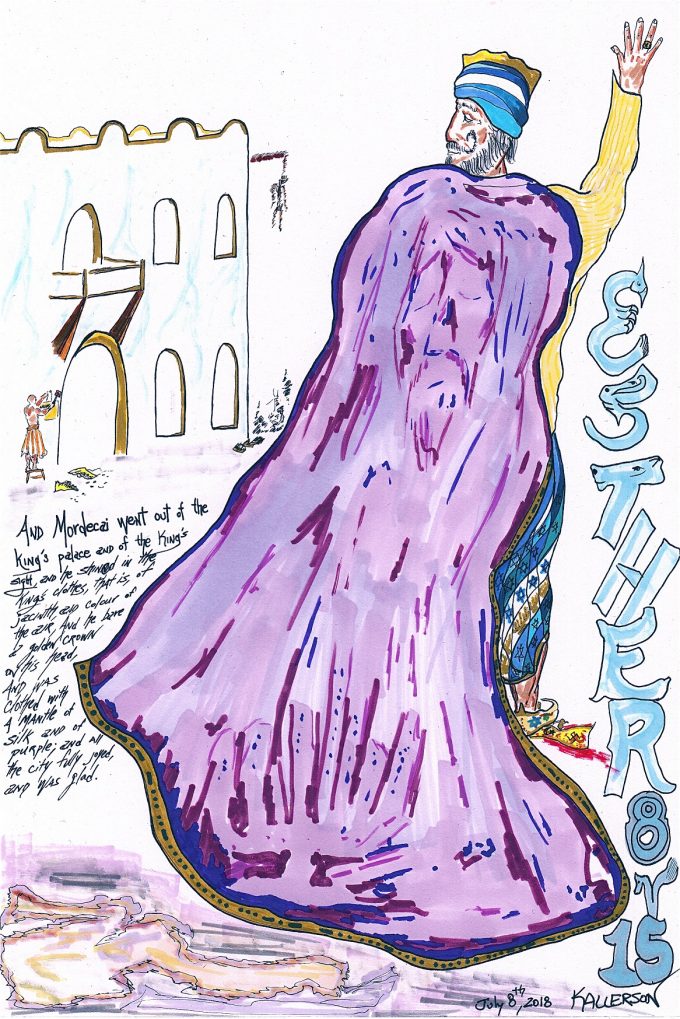
15 So Mordecai went out from the presence of the king in royal apparel of blue and white, with a great crown of gold and a garment of fine linen and purple;
Mordecai is granted royal honors, not just in the presence of the king, but as he went in and out from the king’s presence. His garments and crown would be seen by any and all. The crown here is not the same word as for the crown used while being conducted on the horse by Haman. It is one fit for the office he holds. Surely the words of Isaiah were true of Mordecai. Isaiah, speaking of those in Israel who were set free by their Redeemer, said –
“To proclaim the acceptable year of the Lord,
And the day of vengeance of our God;
To comfort all who mourn,
3 To console those who mourn in Zion,
To give them beauty for ashes,
The oil of joy for mourning,
The garment of praise for the spirit of heaviness;
That they may be called trees of righteousness,
The planting of the Lord, that He may be glorified.” Isaiah 61:2, 3
Mordecai had received joy instead of mourning, and beauty in place of his previous sackcloth and ashes. His spirit of heaviness was changed to a position of praise. To highlight this, the garment of fine linen mentioned here is described by a unique word in Scripture, takrik. It comes from an unused root meaning to encompass, thus it was a particular robe special to his office alone.
This verse now completes another set of two’s. In 6:11, Mordecai was invested with special clothes and accompanying honors appropriate to his good deed towards the king. Here, he is again noted “in royal apparel of blue and white, with a great crown of gold and a garment of fine linen and purple.” The two contrast in that he was first temporarily honored for a deed accomplished in the saving of the king. Now it is for a permanent appointment as a royal in the king’s palace. They contrast, and yet they confirm the honorable deeds and skill of Mordecai.
15 (con’t) and the city of Shushan rejoiced and was glad.
The word for “rejoiced” here is a new one in Scripture, tsahal. It signifies shouting out and crying aloud. The people literally bellow with joy. With these happy words, we close yet out another set of two’s. In verse 3:15, the city of Shusan was said to be perplexed. Here, it rejoices and is glad. They contrast certainly, but they confirm the wise proverb of Solomon –
“When the righteous are in authority, the people rejoice;
But when a wicked man rules, the people groan.” Proverbs 29:2
16 The Jews had light and gladness, joy and honor.
The words here are reflective of a state of absolute elation of heart. Each signifies a type of joy. The first is orah, or light. Just as a person is said to beam with joy, so light is used in the Bible. It is reflective of Psalm 97:11 –
“Light is sown for the righteous,
And gladness for the upright in heart.” Psalm 97:11
This light had come to replace the once-coming darkness. Next is simkhah, or mirth. It is a joy of rejoicing. This is followed by sason, a new word in the Bible signifying exultation. It is practically synonymous with the previous word – thus it is given to show the greatness of the joy. And finally is yeqar, or honor. This was introduced in Esther 1:4 and has now been used ten times in Esther. It gives the sense of dignity, or even pomp. The Jews have been elevated from the ash heap to the mountain top.
17 And in every province and city, wherever the king’s command and decree came, the Jews had joy and gladness, a feast and a holiday.
The joy of Shushan eventually spread to every location where the decree was sent, so that the same superlative words of the previous verse are repeated here. There was joy upon joy, but even more there came a mishteh, or banqueting feast, and a yom tov, or a “good day.” One can see the partying going on and on as the Jews celebrated the wonderful news.
This verse closes out another set of twos. In Chapter 4, after the giving of the first edict, there is great mourning, fasting, weeping, and wailing, and many laying in sackcloth and ashes. Here, after this edict, there is joy, gladness, honor, a feast, and a holiday. The two contrast, yes, but they also confirm the unity of the people in both distress and in exultation.
17 (con’t) Then many of the people of the land became Jews,
The word yahad or, to become a Jew, is found only here in the Bible. The actual requirements for this are found in Exodus 12:48. The people were to be circumcised and then they could keep the Passover at the appropriate time of the year. With this done, they were to be considered as natives of the land. From there, they would be obligated to the same laws as the rest of the Jews. This conversion is also something which is prophesied in Zechariah for the people of the future –
“Thus says the Lord of hosts: ‘In those days ten men from every language of the nations shall grasp the sleeve of a Jewish man, saying, “Let us go with you, for we have heard that God is with you.”’” Zechariah 8:23.
*17 (fin) because fear of the Jews fell upon them.
There are verses which show that this would occur when Israel entered Canaan. One is found in Exodus 15, in the Song of Moses. The other is found in Deuteronomy 11. Both say that dread would fall on the inhabitants when Israel came to the land. The same is true now, even outside of the land of Canaan. Because of the Lord their God, and even when not openly recognized by them, it is still perceived that a Force greater than them was with them. The dread of the Jews fell upon the people, and those around them threw their lot in with them, joining to them in a permanent bond.
As we close, it should be noted that throughout history, people have united with the Jews in this same fashion. There are debates who the real Jews are. Are they the Sephardic Jews, the Ashkenazic Jews, the Ethiopian Jews, and so on. Many claim that the people in the land of Israel are not true Jews, or that only a portion of them are. Even Jews argue among themselves. The debate, at least from a biblical standpoint, is unsound. The requirements for being a Jew do not stem from the Talmud, nor do they stem from the practices of the various offshoots of Jews. They stem from the Bible, and they show that those who have met the requirements of compliance found in Scripture can become Jews, and thus are Jews.
What this means is that those who are in the land today, regardless of their background over the past 2000 years, are the real Jews who are set to see the fulfillment of the final plan that God has for them in redemptive history. Those who survive what lies ahead will, at that time, become completed Jews. They will call out for their true Savior, whom they have missed for these past millennia, and they will be saved when He comes to deliver them.
The time is coming, and it probably is not far off. Esther is showing snapshots of the past which anticipate fulfillment of them in the future. Like all of the Bible, it is showing us what is, and what lies ahead, for those in Christ. It is all about Him, and the Jewish people are a great part of His unfolding plans. As we say our daily prayers, we should include them in what we pray about. The unseen Lord in Esther is the only hope for them. Without Him, they are as lost as the worst of pagans. But the same is also true with us.
We have a need, and that need is Jesus. He is the Lord directing the events of Esther, and He is the Lord directing the events of all of redemptive history, a history of which every soul is a part. The question for us is, “What side of the redemptive plans of God will we be on?” Will we come to Christ and be delivered? Or, will we refuse Him and be lost. The choice belongs to us; the salvation belongs to Him, and He grants it freely to those who choose wisely.
Closing Verse: “Oh, sing to the Lord a new song!
For He has done marvelous things;
His right hand and His holy arm have gained Him the victory.
2 The Lord has made known His salvation;
His righteousness He has revealed in the sight of the nations.” Psalm 96:1, 2
Next Week: Esther 9:1-17 The Lord directed and provided the remedies… (Rest From Their Enemies) (11th Esther Sermon)
The Lord has you exactly where He wants you. He has a good plan and purpose for you. At times, you might feel as if he has no great design for you in life, but he has brought you to this moment to reveal His glory in and through you. So follow Him and trust Him and He will do marvelous things for you and through you.
Beauty for Ashes
On that day King Ahasuerus
Gave Queen Esther the house of Haman
The enemy of the Jews
There it was in Shushan, and not in Grand Cayman
And Mordecai came before the king
For Esther had told how he was related to her
———-she informed the king of this thing
So the king took off his signet ring
Which he had taken from Haman, and gave it to Mordecai
And Esther appointed Mordecai over the house of Haman
Because her cousin was a really good guy
Now Esther spoke again to the king
Fell down at his feet, and implored him with tears
———-she really had the blues
To counteract the evil of Haman the Agagite
And the scheme which he had devised against the Jews
And the king held out the golden scepter toward Esther
———-for her he did this thing
So Esther arose and stood before the king
And said, “If it pleases the king
And if I have found favor in his sight
And the thing seems right to the king
And I am pleasing in his eyes, then relive our plight
Let it be written to revoke the letters devised by Haman
The son of Hammedatha the Agagite
Which he wrote to annihilate the Jews
Who are in all the king’s provinces, to remove us from his sight
For how can I endure to see the evil
That will come to my people then
Or how can I endure to see the destruction
Of my countrymen
Then King Ahasuerus said to Queen Esther
And Mordecai the Jew, relaying this news
“Indeed, I have given Esther the house of Haman
———-And they have hanged him on the gallows
Because he tried to lay his hand on the Jews
You yourselves write a decree concerning the Jews
As you please, in the king’s name
And seal it with the king’s signet ring
Write it according to your desired aim
For whatever is written in the king’s name
———-Really it’s not a joke!
And sealed with the king’s signet ring, no one can revoke
So the king’s scribes were called at that time
In the third month, which is the month of Sivan
On the twenty-third day
The task was taken on
And it was written, according to all that Mordecai commanded
To the Jews, the satraps, the governors, and the princes too
Of the provinces from India to Ethiopia
One hundred and twenty-seven provinces in all
———-A lot of writing they needed to do
To every province in its own script, so they did do
To every people in their own language
And to the Jews in their own script and language too
And he wrote in the name of King Ahasuerus
Sealed it with the king’s signet ring; from the throne it proceeds
And sent letters by couriers on horseback
Riding on royal horses bred from swift steeds
By these letters the king permitted the Jews
Who were in every city to gather together and their lives protect
To destroy, kill, and annihilate all the forces of any people
Or province that would assault them
———-if any harm they did detect
Both little children and women, and to plunder their possessions
On one day in all the provinces of King Ahasuerus, near and far
On the thirteenth day of the twelfth month
Which is the month of Adar
A copy of the document was to be issued
As a decree in every province and published for all people too
So that the Jews would be ready on that day
To avenge themselves on their enemies; so they were to do
The couriers who rode on royal horses went out
Hastened and pressed on by the king’s command
And the decree was issued in Shushan the citadel
And throughout all the empire’s land
So Mordecai went out from the presence of the king
In royal apparel of blue and white
With a great crown of gold and a garment of fine linen and purple
He was a pretty dandy sight
And the city of Shushan rejoiced and was glad
Things had turned to good from what was once really bad
The Jews had light and gladness, joy and honor
And in every province and city… hooray!
Wherever the king’s command and decree came
The Jews had joy and gladness, a feast and a holiday
Then many of the people of the land became Jews
Because fear of the Jews fell upon them by this royal news
Lord God, thank You for Your presence that is with us
Even when we don’t realize that You are there
Because You sent Your own Son Jesus
We can know that You truly do care
And so Lord, be real to us in a wonderful new way
Open our minds and our hearts to seeing You always
Through every step we take, and throughout every day
Be real to us, O God, and to You will shall give all of our praise
Hallelujah and Amen…