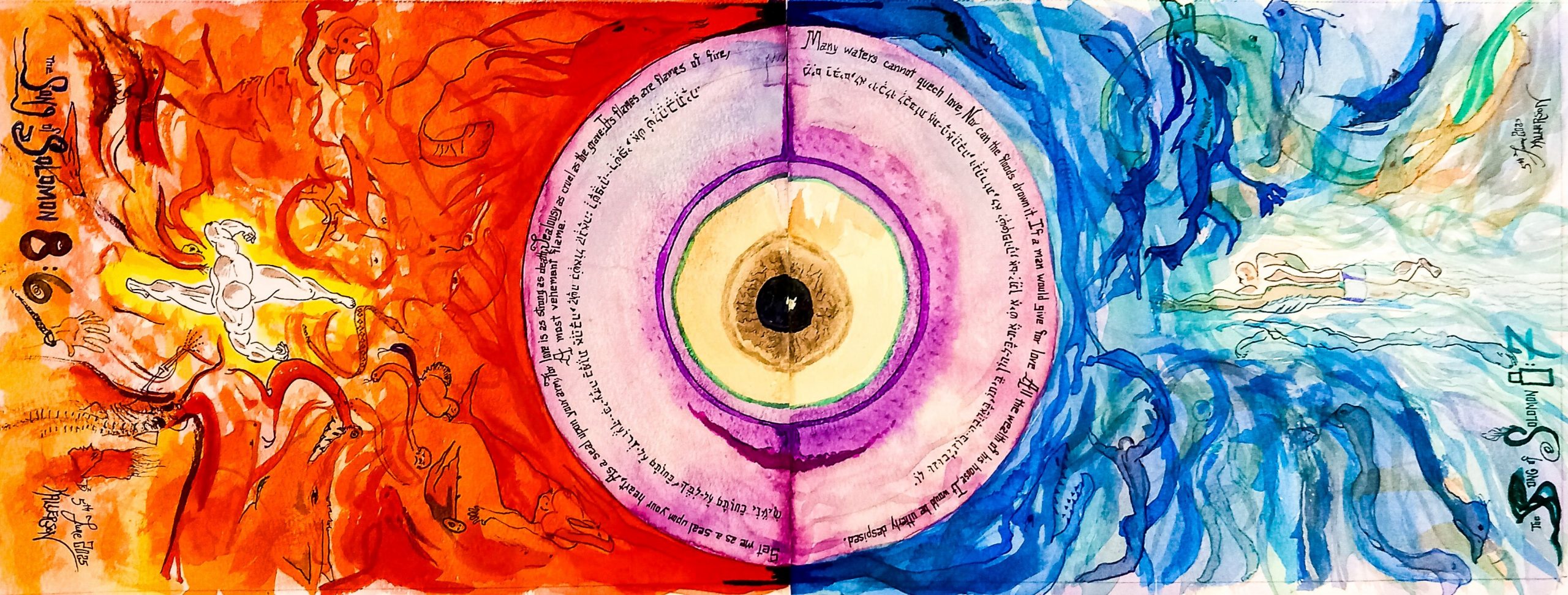
Artwork by Douglas Kallerson
Song of Songs 8:1-7
The Seal Upon Your Heart
(Typed 10 March 2025) The woman says that many waters cannot quench love. The many waters refer to that which is superlative. The Lord’s voice is said to be like that of many waters.
Likewise, the forces that can overwhelm a person are considered many waters. It is a phrase used repeatedly in Scripture to get across the idea of that which is superlative in nature in whatever comparison is being made.
In the comparison of love seen in this passage, it means that even all the waters of this world cannot drown out or extinguish love. Considering that the love of God for His redeemed is mentioned throughout Scripture, one would think that people would understand the doctrine of eternal salvation.
However, such would not be the case. Various churches claim that if you leave their congregation, you will lose your salvation, as if it is the denomination or individual church that provides security. Other churches claim, without really explaining the mechanics of it, that salvation can be lost in various ways.
Not only do they teach this, but they also provide no biblical support for how an “unsaved” person can be resaved. In such theology, verses must be ripped out of their context or completely misapplied. Works, the supposed evidence of salvation, are the emphasis.
The problem is that no specific works are identified as being necessary for continued salvation. It’s a sad trap that people find themselves in, but it is a rather common one.
Text Verse: “The voice of the Lord is over the waters;
The God of glory thunders;
The Lord is over many waters.
4 The voice of the Lord is powerful;
The voice of the Lord is full of majesty.” Psalm 29:3, 4
The Lord did not come to live the perfect life under the Law of Moses, instruct Israel in what is right and proper concerning the things of God, and give His life up on the cross just so that believers would have eternal insecurity.
Rather, the Lord taught that whoever believes in Him would not perish but have everlasting life. That isn’t something that comes with a lot of added theological baggage attached to it. Instead, it is a petition to believe.
How difficult it is to understand the meaning of the five-letter word, GRACE. The powerful and majestic voice of the Lord has told us what it is that saves us, His grace as revealed in the Person of Jesus Christ. If we aren’t sure of the meaning of grace, it would be right to consult the nearest dictionary. That simple act would clear up a great deal of muddied waters flowing through the church.
May we be responsible and pay heed. Telling others that they can lose what they couldn’t earn in the first place is not responsible. God has bestowed grace in the giving of Jesus. That bestowal is realized through belief. Nothing more.
Have faith. Believe the good news. This simple and yet marvelous truth is to be found in His superior word. And so, let us turn to that precious word once again, and… May God speak to us through His word today, and may His glorious name ever be praised.
I. His Right Embraces Me (verses 1-4)
Oh, that you were like my brother,
mi yiten’kha k’akh – “Who gives you according to brother.” The most common explanation for this is that she is wishing he were her brother so that they could express their affection for one another the way a brother and sister can. That way, they could be in public and dote upon one another.
However, though this idea may be correct, there is a fuller explanation. She wishes that he could be like her brother so that in their union, they would not have the difficulties that lovers face. For example, a brother is there in times of adversity (Proverbs 17:17), and the bond of brothers with sisters generally endures throughout life.
On the other hand, lovers have spats, and the love between them diminishes through the stresses and trials of life. He has previously called her “sister – completer.” She wants him to be like a brother so that the sibling relationship is truly realized between the two of them. To more poignantly reveal this, she says…
1 (con’t) Who nursed at my mother’s breasts!
li yoneq shede imi – “To my ‘sucking breasts my mother.’” In other words, she isn’t simply asking him to be a brother but a brother of her own mother. For example, it was known that David had many wives and also concubines. From them came many sons. The listing is given in 1 Chronicles 3:1-9.
However, there was a great deal of rivalry between the sons of different mothers. At times, such rivalries ended in murder or an attempt to usurp Solomon’s position as king.
Through all of this conflict, the bond between Absolom and Tamar is one of the strongest noted. This is because it is implied that they were born to David from the same mother. This strongest bond of blood through both the father and the mother is what the beloved is referring to. If this were the case…
1 (con’t) If I should find you outside,
I would kiss you;
emtsaakha bakhuts eshaq’kha –
“Find you in the outside –
Kiss you.”
These words reveal that the first reason for her wanting to be like a brother to him is that they could, in fact, express their doting affections upon one another in a public setting. For example, Cambridge states –
“Only the uterine brother and the father’s brother’s son have among the Bedawin the right to kiss a maiden. Cp. Wetzstein, ZDMG. XXII. pp. 93, 108.”
This was probably true in the culture of Israel at the time as well. A brother and a sister could display affection openly without anyone giving a hoot, something that even married people might not feel comfortable doing. Instead, she could run up to him and say, “Hello, my dear brother!” while giving him a kiss on his cheek. Because he is her brother…
1 (con’t) I would not be despised.
gam lo yavuzu li – “Also, not disrespect to me.” Today, we tend to see people doing whatever they want in public. But when I was young, I don’t ever remember seeing even married people showing intimate affection in public. Such displays were meant for the privacy of home.
However, I remember brothers and sisters acting as naturally as the best of friends or even giving a kiss on the cheek without anyone batting an eye. Not having my own sister, it was almost a point of jealousy that they could get away with such things.
This is the intent of her words. She is looking for the strongest bond, one that will not fade but which is also unashamed of the nearness that a full-blood relationship can allow. With such intimacy and yet boldness…
2 I would lead you and bring you
enhagakha aviakha – “Lead you and bring you.” One can follow the train of thought: she sees her brother, the son of her mother, outside. She runs up to him and kisses him without a qualm or concern. There is no timidity or shame, and no one bats an eye. Then she grabs his hand and says, “Come along, brother,” dragging him as she takes him…
2 (con’t) Into the house of my mother,
el beith imi – “Unto house, my mother.” If he were a brother, she would lead him right to the house they grew up in. Nobody would question the matter because it is what brothers and sisters do all the time. With them there, instruction would take place. However, who the instructor is depends on how the next words are translated…
2 (con’t) She who used to instruct me.
The words are incorrect, regardless of the “who.” The verb is not past tense. Rather: t’lam’deni – “Will teach me.” Some translations believe that this is a relative clause belonging to the previous words, making the verb feminine. In essence, “I will take you into the house of my mother, and she will teach me how to tend to you.”
If it is the mother, an unstated but implied relative pronoun needs to be inserted, indicated by the word “who” in the NKJV. Other translations take the word as masculine, indicating it is Solomon who is the subject.
The mother is the nearest antecedent, so I would favor her being the subject, but it could be the woman saying that when she has brought Solomon to her house, he would teach her. The only other time this verb is used in this form t’lam’deni is in Psalm 119, when referring to the Lord –
“Must cause to utter, my lips, praise –
For will teach me [t’lam’deni] your enactments.” Psalm 119:171 (CG)
It is hard to be dogmatic. Either way, she is saying that in taking him to her mother’s house as if he were a brother, she would then receive instruction, be it from her mother or from Solomon. She would then know what to do…
2 (con’t) I would cause you to drink of spiced wine,
The final word is neither a verb nor an adjective, as all translations make it. Rather, it is a noun: ashq’kha miyayin hareqakh – “Cause you to drink from wine, the vintner.” The word reqakh is found only here. It is derived from the verb raqakh, to compound or mix perfumes or spices.
Because she is referring to wine, the word vintner gets the point across. A vintner does more than just make wine. He is involved in every step of the process, including mixing to obtain the most delightful flavor, bouquet, and notes. It is the one word that most succinctly explains her intent.
Wine symbolizes the merging of cultural expressions into a result. The thing that ought to happen can happen, symbolized by wine. As such, it represents our reasoning and that which can change our minds. The particular wine she refers to is next named…
2 (con’t) Of the juice of my pomegranate.
measis rimoni – “From juice my pomegranate.” Pomegranate wine has been around for thousands of years. You can buy it pretty much anywhere today, and if you want to make your own, you can buy a gallon of Vintner’s Best Pomegranate wine starter mix from Amazon for about $50.00. Ooh. Ahh.
The rimon, pomegranate, is derived from ramam, to be high or exalted. It symbolizes harvest-ready fruit and means Mature Mind or Harvest Ready. From the idea of imbibing in her wine, she next turns to a new line of thought that was already expressed in verse 2:6…
3 His left hand is under my head,
And his right hand embraces me.
s’molo takhath roshi vimino t’khab’qeni –
“His left under my head,
And his right embraces me.”
The words are letter-for-letter identical to verse 2:6 with the exception of the letter lamed, translated as “to.”
2:6 – His left under ‘to my head,’
And his right embraces me.
8:3 – His left under my head,
And his right embraces me.
In Chapter 2, she was almost in a state of swooning when she said this. That is probably the same thought being conveyed here. Notice the similarities between the two –
Chapter 2
4 Brought me unto house the wine,
And his banner upon me – love.
5 Prop me in the pressed-cakes,
Spread me in the apples,
For rubbing love – I.
6 His left under ‘to my head,’
And his right embraces me.
Chapter 8
2 Lead you and bring you,
Unto house, my mother –
Will teach me.
Cause you to drink from wine, the vintner,
From juice my pomegranate.
3 His left under my head,
And his right embraces me.
In Chapter 2, Solomon brought her into the house of wine. In Chapter 8, she brings him into her mother’s house, where she is instructed, and then gives him the wine of the vintner. In both instances, there is a loving embrace, and in both, there is also an adjuration which follows the scene…
4 I charge you, O daughters of Jerusalem,
Do not stir up nor awaken love
Until it pleases.
hishbati etkhem b’noth y’rushalim mah tairu u-mah t’or’ru eth ha’ahavah ad shetekhpats –
“Adjured you, daughters Jerusalem –
Why waken and why awaken the love,
Until she inclines?”
The words are very similar to verse 2:7. One difference is that in verse 2:7, the adjuration is made “in gazelles or in does the field.” That is dropped out.
Next, 2:7 again says in the form of an adjuration, “If wakens and if awakens.” Here, in the form of a question, it asks, “Why waken and why awaken?” The sense, then, is “Why would you try to arouse love before she is ready to act? She will stir when the moment is right.”
Also, another change is that in the word translated as “awaken,” a single letter, a vav, drops out of it from verse 2:7 –
תְּעֽוֹרְר֛וּ
תְּעֹֽרְר֛וּ
This is the same thing that happened in the word “twins” found in verses 4:5 and 7:3. The pronunciation is identical, so unless you are inquisitive like Charlie, without putting the verses side by side, the change is completely indiscernible.
Without modern technology, the task would be much more laborious. The change is probably first noted for those who come to the Superior Word for their instruction.
Understanding these changes, we can put the verses side by side for comparison –
2:7 – Adjured you, daughters Jerusalem,
In gazelles or in does the field –
If wakens and if awakens the love,
Until she inclines.
8:4 – Adjured you, daughters Jerusalem –
Why waken and why awaken the love,
Until she inclines?
We are at the final break of the book. Each break has been followed by a sudden new beginning. The fourth part ends, as noted by Jamieson-Faucett-Brown, “in full repose and refreshment.” The fifth part is next…
A cross is there on the hill of Calvary
It is a sign of God’s love to the people of the world
On that cross, Jesus died for you and for me
The greatest display of love was on that day unfurled
Oh! That Christ died for sinners like us!
How deep is the love of God for this to have come about?
Wondrous is the giving of His Son, Jesus
Take hold of the promise, stand fast, and do not doubt
Christ died, and into the grave He went – had death won?
A lifeless body, seemingly the end of the story
But No! Death could not hold the sinless Son
He burst forth from the grave in radiant glory!
II. Fffflame Yah! (verses 5-7)
5 Who is this coming up from the wilderness,
mi zoth olah min ha’midbar – “Who this ascending from the wilderness.” The words are letter-for-letter identical to the first clause of verse 3:6. The words introduce what will only later be identified. They are intended to bring a sense of wonder and anticipation to the minds of the hearers.
As for the wilderness, it is any place that is uncultivated, usually with sparse vegetation. Therefore, it is in contrast to the one coming out of the wilderness. She is coming…
5 (con’t) Leaning upon her beloved?
mithrapeqeth al dodah – “Reclining upon her beloved.” The word raphaq, to recline, is found only here. She is ascending together with her beloved, reclining on him. It appears that they are together in his palanquin. It is unstated, but it would make sense based on the comparable words in Chapter 3 –
“Who this ascending from the wilderness,
According to columns smoke?
Smoked – myrrh and frankincense,
From all powder peddling.
7 Behold! His bed, that to Solomon –
Sixty mighties around to it,
From mighties Israel.” Song of Songs 3:6, 7 (CG)
If she is reclining on him, it could be either that they are walking and she is reclining on him as they walk or that she is reclining on him as they are carried. I would go with the latter because of the parallel to the words of Chapter 3. Either way, the words next change direction…
5 (con’t) I awakened you under the apple tree.
takhat ha’tapuakh orar’tikha – “Under the apple, I awakened you.” The words are not complicated, but they at first appear to have no connection to what was asked. Further, in the Hebrew text, these clauses are masculine, making the woman the one speaking. However, the Syriac and the Latin have them as feminine, making Solomon the speaker.
Without being dogmatic, it is probable, therefore, that the words are those of Solomon, and this is how I would personally take them. For some reason, the Masoretes changed the vowel pointing to have it reflect the woman speaking instead of the man.
If so, they got a sniff of Jesus and did not want that to be considered. That is not unusual in their text. They have hidden or obscured obvious hints of Christ in key passages of Scripture.
Either way, Solomon and his beloved are coming out of the wilderness, she is reclining on him, and he asks rhetorically who she is, knowing full well the answer because one of them had aroused the other under the apple tree. Next…
5 (con’t) There your mother brought you forth;
No way, José: shamah khib’latkha imekha – “There-ward bound you, your mother.” The word khaval signifies to wind tightly and thus to bind. Specifically, then, it means to bind by a pledge. For example –
“If you ever take your neighbor’s garment as a pledge [khaval], you shall return it to him before the sun goes down.” Exodus 22:26
The sense then is that under the apple (there-ward) she (or he) was given in pledge by her (or his) mother. That is then repeated, stressing the idea and also forming parallelism…
5 (con’t) There she who bore you brought you forth.
shamah khib’lah y’ladakha – “There-ward bound, ‘borne you.’” The words “your mother” and “borne you” are set in apposition to highlight that the mother was a part of the process in bringing her to be with Solomon (or Solomon to be with her) as she reclines or leans on him.
With that, it is certain that she now speaks to him…
6 Set me as a seal upon your heart,
simeni khakhotham al libkha – “Set me according to the seal upon your heart.” Saying “according to” tells us that this is figurative. A seal is something that marks something as dear or precious. It even gives a sense of ownership.
In the Bible, the heart is used metaphorically when referring to the inner person, the mind, the intellect, the will, etc. She is asking him to have her always in his thoughts and desires. Next, speaking in parallel, she says…
6 (con’t) As a seal upon your arm;
kakhohtam al z’roekha – “According to the seal upon your arm.” The zeroa, or arm, comes from the word zara, meaning “to sow” or “scatter seed.” The arm thus speaks of power and exertion, but also of effectual reach to accomplish.
When a man desires to show his strength or to defeat an enemy, he will stretch his arms out. In this one stance, he will both defend some and work against others. Therefore, her appeal is for his protection and defense through his strength and reach…
6 (con’t) For love is as strong as death,
ki azah khamaveth ahavah – “For strong, according to the death – love.” This is not referring to its inevitability. Rather, the meaning is that the state of love is like death. It is something that cannot be escaped. She is completely captured by it. Likewise…
6 (con’t) Jealousy as cruel as the grave;
qashah khish’ol qinah – “Severe, according to Sheol – jealousy.” The word qinah signifies jealousy, envy, or even zeal. Love is set in apposition to jealousy, and Sheol is set in apposition to death. Just as the state of love is something that cannot be escaped, so is the state of jealousy.
These parallel clauses are based on her request to be set as a seal. She is in the state of love and jealousy for her beloved. She is entrapped by them and wants to be affixed to him both mentally and physically at all times. One can see that she is equating each with the other –
For strong^, according to the death* – love+
Severe^, according to Sheol* – jealousy+
Therefore, because love and jealousy are one thing, the singular is used to identify them as such…
6 (con’t) Its flames are flames of fire,
r’shapheha rishpe esh – “Her embers – embers fire.” The resheph refers to a live coal, meaning an ember. The state of love, which is a state of jealousy, is thus equated to such an ember. To accentuate and highlight that thought, she speaks in heightened parallelism…
6 (con’t) A most vehement flame.
The NKJV is a poor paraphrase. Way more excitedly: shalhevethyah – “Fffflame Yah!” The word is rare, shalheveth. It is from the same as lahav, a flame, but it has a sibilant prefix. In other words, it is an extended sound, like a hiss. In this case, however, it has an extended f. Thus, fffflame.
But more, the word is suffixed with a shortened form of the divine name, Yehovah. Just as we say Hallelujah, to signify Praise Yah, this says shalhevethyah, “Fffflame Yah!” This is the one reference to the divine name in the book.
Understanding the emphatic nature of what is stated, she next continues to describe love…
7 Many waters cannot quench love,
mayim rabim lo yukh’lu l’khaboth eth ha’ahavah – “Waters, many, no able to extinguish the love.” The term mayim rabim, translated by most as “many waters,” is a superlative term indicating a roaring, raging torrent. It is something that is overwhelming.
The idea is that of a magnesium torch, even though she doesn’t know what that is. The Fffflame of Yah, symbolizing the state of love, is such a powerful flame that it will burn even when completely doused in a great, roaring stream.
Next, continuing to speak in parallel thought, she says…
7 (con’) Nor can the floods drown it.
un’haroth lo yishtphuha – “And streams, no quench her.” It is the same idea as just expressed concerning the unquenchable, jealous nature of love. When the waters have dried up, the love will continue to exist.
This is such a powerful truth that she turns to an affirmative statement to highlight the value and preciousness of the state of love…
7 (con’) If a man would give for love
All the wealth of his house,
im yiten ish eth kal khon beito ba’ahavah – “If give, man, all wealth his house in the love.” The idea here is more expansive than what we would think of when referring to a house. My house got flooded last year. If it got swept away, someone might say, “All the wealth of his house is gone.”
But that is not the totality of a house in Hebrew thought. Rather, it speaks of the family that issues from a man as well. The House of David refers to everything that the name David encompasses, meaning his descendants and all of the promises or blessings they accrue because he represents them.
The meaning is that if a man were to attempt to purchase love with everything his existence encompasses…
*7 (fin) It would be utterly despised.
boz yavuzu lo – “Disrespecting disrespect to him.” The word buz, to disrespect or despise, is used eleven times. All eleven by Solomon, and the last three are in this chapter. In this verse, it is used twice in a row.
This is the traditional way of emphasizing a verbal action to indicate the greatest or most superlative nature of what is being said. The word is stated as an infinitive absolute, and then it is restated in the imperfect. In English, we would say “utterly despised.”
Everything that a man is comprised of would be an utterly disrespectful offer for the purchase of love. With that, the verses for today are complete.
The Word of God – holy, pure, and perfect too
Is given to satisfy man’s weary soul
Let us take an eternal view
Let the word convert us to God’s heavenly roll
There, in the Book of Life, our names will be
Because we pursued His word and found Jesus
Innumerable redeemed, there beside the glassy sea
Such a marvelous thing God has done for us
If we will just open the Bible, our own Book of Life
And accept what it says as holy and true
Then, between us and God, will end the strife
In believing the gospel, life begins anew
III. Jesus in the Details
The significance of these verses in relation to Christ is more difficult than in the previous few chapters. However, what is key is that it refers to the house of the woman’s mother and the binding of the woman by the mother.
The woman speaks of the closest family relationship she could describe, where there is no hint of difficulty that lovers might face and no hint of impurity assumed by those who witness them. That relationship is of a brother from the same mother.
They are a couple, but this is the state she desires. That is the state of the redeemed in Christ –
“And we know that all things work together for good to those who love God, to those who are the called according to His purpose. 29 For whom He foreknew, He also predestined to be conformed to the image of His Son, that He might be the firstborn among many brethren. 30 Moreover whom He predestined, these He also called; whom He called, these He also justified; and whom He justified, these He also glorified.” Romans 8:28-30
There must be a common mother figure to identify the people of God. That is seen in Galatians 4 –
“Tell me, you who desire to be under the law, do you not hear the law? 22 For it is written that Abraham had two sons: the one by a bondwoman, the other by a freewoman. 23 But he who was of the bondwoman was born according to the flesh, and he of the freewoman through promise, 24 which things are symbolic. For these are the two covenants: the one from Mount Sinai which gives birth to bondage, which is Hagar— 25 for this Hagar is Mount Sinai in Arabia, and corresponds to Jerusalem which now is, and is in bondage with her children— 26 but the Jerusalem above is free, which is the mother of us all. 27 For it is written:
‘Rejoice, O barren,
You who do not bear!
Break forth and shout,
You who are not in labor!
For the desolate has many more children
Than she who has a husband.’” Galatians 4:21-27
The Jerusalem above, identified by the New Covenant, is considered as our mother. This must apply to Christ, too, because He is the first of the brethren according to Paul in Romans 8.
Stating that he was like a brother sucking at her mother’s breasts signifies the same source of nourishment. That is reflected in Peter’s words –
“Therefore, laying aside all malice, all deceit, hypocrisy, envy, and all evil speaking, 2 as newborn babes, desire the pure milk of the word, that you may grow thereby, 3 if indeed you have tasted that the Lord is gracious.” 1 Peter 1:2, 3
She didn’t say that her beloved actually sucked at her mother’s breasts, but made the comparison, which in Christ is a valid one. The same source of the word applies to Him and to His people.
She also stated that she would kiss him openly. The final verse of the 2nd Psalm speaks of kissing the Son. In other words, it refers to paying homage to Him. The final words say, “Blessed are all those who put their trust in Him” (Psalm 2:12).
In such an act of love, there is no disrespect to that person. Verse 2 noted taking her beloved into her mother’s house, being taught, and drinking from the vintner’s wine, meaning juice of the pomegranate.
The pomegranate signifies that which is harvest-ready and of the mature mind. Previously, it has been used to refer to the redeemed of the Lord. Here, that follows as well. The cultural expression (the wine) of the mature-minded (the pomegranate) is what Christ drinks.
That would explain the intimate embrace of verse 3. The beloved gave her adjuration, asking why someone would waken and awaken love until she inclines.
In her question, the vav, the sixth letter which represents man, particularly fallen man, drops out of the word.
The change, though hidden and subtle, is purposeful. Just as it was in verse 7:3, it is a personal note telling us of our already assured heavenly state. Those who have not awakened love through that which is false, but rather allowed it to develop in Christ, are His, meaning fully redeemed. In other words, eternal salvation is realized in Christ. The nature of the person is changed in Him.
Verse 5 had the debated form of the words as to whether they were masculine or feminine. I argued because of the nature of the words and supporting source texts that they are masculine. As such, it is Solomon speaking throughout the verse.
The redeemed are those brought out of the wilderness and who recline on Christ. Next, he notes that He awakened them under the apple tree. As seen previously, the tappuakh, apple, is derived from naphakh, to breathe or blow.
It is what the Lord did when He breathed the breath of life into Adam, and it is what Christ does in His people when they believe in Him, awakening new life in us.
The binding of the mother (there-ward) refers to the inclusion of those who believe in the New Jerusalem. Next, the woman (the redeemed) spoke of being set as a seal upon His heart and His arm.
That is well-reflected in the sealing of the Spirit, where believers are sealed in the mind (the heart) of Christ and under the authority and power (the reach of the arm) of Christ.
That love is expressed in permanently binding (death/Sheol) and in the unquenchable nature of Christ’s redemption (cinders and Fffflame Yah). It is eternal in nature. It cannot be extinguished, and yet, it cannot be purchased, even with everything that a man is comprised of. It can only be received by faith.
The passage speaks of the redemption of the redeemed: their state, their nature, and their security. It is why this is “Song the songs.” It speaks not only of the work of Christ, but the nature of it in the people He came to bring unto Himself.
The unfailing nature of the love spoken of by the woman is reflected in the eternal nature of God’s love for those He has covenanted with through the blood of Christ.
Let us consider what God has done. Thinking about the love between the king and a woman is anticipatory of the greatest love of all, the love of God for His people, because of Jesus. Hallelujah for the shalhevethyah, the Fffflame of Yah!
Closing Verse: “In Him you also trusted, after you heard the word of truth, the gospel of your salvation; in whom also, having believed, you were sealed with the Holy Spirit of promise, 14 who is the guarantee of our inheritance until the redemption of the purchased possession, to the praise of His glory.” Ephesians 1:13, 14
Next Week: Song of Songs 8:8-14 Your voice is so precious, My dear… (Cause Me to Hear!) (19th and final Song of Songs sermon)
The Lord has you exactly where He wants you. He has a good plan and purpose for you. He alone is the perfect example of love – untarnished, unblemished, and completely pure and holy. He offers this love to you. So, follow Him, live for Him, and trust Him, and He will do marvelous things for you and through you.
Song of Songs 8 (CG)
8 Who gives you according to brother,
To my ‘sucking breasts my mother.’
Find you in the outside –
Kiss you.
Also, not disrespect to me.
2 Lead you and bring you,
Unto house, my mother –
Will teach me.
Cause you to drink from wine, the vintner,
From juice my pomegranate.
3 His left under my head,
And his right embraces me.
4 Adjured you, daughters Jerusalem –
Why waken and why awaken the love,
Until she inclines?
5 Who this ascending from the wilderness,
Reclining upon her beloved?
Under the apple, I awakened you.
There-ward pledged you, your mother.
There-ward pledged, ‘borne you.’
6 Set me according to the seal upon your heart,
According to the seal upon your arm.
For strong, according to the death – love,
Severe, according to Sheol – jealousy.
Her cinders, cinders fire,
Fffflame Yah!
7 Waters, many, no able to extinguish the love,
And streams, no quench her.
If give, man, all wealth his house in the love,
Disrespecting disrespect to him.
Song of Songs 8 (NKJV)
Oh, that you were like my brother,
Who nursed at my mother’s breasts!
If I should find you outside,
I would kiss you;
I would not be despised.
2 I would lead you and bring you
Into the house of my mother,
She who used to instruct me.
I would cause you to drink of spiced wine,
Of the juice of my pomegranate.
3 His left hand is under my head,
And his right hand embraces me.
4 I charge you, O daughters of Jerusalem,
Do not stir up nor awaken love
Until it pleases.
5 Who is this coming up from the wilderness,
Leaning upon her beloved?
I awakened you under the apple tree.
There your mother brought you forth;
There she who bore you brought you forth.
6 Set me as a seal upon your heart,
As a seal upon your arm;
For love is as strong as death,
Jealousy as cruel as the grave;
Its flames are flames of fire,
A most vehement flame.
7 Many waters cannot quench love,
Nor can the floods drown it.
If a man would give for love
All the wealth of his house,
It would be utterly despised.