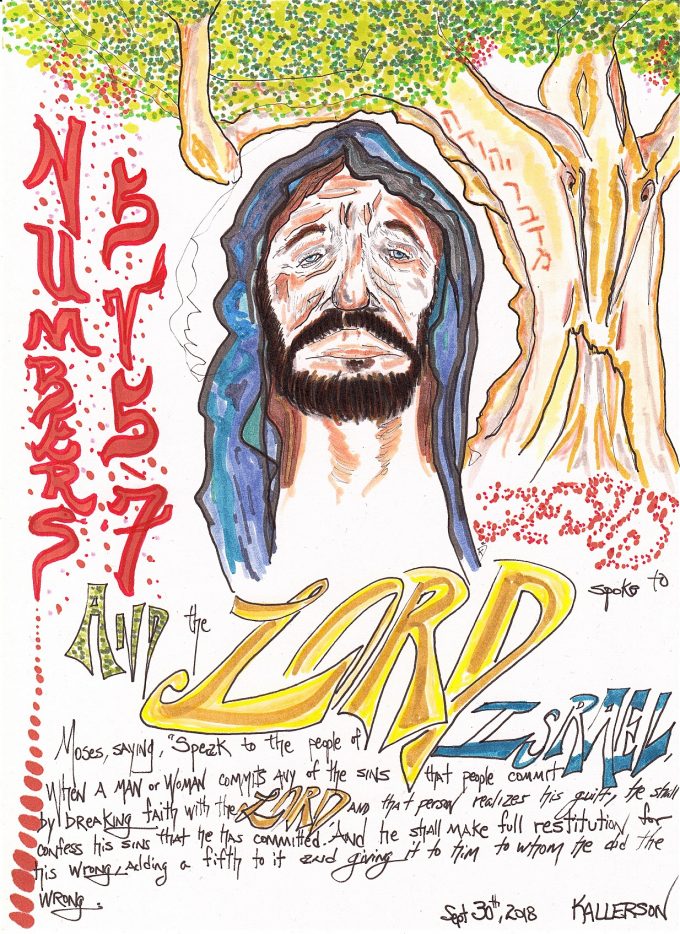
Numbers 5:1-10
A Conscience Cleansed
There are two short sections in today’s verses. The first deals with physical defilement which necessitates the removal of an individual from the camp of Israel. The second deals with committed sin which defiles the conscience, and which must be dealt with in order to remove guilt.
An age-old question for believers in Christ is, “Do I have to confess my sins to the Lord if I am already forgiven of what I have done wrong?” The question is asked, and then it is asked again, and it is then asked again. Quite often, the same person asks it several times as he tries to find an answer which resolves the matter suitably for him.
The fact that this is the case tells us that we worry about wrongdoing because we know that we have done wrong. My thought on this is that if we know we’ve done wrong, and we worry if we need to acknowledge that wrongdoing or not, it should tell us that we already know the answer to the question.
One logical answer should be based on the question, “If I don’t confess my sins, can I lose my salvation?” The answer is a resounding, “NO!” We will not lose our salvation over this, or over any other matter. Logic alone tells us that both thoughts are true. “No we do not need to confess our sins after being saved or we will lose our salvation.” And “No, we cannot lose our salvation.”
Having said that, the logical answer does not resolve the obvious problem. “I have done wrong before the Lord, and I feel guilty about it.” If you have done wrong, and you don’t feel guilty about it, you have a completely different, and much worse problem – a heart problem.
Text Verse: “The word is near you, in your mouth and in your heart” (that is, the word of faith which we preach): 9 that if you confess with your mouth the Lord Jesus and believe in your heart that God has raised Him from the dead, you will be saved.” Romans 10:9, 10
Does Jesus read the hearts and minds of His people? Well, yes – yes he does. So we can confess the Lord Jesus, and yet not believe in our hearts, and we will still not be saved. On the flip side, we can assume that Jesus reads our hearts and we can then figure we are saved without confessing with our mouths the Lord Jesus. What’s the point if He has already read our heart? But Paul ties the two together as one act. Indeed, who out there without working vocal cords would believe in the Lord Jesus and NOT confess with his mouth?
If I steal something from my mother, and she sees me doing it, and I know that she saw me, and yet she says nothing about it, am I free from guilt? Not at all. Maybe she just doesn’t want to argue, but I have done wrong. In order to truly make restitution for what I’ve done, I need to own up to my wrongdoing. She already knows, but that is insufficient to resolve the issue of her offense, and now also my guilty conscience. Why… why would we treat the Lord any differently?
It actually bothers me when people argue that we don’t need to confess our sins before the Lord. Do we think that just because He knows we’ve done wrong, we don’t need to admit it? That is as arrogant as a democrat spending your tax dollars, even more so.
Every time that we say, “I don’t need to talk to the Lord about my sin,” two things happen. First, our hearts get a bit more callous to our sin, and secondly, we put up that much more of a wall between ourselves and the Lord. That wall will be broken down someday, and our deeds will be passed through the fire. In the end, what is left will be our lot.
I talk to the Lord about how happy I am it rained. I talk to the Lord about how nice the flowers are. I talk to the Lord about how wonderful His word is. I talk to the Lord about how angry I am at the wicked. I talk to Him about this, and I talk to Him about that. But I won’t talk to Him about my wrongdoing? How stupid. The arrogance of this mindset is poison. Who cares what the logical outcome of a matter is if it harms us in the process?
Let us take all of what is in our heart and gladly share it with Him. So what if He already knows it. He knows You love Him, but He’d sure like to hear You confess that with your lips. Get right thinking along sound doctrine. The two go hand in hand. The place to get right doctrine is from the Bible. The place to get right wisdom in your thinking is there too. It’s all to be found in His superior word. And so let’s turn to that precious word once again and… May God speak to us through His word today and may His glorious name ever be praised.
I. Separation from Defilement (verses 1-4)
And the Lord spoke to Moses, saying:
This is the normal address of the Lord to Moses, and it indicates a new section is being introduced. The words of Chapter 5 are actually divided into three sections. This first one is just four verses long, and it will deal with purity within the camp. The second section, which goes from verse 5 until verse 10, will deal with restitution for wrongdoing. The third section goes from verse 11 until the end of the chapter and concerns the law of jealousy in a husband concerning a wife that may have been unfaithful to him.
The overall idea of these verses then is the sanctity and purity of the camp, but the thought won’t stop here, it will carry on through Chapter 5. Anything impure or undefiled is to be removed from the camp. If we think about it from a logical perspective, this is the perfect place for these rules to be stated. There has been a meticulous and orderly arrangement of the camp over the past chapters. In the middle of the camp is the sanctuary where the Lord dwells. The camp – now laid out as directed by Him – is to be pure, holy, and undefiled. And so before setting out towards Canaan, the laws of exclusion from the camp, and other laws which conform to that idea, are expressed now. Such a law of purity will actually be given concerning the whole land of Canaan in Numbers 35. When the people arrive, they will be told –
“So you shall not pollute the land where you are; for blood defiles the land, and no atonement can be made for the land, for the blood that is shed on it, except by the blood of him who shed it. 34 Therefore do not defile the land which you inhabit, in the midst of which I dwell; for I the Lord dwell among the children of Israel.” Numbers 35:33, 34
As the Lord dwells in the midst of the camp now, He will dwell in the midst of the land, and among His people, once they arrive in Canaan. And these Old Testament lessons are given as mere types and shadows of the greater picture of purity which is anticipated in the new heavens and earth which is described in Revelation 21 –
“But there shall by no means enter it anything that defiles, or causes an abomination or a lie, but only those who are written in the Lamb’s Book of Life.” Revelation 21:27
There, the Lord will dwell in the temple, in the midst of the people, and the pure, undefiled, and holy state which was anticipated in the people of Israel will be realized in its fullness in the people of God.
2 “Command the children of Israel that they put out of the camp every leper,
The first note of instruction concerning purity is to exclude those who are defiled from remaining within the camp. Beginning with lepers, the Lord directs Moses to command the people to put them outside the camp where He dwells.
One point that is interesting to contemplate is that these directions are only coming about now, after the layout of the camp has been given. The directions for all of these exclusions came about in Leviticus. For example, the laws concerning leprosy are found in great detail in Leviticus 13 & 14. Chapter 13 identified what it meant to be leprous in body, and Chapter 14 explained what it meant to be cleansed in the body from that leprosy.
The words here show that there are, in fact, lepers and other defiled people within the camp. However, only now – after the camp has been laid out by the Lord, and the duties of the Levites have been explained – are the laws of leprosy being enacted among the people. In this, we can see that there is the material aspect of the camp, and there is the form of the camp. The two are not the same.
A human is made of materials, but unless the body is animated by the soul, it is simply a compilation of materials. Only when the form comes into existence is the man considered human. The same is true here. The materials of the camp existed, but only when the form of the camp came into existence is the direction for meeting the previously laid out commands concerning purity actually applied.
What this means in its pictorial sense, is concerning what the form of the camp is. We saw that the layout forms a cross. Regardless as to whether the camp actually was able to form this cross at all times or not, based on the surrounding landscape, the intended form is given. As the cross is the true fount of cleansing of all things spiritual, those defilements within the camp, such as leprosy, must be removed. If you remember, each defilement named in Leviticus pointed to a spiritual defilement in the New Testament. Thus, the cross is the defining standard for purity for the people of God. What we are instructed in the New Testament epistles is given to maintain that purity. If we are unclean according to those letters, we are to be separated from the camp. This is noted in several ways by Paul such as these examples –
“It is actually reported that there is sexual immorality among you, and such sexual immorality as is not even named among the Gentiles—that a man has his father’s wife! 2 And you are puffed up, and have not rather mourned, that he who has done this deed might be taken away from among you. … For what have I to do with judging those also who are outside? Do you not judge those who are inside? 13 But those who are outside God judges. Therefore ‘put away from yourselves the evil person.’” 1 Corinthians 5:1, 2 & 12, 13
“But as for you, brethren, do not grow weary in doing good. 14 And if anyone does not obey our word in this epistle, note that person and do not keep company with him, that he may be ashamed. 15 Yet do not count him as an enemy, but admonish him as a brother.” 2 Thessalonians 3:13-15
There is a formative power in biblical ideas which needs to be considered when we look at Scripture. When we come at the doctrines of the Bible in a willy-nilly way, we will inevitably, and always, have unsound doctrine. And yet, this has been, and continues to be, the standard for most people in the faith. It isn’t just a modern thing which has come about in recent years. Rather, it has been this way since the beginning. Paul says as much in Ephesians –
And He Himself gave some to be apostles, some prophets, some evangelists, and some pastors and teachers, 12 for the equipping of the saints for the work of ministry, for the edifying of the body of Christ, 13 till we all come to the unity of the faith and of the knowledge of the Son of God, to a perfect man, to the measure of the stature of the fullness of Christ; 14 that we should no longer be children, tossed to and fro and carried about with every wind of doctrine, by the trickery of men, in the cunning craftiness of deceitful plotting, 15 but, speaking the truth in love, may grow up in all things into Him who is the head—Christ— 16 from whom the whole body, joined and knit together by what every joint supplies, according to the effective working by which every part does its share, causes growth of the body for the edifying of itself in love.” Ephesians 4:11-16
Paul notes the materials and the form. Without the form, we are simply being blown about by every wind of doctrine – be it sound or unsound. The camp of Israel is now a form, and that form is to be respected, kept pure, and sanctified in its service to the Lord. The church of God is a form, and likewise, that form is to be respected, kept pure, and sanctified in its service to the Lord.
When we depart from what is given in Scripture, or when we willy-nilly pull apart the form, we end up with every possible bad doctrine that can be made up. It fills our pulpits, and this in turn expands out to fill the entire congregation. If that congregation includes a TV or internet ministry, it goes out even further. There must be a respect for the word, carefully transmitted through the leader of the congregation to the people of God, or there will be only breakdown, disorder, and impurity.
The direction to remove these impure people from the camp at this time isn’t just an arbitrary decision that the Lord got to when He felt like it. It is a precisely determined decision based on the cross of Jesus Christ which is now on display for the people of the world to see, even if nobody sees it. The form exists, and it is to be honored for what it signifies. With that in mind, the lepers were to be removed from the camp.
The types of leprosy were named and carefully evaluated. To fully understand how they point to spiritual truths, you should go back and brush up on those Leviticus sermons, but as a few examples to remind you, in just one verse, Leviticus 13:2, several types of leprosy disorders were named – the seeth, or swelling, which is spiritually equated to the pride of life; the sapakhath, or “scab,” was equated to that which is vile – the lust of the flesh; the baheret, or bright spot, indicated that which draws attention to itself – the lust of the eyes. Each and every leprosy pointed to a spiritual defect in man that needs to be kept away from or corrected to ensure purity within the camp.
2 (con’t) everyone who has a discharge,
Discharges of all sorts, whether flowing or stopped up, were considered unclean and mandated exclusion from the camp. These were detailed in Leviticus 15. As we saw, there were many types of them, but for a quick synopsis, they pictured both active and passive sins of the flesh. A person engaged in making pornography would be considered as an active discharge. On the other hand, the stopped up discharge would be a person who looks at pornography. One is outwardly evident, the other is inwardly so. This same concept can be seen in multiple types of sins of the flesh. In such, the person is defiled and unclean.
For Israel, the physical discharges meant that they were to be excluded from defiling the camp of Lord. For the church, such sins of the flesh mandate excommunication from fellowship within the church. The physical looks forward to the spiritual, but in both, the sanctity and purity of the camp of God’s people are what is expected. What this means is that almost all of those in liberal churches across the world are, by their very nature and because of their tolerance of sexual sins, impure. They stand outside of the Lord’s favor, and we are to have no fellowship with them.
2 (con’t) and whoever becomes defiled by a corpse.
The wording here says, “defiled because of a soul,” however, all translators and scholars attribute this to either a dead person in general, or more specifically, a corpse. This category is defined, and procedures for cleansing from it, will be found in Numbers 19. However, it has already been mentioned for priests in Leviticus. People die because of sin; it is the ultimate and final testament that a person had received what they deserved for the sin in their lives. Simply put, by being a descendant of Adam, we inherited his sin, and we are destined to die. Touching a corpse then brings about defilement in Israel, just as touching sin – in any shape or form – brings about defilement in us. Peter gives the church an example for us to follow concerning Christ’s death, and what it means to all who are now in Him –
“Therefore, since Christ suffered for us in the flesh, arm yourselves also with the same mind, for he who has suffered in the flesh has ceased from sin, 2 that he no longer should live the rest of his time in the flesh for the lusts of men, but for the will of God.” 1 Peter 4:2
3 You shall put out both male and female; you shall put them outside the camp,
Although it was surely already understood because of the previous regulations of Leviticus, these words are given to ensure that there would be no misunderstanding. Males were not exempt. It didn’t matter if they were young or old, or commoner, soldier, or priest. They were to be put out. Likewise, women were not exempt because they were not soldiers or priests. Any who were defiled were to be put outside of the camp. In Numbers 12, even Miriam, Moses’s sister, will be sent out of the camp when the plague of leprosy comes upon her. No exceptions were allowed to the rule of purity and sanctity within the camp. This was so…
3 (con’t) that they may not defile their camps in the midst of which I dwell.”
There is the old saying that “Cleanliness is next to godliness.” However, what these words state is that “Cleanliness is a part of godliness.” This was to be the state of the people. Those unclean were to be taken from His presence. He had graciously agreed to dwell in their midst, and there was a high and expected-to-be-met standard for this honor. We can frown up each of these physical pollutions and say that it was right and proper that they were to be sent outside the camp, but do we feel the same about the even more polluting spiritual defilements which they picture? Or will we overlook the faults which are openly seen and allow them to tarnish the purity of the camp of God’s people?
This is not meant that we are to become legalistic, arrogant, snobbish sorts who look down on the occasional faults or misspoken words of those around us. There must be gracious allowances for situations which arise from stresses, trials, and the like. But, there are to be standards which are held in high regard for those who flagrantly allow their uncleanness to go uncorrected. The Lord expected nothing less from Israel, and He expects nothing less from us.
Before going on, we should consider that some of the things which defiled a person required exclusion for a set period of time, such as seven days. Others made a person unclean for an undefined amount of time. They simply remained unclean until their affliction was cured. Further, only the things which have been identified by name here require exclusion from the camp. Some things defiled for a single day. The term, “unclean until evening,” was used 27 times in Leviticus. This type of uncleanliness did not require expulsion from the camp.
Likewise, a woman was considered unclean for a set period of time after giving birth to a child, but she was only kept from the holy things. She was not separated from the camp. Because of this, John Calvin rightly said, “God was not acting as a physician and merely consulting the health of the people, but exercised them in purity. For by joining with the lepers those who had an issue, etc., he instructs the people simply to keep away from all uncleanness.”
Finally, in this verse, a rare term is used. It says, “in their camps.” The plural is suspected to mean one of two things. The first would be the various camps as they are arranged around the sanctuary, such as the divisions to the east, which included Moses and Aaron and the tribes of Judah, Issachar and Zebulun. Or, it may mean the three divisions of camps – the sanctuary itself, the Levites which surround that, and then the rest of Israel which branches out. Either way, the plural signifies an all-inclusive counting of the entire congregation. All camps are to remain free from all defilement.
4 And the children of Israel did so, and put them outside the camp;
There is no way of knowing the number of people who were so affected, but it would have been no small number. The term “leprosy” signifies more than what we think of it today, which is Hansen’s Disease. Discharges come at any time, for a wide range of reasons, and they can linger for quite a while, depending on what type of discharge it is. The woman in the gospels who has a discharge of blood was in that state for 12 years. And then, in a congregation of 2-3 million people, the number of deaths on any given day would not be small. The number of those defiled by a corpse would not be insignificant.
Were the body of people not cohesive, the separation mandated here could actually cause riots or worse. But because of what had been jointly experienced by all, and because of the obvious presence of the Lord, the separation of the people would be an act of faith, but it would have been faithfully acted upon, as is now noted. The Lord has spoken, and the people have complied.
It is noted that this is the earliest record of such a separation of those who are defiled. Beyond this, we can only speculate as to how or where they were kept separate. But the fact that they were kept separate teaches us something. They were kept. People who were a part of the congregation, and who were defiled in a way which excluded them from fellowship with the congregation, were still a part of it. They were not told to depart and just keep walking. Instead, they were set out in a particular place, and they were provided for from the camp itself. When manna fell, they would still receive angel’s food.
This takes us back to the words of 2 Thessalonians 3 which instructed us concerning a wayward brother. We are not to keep to company with him, that he may be ashamed, but we are not to count him as enemy.
In the camp is fellowship. In the camp is acceptance. In the camp is also safety. Wayward brothers forsake those things, but they are still brothers. Some of the most harmful people of all are in the church. When a fellow Christian walks out of proper bounds, there is always to be found one or two ultra-pious and extra-holy church members who eviscerate them, and tell them to walk and keep walking. They are uncompassionate, self-righteous, and yet probably filled with more internal wickedness than a truckload of unsaved sinners. The finger-pointers cause much damage and have little true value to the church as a whole. Watch out for them.
4 (con’t) as the Lord spoke to Moses, so the children of Israel did.
As always, there is a verse of compliance to show that what was expected was followed through with. The Lord spoke, Moses relayed what was expected, and the congregation as a whole complied. Just imagine if the same attitude was seen in the church as a whole today! God gave us His word, the Holy Bible. From there, church pastors then relay that word, in context and as expected, on to the congregation. And then from there, the congregation does as they have heard. “Wake up Charlie… you seem to have been dreaming for a moment.” Well, someday a new order of things will come about. In that day, things will be as they should. Won’t that be marvelous!
What is it that makes a soul unclean?
What is it that makes us defiled before our God?
Is it something that is visibly seen?
Or is it rather something about our earthly trod?
Certainly it is something from within us
It is that which springs forth from deep within the heart
And there is no cure for it apart from Jesus
Only through Him can we make a brand new start
Our lives are not our own, and only one master can we serve
It is either the devil, and our working a life of sin
Or it is Jesus Christ who can our soul preserve
Without Him in our lives, we are certainly done in
Lead us to the Fount from where all cleansing does flow
Show us the way, and to there we shall go
Thank God for what He has done through Christ Jesus
Thank God for what He has done for each one of us
II. Confess and Be Restored (verses 5-10)
5 Then the Lord spoke to Moses, saying,
The exact same words as verse 1 are once again repeated. A new thought will be presented, first to Moses, and then for Moses to act upon. And so the Lord says…
6 “Speak to the children of Israel:
In verse 2, the Lord said to Moses, “Command the children of Israel.” The Lord expected that His words would be acted upon, and without exception. Here, the Lord is giving further instruction to something already presented, and so rather than command at this time, Moses is instructed to speak the words out as they are conveyed to him. As the first section dealt with purity, this one deals with integrity. It would make no sense, however, to have the two reversed. An impure person could not make the restitution that is now to be conveyed due to their unclean state. Again, as always, there is a sound logic behind the progression of thoughts as they are presented.
6 (con’t) ‘When a man or woman commits any sin that men commit in unfaithfulness against the Lord,
Two separate, but completely connected, things are brought into focus here. The first is that a man or a woman sins against another person, meaning a son of Adam. The Hebrew reads, “any sins of the man.” The Holman Bible does well by saying, “When a man or a woman commits any sin against another.”
The thought here is one of case in the language. We have in Matthew 12:31 what is referred to as “blasphemy of the Spirit.” However, in Matthew 3 and Luke 12, the same thing is called “blasphemy against the Holy Spirit.” This is what is now being conveyed for us in Numbers. The “of” means “against.”
The second thing is that such an act is considered as a trespass against the Lord. As the Hebrew reads, “trespassing as a trespass against Yehovah.” And so what we have here is one person causing harm to another is considered as breaking faith with the Lord, even if they did not know that they had so broken the faith. Even if this is the case, it is still considered as a trespass against His righteousness. When discovered, it thus needed to be corrected.
6 (con’t) and that person is guilty,
The person has trespassed against the Lord. Some people harm others, and they couldn’t care. To them, there is no need to make restitution for their wrongdoing. This is not a case where someone has done wrong, others know about it, and he is brought before the judges. There are already provisions for such things. Therefore, the word “guilty” here is one of conscience.
The guilt is real before the Lord, but it is the conscience which causes that guilt to be realized in the individual. This is why the ESV says of these words, “and that person realizes his guilt.” Very few translations give this proper sense of what is being relayed. The person has done something, and now he realizes his guilt before the Lord, and he (man or woman) now wants to make it right before the Lord…
7 then he shall confess the sin which he has committed.
They say, “Confession is good for the soul.” This is the idea behind these words. Confession may also be expensive, depending on the matter, but the sleep of a person who has done what is right will be sweet and well-deserved. In the case of this matter, without confession, guilt remains; without confession, mercy is not granted; without confession, the conscience remains defiled.
7 (con’t) He shall make restitution for his trespass in full,
The Hebrew reads, “He shall restore his guilt.” The abstract is given for the concrete. He has guilt and it requires restoration in order to be nullified. But, in order to make it acceptable, a fine is imposed upon him as well…
7 (con’t) plus one-fifth of it, and give it to the one he has wronged.
In such a case as is seen here, there is 1) confession – taking the shame upon himself and not denying what had occurred; 2) restoring the principle – it must be the same thing, or that of equal value and/or comparable nature; and 3) a one-fifth addition – a compensation for having done the thing in the first place, for having inconvenienced another in the process, and to discourage this in himself and others in the future.
This one-fifth addition is seen in Leviticus also in regards to the unintentional eating of a holy offering, and also in the redemption of an unclean animal and in the redemption of tithes. However, when reading the Bible, there may seem to be a contradiction in the penalty. In Exodus 22:1, it says, “If a man steals an ox or a sheep, and slaughters it or sells it, he shall restore five oxen for an ox and four sheep for a sheep.” There is no contradiction here. One is a brazen act of theft, the other is a trespass which is realized, acknowledged, and of which restitution is made.
8 But if the man has no relative to whom restitution may be made for the wrong,
The word here for “relative” is goel. It signifies a kinsman redeemer. Almost without exception, scholars say that this supposes that the person who was offended was either dead or had moved away, thus restitution could not be made to him. John Lange, however, seems to be right in saying that this is speaking of either the offended man, or someone who could act in his stead. The reason for this is that the goel, or receiver of the restitution, is the one who actually frees the guilty person of the guilt of his conscience. Thus it is the one originally offended, or someone who acts in his place. They accept the restitution, and they acknowledge acceptance of the man’s guilt, freeing him from his conscience against them. In this, his conscience against the Lord is also cleared. If no such goel is available…
8 (con’t) the restitution for the wrong must go to the Lord for the priest,
The priest is the mediator between the people of Israel and the Lord. Thus, he acts in the place of the goel to whom restitution could not be made. It is the priest who thus is provided to clear the conscience of the offender.
What is stated in these verses is supplementary to the law recorded in Leviticus 6:1-7, and it is necessary. If a person had no one to pay restitution to, then he would actually profit off of his offense. Therefore, the restitution, if not to a goel, is recompensed to the Lord, who is actually a joint-plaintiff, through the priest. Therefore the priest receives the restitution, the one-fifth addition, along with one more thing…
8 (con’t) in addition to the ram of the atonement with which atonement is made for him.
The ram offering here is mandated first in Leviticus 6:6, but the offering itself – how it is presented and the like – is detailed in Leviticus 7. Every portion of that instruction, to the finest detail, pictured the Person and work of Christ. If you missed that sermon, or if you can’t quote it word for word as it was presented to you, you should go home and brush up on it this evening. It really was a remarkable picture of the work of Jesus.
It is this ram which is said to be “the covering which covers.” In other words, the offense is covered, and the Lord no longer views it as an offense against Him. Instead, He only sees the offering. Such is the nature of Christ’s work. He is our offering of atonement. When we come to God through Him, the Lord no longer sees our sins, but rather He sees the perfection of Christ. What a bargain that is for the weary soul, once weighed down with guilt.
9 Every offering of all the holy things of the children of Israel, which they bring to the priest, shall be his.
The Hebrew here is specific – terumah, or heave offering. It is that which is lifted up to the Lord as a whole, or as a part of a larger mass which is lifted up. It is speaking not of sacrifices which were burnt up to the Lord. Instead, it is referring to dedicated offerings, firstfruits, tithes, and the like. Any such offering which was brought from the people belonged to the priest…
*10 And every man’s holy things shall be his; whatever any man gives the priest shall be his.’”
There are obviously three categories of things which would come before the Lord. Those things which would be burnt up to the Lord – either wholly or in part. Those things which were shared between the Lord and the people, such as in fellowship offerings. And then there were those things which were not burnt up, and which did not go back to the offeror. In this third case, all such things became the property of the priests.
Firstfruit offerings were made to the Lord, but they were not burnt up on the altar. Such is also the case with the tithes, and with other things. These things had to have a place of possession, and because they were offered to the Lord, that place of possession remained with the priests who served the Lord on behalf of the people.
In Israel, everything found a place, and the law would work well if it was properly handled by priest and by people. Unfortunately, the ideals set here were abused by both. The priests misused their position, such as the sons of Eli. The people misused theirs, by offering defiled gifts. And then the priests would accept those defiled gifts and pass them on to the Lord. The thing the Law of Moses could never solve is the problem of the heart of man. As the Lord said through Jeremiah –
“The heart is deceitful above all things,
And desperately wicked;
Who can know it?
10 I, the Lord, search the heart,
I test the mind,
Even to give every man according to his ways,
According to the fruit of his doings.”Jeremiah 17:9, 10
Despite the magnificent structure and precision of the Law of Moses, it was ineffectual in resolving the problem of the heart. However, what Christ did does solve that matter. This is because what He did is not for a particular group of people who already claim that they are the Lord’s. Instead, it is designed for any who desire to be the Lord’s. And it is therefore based on the understanding that he needs to be the Lord’s. The heart problem is dealt with right at the beginning of the equation.
This doesn’t mean that the heart won’t get jaded, return to dishonesty, or get swayed by temptations. What it does mean is that those things will be handled by the Lord as a Father would to His wayward son, not as an illegitimate son. What we are seeing in the words of the law are anticipatory markers of what Christ would come to do for us in a much more perfect way.
Let us be assured of His good and kind favor upon us if we have called on Jesus. That is IF we have called on Jesus. There is no need to wonder if we are God’s children. All we need to do is settle the matter, once and for all. When we do, we are His. From there, let us remember that we are, and then honor our heavenly Father in a way which will bring Him glory, and which will keep us from the need of once again clearing our guilty conscience.
Closing Verse: “For if the blood of bulls and goats and the ashes of a heifer, sprinkling the unclean, sanctifies for the purifying of the flesh, 14 how much more shall the blood of Christ, who through the eternal Spirit offered Himself without spot to God, cleanse your conscience from dead works to serve the living God?” Hebrews 9:13, 14
Next Week: Numbers 5:11-31 To decide concerning the husband’s wrath… (The Holy Polygraph) (10th Numbers Sermon)
The Lord has you exactly where He wants you. He has a good plan and purpose for you. It may seem at times as if you are lost in a desert, wandering aimlessly. But the Lord is there, carefully leading you to the Land of Promise. So follow Him and trust Him and He will do marvelous things for you and through you.
A Conscience Cleansed
And the Lord spoke to Moses, saying:
These words to him He was then relaying
“Command the children of Israel
That they put out of the camp every leper; so you shall do
Everyone who has a discharge
And whoever becomes defiled by a corpse too
You shall put out both male and female
You shall put them outside the camp, as to you I now tell
That they may not defile their camps
In the midst of which I dwell
And the children of Israel did so
And put them outside the camp, as He did tell
As the Lord spoke to Moses
So did the children of Israel
Then the Lord spoke to Moses, saying
These words to him He was next relaying
“Speak to the children of Israel:
When a man or woman commits any sin which may be
That men commit in unfaithfulness against the Lord
And that person is guilty
Then he shall confess the sin which he has committed
He shall make restitution for his trespass in full, yes completely
Plus one-fifth of it
And give it to the one he has wronged; so shall it be
But if the man has no relative
To whom for the wrong may be made restitution
The restitution for the wrong must go to the Lord for the priest
In addition to the ram of the atonement with which
———-atonement is made for him; so will be the solution
Every offering of all the holy things
Of the children of Israel
Which they bring to the priest, shall be his
So to you I do now tell
And every man’s holy things shall be his, you see
Whatever any man gives the priest shall his be
Lord God, we are even now in a wilderness
And we are wanting to be led by You
Without You to direct, our lives would be a mess
And so be our guide, O God; You who are faithful and true
We long for the water in this barren land
May it flow forth from the Rock, our souls to satisfy
Give us this refreshing, spiritual hand
And may we take it, and to our lives daily it apply
And we shall be content and satisfied in You alone
We will follow You as we sing our songs of praise
Hallelujah to You; to us Your path You have shown
Hallelujah we shall sing to you for all of our days
Hallelujah and Amen…