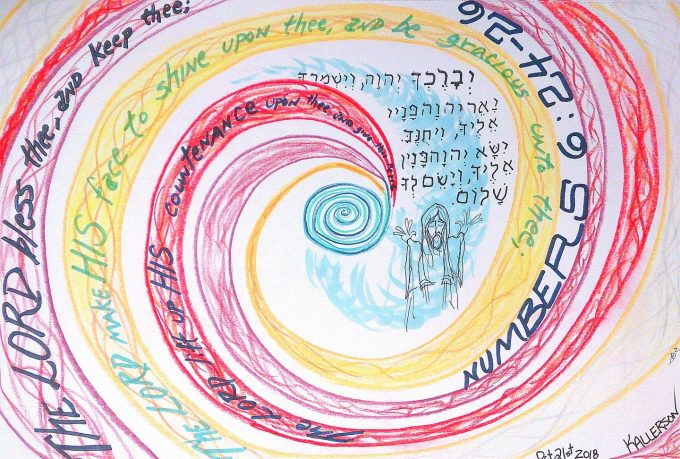
Numbers 6:22-27
The Priestly Blessing
There’s a Jewish guy who is also a very militant atheist that lives on the Upper West Side of NYC. And yet, he sent his son, Morris, to Trinity School. Despite its denominational roots it’s a great school which has become completely secular, so he didn’t mind. After a month, Morris came home and said casually, “By the way, Dad, I learned what Trinity means! It means ‘The Father, the Son, and the Holy Ghost.’” The father could barely control his rage. He seized Morris by the shoulders and declared, “Morris, I’m going to tell you something, and I want you to remember it. Forget this Trinity business. There is only one God… and we don’t believe in Him!”
One way that people deny the doctrine of the Trinity is to say that the word “Trinity” is never used in Scripture. That is a theological football bat. There are lots of things that are taught in Scripture which are not specifically named there. The term “original sin” is never used, but it is clearly taught. The word “rapture” is not used, but the doctrine is perfectly explained by Paul.
Because the Trinity is revealed in the Bible, it has been studied, contemplated, and taught since the time of the apostles, and later by the Church Fathers. Tertullian, who lived during the second and third centuries, was an African apologist and theologian. He wrote a great deal in defense of Christianity, including on the doctrine of the Trinity –
“We define that there are two, the Father and the Son, and three with the Holy Spirit, and this number is made by the pattern of salvation… [which] brings about unity in trinity, interrelating the three, the Father, the Son, and the Holy Spirit. They are three, not in dignity, but in degree, not in substance but in form, not in power but in kind. They are of one substance and power, because there is one God from whom these degrees, forms and kinds devolve in the name of Father, Son and Holy Spirit.” Tertullian
After Tertullian, countless other scholars have added their thoughts to the ever-expanding body of knowledge dealing with this hugely complex doctrine. Some have been less than adequate, some have been downright wrong, and so we need to be careful to sort through commentaries and not just cut and paste whatever anyone says without really considering it. When speaking of the Trinity, heresy is just a simple misstep away.
Text Verse: “Holy, holy, holy is the Lord of hosts;
The whole earth is full of His glory!” Isaiah 6:3
This verse is known as the Tres Hagion which is Scripture’s great proclamation of the splendor of God. It alludes to a fullness in God that is hard to mistake. It is from this verse which is derived the beloved hymn written by Reginald Heber –
Holy, holy, holy! Lord God Almighty!
Early in the morning our song shall rise to Thee;
Holy, holy, holy, merciful and mighty!
God in Three Persons, blessed Trinity.
True Christians are Trinitarian monotheists. This may seem, on the surface, contradictory. And indeed, cults – such as the Jehovah’s Witnesses – misunderstand the concept of the Trinity to such a point that what they claim mainstream Christians believe is actually a triad within a godhead, not a Trinity within the Godhead. But this is certainly not the case. The difference between a triad and the Trinity is the difference between the finite and the infinite.
We believe in one God and only one God. We believe this because the Bible proclaims it. But we believe there is a fullness to this God which is represented in the Trinitarian model. Why do we believe this? Because it is what the Bible teaches. Including in a rather unusual way in the sermon verses of Numbers 6. As the Bible is the rule and guide of our faith, we would be ignorant at best, and found false teachers as well, should we deny what this book proclaims. But this doesn’t mean it’s an easy concept to understand. Men have been struggling with it since it was revealed. John Wesley stated – “Bring me a worm that can comprehend a man, and then I will show you a man that can comprehend the Triune God.”
Today, we will look for that worm, because – at least in a limited way – we can comprehend the Triune God. We can comprehend His nature, and we can know that what we so comprehend is correct. Why? Because it is in accord with His superior word. And so let’s turn to that precious word once again and… May God speak to us through His word today and may His glorious name ever be praised.
I. The Monotheistic God
Malik Jabbar says –
“All of the monotheistic religions, which primarily include Islam, Christianity and Judaism are mythological representations of the natural environment. The ancients fashioned their spiritual concepts as mythical copies of natural phenomena, the environment and its interactions. They pictured the sun as the ruler of the universe, the life giver, the conqueror of darkness and cold, the scorcher with its intense fire, the compassionate with its soothing heat. When the sun triumphantly appeared on the eastern horizon at the dawning of the day, the whole universe (from our earthly perspective) was seen bowing in submission to the greatest of all lights. All the stars and planets of the higher and lower heavens were vanquished without trace at the dawning of the great sun god. This physical reality is the true seminal generator of our religious rituals in reference to an omnipotent conquering god, evolved from the customs of the ancients.”
What Jabbar says here is incoherent at best. If man were to make a religion based on natural phenomena, it would be a rare occurrence for him to be a monotheist. The sun would be one of many gods, and this is what has occurred as religion has devolved throughout the ages. In the 19th Psalm David skips over the created god Jabbar proclaims and exalts the God who created the very sun who was supposedly the object of reverence in his confused analysis.
“The heavens declare the glory of God;
And the firmament shows His handiwork.
…
In them He has set a tabernacle for the sun.” Psalm 19:1 & 4
David understood that the Creator is above, not subservient to or part of, His creation. In modern times though, liberal theologians have twisted the evolution of religion, turning it completely upside down. It’s evident from the historical record in the worship of God by man that the most ancient belief is that of monotheism. From that point, worship has devolved into polytheism, animism, etc., not the other way around. The noted Assyriologist Stephen Langdon records –
“The history of Sumerian religion, which was the most powerful cultural influence in the ancient world, could be traced by means of pictographic inscriptions almost to the earliest religious concepts of man. The evidence points unmistakably to an original monotheism, the inscriptions and literary remains of the oldest Semitic peoples also indicate a primitive monotheism, and the totemistic origin of Hebrew and other Semitic religions is now entirely discredited.”
The region of Sumeria, which Langdon cites, is where many of the early Bible figures found their homes. And it is the record of these early people which are included in the pages of the Bible as breathed out by the One true God. From the first page of the Bible to its last, the existence of only One true God is proclaimed.
Man speaking to God – For You are great, and do wondrous things; You alone are God. Psalm 86:10
God speaking to man – For thus says the LORD, Who created the heavens, Who is God, Who formed the earth and made it, Who has established it, Who did not create it in vain, Who formed it to be inhabited: “I am the LORD, and there is no other. Isaiah 45:18
In the book of Isaiah alone, this claim is directly made almost a dozen times. Yes, there is one God. Reason and intellect tell us this and the Bible fully supports what we can know simply by thinking things through in a rational manner. However, how could a being that didn’t understand fellowship create anything beyond Himself containing fellowship? Rather, he’d be completely contained within himself and without fellowship. The Principle of Analogy states that “The cause of being cannot produce what it does not possess.” Because of this, the fact that we’re social beings confirms a plurality within a single essence such as the Trinity.
II. The Trinity
Despite the Bible proclaiming only one God, one of the most important tenants of true Christianity is the concept of the Trinity. It is clearly presented throughout the Bible, but it was a mystery long hidden at God’s prerogative. It wasn’t until Christ that the mystery of this profound secret was finally and truly revealed:
“Now to Him who is able to establish you according to my gospel and the preaching of Jesus Christ, according to the revelation of the mystery kept secret since the world began but now made manifest, and by the prophetic Scriptures made known to all nations, according to the commandment of the everlasting God, for obedience to the faith—to God, alone wise, be glory through Jesus Christ forever. Amen.” Romans 16:25-27
The doctrine of the Trinity as understood by Christianity states that God has a threefold person-hood and yet they together are one God – three Persons in one Essence. The term “persons” comes from St. Augustine who agreed that it wasn’t the best of terms but, as he said, “rather than being silent on the subject…” This Trinity as revealed through Scripture is God the Father, God the Son, & God the Holy Spirit.
In the Bible, at one time or another, the pronoun “He” is used to describe each separate part of this eternal Godhead demonstrating an individual “Person” and yet this Person has all of the qualities of God – He is the Creator, He is eternal, He reads our hearts and minds, etc. All of these attributes are attributed at one time or another to the Father, to the Son, and to the Holy Spirit. Either the Bible is filled with confusion, or each of these is God. When Jesus uttered the Great Commission to His apostles, he said –
“Go therefore and make disciples of all the nations, baptizing them in the name of the Father and of the Son and of the Holy Spirit.” Matthew 28:19, 20
In the Greek, the word “name” is onoma. It is a singular noun, meaning each of these entities combines into one essence. It would be good to ask, “Is this completely unique to the New Testament or can we find a parallel in the Old?” The answer is “Yes, we can.” The Sh’ma, or “Hear” of Deuteronomy 6:4 gives us an example –
Sh’ma Yisrael Yehovah Elohaynu Yehovah Echad
Hear, O Israel: The LORD our God, the LORD is One!
In these words, it says, “The LORD is One.” A cluster of grapes is one; the people Israel are one people, Adam and Eve were called besar echad, or “one flesh.” These are made up of individual parts and yet are termed “one.” The word echad used in the Sh’ma enables this interpretation. Another word signifying one and only one – yachid was not used. We can rightly assume that the Creator knows Hebrew better than we do! However, the term echad was used in this most important of statements.
Throughout the ages, since the establishment of the church, people have used tangible concepts to try to explain this Trinity, such as water being steam, liquid, or solid. Or, a circle divided into three equal parts, etc. Or maybe an egg which has a shell, a yolk, and a white part. However, none of these accurately portrays the concept correctly, and if used will lead to heresy.
So we should ask, “Is it that there is no proper analogy?” Has God left us with a concept but no way to properly explain it? No. A concept has been provided, and it’s visible everywhere you look and is beautifully explained by Dr. Nathan Wood in the book The Secret of the Universe.
He explains that the universe is made of a trinity of Space, Time, and Matter. All of them exist, all of them exist everywhere and at all times, and yet they are not the same. Furthermore, each of these is a trinity itself. Space is comprised of Length, Breadth, and Height. Time is expressed in Past, Present, and Future. And matter consists of Energy in Motion producing Phenomena. The universe itself is a trinity of trinities!
Further, we can make the assertion and equate Space with the Father – unseen and yet omnipresent; matter with the Son – visible, tangible, understandable; and Time with the Spirit – which is unseen and yet it is a medium in which we move and gain understanding. Taking this concept, Time, Dr. Wood breaks it down in an understandable way. After doing this, he changes only four words and thereby beautifully explains the mystery of the Trinity –
The Future is the source. The Future is unseen, unknown, except as it continually embodies itself and makes itself visible in the Present. The Present is what we see, and hear, and know. It is ceaselessly embodying the Future, day by day, hour by hour, moment by moment. It is perpetually revealing the Future, hitherto invisible.
The Future is logically first, but not chronologically. For the Present exists as long as Time exists, and was in the absolute beginning of Time. The Present has existed as long as Time has existed. Time acts through and in the Present. It makes itself visible only in the Present. The Future acts, and reveals itself through the Present. It is through the Present that Time, that the Future, enters into union with human life. Time and humanity meet and unite in the Present. It is in the Present that Time, that the Future, becomes a part of human life, and so is born and lives and dies in human life.
The Past, in turn, comes from the Present. We cannot say that it embodies the Present. On the contrary Time in issuing from the Present into the Past becomes invisible again. The Past does not embody the Present. Rather it proceeds silently, endlessly, invisibly from it.
But the Present is not the source of the Past which proceeds from it. The Future is the source of both the Present and the Past. The Past issues in endless, invisible procession from the Present, but, back of that, from the Future out of which the Present comes.
The Past issues, it proceeds, from the Future, through the Present.
The Present therefore comes out from the invisible Future. The Present perpetually and ever-newly embodies the Future in visible, audible, livable form; and returns again into invisible Time in the Past. The Past acts invisibly. It continually influences us with regard to the Present. It casts light upon the Present. That is its great function. It helps us to live in the Present which we know, and with reference to the Future which we expect to see.
Now, substitutes 4 words. God replaces Time. Father replaces Future. Son replaces Present. Spirit replaces Past.
The Father is the source. The Father is unseen, unknown, except as He continually embodies Himself and makes Himself visible in the Son. The Son is what we see, and hear, and know. He is ceaselessly embodying the Father, day by day, hour by hour, moment by moment. He is perpetually revealing the Father, hitherto invisible.
The Father is logically first, but not chronologically. For the Son exists as long as God exists, and was in the absolute beginning of God. The Son has existed as long as God has existed. God acts through and in the Son. The Father makes Himself visible only in the Son. The Father acts, and reveals Himself through the Son. It is through the Son that God, that the Father, enters into union with human life, and so is born and lives and dies in human life. God and humanity meet and unite in the Son. It is in the Son that God, that the Father, becomes a part of human life, and so is born and lives and dies in human life.
The Spirit, in turn, comes from the Son. We cannot say that it embodies the Son. On the contrary, the Spirit in issuing from the Son into the Spirit becomes invisible again. The Spirit does not embody the Son. Rather it proceeds silently, endlessly, invisibly from Him.
But the Son is not the source of the Spirit who proceeds from Him. The Father is the source of both the Son and the Spirit. The Spirit issues in endless, invisible procession from the Son, but back of that, from the Father out of whom the Son comes.
The Spirit issues, He proceeds, from the Father, through the Son.
The Son, therefore, comes out from the invisible Father. The Son perpetually and ever-newly embodies the Father in visible, audible, livable form; and returns again into invisible God in the Spirit. The Spirit acts invisibly. It continually influences us with regard to the Son. It casts light upon the Son. That is His great function. He helps us to live in the Son which we know, and with reference to the Father which we expect to see.
This is what has been evident since creation in the physical universe and to which God’s word, the Bible, faithfully testifies to in the nature of the Godhead, such as –
“Then God said, ‘Let Us make man in Our image, according to Our likeness…’” Genesis 1:26
In the first chapter of Scripture the terms “us” and “our” are used by the Creator reflecting His triune nature. And again, in Isaiah:
Also I heard the voice of the Lord, saying:
“Whom shall I send,
And who will go for Us?”
Then I said, “Here am I! Send me.” Isaiah 6:8
Zechariah 12 places the members of the Trinity together in one passage –
“And I will pour on the house of David and on the inhabitants of Jerusalem the Spirit of grace and supplication; then they will look on Me whom they pierced. Yes, they will mourn for Him as one mourns for his only son, and grieve for Him as one grieves for a firstborn.” Zechariah 12:10
These words in Zechariah are so obvious in what they proclaim, that the Jehovah’s Witnesses, in their tragically flawed translation of the Bible, use a margin note, rather than the text itself, when translating this verse. They won’t even touch this verse because it destroys all of their already incoherent theology. The Gospel of John, time and again, reflects the relationship between the Father and the Son as well as the Spirit –
Philip said to Him, “Lord, show us the Father, and it is sufficient for us.” Jesus said to him, “Have I been with you so long, and yet you have not known Me, Philip? He who has seen Me has seen the Father; so how can you say, ‘Show us the Father’? John 14:8, 9
Paul shows he clearly understood God’s triune nature. He alludes to it several times in his epistles, such as –
“The grace of the Lord Jesus Christ, and the love of God, and the communion of the Holy Spirit be with you all. Amen.” 2 Corinthians 13:14
These are just a couple of innumerable verses which either implicitly, or explicitly, reveal a Godhead.
III. God the Father
God the Father is clearly acknowledged by all Christians as well as most cults and sects who use the Bible as their reference. An unfortunate exception, of course, has come out of modern liberal denominations and translations of the Bible which have purposed a gender-neutral God and a gender-neutral Bible. Regardless of this nonsense, the texts as received from God for our Bible are in the masculine, and for that reason, we adopt political correctness in this matter at our own peril. God’s word stands though. Concerning God the Father we read –
“But the hour is coming, and now is, when the true worshipers will worship the Father in spirit and truth; for the Father is seeking such to worship Him. 24 God is Spirit, and those who worship Him must worship in spirit and truth.” John 4:23, 24
Not that anyone has seen the Father, except He who is from God; He has seen the Father. John 6:46
These verses perfectly match the description Dr. Wood made concerning the nature of the Father within the Trinity.
IV. God the Son
“In the beginning was the Word, and the Word was with God, and the Word was God. He was in the beginning with God. All things were made through Him, and without Him nothing was made that was made. In Him was life, and the life was the light of men. And the light shines in the darkness, and the darkness did not comprehend it.” John 1:1-5
John couldn’t have been any clearer about the nature of the Word and His eternal relationship in God. It never ceases to amaze me how people can twist something so clear and so precise in order to deny the truth of the very words John so carefully penned. In his first epistle, he follows the exact same pattern concerning the Word. These verses, along with everything else John writes is so absolutely grounded in the deity of Jesus that it is inexcusable to misunderstand or deny what he is saying, such as –
“That which was from the beginning, which we have heard, which we have seen with our eyes, which we have looked upon, and our hands have handled, concerning the Word of life— the life was manifested, and we have seen, and bear witness, and declare to you that eternal life which was with the Father and was manifested to us—…” 1 John 1:1, 2
Later in Revelation, John quotes Jesus’ own words, His own claim to deity –
“I am the Alpha and the Omega, the Beginning and the End, the First and the Last.” Revelation 22:13
To be a fair evaluator of God’s word, I want you to be careful about the next verse I give. The Greek used here is often cited as proof that Jesus claimed to be God –
“Most assuredly, I say to you, before Abraham was, I AM.” John 8:58
How many of you have heard that the words there translated as “I AM” prove Jesus was claiming to be God? The Greek words are ego eimi. However, going to the very next chapter, the same words, with the same parsing, are used by the man Jesus healed –
“Therefore the neighbors and those who previously had seen that he was blind said, ‘Is not this he who sat and begged?’ Some said, ‘This is he.’ Others said, ‘He is like him.’ He said, ‘I am he.’” John 9:8, 9
In this verse, the man states ego eimi just as Jesus did. This person clearly wasn’t claiming to be God, so we need to be careful to understand the context, not simply the words used. The claim of deity is evident from the construct of the verse – “Before Abraham was.” Further, He spoke Hebrew or Aramaic, not Greek. The words he used would have been understood as a claim to being Yehovah. He was making a claim to eternality and to deity. How do we know this?
“Then they took up stones to throw at Him;” John 8:59
The fact that they picked up stones to throw at Him testifies that He had claimed to be deity while speaking in Hebrew or Aramaic – He was being accused of blasphemy, for which stoning was the penalty. John 10 leaves no doubt about the nature of the Son –
“‘I and My Father are one.’ 31 Then the Jews took up stones again to stone Him.” John 10:30, 31
In these words, both what Jesus said and the people’s reaction again assure us that Jesus was claiming to be deity. Next, Luke had no doubt of Christ’s deity. Listen to how carefully he worded the following, which is a pattern throughout his writings:
“‘Return to your own house, and tell what great things God has done for you.’ And he went his way and proclaimed throughout the whole city what great things Jesus had done for him.” Luke 8:39
Either Luke was making a point for us to read and understand, or he was an incompetent blasphemer. There’s simply no other way to take the words. Paul completely supports the deity and Godhood of Jesus Christ with –
“He is the image of the invisible God, the firstborn over all creation. For by Him all things were created that are in heaven and that are on earth, visible and invisible, whether thrones or dominions or principalities or powers. All things were created through Him and for Him. And He is before all things, and in Him all things consist.” Colossians 1:15-17
The writer of Hebrews makes exactly the same claim as Paul –
“The Son is the radiance of God’s glory and the exact representation of His being, sustaining all things by His powerful word.” Hebrews 1:3
It is incomprehensible to think that a created being could somehow “sustain all things.” Not only is this the case, but the Principle of Contingency disallows it. An attempt to deny the principle will instead actually validate it. A contingent, or created being, cannot create or sustain anything else because it is already contingent.
No matter what else, the deity of Jesus Christ is not only fully supportable by the Bible, but it is the only logical and reasonable conclusion we can come to, if we believe the Bible. It is through Jesus that the eternal God reveals Himself to us. And it is the Holy Spirit who will, if we allow Him, teach us proper doctrine concerning the nature of God.
V. God the Holy Spirit
“That which is born of the flesh is flesh, and that which is born of the Spirit is spirit. Do not marvel that I said to you, ‘You must be born again.’ The wind blows where it wishes, and you hear the sound of it, but cannot tell where it comes from and where it goes. So is everyone who is born of the Spirit.” John 3:6-8
In the Bible, the work of “begetting” sons is the job of the Father, but it is also the work of the Spirit. To attribute this to the Spirit, were it not the case, would be blasphemous.
The Jehovah’s Witnesses naturally deny the deity of the Holy Spirit. They call Him an “active force” – whatever that means. They have to make up a term for the Spirit which is completely unbiblical in order to diminish His proper role as the third member of the Godhead. But the Spirit is the One who searches the Godhead and reveals to us God’s workings –
“For what man knows the things of a man except the spirit of the man which is in him? Even so no one knows the things of God except the Spirit of God.” 1 Corinthians 2:11
In 2 Corinthians, Paul, after talking about Christ (the Lord) does a changeup and says in practically in the same breath…
“Now the Lord is the Spirit; and where the Spirit of the Lord is, there is liberty.” 2 Corinthians 3:17
Either Paul is theologically confused, or He is as clear as a crystal in his claim – Christ is the Lord, the Spirit is the Lord, and the Spirit is the “Spirit of the Lord.” Surely we praise our Creator – Father, Son, and Holy Spirit! Scripture, in both Testaments, leaves no doubt about the Triune nature of God.
A blessing upon the people of God
A blessing of His name resting on them in peace
No matter where on this earth shall their feet trod
His blessing is upon them, and it will never cease
The name of the Lord is their protection and life
The name of the Lord is their anchor and stay
In the name of the Lord is the ending of strife
When placed upon the people, peace leads the way
May Your precious and holy name rest upon us
May the glory of Christ be ours to protect us from harm
We look to the Lord, our precious Lord Jesus
His name reveals to us God’s tenderly caring arm
VI. The Aaronic Blessing (verses 22-27)
Because our sermon text today is the High Priestly blessing of Numbers 6, you might have been wondering why we would first go through a short evaluation on the nature of the Trinity. The reason is that within this blessing, like within the Sh’ma we read earlier, there is an implicit hint of the Trinity. But this hint is more forceful than in that of the Sh’ma, as we will see…
22 And the Lord spoke to Moses, saying:
To close out Chapter 6, the Lord conveys a most magnificent set of words to the people of Israel. It is unsure when these words were spoken to Moses, but they have been placed here as a logical progression of thought concerning the camp and the armies of Israel. The Lord speaks first through Moses and then through Aaron, as is seen with the words…
23 “Speak to Aaron and his sons, saying,
The words are the Lord’s but they are intended for speaking by Aaron and his sons. Thus they are known as the Aaronic blessing, following after Aaron, the first high priest; or as the birkat kohanim, the Priestly Blessing, following after the line of priests to whom they were addressed. Both names are acceptable because it is to both Aaron and his sons that they are so instructed…
23 (con’t) ‘This is the way you shall bless the children of Israel. Say to them:
So far in Numbers, the armies of the Lord have been drawn up, their encampments have been identified. The priests and Levites have been given their charge and have been assigned their stations around the sanctuary. The camp has been purified from those who are unclean. The matter of confession and restitution has been addressed. The law of jealousy was dealt with, and the law of the Nazirite has been explained.
The people are now a united whole, laid out according to the Lord’s design. They will soon be ready to depart for Canaan. These details of organized life so far, and the departure which is soon at hand, are now to be accentuated and graced by the following, most memorable, verses. In the Hebrew, the main blessing consists of three verses of fifteen words of sixty letters. The verses are divided into double clauses with each clause referring to Yehovah, the LORD, in a petition that He bestow the stated blessing upon Israel.
It is a blessing that sustained them for 1500 years until the time of Christ. And, it is a blessing which still gives them hope and assurance since that day. Though they missed the significance of who Jesus is, they still have a hope in the Lord, even if misdirected at this time, because of what the words proclaim. Someday, their hope in the Lord, Yehovah, will be united with their understanding of who He is. It is this Lord who now speaks out the simple and yet life-sustaining words of blessing…
24 “The Lord bless you and keep you;
y’berekhekha Yehovah
v’yshmerekha – In the Hebrew, the name Yehovah is spelled YHVH, as it always is. The accent to the name is written out with its accompanying vowel points which indicate the pronunciation and formative aspect of the name beyond the basic letters.
The words here, and throughout the blessing, are in the singular, kha instead of khem. Though Israel is a group of people, they are still one people. The many are blessed individually, and the individuals are thus collectively blessed.
“The Lord bless you” is a petition to bestow upon Israel all blessing – both spiritual and temporal. It is a call to such blessing in a continuous outpouring of God’s grace and mercy upon this chosen, but undeserving, people.
The word translated as “and keep you” clarifies, and more fully explains, the words, “The Lord bless you.” In blessing the people, they can anticipate being kept – both physically and spiritually – for good and from evil. Though curses have been assured already for disobedience, the blessing now is one which would keep them, even in their disobedience. To be kept is an ongoing fountain of support and relief. It is not a one-time, but an all-time, continuous outpouring of God’s sustaining hand upon His people.
Remember, this is a cumulative blessing upon Israel the people. Has the blessing failed? No. They have been blessed, and they have been kept. Even in times of experiencing the curses of the law, the words have remained faithfully true to them.
25 The Lord make His face shine upon you,
And be gracious to you;
ya’er Yehovah panav eleyekha
vi’khoonekha – The name Yehovah here is again spelled YHVH, but this time, the vowel points which indicate the pronunciation and formative aspect of the name beyond the basic letters are different than previously.
The blessing of the first two clauses of verse 24 is now elevated in the continuation of it in verse 25. “The Lord make His face shine upon you” is a way of saying that the very light of Yehovah, His infinitely bright countenance, should radiate upon Israel. The face of the Lord reflects who He is. His personality, His demeanor, and His eternality are all tied into the thought of His face. When these shine upon the people, they will receive the abundance of who He is in a ceaseless, endless, procession of His divine attributes.
The face of the Lord can be turned away from the people in rejection, or it can be turned toward them in wrath. The blessing asks for neither, though either may come. But it does ask that the radiance and goodness of Yehovah be directed to them. In the simplest form, for the face of the Lord to shine upon them is for Him to smile upon them as a father would to his children. Only goodness and mercy are anticipated in the blessing.
The words of the clause, “and be gracious to you,” simply heighten the thought of the first clause. The Lord’s shining and radiant face is directed toward the people, and in His light they find grace. Though life for them is a vast wilderness of unknown duration, direction, and expectation, with the grace of the Lord upon them, they will find their way into safe places of rest and comfort. This is for both their physical existence and for their spiritual walk. The cool waters of life will come flowing into the parched soul when the Lord is gracious to them as a people.
As this is a cumulative blessing upon the people, has the blessing failed? No. The Lord’s face has shone upon them, and it continues to do so. And the Lord has been exceedingly gracious to them, granting them what they have not deserved for 3500 years.
26 The Lord lift up His countenance upon you,
And give you peace.”’
y’sha Yehovah panav eleyekha
v’yasem lekha shalom – The name Yehovah is again spelled YHVH, and for the third time, the vowel points are different than before. It is abundantly clear from this that there are three distinct and individual persons in one Yehovah – a Trinity. The Hebrew clearly indicates this.
The words, “The Lord lift up His countenance upon you,” are a third elevation of the intensity of the blessing. They indicate a rising up of the refulgency of the Lord’s face over Israel in abundance of grace, kindness, love, and attention. He has gone from shining His face upon them to having it radiate over them, blotting out any darkness as His glory overwhelms everything else. He is on Israel’s side, and no foe can bring them harm or shame apart from His allowances. Wounds may come, but they will only be self-inflicted. The Lord has shone upon them, and they are secure because of that.
And the blessing closes out with, “And give you peace.” The word is shalom. This is more than a blessing for calm or quiet, but is a state of wholeness and completion in all ways. The lifting up of the Lord’s countenance finds its intended fulfillment in the peace of His people. They stand safe, secure, and in perfect harmony with the world around them, and with their ambitions, their desires, and their needs. And they find perfect harmony in their spiritual state as well. They have peace with God and are in contentment with themselves and their neighbors. This is what the Lord commands for Aaron and his sons to bless the people with – words of light, life, love, and peace.
*27 “So they shall put My name on the children of Israel, and I will bless them.”
It is interesting that the Lord has given the responsibility of blessing the people to Aaron and his sons, and yet He retains the accomplishment and fulfillment of the blessing for Himself – So they shall put My name / and I will bless them. There is the audibly spoken name of the Lord which is pronounced upon Israel, and there is in return the conveyance of an unseen reality which rests upon them.
To fully understand what it means to have the name of the Lord placed upon Israel, it would be good to understand the meaning behind the name. The sermon on Exodus 3:13-15, entitled I AM THAT I AM, would be a logical place for you to go in order to more fully understand the magnificence of what is being proclaimed here in Numbers.
As I’ve already told you, the divine name is given three times, and it is pointed differently each time. Though the points did not exist in the original Hebrew, there is a reason that they were so pointed by the Masoretes. To them, the three instances are considered a mystery, but in Christ and in the New Testament, the mystery is revealed. They together are revealed in verses such as Matthew 28:19, 2 Corinthians 13:14, and elsewhere.
In Christ, it is no leap to go from a threefold repetition of the divine name in Numbers, to an understanding of the three Persons in the Trinity. Such is the nature of God, and how God reveals Himself. If you struggle with the doctrine of the Trinity, that’s OK, everyone does – even the finest scholars. What you should not struggle with is your faith in the Trinity. We don’t have to understand a thing in order to believe in it. I don’t understand my wife, but I believe in her. What is important is to accept God’s word despite our lack of complete understanding. His word proclaims there is a Trinity within the Godhead, and so we are asked to accept that.
And included in that is the subject of Jesus Christ, the second Member of the Trinity. It is through faith in Him that we are reconciled to this triune God. It is this same triune God who instructed through Moses that Aaron and his sons should proclaim to the people of Israel –
y’berekhekha Yehovah
v’yshmerekha
ya’er Yehovah panav eleyekha
vi’khoonekha
y’sha Yehovah panav eleyekha
v’yasem lekha shalom
“The Lord bless you and keep you;
25 The Lord make His face shine upon you,
And be gracious to you;
26 The Lord lift up His countenance upon you,
And give you peace.”
Our Closing Verse: today may not be in your Bible, or it may be there and footnoted. It’s true that many ancient manuscripts don’t contain this verse, which has become known as the Johanine Comma, but it does date back to the time of Cyprian who lived in the 3rd Century and it survives in his treatise against the heretics who denied the Trinity – “For there are three that bear witness in heaven: the Father, the Word, and the Holy Spirit; and these three are one.” 1 John 5:7
Next Week: Numbers 7:1-9 Twelve days it took to accomplish these rites… (An Offering for the Levites) (13th Numbers Sermon)
The Lord has you exactly where He wants you. He has a good plan and purpose for you. It may seem at times as if you are lost in a desert, wandering aimlessly. But the Lord is there, carefully leading you to the Land of Promise. So follow Him and trust Him and He will do marvelous things for you and through you.
The Priestly Blessing
And the Lord spoke to Moses, saying
Memorable words he was then relaying
“Speak to Aaron and his sons, saying the words I now tell
‘This is the way you shall bless the children of Israel
Say to them:
“The Lord bless you and keep you;
The Lord make His face shine upon you,
And be gracious to you;
The Lord lift up His countenance upon you,
And give you peace.” ’
“So they shall put My name on the children of Israel
And I will bless them as to you I now tell
Lord God, we are even now in a wilderness
And we are wanting to be led by You
Without You to direct, our lives would be a mess
And so be our guide, O God; You who are faithful and true
We long for the water in this barren land
May it flow forth from the Rock, our souls to satisfy
Give us this refreshing, spiritual hand
And may we take it, and to our lives daily it apply
And we shall be content and satisfied in You alone
We will follow You as we sing our songs of praise
Hallelujah to You; to us Your path You have shown
Hallelujah we shall sing to you for all of our days
Hallelujah and Amen…