Numbers 13:1-25
A Taste of the Land of Promise, Part I
In today’s verses, there is a surprising lack of detail about the time the men spent in the land of Canaan checking things out. Their travels took them a long way, through a lot of different areas and climates, and yet, almost all of the focus is centered on four verses which are in one part of the land. The verses coming up in a week give a bit more detail, but it is after-the-fact detail.
If one were to make exacting records, as Moses asked for, you might think they would have made several books of notes, and yet we get less than a paragraph of that here. It really should make one wonder. And yet, at the same time, it is obviously exactly what the Lord wanted us to read. There is nothing superfluous added in, and all the other details of travels and other adventures must, in fact, be superfluous.
And so, we will look through the details today, as they have been provided. Wherever the Lord is leading us, that is where we need to go. As I typed this introduction, the truth is, I had no idea where the narrative was going. It was 4pm on November 5th, I had evaluated all 25 of the verses of today’s text, and I had no idea at all what they were trying to say.
That kind of dilemma means there will either be a nice life application at the end of the chapter next week, or the Lord will have eventually revealed it so that I could compose a final explanation of what is given here as a record of how it all points to Christ. I didn’t know what the outcome would be, but by the time I present these two sermons, we’ll know which way it went. Such afternoons are very frustrating!
Text Verse: “Every word of God is ]pure;
He is a shield to those who put their trust in Him.
6 Do not add to His words,
Lest He rebuke you, and you be found a liar.” Proverbs 30:5, 6
If nothing else, the Bible makes it abundantly clear – both in this verse and elsewhere, that every word of Scripture is important. The Lord has a set plan which is compiled into a small, organized, and highly detailed book. Despite being small, it is larger than any man’s brain can fully grasp. Despite being organized, even highly so, it is still extremely difficult to be able to understand the organization in any reasonable manner. And being highly detailed, we still tend to want to go beyond the detail in order to make it flow more smoothly, make more sense, or make us not feel so incompetent at not being able to deal with the detail we do have.
The real rewards, however, are to be able to grasp what is being said, within the confines of the book itself. Yes, we can use thoughts and ideas from outside this marvelous treasure if, and only if, they line up with what the word says. But we need to be careful to never try to read into the Bible what we want it to say. Instead, we need to draw out from it what the intended meaning is.
That is where the real effort comes in. “Lord, what are you telling us?” This is where the treasure is found, and this is what makes searching out Scripture so enjoyable. It is a puzzle filled with puzzles. Each one helps explain and reveal the next one a bit more. We’ll see where this one goes… For now, let’s get into these verses to see what they say, at least on the surface. It’s all to be found in His superior word. And so let’s turn to that precious word once again and… May God speak to us through His word today and may His glorious name ever be praised.
I. Chosen to Go (verses 1-16)
Geographically, we are now beginning the third major section of Numbers with this chapter. The first section was a “wilderness section” where the people were located at the foot of Mount Sinai. That went from verse 1:1 to 10:10. The next section was a road trip between Sinai and Paran which went from 10:11 to 12:16. The people have now arrived in Paran, and this section will last from 13:1 to 19:22. With this understanding, we now begin the narrative.
And the Lord spoke to Moses, saying,
The words are to be taken in the light of Deuteronomy 1:19-22 –
“So we departed from Horeb, and went through all that great and terrible wilderness which you saw on the way to the mountains of the Amorites, as the Lord our God had commanded us. Then we came to Kadesh Barnea. 20 And I said to you, ‘You have come to the mountains of the Amorites, which the Lord our God is giving us. 21 Look, the Lord your God has set the land before you; go up and possess it, as the Lord God of your fathers has spoken to you; do not fear or be discouraged.’
22 “And every one of you came near to me and said, ‘Let us send men before us, and let them search out the land for us, and bring back word to us of the way by which we should go up, and of the cities into which we shall come.’”
Those words from Moses show that the intent was for the people to simply go forth in the strength of the Lord and to possess the land. However, instead of just agreeing to go forward, it is they who proposed a delay, demonstrating a faithless fear rather than a faithful fortitude. As a pretext for simply wanting to have things clearly laid out as to how to enter the land, they ask for representatives to go forth first and check out the land.
Their words asked for 1) to search out the land, 2) instructions on which way they should go up, and 3) details about the cities. First, the Lord had already told them of the land, saying, “You shall inherit their land, and I will give it to you to possess, a land flowing with milk and honey” (Leviticus 20:24). It was a good land and it was given by promise to them. All they had to do was accept His words and go forward.
Secondly, He said that He would go before them – “For My Angel will go before you and bring you in to the Amorites and the Hittites and the Perizzites and the Canaanites and the Hivites and the Jebusites; and I will cut them off” (Exodus 23:23). There was no need to decide upon the best route. All they would need to do is follow the Lord as He determined.
And thirdly, the state of the cities is irrelevant. Whether they were open areas without defense, or highly fortified cities with no seemingly possible way of being taken, the Lord has said already that they would not be able to defend against His hand. This is repeated several times in Exodus. It is He who would drive them out. All they needed to do was go in and follow His lead. All of this brings about these first words of Chapter 13 – “And the Lord spoke to Moses saying.” It is actually not the Lord who initiated this conversation, but rather Israel. And so, in agreement with their faithless request, He then says…
2 “Send men to spy out the land of Canaan,
Despite there being absolutely no need for spies to be sent, the Lord agrees to their request, knowing the outcome, and knowing what the request will lead to. The Lord cannot be blamed for what lies ahead, but He can use it to make patterns, parallels, and pictures of Jesus. And this is exactly what He will do. Israel’s faithlessness is used as an opportunity for us to see, in advance of Christ’s coming, things which would confirm who He is as the events which surround Israel will be repeated in events which surround Him and His ministry.
And so, the Lord says they are to do as requested and send out men to spy out the land of Canaan…
2 (con’t) which I am giving to the children of Israel;
The words are not a superfluous addition. Instead, they are an integral part of what is being relayed. It is an accomplished fact that the land is a gift to Israel. One can only give what he possesses. In saying that He is giving the land to the children of Israel, it means that the land is already His. If they want to delay the process, be it forty days or forty years, that is their choice. The Lord has already assured them of it and Moses has, according to what is recorded in Deuteronomy, already told them to go forward and possess it. If they want a detailed report, that is what they will get. And it will be from competent men…
2 (con’t) from each tribe of their fathers you shall send a man,
ish ekhad ish ekhad la’mateh avotav – “man one man one for tribe of their fathers.” The repetition is a way of specifying each tribe is to send one man per tribe.
2 (con’t) every one a leader among them.”
It is the same term, nasiy – a “prince” or “leader” – that was used of the men who were selected as leaders of each tribe in Chapter 1. These will also be such men, but they will not be the same men. The Lord specifically calls for such men to ensure that what they report will be reliable, and that it will have its intended effect – whatever they decided – upon the people. If twelve Charlie’s were picked at random, upon their return, if they even found their way back to camp, their words would never be considered as acceptably representative of what they searched out.
3 So Moses sent them from the Wilderness of Paran according to the command of the Lord,
In agreeing to their suggestion, and by the mouth of the Lord, Moses sends the chosen men from the encampment. These were…
3 (con’t) all of them men who were heads of the children of Israel.
Again, the men are given a descriptive title, rashe, or heads, of the children of Israel. The word rosh signifies a head, and thus the top or the first. They are men who are trustworthy. One can almost sense, based on the disobedience already displayed by the people since leaving Sinai, that highlighting these men in this second way implies a sense of impending doom. The question which is already being raised is, “Which head will they listen to?” Will it be their true Head who has spoken out His assurances, or these lesser heads who are “head men,” but still just men?
4 Now these were their names: from the tribe of Reuben, Shammua the son of Zaccur;
The following verses give the names of those who went and their father’s name as an identification. Some of the names are debated, but you will hear the most likely meaning of each. Shammua means “Hearing,” or in the sense of being heard, and thus “Renowned.” Zaccur means “Remembered,” or in the sense of remembering and thus “Mindful.”
5 from the tribe of Simeon, Shaphat the son of Hori;
Shaphat means, “He has judged.” Khori could have one of several meanings, it being derived from khor, a cave or a hole, or something white or burning. It’s hard to say for sure.
6 from the tribe of Judah, Caleb the son of Jephunneh;
Calev means “Dog.” Yephunneh means “He will be beheld.” or “He will turn.” Caleb will later be identified as a Kenizzite, a descendant of Canaan. Thus, it is likely that he is of foreign birth, but brought into the people of Israel and the tribe of Judah.
7 from the tribe of Issachar, Igal the son of Joseph;
Igal means “He avenges,” or “He redeems.” Yoseph means, “He will add.”
8 from the tribe of Ephraim, Hoshea the son of Nun;
Hoshea means “Salvation.” Nun comes from a word meaning “to propagate” or “to increase.”
9 from the tribe of Benjamin, Palti the son of Raphu;
Palti means “Yehovah has freed.” Raphu means “Healed.”
10 from the tribe of Zebulun, Gaddiel the son of Sodi;
Gaddiel means “God is my fortune.” Sodi means “My counselor.”
11 from the tribe of Joseph, that is, from the tribe of Manasseh, Gaddi the son of Susi;
Gaddi means “My Fortune.” Susi means “Horseman.” Here it says that this person is “from the tribe of Joseph.” Ephraim, the other son of Joseph, has already been listed, and it did not say this. This is especially odd because Ephraim is usually listed specifically in this way. The reason appears to be looking forward. Hoshea (Joshua), who is from Ephraim, will remain faithful to the Lord, but Gaddi will reflect dishonor upon Joseph who was considered a noble ancestor who held faithfully to the Lord.
12 from the tribe of Dan, Ammiel the son of Gemalli;
Ammiel means “My Kinsman is God.” Gemalli means “Camel driver,” or “Possessor of Camels.”
13 from the tribe of Asher, Sethur the son of Michael;
Sethur means “Hidden.” Michael means “Who is Like God?” As a point of interest, the letters of the name, Sethur, equal 666. It is almost a puzzle to consider because his name here reads, “Hidden, the son of Who is Like God.”
14 from the tribe of Naphtali, Nahbi the son of Vophsi;
Nahbi means “Concealed.” Vophsi means “And (My) Abundance” and thus “Rich.”
15 from the tribe of Gad, Geuel the son of Machi.
Geuel means “Majesty of God.” Makhi means “My Poverty.”
16 These are the names of the men whom Moses sent to spy out the land.
Nobody from Levi is named here because they are set apart to the Lord, and also because they were to receive no land inheritance. Also, like in the listing in Numbers 1, Joseph was divided into his two sons, Ephraim and Manasseh. However, three of the tribes in Numbers 1 have their order changed in this listing here. Zebulun, Manasseh, and Gad move to a lower place.
16 (con’t) And Moses called Hoshea the son of Nun, Joshua.
Hoshea, as we saw, means “Salvation.” Joshua, or Yehoshua,” means “The Lord is Salvation.” When and why Moses first called him Joshua is unknown. The Hebrew can be read as indicating any time. It may be he was given the name when they battled the Amalekites in Exodus 17, or it could be that he gave him the name here, but the name Joshua has been used in advance of the actual granting of the name, just as Peter is recorded as Peter earlier in the gospels, even before Jesus gave him the name. The “why” of his name change is possibly because when he first came to Moses and Moses asked his name, he might have said, “I am Hoshea,” meaning, “I am salvation.” Moses might have smiled and said, “No, you are Joshua, because the Lord is salvation.”
The reason for stating the name change here is probably because Joshua would have been listed as Hoshea in the tribal records. However, with the changing of his name by Moses, it is now recorded officially as Joshua. In this, Joshua is a type of Christ. In fact, the Greek name of Joshua is identical in spelling to the Greek name of Jesus, or Yeshua, in the New Testament. He thus anticipates Jesus in the name, “The Lord is Salvation.” When Yeshua, or Jesus, came He is the Lord who is “Salvation.”
Joshua will be the one who will have come from the Land of Promise with a zeal to bring his people where he has been. This is then typical of Christ who came from heaven and fervently completed His work to bring His people to where He had been. Similarly, it is Joshua who will lead the people into their temporal salvation in Canaan. It is Jesus who leads the people in their spiritual salvation in a return to paradise. The acknowledgment of the name change here is to anticipate Joshua’s faithful return from Canaan as the figure who is typical of Christ.
Be of good courage, be brave, and resolute
Do not fear as you pass through the land
I mean to encourage, so that you bear fruit
Know that the Lord is with you, at your right hand
And soon enough, you will have the task completed
You shall be heading for home where I await
Don’t let length of time seem as if you will be defeated
Just set your eyes on the goal, and keep your path straight
Be of good courage, your work is a part of My plan
And what you do shall be used for that good end
I mean to encourage; set yourself for the entire span
And on this life’s mission, you I shall send
II. Be of Good Courage (verses 17-20)
17 Then Moses sent them to spy out the land of Canaan, and said to them, “Go up this way into the South, and go up to the mountains,
The word is singular, ha’har, “the mountain.” It is a term meaning “hill country.” Moses directs them to go through the Negev, or South land of Israel first. This is the barren and wasted part of the land. It is dry and inhospitable and is truly the dregs of Canaan. Thus, in venturing through this area first, they would go from the least favorable to the more choice areas. That is comparable to the wedding feast noted in John 2. The poorer wine was brought out first, and only afterwards was the finest wine made available.
The intent was that the memory of the inhospitable land would be forgotten on their return, and that which was of delight and worthy of exciting the people would be fresh on the lips of the spies.
18 and see what the land is like:
The people are now in the wilderness. They were sustained by manna, but they have had very little variety in their lives. A detailed account of the land was to be an encouragement to them. There were mountains, rivers and streams, forests, an ocean with beaches on one side, fruit trees, open lands for herds, and on and on. The men were to do a thorough inspection of the land in order to whet the appetites of those who awaited word of what lay ahead. Moses then defines the meaning of this first clause with a list of specific instructions of what they were to be on the lookout for…
18 (con’t) whether the people who dwell in it are strong or weak, few or many;
The Pulpit Commentary chides Moses here for these words, saying he is guilty of some indiscretion for asking them to consider these points. But this is not so. The Lord has already said He would go before the people. The report can only reflect on the faith of the people in that promise. It would take no faith to go into a land filled with a bunch of pusillanimous punks. Rather, the people are to be presented with a fair and proper evaluation of what lies ahead. Their faith in the Lord will be tested by their response to whatever is presented to them. In this clause is a new word, rapheh. It is an adjective meaning weak.
19 whether the land they dwell in is good or bad;
The Lord has already told them that it is a land filled with milk and honey. The people have tested the Lord by asking for an inspection. Moses is asking the spies to confirm His word. When it is confirmed, and it will be, it is intended to have at least two effects on them – 1) They should be ashamed of their doubting His promises and intents for them, and 2) they should be more willing to trust that His other promises are equally as true.
In the future, there should – logically – be no further reason to doubt His word. These things are unknown to the people, but they are known to the Lord. Is experiential knowledge necessary for belief? Or, is the Lord to be taken at His word? It is a lesson for us today as much as it was for Israel as they stood ready to enter Canaan. Moses then says…
19 (con’t) whether the cities they inhabit are like camps or strongholds;
If the people lived in camps, they would be open prey to the forces of Israel. But if they were in strongholds, they would be defended and they would be able to slowly reduce the numbers who came against them. The word for “strongholds,” mibtsar, is new. It indicates a fortification, coming from a root meaning “enclosed,” or “inaccessible.” The Lord knows already what the land is like, but the people don’t. They wanted a report; the Lord is providing that report. What they do with it is up to them. Will they trust Him, regardless of the description, or will they grow fainthearted at the mention of difficulty? They wanted to know about Canaan, but the Lord wants them to know their own hearts.
20 whether the land is rich or poor;
u-mah ha’arets ha’shemenah hi im razah – “and what the land – the fat is, or lean.” Fat in this sense is that which is rich and luxurious, even to abundance. This is the opposite of razeh, or lean. It is a new word seen only here and in Ezekiel 34:20. The idea here is, if there are cows, are they chubby or scrawny. If there are trees, are they mighty or twig-like. If there is fruit in season, are they large, juicy, and nummy; or are they poor, desiccated, and sour.
Again, the Lord has promised what it will be like. Will His words be confirmed? If so, the people should be ashamed. If not, then they have been misled. But such will never be the case. The placement of their faith is what is under evaluation.
20 (con’t) and whether there are forests there or not.
The words say, “and whether there is wood in it or not.” It isn’t until Deuteronomy that the yaar, or forest, is first mentioned. For now, regardless of there being numerous trees, or wooded forests, Moses is asking for a description of whatever is available. As forests will be a part of the report (as we can tell from Deuteronomy), it would, again, be a great encouragement to the people who have been living in an environment with an extremely limited supply of wood – both in Egypt, and now in the wilderness.
20 (con’t) Be of good courage.
v’hit-khazaqtem. The single Hebrew word basically says, “And you all be of good courage.” It is plural. One can see Moses, after having pointed to head to the South land, and then having given these instructions, now looking at them all collectively, and then each individually, and saying, “Don’t fear you guys. Be strong, and be encouraged.” Moses is perfectly at peace with their mission, and he is desirous that they be just as much so as he is. And to assure them that their way will lead them back to the camp, and in fact, they will make it back to the camp, he says…
20 (con’t) And bring some of the fruit of the land.”
To ask them to bring home fruit has several important aspects to it. First, it is something that they would do towards the end of their travels, signifying that they would, in fact, get to that point. Secondly, it would show the people what they were missing out on by staying in the wildness any longer. And thirdly, it would be a pledge and confirmation of the good things promised to them.
20 (con’t) Now the time was the season of the first ripe grapes.
This places the account around July or August unless it is speaking of the time of the return with grapes. Then they would have left forty days earlier, making their departures May-July sometime. The traditional date of Jewish teaching is that they returned on the 8th day of the month of Av, and the people heard their report and moaned against the Lord on the 9th of Av, setting a date in Jewish history which is especially marked with bad tidings, including the destruction of both temples in Jerusalem. If this correct, it is the July/August time-frame, and thus they would have left forty days earlier than this clause of verse 20.
What is the land like? We can’t wait to see
Is it truly flowing with milk and with honey?
What does future hold? We are waiting expectantly
We anticipate a land where the skies will be sunny
When will be the day when we finally set out?
And head for the land we have been waiting to see?
We anticipate good news, we are hopeful – no doubt
Yes, we are in anticipation, and waiting expectantly
The news will be brought back, and we will hope it is good
We anticipate that a good report it will be
Surely that will be the case, this is understood
And so we wait for the news, ever so expectantly
III. The Valley of Eshcol (verses 21-25)
21 So they went up and spied out the land from the Wilderness of Zin as far as Rehob, near the entrance of Hamath.
Zin, if from a biblical word, gives the sense of a thorn or a barb. It is not the same as the Wilderness of Sin, which was closer to Egypt. This is right on the border of Israel. From there, they traveled, essentially following the course of the Jordan north to Rekhov, which means “Open Place.” It is right at the northern extremity of the land, near the area of Dan. It is on the road which leads to Lebo-Khamath, or “the entrance to Hamath.” Hamath means “Defense,” or “Citadel.”
22 And they went up through the South and came to Hebron;
The Hebrew goes from the 3rd person plural to the 3rd person singular. It says, And they went up through the Negev and he came to Hebron. Hebron means “Association,” or “League.” What this means is that the spies all went up through the Negev, and one branched off and went to Hebron while others searched out other towns. In this, they would be able to cover much more land dividing among cities within geographical areas. This then would be speaking of Caleb. In Joshua 14, we read –
“I was forty years old when Moses the servant of the Lord sent me from Kadesh Barnea to spy out the land, and I brought back word to him as it was in my heart. 8 Nevertheless my brethren who went up with me made the heart of the people melt, but I wholly followed the Lord my God. 9 So Moses swore on that day, saying, ‘Surely the land where your foot has trodden shall be your inheritance and your children’s forever, because you have wholly followed the Lord my God.’” Joshua 14:7-9
Caleb was the one who searched out this area, it stirred his heart, and he was granted the right to it by Moses. This is common in the Bible, where a matter is stated concerning its end, and then only later are the details filled in. Such was the case where Genesis 1 completed the creation, and where Genesis 2 then filled in the details. From there, it occurs again and again in Scripture.
22 (con’t) Ahiman, Sheshai, and Talmai, the descendants of Anak, were there.
Akhiman means “My brother is a gift.” Sheshai means “Whitish.” Talmai means, “Plowman.” Anak means “Long Neck,” or “Necklace.” They are a tribe known for their appearance. This is sure, because the Hebrew says, “the Anak.” It is not speaking of an individual, but of a group of people. These people – the Anakim – thus became known as the “Long Necks,” or for the distinctive neck ornamentation they wore. The latter is more probable because it means they were like the Egyptians who were known for their unusual neck ornamentations. That would help explain the unusual clause which is next stated…
22 (con’t) (Now Hebron was built seven years before Zoan in Egypt.)
This is a parenthetical thought without seeming relevance to the narrative. However, it appears that Moses may be confronting the belief of the Egyptians that they were the most ancient of civilizations. In fact, then, Hebron is of greater antiquity than Zoan, now known as Tanis, in Egypt. Zoan means “Lowland,” but to a Hebrew, it would sound like “Nomadic.” This would then indicate that the Anak are a people group related to the Egyptians and shared in the same ostentatious display of neck ornamentation.
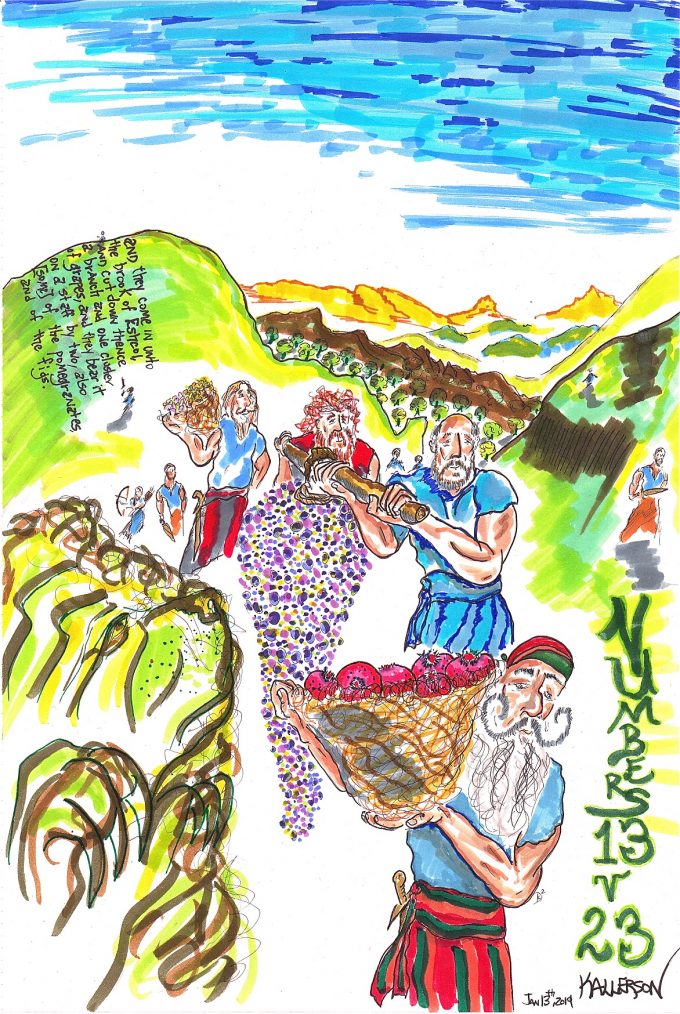
23 Then they came to the Valley of Eshcol,
This is not a valley as one would think of it today. The word is nakhal and it signifies a wadi where water would flow through during the seasons of rain. That word comes from nakhal meaning, “to take possession,” or “inherit.” Eshcol means “cluster.” But that comes from the word eshek, meaning testicle. Again, the details are given, and then the blanks are filled in. The valley is named for the cluster which was cut. This is actually explained in the next verse.
23 (con’t) and there cut down a branch with one cluster of grapes;
Here is another new word, zemorah. It is a branch which is pruned. It is a single branch of anavim, or grapes. In the Bible, grapes are used to provide a sense of cultural expression.
23 (con’t) they carried it between two of them on a pole.
After cutting the cluster, they placed it on a pole. The same word is used to describe the pole on which the menorah and the golden altar of incense were carried. It is a shaking pole, meaning one which would be carried between two people, thus moving with their body movements. The Hebrew says that it was carried b’shnayim, or between two of them, but it doesn’t say which two. However, it can also mean, “in twos.” That means they could have taken turns.
23 (con’t) They also brought some of the pomegranates and figs.
The rimmon, or pomegranate is associated with the word rum, or “to be high,” or “exalted.” It carries the connotation of mental maturity and calling to remembrance. The te-enah, or fig has not been seen since Genesis 3. It is the third tree mentioned in the Bible, and its significance is one of a connection to God, or a disconnect from Him.
Adam and Eve sewed fig leaves as a type of work, demonstrating a disconnect from God. The fig tree that Jesus cursed had no fruit, only leaves. That was a walking parable of the temple which no longer held a connection to God, and which was destined to be cursed, never to bear fruit again. People say the fig represents Israel, but that is incorrect. When used in connection with Israel, it represents its connection to God. Is it spiritually healthy, or not?
24 The place was called the Valley of Eshcol, because of the cluster which the men of Israel cut down there.
This verse provides the details of that which has already been stated. The place they came to is named the Valley of Cluster. However, the name may also be a confirmation of Abraham’s friend, Eshcol, who lived in this area many centuries before.
25 And they returned from spying out the land after forty days.
The number forty is defined as a period of probation, trial, and chastisement, but not judgment. It is a time of testing to determine an outcome. It is the product of 5 and 8, and points to the action of grace (5), leading to and ending in revival and renewal (8). The forty days are ended, and the spies have returned. What will be the outcome? At this point, the answer remains unstated, and it won’t be until we complete the verses next week where the answer will hopefully be given.
For now, and as we finish up, we should remember what precipitated this journey into Canaan by these spies. It wasn’t something directed by the Lord, but something requested by the people. In this, it truly is a lack of faith in His word that brought this about. It is the only reasonable explanation. He had told them they would possess the land, He had told them that He would go before them and ensure it would be accomplished, and yet they wanted to follow this course of action – looking for a sign that things would be favorable.
If we can walk away with one main thought from this, it should be of the parallel thought in our own lives. The Lord has spoken, His word is written, and He asks us to accept it by faith. How difficult that is when things aren’t going well, with the unknown just over the next set of hills, or with the prospect of facing a battle that we have only been told will come out OK.
He has said death is defeated, but the cancer is eating away at us. He has said that paradise awaits, but so does the grave. He has said that the devil is defeated for those who are His, and yet we act as if the devil has possession of our very souls at times. Will we be like faithless Israel and ask for more? Or will we stand content that what the Lord has promised He will – in fact – bring about?
Let us trust the Lord, put our confidence in Him, and know with every fiber of our being that He has it all under control. But, that is only true if you are His. Only after that, then comes the path to full and complete trust. Be sure to know your destiny now. Once that is settled, then you can steadily work on developing a faith that nothing can shatter.
Closing Verse: Thus says the Lord, your Redeemer,
The Holy One of Israel:
“I am the Lord your God,
Who teaches you to profit,
Who leads you by the way you should go.”Isaiah 48:17
Next Week: Numbers 13:26-33 What will happen, I had no idea at the time of typing this sermon, it is true… (A Taste of the Land of Promise, Part II) (24th Numbers Sermon)
The Lord has you exactly where He wants you. He has a good plan and purpose for you. It may seem at times as if you are lost in a desert, wandering aimlessly. But the Lord is there, carefully leading you to the Land of Promise. So follow Him and trust Him and He will do marvelous things for you and through you.
A Taste of the Land of Promise
And the Lord spoke to Moses, saying
These are the words He was then relaying
“Send men to spy out the land of Canaan
Which I am giving to the children of Israel
From each tribe of their fathers you shall send a man
Every one a leader among them, as to you I now tell
So Moses sent them from the Wilderness of Paran
According to the command of the Lord
All of them men who were heads of the children of Israel
According to His word
Now these were their names:
From the tribe of Reuben, Shammua the son of Zaccur
From the tribe of Simeon, Shaphat the son of Hori
From the tribe of Judah, Caleb the son of Jephunneh, for sure
From the tribe of Issachar, Igal the son of Joseph
From the tribe of Ephraim, Hoshea the son of Nun
From the tribe of Benjamin, Palti the son of Raphu
From the tribe of Zebulun, Gaddiel the son of Sodi, yes Sodi’s son
From the tribe of Joseph, that is
From the tribe of Manasseh, Gaddi the son of Susi
From the tribe of Dan, Ammiel the son of Gemalli
From the tribe of Asher, Sethur the son of Michael, as we now see
From the tribe of Naphtali, Nahbi the son of Vophsi
From the tribe of Gad, Geuel the son of Machi
These are the names of the men
Whom Moses sent to spy out the land
And Moses called Hoshea the son of Nun, Joshua
As we now perfectly understand
Then Moses sent them to spy out the land of Canaan
And said to them, “Go up into the South this way
And go up to the mountains
And see what the land is like, as to you I now say
Whether the people who dwell in it are strong or weak
Few or many you should find out too
Whether the land they dwell in is good or bad
Whether the cities they inhabit are like camps or strongholds
———-as I am now telling you
Whether the land is rich or poor
And whether there are forests there or not
Be of good courage
And bring some of the fruit of the land back to us here at this spot
Now the time was the season of the first ripe grapes
So they went up and spied out the land
From the Wilderness of Zin as far as Rehob
Near the entrance of Hamath, so we now understand
And they went up through the South and came to Hebron
Ahiman, Sheshai, and Talmai, the descendants of Anak, were there
(Now Hebron was built seven years before Zoan in Egypt)
Of such interesting information, the Bible does not spare
Then they came to the Valley of Eshcol
And there cut down a branch with one cluster of grapes
———-so they did do
They carried it between two of them on a pole
They also brought some of the pomegranates and figs too
The place was called the Valley of Eshcol
Because of the cluster which the men of Israel cut down there
And they returned from spying out the land
After forty days so ended this particular affair
Lord God, we are even now in a wilderness
And we are wanting to be led by You
Without You to direct, our lives would be a mess
And so be our guide, O God; You who are faithful and true
We long for the water in this barren land
May it flow forth from the Rock, our souls to satisfy
Give us this refreshing, spiritual hand
And may we take it, and to our lives daily it apply
And we shall be content and satisfied in You alone
We will follow You as we sing our songs of praise
Hallelujah to You; to us Your path You have shown
Hallelujah we shall sing to you for all of our days
Hallelujah and Amen…
Shammua means “Hearing,” or in the sense of being heard, and thus “Renowned.”
Shaphat means, “He has judged.”
Caleb means “Dog.”
Igal means “He avenges,” or “He redeems.”
Hoshea means “Salvation.”
Palti means “Yehovah has freed.”
Gaddiel means “God is my fortune.”
Gaddi means “My Fortune.”
Ammiel means “My Kinsman is God.”
Sethur means “Hidden.”
Nahbi means “Concealed.”
Geuel means “Majesty of God.”
Zaccur means “Remembered,” or in the sense of remembering and thus “Mindful.”
Khori could have one of several meanings, it being derived from khor, a cave or a hole, or something white or burning. It’s hard to say for sure.
Yephunneh means “He will be beheld.”
Yoseph means, “He will add.”
Nun comes from a word meaning “to propagate” or “to increase.”
Raphu means “Healed.”
Sodi means “My counselor.”
Susi means “Horseman.”
Gemalli means “Camel driver,” or “Possessor of Camels.”
Michael means “Who is Like God?”
Vophsi means “And (My) Abundance” and thus “Rich.”
Machi means “My Poverty.”